JC Consultant SolutionsA Toolkit for championing the people perspectiveJon Chidley<br />A Toolkit for championing the people perspective<br />After 30 years as a line manager at director level and as a consultant, I asked myself where I had made the most difference. This often happened when I complemented the technical, financial and organisational skills found in most teams by concentrating on the needs and motivators of people who had a major impact on the initiative. “People” can include customers, users, suppliers, the workforce, advisors, regulators and many other groups. All are sources for generating value or inhibiting a successful implementation.<br />Where key drivers for programmes are often expressed as exploiting new technology, controlling costs or making efficient use of resources, this perspective is important. For example:<br />Not adequately identifying customer, user and stakeholder needs and preferences leads to disappointment and reduced take up of new services, applications or digital channels;
Focus on cost cutting rather than on the value delivered to the organisation and to the individual reduces the potential for growth;
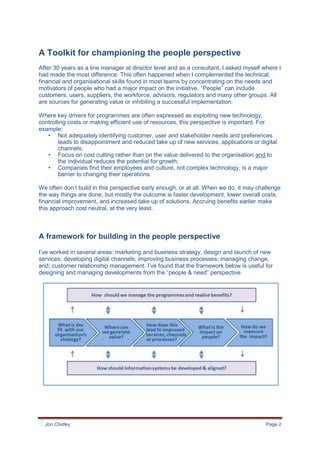
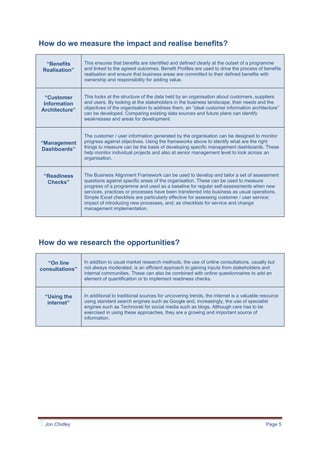
Companies find their employees and culture, not complex technology, is a major barrier to changing their operations.We often don’t build in this perspective early enough, or at all. When we do, it may challenge the way things are done, but mostly the outcome is faster development, lower overall costs, financial improvement, and increased take up of solutions. Accruing benefits earlier make this approach cost neutral, at the very least.<br />A framework for building in the people perspective<br />I’ve worked in several areas: marketing and business strategy, design and launch of new services; developing digital channels; improving business processes; managing change, and; customer relationship management. I’ve found that the framework below is useful for designing and managing developments from the “people & need” perspective.<br />In addition to checking progress at different stages, this framework is useful when there is no clear ownership of a programme when, for example, HR is involved in developing acquisition and retention plans; IT managers own the enabling technology; functional, line and project managers must create the values and culture to drive the behaviours needed to implement changes. The sections below illustrate some of the key approaches that I have found useful for applying this framework.<br />What is the fit with our organisation’s strategy?<br />“Business Landscaping / Stakeholder Mapping”This identifies and maps the interaction between customers, users and other groups that are affected by, or have an influence on, an operation. These groups can be outside or within an organisation and formal mapping is very effective when done early in a programme. It can be used to inform the development of services; identify where to improve processes, and; determine audiences for communication programmes.“Business  Alignment Framework”This matches the outcomes of an initiative against a framework of current strategies and business drivers, areas of value creation, customer delivery and service, workforce capabilities, customer systems and customer information. It is a powerful tool originally  developed as for CRM implementations, but has relevance for channel development and integration; process re-engineering, and; organisational re-alignment“Business Grid”This uses a variation of the GEC business screen based on measures of attractiveness and influence. It is a simple idea that can be used as a sophisticated tool for evaluating and prioritising alternative services, channels, process improvements and innovations.<br />Where can we generate value?<br />“Customer Journey Mapping”This looks at the current “journeys” that a customer or user makes to obtain a service within and external to the organisation to identify problem areas and opportunities for improvement. It then allows the team to think through what any proposed changes will look like to the customer / user. It is particularly effective when changing processes, considering the use of different channels such as web or social media and for thinking through the impact of new services and support.“Standing in the shoes of customers”Standing in the “shoes of customers” is a way of identifying and prioritising customer, user and stakeholder needs. It differentiates between groups of individuals and is the basis of developing distinctive services based on their needs. Understanding any inhibitors is useful for predicting and managing the take up of a service or the impact of changes in processes.“Value Balancing”This looks at both the value created for the organisation balanced against the value to the customer or user. It can be used, for example, to look at the potential value of improving customer retention, acquiring new users and improving processes .This places early emphasis on measuring the potential benefits of any programme and is a link between the strategic objectives of an organisation and the implementation of new services, processes and organisations.“Outcome mapping”This looks at the potential outcomes of an initiative and links them against the strategic objectives of the organisation. Intermediate outcomes are plotted to show, for example, impact on markets, workforce, finance or compliance. This helps identify benefits for different stakeholder groups and is the basis of benefits realisation programmes as well as key messages that can be used in change management communications.<br />How does this lead to improved services, channels and processes?<br />“Evaluate Existing Web Effectiveness”This uses some of the above tools to develop a set of audience profiles for an internal or external web service.  Comparing an existing website against these profiles identifies areas of weakness or areas where business change has affected underlying user needs. It can be used to identify how effective are current web offerings and as a basis for developing new capabilities,“Needs-based Service Design”This brings together needs analysis for different audiences as the basis for designing a service, internal and external websites or software. We develop customer / user propositions based on these needs as the basis for structured content blueprints, tools and navigation. The specification is tested through wireframing before development.“Whole Customer View”An approach to external and internal service design where there are multiple channels to a user. The design is driven from the perspective of different groups of individuals and looks at how they prefer to deal with an organisation. The outcomes are integrated channels supported by information that provides a single view of the customer independent of the channel used. “Revise Key Processes”This is most efficiently done from a customer / supplier / user / stakeholder perspective, rather than just “let’s fix the current operation”.  Identifying the desired capabilities of customers, suppliers and internal users is a key element for defining the desired future state of an organisation and can be used to identify key processes and upgrade existing practices or introduce new approaches.;“Specify Propositions/ Capabilities”This uses needs analysis and strategic workshops to agree a set of capabilities and customer / user propositions on which to base new services, channels and processes. It is very effective in designing and launching new services or channels and for developing views of the “future” state of an operation for business process re-engineering.“Take up analysis”Understanding the drivers and inhibitors of the users for a service can be used to model the possible take up by different audiences. Product introduction models [diffusion theory, catastrophe theory etc] can be used to predict the take up over time as a guide to launch planning.<br />What is the impact on people?<br />“Knowledge Vulnerability & Generational Shift”Mapping the explicit and implicit knowledge, expertise and experience in different groups of the workforce. This is used to develop knowledge exchange programmes and ways of working. This offsets possible vulnerabilities through shifts in the workforce, for example when knowledge and expertise is lost as the older, usually more experienced team members leave.“Audience & communication planning”The Business Landscape, Needs Analysis and Customer Journeys are used to identify different audiences for communications. The key messages can be developed to match the different audience needs, expected outcomes and communication preferences. These form the basis for strong communication programmes.<br />How do we measure the impact and realise benefits?<br />“Benefits Realisation”This ensures that benefits are identified and defined clearly at the outset of a programme and linked to the agreed outcomes. Benefit Profiles are used to drive the process of benefits realisation and ensure that business areas are committed to their defined benefits with ownership and responsibility for adding value. “Customer Information Architecture”This looks at the structure of the data held by an organisation about customers, suppliers and users. By looking at the stakeholders in the business landscape, their needs and the objectives of the organisation to address them, an “ideal customer information architecture” can be developed. Comparing existing data sources and future plans can identify weaknesses and areas for development.“Management Dashboards”The customer / user information generated by the organisation can be designed to monitor progress against objectives. Using the frameworks above to identify what are the right things to measure can be the basis of developing specific management dashboards. These help monitor individual projects and also at senior management level to look across an organisation.“Readiness Checks”The Business Alignment Framework can be used to develop and tailor a set of assessment questions against specific areas of the organisation. These can be used to measure progress of a programme and used as a baseline for regular self-assessments when new services, practices or processes have been transferred into business as usual operations. Simple Excel checklists are particularly effective for assessing customer / user service; impact of introducing new processes, and; as checklists for service and change management implementation. <br />How do we research the opportunities?<br />“On line consultations”In addition to usual market research methods, the use of online consultations, usually but not always moderated, is an efficient approach to gaining inputs from stakeholders and internal communities. These can also be combined with online questionnaires to add an element of quantification or to implement readiness checks.“Using the internet”In additional to traditional sources for uncovering trends, the internet is a valuable resource using standard search engines such as Google and, increasingly, the use of specialist engines such as Technorati for social media such as blogs. Although care has to be exercised in using these approaches, they are a growing and important source of information.<br />Areas in which paying attention to peoples’ needs adds value <br />Map the changing business landscape: Recession changed radically the relationship between customers, distributors, suppliers and the workforce in client organisations. Understanding the new realities through a focus on these groups and their needs can be used, for example, to: review the product / service portfolio to meet changed needs; reduce supply side complexity by partnering with suppliers, and; make R&D leaner and reduce time to market;
Ensure fit for purpose [web] channels: Channels grow over time and may not be fully meet the needs of a changing market. Understanding needs can be used to evaluate existing external and internal channels. These include company websites and online tools, and be used to introduce and integrate new approaches such as digital channels and social media into CRM and supplier solutions;
Revise key processes to maintain momentum for reducing costs while providing space for new opportunities. This is better done from a market perspective, rather than just “let’s fix the current operation”. Identifying the desired capabilities of customers, suppliers and internal users is a key element for defining the future state of an organisation;
Design services from the customer or user perspective: Design external and internal services from the needs of different customer or user groups to improve the take up. Defining from a technology viewpoint can lead to low customer satisfaction and take up;
Evaluate opportunities and encourage innovation: Understanding the needs of the different groups and linking these with the organisation’s objectives provides a strong framework to identify initiatives that create value and drop those that do not contribute to future success.  This can include teams from across functions to make an organisation that is more flexible and responsive;

110222 Chidley Jon People Perspective Toolkit

  • 1.
    JC Consultant SolutionsAToolkit for championing the people perspectiveJon Chidley<br />A Toolkit for championing the people perspective<br />After 30 years as a line manager at director level and as a consultant, I asked myself where I had made the most difference. This often happened when I complemented the technical, financial and organisational skills found in most teams by concentrating on the needs and motivators of people who had a major impact on the initiative. “People” can include customers, users, suppliers, the workforce, advisors, regulators and many other groups. All are sources for generating value or inhibiting a successful implementation.<br />Where key drivers for programmes are often expressed as exploiting new technology, controlling costs or making efficient use of resources, this perspective is important. For example:<br />Not adequately identifying customer, user and stakeholder needs and preferences leads to disappointment and reduced take up of new services, applications or digital channels;
  • 2.
    Focus on costcutting rather than on the value delivered to the organisation and to the individual reduces the potential for growth;
  • 3.
    Companies find theiremployees and culture, not complex technology, is a major barrier to changing their operations.We often don’t build in this perspective early enough, or at all. When we do, it may challenge the way things are done, but mostly the outcome is faster development, lower overall costs, financial improvement, and increased take up of solutions. Accruing benefits earlier make this approach cost neutral, at the very least.<br />A framework for building in the people perspective<br />I’ve worked in several areas: marketing and business strategy, design and launch of new services; developing digital channels; improving business processes; managing change, and; customer relationship management. I’ve found that the framework below is useful for designing and managing developments from the “people & need” perspective.<br />In addition to checking progress at different stages, this framework is useful when there is no clear ownership of a programme when, for example, HR is involved in developing acquisition and retention plans; IT managers own the enabling technology; functional, line and project managers must create the values and culture to drive the behaviours needed to implement changes. The sections below illustrate some of the key approaches that I have found useful for applying this framework.<br />What is the fit with our organisation’s strategy?<br />“Business Landscaping / Stakeholder Mapping”This identifies and maps the interaction between customers, users and other groups that are affected by, or have an influence on, an operation. These groups can be outside or within an organisation and formal mapping is very effective when done early in a programme. It can be used to inform the development of services; identify where to improve processes, and; determine audiences for communication programmes.“Business Alignment Framework”This matches the outcomes of an initiative against a framework of current strategies and business drivers, areas of value creation, customer delivery and service, workforce capabilities, customer systems and customer information. It is a powerful tool originally developed as for CRM implementations, but has relevance for channel development and integration; process re-engineering, and; organisational re-alignment“Business Grid”This uses a variation of the GEC business screen based on measures of attractiveness and influence. It is a simple idea that can be used as a sophisticated tool for evaluating and prioritising alternative services, channels, process improvements and innovations.<br />Where can we generate value?<br />“Customer Journey Mapping”This looks at the current “journeys” that a customer or user makes to obtain a service within and external to the organisation to identify problem areas and opportunities for improvement. It then allows the team to think through what any proposed changes will look like to the customer / user. It is particularly effective when changing processes, considering the use of different channels such as web or social media and for thinking through the impact of new services and support.“Standing in the shoes of customers”Standing in the “shoes of customers” is a way of identifying and prioritising customer, user and stakeholder needs. It differentiates between groups of individuals and is the basis of developing distinctive services based on their needs. Understanding any inhibitors is useful for predicting and managing the take up of a service or the impact of changes in processes.“Value Balancing”This looks at both the value created for the organisation balanced against the value to the customer or user. It can be used, for example, to look at the potential value of improving customer retention, acquiring new users and improving processes .This places early emphasis on measuring the potential benefits of any programme and is a link between the strategic objectives of an organisation and the implementation of new services, processes and organisations.“Outcome mapping”This looks at the potential outcomes of an initiative and links them against the strategic objectives of the organisation. Intermediate outcomes are plotted to show, for example, impact on markets, workforce, finance or compliance. This helps identify benefits for different stakeholder groups and is the basis of benefits realisation programmes as well as key messages that can be used in change management communications.<br />How does this lead to improved services, channels and processes?<br />“Evaluate Existing Web Effectiveness”This uses some of the above tools to develop a set of audience profiles for an internal or external web service. Comparing an existing website against these profiles identifies areas of weakness or areas where business change has affected underlying user needs. It can be used to identify how effective are current web offerings and as a basis for developing new capabilities,“Needs-based Service Design”This brings together needs analysis for different audiences as the basis for designing a service, internal and external websites or software. We develop customer / user propositions based on these needs as the basis for structured content blueprints, tools and navigation. The specification is tested through wireframing before development.“Whole Customer View”An approach to external and internal service design where there are multiple channels to a user. The design is driven from the perspective of different groups of individuals and looks at how they prefer to deal with an organisation. The outcomes are integrated channels supported by information that provides a single view of the customer independent of the channel used. “Revise Key Processes”This is most efficiently done from a customer / supplier / user / stakeholder perspective, rather than just “let’s fix the current operation”. Identifying the desired capabilities of customers, suppliers and internal users is a key element for defining the desired future state of an organisation and can be used to identify key processes and upgrade existing practices or introduce new approaches.;“Specify Propositions/ Capabilities”This uses needs analysis and strategic workshops to agree a set of capabilities and customer / user propositions on which to base new services, channels and processes. It is very effective in designing and launching new services or channels and for developing views of the “future” state of an operation for business process re-engineering.“Take up analysis”Understanding the drivers and inhibitors of the users for a service can be used to model the possible take up by different audiences. Product introduction models [diffusion theory, catastrophe theory etc] can be used to predict the take up over time as a guide to launch planning.<br />What is the impact on people?<br />“Knowledge Vulnerability & Generational Shift”Mapping the explicit and implicit knowledge, expertise and experience in different groups of the workforce. This is used to develop knowledge exchange programmes and ways of working. This offsets possible vulnerabilities through shifts in the workforce, for example when knowledge and expertise is lost as the older, usually more experienced team members leave.“Audience & communication planning”The Business Landscape, Needs Analysis and Customer Journeys are used to identify different audiences for communications. The key messages can be developed to match the different audience needs, expected outcomes and communication preferences. These form the basis for strong communication programmes.<br />How do we measure the impact and realise benefits?<br />“Benefits Realisation”This ensures that benefits are identified and defined clearly at the outset of a programme and linked to the agreed outcomes. Benefit Profiles are used to drive the process of benefits realisation and ensure that business areas are committed to their defined benefits with ownership and responsibility for adding value. “Customer Information Architecture”This looks at the structure of the data held by an organisation about customers, suppliers and users. By looking at the stakeholders in the business landscape, their needs and the objectives of the organisation to address them, an “ideal customer information architecture” can be developed. Comparing existing data sources and future plans can identify weaknesses and areas for development.“Management Dashboards”The customer / user information generated by the organisation can be designed to monitor progress against objectives. Using the frameworks above to identify what are the right things to measure can be the basis of developing specific management dashboards. These help monitor individual projects and also at senior management level to look across an organisation.“Readiness Checks”The Business Alignment Framework can be used to develop and tailor a set of assessment questions against specific areas of the organisation. These can be used to measure progress of a programme and used as a baseline for regular self-assessments when new services, practices or processes have been transferred into business as usual operations. Simple Excel checklists are particularly effective for assessing customer / user service; impact of introducing new processes, and; as checklists for service and change management implementation. <br />How do we research the opportunities?<br />“On line consultations”In addition to usual market research methods, the use of online consultations, usually but not always moderated, is an efficient approach to gaining inputs from stakeholders and internal communities. These can also be combined with online questionnaires to add an element of quantification or to implement readiness checks.“Using the internet”In additional to traditional sources for uncovering trends, the internet is a valuable resource using standard search engines such as Google and, increasingly, the use of specialist engines such as Technorati for social media such as blogs. Although care has to be exercised in using these approaches, they are a growing and important source of information.<br />Areas in which paying attention to peoples’ needs adds value <br />Map the changing business landscape: Recession changed radically the relationship between customers, distributors, suppliers and the workforce in client organisations. Understanding the new realities through a focus on these groups and their needs can be used, for example, to: review the product / service portfolio to meet changed needs; reduce supply side complexity by partnering with suppliers, and; make R&D leaner and reduce time to market;
  • 4.
    Ensure fit forpurpose [web] channels: Channels grow over time and may not be fully meet the needs of a changing market. Understanding needs can be used to evaluate existing external and internal channels. These include company websites and online tools, and be used to introduce and integrate new approaches such as digital channels and social media into CRM and supplier solutions;
  • 5.
    Revise key processesto maintain momentum for reducing costs while providing space for new opportunities. This is better done from a market perspective, rather than just “let’s fix the current operation”. Identifying the desired capabilities of customers, suppliers and internal users is a key element for defining the future state of an organisation;
  • 6.
    Design services fromthe customer or user perspective: Design external and internal services from the needs of different customer or user groups to improve the take up. Defining from a technology viewpoint can lead to low customer satisfaction and take up;
  • 7.
    Evaluate opportunities andencourage innovation: Understanding the needs of the different groups and linking these with the organisation’s objectives provides a strong framework to identify initiatives that create value and drop those that do not contribute to future success. This can include teams from across functions to make an organisation that is more flexible and responsive;