IT Project Management
The Nature of Projects
Learning Outcomes
At the end of this lecture, you should be able to:
 Describe the scope of PM
 understand some problems and concerns of software project managers
 define the success criteria for a project
 Explain knowledge areas and process groups applicable to PM
Introduction
 Software development projects are organizational investments
that require
 Time
 Money
 Other resources such as people, technology, facilities, etc.
 Organizations expect some type of value (MOV) in return of this
investment
Which Situation is Worse?
 Successfully building and implementing a system that provides
little or no value to the organization.
Or…
 Failing to implement an information system that could have
provided value to the organization, but was poorly developed or
poorly managed.
The Software Crisis
 The CHAOS study published in 1995 by The Standish Group
found that although the U.S spent over $250 billion on IT
projects, approximately…
 31% were cancelled before completion
 53% were completed but over budget, over schedule, and did not meet
original specifications.
 For mid-size companies, average cost overruns were 182%, while average
schedule overruns were 202%!
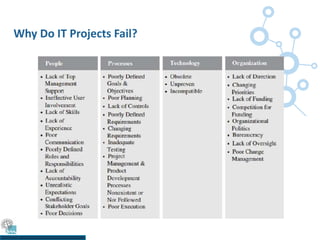
Why Do IT Projects Fail?
 Larger projects have the lowest success rate and appear to be
more risky than medium and smaller projects
 Technology, business models and markets change so rapidly that a
project that takes more than a year can be obsolete before they are
completed.
 The Chaos study also provides some insight as to the factors that
influence project success.
Why Do IT Projects Fail?
Has the State of IT Projects Changed Since 1995?
 The Standish Group has continued to study IT projects over the
years.
 In general, IT Projects are showing higher success rates due to
 Better project management tools & processes
 Smaller projects
 Improved communication among stakeholders
 More skillful IT project managers
 But there is still ample opportunity for improvement!
Has the State of IT Projects Changed Since 1995?
Top Ten Factors for IT Project Success
The Context of Project Management
 Definitions:
 A project is a temporary endeavor undertaken to accomplish
a unique purpose.
 Project management is the application of knowledge, skills,
tools, and techniques to project activities in order to meet or
exceed project requirements
 Project Vs Product
 Success criteria
The Context of Project Management - Project Attributes
 Time Frame
 Purpose (to provide value!)
 Ownership
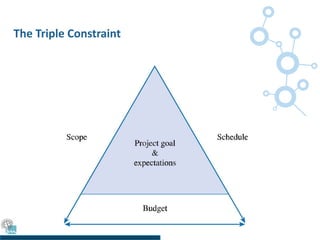
 Resources (the triple constraint)
 Roles
 Project Manager, Project Sponsor. SME (domain & technical)
 Risk & Assumptions
 Interdependent Tasks
 Planned Organizational Change
 Operate in Environments Larger than the Project Itself
The Triple Constraint
The Project Life Cycle and IT Development
 Project Life Cycle (PLC)
 A collection of logical stages or phases that maps the life of a project
from its beginning to its end in order to define, build and deliver the
product of the project – i.e., the information system
 Projects are divided into phases to increase manageability and
reduce risk
 Phase exits, stage gates, or kill points are decision points at the end of
each phase to evaluate performance, correct problems or cancel the
project
 Fast tracking is the overlapping of phases to reduce the project’s
schedule
 Can be risky!
Generic Project Life Cycle
Systems Development Life Cycle (SDLC)
 Represents the sequential phases or stages an information
system follows throughout its useful life
 Useful for understanding the development of the project’s
largest work product – the application system
 Phases/Stages
 Planning
 Analysis
 Design
 Implementation
 Maintenance and Support
The Relationship Between the PLC and the SDLC
 The systems development life cycle (SDLC) becomes part of the
project life cycle (PLC).
 The PLC focuses on the project management phases, processes, tools
and techniques for effectively managing the project.
 The SDLC focuses on the software engineering phases, processes, tools
and techniques for building and/or implementing the IT solution.
The Relationship Between the PLC & SDLC
Putting the SDLC into Practice
 Structured Approach to Systems Development
 Waterfall Method
 Rapid Applications Development (RAD)
 Prototyping
 Spiral Development
 Agile approaches
PMBOK and PMI
 The PMBOK® Guide is published and maintained by the Project
Management Institute (PMI). http://www.pmi.org
 PMI provides a certification in project management called the
Project Management Professional (PMP) that many people today
believe will be as relevant as a CPA certification.
 PMP certification requires that you pass a PMP certification exam
to demonstrate a level of understanding about project
management, as well as satisfy education and experience
requirements, and agree to a professional code of conduct.
 Software extension to the PMBOK® guide 5th edition (PMI &
IEEE)
Process Groups
 47 processes
1. Initiating
2. Planning
3. Executing
4. Monitoring and Controlling
5. Closing
Process Groups
Process Groups and ITPM Phases
PM Knowledge Areas
1. Project Integration Management
2. Project Scope Management
3. Project Time Management
4. Project Cost Management
5. Project Quality Management
6. Project Human Resources Management
7. Project Communications Management
8. Project Risk Management
9. Project Procurement Management
10. Project Stakeholder Management
Process Groups and Knowledge areas
Programme and Portfolio Management
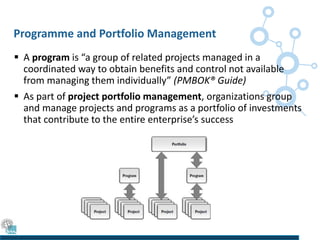
 A program is “a group of related projects managed in a
coordinated way to obtain benefits and control not available
from managing them individually” (PMBOK® Guide)
 As part of project portfolio management, organizations group
and manage projects and programs as a portfolio of investments
that contribute to the entire enterprise’s success
Trends in SPM
 Globalization
 Outsourcing
 Virtual teams
 Agile project management
Q&A

1. introduction

  • 1.
    IT Project Management TheNature of Projects
  • 2.
    Learning Outcomes At theend of this lecture, you should be able to:  Describe the scope of PM  understand some problems and concerns of software project managers  define the success criteria for a project  Explain knowledge areas and process groups applicable to PM
  • 3.
    Introduction  Software developmentprojects are organizational investments that require  Time  Money  Other resources such as people, technology, facilities, etc.  Organizations expect some type of value (MOV) in return of this investment
  • 4.
    Which Situation isWorse?  Successfully building and implementing a system that provides little or no value to the organization. Or…  Failing to implement an information system that could have provided value to the organization, but was poorly developed or poorly managed.
  • 5.
    The Software Crisis The CHAOS study published in 1995 by The Standish Group found that although the U.S spent over $250 billion on IT projects, approximately…  31% were cancelled before completion  53% were completed but over budget, over schedule, and did not meet original specifications.  For mid-size companies, average cost overruns were 182%, while average schedule overruns were 202%!
  • 7.
    Why Do ITProjects Fail?  Larger projects have the lowest success rate and appear to be more risky than medium and smaller projects  Technology, business models and markets change so rapidly that a project that takes more than a year can be obsolete before they are completed.  The Chaos study also provides some insight as to the factors that influence project success.
  • 8.
    Why Do ITProjects Fail?
  • 10.
    Has the Stateof IT Projects Changed Since 1995?  The Standish Group has continued to study IT projects over the years.  In general, IT Projects are showing higher success rates due to  Better project management tools & processes  Smaller projects  Improved communication among stakeholders  More skillful IT project managers  But there is still ample opportunity for improvement!
  • 11.
    Has the Stateof IT Projects Changed Since 1995?
  • 12.
    Top Ten Factorsfor IT Project Success
  • 13.
    The Context ofProject Management  Definitions:  A project is a temporary endeavor undertaken to accomplish a unique purpose.  Project management is the application of knowledge, skills, tools, and techniques to project activities in order to meet or exceed project requirements  Project Vs Product  Success criteria
  • 14.
    The Context ofProject Management - Project Attributes  Time Frame  Purpose (to provide value!)  Ownership  Resources (the triple constraint)  Roles  Project Manager, Project Sponsor. SME (domain & technical)  Risk & Assumptions  Interdependent Tasks  Planned Organizational Change  Operate in Environments Larger than the Project Itself
  • 15.
  • 16.
    The Project LifeCycle and IT Development  Project Life Cycle (PLC)  A collection of logical stages or phases that maps the life of a project from its beginning to its end in order to define, build and deliver the product of the project – i.e., the information system  Projects are divided into phases to increase manageability and reduce risk  Phase exits, stage gates, or kill points are decision points at the end of each phase to evaluate performance, correct problems or cancel the project  Fast tracking is the overlapping of phases to reduce the project’s schedule  Can be risky!
  • 17.
  • 18.
    Systems Development LifeCycle (SDLC)  Represents the sequential phases or stages an information system follows throughout its useful life  Useful for understanding the development of the project’s largest work product – the application system  Phases/Stages  Planning  Analysis  Design  Implementation  Maintenance and Support
  • 19.
    The Relationship Betweenthe PLC and the SDLC  The systems development life cycle (SDLC) becomes part of the project life cycle (PLC).  The PLC focuses on the project management phases, processes, tools and techniques for effectively managing the project.  The SDLC focuses on the software engineering phases, processes, tools and techniques for building and/or implementing the IT solution.
  • 20.
  • 21.
    Putting the SDLCinto Practice  Structured Approach to Systems Development  Waterfall Method  Rapid Applications Development (RAD)  Prototyping  Spiral Development  Agile approaches
  • 22.
    PMBOK and PMI The PMBOK® Guide is published and maintained by the Project Management Institute (PMI). http://www.pmi.org  PMI provides a certification in project management called the Project Management Professional (PMP) that many people today believe will be as relevant as a CPA certification.  PMP certification requires that you pass a PMP certification exam to demonstrate a level of understanding about project management, as well as satisfy education and experience requirements, and agree to a professional code of conduct.  Software extension to the PMBOK® guide 5th edition (PMI & IEEE)
  • 23.
    Process Groups  47processes 1. Initiating 2. Planning 3. Executing 4. Monitoring and Controlling 5. Closing
  • 24.
  • 25.
    Process Groups andITPM Phases
  • 26.
    PM Knowledge Areas 1.Project Integration Management 2. Project Scope Management 3. Project Time Management 4. Project Cost Management 5. Project Quality Management 6. Project Human Resources Management 7. Project Communications Management 8. Project Risk Management 9. Project Procurement Management 10. Project Stakeholder Management
  • 27.
    Process Groups andKnowledge areas
  • 28.
    Programme and PortfolioManagement  A program is “a group of related projects managed in a coordinated way to obtain benefits and control not available from managing them individually” (PMBOK® Guide)  As part of project portfolio management, organizations group and manage projects and programs as a portfolio of investments that contribute to the entire enterprise’s success
  • 29.
    Trends in SPM Globalization  Outsourcing  Virtual teams  Agile project management
  • 30.