ICT Strategy Development
 What is a Strategic Plan?
 Why do organisations have Strategic Plans?
 What is an ICT Strategy?
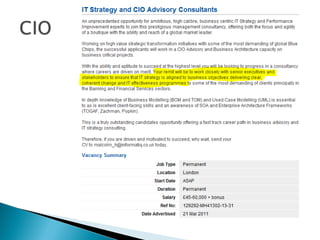
 What is the purpose of a CIO?
 What does the CIO do?
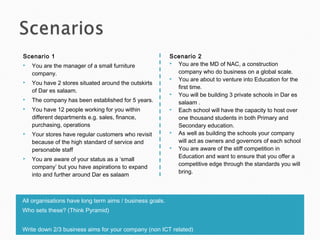
Scenario 1
 You are the manager of a small furniture
company.
 You have 2 stores situated around the outskirts
of Dar es salaam.
 The company has been established for 5 years.
 You have 12 people working for you within
different departments e.g. sales, finance,
purchasing, operations
 Your stores have regular customers who revisit
because of the high standard of service and
personable staff
 You are aware of your status as a ‘small
company’ but you have aspirations to expand
into and further around Dar es salaam
Scenario 2
 You are the MD of NAC, a construction
company who do business on a global scale.
 You are about to venture into Education for the
first time.
 You will be building 3 private schools in Dar es
salaam .
 Each school will have the capacity to host over
one thousand students in both Primary and
Secondary education.
 As well as building the schools your company
will act as owners and governors of each school
 You are aware of the stiff competition in
Education and want to ensure that you offer a
competitive edge through the standards you will
bring.
All organisations have long term aims / business goals.
Who sets these? (Think Pyramid)
Write down 2/3 business aims for your company (non ICT related)
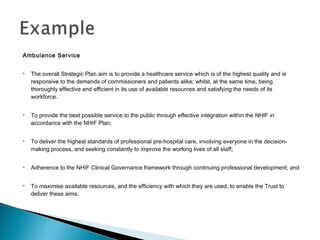
Ambulance Service
 The overall Strategic Plan aim is to provide a healthcare service which is of the highest quality and is
responsive to the demands of commissioners and patients alike; whilst, at the same time, being
thoroughly effective and efficient in its use of available resources and satisfying the needs of its
workforce.
 To provide the best possible service to the public through effective integration within the NHIF in
accordance with the NHIF Plan;
 To deliver the highest standards of professional pre-hospital care, involving everyone in the decision-
making process, and seeking constantly to improve the working lives of all staff;
 Adherence to the NHIF Clinical Governance framework through continuing professional development; and
 To maximise available resources, and the efficiency with which they are used, to enable the Trust to
deliver these aims.
 You have just written an organisations Aims
 These would exist within the organisations Strategic
Plan
 A Strategic Plan should outline the direction and scope
of an organisation over the long term. It should layout
specific aims and objectives of which the company are
trying to achieve.
 Think back to your scenarios and consider how organisations function in the 21st
century. We are no longer living in an Industrial Revolution we are living in an
Information Age.
 It is almost certain that any Strategic Plans require the need for Information
Management. For Example:
Ambulance Service
Core Aims
◦ To provide the best possible service to the public through effective integration within the NHIF in accordance
with the NHIF Plan;
 The objectives relating to this might be:
◦ continue to respond to patients’ needs;
◦ develop a culture of listening to patients, staff and users and matching services to what we are told
 Information is required to achieve the above
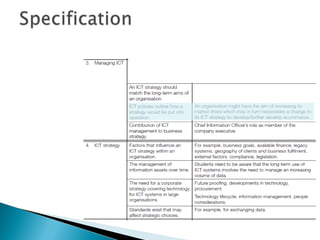
 An ICT Strategy should reflect the business aims and objectives.
 An ICT Strategy reflects the business aims and objectives by overlaying the
delivery of information services and the mechanisms by which that delivery
will take place (e.g. hardware, software, communication, standards, training
etc.)
 A common phrase is “There are no ICT projects, only business projects”
 Therefore it is important that all ICT Strategies are business driven NOT
technology driven.
 It is Vital that strategic decisions e.g. Strategic
Business Plans, ICT Strategies are made at the
highest level The Strategic Level
 In light of this, most medium to large organisations
now appoint a Chief Information Officer (CIO)
 Will work at a Strategic Level
 Acts as a bridge between the business goals of the organisation and the
implementation of the ICT solutions that are needed to meet those goals.
 The CIO (Also known as CTO Chief Technology Officer)
◦ Writes the ICT Strategy (Contributes to the business strategy)
◦ Coordinates between the technical team, users and management
(Manages the ICT Department)
◦ Suggests areas where ICT can help the organisation
◦ Oversees the strategies implementation through the Policies written
◦ Manages the unrealistic expectations with regards to what is possible
◦ Should be the champion of ICT within the organisation
Internal
 Business goals
 Finance
 Size, type and structure of organisation
 Legacy systems (Hardware and software)
 Information Assets over time
External
 Where its customers are (Geography)
 Technological changes
 Competitors
 Compliance with external organisations
 Compliance with legislations
 Internal – Business Goals
◦ A business goal might be to reduce
the volume of data input by the
employees
◦ The ICT strategy could include the
development of online forms fro the
website for customers to fill in
directly
 Internal – Finance
◦ Cost benefit techniques have to be used
 Will a new system improve efficiency?
 Will a new system reduce time spent
transferring data between systems?
◦ Might have to consider initial costs against
time
◦ Consider ways of reducing costs
 Maybe lease out hardware and software
 Internal – Size, Type and Structure of
Organisation
◦ Do you outsource parts of the system?
◦ Do you have your own in-house development team?
◦ What functions/procedures already exist in the
organisation?
◦ Is the Information Flow, formal/informal
 Formal hierarchical structure requires methods/procedures
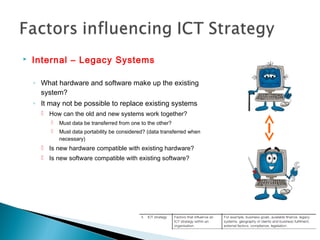
 Internal – Legacy Systems
◦ What hardware and software make up the existing
system?
◦ It may not be possible to replace existing systems
 How can the old and new systems work together?
 Must data be transferred from one to the other?
 Must data portability be considered? (data transferred when
necessary)
 Is new hardware compatible with existing hardware?
 Is new software compatible with existing software?
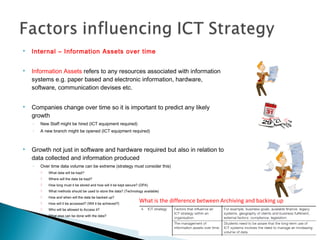
 Internal – Information Assets over time
 Information Assets refers to any resources associated with information
systems e.g. paper based and electronic information, hardware,
software, communication devises etc.
 Companies change over time so it is important to predict any likely
growth
◦ New Staff might be hired (ICT equipment required)
◦ A new branch might be opened (ICT equipment required)
 Growth not just in software and hardware required but also in relation to
data collected and information produced
◦ Over time data volume can be extreme (strategy must consider this)
 What data will be kept?
 Where will the data be kept?
 How long must it be stored and how will it be kept secure? (DPA)
 What methods should be used to store the data? (Technology available)
 How and when will the data be backed up?
 How will it be accessed? (Will it be achieved?)
 Who will be allowed to Access it?
 What else can be done with the data?
What is the difference between Archiving and backing up
data?
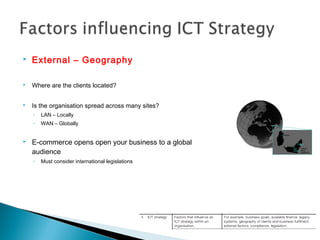
 External – Geography
 Where are the clients located?
 Is the organisation spread across many sites?
◦ LAN – Locally
◦ WAN – Globally
 E-commerce opens open your business to a global
audience
◦ Must consider international legislations
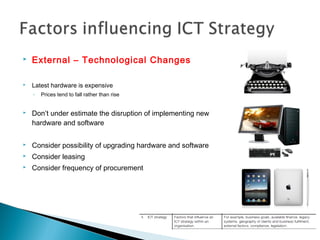
 External – Technological Changes
 Latest hardware is expensive
◦ Prices tend to fall rather than rise
 Don’t under estimate the disruption of implementing new
hardware and software
 Consider possibility of upgrading hardware and software
 Consider leasing
 Consider frequency of procurement
 External – Competitors
 Be aware of what technology other organisations are using to
gain a competitive edge
 External – Compliance with external
organisations
 If you are outsourcing parts of your system or departments are
offshore, consider their needs, how the information will flow
 Consider communication devices and methods
◦ Speed
◦ Accessibility
◦ Security
 Remember often with external sources you might have to
comply to their requirements
 External – Compliance with legislations
 Government rules and regulations outline how data should be managed
 Organisations must comply with these regulations
 ICT Strategy must ensure legislations are followed
 A Chief Compliance Officer might be employed to mange and advise of
legislations
 Legislations relate to:
◦ Software Licensing
◦ Data Protestation Regulations
◦ Freedom of Information Act
◦ Computer Misuse Act
◦ Copyright
◦ Rights in Databases Regulations 1997
 External – Compliance with legislations
 At AS you cover the details of legislations, at A2 you need to
understand the effects that these legislations have on the practical
operations.
 Imagine you were appointed as CIO of an organisation part of your role
is to ensure that the policies written to support the ICT Strategy ensure
compliance with the legislations mentioned.
 How would you go about this?
◦ Make sure you’re fully aware of the implications for your organisation
◦ Check the current situation
◦ Identify any areas of non compliance and correct them
◦ Update procedures to make sure the organisation continues to comply
◦ Train staff regarding their responsibilities under each act
◦ Build the procedures into induction training, contracts and disciplinary procedures
◦ Check that procedures are being followed
 External – Compliance with
legislations
 Data Protection Act
 Appoint a data controller (responsible for company’s data)
 Check the organisation has registered with the Information
Commissioner's Office
 Look at each of the principles and put the necessary
procedures in place
◦ Handling customer requests to view data (Who’s in charge? how’s it
logged?)
◦ Security of data (privileges to access data)
◦ Updating and deleting data
 External – Compliance with
legislations
 Freedom of Information Act
 Public Sector organisations must comply to this act
 Must deal with information requests promptly
◦ What information must be released, which information is exempt
 Procedures needed to handle requests and collect payments if
necessary
 External – Compliance with
legislations
 Computer Misuse Act
 Down to staff training and network security
 Usernames and Passwords key to network access and
rights/privileges
 Training will involve
◦ Not sharing password
◦ Leaving workstations logged on
 External – Compliance with
legislations
 Copyright, Designs and Patents Act
 Mainly concerned with software licenses
 Software Audits to be carried out
 Unauthorised software removed
 Restrictions to install (remove drives, ban internet downloads,
restrict permissions on .exe files)
 May have to consider use of copyright material (e.g. stock
images used online)
 External – Compliance with
legislations
 Health and Safety at Work Act
 Display Screen regulations are part of the Act
 Covered extensively at AS level
 Large organisations need a corporate ICT
Strategy that applies over the entire organisation if
it is to avoid individual departments following their
own strategies and, possibly, putting the corporate
aims at risk.
The following technology factors must be considered when developing
a Corporate ICT Strategy:
 Technology Life Cycle
 Future Proofing
 Procurement
 People considerations
 Information Management
Technology Life Cycle (Technology)
 All technology has a distinct lifecycle
 Latest hardware is expensive
◦ Prices tend to fall rather than rise
◦ But the latest technology may allow you to gain advantage over your competitors
 Purchasing technology in it’s mature stage of the lifecycle is likely to be well
supported and glitch free
 Consider possibility of upgrading hardware and software
 Consider leasing
 Consider frequency of procurement
Future Proofing (Technology)
 Concerned with finding ways of making sure that a system has a reasonable life and does not
need to be totally replaced too soon. Must predict changes in growth.
 Consider the Lifecycle of any hardware
 Consider future network traffic
 Consider wireless capabilities
 Flexibility in number of work stations
Procurement (Technology)
 Procurement is the acquisition of goods and/or services at the best possible
total cost of ownership, in the right quality and quantity, at the right time, in
the right place and from the right source for the direct benefit or use of
corporations
 Organisations must consider this on a grand scale and develop policies to
ensure that they have the appropriate resources needed to achieve the
business objectives.
People Considerations (Technology)
 The CIS should consider how the HR of the ICT staff are managed
◦ Recruitment policies may cover qualifications and experience demanded for various jobs
◦ The CIS will ensure that these rules apply consistently across the company
 Staffing issues impact security too
◦ Security vetting for staff accessing sensitive data
◦ Job roles and responsibilities can be designed to ensure that sensitive job functions are not
performed by a single employee
People Considerations (Technology)
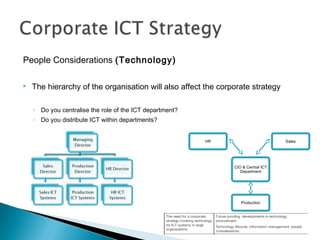
 The hierarchy of the organisation will also affect the corporate strategy
◦ Do you centralise the role of the ICT department?
◦ Do you distribute ICT within departments?
CIO & Central ICT
Department
Sales
Production
HR
Information Management (Technology)
 Access to information must be defined at a corporate level.
 A corporate Management Information System may be desirable
 Issues of security and confidentiality need to be laid down
◦ Passed on through security policies
◦ Privileges can be set up within the network management software
 Rights and permissions are allocated to users
 A standard is a common way of doing something
 Standards and protocols exist throughout the ICT industry and must
be considered when establishing an ICT strategy
 The following are examples of standards for communication
◦ TCP/IP
◦ HTTP
◦ HTTPS
◦ FTP
 A company might consider standard formats for storing business
data so it can be exchanged through EDI (Electronic Data
Interchange)
 Portability is also effected by standards
◦ Being able to transfer data to or from another package or hardware
 Internal and external Standards must be considered to ensure
information can flow through multiple systems and conflicts do not
arise.

Computer systems management lecture 03

  • 1.
  • 3.
     What isa Strategic Plan?  Why do organisations have Strategic Plans?  What is an ICT Strategy?  What is the purpose of a CIO?  What does the CIO do?
  • 5.
    Scenario 1  Youare the manager of a small furniture company.  You have 2 stores situated around the outskirts of Dar es salaam.  The company has been established for 5 years.  You have 12 people working for you within different departments e.g. sales, finance, purchasing, operations  Your stores have regular customers who revisit because of the high standard of service and personable staff  You are aware of your status as a ‘small company’ but you have aspirations to expand into and further around Dar es salaam Scenario 2  You are the MD of NAC, a construction company who do business on a global scale.  You are about to venture into Education for the first time.  You will be building 3 private schools in Dar es salaam .  Each school will have the capacity to host over one thousand students in both Primary and Secondary education.  As well as building the schools your company will act as owners and governors of each school  You are aware of the stiff competition in Education and want to ensure that you offer a competitive edge through the standards you will bring. All organisations have long term aims / business goals. Who sets these? (Think Pyramid) Write down 2/3 business aims for your company (non ICT related)
  • 6.
    Ambulance Service  Theoverall Strategic Plan aim is to provide a healthcare service which is of the highest quality and is responsive to the demands of commissioners and patients alike; whilst, at the same time, being thoroughly effective and efficient in its use of available resources and satisfying the needs of its workforce.  To provide the best possible service to the public through effective integration within the NHIF in accordance with the NHIF Plan;  To deliver the highest standards of professional pre-hospital care, involving everyone in the decision- making process, and seeking constantly to improve the working lives of all staff;  Adherence to the NHIF Clinical Governance framework through continuing professional development; and  To maximise available resources, and the efficiency with which they are used, to enable the Trust to deliver these aims.
  • 7.
     You havejust written an organisations Aims  These would exist within the organisations Strategic Plan  A Strategic Plan should outline the direction and scope of an organisation over the long term. It should layout specific aims and objectives of which the company are trying to achieve.
  • 8.
     Think backto your scenarios and consider how organisations function in the 21st century. We are no longer living in an Industrial Revolution we are living in an Information Age.  It is almost certain that any Strategic Plans require the need for Information Management. For Example: Ambulance Service Core Aims ◦ To provide the best possible service to the public through effective integration within the NHIF in accordance with the NHIF Plan;  The objectives relating to this might be: ◦ continue to respond to patients’ needs; ◦ develop a culture of listening to patients, staff and users and matching services to what we are told  Information is required to achieve the above
  • 9.
     An ICTStrategy should reflect the business aims and objectives.  An ICT Strategy reflects the business aims and objectives by overlaying the delivery of information services and the mechanisms by which that delivery will take place (e.g. hardware, software, communication, standards, training etc.)  A common phrase is “There are no ICT projects, only business projects”  Therefore it is important that all ICT Strategies are business driven NOT technology driven.
  • 10.
     It isVital that strategic decisions e.g. Strategic Business Plans, ICT Strategies are made at the highest level The Strategic Level  In light of this, most medium to large organisations now appoint a Chief Information Officer (CIO)
  • 11.
     Will workat a Strategic Level  Acts as a bridge between the business goals of the organisation and the implementation of the ICT solutions that are needed to meet those goals.  The CIO (Also known as CTO Chief Technology Officer) ◦ Writes the ICT Strategy (Contributes to the business strategy) ◦ Coordinates between the technical team, users and management (Manages the ICT Department) ◦ Suggests areas where ICT can help the organisation ◦ Oversees the strategies implementation through the Policies written ◦ Manages the unrealistic expectations with regards to what is possible ◦ Should be the champion of ICT within the organisation
  • 13.
    Internal  Business goals Finance  Size, type and structure of organisation  Legacy systems (Hardware and software)  Information Assets over time External  Where its customers are (Geography)  Technological changes  Competitors  Compliance with external organisations  Compliance with legislations
  • 14.
     Internal –Business Goals ◦ A business goal might be to reduce the volume of data input by the employees ◦ The ICT strategy could include the development of online forms fro the website for customers to fill in directly
  • 15.
     Internal –Finance ◦ Cost benefit techniques have to be used  Will a new system improve efficiency?  Will a new system reduce time spent transferring data between systems? ◦ Might have to consider initial costs against time ◦ Consider ways of reducing costs  Maybe lease out hardware and software
  • 16.
     Internal –Size, Type and Structure of Organisation ◦ Do you outsource parts of the system? ◦ Do you have your own in-house development team? ◦ What functions/procedures already exist in the organisation? ◦ Is the Information Flow, formal/informal  Formal hierarchical structure requires methods/procedures
  • 17.
     Internal –Legacy Systems ◦ What hardware and software make up the existing system? ◦ It may not be possible to replace existing systems  How can the old and new systems work together?  Must data be transferred from one to the other?  Must data portability be considered? (data transferred when necessary)  Is new hardware compatible with existing hardware?  Is new software compatible with existing software?
  • 18.
     Internal –Information Assets over time  Information Assets refers to any resources associated with information systems e.g. paper based and electronic information, hardware, software, communication devises etc.  Companies change over time so it is important to predict any likely growth ◦ New Staff might be hired (ICT equipment required) ◦ A new branch might be opened (ICT equipment required)  Growth not just in software and hardware required but also in relation to data collected and information produced ◦ Over time data volume can be extreme (strategy must consider this)  What data will be kept?  Where will the data be kept?  How long must it be stored and how will it be kept secure? (DPA)  What methods should be used to store the data? (Technology available)  How and when will the data be backed up?  How will it be accessed? (Will it be achieved?)  Who will be allowed to Access it?  What else can be done with the data? What is the difference between Archiving and backing up data?
  • 19.
     External –Geography  Where are the clients located?  Is the organisation spread across many sites? ◦ LAN – Locally ◦ WAN – Globally  E-commerce opens open your business to a global audience ◦ Must consider international legislations
  • 20.
     External –Technological Changes  Latest hardware is expensive ◦ Prices tend to fall rather than rise  Don’t under estimate the disruption of implementing new hardware and software  Consider possibility of upgrading hardware and software  Consider leasing  Consider frequency of procurement
  • 21.
     External –Competitors  Be aware of what technology other organisations are using to gain a competitive edge
  • 22.
     External –Compliance with external organisations  If you are outsourcing parts of your system or departments are offshore, consider their needs, how the information will flow  Consider communication devices and methods ◦ Speed ◦ Accessibility ◦ Security  Remember often with external sources you might have to comply to their requirements
  • 23.
     External –Compliance with legislations  Government rules and regulations outline how data should be managed  Organisations must comply with these regulations  ICT Strategy must ensure legislations are followed  A Chief Compliance Officer might be employed to mange and advise of legislations  Legislations relate to: ◦ Software Licensing ◦ Data Protestation Regulations ◦ Freedom of Information Act ◦ Computer Misuse Act ◦ Copyright ◦ Rights in Databases Regulations 1997
  • 24.
     External –Compliance with legislations  At AS you cover the details of legislations, at A2 you need to understand the effects that these legislations have on the practical operations.  Imagine you were appointed as CIO of an organisation part of your role is to ensure that the policies written to support the ICT Strategy ensure compliance with the legislations mentioned.  How would you go about this? ◦ Make sure you’re fully aware of the implications for your organisation ◦ Check the current situation ◦ Identify any areas of non compliance and correct them ◦ Update procedures to make sure the organisation continues to comply ◦ Train staff regarding their responsibilities under each act ◦ Build the procedures into induction training, contracts and disciplinary procedures ◦ Check that procedures are being followed
  • 25.
     External –Compliance with legislations  Data Protection Act  Appoint a data controller (responsible for company’s data)  Check the organisation has registered with the Information Commissioner's Office  Look at each of the principles and put the necessary procedures in place ◦ Handling customer requests to view data (Who’s in charge? how’s it logged?) ◦ Security of data (privileges to access data) ◦ Updating and deleting data
  • 26.
     External –Compliance with legislations  Freedom of Information Act  Public Sector organisations must comply to this act  Must deal with information requests promptly ◦ What information must be released, which information is exempt  Procedures needed to handle requests and collect payments if necessary
  • 27.
     External –Compliance with legislations  Computer Misuse Act  Down to staff training and network security  Usernames and Passwords key to network access and rights/privileges  Training will involve ◦ Not sharing password ◦ Leaving workstations logged on
  • 28.
     External –Compliance with legislations  Copyright, Designs and Patents Act  Mainly concerned with software licenses  Software Audits to be carried out  Unauthorised software removed  Restrictions to install (remove drives, ban internet downloads, restrict permissions on .exe files)  May have to consider use of copyright material (e.g. stock images used online)
  • 29.
     External –Compliance with legislations  Health and Safety at Work Act  Display Screen regulations are part of the Act  Covered extensively at AS level
  • 30.
     Large organisationsneed a corporate ICT Strategy that applies over the entire organisation if it is to avoid individual departments following their own strategies and, possibly, putting the corporate aims at risk.
  • 31.
    The following technologyfactors must be considered when developing a Corporate ICT Strategy:  Technology Life Cycle  Future Proofing  Procurement  People considerations  Information Management
  • 32.
    Technology Life Cycle(Technology)  All technology has a distinct lifecycle  Latest hardware is expensive ◦ Prices tend to fall rather than rise ◦ But the latest technology may allow you to gain advantage over your competitors  Purchasing technology in it’s mature stage of the lifecycle is likely to be well supported and glitch free  Consider possibility of upgrading hardware and software  Consider leasing  Consider frequency of procurement
  • 33.
    Future Proofing (Technology) Concerned with finding ways of making sure that a system has a reasonable life and does not need to be totally replaced too soon. Must predict changes in growth.  Consider the Lifecycle of any hardware  Consider future network traffic  Consider wireless capabilities  Flexibility in number of work stations
  • 34.
    Procurement (Technology)  Procurementis the acquisition of goods and/or services at the best possible total cost of ownership, in the right quality and quantity, at the right time, in the right place and from the right source for the direct benefit or use of corporations  Organisations must consider this on a grand scale and develop policies to ensure that they have the appropriate resources needed to achieve the business objectives.
  • 35.
    People Considerations (Technology) The CIS should consider how the HR of the ICT staff are managed ◦ Recruitment policies may cover qualifications and experience demanded for various jobs ◦ The CIS will ensure that these rules apply consistently across the company  Staffing issues impact security too ◦ Security vetting for staff accessing sensitive data ◦ Job roles and responsibilities can be designed to ensure that sensitive job functions are not performed by a single employee
  • 36.
    People Considerations (Technology) The hierarchy of the organisation will also affect the corporate strategy ◦ Do you centralise the role of the ICT department? ◦ Do you distribute ICT within departments? CIO & Central ICT Department Sales Production HR
  • 37.
    Information Management (Technology) Access to information must be defined at a corporate level.  A corporate Management Information System may be desirable  Issues of security and confidentiality need to be laid down ◦ Passed on through security policies ◦ Privileges can be set up within the network management software  Rights and permissions are allocated to users
  • 38.
     A standardis a common way of doing something  Standards and protocols exist throughout the ICT industry and must be considered when establishing an ICT strategy  The following are examples of standards for communication ◦ TCP/IP ◦ HTTP ◦ HTTPS ◦ FTP
  • 39.
     A companymight consider standard formats for storing business data so it can be exchanged through EDI (Electronic Data Interchange)  Portability is also effected by standards ◦ Being able to transfer data to or from another package or hardware  Internal and external Standards must be considered to ensure information can flow through multiple systems and conflicts do not arise.