Chapter 2
THE ENVIROMNMENT IN WHICH
PROJECTS OPERAT
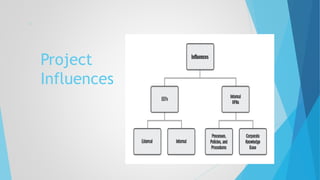
Project
Influences
2
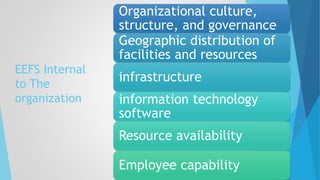
EEFS Internal
to The
organization
3
Organizational culture,
structure, and governance
Geographic distribution of
facilities and resources
infrastructure
information technology
software
Resource availability
Employee capability
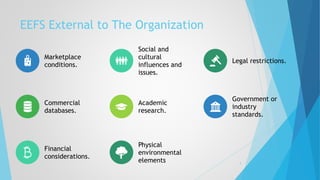
EEFS External to The Organization
4
Marketplace
conditions.
Social and
cultural
influences and
issues.
Legal restrictions.
Commercial
databases.
Academic
research.
Government or
industry
standards.
Financial
considerations.
Physical
environmental
elements
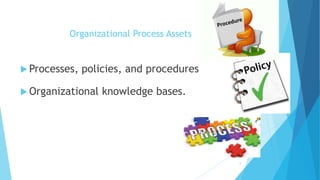
Organizational Process Assets
 Processes, policies, and procedures
 Organizational knowledge bases.
5
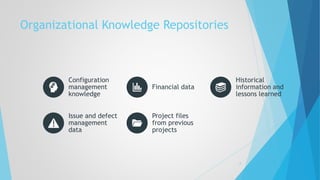
Organizational Knowledge Repositories
Configuration
management
knowledge
Financial data
Historical
information and
lessons learned
Issue and defect
management
data
Project files
from previous
projects
6
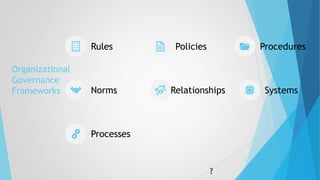
Organizational
Governance
Frameworks
7
Rules Policies Procedures
Norms Relationships Systems
Processes
?
organizational structures
Functional
Matrices
Projectized
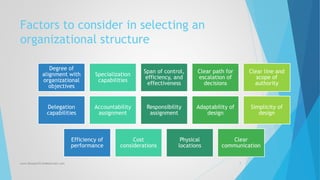
Factors to consider in selecting an
organizational structure
www.ReadytoTrainMaterials.com 9
Degree of
alignment with
organizational
objectives
Specialization
capabilities
Span of control,
efficiency, and
effectiveness
Clear path for
escalation of
decisions
Clear line and
scope of
authority
Delegation
capabilities
Accountability
assignment
Responsibility
assignment
Adaptability of
design
Simplicity of
design
Efficiency of
performance
Cost
considerations
Physical
locations
Clear
communication
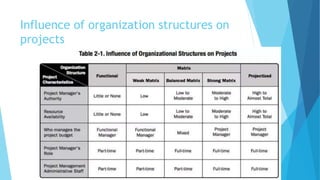
Influence of organization structures on
projects
Project management office
PMO Types
Supportive
Controlling
Directive
PMO role
Make recommendations
Lead knowledge transfer
Terminate projects
Take other actions as required
Support project managers
CHAPTER 3
THE ROLE OF THE PROJECT MANAGER
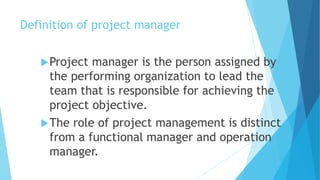
Definition of project manager
Project manager is the person assigned by
the performing organization to lead the
team that is responsible for achieving the
project objective.
The role of project management is distinct
from a functional manager and operation
manager.
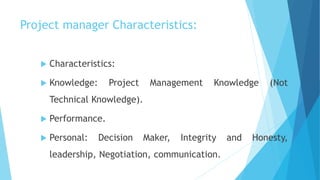
Project manager Characteristics:
 Characteristics:
 Knowledge: Project Management Knowledge (Not
Technical Knowledge).
 Performance.
 Personal: Decision Maker, Integrity and Honesty,
leadership, Negotiation, communication.
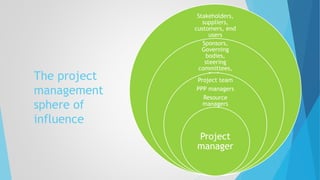
The project
management
sphere of
influence
Stakeholders,
suppliers,
customers, end
users
Sponsors,
Governing
bodies,
steering
committees,
PMOs
Project team
PPP managers
Resource
managers
Project
manager
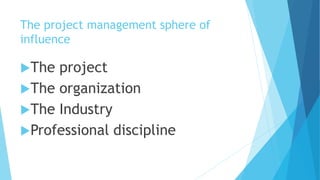
The project management sphere of
influence
The project
The organization
The Industry
Professional discipline
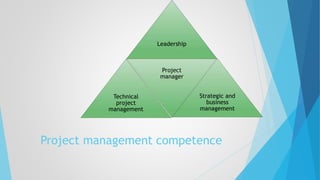
Project management competence
Leadership
Technical
project
management
Project
manager
Strategic and
business
management
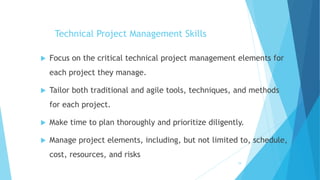
Technical Project Management Skills
 Focus on the critical technical project management elements for
each project they manage.
 Tailor both traditional and agile tools, techniques, and methods
for each project.
 Make time to plan thoroughly and prioritize diligently.
 Manage project elements, including, but not limited to, schedule,
cost, resources, and risks
19
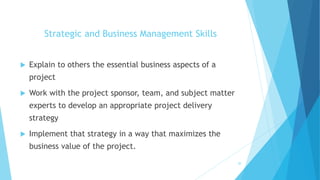
Strategic and Business Management Skills
 Explain to others the essential business aspects of a
project
 Work with the project sponsor, team, and subject matter
experts to develop an appropriate project delivery
strategy
 Implement that strategy in a way that maximizes the
business value of the project.
20
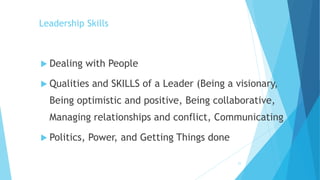
Leadership Skills
 Dealing with People
 Qualities and SKILLS of a Leader (Being a visionary,
Being optimistic and positive, Being collaborative,
Managing relationships and conflict, Communicating
 Politics, Power, and Getting Things done
21

Lecture 2