Version 1a, September 2014
BASIC PROFESSIONAL TRAINING COURSE
Module I
Nuclear physics and reactor theory
This material was prepared by the IAEA and co-funded by the
European Union.
Basic Professional Training Course; Module I
Nuclear physics and reactor theory
ATOMIC STRUCTURE OF MATTER
Learning objectives
After completing this chapter, the trainee will be able to:
1. Describe the terms element, atom, compound and
molecule.
2. Define the atomic mass unit.
3. Define the relative atomic mass Ar.
4. Define the relative molecular mass M and calculate it
from the chemical formula.
5. Calculate the mass of elements in a given mass of a
compound.
2
Basic Professional Training Course; Module I
Nuclear physics and reactor theory
Elements and atoms
• Elements are basic components of matter
− 112 elements are currently known, 90 elements naturally occurring
− Elements have specific names and symbols, e.g.:
H – Hydrogen
He – Helium
Li – Lithium
O – Oxygen
U – Uranium
…
• Basic constituents of element are atoms:
- Atom is the smallest particle of an element, having its chemical properties
- Atoms of different elements have different chemical properties
3
Basic Professional Training Course; Module I
Nuclear physics and reactor theory
Compounds
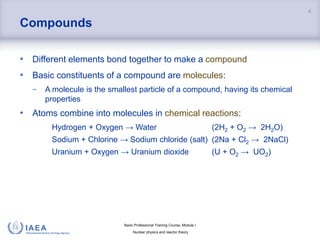
• Different elements bond together to make a compound
• Basic constituents of a compound are molecules:
− A molecule is the smallest particle of a compound, having its chemical
properties
• Atoms combine into molecules in chemical reactions:
Hydrogen + Oxygen → Water (2H2 + O2 → 2H2O)
Sodium + Chlorine → Sodium chloride (salt) (2Na + Cl2 → 2NaCl)
Uranium + Oxygen → Uranium dioxide (U + O2 → UO2)
4
Basic Professional Training Course; Module I
Nuclear physics and reactor theory
Atomic mass unit
• Atoms are very small and very light
• A mass unit used in atomic physics and chemistry:
1 atomic mass unit = 1 amu = 1 u
• Definition:
1 u = 1/12 of mass of 12C = 1.66∙10-27 kg
5
Basic Professional Training Course; Module I
Nuclear physics and reactor theory
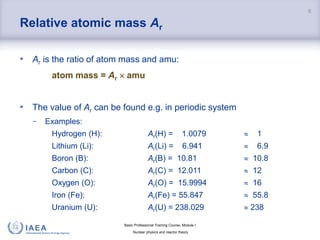
Relative atomic mass Ar
• Ar is the ratio of atom mass and amu:
atom mass = Ar  amu
• The value of Ar can be found e.g. in periodic system
− Examples:
Hydrogen (H): Ar(H) = 1.0079  1
Lithium (Li): Ar(Li) = 6.941  6.9
Boron (B): Ar(B) = 10.81  10.8
Carbon (C): Ar(C) = 12.011  12
Oxygen (O): Ar(O) = 15.9994  16
Iron (Fe): Ar(Fe) = 55.847  55.8
Uranium (U): Ar(U) = 238.029  238
6
Basic Professional Training Course; Module I
Nuclear physics and reactor theory
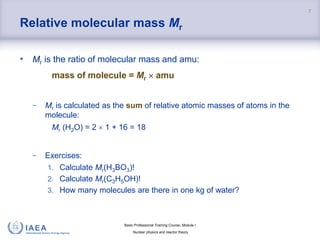
Relative molecular mass Mr
• Mr is the ratio of molecular mass and amu:
mass of molecule = Mr  amu
− Mr is calculated as the sum of relative atomic masses of atoms in the
molecule:
Mr (H2O) = 2  1 + 16 = 18
− Exercises:
1. Calculate Mr(H3BO3)!
2. Calculate Mr(C3H5OH)!
3. How many molecules are there in one kg of water?
7
Basic Professional Training Course; Module I
Nuclear physics and reactor theory
Exercises
1. Calculate the relative molecular mass of carbon dioxide!
2. How many atoms of boron there are in 1 kg of boron?
3. How many atoms of hydrogen and how many atoms of oxygen
there are in 1 kg of water?
4. What is the mass of hydrogen and the mass of oxygen in 1 kg of
water?
5. What is the mass of boron in 10 kg of boric acid H3BO3?
6. How many grams of oxygen need to be added to 2 g of hydrogen,
in order that all hydrogen combines with oxygen into water? How
much water we would get?
7. How many uranium atoms there are in 1 cm3 of uranium? (which
additional information is needed?)
8
Basic Professional Training Course; Module I
Nuclear physics and reactor theory
STRUCTURE OF ATOM
Learning objectives
After completing this chapter, the trainee will be able to:
1. Describe the structure of an atom.
2. Name the main characteristics of an electron.
3. Define the atomic number, Z.
4. Explain the terms positive and negative ion.
5. Define the binding energy of an electron.
6. Define the unit electron-volt.
7. Describe the energy levels of electrons in an atom.
8. Explain the ground state and excited state of an atom.
9. Explain the transition of an atom from an excited state to the
ground state.
9
Basic Professional Training Course; Module I
Nuclear physics and reactor theory
Atom
• Atom: the smallest particle of an element, having it chemical and
physical properties
• Atom is composed of:
− Nucleus, which has positive electrical charge
− Negatively charged electrons, which form sort of cloud around the
nucleus – the electron envelope
• Size of atom ~ 10-10 m
• Diameter of atom : nucleus ~ 10000 : 1
• Mass of nucleus > 99,95% of atom mass
10
10-10 m 10-14 m
nucleus
electrons
Basic Professional Training Course; Module I
Nuclear physics and reactor theory
Electrons
• Electrons: light particles with negative electric charge
− eelectron = -1.6∙10-19 As = -1.6∙10-19 C ≡ -e0
− melectron = 9.1∙10-31 kg  1/1820 u
• Electrons move in the electron cloud.
− Electron cloud determines the outer boundary of atom and the
chemical, electrical and mechanical properties of an element.
• Electrons are bound to positively charged nucleus with electrical
force.
11
Basic Professional Training Course; Module I
Nuclear physics and reactor theory
Atomic number Z
• Z – atomic number
− equal to number of electrons in neutral atom
− equal to consecutive number of element in the periodic table
− all atoms of a specific element have the same number of electrons
• As a rule, atom is electrically neutral
 negative charge of electrons = positive charge of nucleus
− charge of electrons in the atom = - Z ∙ e0
− charge of nucleus in the atom = Z ∙ e0
12
Basic Professional Training Course; Module I
Nuclear physics and reactor theory
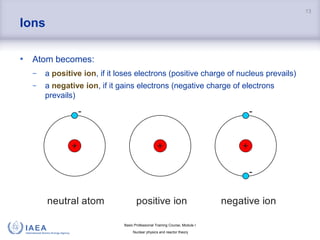
Ions
• Atom becomes:
− a positive ion, if it loses electrons (positive charge of nucleus prevails)
− a negative ion, if it gains electrons (negative charge of electrons
prevails)
13
+ + +
-
- -
neutral atom positive ion negative ion
Basic Professional Training Course; Module I
Nuclear physics and reactor theory
Electron energy
• Free electrons, when moving, have positive (kinetic) energy
• Free electrons at rest have zero energy
• Electron which is bound in atom must be supplied with energy to
become free electron
 Energy of bound electron is negative
• Binding energy is always negative; the lower (more negative) the
binding energy, the stronger electron is bound
14
Basic Professional Training Course; Module I
Nuclear physics and reactor theory
Electronvolt
• Atoms are very small and light  energies of particles within atom
are very small
• The unit for energy on atomic scale is electronvolt (eV):
− Energy of a particle with elementary charge (e0), accelerated with
voltage of 1 V
1 eV = 1.6∙10-19 As ∙ 1 V = 1.6∙10-19 J
1 keV = 103 eV (= 1.6∙10-16 J)
1 MeV = 106 eV (= 1.6∙10-13 J)
• Binding energies of electrons in atom: ~ eV - ~ keV
15
Basic Professional Training Course; Module I
Nuclear physics and reactor theory
Energies of electrons in atom
• Electrons moving in electron cloud can have only specific
energies
• Closer the electron to nucleus, lower (more negative) its energy
• The specific values of energy that electrons can possess, are called
energy levels of electrons in atom
• Any energy level can only be occupied by one electron
• Energy levels with lowest energies are occupied first
• Atom is in ground state when the lowest possible energy levels are
occupied
• Atom is in excited state when some energy levels below those
occupied are left empty
16
Basic Professional Training Course; Module I
Nuclear physics and reactor theory
Transitions between electron energy levels
• Transition from excited state to ground state: electron falls from a
higher energy level into an empty lower energy level
− Energy difference is given off in the form of electromagnetic radiation –
a photon is emitted
• Energy difference between
levels:
~ eV
 visible light is emitted
~ keV
 X-ray of Roentgen
radiation is emitted
17
EM radiation
Basic Professional Training Course; Module I
Nuclear physics and reactor theory
ATOMIC NUCLEUS
Learning objectives
After completing this chapter, the trainee will be able to:
1. Describe the basic properties of protons and neutrons.
2. Define the mass number A and write the relationship between
mass number, A, atomic number, Z, and the number of neutrons
in the nucleus, N.
3. Define a nuclide and an isotope and describe their notation.
4. Explain the isotopic abundance of an element.
5. Describe the systematic arrangement of nuclei in a table.
6. Describe the energy states of a nucleus.
7. Define the binding energy of a nucleon.
8. Plot the binding energy of a nucleon as a function of mass
number, A.
18
Basic Professional Training Course; Module I
Nuclear physics and reactor theory
Composition of the nucleus
• Nucleus is composed of particles called nucleons:
• They are bound together with nuclear force (strongest force in nature)
19
PROTON (p) NEUTRON (n)
charge +e0 no charge
mass 1,0072766 u 1,0086654 u
Basic Professional Training Course; Module I
Nuclear physics and reactor theory
Protons, atomic number
• Protons are nucleons with positive elementary charge (+ e0)
• Neutral atom:
the number of negative charge carriers (electrons)
= the number of positive charge carriers (protons)
• Atomic number is also the number of protons in nucleus
− Nuclei of atoms of same element have equal number of protons
− Nuclei of atoms of different elements have different number of protons
20
Basic Professional Training Course; Module I
Nuclear physics and reactor theory
Neutrons, mass number
• Neutrons are nucleons without electrical charge
• Mass number A is the number of all nucleons in nucleus
• The number of neutrons N is given by
N = A - Z
• Nuclei of the same element can have different number of
neutrons
21
Basic Professional Training Course; Module I
Nuclear physics and reactor theory
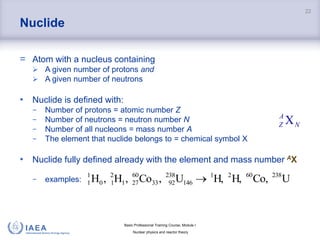
Nuclide
= Atom with a nucleus containing
 A given number of protons and
 A given number of neutrons
• Nuclide is defined with:
− Number of protons = atomic number Z
− Number of neutrons = neutron number N
− Number of all nucleons = mass number A
− The element that nuclide belongs to = chemical symbol X
• Nuclide fully defined already with the element and mass number AX
− examples:
22
U
Co,
H,
H,
U
,
Co
,
H
,
H 238
60
2
1
146
238
92
33
60
27
1
2
1
0
1
1 
N
A
Z X
Basic Professional Training Course; Module I
Nuclear physics and reactor theory
Isotopes
• Atoms of the same element can differ in weight:
− Equal number of protons (and electrons)
− Equal chemical properties
− Their nuclei have different masses
− The difference in masses originates from different number of neutrons
• Atoms of a given element with different number of neutrons are
called isotopes
• (isotopes are nuclides, belonging to the same element)
23
Basic Professional Training Course; Module I
Nuclear physics and reactor theory
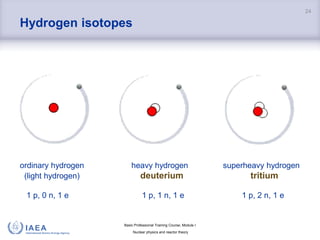
Hydrogen isotopes
ordinary hydrogen heavy hydrogen superheavy hydrogen
(light hydrogen) deuterium tritium
1 p, 0 n, 1 e 1 p, 1 n, 1 e 1 p, 2 n, 1 e
24
Basic Professional Training Course; Module I
Nuclear physics and reactor theory
Isotopic abundance
• Everywhere on Earth, elements are composed from same isotopes
in fixed relative proportions.
• These proportions are called isotopic abundance of an element.
• Examples:
25
Element Isotopes and their relative proportions
Hydrogen 1H – 99.985% 2H – 0.015%
Boron 10B – 19.8% 11B – 80.2%
Aluminium 27Al – 100%
Iron 54Fe – 5.8% 56Fe – 91.72% 57Fe – 2.2% 58Fe – 0.28%
Uranium 234U – 0.0054% 235U – 0.72% 238U – 99.2746%
Basic Professional Training Course; Module I
Nuclear physics and reactor theory
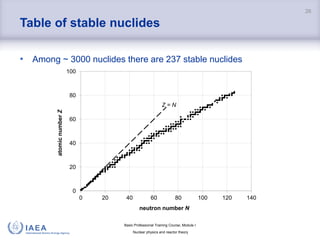
Table of stable nuclides
• Among ~ 3000 nuclides there are 237 stable nuclides
26
0
20
40
60
80
100
0 20 40 60 80 100 120 140
atomic
number
Z
neutron number N
Z = N
Basic Professional Training Course; Module I
Nuclear physics and reactor theory
Energy levels in nuclei
• Nucleons can occupy different energy levels
− All nucleons in lowest possible energy levels: ground state
− Nucleons in higher energy levels: excited state
27
ground
state
energy
[MeV]
a) b)
0
etc.
etc.
0 0
10
20
Basic Professional Training Course; Module I
Nuclear physics and reactor theory
Binding energy of a nucleon
• Average energy needed to release one nucleon from the nucleus
28
-9
-8
-7
-6
-5
-4
-3
-2
-1
0
0 20 40 60 80 100 120 140 160 180 200 220 240
binding
energy
per
nucleon
w
B
[MeV]
mass number A
Basic Professional Training Course; Module I
Nuclear physics and reactor theory
RADIOACTIVITY
Learning objectives
After completing this chapter, the trainee will be able to:
1. Describe the phenomenon of radioactive decay.
2. Describe the random nature of radioactive decay.
3. Define the half-life, average lifetime and the decay constant of a
radioactive nuclide.
4. Define the activity of a radioactive nuclide.
5. Write the equation for the decay of activity with time.
6. Calculate using the exponential law of radioactive decay.
7. Explain the terms short-lived, long-lived and stable nuclide.
8. Describe alpha, beta and gamma radioactive decay and give the
basic properties of these types of radiation.
29
Basic Professional Training Course; Module I
Nuclear physics and reactor theory
Stable and unstable nuclei
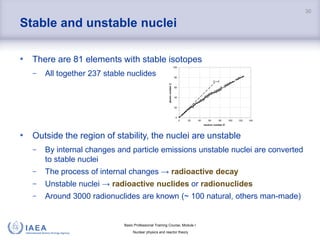
• There are 81 elements with stable isotopes
− All together 237 stable nuclides
• Outside the region of stability, the nuclei are unstable
− By internal changes and particle emissions unstable nuclei are converted
to stable nuclei
− The process of internal changes → radioactive decay
− Unstable nuclei → radioactive nuclides or radionuclides
− Around 3000 radionuclides are known (~ 100 natural, others man-made)
30
0
20
40
60
80
100
0 20 40 60 80 100 120 140
atomic
number
Z
neutron number N
Z = N
Basic Professional Training Course; Module I
Nuclear physics and reactor theory
Radioactive decay
• Decay of unstable atomic nuclei
− The internal energy of nucleus is decreased
− The energy difference is carried away by particles and/or EM radiation
 (radioactive) radiation
• Radioactive decay is a spontaneous process
− The mode and the rate of decay cannot be influenced from the outside
• Often, an isotope of one element is converted to an isotope of
another element
31
Basic Professional Training Course; Module I
Nuclear physics and reactor theory
Statistics of radioactive decay
• Unstable nuclei decay randomly and independently
• One can only predict the probability of decay with time
• The probability of decay per unit time is called decay constant 
(unit s-1)
• The decay constant is independent of time and external influences
32
Basic Professional Training Course; Module I
Nuclear physics and reactor theory
Half-life
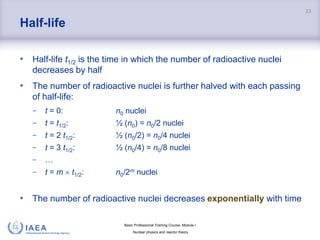
• Half-life t1/2 is the time in which the number of radioactive nuclei
decreases by half
• The number of radioactive nuclei is further halved with each passing
of half-life:
− t = 0: n0 nuclei
− t = t1/2: ½ (n0) = n0/2 nuclei
− t = 2 t1/2: ½ (n0/2) = n0/4 nuclei
− t = 3 t1/2: ½ (n0/4) = n0/8 nuclei
− …
− t = m  t1/2: n0/2m nuclei
• The number of radioactive nuclei decreases exponentially with time
33
Basic Professional Training Course; Module I
Nuclear physics and reactor theory
The exponential law of radioactive decay
• Mean lifetime τ is the average time from formation of radioactive
nucleus to its decay
− Relation to half-life: τ = 1.44 t1/2
34
n0
t1/2 2 t1/2 3 t1/2
n0
2
n0
4
n0
8
2
/
1
/
0 2
)
( t
t
n
t
n 

• n(t) ... number of nuclei that have not decayed after time t
• n0 ... number of radioactive nuclei at time t = 0
• t1/2 ... half-life
Basic Professional Training Course; Module I
Nuclear physics and reactor theory
A comparison of nuclides with different t1/2
• Long-lived nuclides: large t1/2, small 
• Short-lived nuclides: small t1/2, large 
35
time
0 %
20 %
40 %
60 %
80 %
100 %
short-lived (large )

long-lived (small )

stable ( )

number
of
radioactive
nuclei
Basic Professional Training Course; Module I
Nuclear physics and reactor theory
Activity
• Activity Ac is the number of disintegrations per unit time
• Activity is the product of number of radioactive nuclei and the decay
constant
Ac =  ∙ n
• Activity changes with time in the same way as the number of
radioactive nuclei – decreasing exponentially:
Ac(t) = Ac0 ∙ 2-t/t1/2
Ac0 … initial activity
36
Basic Professional Training Course; Module I
Nuclear physics and reactor theory
Units for activity
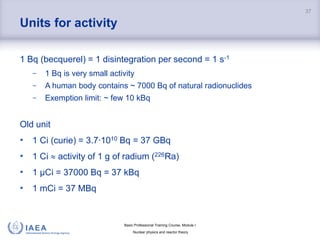
1 Bq (becquerel) = 1 disintegration per second = 1 s-1
− 1 Bq is very small activity
− A human body contains ~ 7000 Bq of natural radionuclides
− Exemption limit: ~ few 10 kBq
Old unit
• 1 Ci (curie) = 3.7∙1010 Bq = 37 GBq
• 1 Ci  activity of 1 g of radium (226Ra)
• 1 μCi = 37000 Bq = 37 kBq
• 1 mCi = 37 MBq
37
Basic Professional Training Course; Module I
Nuclear physics and reactor theory
Specific activity
• Specific activity ac is activity per unit mass or volume
− units: kg-1 s-1 = Bq/kg
or: m-3 s-1 = Bq/m3
• Examples:
1. A barrel weighing 460 kg contains 69 MBq of radionuclide 137Cs.
Calculate its specific activity!
2. The measured concentration of radon in a room was 125 Bq/m3. What
is the total activity of radon in the room which is 6 m long, 4 m wide and
its height is 2.2 m?
38
Basic Professional Training Course; Module I
Nuclear physics and reactor theory
Types of radioactive decay
• the type of radioactive decay is determined by the type of radiation
emitted during disintegration
• most common types of decay are:
− alpha decay
− beta decay
− gamma decay
• the result of all types of radioactive decay is ionizing radiation:
− energetic particles or EM radiation that ionizes matter (removes
electrons from atoms)
39
Basic Professional Training Course; Module I
Nuclear physics and reactor theory
Alpha decay ( decay)
• Alpha decay is a consequence of repulsion between protons
• heavy nuclei (A > 209) disintegrate with α decay
•  particle is 4He nucleus
• energies of  particles are several MeV
40
92
238
U → 90
234
Th + 𝛼
𝑧
𝐴X → 𝑍−2
𝐴−4
Y + 2
4
He
88Ra226
86Rn
222
2He4
226
4
222
88Ra226
86Rn
222
2He4
226
4
222
Basic Professional Training Course; Module I
Nuclear physics and reactor theory
Beta decay ( decay)
• beta decay is a consequence of ratio between the number of
protons and neutrons outside the stability range
• subtypes of  decay: -, +, and electron capture (ε)
• nuclei with surplus of neutrons disintegrate with - decay
• nuclei with surplus of protons disintegrate with + decay or ε
• - particle is electron, + particle is positron
• beta decay produces also neutrino ν which carries some energy
− neutrino has practically no influence on matter or the environment
41
Basic Professional Training Course; Module I
Nuclear physics and reactor theory
- decay
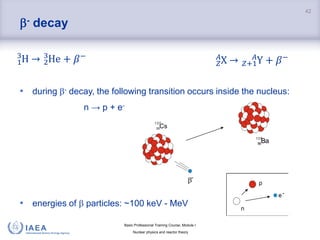
• during - decay, the following transition occurs inside the nucleus:
n → p + e-
• energies of  particles: ~100 keV - MeV
42
1
3
H → 2
3
He + 𝛽−
𝑍
𝐴
X → 𝑍+1
𝐴
Y + 𝛽−
55Cs
56Ba
-
n
p
e-

137
137
5
5
-

137
137
Basic Professional Training Course; Module I
Nuclear physics and reactor theory
+ decay
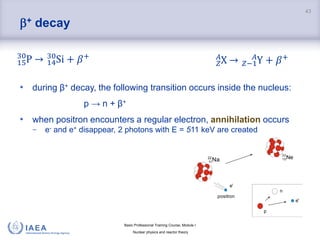
• during β+ decay, the following transition occurs inside the nucleus:
p → n + β+
• when positron encounters a regular electron, annihilation occurs
− e- and e+ disappear, 2 photons with E = 511 keV are created
43
15
30
P → 14
30
Si + 𝛽+
𝑍
𝐴
X → 𝑍−1
𝐴
Y + 𝛽+
Ne
22
10
n
positron
p
e
e
+
+
Na
22
11
Basic Professional Training Course; Module I
Nuclear physics and reactor theory
 decay
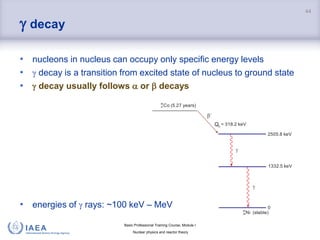
• nucleons in nucleus can occupy only specific energy levels
•  decay is a transition from excited state of nucleus to ground state
•  decay usually follows  or  decays
• energies of  rays: ~100 keV – MeV
44
2505.8 keV
1332.5 keV
0
= 318.2 keV
60
Ni (stable)
60
Co (5.27 years)



Q
27
28
Basic Professional Training Course; Module I
Nuclear physics and reactor theory
Isomers
• some excited nuclei are stable enough to exist in an excited state
for a definite time
• such nucleus is called isomer
or
45
Ba
137m
56
Ba
137
56

43
99𝑚
Tc → 43
99
Tc + γ 43
99
Tc∗ → 43
99
Tc + γ
𝑍
𝐴
X∗ → 𝑍
𝐴
X + γ
Basic Professional Training Course; Module I
Nuclear physics and reactor theory
Nuclear changes
• In α and β decays, the structure of nuclei changes
− radioactive decay is a spontaneous change of nuclei
• In any change of structure of nuclei, the following is conserved:
− number of nucleons
− electric charge
• Examples:
− α decay:
− β decay:
− γ decay:
46
𝑧
𝐴
X → 𝑍−2
𝐴−4
Y + 2
4
He
𝑍
𝐴
X → 𝑍+1
𝐴
Y + −1
0
e
𝑍
𝐴
X∗ → 𝑍
𝐴
X + 0
0
γ
Basic Professional Training Course; Module I
Nuclear physics and reactor theory
General facts about radioactive decays
• Heavy nuclei decay with alpha decay
• Nuclei with surplus of neutrons decay with - decay
• Nuclei with surplus of protons decay with + decay or electron
capture (ε)
• After  or  decay, the daughter nucleus is often in excited state
which de-excites by  decay
• Excited state of the resulting nucleus is usually so short-lived that
 rays are attributed to the decayed nucleus
47
Basic Professional Training Course; Module I
Nuclear physics and reactor theory
Table of nuclides
• Other (wall-sized) tables of nuclides provide a number of data for
each nuclide
48
Basic Professional Training Course; Module I
Nuclear physics and reactor theory
Radiation characteristics
Neutrons do not result from radioactive decay but from nuclear reactions
49
name symbol characteristic mass charge penetration depth
alpha  4He nuclei  4 u +2 e0 least penetrating
radiation
beta β-
β+
electrons
positrons
0.00055 u
–e0
+e0
more penetrating
than 
gamma γ EM radiation – 0 more penetrating
than β
neutron n nucleon 1 u 0 more penetrating
than β
Basic Professional Training Course; Module I
Nuclear physics and reactor theory
NUCLEAR REACTIONS
Learning objectives
After completing this chapter, the trainee will be able to:
1. Explain nuclear reactions.
2. Name the two key conservation laws of nuclear reactions.
3. Define the terms exoergic and endoergic nuclear reaction.
4. List the reactions of neutrons with matter.
5. Write down some important nuclear reactions.
6. Define neutron flux and the reaction cross section.
50
Basic Professional Training Course; Module I
Nuclear physics and reactor theory
General description of nuclear reaction
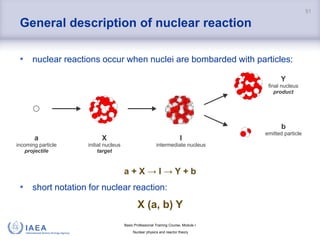
• nuclear reactions occur when nuclei are bombarded with particles:
a + X → I → Y + b
• short notation for nuclear reaction:
X (a, b) Y
51
a
incoming particle
projectile
Y
final nucleus
product
X
initial nucleus
target
I
intermediate nucleus
b
emitted particle
Basic Professional Training Course; Module I
Nuclear physics and reactor theory
Nuclear reactions often involve nuclear changes
• nuclear reactions:
− nuclei react with particles or other nuclei
− new nuclei are created  nuclear changes
• radioactive decay usually also results in a nuclear change
• fundamental difference:
• conservation of charge and the number of nucleons / examples:
or
or
52
nuclear reactions can be controlled
radioactive decay is spontaneous
0
1
n+ 5
10
B → 3
7
Li + 2
4
α
0
1
n+ 8
16
O → 7
16
N + 1
1
p
5
10
B (0
1
n, 2
4
α)3
7
Li
8
16
O(0
1
n, 1
1
p) 7
16
N
Basic Professional Training Course; Module I
Nuclear physics and reactor theory
Exoergic and endoergic reactions
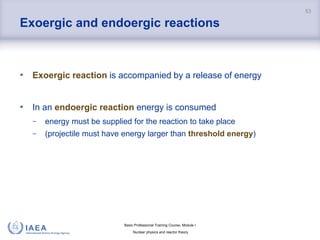
• Exoergic reaction is accompanied by a release of energy
• In an endoergic reaction energy is consumed
− energy must be supplied for the reaction to take place
− (projectile must have energy larger than threshold energy)
53
Basic Professional Training Course; Module I
Nuclear physics and reactor theory
Reactions with neutrons
• neutron is a neutral particle
− neutrons do not interact with electron cloud
− neutrons get to nucleus without hindrance
− neutron interactions can be divided into scattering and absorption
• Scattering
− neutrons collide with nuclei bounce off them
− transfer of energy, no creation of new particles
− the result of the reaction is the initial nucleus and the neutron
• Absorption
− nucleus captures the neutron
− final nucleus and emitted particle are different than the initial nucleus
and projectile
− nuclear change
54
Basic Professional Training Course; Module I
Nuclear physics and reactor theory
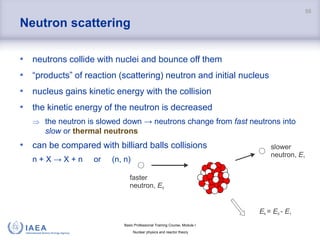
Neutron scattering
• neutrons collide with nuclei and bounce off them
• “products” of reaction (scattering) neutron and initial nucleus
• nucleus gains kinetic energy with the collision
• the kinetic energy of the neutron is decreased
 the neutron is slowed down → neutrons change from fast neutrons into
slow or thermal neutrons
• can be compared with billiard balls collisions
n + X → X + n or (n, n)
55
faster
neutron, E0
E E E
k 0 1
= -
slower
neutron, E1
Basic Professional Training Course; Module I
Nuclear physics and reactor theory
Neutron absorption
• capture
− radiative capture (n, ) – most typical
− (n, ), (n, p), …
• fission (neutron induced fission)
56
Basic Professional Training Course; Module I
Nuclear physics and reactor theory
The rate of nuclear reactions
 the number of nuclei reacting with neutrons in unit time
• the number of reactions depends on:
1. The intensity of neutron radiation
2. The probability for neutrons to react with nuclei
− (type and density of nuclei in the target)
57
Basic Professional Training Course; Module I
Nuclear physics and reactor theory
Neutron flux
• ~ number of neutron per unit area and per unit time
− units for flux: 1 m-2 s-1 = 10-4 cm-2 s-1
− flux of neutrons in the reactor: 1012 cm-2 s-1 – 1014 cm-2 s-1
58
area
time
neutrons
of
number



Basic Professional Training Course; Module I
Nuclear physics and reactor theory
Reaction cross section
• cross section  ~ effective cross sectional area of a nucleus “seen”
by a beam of particles
• a measure for probability of a reaction on nucleus
• cross section unit: 1 barn = 1 b = 10-24 cm2
• cross section values change markedly from one nucleus to another,
and also relative to neutron energy
number of nuclear reactions =   n t
59
Basic Professional Training Course; Module I
Nuclear physics and reactor theory
Neutron cross sections
• cross sections for individual types of reactions are marked with
corresponding index
− S … scattering
− a … absorption
− c … capture
− f … fission
−  … radiative capture
− …
• some cross sections are related to each other, e.g.
− a = c + f
60
Basic Professional Training Course; Module I
Nuclear physics and reactor theory
Important nuclear reactions in fuel
• FISSION: discussed separately in the next chapter
• Formation of Plutonium:
(fuel contains > 95% of 238U which is not fissile)
238U (n, ) 239U
239U → 239Np + - (t1/2 = 24 min)
239Np → 239Pu + - (t1/2 = 2 d)
61
Basic Professional Training Course; Module I
Nuclear physics and reactor theory
Important nuclear reactions in coolant
• reactor coolant activation: 16O (n, p) 16N
− this reaction possible only with very fast neutrons (E > 10 MeV)
• neutron absorption in boric acid (mixed with reactor coolant)
10B (n, ) 7Li
− reaction 10B (n, ) 7Li important also for thermal neutron detection:
− 7Li ion and  particle react with the detector material
• tritium production in coolant: 10B (n, 2) 3H
6Li (n, ) 3H
− LiOH is added to reactor coolant to control its pH
62
Basic Professional Training Course; Module I
Nuclear physics and reactor theory
Corrosion products, neutron sources
• Corrosion product formation:
58Fe (n, ) 59Fe
59Co (n, ) 60Co
60Ni (n, p) 60Co
58Ni (n, p) 58Co
50Cr (n, ) 51Cr
• neutrons are, as a rule, not created during radioactive decay
• beryllium powder is mixed with -emitting radionuclide
(226Ra-Be, 241Am-Be, … neutron source)
9Be (, n) 12C
63
Basic Professional Training Course; Module I
Nuclear physics and reactor theory
NUCLEAR FISSION
Learning objectives
After completing this chapter, the trainee will be able to:
1. Describe the fission mechanism.
2. Define fissile and fertile nuclides.
3. Illustrate the formation of 239Pu.
4. Name the products of fission.
5. Sketch the dependence of fission fragment yield on mass number A.
6. Explain why fission fragments are unstable.
7. Explain the terms prompt and delayed neutrons.
8. Describe the distribution of energy released by fission.
9. Estimate the consumption of fissile material in a reactor operating at
a certain power level.
10. Sketch the time course of decay heat.
64
Basic Professional Training Course; Module I
Nuclear physics and reactor theory
Types of nuclear fission
• In fission, heavy nucleus splits – usually into two lighter nuclei
− spontaneous (a rare type of radioactive decay)
− induced (a type of nuclear reaction)
• Spontaneous fission (a rare type of radioactive decay)
− nuclei split on their own accord
− neutron source
− A » 230
− 242Cm (curium), t1/2 = 163 d
− 244Cm, t1/2 = 18 y
65
Basic Professional Training Course; Module I
Nuclear physics and reactor theory
Induced fission
− caused by an increase of internal energy of nucleus
− most frequently when nucleus absorbs a neutron
• Induced fission is labelled according to energy of neutrons:
− thermal fission = fission caused by absorption of thermal neutron
− fast fission = fission caused by absorption of fast neutron
66
Basic Professional Training Course; Module I
Nuclear physics and reactor theory
The mechanism of fission
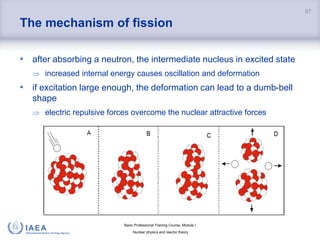
• after absorbing a neutron, the intermediate nucleus in excited state
 increased internal energy causes oscillation and deformation
• if excitation large enough, the deformation can lead to a dumb-bell
shape
 electric repulsive forces overcome the nuclear attractive forces
67
Basic Professional Training Course; Module I
Nuclear physics and reactor theory
Fissile and fertile nuclides
• Nuclides that undergo fission after absorption of thermal neutron are
called fissile nuclides:
− 235U and 239Pu
− fissile nuclides can also split after absorption of fast neutron
• Nuclides that after absorption of neutron are transformed with
radioactive decay into fissile nuclide, are called fertile nuclides:
− 238U
− example: 238
U n, γ 239
U
β−
239
Np
β−
239
Pu
− fertile nuclides can also undergo fission after absorption of fast neutron
68
Basic Professional Training Course; Module I
Nuclear physics and reactor theory
Products of fission
• Immediate products of nuclear fission:
− fission fragments
− prompt neutrons
− prompt gamma rays
− release of energy
69
56
144
Ba
36
90
Kr
92
235
U
0
1
n
0
0
1
1
n
n
+
Basic Professional Training Course; Module I
Nuclear physics and reactor theory
Fission fragments
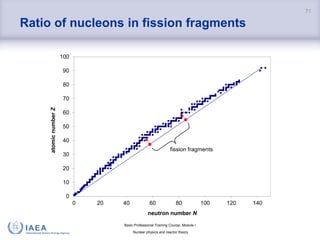
• medium-sized nuclei with Z: 30 ~ 64 and A: 75 ~ 160
• they carry most of energy released (~ 168 MeV)
• range ~ 10-3 cm  fragments stop within the fuel
• fission yield: probability of producing a fission fragment with mass
number A
70
Basic Professional Training Course; Module I
Nuclear physics and reactor theory
Ratio of nucleons in fission fragments
71
0
10
20
30
40
50
60
70
80
90
100
0 20 40 60 80 100 120 140
atomic
number
Z
neutron number N
fission fragments
Basic Professional Training Course; Module I
Nuclear physics and reactor theory
Fission products
N/Zfragments  N/Zinitial heavy nucleus
N/Zfragments > N/Zstable medium-sized nuclei
• Fission fragments are not stable nuclei
− - decays
• Fission products
− fission fragments and their daughter nuclides
− 3 or 4 - decays to stable nucleus (5 – 20 MeV is released)
− t1/2 of fission products:
from ~0.1 s to several million years
72
Basic Professional Training Course; Module I
Nuclear physics and reactor theory
Importance of fission product decay
• Large quantities of heat (decay heat) is released after shutdown of
the reactor and removal of this heat is necessary
• Radiation from decay is dangerous to health
• Emission of delayed neutrons
• Some fission products are strong neutron absorbers
73
Basic Professional Training Course; Module I
Nuclear physics and reactor theory
Prompt neutrons and prompt gamma rays
• Prompt neutrons
− parameter : average number of neutrons per fission
−  depends on the nuclide an the neutron energy
− for most nuclides,  is between 2 and 3 (235U:  = 2.43)
− average kinetic energy  2 MeV
− in total they carry away  5 MeV
• Prompt gamma rays
− on average, around 8 gamma rays are released per fission
− in total they carry away  7 MeV
74
Basic Professional Training Course; Module I
Nuclear physics and reactor theory
Delayed neutrons
• emitted after - decay of some fission fragments
• daughter nuclides of these fragments emit a neutron
 -n decay
• The fission fragment that leads to neutron emission is called
delayed neutron precursor
• The delay time of such neutron is determined by the lifetime of its
precursor
75
Basic Professional Training Course; Module I
Nuclear physics and reactor theory
Production of delayed neutrons
76
Basic Professional Training Course; Module I
Nuclear physics and reactor theory
87Br: example of -n decay
• lifetime   80 s
− 87Br disintegrates after ~ 80 s
 delayed neutron is born 80 s after fission
77
Br
87
Kr
86
Kr
87
Rb
87
Sr
87




+
+
+
+ n
stable
2.6 %
17.4 %
Basic Professional Training Course; Module I
Nuclear physics and reactor theory
Parameters of delayed neutrons
• Delay time from fission to release of delayed neutrons:
− average delay time  ~ 13 s
• Delayed neutron fraction :
− fraction of delayed neutrons in the total number of neutrons produced
per fission
−  < 1%, but crucial for successful reactor control
−  depends on nuclide and neutron energy
− thermal fission of 235U:  = 0.0065
− thermal fission of 239Pu:  = 0.0021
− fast fission of 238U:  = 0.0164
− due to mixture of nuclides in the fuel, the average delayed neutron
fraction changes (decreases) with fuel burn-up
78
Basic Professional Training Course; Module I
Nuclear physics and reactor theory
Distribution of energy released by 235U fission
Prompt energy release range
fission fragments 168 MeV ~ 10 μm
prompt neutrons 5 MeV 0.1 – 1 m
prompt gamma rays 7 MeV 0.1 – 1 m
gamma rays from (n, ) reactions 6 MeV 0.1 – 1 m
total prompt energy release 186 MeV
Delayed energy release
β from fission fragment decay 7 MeV ~ mm
γ from fission fragment decay 6 MeV 0.1 – 1 m
β and  from nuclei produced by (n, ) 1 MeV 0.001 – 1 m
total delayed energy release 14 MeV
total energy release 200 MeV
79
Basic Professional Training Course; Module I
Nuclear physics and reactor theory
Consumption of fissile material
• reactor operates 1 day at power at 1 MW power
 energy produced = 1 MWd
• number of fissions = number of fissioned 235U nuclei
• the uranium mass that corresponds:
m = 2.7·1021 · 235 · 1.66·10-27 kg = 1.05·10-3 kg ≈ 1 g
• example:
− 30 days of operation at power of 3000 MW: 90 kg of 235U is consumed
80
1 MWd =
1 MWd
200 MeV/fission
=
106 J
s
∙ 24 ∙ 3600 s
200 ∙ 106 ∙ 1.6 ∙ 10−19 J
fission
= 2.7 ∙ 1021 fissions
Basic Professional Training Course; Module I
Nuclear physics and reactor theory
Decay heat
• Energy released in the core after reactor shutdown
− a consequence of - and  decay of fission products
• Decay heat proportional to reactor power before shutdown
− with higher power, more fission products are produced
• Immediately after shutdown, the decay heat diminishes rapidly
− consequence of quick decay of short-lived fission products
• Decay heat diminishes slower, the longer reactor has operated
− more long/lived fission products have been produced
81
Basic Professional Training Course; Module I
Nuclear physics and reactor theory
Time dependence of decay heat decrease
• depends on the reactor operating time prior to its shutdown
82
Basic Professional Training Course; Module I
Nuclear physics and reactor theory
Decay heat after a long operation at 3000 MWth
Time after shutdown Full power fraction Decay heat
1 s 6.2 % 185 MW
1 min 3.6 % 107 MW
1 hour 1.3 % 38 MW
8 hours 0.6 % 19 MW
1 day 0.4 % 13 MW
1 week 0.2 % 7 MW
1 month 0.1 % 4 MW
83
Basic Professional Training Course; Module I
Nuclear physics and reactor theory
Decay heat in the spent fuel pit of a 3000 MWth
reactor
84
0
1
2
3
4
0 10 20 30 40 50 60 70 80 90 100
Thermal
power
(MW)
Years after start of operation
Basic Professional Training Course; Module I
Nuclear physics and reactor theory
NEUTRON CYCLE
Learning objectives
After completing this chapter, the trainee will be able to:
1. Explain the slowing down of neutrons in the core.
2. Give the properties of an effective moderator.
3. Define individual factors in the neutron cycle.
4. Define the multiplication factor, k.
5. Explain a chain reaction.
6. Define reactivity and the corresponding units.
85
Basic Professional Training Course; Module I
Nuclear physics and reactor theory
Division of neutrons in terms of their energy
• Basic division:
− fast: E > 0.1 MeV
− epithermal: 1 eV < E < 0.1 MeV
− thermal E < 1 eV
• fast neutrons are produced by fission
• epithermal neutrons are in the slowing-down process
− slowing-down takes place in the moderator
• thermal neutrons have completed the slowing-down process
− their energy (Ek) depends in the temperature of matter they move in
86
Basic Professional Training Course; Module I
Nuclear physics and reactor theory
Slowing-down of neutrons in the reactor core
• fast neutron loses its energy by scattering on nuclei in the matter
− most effective is elastic scattering on light nuclei
• moderator: material that slows down neutrons in the reactor core
• in light-water reactors the moderator is water (hydrogen)
• other possible moderators:
− heavy water (deuterium)
− graphite (carbon)
87
Basic Professional Training Course; Module I
Nuclear physics and reactor theory
Characteristics of moderator
• A good moderator has:
− large probability of scattering, i.e. large scattering x-section s,
− large average energy loss per collision
− small probability for neutron absorption, i.e. small absorption x-section a,
− non-nuclear properties: stable, good thermo-hydraulic properties, low
price.
• Ordinary (light) water is relatively good moderator:
− however, it is corrosive at high temperatures
− activated in neutron flux
− good thermal/hydraulic properties
− cheap
• Heavy water is better because of lower neutron absorption.
88
Basic Professional Training Course; Module I
Nuclear physics and reactor theory
Lifetime of a generation of neutrons
• The majority of fissions in light water reactors is induced by thermal
neutrons.
• In fission, fast neutrons are produced.
• What happens to a generation of fast neutrons, born in thermal
fission?
89
Basic Professional Training Course; Module I
Nuclear physics and reactor theory
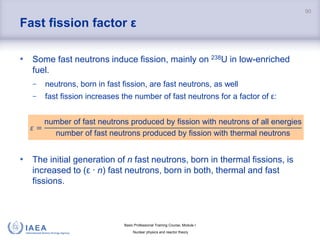
Fast fission factor ε
• Some fast neutrons induce fission, mainly on 238U in low-enriched
fuel.
− neutrons, born in fast fission, are fast neutrons, as well
− fast fission increases the number of fast neutrons for a factor of ε:
• The initial generation of n fast neutrons, born in thermal fissions, is
increased to (ε ∙ n) fast neutrons, born in both, thermal and fast
fissions.
90
𝜀 =
number of fast neutrons produced by fission with neutrons of all energies
number of fast neutrons produced by fission with thermal neutrons
Basic Professional Training Course; Module I
Nuclear physics and reactor theory
Fast fission: factor ε
• Fast fission factor is always greater than one.
− LWRs: ε ~ 1.1
91
n   n
fast
fission
U
238
thermal
fission
U
235
Pu
239
Basic Professional Training Course; Module I
Nuclear physics and reactor theory
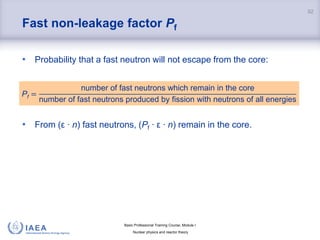
Fast non-leakage factor Pf
• Probability that a fast neutron will not escape from the core:
• From (ε ∙ n) fast neutrons, (Pf ∙ ε ∙ n) remain in the core.
92
Pf =
number of fast neutrons which remain in the core
number of fast neutrons produced by fission with neutrons of all energies
Basic Professional Training Course; Module I
Nuclear physics and reactor theory
Fast neutron leakage: factor Pf
• Fast non-leakage factor is always smaller than one
− typical PWR: Pf  0.98
93
fast neutrons
which escape
from the core
  n P n
f
  
Basic Professional Training Course; Module I
Nuclear physics and reactor theory
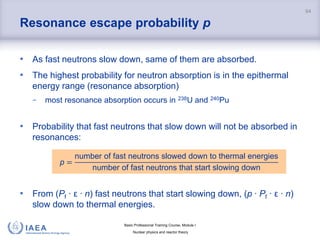
Resonance escape probability p
• As fast neutrons slow down, same of them are absorbed.
• The highest probability for neutron absorption is in the epithermal
energy range (resonance absorption)
− most resonance absorption occurs in 238U and 240Pu
• Probability that fast neutrons that slow down will not be absorbed in
resonances:
• From (Pf ∙ ε ∙ n) fast neutrons that start slowing down, (p ∙ Pf ∙ ε ∙ n)
slow down to thermal energies.
94
p =
number of fast neutrons slowed down to thermal energies
number of fast neutrons that start slowing down
Basic Professional Training Course; Module I
Nuclear physics and reactor theory
Resonance escape: factor p
• resonance escape probability is always smaller than 1
− depends on the fuel enrichment
95
Pf
   n
p . P n
f
  
resonance
absorption
E
a
Basic Professional Training Course; Module I
Nuclear physics and reactor theory
Thermal non-leakage factor Pt
• Probability that a thermal neutron will not escape from the core:
• From (p ∙ Pf ∙ ε ∙ n) neutrons that slowed down to thermal energies,
(Pt ∙ p ∙ Pf ∙ ε ∙ n) remain in the core.
96
Pt =
number of thermal neutrons which remain in the core
number of neutrons which slow down to thermal energies
Basic Professional Training Course; Module I
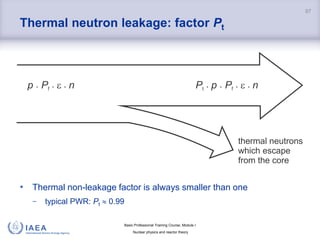
Nuclear physics and reactor theory
Thermal neutron leakage: factor Pt
• Thermal non-leakage factor is always smaller than one
− typical PWR: Pt  0.99
97
p P n
   
f P p P n
t f
    
thermal neutrons
which escape
from the core
Basic Professional Training Course; Module I
Nuclear physics and reactor theory
Thermal utilisation factor f
• Fraction of thermal neutrons absorbed in fuel relative to absorption
elsewhere the core:
• From (Pt ∙ p ∙ Pf ∙ ε ∙ n) thermal neutrons that remain in the core,
(f ∙ Pt ∙ p ∙ Pf ∙ ε ∙ n) thermal neutrons are absorbed in the fuel
98
f =
number of thermal neutrons absorbed in the fuel
number of thermal neutrons absorbed in all core materials
Basic Professional Training Course; Module I
Nuclear physics and reactor theory
Utilisation of thermal neutrons: factor f
• The value of factor f can change significantly
− it is changed intentionally, in order to control the operation of reactor
99
P p P n
t f
    
f P p P n
     
t f
absorption in
const. mater.
absorption
in boron
absorption in
control rods
Basic Professional Training Course; Module I
Nuclear physics and reactor theory
Neutron yield per absorption 
• Number of fast neutrons which are released in thermal fission per
thermal neutron absorbed in fuel:
• From (f ∙ Pt ∙ p ∙ Pf ∙ ε ∙ n) thermal neutrons absorbed in the fuel,
( ∙ f ∙ Pt ∙ p ∙ Pf ∙ ε ∙ n) fast neutrons are produced in fission.
100
 =
number of fast neutrons from thermal fission
number of thermal neutrons absorbed in fuel
Basic Professional Training Course; Module I
Nuclear physics and reactor theory
Neutron reproduction: factor 
• Neutron yield per absorption is always greater than one.
− depends significantly on fuel enrichment:
− natural uranium:  = 1.34,
− 3% enrichment:  = 1.84,
− pure 235U:  = 2.08.
101
       
f P p P n
t f
f P p P n
     
t f
fuel
U
235
U
238
Pu
239
Basic Professional Training Course; Module I
Nuclear physics and reactor theory
Neutron cycle
102
n
generation of fast neutrons
by thermal fission
new generation of fast
neutrons by thermal
fission
fast
fission
thermal
utilization
resonance escape
fast non-
leakage
thermal
non-leakage
 
• • •
f P p P n
• •
t f
•
f P p P n
• •
t f
• • •

P p P n
t f
• • • •

p P n
• f • •

P n
f • •

 • n
Basic Professional Training Course; Module I
Nuclear physics and reactor theory
Multiplication factor k
• Multiplication factor, k, is the defined as the radio of the number of
neutrons in one generation to the number of neutrons in the
previous generation:
• In the neutron cycle, as described previously, k can be expressed
as a product of six factors:
103
k =
number of neutrons in given generation
number of neutrons in the previous generation
k =  ∙ f ∙ Pt ∙ p ∙ Pf ∙ ε
Basic Professional Training Course; Module I
Nuclear physics and reactor theory
Chain reaction
• each generation of neutrons leads to the birth of next generation of
neutrons
• chain reaction in the case k = 2:
1st generation 2nd generation 3rd generation
of neutrons of neutrons of neutrons
104
1. generacija
nevtronov
2. generacija
nevtronov
3. generacija
nevtronov
Basic Professional Training Course; Module I
Nuclear physics and reactor theory
Criticality
• k = 1: critical chain reaction
− the number of neutrons in the core does not change with time,
− the number of fissions per unit time is constant,
− reactor power is constant.
• k > 1: supercritical chain reaction
− the number of neutrons in the core increases with time,
− the number of fissions per unit time increases with time,
− reactor power increases.
• k < 1: critical chain reaction
− the number of neutrons in the core does decreases with time,
− the number of fissions per unit time decreases with time,
− reactor power decreases.
105
Basic Professional Training Course; Module I
Nuclear physics and reactor theory
Reactivity
• We are usually interested in reactor conditions where k  1
− we want to avoid using a large number of decimal places
• Let us introduce reactivity, which represents departure from
criticality:
k < 1  ρ < 0  reactor is subcritical,
k = 1  ρ = 0  reactor is critical,
k > 1  ρ > 0  reactor is supercritical.
106
k
k
k 1
1
1





Basic Professional Training Course; Module I
Nuclear physics and reactor theory
Notations for reactivity
• reactivity is dimensionless quantity
• several notations are used:
− k/k: reactivity is calculated and the number is followed by k/k
− % k/k: 1% k/k = 0.01 k/k
− pcm: 1 pcm = 0.00001 k/k
− $: 1 $ = k/k
107
Basic Professional Training Course; Module I
Nuclear physics and reactor theory
Positive and negative reactivity
• Any change of the core properties modifies k and ρ:
− burnup of fuel, production of fission products,
− operator actions (boron concentration, control rods).
• If changes in the core decrease the multiplication factor k:
− negative reactivity has been added in the core.
• If changes in the core increase the multiplication factor k:
− positive reactivity has been added in the core.
108
Basic Professional Training Course; Module I
Nuclear physics and reactor theory
Reactivity and change of reactor power
• During operation at constant power:
− the reactor is critical,
− multiplication factor k = 1,
− core reactivity ρ = 0.
• If we want to increase the power, positive reactivity has to be
added in the core.
• If we want to decrease the power, negative reactivity has to be
added in the core.
109
Basic Professional Training Course; Module I
Nuclear physics and reactor theory
REACTOR KINETICS
Learning objectives
After completing this chapter, the trainee will be able to:
1. Explain the exponential increase in reactor power.
2. Define the period T.
3. Define the start-up rate or SUR.
4. Describe the relationship between the multiplication factor,
reactivity, the period and start-up rate and sketch how power
changes for different k values.
5. Explain a chain reaction by taking and without taking delayed
neutrons into account.
6. Define prompt criticality.
7. Sketch the reactor power response to a step change in reactivity.
110
Basic Professional Training Course; Module I
Nuclear physics and reactor theory
Operation ranges of reactor
111
Basic Professional Training Course; Module I
Nuclear physics and reactor theory
Reactor operation at low power range
• Thermal power negligible  the temperature of fuel and coolant
does not change perceptibly with change of power
− no temperature feedback effects on reactivity
• Any change of reactivity is cause exclusively with external actions,
e.g. withdrawal or lowering the control rods
112
Basic Professional Training Course; Module I
Nuclear physics and reactor theory
Time dependence of reactor power
• time for one neutron cycle to pass = average lifetime of neutrons = l
• change in the number of neutrons in one cycle:
N = k ∙ N – N = (k – 1) ∙ N = k ∙ N
• change per unit time:
∆𝑁
∆𝑡
=
∆𝑘 ∙ 𝑁
𝑙
• solution:
𝑁 = 𝑁0 ∙ 𝑒
∆𝑘
𝑙 ∙𝑡
N0 … number of neutrons at time t = 0
N … number of neutrons at time t
113
Basic Professional Training Course; Module I
Nuclear physics and reactor theory
Reactor period T
• introducing
𝑙
∆𝑘
= 𝑇:
𝑁 = 𝑁0 ∙ 𝑒
𝑡
𝑇 ⇒ 𝑃 = 𝑃0 ∙ 𝑒
𝑡
𝑇
• T is the reactor period – in this time the reactor power changes for
a factor of e.
114
Basic Professional Training Course; Module I
Nuclear physics and reactor theory
Start-up rate
• the rate at which reactor power changes is usually expressed by the
start-up rate, SUR, defined by the equation:
𝑃 = 𝑃0 ∙ 10𝑆𝑈𝑅
P0 … initial reactor power
P … reactor power after t minutes
SUR is measured in DPM (decades per minute) or min-1
• relationship between SUR and the reactor period T:
𝑆𝑈𝑅 =
26
𝑇
T is in seconds, SUR in DPM!
115
Basic Professional Training Course; Module I
Nuclear physics and reactor theory
Supercritical reactor
k > 1  ρ > 0  T > 0  SUR > 0
• Reactor power increases exponentially with time.
− The higher k, the higher the core reactivity ρ and the faster reactor
power increases: higher is SUR and shorter the reactor period T.
• When increasing the power, the reactor is supercritical.
− The operators must increase reactor power slowly and in accordance
with the procedure which specifies the maximum start-up rate.
116
Basic Professional Training Course; Module I
Nuclear physics and reactor theory
Supercritical reactor dynamics
117
P
P0
t
k1
T1
SUR1
k2
T2
SUR2
k1 > k 2 > 1
T1 < T2
SUR1 > SUR2
Basic Professional Training Course; Module I
Nuclear physics and reactor theory
Critical reactor
k = 1  ρ = 0  T = ∞  SUR = 0
• At higher power levels, the number of fissions per unit of time (or
number of neutrons) is higher than at lower power levels, but
constant in a critical reactor (it does not change with time).
118
Basic Professional Training Course; Module I
Nuclear physics and reactor theory
Subcritical reactor
k < 1  ρ < 0  T < 0  SUR < 0
• Reactor power decreases exponentially with time.
− The smaller k, the smaller the core reactivity ρ (more negative) and the
faster reactor power decreases: shorter negative period T and higher
negative SUR.
• When decreasing the power, the reactor is always subcritical.
119
Basic Professional Training Course; Module I
Nuclear physics and reactor theory
Subcritical reactor dynamics
120
Basic Professional Training Course; Module I
Nuclear physics and reactor theory
Neutron lifetime
• Time from the birth to the disappearance of a neutron (escape,
absorption).
• It is divided into:
− birth time: the time from fission to neutron release ~ 10-14 s,
− slowing-down time: the average time from neutron’s release to its
thermalization ~ 10-5 s,
− diffusion time: the average time from a neutron’s thermalization to its
disappearance ~ 10-5 s.
121
Basic Professional Training Course; Module I
Nuclear physics and reactor theory
Phases of neutron lifetime
• lifetime of prompt neutrons in a pressurized water reactor core is of
the order of magnitude of 10-4 s.
122
lifetime
birth time
birth
release
thermalization
absorption
slowing-down time diffusion time
Basic Professional Training Course; Module I
Nuclear physics and reactor theory
Chain reaction with prompt neutrons
• Reactor operates at 10 kW constant power. The operator withdraws
the control rods few steps, i.e., adds positive reactivity ρ = 70 pcm.
 k  1.0007
𝑇 =
𝑙
∆𝑘
=
10−4
s
0.0007
= 0.143 s
• after 1 second:
𝑃 = 𝑃0 ∙ 𝑒
𝑡
𝑇 = 𝑃0 ∙ 𝑒
1 s
0.143 s ≈ 1100 𝑃0
If the chain reaction is maintained with prompt neutrons only, the
corresponding fast changes of power are impossible to control.
123
Basic Professional Training Course; Module I
Nuclear physics and reactor theory
Average lifetime of prompt and delayed
neutrons
• Slowing-down and diffusion times of delayed neutrons are
comparable to those of prompt neutrons
• Birth time of delayed neutron is the life time  of its precursor (for
235U fission ~ 13 s) and is much longer that diffusion or
slowing/down time.
• Lifetime of delayed neutrons is essentially the lifetime  of their
precursors.
• Average lifetime of all neutrons:
l = (1 – β) ∙ lp + β ∙ 
l = (1 – 0.0065) ∙ 10-4 s + 0.0065 ∙ 13 s  0.1 s
124
Basic Professional Training Course; Module I
Nuclear physics and reactor theory
Chain reaction with prompt and delayed
neutrons
• Reactor at 10 kW constant power, positive reactivity ρ = 70 pcm
𝑇 =
𝑙
∆𝑘
=
0.1 s
0.0007
= 143 s
• after 1 second:
𝑃 = 𝑃0 ∙ 𝑒
𝑡
𝑇 = 𝑃0 ∙ 𝑒
1 s
143 s ≈ 1.007 𝑃0
• after 100 seconds:
𝑃 = 𝑃0 ∙ 𝑒
𝑡
𝑇 = 𝑃0 ∙ 𝑒
100 s
143 s ≈ 2.0 𝑃0
In 1 s, the power increases by 0.7% and in 100 s it doubles. Such slow
changes, due to contribution of delayed neutrons, are well within
the operator’s control.
125
Basic Professional Training Course; Module I
Nuclear physics and reactor theory
Dependence of reactor period on reactivity
• the graph shows absolute
values of reactivity and reactor
period
• the shortest negative period
is -80 s.
− reactor can not shut down
faster than the decay of most
long-lived precursors
126
0.001
0.01 .02 .03 .04 .06.08 .1 .2 .3 .4 .6 .8 1.0 2.0
reactivity [$]
stable
period
[s]
0.01
0.1
1
10
100
10000
80
1000
positive reactivity
positive period
negative reactivity
negative period
Basic Professional Training Course; Module I
Nuclear physics and reactor theory
Prompt criticality
in case 𝜌 ≥ 𝛽:
• reactor period determined by the lifetime of prompt neutrons
• reactor period becomes very short
• reactor is said to be prompt critical
127
Rule: reactor reactivity must always be kept smaller than
𝜷 (1$) both during start-up and power increase.
Basic Professional Training Course; Module I
Nuclear physics and reactor theory
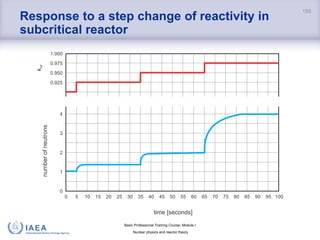
Reactor power response to a positive step
change in reactivity
128
Basic Professional Training Course; Module I
Nuclear physics and reactor theory
Reactor response to a negative step change in
reactivity
129
Basic Professional Training Course; Module I
Nuclear physics and reactor theory
REACTIVITY CHANGES
Learning objectives
After completing this chapter, the trainee will be able to:
1. Give a qualitative explanation of the temperature coefficients of
reactivity.
2. Describe the impact of power change on reactivity.
3. Sketch reactor power response to a step change in reactivity.
4. Describe the formation and removal of 135Xe and 149Sm.
5. Sketch the reactivity due to Xe and Sm as a function of time after
start-up.
6. Sketch the reactivity due to Xe and Sm after shutdown.
7. Sketch how the critical concentration of boron, CB, changes
relative to its burn-up rate.
8. Describe the principle of reactor control.
130
Basic Professional Training Course; Module I
Nuclear physics and reactor theory
Classification of reactivity changes
• During reactor operation, the core properties and consequently its
reactivity change.
• Based on how fast the core properties or its reactivity change during
reactor operation, reactivity changes are classified as:
− short-term changes (~ seconds, minutes)
− medium-term changes (~ hours)
− long-term changes (~ months)
131
Basic Professional Training Course; Module I
Nuclear physics and reactor theory
Short-term reactivity changes
• when reactor is in operating power range (0% - 100%), fuel and
coolant temperatures change
• change of temperature influences:
− density of the moderator
− resonance absorption in fuel
− void fraction in the coolant
132
Basic Professional Training Course; Module I
Nuclear physics and reactor theory
Impact of coolant (moderator) temperature on
reactivity
• increase in coolant (moderator) temperature decreases its density
− mass of water in the core decreases, mass of fuel remains constant:
1. increase in neutron absorption in fuel relative to absorption in water
 increase of the thermal utilization factor f
2. slowing down distance of neutrons increases
 resonance absorption increases: resonance escape factor p
decreases
• Depending on which of the two effects prevails: αm is negative or positive.
• LWRs usually constructed for a negative αm
133
The moderator temperature coefficient, αm, is defined as the change
in reactivity per degree change in the average moderator temperature.
Basic Professional Training Course; Module I
Nuclear physics and reactor theory
Impact of fuel temperature on reactivity
• Increase in fuel temperature increases the resonance absorption of
neutrons.
• Commercial reactors have low enriched fuel  parasitic resonance
absorption in 238U (and 240Pu) predominates.
• The fuel temperature coefficient αf is always negative.
134
The fuel temperature coefficient, αf, is defined as the change in
reactivity per degree change in the fuel temperature.
Basic Professional Training Course; Module I
Nuclear physics and reactor theory
Impact of void fraction on reactivity
• Increase in fraction of voids (steam bubbles) in the core reduces the
moderator density.
• Impact on reactivity is similar to the impact of the moderator
temperature.
• Due to small total void fraction formed in the core of a PWR, the
associated total reactivity change is small.
• Void coefficient is important in BWRs.
135
The void coefficient, αv, is the reactivity change per percent change in
the void fraction.
Basic Professional Training Course; Module I
Nuclear physics and reactor theory
Impact of power change on reactivity
• Change of power changes the coolant temperature, the fuel
temperature, and the void fraction.
• The combined effects of moderator, fuel and axial power
redistribution are accounted for in the total power coefficient.
• In PWRs, power coefficient is always negative.
136
The power coefficient, αp, is defined as the change in reactivity per
percent power change.
The power defect tells us how much core reactivity changes if reactor
power is changed by a given value of P.
Basic Professional Training Course; Module I
Nuclear physics and reactor theory
Response to a step change in reactivity at
operating power
• At operating power range,
temperature feedback
effects are present
(neglected in chapter “Reactor
kinetics”).
• Operator withdraws the
control rods for a few steps
• Power is stabilized at
higher level
137
Basic Professional Training Course; Module I
Nuclear physics and reactor theory
Mid-term changes of reactivity
• Fissions in the core result in over 200 different fission products.
• Two fission products important for reactor operation:
− 135Xe – absorption cross-section for thermal neutrons a = 2∙106 b
− 149Sm – absorption cross-section for thermal neutrons a = 4∙104 b
138
Basic Professional Training Course; Module I
Nuclear physics and reactor theory
Production and removal of Xenon-135
• 135Xe is produced:
− as a direct product of fission
− from the decay of 135I which decays with a half-life of 6.6 hours and is a
daughter products of the fission fragments 135Sb and/or 135Te
52
135
Te
β−, 19 s
53
135
I
β−, 6.6 h
fission →
54
135
Xe
• 135Xe is removed:
− by burn-up via the neutron capture reaction
− decays with a half-life of 9.1 hours
54
135
Xe
β−, 9.1 h
55
135
Cs
β−, 2∙106 y
56
135
Ba
n,γ
54
136
Xe
139
Basic Professional Training Course; Module I
Nuclear physics and reactor theory
135Xe during reactor start-up
• After reactor start-up, 135Xe concentration starts to grow
• Equilibrium concentration of 135Xe approx. 40 - 50 h after start-up
− equilibrium conc. depends on reactor power, but dependence not linear
140
25%
0
0
-500
-1000
-1500
-2000
-2500
-3000
time [hours]
reactivity
due
to
Xe
[pcm]
10 20 30 40 50 60 70 80 90 100
50%
75%
100%
Basic Professional Training Course; Module I
Nuclear physics and reactor theory
135Xe during reactor shutdown
• after shut-down, 135Xe in produced by the decay of 135I (t1/2 = 6.6 h),
and is removed by its own decay (t1/2 = 9.1 h)
• maximum 135Xe concentration reached ~ 9 h after shutdown
(depending on reactor power)
• after ~24 h 135Xe concentration roughly equal to its level at shutdown
• after ~ 80 – 90 h there is practically no 135Xe in the core
• during 135Xe decay, positive reactivity is inserted into the core –
possible recriticality of reactor!
141
Basic Professional Training Course; Module I
Nuclear physics and reactor theory
Reactivity due to 135Xe after shutdown
142
25%
0
0
500
1000
1500
2000
2500
3000
-500
-1000
-1500
-2000
-2500
-3000
time [hours]
reactivity
due
to
Xe
[pcm]
10 20 30 40 50 60 70 80 90 100
50%
75%
100%
Basic Professional Training Course; Module I
Nuclear physics and reactor theory
Production and removal of Samarium-149
• 149Sm is produced:
− from the decay of 149Pm (promethium) which decays with t1/2 = 53.1 h
58
149
Ce
β−, 5 s
59
149
Pr
β−, 2.3 min
60
149
Nd
β−, 1.7 ℎ
61
149
Pm
β−, 53.1 h
62
149
Sm
• 149Sm is removed:
− by burn-up via the neutron capture reaction
62
149
Sm
n,γ
62
150
Sm
143
Basic Professional Training Course; Module I
Nuclear physics and reactor theory
149Sm during reactor start-up
• After reactor start-up and with a fresh core, 149Sm concentration
starts to grow.
• Equilibrium concentration of 135Xe approx. 400 h after start-up and
is independent of reactor power.
144
Basic Professional Training Course; Module I
Nuclear physics and reactor theory
149Sm during reactor shutdown
• after shut-down, 149Sm
burn-up by neutron
absorption ceases, but
149Sm is still produced
by the decay of 149Pm
• maximum 149Sm
concentration reached
~ 400 h after shutdown
(depending on reactor
power)
145
0
Basic Professional Training Course; Module I
Nuclear physics and reactor theory
149Sm during reactor restart
• As the reactor is restarted on power, the equilibrium concentration
of 149Sm equal to its value prior to shut-down is re-established.
146
Basic Professional Training Course; Module I
Nuclear physics and reactor theory
Long-term changes of reactivity
• With operation of a LWR through a fuel cycle:
− burn-up of 235U
− burn-up of 238U (negligible importance)
− production of 239Pu and other Plutonium isotopes
− production of fission products, some of which are important neutron
absorbers
• With core burn-up, the reactivity of core decreases.
147
Basic Professional Training Course; Module I
Nuclear physics and reactor theory
Excess reactivity
• Excess reactivity is compensated by adding boron to the coolant
and by burnable poisons.
• Since core reactivity decreases with burn-up, the concentration of
boron CB in the moderator is gradually reduced over the fuel cycle.
148
Excess reactivity is defined as the amount of surplus reactivity over
that needed to enable reactor operation at zero power.
Basic Professional Training Course; Module I
Nuclear physics and reactor theory
Critical boron concentration
• The critical boron concentration (CB) is defined as the concentration
of boron required for the reactor to be critical on full power with the
control rods withdrawn.
• Typical course of critical boron concentration over the fuel cycle:
149
4000
1000
2000
C
[ppm]
B
burn-up [MWd/MTU]
8000 12000 16000 20000
Basic Professional Training Course; Module I
Nuclear physics and reactor theory
Reactor control
• Operators primarily influence core reactivity in two ways:
1. by control rods
− alloy of 80% Ag, 15% In and 5% Cd
− good absorber of thermal and epithermal neutrons
− compensation of short-term reactivity changes
− ensure a negative reactivity reserve needed for fast reactor shut-down
2. by changing the boric acid concentration in the coolant
− good absorber of thermal neutrons
− compensation of mid-term and long-term reactivity changes
150
Basic Professional Training Course; Module I
Nuclear physics and reactor theory
SUBCRITICAL MULTIPLICATION
Learning objectives
After completing this chapter, the trainee will be able to:
1. Explain subcritical multiplication.
2. Define the subcritical multiplication factor, M.
3. Explain the 1/M curve for core loading.
151
Basic Professional Training Course; Module I
Nuclear physics and reactor theory
Neutron sources
• Neutron population in core measured by excore detectors
− they measure neutrons that leak out of the core
− when reactor is shut down, the neutron population is low
• Independent neutron sources in the core are needed:
− control of the reactivity changes in the subcritical reactor,
− signal on the detectors high enough for controlled approach to criticality,
− verification that the excore detectors are operational.
152
Basic Professional Training Course; Module I
Nuclear physics and reactor theory
Types of neutron sources
• Nonregenerative neutron sources:
− (Pu-Be) source: α particle emitted by Pu triggers reaction 9Be(α,n)12C
− 252Cf: spontaneous fission
• Regenerative neutron source:
− (Sb-Be) source: antimony is activated in neutron flux: 123Sb(n,)124Sb;
gammas from the decay of 124Sb trigger reaction 9Be(,n)2 α
• Reactors that have operated for several cycles:
− no need for additional neutron sources in the core
− old fuel elements contain sufficient amount of 242Cm and 244Cm which
fission spontaneously and emit neutrons
153
Basic Professional Training Course; Module I
Nuclear physics and reactor theory
Population of neutrons in subcritical reactor
• Number of neutrons per unit time in a subcritical reactor:
𝑁 =
𝑆0
1 − 𝑘
S0 … number of neutrons emitted by source per time unit
• A subcritical reactor with an independent source creates an
equilibrium neutron population, N, even when k < 1.
• If the independent source were removed from a subcritical reactor,
the neutron population would drop to zero.
154
Basic Professional Training Course; Module I
Nuclear physics and reactor theory
Response to a step change of reactivity in
subcritical reactor
155
Basic Professional Training Course; Module I
Nuclear physics and reactor theory
Subcritical multiplication factor
𝑀 =
1
1 − 𝑘
• ratio between the total neutron population per unit time and the
number of neutrons per unit time emitted by the neutron source
• when approaching criticality (e.g. core loading)
k → 1  M → ∞
or:
𝑘 ⟶ 1 ⟹
1
𝑀
⟶ 0
Core loading should be managed with great care, and the neutron
population must be continuously monitored → by using the 1/M value
156
Basic Professional Training Course; Module I
Nuclear physics and reactor theory
Example: loading of empty core
• In an empty core, k = 0.
• Count rate co (base count rate) results exclusively from the
independent sources. 1/M is calculated:
1
𝑀
=
𝑐0
𝑐0
= 1
• a few fuel elements are added to the core. This makes k ≠ 0. The
detector counts c1 impulses and 1/M is:
1
𝑀
=
𝑐0
𝑐1
< 1
• both values are entered on a graph and a line is drawn through
• extrapolation of this line to horizontal axis gives an estimate how
many more fuel elements are needed
157
Basic Professional Training Course; Module I
Nuclear physics and reactor theory
Loading of empty core (cont’d)
• each step (adding a few more elements) gives better estimate how
many more elements are needed to reach criticality
158
step Number of
inserted
elements
ci c0/ci
0 0 100 1
1 10 125 0.8
2 20 166 0.6
3 30 250 0.4
4 40 500 0.2
5 45 1000 0.1
0.2
10 20 30 40 50
0.4
0.6
0.8
1.0
number of fuel elements
1/M
Basic Professional Training Course; Module I
Nuclear physics and reactor theory
Inverse Count Rate Ratio – ICRR
• base count rate can be placed anywhere
• 1/M curve is renormalized to a new base count
• in this case we rather speak of the ICRR curve
• prediction of the criticality (ICRR = 0) remains the same
159
Basic Professional Training Course; Module I
Nuclear physics and reactor theory
Loading of a power reactor
• ICRR is determined after loading of each fuel element
− if ICRR deviates abnormally, stop all activities in the core and act in
accordance with the relevant procedures
• for safety reasons, the core is heavily poisoned with boric acid
− even after loading all fuel elements, reactor remain subcritical
160
10
0.1
0.2
0.3
0.4
0.5
0.6
0.7
0.8
0.9
1.0
number of inserted fuel elements
1/M
20 30 40 50 60 70 80 90 100 110 120
Basic Professional Training Course; Module I
Nuclear physics and reactor theory
HEAT REMOVAL FROM NUCLEAR REACTORS
Learning objectives
After completing this chapter, the trainee will be able to:
1. Name three modes of heat transfer.
2. Describe heat conduction.
3. Describe forced and natural convection.
4. Describe heat transfer to a fluid with phase change.
5. Explain the formation of steam bubbles.
6. Sketch and describe the boiling curve.
7. Define the boiling crisis.
8. Describe the average and maximum thermal power of a fuel rod in
a PWR.
9. Describe hot channel factors and explain the reasons for their
limits.
161
Basic Professional Training Course; Module I
Nuclear physics and reactor theory
Definition of basic quantities
Heat flux is defined as the quantity of heat per unit time:
𝑄 =
∆𝑄
∆𝑡
[J/s = W]
Heat flux density is heat flux per unit surface area [W/m2].
162
Heat is energy which passes from a point of higher temperature to
a point of lower temperature.
If there is no difference in temperature, there can be no heat transfer.
Basic Professional Training Course; Module I
Nuclear physics and reactor theory
Modes of heat transfer
1. heat conduction through matter (diffusion)
2. heat transfer by means of fluid flows (convection)
3. radiation
163
convection
radiation
Basic Professional Training Course; Module I
Nuclear physics and reactor theory
Heat conduction
• process which takes place at the atomic level
164
Basic Professional Training Course; Module I
Nuclear physics and reactor theory
Heat conduction equation
𝑄 =
𝜆 𝐴 Δ𝑇
Δ𝑥
 heat conductivity [W/mK]
A surface area of the wall [m2]
T temperature difference [K]
x wall thickness [m]
165
Basic Professional Training Course; Module I
Nuclear physics and reactor theory
Temperature profile in a wall made of various
materials
166
Basic Professional Training Course; Module I
Nuclear physics and reactor theory
Temperature profile in fuel rod
167
CL r1 r2 r3
coolant
fuel pellet gap cladding
T
TW
TB
~8 mm 0.01 ~0.6 mm
Basic Professional Training Course; Module I
Nuclear physics and reactor theory
Convection
Example of natural convection in
PWR: core cooling after primary
pumps have been shut down
168
Convection involves heat transferred by the flow of fluid.
Convection can be natural or forced.
heat source
heat sink
Δh
Basic Professional Training Course; Module I
Nuclear physics and reactor theory
Natural convection
• Convection is heat transfer by the flow of fluid.
• Natural convection: the fluid moves due to a difference in fluid
density (temperature difference or phase change)
• Example of natural convection due to difference in liquid density is
PWR core cooling after shut down of primary pumps.
• Example of natural convection due to phase change is the
circulation of secondary water inside a steam generator.
169
Basic Professional Training Course; Module I
Nuclear physics and reactor theory
Forced convection
• Fluid is forced to move by means of a pump or fan.
• Example in PWR: the flow of the primary coolant through the core
driven by the operation of reactor coolant pumps.
170
Basic Professional Training Course; Module I
Nuclear physics and reactor theory
Equation of heat transfer
𝑄 = ℎc 𝐴 Δ𝑇
hc heat transfer coefficient [W/m2K]
A wall surface area [m2]
T temperature difference between wall and fluid [K]
• hc depends on fluid velocity, pressure, temperature, the flow
regimes of potential two-phase flow, etc. It is determined
experimentally.
171
Basic Professional Training Course; Module I
Nuclear physics and reactor theory
Radiative heat transfer
• Emission of internal energy by electromagnetic waves.
− Radiation can spread through empty space (a vacuum), as well.
• Stefan-Boltzmann law:
𝑄 = 𝜀 𝜎 𝐴 𝑇4
ε emission coefficient (1 for a black body)
σ Stefan-Boltzmann constant
A total area of the body radiating heat
T absolute temperature
• Examples:
− solar radiation
− uncovered reactor core in case of Loss-Of-Coolant-Accident (LOCA)
172
Basic Professional Training Course; Module I
Nuclear physics and reactor theory
Boiling heat transfer
• When heat is transferred from a solid body to a liquid and the
temperature of solid body is high enough, the liquid may boil
 phase change
• heat flux is significantly higher than in the case of natural or
forced convection
− similar applies for condensation, as well
• saturated boiling: water is at the boiling point temperature
throughout its bulk
• subcooled boiling: temperature lower than boiling point, bubbles
collapse when they break away from the heating surface
173
Basic Professional Training Course; Module I
Nuclear physics and reactor theory
Bubble formation
174
steam
liquid
Bubbles break away from the heating surface, “mixing” the liquid and
“breaking” the laminar layer of liquid which would otherwise cause
much lower heat transfer.
Basic Professional Training Course; Module I
Nuclear physics and reactor theory
Boiling curve
175
Basic Professional Training Course; Module I
Nuclear physics and reactor theory
4 regions of the boiling curve
1. Natural convection: small T
2. Nucleate boiling: beginning of boiling
− subcooled nucleate boiling
− saturated nucleate boiling
3. Partial film boiling: bubbles combine into layers next to the wall
− this layer of vapour insulates the surface and reduces heat transfer
− in this region, the vapour layers are not stable
4. Film boiling and radiation: stable layers of vapour form next to
the heating body
− poor heat transfer despite a relatively large temperature difference
176
Basic Professional Training Course; Module I
Nuclear physics and reactor theory
Departure from Nucleate Boiling
• Point c:
boiling crisis or
Departure from Nucleate Boiling – DNB
• nucleate boiling switches over to film boiling
• heat flux at point c is called the critical or DNB heat flux.
• Departure from Nucleate Boiling Ratio – DNBR:
• DNBR should always be greater than 1
− DNBR limit value is set down in the Technical Specifications
177
DNBR =
critical heat flux
actual heat flux
Basic Professional Training Course; Module I
Nuclear physics and reactor theory
Heat transfer in the reactor core
• During normal operation and during incidents, the integrity of the
reactor core must be maintained.
• Design limits for the fuel pellet temperature and the boiling crisis
• Power distribution in the core is uneven and depends on:
− nuclear properties
− thermodynamic parameters
− fabrication parameters
• Power distribution is described by using peaking factors
− maximum value of certain parameter is a product of average value and
respective peaking factor
178
Basic Professional Training Course; Module I
Nuclear physics and reactor theory
Average linear power density
• thermal power released per unit fuel rod length [kW/m]
Example:
− thermal power of a PWR: 1994 MW
− number of fuel elements in the core: 121
− number of fuel rods in each element: 235
− length of fuel rod: 3.6 m
− fraction of heat released in the fuel: 97.4%
𝑞 =
1994 ∙ 1000 kW ∙ 0.974
121 ∙ 235 ∙ 3.6 m
= 18.7 kW/m
• Linear power density is not equal for all the rods in a fuel element
− varies among individual elements
− varies with the height of a fuel rod in the core
179
Basic Professional Training Course; Module I
Nuclear physics and reactor theory
Heat flux hot channel factor FQ
• maximum allowed FQ set in the operational limits
− example:
180
FQ =
maximum heat flux in the core
average heat flux in the core
1
2
3
4
0% 50% 100%
F
Q
reactor power
Basic Professional Training Course; Module I
Nuclear physics and reactor theory
Maximum allowed linear power density
example:
𝑞max = 𝐹𝑄 ∙ 𝑞 = 2.35 ∙ 18.7 kW/m = 44 kW/m
181
The FQ limit ensures that:
• the maximum temperature in the middle of a
fuel pellet (centreline temperature) during
normal operation is lower than the melting
point temperature,
• the maximum temperature of fuel rod
cladding during a loss of coolant accident is
lower than 1200° C.
Basic Professional Training Course; Module I
Nuclear physics and reactor theory
Enthalpy rise hot channel factor, FΔH
example:
Hot channel factors calculated from periodic (~ every 1000 MWd/t)
measurements of thermal neutron flux with movable neutron detectors.
182
FH =
maximum fuel rod integral power
average fuel rod integral power
1
1.5
2
0% 50% 100%
F
H reactor power
The FH limit ensures that a boiling
crisis does not occur during
normal operation and moderately
frequent incidents.
Basic Professional Training Course; Module I
Nuclear physics and reactor theory
Operating conditions and DNBR
• during operation, DNBR > 2.0
183
DNBR =
critical heat flux
actual heat flux
DNBR is reduced when:
a) the pressure in the primary system falls,
b) the flow in the primary system decreases,
c) the temperature of the primary coolant rises
The views expressed in this document
do not necessarily reflect the views of
the European Commission.

Module01 nuclear physics and reactor theory

  • 1.
    Version 1a, September2014 BASIC PROFESSIONAL TRAINING COURSE Module I Nuclear physics and reactor theory This material was prepared by the IAEA and co-funded by the European Union.
  • 2.
    Basic Professional TrainingCourse; Module I Nuclear physics and reactor theory ATOMIC STRUCTURE OF MATTER Learning objectives After completing this chapter, the trainee will be able to: 1. Describe the terms element, atom, compound and molecule. 2. Define the atomic mass unit. 3. Define the relative atomic mass Ar. 4. Define the relative molecular mass M and calculate it from the chemical formula. 5. Calculate the mass of elements in a given mass of a compound. 2
  • 3.
    Basic Professional TrainingCourse; Module I Nuclear physics and reactor theory Elements and atoms • Elements are basic components of matter − 112 elements are currently known, 90 elements naturally occurring − Elements have specific names and symbols, e.g.: H – Hydrogen He – Helium Li – Lithium O – Oxygen U – Uranium … • Basic constituents of element are atoms: - Atom is the smallest particle of an element, having its chemical properties - Atoms of different elements have different chemical properties 3
  • 4.
    Basic Professional TrainingCourse; Module I Nuclear physics and reactor theory Compounds • Different elements bond together to make a compound • Basic constituents of a compound are molecules: − A molecule is the smallest particle of a compound, having its chemical properties • Atoms combine into molecules in chemical reactions: Hydrogen + Oxygen → Water (2H2 + O2 → 2H2O) Sodium + Chlorine → Sodium chloride (salt) (2Na + Cl2 → 2NaCl) Uranium + Oxygen → Uranium dioxide (U + O2 → UO2) 4
  • 5.
    Basic Professional TrainingCourse; Module I Nuclear physics and reactor theory Atomic mass unit • Atoms are very small and very light • A mass unit used in atomic physics and chemistry: 1 atomic mass unit = 1 amu = 1 u • Definition: 1 u = 1/12 of mass of 12C = 1.66∙10-27 kg 5
  • 6.
    Basic Professional TrainingCourse; Module I Nuclear physics and reactor theory Relative atomic mass Ar • Ar is the ratio of atom mass and amu: atom mass = Ar  amu • The value of Ar can be found e.g. in periodic system − Examples: Hydrogen (H): Ar(H) = 1.0079  1 Lithium (Li): Ar(Li) = 6.941  6.9 Boron (B): Ar(B) = 10.81  10.8 Carbon (C): Ar(C) = 12.011  12 Oxygen (O): Ar(O) = 15.9994  16 Iron (Fe): Ar(Fe) = 55.847  55.8 Uranium (U): Ar(U) = 238.029  238 6
  • 7.
    Basic Professional TrainingCourse; Module I Nuclear physics and reactor theory Relative molecular mass Mr • Mr is the ratio of molecular mass and amu: mass of molecule = Mr  amu − Mr is calculated as the sum of relative atomic masses of atoms in the molecule: Mr (H2O) = 2  1 + 16 = 18 − Exercises: 1. Calculate Mr(H3BO3)! 2. Calculate Mr(C3H5OH)! 3. How many molecules are there in one kg of water? 7
  • 8.
    Basic Professional TrainingCourse; Module I Nuclear physics and reactor theory Exercises 1. Calculate the relative molecular mass of carbon dioxide! 2. How many atoms of boron there are in 1 kg of boron? 3. How many atoms of hydrogen and how many atoms of oxygen there are in 1 kg of water? 4. What is the mass of hydrogen and the mass of oxygen in 1 kg of water? 5. What is the mass of boron in 10 kg of boric acid H3BO3? 6. How many grams of oxygen need to be added to 2 g of hydrogen, in order that all hydrogen combines with oxygen into water? How much water we would get? 7. How many uranium atoms there are in 1 cm3 of uranium? (which additional information is needed?) 8
  • 9.
    Basic Professional TrainingCourse; Module I Nuclear physics and reactor theory STRUCTURE OF ATOM Learning objectives After completing this chapter, the trainee will be able to: 1. Describe the structure of an atom. 2. Name the main characteristics of an electron. 3. Define the atomic number, Z. 4. Explain the terms positive and negative ion. 5. Define the binding energy of an electron. 6. Define the unit electron-volt. 7. Describe the energy levels of electrons in an atom. 8. Explain the ground state and excited state of an atom. 9. Explain the transition of an atom from an excited state to the ground state. 9
  • 10.
    Basic Professional TrainingCourse; Module I Nuclear physics and reactor theory Atom • Atom: the smallest particle of an element, having it chemical and physical properties • Atom is composed of: − Nucleus, which has positive electrical charge − Negatively charged electrons, which form sort of cloud around the nucleus – the electron envelope • Size of atom ~ 10-10 m • Diameter of atom : nucleus ~ 10000 : 1 • Mass of nucleus > 99,95% of atom mass 10 10-10 m 10-14 m nucleus electrons
  • 11.
    Basic Professional TrainingCourse; Module I Nuclear physics and reactor theory Electrons • Electrons: light particles with negative electric charge − eelectron = -1.6∙10-19 As = -1.6∙10-19 C ≡ -e0 − melectron = 9.1∙10-31 kg  1/1820 u • Electrons move in the electron cloud. − Electron cloud determines the outer boundary of atom and the chemical, electrical and mechanical properties of an element. • Electrons are bound to positively charged nucleus with electrical force. 11
  • 12.
    Basic Professional TrainingCourse; Module I Nuclear physics and reactor theory Atomic number Z • Z – atomic number − equal to number of electrons in neutral atom − equal to consecutive number of element in the periodic table − all atoms of a specific element have the same number of electrons • As a rule, atom is electrically neutral  negative charge of electrons = positive charge of nucleus − charge of electrons in the atom = - Z ∙ e0 − charge of nucleus in the atom = Z ∙ e0 12
  • 13.
    Basic Professional TrainingCourse; Module I Nuclear physics and reactor theory Ions • Atom becomes: − a positive ion, if it loses electrons (positive charge of nucleus prevails) − a negative ion, if it gains electrons (negative charge of electrons prevails) 13 + + + - - - neutral atom positive ion negative ion
  • 14.
    Basic Professional TrainingCourse; Module I Nuclear physics and reactor theory Electron energy • Free electrons, when moving, have positive (kinetic) energy • Free electrons at rest have zero energy • Electron which is bound in atom must be supplied with energy to become free electron  Energy of bound electron is negative • Binding energy is always negative; the lower (more negative) the binding energy, the stronger electron is bound 14
  • 15.
    Basic Professional TrainingCourse; Module I Nuclear physics and reactor theory Electronvolt • Atoms are very small and light  energies of particles within atom are very small • The unit for energy on atomic scale is electronvolt (eV): − Energy of a particle with elementary charge (e0), accelerated with voltage of 1 V 1 eV = 1.6∙10-19 As ∙ 1 V = 1.6∙10-19 J 1 keV = 103 eV (= 1.6∙10-16 J) 1 MeV = 106 eV (= 1.6∙10-13 J) • Binding energies of electrons in atom: ~ eV - ~ keV 15
  • 16.
    Basic Professional TrainingCourse; Module I Nuclear physics and reactor theory Energies of electrons in atom • Electrons moving in electron cloud can have only specific energies • Closer the electron to nucleus, lower (more negative) its energy • The specific values of energy that electrons can possess, are called energy levels of electrons in atom • Any energy level can only be occupied by one electron • Energy levels with lowest energies are occupied first • Atom is in ground state when the lowest possible energy levels are occupied • Atom is in excited state when some energy levels below those occupied are left empty 16
  • 17.
    Basic Professional TrainingCourse; Module I Nuclear physics and reactor theory Transitions between electron energy levels • Transition from excited state to ground state: electron falls from a higher energy level into an empty lower energy level − Energy difference is given off in the form of electromagnetic radiation – a photon is emitted • Energy difference between levels: ~ eV  visible light is emitted ~ keV  X-ray of Roentgen radiation is emitted 17 EM radiation
  • 18.
    Basic Professional TrainingCourse; Module I Nuclear physics and reactor theory ATOMIC NUCLEUS Learning objectives After completing this chapter, the trainee will be able to: 1. Describe the basic properties of protons and neutrons. 2. Define the mass number A and write the relationship between mass number, A, atomic number, Z, and the number of neutrons in the nucleus, N. 3. Define a nuclide and an isotope and describe their notation. 4. Explain the isotopic abundance of an element. 5. Describe the systematic arrangement of nuclei in a table. 6. Describe the energy states of a nucleus. 7. Define the binding energy of a nucleon. 8. Plot the binding energy of a nucleon as a function of mass number, A. 18
  • 19.
    Basic Professional TrainingCourse; Module I Nuclear physics and reactor theory Composition of the nucleus • Nucleus is composed of particles called nucleons: • They are bound together with nuclear force (strongest force in nature) 19 PROTON (p) NEUTRON (n) charge +e0 no charge mass 1,0072766 u 1,0086654 u
  • 20.
    Basic Professional TrainingCourse; Module I Nuclear physics and reactor theory Protons, atomic number • Protons are nucleons with positive elementary charge (+ e0) • Neutral atom: the number of negative charge carriers (electrons) = the number of positive charge carriers (protons) • Atomic number is also the number of protons in nucleus − Nuclei of atoms of same element have equal number of protons − Nuclei of atoms of different elements have different number of protons 20
  • 21.
    Basic Professional TrainingCourse; Module I Nuclear physics and reactor theory Neutrons, mass number • Neutrons are nucleons without electrical charge • Mass number A is the number of all nucleons in nucleus • The number of neutrons N is given by N = A - Z • Nuclei of the same element can have different number of neutrons 21
  • 22.
    Basic Professional TrainingCourse; Module I Nuclear physics and reactor theory Nuclide = Atom with a nucleus containing  A given number of protons and  A given number of neutrons • Nuclide is defined with: − Number of protons = atomic number Z − Number of neutrons = neutron number N − Number of all nucleons = mass number A − The element that nuclide belongs to = chemical symbol X • Nuclide fully defined already with the element and mass number AX − examples: 22 U Co, H, H, U , Co , H , H 238 60 2 1 146 238 92 33 60 27 1 2 1 0 1 1  N A Z X
  • 23.
    Basic Professional TrainingCourse; Module I Nuclear physics and reactor theory Isotopes • Atoms of the same element can differ in weight: − Equal number of protons (and electrons) − Equal chemical properties − Their nuclei have different masses − The difference in masses originates from different number of neutrons • Atoms of a given element with different number of neutrons are called isotopes • (isotopes are nuclides, belonging to the same element) 23
  • 24.
    Basic Professional TrainingCourse; Module I Nuclear physics and reactor theory Hydrogen isotopes ordinary hydrogen heavy hydrogen superheavy hydrogen (light hydrogen) deuterium tritium 1 p, 0 n, 1 e 1 p, 1 n, 1 e 1 p, 2 n, 1 e 24
  • 25.
    Basic Professional TrainingCourse; Module I Nuclear physics and reactor theory Isotopic abundance • Everywhere on Earth, elements are composed from same isotopes in fixed relative proportions. • These proportions are called isotopic abundance of an element. • Examples: 25 Element Isotopes and their relative proportions Hydrogen 1H – 99.985% 2H – 0.015% Boron 10B – 19.8% 11B – 80.2% Aluminium 27Al – 100% Iron 54Fe – 5.8% 56Fe – 91.72% 57Fe – 2.2% 58Fe – 0.28% Uranium 234U – 0.0054% 235U – 0.72% 238U – 99.2746%
  • 26.
    Basic Professional TrainingCourse; Module I Nuclear physics and reactor theory Table of stable nuclides • Among ~ 3000 nuclides there are 237 stable nuclides 26 0 20 40 60 80 100 0 20 40 60 80 100 120 140 atomic number Z neutron number N Z = N
  • 27.
    Basic Professional TrainingCourse; Module I Nuclear physics and reactor theory Energy levels in nuclei • Nucleons can occupy different energy levels − All nucleons in lowest possible energy levels: ground state − Nucleons in higher energy levels: excited state 27 ground state energy [MeV] a) b) 0 etc. etc. 0 0 10 20
  • 28.
    Basic Professional TrainingCourse; Module I Nuclear physics and reactor theory Binding energy of a nucleon • Average energy needed to release one nucleon from the nucleus 28 -9 -8 -7 -6 -5 -4 -3 -2 -1 0 0 20 40 60 80 100 120 140 160 180 200 220 240 binding energy per nucleon w B [MeV] mass number A
  • 29.
    Basic Professional TrainingCourse; Module I Nuclear physics and reactor theory RADIOACTIVITY Learning objectives After completing this chapter, the trainee will be able to: 1. Describe the phenomenon of radioactive decay. 2. Describe the random nature of radioactive decay. 3. Define the half-life, average lifetime and the decay constant of a radioactive nuclide. 4. Define the activity of a radioactive nuclide. 5. Write the equation for the decay of activity with time. 6. Calculate using the exponential law of radioactive decay. 7. Explain the terms short-lived, long-lived and stable nuclide. 8. Describe alpha, beta and gamma radioactive decay and give the basic properties of these types of radiation. 29
  • 30.
    Basic Professional TrainingCourse; Module I Nuclear physics and reactor theory Stable and unstable nuclei • There are 81 elements with stable isotopes − All together 237 stable nuclides • Outside the region of stability, the nuclei are unstable − By internal changes and particle emissions unstable nuclei are converted to stable nuclei − The process of internal changes → radioactive decay − Unstable nuclei → radioactive nuclides or radionuclides − Around 3000 radionuclides are known (~ 100 natural, others man-made) 30 0 20 40 60 80 100 0 20 40 60 80 100 120 140 atomic number Z neutron number N Z = N
  • 31.
    Basic Professional TrainingCourse; Module I Nuclear physics and reactor theory Radioactive decay • Decay of unstable atomic nuclei − The internal energy of nucleus is decreased − The energy difference is carried away by particles and/or EM radiation  (radioactive) radiation • Radioactive decay is a spontaneous process − The mode and the rate of decay cannot be influenced from the outside • Often, an isotope of one element is converted to an isotope of another element 31
  • 32.
    Basic Professional TrainingCourse; Module I Nuclear physics and reactor theory Statistics of radioactive decay • Unstable nuclei decay randomly and independently • One can only predict the probability of decay with time • The probability of decay per unit time is called decay constant  (unit s-1) • The decay constant is independent of time and external influences 32
  • 33.
    Basic Professional TrainingCourse; Module I Nuclear physics and reactor theory Half-life • Half-life t1/2 is the time in which the number of radioactive nuclei decreases by half • The number of radioactive nuclei is further halved with each passing of half-life: − t = 0: n0 nuclei − t = t1/2: ½ (n0) = n0/2 nuclei − t = 2 t1/2: ½ (n0/2) = n0/4 nuclei − t = 3 t1/2: ½ (n0/4) = n0/8 nuclei − … − t = m  t1/2: n0/2m nuclei • The number of radioactive nuclei decreases exponentially with time 33
  • 34.
    Basic Professional TrainingCourse; Module I Nuclear physics and reactor theory The exponential law of radioactive decay • Mean lifetime τ is the average time from formation of radioactive nucleus to its decay − Relation to half-life: τ = 1.44 t1/2 34 n0 t1/2 2 t1/2 3 t1/2 n0 2 n0 4 n0 8 2 / 1 / 0 2 ) ( t t n t n   • n(t) ... number of nuclei that have not decayed after time t • n0 ... number of radioactive nuclei at time t = 0 • t1/2 ... half-life
  • 35.
    Basic Professional TrainingCourse; Module I Nuclear physics and reactor theory A comparison of nuclides with different t1/2 • Long-lived nuclides: large t1/2, small  • Short-lived nuclides: small t1/2, large  35 time 0 % 20 % 40 % 60 % 80 % 100 % short-lived (large )  long-lived (small )  stable ( )  number of radioactive nuclei
  • 36.
    Basic Professional TrainingCourse; Module I Nuclear physics and reactor theory Activity • Activity Ac is the number of disintegrations per unit time • Activity is the product of number of radioactive nuclei and the decay constant Ac =  ∙ n • Activity changes with time in the same way as the number of radioactive nuclei – decreasing exponentially: Ac(t) = Ac0 ∙ 2-t/t1/2 Ac0 … initial activity 36
  • 37.
    Basic Professional TrainingCourse; Module I Nuclear physics and reactor theory Units for activity 1 Bq (becquerel) = 1 disintegration per second = 1 s-1 − 1 Bq is very small activity − A human body contains ~ 7000 Bq of natural radionuclides − Exemption limit: ~ few 10 kBq Old unit • 1 Ci (curie) = 3.7∙1010 Bq = 37 GBq • 1 Ci  activity of 1 g of radium (226Ra) • 1 μCi = 37000 Bq = 37 kBq • 1 mCi = 37 MBq 37
  • 38.
    Basic Professional TrainingCourse; Module I Nuclear physics and reactor theory Specific activity • Specific activity ac is activity per unit mass or volume − units: kg-1 s-1 = Bq/kg or: m-3 s-1 = Bq/m3 • Examples: 1. A barrel weighing 460 kg contains 69 MBq of radionuclide 137Cs. Calculate its specific activity! 2. The measured concentration of radon in a room was 125 Bq/m3. What is the total activity of radon in the room which is 6 m long, 4 m wide and its height is 2.2 m? 38
  • 39.
    Basic Professional TrainingCourse; Module I Nuclear physics and reactor theory Types of radioactive decay • the type of radioactive decay is determined by the type of radiation emitted during disintegration • most common types of decay are: − alpha decay − beta decay − gamma decay • the result of all types of radioactive decay is ionizing radiation: − energetic particles or EM radiation that ionizes matter (removes electrons from atoms) 39
  • 40.
    Basic Professional TrainingCourse; Module I Nuclear physics and reactor theory Alpha decay ( decay) • Alpha decay is a consequence of repulsion between protons • heavy nuclei (A > 209) disintegrate with α decay •  particle is 4He nucleus • energies of  particles are several MeV 40 92 238 U → 90 234 Th + 𝛼 𝑧 𝐴X → 𝑍−2 𝐴−4 Y + 2 4 He 88Ra226 86Rn 222 2He4 226 4 222 88Ra226 86Rn 222 2He4 226 4 222
  • 41.
    Basic Professional TrainingCourse; Module I Nuclear physics and reactor theory Beta decay ( decay) • beta decay is a consequence of ratio between the number of protons and neutrons outside the stability range • subtypes of  decay: -, +, and electron capture (ε) • nuclei with surplus of neutrons disintegrate with - decay • nuclei with surplus of protons disintegrate with + decay or ε • - particle is electron, + particle is positron • beta decay produces also neutrino ν which carries some energy − neutrino has practically no influence on matter or the environment 41
  • 42.
    Basic Professional TrainingCourse; Module I Nuclear physics and reactor theory - decay • during - decay, the following transition occurs inside the nucleus: n → p + e- • energies of  particles: ~100 keV - MeV 42 1 3 H → 2 3 He + 𝛽− 𝑍 𝐴 X → 𝑍+1 𝐴 Y + 𝛽− 55Cs 56Ba - n p e-  137 137 5 5 -  137 137
  • 43.
    Basic Professional TrainingCourse; Module I Nuclear physics and reactor theory + decay • during β+ decay, the following transition occurs inside the nucleus: p → n + β+ • when positron encounters a regular electron, annihilation occurs − e- and e+ disappear, 2 photons with E = 511 keV are created 43 15 30 P → 14 30 Si + 𝛽+ 𝑍 𝐴 X → 𝑍−1 𝐴 Y + 𝛽+ Ne 22 10 n positron p e e + + Na 22 11
  • 44.
    Basic Professional TrainingCourse; Module I Nuclear physics and reactor theory  decay • nucleons in nucleus can occupy only specific energy levels •  decay is a transition from excited state of nucleus to ground state •  decay usually follows  or  decays • energies of  rays: ~100 keV – MeV 44 2505.8 keV 1332.5 keV 0 = 318.2 keV 60 Ni (stable) 60 Co (5.27 years)    Q 27 28
  • 45.
    Basic Professional TrainingCourse; Module I Nuclear physics and reactor theory Isomers • some excited nuclei are stable enough to exist in an excited state for a definite time • such nucleus is called isomer or 45 Ba 137m 56 Ba 137 56  43 99𝑚 Tc → 43 99 Tc + γ 43 99 Tc∗ → 43 99 Tc + γ 𝑍 𝐴 X∗ → 𝑍 𝐴 X + γ
  • 46.
    Basic Professional TrainingCourse; Module I Nuclear physics and reactor theory Nuclear changes • In α and β decays, the structure of nuclei changes − radioactive decay is a spontaneous change of nuclei • In any change of structure of nuclei, the following is conserved: − number of nucleons − electric charge • Examples: − α decay: − β decay: − γ decay: 46 𝑧 𝐴 X → 𝑍−2 𝐴−4 Y + 2 4 He 𝑍 𝐴 X → 𝑍+1 𝐴 Y + −1 0 e 𝑍 𝐴 X∗ → 𝑍 𝐴 X + 0 0 γ
  • 47.
    Basic Professional TrainingCourse; Module I Nuclear physics and reactor theory General facts about radioactive decays • Heavy nuclei decay with alpha decay • Nuclei with surplus of neutrons decay with - decay • Nuclei with surplus of protons decay with + decay or electron capture (ε) • After  or  decay, the daughter nucleus is often in excited state which de-excites by  decay • Excited state of the resulting nucleus is usually so short-lived that  rays are attributed to the decayed nucleus 47
  • 48.
    Basic Professional TrainingCourse; Module I Nuclear physics and reactor theory Table of nuclides • Other (wall-sized) tables of nuclides provide a number of data for each nuclide 48
  • 49.
    Basic Professional TrainingCourse; Module I Nuclear physics and reactor theory Radiation characteristics Neutrons do not result from radioactive decay but from nuclear reactions 49 name symbol characteristic mass charge penetration depth alpha  4He nuclei  4 u +2 e0 least penetrating radiation beta β- β+ electrons positrons 0.00055 u –e0 +e0 more penetrating than  gamma γ EM radiation – 0 more penetrating than β neutron n nucleon 1 u 0 more penetrating than β
  • 50.
    Basic Professional TrainingCourse; Module I Nuclear physics and reactor theory NUCLEAR REACTIONS Learning objectives After completing this chapter, the trainee will be able to: 1. Explain nuclear reactions. 2. Name the two key conservation laws of nuclear reactions. 3. Define the terms exoergic and endoergic nuclear reaction. 4. List the reactions of neutrons with matter. 5. Write down some important nuclear reactions. 6. Define neutron flux and the reaction cross section. 50
  • 51.
    Basic Professional TrainingCourse; Module I Nuclear physics and reactor theory General description of nuclear reaction • nuclear reactions occur when nuclei are bombarded with particles: a + X → I → Y + b • short notation for nuclear reaction: X (a, b) Y 51 a incoming particle projectile Y final nucleus product X initial nucleus target I intermediate nucleus b emitted particle
  • 52.
    Basic Professional TrainingCourse; Module I Nuclear physics and reactor theory Nuclear reactions often involve nuclear changes • nuclear reactions: − nuclei react with particles or other nuclei − new nuclei are created  nuclear changes • radioactive decay usually also results in a nuclear change • fundamental difference: • conservation of charge and the number of nucleons / examples: or or 52 nuclear reactions can be controlled radioactive decay is spontaneous 0 1 n+ 5 10 B → 3 7 Li + 2 4 α 0 1 n+ 8 16 O → 7 16 N + 1 1 p 5 10 B (0 1 n, 2 4 α)3 7 Li 8 16 O(0 1 n, 1 1 p) 7 16 N
  • 53.
    Basic Professional TrainingCourse; Module I Nuclear physics and reactor theory Exoergic and endoergic reactions • Exoergic reaction is accompanied by a release of energy • In an endoergic reaction energy is consumed − energy must be supplied for the reaction to take place − (projectile must have energy larger than threshold energy) 53
  • 54.
    Basic Professional TrainingCourse; Module I Nuclear physics and reactor theory Reactions with neutrons • neutron is a neutral particle − neutrons do not interact with electron cloud − neutrons get to nucleus without hindrance − neutron interactions can be divided into scattering and absorption • Scattering − neutrons collide with nuclei bounce off them − transfer of energy, no creation of new particles − the result of the reaction is the initial nucleus and the neutron • Absorption − nucleus captures the neutron − final nucleus and emitted particle are different than the initial nucleus and projectile − nuclear change 54
  • 55.
    Basic Professional TrainingCourse; Module I Nuclear physics and reactor theory Neutron scattering • neutrons collide with nuclei and bounce off them • “products” of reaction (scattering) neutron and initial nucleus • nucleus gains kinetic energy with the collision • the kinetic energy of the neutron is decreased  the neutron is slowed down → neutrons change from fast neutrons into slow or thermal neutrons • can be compared with billiard balls collisions n + X → X + n or (n, n) 55 faster neutron, E0 E E E k 0 1 = - slower neutron, E1
  • 56.
    Basic Professional TrainingCourse; Module I Nuclear physics and reactor theory Neutron absorption • capture − radiative capture (n, ) – most typical − (n, ), (n, p), … • fission (neutron induced fission) 56
  • 57.
    Basic Professional TrainingCourse; Module I Nuclear physics and reactor theory The rate of nuclear reactions  the number of nuclei reacting with neutrons in unit time • the number of reactions depends on: 1. The intensity of neutron radiation 2. The probability for neutrons to react with nuclei − (type and density of nuclei in the target) 57
  • 58.
    Basic Professional TrainingCourse; Module I Nuclear physics and reactor theory Neutron flux • ~ number of neutron per unit area and per unit time − units for flux: 1 m-2 s-1 = 10-4 cm-2 s-1 − flux of neutrons in the reactor: 1012 cm-2 s-1 – 1014 cm-2 s-1 58 area time neutrons of number   
  • 59.
    Basic Professional TrainingCourse; Module I Nuclear physics and reactor theory Reaction cross section • cross section  ~ effective cross sectional area of a nucleus “seen” by a beam of particles • a measure for probability of a reaction on nucleus • cross section unit: 1 barn = 1 b = 10-24 cm2 • cross section values change markedly from one nucleus to another, and also relative to neutron energy number of nuclear reactions =   n t 59
  • 60.
    Basic Professional TrainingCourse; Module I Nuclear physics and reactor theory Neutron cross sections • cross sections for individual types of reactions are marked with corresponding index − S … scattering − a … absorption − c … capture − f … fission −  … radiative capture − … • some cross sections are related to each other, e.g. − a = c + f 60
  • 61.
    Basic Professional TrainingCourse; Module I Nuclear physics and reactor theory Important nuclear reactions in fuel • FISSION: discussed separately in the next chapter • Formation of Plutonium: (fuel contains > 95% of 238U which is not fissile) 238U (n, ) 239U 239U → 239Np + - (t1/2 = 24 min) 239Np → 239Pu + - (t1/2 = 2 d) 61
  • 62.
    Basic Professional TrainingCourse; Module I Nuclear physics and reactor theory Important nuclear reactions in coolant • reactor coolant activation: 16O (n, p) 16N − this reaction possible only with very fast neutrons (E > 10 MeV) • neutron absorption in boric acid (mixed with reactor coolant) 10B (n, ) 7Li − reaction 10B (n, ) 7Li important also for thermal neutron detection: − 7Li ion and  particle react with the detector material • tritium production in coolant: 10B (n, 2) 3H 6Li (n, ) 3H − LiOH is added to reactor coolant to control its pH 62
  • 63.
    Basic Professional TrainingCourse; Module I Nuclear physics and reactor theory Corrosion products, neutron sources • Corrosion product formation: 58Fe (n, ) 59Fe 59Co (n, ) 60Co 60Ni (n, p) 60Co 58Ni (n, p) 58Co 50Cr (n, ) 51Cr • neutrons are, as a rule, not created during radioactive decay • beryllium powder is mixed with -emitting radionuclide (226Ra-Be, 241Am-Be, … neutron source) 9Be (, n) 12C 63
  • 64.
    Basic Professional TrainingCourse; Module I Nuclear physics and reactor theory NUCLEAR FISSION Learning objectives After completing this chapter, the trainee will be able to: 1. Describe the fission mechanism. 2. Define fissile and fertile nuclides. 3. Illustrate the formation of 239Pu. 4. Name the products of fission. 5. Sketch the dependence of fission fragment yield on mass number A. 6. Explain why fission fragments are unstable. 7. Explain the terms prompt and delayed neutrons. 8. Describe the distribution of energy released by fission. 9. Estimate the consumption of fissile material in a reactor operating at a certain power level. 10. Sketch the time course of decay heat. 64
  • 65.
    Basic Professional TrainingCourse; Module I Nuclear physics and reactor theory Types of nuclear fission • In fission, heavy nucleus splits – usually into two lighter nuclei − spontaneous (a rare type of radioactive decay) − induced (a type of nuclear reaction) • Spontaneous fission (a rare type of radioactive decay) − nuclei split on their own accord − neutron source − A » 230 − 242Cm (curium), t1/2 = 163 d − 244Cm, t1/2 = 18 y 65
  • 66.
    Basic Professional TrainingCourse; Module I Nuclear physics and reactor theory Induced fission − caused by an increase of internal energy of nucleus − most frequently when nucleus absorbs a neutron • Induced fission is labelled according to energy of neutrons: − thermal fission = fission caused by absorption of thermal neutron − fast fission = fission caused by absorption of fast neutron 66
  • 67.
    Basic Professional TrainingCourse; Module I Nuclear physics and reactor theory The mechanism of fission • after absorbing a neutron, the intermediate nucleus in excited state  increased internal energy causes oscillation and deformation • if excitation large enough, the deformation can lead to a dumb-bell shape  electric repulsive forces overcome the nuclear attractive forces 67
  • 68.
    Basic Professional TrainingCourse; Module I Nuclear physics and reactor theory Fissile and fertile nuclides • Nuclides that undergo fission after absorption of thermal neutron are called fissile nuclides: − 235U and 239Pu − fissile nuclides can also split after absorption of fast neutron • Nuclides that after absorption of neutron are transformed with radioactive decay into fissile nuclide, are called fertile nuclides: − 238U − example: 238 U n, γ 239 U β− 239 Np β− 239 Pu − fertile nuclides can also undergo fission after absorption of fast neutron 68
  • 69.
    Basic Professional TrainingCourse; Module I Nuclear physics and reactor theory Products of fission • Immediate products of nuclear fission: − fission fragments − prompt neutrons − prompt gamma rays − release of energy 69 56 144 Ba 36 90 Kr 92 235 U 0 1 n 0 0 1 1 n n +
  • 70.
    Basic Professional TrainingCourse; Module I Nuclear physics and reactor theory Fission fragments • medium-sized nuclei with Z: 30 ~ 64 and A: 75 ~ 160 • they carry most of energy released (~ 168 MeV) • range ~ 10-3 cm  fragments stop within the fuel • fission yield: probability of producing a fission fragment with mass number A 70
  • 71.
    Basic Professional TrainingCourse; Module I Nuclear physics and reactor theory Ratio of nucleons in fission fragments 71 0 10 20 30 40 50 60 70 80 90 100 0 20 40 60 80 100 120 140 atomic number Z neutron number N fission fragments
  • 72.
    Basic Professional TrainingCourse; Module I Nuclear physics and reactor theory Fission products N/Zfragments  N/Zinitial heavy nucleus N/Zfragments > N/Zstable medium-sized nuclei • Fission fragments are not stable nuclei − - decays • Fission products − fission fragments and their daughter nuclides − 3 or 4 - decays to stable nucleus (5 – 20 MeV is released) − t1/2 of fission products: from ~0.1 s to several million years 72
  • 73.
    Basic Professional TrainingCourse; Module I Nuclear physics and reactor theory Importance of fission product decay • Large quantities of heat (decay heat) is released after shutdown of the reactor and removal of this heat is necessary • Radiation from decay is dangerous to health • Emission of delayed neutrons • Some fission products are strong neutron absorbers 73
  • 74.
    Basic Professional TrainingCourse; Module I Nuclear physics and reactor theory Prompt neutrons and prompt gamma rays • Prompt neutrons − parameter : average number of neutrons per fission −  depends on the nuclide an the neutron energy − for most nuclides,  is between 2 and 3 (235U:  = 2.43) − average kinetic energy  2 MeV − in total they carry away  5 MeV • Prompt gamma rays − on average, around 8 gamma rays are released per fission − in total they carry away  7 MeV 74
  • 75.
    Basic Professional TrainingCourse; Module I Nuclear physics and reactor theory Delayed neutrons • emitted after - decay of some fission fragments • daughter nuclides of these fragments emit a neutron  -n decay • The fission fragment that leads to neutron emission is called delayed neutron precursor • The delay time of such neutron is determined by the lifetime of its precursor 75
  • 76.
    Basic Professional TrainingCourse; Module I Nuclear physics and reactor theory Production of delayed neutrons 76
  • 77.
    Basic Professional TrainingCourse; Module I Nuclear physics and reactor theory 87Br: example of -n decay • lifetime   80 s − 87Br disintegrates after ~ 80 s  delayed neutron is born 80 s after fission 77 Br 87 Kr 86 Kr 87 Rb 87 Sr 87     + + + + n stable 2.6 % 17.4 %
  • 78.
    Basic Professional TrainingCourse; Module I Nuclear physics and reactor theory Parameters of delayed neutrons • Delay time from fission to release of delayed neutrons: − average delay time  ~ 13 s • Delayed neutron fraction : − fraction of delayed neutrons in the total number of neutrons produced per fission −  < 1%, but crucial for successful reactor control −  depends on nuclide and neutron energy − thermal fission of 235U:  = 0.0065 − thermal fission of 239Pu:  = 0.0021 − fast fission of 238U:  = 0.0164 − due to mixture of nuclides in the fuel, the average delayed neutron fraction changes (decreases) with fuel burn-up 78
  • 79.
    Basic Professional TrainingCourse; Module I Nuclear physics and reactor theory Distribution of energy released by 235U fission Prompt energy release range fission fragments 168 MeV ~ 10 μm prompt neutrons 5 MeV 0.1 – 1 m prompt gamma rays 7 MeV 0.1 – 1 m gamma rays from (n, ) reactions 6 MeV 0.1 – 1 m total prompt energy release 186 MeV Delayed energy release β from fission fragment decay 7 MeV ~ mm γ from fission fragment decay 6 MeV 0.1 – 1 m β and  from nuclei produced by (n, ) 1 MeV 0.001 – 1 m total delayed energy release 14 MeV total energy release 200 MeV 79
  • 80.
    Basic Professional TrainingCourse; Module I Nuclear physics and reactor theory Consumption of fissile material • reactor operates 1 day at power at 1 MW power  energy produced = 1 MWd • number of fissions = number of fissioned 235U nuclei • the uranium mass that corresponds: m = 2.7·1021 · 235 · 1.66·10-27 kg = 1.05·10-3 kg ≈ 1 g • example: − 30 days of operation at power of 3000 MW: 90 kg of 235U is consumed 80 1 MWd = 1 MWd 200 MeV/fission = 106 J s ∙ 24 ∙ 3600 s 200 ∙ 106 ∙ 1.6 ∙ 10−19 J fission = 2.7 ∙ 1021 fissions
  • 81.
    Basic Professional TrainingCourse; Module I Nuclear physics and reactor theory Decay heat • Energy released in the core after reactor shutdown − a consequence of - and  decay of fission products • Decay heat proportional to reactor power before shutdown − with higher power, more fission products are produced • Immediately after shutdown, the decay heat diminishes rapidly − consequence of quick decay of short-lived fission products • Decay heat diminishes slower, the longer reactor has operated − more long/lived fission products have been produced 81
  • 82.
    Basic Professional TrainingCourse; Module I Nuclear physics and reactor theory Time dependence of decay heat decrease • depends on the reactor operating time prior to its shutdown 82
  • 83.
    Basic Professional TrainingCourse; Module I Nuclear physics and reactor theory Decay heat after a long operation at 3000 MWth Time after shutdown Full power fraction Decay heat 1 s 6.2 % 185 MW 1 min 3.6 % 107 MW 1 hour 1.3 % 38 MW 8 hours 0.6 % 19 MW 1 day 0.4 % 13 MW 1 week 0.2 % 7 MW 1 month 0.1 % 4 MW 83
  • 84.
    Basic Professional TrainingCourse; Module I Nuclear physics and reactor theory Decay heat in the spent fuel pit of a 3000 MWth reactor 84 0 1 2 3 4 0 10 20 30 40 50 60 70 80 90 100 Thermal power (MW) Years after start of operation
  • 85.
    Basic Professional TrainingCourse; Module I Nuclear physics and reactor theory NEUTRON CYCLE Learning objectives After completing this chapter, the trainee will be able to: 1. Explain the slowing down of neutrons in the core. 2. Give the properties of an effective moderator. 3. Define individual factors in the neutron cycle. 4. Define the multiplication factor, k. 5. Explain a chain reaction. 6. Define reactivity and the corresponding units. 85
  • 86.
    Basic Professional TrainingCourse; Module I Nuclear physics and reactor theory Division of neutrons in terms of their energy • Basic division: − fast: E > 0.1 MeV − epithermal: 1 eV < E < 0.1 MeV − thermal E < 1 eV • fast neutrons are produced by fission • epithermal neutrons are in the slowing-down process − slowing-down takes place in the moderator • thermal neutrons have completed the slowing-down process − their energy (Ek) depends in the temperature of matter they move in 86
  • 87.
    Basic Professional TrainingCourse; Module I Nuclear physics and reactor theory Slowing-down of neutrons in the reactor core • fast neutron loses its energy by scattering on nuclei in the matter − most effective is elastic scattering on light nuclei • moderator: material that slows down neutrons in the reactor core • in light-water reactors the moderator is water (hydrogen) • other possible moderators: − heavy water (deuterium) − graphite (carbon) 87
  • 88.
    Basic Professional TrainingCourse; Module I Nuclear physics and reactor theory Characteristics of moderator • A good moderator has: − large probability of scattering, i.e. large scattering x-section s, − large average energy loss per collision − small probability for neutron absorption, i.e. small absorption x-section a, − non-nuclear properties: stable, good thermo-hydraulic properties, low price. • Ordinary (light) water is relatively good moderator: − however, it is corrosive at high temperatures − activated in neutron flux − good thermal/hydraulic properties − cheap • Heavy water is better because of lower neutron absorption. 88
  • 89.
    Basic Professional TrainingCourse; Module I Nuclear physics and reactor theory Lifetime of a generation of neutrons • The majority of fissions in light water reactors is induced by thermal neutrons. • In fission, fast neutrons are produced. • What happens to a generation of fast neutrons, born in thermal fission? 89
  • 90.
    Basic Professional TrainingCourse; Module I Nuclear physics and reactor theory Fast fission factor ε • Some fast neutrons induce fission, mainly on 238U in low-enriched fuel. − neutrons, born in fast fission, are fast neutrons, as well − fast fission increases the number of fast neutrons for a factor of ε: • The initial generation of n fast neutrons, born in thermal fissions, is increased to (ε ∙ n) fast neutrons, born in both, thermal and fast fissions. 90 𝜀 = number of fast neutrons produced by fission with neutrons of all energies number of fast neutrons produced by fission with thermal neutrons
  • 91.
    Basic Professional TrainingCourse; Module I Nuclear physics and reactor theory Fast fission: factor ε • Fast fission factor is always greater than one. − LWRs: ε ~ 1.1 91 n   n fast fission U 238 thermal fission U 235 Pu 239
  • 92.
    Basic Professional TrainingCourse; Module I Nuclear physics and reactor theory Fast non-leakage factor Pf • Probability that a fast neutron will not escape from the core: • From (ε ∙ n) fast neutrons, (Pf ∙ ε ∙ n) remain in the core. 92 Pf = number of fast neutrons which remain in the core number of fast neutrons produced by fission with neutrons of all energies
  • 93.
    Basic Professional TrainingCourse; Module I Nuclear physics and reactor theory Fast neutron leakage: factor Pf • Fast non-leakage factor is always smaller than one − typical PWR: Pf  0.98 93 fast neutrons which escape from the core   n P n f   
  • 94.
    Basic Professional TrainingCourse; Module I Nuclear physics and reactor theory Resonance escape probability p • As fast neutrons slow down, same of them are absorbed. • The highest probability for neutron absorption is in the epithermal energy range (resonance absorption) − most resonance absorption occurs in 238U and 240Pu • Probability that fast neutrons that slow down will not be absorbed in resonances: • From (Pf ∙ ε ∙ n) fast neutrons that start slowing down, (p ∙ Pf ∙ ε ∙ n) slow down to thermal energies. 94 p = number of fast neutrons slowed down to thermal energies number of fast neutrons that start slowing down
  • 95.
    Basic Professional TrainingCourse; Module I Nuclear physics and reactor theory Resonance escape: factor p • resonance escape probability is always smaller than 1 − depends on the fuel enrichment 95 Pf    n p . P n f    resonance absorption E a
  • 96.
    Basic Professional TrainingCourse; Module I Nuclear physics and reactor theory Thermal non-leakage factor Pt • Probability that a thermal neutron will not escape from the core: • From (p ∙ Pf ∙ ε ∙ n) neutrons that slowed down to thermal energies, (Pt ∙ p ∙ Pf ∙ ε ∙ n) remain in the core. 96 Pt = number of thermal neutrons which remain in the core number of neutrons which slow down to thermal energies
  • 97.
    Basic Professional TrainingCourse; Module I Nuclear physics and reactor theory Thermal neutron leakage: factor Pt • Thermal non-leakage factor is always smaller than one − typical PWR: Pt  0.99 97 p P n     f P p P n t f      thermal neutrons which escape from the core
  • 98.
    Basic Professional TrainingCourse; Module I Nuclear physics and reactor theory Thermal utilisation factor f • Fraction of thermal neutrons absorbed in fuel relative to absorption elsewhere the core: • From (Pt ∙ p ∙ Pf ∙ ε ∙ n) thermal neutrons that remain in the core, (f ∙ Pt ∙ p ∙ Pf ∙ ε ∙ n) thermal neutrons are absorbed in the fuel 98 f = number of thermal neutrons absorbed in the fuel number of thermal neutrons absorbed in all core materials
  • 99.
    Basic Professional TrainingCourse; Module I Nuclear physics and reactor theory Utilisation of thermal neutrons: factor f • The value of factor f can change significantly − it is changed intentionally, in order to control the operation of reactor 99 P p P n t f      f P p P n       t f absorption in const. mater. absorption in boron absorption in control rods
  • 100.
    Basic Professional TrainingCourse; Module I Nuclear physics and reactor theory Neutron yield per absorption  • Number of fast neutrons which are released in thermal fission per thermal neutron absorbed in fuel: • From (f ∙ Pt ∙ p ∙ Pf ∙ ε ∙ n) thermal neutrons absorbed in the fuel, ( ∙ f ∙ Pt ∙ p ∙ Pf ∙ ε ∙ n) fast neutrons are produced in fission. 100  = number of fast neutrons from thermal fission number of thermal neutrons absorbed in fuel
  • 101.
    Basic Professional TrainingCourse; Module I Nuclear physics and reactor theory Neutron reproduction: factor  • Neutron yield per absorption is always greater than one. − depends significantly on fuel enrichment: − natural uranium:  = 1.34, − 3% enrichment:  = 1.84, − pure 235U:  = 2.08. 101         f P p P n t f f P p P n       t f fuel U 235 U 238 Pu 239
  • 102.
    Basic Professional TrainingCourse; Module I Nuclear physics and reactor theory Neutron cycle 102 n generation of fast neutrons by thermal fission new generation of fast neutrons by thermal fission fast fission thermal utilization resonance escape fast non- leakage thermal non-leakage   • • • f P p P n • • t f • f P p P n • • t f • • •  P p P n t f • • • •  p P n • f • •  P n f • •   • n
  • 103.
    Basic Professional TrainingCourse; Module I Nuclear physics and reactor theory Multiplication factor k • Multiplication factor, k, is the defined as the radio of the number of neutrons in one generation to the number of neutrons in the previous generation: • In the neutron cycle, as described previously, k can be expressed as a product of six factors: 103 k = number of neutrons in given generation number of neutrons in the previous generation k =  ∙ f ∙ Pt ∙ p ∙ Pf ∙ ε
  • 104.
    Basic Professional TrainingCourse; Module I Nuclear physics and reactor theory Chain reaction • each generation of neutrons leads to the birth of next generation of neutrons • chain reaction in the case k = 2: 1st generation 2nd generation 3rd generation of neutrons of neutrons of neutrons 104 1. generacija nevtronov 2. generacija nevtronov 3. generacija nevtronov
  • 105.
    Basic Professional TrainingCourse; Module I Nuclear physics and reactor theory Criticality • k = 1: critical chain reaction − the number of neutrons in the core does not change with time, − the number of fissions per unit time is constant, − reactor power is constant. • k > 1: supercritical chain reaction − the number of neutrons in the core increases with time, − the number of fissions per unit time increases with time, − reactor power increases. • k < 1: critical chain reaction − the number of neutrons in the core does decreases with time, − the number of fissions per unit time decreases with time, − reactor power decreases. 105
  • 106.
    Basic Professional TrainingCourse; Module I Nuclear physics and reactor theory Reactivity • We are usually interested in reactor conditions where k  1 − we want to avoid using a large number of decimal places • Let us introduce reactivity, which represents departure from criticality: k < 1  ρ < 0  reactor is subcritical, k = 1  ρ = 0  reactor is critical, k > 1  ρ > 0  reactor is supercritical. 106 k k k 1 1 1     
  • 107.
    Basic Professional TrainingCourse; Module I Nuclear physics and reactor theory Notations for reactivity • reactivity is dimensionless quantity • several notations are used: − k/k: reactivity is calculated and the number is followed by k/k − % k/k: 1% k/k = 0.01 k/k − pcm: 1 pcm = 0.00001 k/k − $: 1 $ = k/k 107
  • 108.
    Basic Professional TrainingCourse; Module I Nuclear physics and reactor theory Positive and negative reactivity • Any change of the core properties modifies k and ρ: − burnup of fuel, production of fission products, − operator actions (boron concentration, control rods). • If changes in the core decrease the multiplication factor k: − negative reactivity has been added in the core. • If changes in the core increase the multiplication factor k: − positive reactivity has been added in the core. 108
  • 109.
    Basic Professional TrainingCourse; Module I Nuclear physics and reactor theory Reactivity and change of reactor power • During operation at constant power: − the reactor is critical, − multiplication factor k = 1, − core reactivity ρ = 0. • If we want to increase the power, positive reactivity has to be added in the core. • If we want to decrease the power, negative reactivity has to be added in the core. 109
  • 110.
    Basic Professional TrainingCourse; Module I Nuclear physics and reactor theory REACTOR KINETICS Learning objectives After completing this chapter, the trainee will be able to: 1. Explain the exponential increase in reactor power. 2. Define the period T. 3. Define the start-up rate or SUR. 4. Describe the relationship between the multiplication factor, reactivity, the period and start-up rate and sketch how power changes for different k values. 5. Explain a chain reaction by taking and without taking delayed neutrons into account. 6. Define prompt criticality. 7. Sketch the reactor power response to a step change in reactivity. 110
  • 111.
    Basic Professional TrainingCourse; Module I Nuclear physics and reactor theory Operation ranges of reactor 111
  • 112.
    Basic Professional TrainingCourse; Module I Nuclear physics and reactor theory Reactor operation at low power range • Thermal power negligible  the temperature of fuel and coolant does not change perceptibly with change of power − no temperature feedback effects on reactivity • Any change of reactivity is cause exclusively with external actions, e.g. withdrawal or lowering the control rods 112
  • 113.
    Basic Professional TrainingCourse; Module I Nuclear physics and reactor theory Time dependence of reactor power • time for one neutron cycle to pass = average lifetime of neutrons = l • change in the number of neutrons in one cycle: N = k ∙ N – N = (k – 1) ∙ N = k ∙ N • change per unit time: ∆𝑁 ∆𝑡 = ∆𝑘 ∙ 𝑁 𝑙 • solution: 𝑁 = 𝑁0 ∙ 𝑒 ∆𝑘 𝑙 ∙𝑡 N0 … number of neutrons at time t = 0 N … number of neutrons at time t 113
  • 114.
    Basic Professional TrainingCourse; Module I Nuclear physics and reactor theory Reactor period T • introducing 𝑙 ∆𝑘 = 𝑇: 𝑁 = 𝑁0 ∙ 𝑒 𝑡 𝑇 ⇒ 𝑃 = 𝑃0 ∙ 𝑒 𝑡 𝑇 • T is the reactor period – in this time the reactor power changes for a factor of e. 114
  • 115.
    Basic Professional TrainingCourse; Module I Nuclear physics and reactor theory Start-up rate • the rate at which reactor power changes is usually expressed by the start-up rate, SUR, defined by the equation: 𝑃 = 𝑃0 ∙ 10𝑆𝑈𝑅 P0 … initial reactor power P … reactor power after t minutes SUR is measured in DPM (decades per minute) or min-1 • relationship between SUR and the reactor period T: 𝑆𝑈𝑅 = 26 𝑇 T is in seconds, SUR in DPM! 115
  • 116.
    Basic Professional TrainingCourse; Module I Nuclear physics and reactor theory Supercritical reactor k > 1  ρ > 0  T > 0  SUR > 0 • Reactor power increases exponentially with time. − The higher k, the higher the core reactivity ρ and the faster reactor power increases: higher is SUR and shorter the reactor period T. • When increasing the power, the reactor is supercritical. − The operators must increase reactor power slowly and in accordance with the procedure which specifies the maximum start-up rate. 116
  • 117.
    Basic Professional TrainingCourse; Module I Nuclear physics and reactor theory Supercritical reactor dynamics 117 P P0 t k1 T1 SUR1 k2 T2 SUR2 k1 > k 2 > 1 T1 < T2 SUR1 > SUR2
  • 118.
    Basic Professional TrainingCourse; Module I Nuclear physics and reactor theory Critical reactor k = 1  ρ = 0  T = ∞  SUR = 0 • At higher power levels, the number of fissions per unit of time (or number of neutrons) is higher than at lower power levels, but constant in a critical reactor (it does not change with time). 118
  • 119.
    Basic Professional TrainingCourse; Module I Nuclear physics and reactor theory Subcritical reactor k < 1  ρ < 0  T < 0  SUR < 0 • Reactor power decreases exponentially with time. − The smaller k, the smaller the core reactivity ρ (more negative) and the faster reactor power decreases: shorter negative period T and higher negative SUR. • When decreasing the power, the reactor is always subcritical. 119
  • 120.
    Basic Professional TrainingCourse; Module I Nuclear physics and reactor theory Subcritical reactor dynamics 120
  • 121.
    Basic Professional TrainingCourse; Module I Nuclear physics and reactor theory Neutron lifetime • Time from the birth to the disappearance of a neutron (escape, absorption). • It is divided into: − birth time: the time from fission to neutron release ~ 10-14 s, − slowing-down time: the average time from neutron’s release to its thermalization ~ 10-5 s, − diffusion time: the average time from a neutron’s thermalization to its disappearance ~ 10-5 s. 121
  • 122.
    Basic Professional TrainingCourse; Module I Nuclear physics and reactor theory Phases of neutron lifetime • lifetime of prompt neutrons in a pressurized water reactor core is of the order of magnitude of 10-4 s. 122 lifetime birth time birth release thermalization absorption slowing-down time diffusion time
  • 123.
    Basic Professional TrainingCourse; Module I Nuclear physics and reactor theory Chain reaction with prompt neutrons • Reactor operates at 10 kW constant power. The operator withdraws the control rods few steps, i.e., adds positive reactivity ρ = 70 pcm.  k  1.0007 𝑇 = 𝑙 ∆𝑘 = 10−4 s 0.0007 = 0.143 s • after 1 second: 𝑃 = 𝑃0 ∙ 𝑒 𝑡 𝑇 = 𝑃0 ∙ 𝑒 1 s 0.143 s ≈ 1100 𝑃0 If the chain reaction is maintained with prompt neutrons only, the corresponding fast changes of power are impossible to control. 123
  • 124.
    Basic Professional TrainingCourse; Module I Nuclear physics and reactor theory Average lifetime of prompt and delayed neutrons • Slowing-down and diffusion times of delayed neutrons are comparable to those of prompt neutrons • Birth time of delayed neutron is the life time  of its precursor (for 235U fission ~ 13 s) and is much longer that diffusion or slowing/down time. • Lifetime of delayed neutrons is essentially the lifetime  of their precursors. • Average lifetime of all neutrons: l = (1 – β) ∙ lp + β ∙  l = (1 – 0.0065) ∙ 10-4 s + 0.0065 ∙ 13 s  0.1 s 124
  • 125.
    Basic Professional TrainingCourse; Module I Nuclear physics and reactor theory Chain reaction with prompt and delayed neutrons • Reactor at 10 kW constant power, positive reactivity ρ = 70 pcm 𝑇 = 𝑙 ∆𝑘 = 0.1 s 0.0007 = 143 s • after 1 second: 𝑃 = 𝑃0 ∙ 𝑒 𝑡 𝑇 = 𝑃0 ∙ 𝑒 1 s 143 s ≈ 1.007 𝑃0 • after 100 seconds: 𝑃 = 𝑃0 ∙ 𝑒 𝑡 𝑇 = 𝑃0 ∙ 𝑒 100 s 143 s ≈ 2.0 𝑃0 In 1 s, the power increases by 0.7% and in 100 s it doubles. Such slow changes, due to contribution of delayed neutrons, are well within the operator’s control. 125
  • 126.
    Basic Professional TrainingCourse; Module I Nuclear physics and reactor theory Dependence of reactor period on reactivity • the graph shows absolute values of reactivity and reactor period • the shortest negative period is -80 s. − reactor can not shut down faster than the decay of most long-lived precursors 126 0.001 0.01 .02 .03 .04 .06.08 .1 .2 .3 .4 .6 .8 1.0 2.0 reactivity [$] stable period [s] 0.01 0.1 1 10 100 10000 80 1000 positive reactivity positive period negative reactivity negative period
  • 127.
    Basic Professional TrainingCourse; Module I Nuclear physics and reactor theory Prompt criticality in case 𝜌 ≥ 𝛽: • reactor period determined by the lifetime of prompt neutrons • reactor period becomes very short • reactor is said to be prompt critical 127 Rule: reactor reactivity must always be kept smaller than 𝜷 (1$) both during start-up and power increase.
  • 128.
    Basic Professional TrainingCourse; Module I Nuclear physics and reactor theory Reactor power response to a positive step change in reactivity 128
  • 129.
    Basic Professional TrainingCourse; Module I Nuclear physics and reactor theory Reactor response to a negative step change in reactivity 129
  • 130.
    Basic Professional TrainingCourse; Module I Nuclear physics and reactor theory REACTIVITY CHANGES Learning objectives After completing this chapter, the trainee will be able to: 1. Give a qualitative explanation of the temperature coefficients of reactivity. 2. Describe the impact of power change on reactivity. 3. Sketch reactor power response to a step change in reactivity. 4. Describe the formation and removal of 135Xe and 149Sm. 5. Sketch the reactivity due to Xe and Sm as a function of time after start-up. 6. Sketch the reactivity due to Xe and Sm after shutdown. 7. Sketch how the critical concentration of boron, CB, changes relative to its burn-up rate. 8. Describe the principle of reactor control. 130
  • 131.
    Basic Professional TrainingCourse; Module I Nuclear physics and reactor theory Classification of reactivity changes • During reactor operation, the core properties and consequently its reactivity change. • Based on how fast the core properties or its reactivity change during reactor operation, reactivity changes are classified as: − short-term changes (~ seconds, minutes) − medium-term changes (~ hours) − long-term changes (~ months) 131
  • 132.
    Basic Professional TrainingCourse; Module I Nuclear physics and reactor theory Short-term reactivity changes • when reactor is in operating power range (0% - 100%), fuel and coolant temperatures change • change of temperature influences: − density of the moderator − resonance absorption in fuel − void fraction in the coolant 132
  • 133.
    Basic Professional TrainingCourse; Module I Nuclear physics and reactor theory Impact of coolant (moderator) temperature on reactivity • increase in coolant (moderator) temperature decreases its density − mass of water in the core decreases, mass of fuel remains constant: 1. increase in neutron absorption in fuel relative to absorption in water  increase of the thermal utilization factor f 2. slowing down distance of neutrons increases  resonance absorption increases: resonance escape factor p decreases • Depending on which of the two effects prevails: αm is negative or positive. • LWRs usually constructed for a negative αm 133 The moderator temperature coefficient, αm, is defined as the change in reactivity per degree change in the average moderator temperature.
  • 134.
    Basic Professional TrainingCourse; Module I Nuclear physics and reactor theory Impact of fuel temperature on reactivity • Increase in fuel temperature increases the resonance absorption of neutrons. • Commercial reactors have low enriched fuel  parasitic resonance absorption in 238U (and 240Pu) predominates. • The fuel temperature coefficient αf is always negative. 134 The fuel temperature coefficient, αf, is defined as the change in reactivity per degree change in the fuel temperature.
  • 135.
    Basic Professional TrainingCourse; Module I Nuclear physics and reactor theory Impact of void fraction on reactivity • Increase in fraction of voids (steam bubbles) in the core reduces the moderator density. • Impact on reactivity is similar to the impact of the moderator temperature. • Due to small total void fraction formed in the core of a PWR, the associated total reactivity change is small. • Void coefficient is important in BWRs. 135 The void coefficient, αv, is the reactivity change per percent change in the void fraction.
  • 136.
    Basic Professional TrainingCourse; Module I Nuclear physics and reactor theory Impact of power change on reactivity • Change of power changes the coolant temperature, the fuel temperature, and the void fraction. • The combined effects of moderator, fuel and axial power redistribution are accounted for in the total power coefficient. • In PWRs, power coefficient is always negative. 136 The power coefficient, αp, is defined as the change in reactivity per percent power change. The power defect tells us how much core reactivity changes if reactor power is changed by a given value of P.
  • 137.
    Basic Professional TrainingCourse; Module I Nuclear physics and reactor theory Response to a step change in reactivity at operating power • At operating power range, temperature feedback effects are present (neglected in chapter “Reactor kinetics”). • Operator withdraws the control rods for a few steps • Power is stabilized at higher level 137
  • 138.
    Basic Professional TrainingCourse; Module I Nuclear physics and reactor theory Mid-term changes of reactivity • Fissions in the core result in over 200 different fission products. • Two fission products important for reactor operation: − 135Xe – absorption cross-section for thermal neutrons a = 2∙106 b − 149Sm – absorption cross-section for thermal neutrons a = 4∙104 b 138
  • 139.
    Basic Professional TrainingCourse; Module I Nuclear physics and reactor theory Production and removal of Xenon-135 • 135Xe is produced: − as a direct product of fission − from the decay of 135I which decays with a half-life of 6.6 hours and is a daughter products of the fission fragments 135Sb and/or 135Te 52 135 Te β−, 19 s 53 135 I β−, 6.6 h fission → 54 135 Xe • 135Xe is removed: − by burn-up via the neutron capture reaction − decays with a half-life of 9.1 hours 54 135 Xe β−, 9.1 h 55 135 Cs β−, 2∙106 y 56 135 Ba n,γ 54 136 Xe 139
  • 140.
    Basic Professional TrainingCourse; Module I Nuclear physics and reactor theory 135Xe during reactor start-up • After reactor start-up, 135Xe concentration starts to grow • Equilibrium concentration of 135Xe approx. 40 - 50 h after start-up − equilibrium conc. depends on reactor power, but dependence not linear 140 25% 0 0 -500 -1000 -1500 -2000 -2500 -3000 time [hours] reactivity due to Xe [pcm] 10 20 30 40 50 60 70 80 90 100 50% 75% 100%
  • 141.
    Basic Professional TrainingCourse; Module I Nuclear physics and reactor theory 135Xe during reactor shutdown • after shut-down, 135Xe in produced by the decay of 135I (t1/2 = 6.6 h), and is removed by its own decay (t1/2 = 9.1 h) • maximum 135Xe concentration reached ~ 9 h after shutdown (depending on reactor power) • after ~24 h 135Xe concentration roughly equal to its level at shutdown • after ~ 80 – 90 h there is practically no 135Xe in the core • during 135Xe decay, positive reactivity is inserted into the core – possible recriticality of reactor! 141
  • 142.
    Basic Professional TrainingCourse; Module I Nuclear physics and reactor theory Reactivity due to 135Xe after shutdown 142 25% 0 0 500 1000 1500 2000 2500 3000 -500 -1000 -1500 -2000 -2500 -3000 time [hours] reactivity due to Xe [pcm] 10 20 30 40 50 60 70 80 90 100 50% 75% 100%
  • 143.
    Basic Professional TrainingCourse; Module I Nuclear physics and reactor theory Production and removal of Samarium-149 • 149Sm is produced: − from the decay of 149Pm (promethium) which decays with t1/2 = 53.1 h 58 149 Ce β−, 5 s 59 149 Pr β−, 2.3 min 60 149 Nd β−, 1.7 ℎ 61 149 Pm β−, 53.1 h 62 149 Sm • 149Sm is removed: − by burn-up via the neutron capture reaction 62 149 Sm n,γ 62 150 Sm 143
  • 144.
    Basic Professional TrainingCourse; Module I Nuclear physics and reactor theory 149Sm during reactor start-up • After reactor start-up and with a fresh core, 149Sm concentration starts to grow. • Equilibrium concentration of 135Xe approx. 400 h after start-up and is independent of reactor power. 144
  • 145.
    Basic Professional TrainingCourse; Module I Nuclear physics and reactor theory 149Sm during reactor shutdown • after shut-down, 149Sm burn-up by neutron absorption ceases, but 149Sm is still produced by the decay of 149Pm • maximum 149Sm concentration reached ~ 400 h after shutdown (depending on reactor power) 145 0
  • 146.
    Basic Professional TrainingCourse; Module I Nuclear physics and reactor theory 149Sm during reactor restart • As the reactor is restarted on power, the equilibrium concentration of 149Sm equal to its value prior to shut-down is re-established. 146
  • 147.
    Basic Professional TrainingCourse; Module I Nuclear physics and reactor theory Long-term changes of reactivity • With operation of a LWR through a fuel cycle: − burn-up of 235U − burn-up of 238U (negligible importance) − production of 239Pu and other Plutonium isotopes − production of fission products, some of which are important neutron absorbers • With core burn-up, the reactivity of core decreases. 147
  • 148.
    Basic Professional TrainingCourse; Module I Nuclear physics and reactor theory Excess reactivity • Excess reactivity is compensated by adding boron to the coolant and by burnable poisons. • Since core reactivity decreases with burn-up, the concentration of boron CB in the moderator is gradually reduced over the fuel cycle. 148 Excess reactivity is defined as the amount of surplus reactivity over that needed to enable reactor operation at zero power.
  • 149.
    Basic Professional TrainingCourse; Module I Nuclear physics and reactor theory Critical boron concentration • The critical boron concentration (CB) is defined as the concentration of boron required for the reactor to be critical on full power with the control rods withdrawn. • Typical course of critical boron concentration over the fuel cycle: 149 4000 1000 2000 C [ppm] B burn-up [MWd/MTU] 8000 12000 16000 20000
  • 150.
    Basic Professional TrainingCourse; Module I Nuclear physics and reactor theory Reactor control • Operators primarily influence core reactivity in two ways: 1. by control rods − alloy of 80% Ag, 15% In and 5% Cd − good absorber of thermal and epithermal neutrons − compensation of short-term reactivity changes − ensure a negative reactivity reserve needed for fast reactor shut-down 2. by changing the boric acid concentration in the coolant − good absorber of thermal neutrons − compensation of mid-term and long-term reactivity changes 150
  • 151.
    Basic Professional TrainingCourse; Module I Nuclear physics and reactor theory SUBCRITICAL MULTIPLICATION Learning objectives After completing this chapter, the trainee will be able to: 1. Explain subcritical multiplication. 2. Define the subcritical multiplication factor, M. 3. Explain the 1/M curve for core loading. 151
  • 152.
    Basic Professional TrainingCourse; Module I Nuclear physics and reactor theory Neutron sources • Neutron population in core measured by excore detectors − they measure neutrons that leak out of the core − when reactor is shut down, the neutron population is low • Independent neutron sources in the core are needed: − control of the reactivity changes in the subcritical reactor, − signal on the detectors high enough for controlled approach to criticality, − verification that the excore detectors are operational. 152
  • 153.
    Basic Professional TrainingCourse; Module I Nuclear physics and reactor theory Types of neutron sources • Nonregenerative neutron sources: − (Pu-Be) source: α particle emitted by Pu triggers reaction 9Be(α,n)12C − 252Cf: spontaneous fission • Regenerative neutron source: − (Sb-Be) source: antimony is activated in neutron flux: 123Sb(n,)124Sb; gammas from the decay of 124Sb trigger reaction 9Be(,n)2 α • Reactors that have operated for several cycles: − no need for additional neutron sources in the core − old fuel elements contain sufficient amount of 242Cm and 244Cm which fission spontaneously and emit neutrons 153
  • 154.
    Basic Professional TrainingCourse; Module I Nuclear physics and reactor theory Population of neutrons in subcritical reactor • Number of neutrons per unit time in a subcritical reactor: 𝑁 = 𝑆0 1 − 𝑘 S0 … number of neutrons emitted by source per time unit • A subcritical reactor with an independent source creates an equilibrium neutron population, N, even when k < 1. • If the independent source were removed from a subcritical reactor, the neutron population would drop to zero. 154
  • 155.
    Basic Professional TrainingCourse; Module I Nuclear physics and reactor theory Response to a step change of reactivity in subcritical reactor 155
  • 156.
    Basic Professional TrainingCourse; Module I Nuclear physics and reactor theory Subcritical multiplication factor 𝑀 = 1 1 − 𝑘 • ratio between the total neutron population per unit time and the number of neutrons per unit time emitted by the neutron source • when approaching criticality (e.g. core loading) k → 1  M → ∞ or: 𝑘 ⟶ 1 ⟹ 1 𝑀 ⟶ 0 Core loading should be managed with great care, and the neutron population must be continuously monitored → by using the 1/M value 156
  • 157.
    Basic Professional TrainingCourse; Module I Nuclear physics and reactor theory Example: loading of empty core • In an empty core, k = 0. • Count rate co (base count rate) results exclusively from the independent sources. 1/M is calculated: 1 𝑀 = 𝑐0 𝑐0 = 1 • a few fuel elements are added to the core. This makes k ≠ 0. The detector counts c1 impulses and 1/M is: 1 𝑀 = 𝑐0 𝑐1 < 1 • both values are entered on a graph and a line is drawn through • extrapolation of this line to horizontal axis gives an estimate how many more fuel elements are needed 157
  • 158.
    Basic Professional TrainingCourse; Module I Nuclear physics and reactor theory Loading of empty core (cont’d) • each step (adding a few more elements) gives better estimate how many more elements are needed to reach criticality 158 step Number of inserted elements ci c0/ci 0 0 100 1 1 10 125 0.8 2 20 166 0.6 3 30 250 0.4 4 40 500 0.2 5 45 1000 0.1 0.2 10 20 30 40 50 0.4 0.6 0.8 1.0 number of fuel elements 1/M
  • 159.
    Basic Professional TrainingCourse; Module I Nuclear physics and reactor theory Inverse Count Rate Ratio – ICRR • base count rate can be placed anywhere • 1/M curve is renormalized to a new base count • in this case we rather speak of the ICRR curve • prediction of the criticality (ICRR = 0) remains the same 159
  • 160.
    Basic Professional TrainingCourse; Module I Nuclear physics and reactor theory Loading of a power reactor • ICRR is determined after loading of each fuel element − if ICRR deviates abnormally, stop all activities in the core and act in accordance with the relevant procedures • for safety reasons, the core is heavily poisoned with boric acid − even after loading all fuel elements, reactor remain subcritical 160 10 0.1 0.2 0.3 0.4 0.5 0.6 0.7 0.8 0.9 1.0 number of inserted fuel elements 1/M 20 30 40 50 60 70 80 90 100 110 120
  • 161.
    Basic Professional TrainingCourse; Module I Nuclear physics and reactor theory HEAT REMOVAL FROM NUCLEAR REACTORS Learning objectives After completing this chapter, the trainee will be able to: 1. Name three modes of heat transfer. 2. Describe heat conduction. 3. Describe forced and natural convection. 4. Describe heat transfer to a fluid with phase change. 5. Explain the formation of steam bubbles. 6. Sketch and describe the boiling curve. 7. Define the boiling crisis. 8. Describe the average and maximum thermal power of a fuel rod in a PWR. 9. Describe hot channel factors and explain the reasons for their limits. 161
  • 162.
    Basic Professional TrainingCourse; Module I Nuclear physics and reactor theory Definition of basic quantities Heat flux is defined as the quantity of heat per unit time: 𝑄 = ∆𝑄 ∆𝑡 [J/s = W] Heat flux density is heat flux per unit surface area [W/m2]. 162 Heat is energy which passes from a point of higher temperature to a point of lower temperature. If there is no difference in temperature, there can be no heat transfer.
  • 163.
    Basic Professional TrainingCourse; Module I Nuclear physics and reactor theory Modes of heat transfer 1. heat conduction through matter (diffusion) 2. heat transfer by means of fluid flows (convection) 3. radiation 163 convection radiation
  • 164.
    Basic Professional TrainingCourse; Module I Nuclear physics and reactor theory Heat conduction • process which takes place at the atomic level 164
  • 165.
    Basic Professional TrainingCourse; Module I Nuclear physics and reactor theory Heat conduction equation 𝑄 = 𝜆 𝐴 Δ𝑇 Δ𝑥  heat conductivity [W/mK] A surface area of the wall [m2] T temperature difference [K] x wall thickness [m] 165
  • 166.
    Basic Professional TrainingCourse; Module I Nuclear physics and reactor theory Temperature profile in a wall made of various materials 166
  • 167.
    Basic Professional TrainingCourse; Module I Nuclear physics and reactor theory Temperature profile in fuel rod 167 CL r1 r2 r3 coolant fuel pellet gap cladding T TW TB ~8 mm 0.01 ~0.6 mm
  • 168.
    Basic Professional TrainingCourse; Module I Nuclear physics and reactor theory Convection Example of natural convection in PWR: core cooling after primary pumps have been shut down 168 Convection involves heat transferred by the flow of fluid. Convection can be natural or forced. heat source heat sink Δh
  • 169.
    Basic Professional TrainingCourse; Module I Nuclear physics and reactor theory Natural convection • Convection is heat transfer by the flow of fluid. • Natural convection: the fluid moves due to a difference in fluid density (temperature difference or phase change) • Example of natural convection due to difference in liquid density is PWR core cooling after shut down of primary pumps. • Example of natural convection due to phase change is the circulation of secondary water inside a steam generator. 169
  • 170.
    Basic Professional TrainingCourse; Module I Nuclear physics and reactor theory Forced convection • Fluid is forced to move by means of a pump or fan. • Example in PWR: the flow of the primary coolant through the core driven by the operation of reactor coolant pumps. 170
  • 171.
    Basic Professional TrainingCourse; Module I Nuclear physics and reactor theory Equation of heat transfer 𝑄 = ℎc 𝐴 Δ𝑇 hc heat transfer coefficient [W/m2K] A wall surface area [m2] T temperature difference between wall and fluid [K] • hc depends on fluid velocity, pressure, temperature, the flow regimes of potential two-phase flow, etc. It is determined experimentally. 171
  • 172.
    Basic Professional TrainingCourse; Module I Nuclear physics and reactor theory Radiative heat transfer • Emission of internal energy by electromagnetic waves. − Radiation can spread through empty space (a vacuum), as well. • Stefan-Boltzmann law: 𝑄 = 𝜀 𝜎 𝐴 𝑇4 ε emission coefficient (1 for a black body) σ Stefan-Boltzmann constant A total area of the body radiating heat T absolute temperature • Examples: − solar radiation − uncovered reactor core in case of Loss-Of-Coolant-Accident (LOCA) 172
  • 173.
    Basic Professional TrainingCourse; Module I Nuclear physics and reactor theory Boiling heat transfer • When heat is transferred from a solid body to a liquid and the temperature of solid body is high enough, the liquid may boil  phase change • heat flux is significantly higher than in the case of natural or forced convection − similar applies for condensation, as well • saturated boiling: water is at the boiling point temperature throughout its bulk • subcooled boiling: temperature lower than boiling point, bubbles collapse when they break away from the heating surface 173
  • 174.
    Basic Professional TrainingCourse; Module I Nuclear physics and reactor theory Bubble formation 174 steam liquid Bubbles break away from the heating surface, “mixing” the liquid and “breaking” the laminar layer of liquid which would otherwise cause much lower heat transfer.
  • 175.
    Basic Professional TrainingCourse; Module I Nuclear physics and reactor theory Boiling curve 175
  • 176.
    Basic Professional TrainingCourse; Module I Nuclear physics and reactor theory 4 regions of the boiling curve 1. Natural convection: small T 2. Nucleate boiling: beginning of boiling − subcooled nucleate boiling − saturated nucleate boiling 3. Partial film boiling: bubbles combine into layers next to the wall − this layer of vapour insulates the surface and reduces heat transfer − in this region, the vapour layers are not stable 4. Film boiling and radiation: stable layers of vapour form next to the heating body − poor heat transfer despite a relatively large temperature difference 176
  • 177.
    Basic Professional TrainingCourse; Module I Nuclear physics and reactor theory Departure from Nucleate Boiling • Point c: boiling crisis or Departure from Nucleate Boiling – DNB • nucleate boiling switches over to film boiling • heat flux at point c is called the critical or DNB heat flux. • Departure from Nucleate Boiling Ratio – DNBR: • DNBR should always be greater than 1 − DNBR limit value is set down in the Technical Specifications 177 DNBR = critical heat flux actual heat flux
  • 178.
    Basic Professional TrainingCourse; Module I Nuclear physics and reactor theory Heat transfer in the reactor core • During normal operation and during incidents, the integrity of the reactor core must be maintained. • Design limits for the fuel pellet temperature and the boiling crisis • Power distribution in the core is uneven and depends on: − nuclear properties − thermodynamic parameters − fabrication parameters • Power distribution is described by using peaking factors − maximum value of certain parameter is a product of average value and respective peaking factor 178
  • 179.
    Basic Professional TrainingCourse; Module I Nuclear physics and reactor theory Average linear power density • thermal power released per unit fuel rod length [kW/m] Example: − thermal power of a PWR: 1994 MW − number of fuel elements in the core: 121 − number of fuel rods in each element: 235 − length of fuel rod: 3.6 m − fraction of heat released in the fuel: 97.4% 𝑞 = 1994 ∙ 1000 kW ∙ 0.974 121 ∙ 235 ∙ 3.6 m = 18.7 kW/m • Linear power density is not equal for all the rods in a fuel element − varies among individual elements − varies with the height of a fuel rod in the core 179
  • 180.
    Basic Professional TrainingCourse; Module I Nuclear physics and reactor theory Heat flux hot channel factor FQ • maximum allowed FQ set in the operational limits − example: 180 FQ = maximum heat flux in the core average heat flux in the core 1 2 3 4 0% 50% 100% F Q reactor power
  • 181.
    Basic Professional TrainingCourse; Module I Nuclear physics and reactor theory Maximum allowed linear power density example: 𝑞max = 𝐹𝑄 ∙ 𝑞 = 2.35 ∙ 18.7 kW/m = 44 kW/m 181 The FQ limit ensures that: • the maximum temperature in the middle of a fuel pellet (centreline temperature) during normal operation is lower than the melting point temperature, • the maximum temperature of fuel rod cladding during a loss of coolant accident is lower than 1200° C.
  • 182.
    Basic Professional TrainingCourse; Module I Nuclear physics and reactor theory Enthalpy rise hot channel factor, FΔH example: Hot channel factors calculated from periodic (~ every 1000 MWd/t) measurements of thermal neutron flux with movable neutron detectors. 182 FH = maximum fuel rod integral power average fuel rod integral power 1 1.5 2 0% 50% 100% F H reactor power The FH limit ensures that a boiling crisis does not occur during normal operation and moderately frequent incidents.
  • 183.
    Basic Professional TrainingCourse; Module I Nuclear physics and reactor theory Operating conditions and DNBR • during operation, DNBR > 2.0 183 DNBR = critical heat flux actual heat flux DNBR is reduced when: a) the pressure in the primary system falls, b) the flow in the primary system decreases, c) the temperature of the primary coolant rises The views expressed in this document do not necessarily reflect the views of the European Commission.