Atomic Structure
The contents of this presentation is made to give a brief idea about the topic, details will be
discussed in the classes. Contents have been collected from multiple textbooks and internet.
Dr. Md. Mahbub Alam
Department of Chemistry
BUET, Dhaka-1000
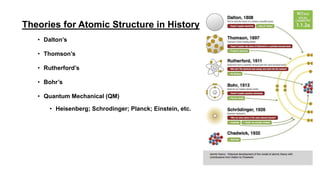
Theories for Atomic Structure in History
• Dalton’s
• Thomson’s
• Rutherford’s
• Bohr’s
• Quantum Mechanical (QM)
• Heisenberg; Schrodinger; Planck; Einstein, etc.
• All matter is made of atoms. Atoms are indivisible and indestructible.
• All atoms of a given element are identical in mass and properties; atoms of different elements are
different from each other.
• Compounds are formed by a combination of two or more different kinds of atoms in simple whole
number ratios.
• A chemical reaction is a rearrangement of atoms.
Postulates:
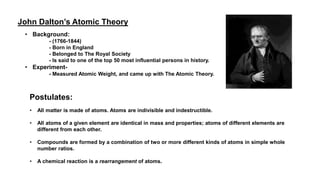
John Dalton’s Atomic Theory
• Background:
- (1766-1844)
- Born in England
- Belonged to The Royal Society
- Is said to one of the top 50 most influential persons in history.
• Experiment-
- Measured Atomic Weight, and came up with The Atomic Theory.
Limitations of Dalton’s Atomic Theory
• It was proved that an atom is not indivisible. As an atom can be subdivided into electrons, protons and
neutrons.
• According to Dalton Atomic Theory, atoms of an element are identical in mass, size and many other
chemical or physical properties. But, practically we observe that atoms of several elements differ in
their densities and masses. These atoms with the different masses are known as isotopes. For
example, Chlorine (Cl) has 2 isotopes with the mass numbers of 35 and 37.
• According to Dalton Atomic Theory, when atoms of different elements (atoms of two or more elements)
combine in simple whole number ratios, we get chemical compounds. But this is not true in case of
complex organic compounds. For example, sucrose (C12H22O11)
Earnest Rutherford’s Atomic Theory
• Background:
- (1871-1937)
- Born In New Zealand
- Nobel prize in Chemistry - 1908
- Knighted – 1914
- Rutherfordium (Rf) was named after him
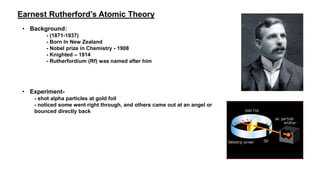
• Experiment-
- shot alpha particles at gold foil
- noticed some went right through, and others came out at an angel or
bounced directly back
Earnest Rutherford’s Atomic Theory
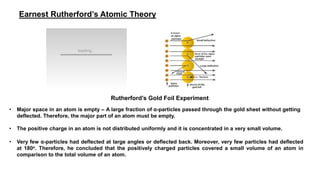
Rutherford’s Gold Foil Experiment
• Very few α-particles had deflected at large angles or deflected back. Moreover, very few particles had deflected
at 180o. Therefore, he concluded that the positively charged particles covered a small volume of an atom in
comparison to the total volume of an atom.
• Major space in an atom is empty – A large fraction of α-particles passed through the gold sheet without getting
deflected. Therefore, the major part of an atom must be empty.
• The positive charge in an atom is not distributed uniformly and it is concentrated in a very small volume.
Earnest Rutherford’s Atomic Theory
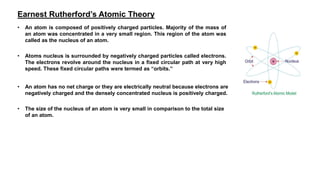
• An atom is composed of positively charged particles. Majority of the mass of
an atom was concentrated in a very small region. This region of the atom was
called as the nucleus of an atom.
• Atoms nucleus is surrounded by negatively charged particles called electrons.
The electrons revolve around the nucleus in a fixed circular path at very high
speed. These fixed circular paths were termed as “orbits.”
• An atom has no net charge or they are electrically neutral because electrons are
negatively charged and the densely concentrated nucleus is positively charged.
• The size of the nucleus of an atom is very small in comparison to the total size
of an atom.
Limitations of Rutherford Atomic Model
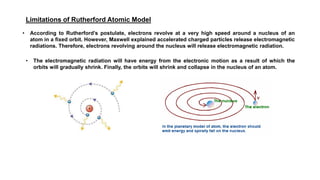
• According to Rutherford’s postulate, electrons revolve at a very high speed around a nucleus of an
atom in a fixed orbit. However, Maxwell explained accelerated charged particles release electromagnetic
radiations. Therefore, electrons revolving around the nucleus will release electromagnetic radiation.
• The electromagnetic radiation will have energy from the electronic motion as a result of which the
orbits will gradually shrink. Finally, the orbits will shrink and collapse in the nucleus of an atom.
Niels Bohr’s Atomic Theory
• Background:
- (1885-1962)
- Born In Denmark
- Nobel prize in Physics - 1922
- Founded the Institute of Theoretical Physics - 1920
- Introduced The Quantum Theory
Bohr’s postulates
• In an atom, electrons revolve around the positively charged nucleus in a definite
circular path called as orbits or shells.
• The angular momentum of an electron revolving around the nucleus in an orbit
is integer multiple of h/2π.
mvr = nh/2π n = 1, 2, 3, 4, ……
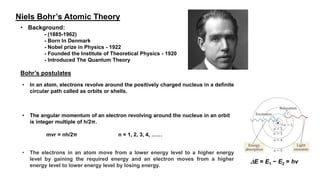
• The electrons in an atom move from a lower energy level to a higher energy
level by gaining the required energy and an electron moves from a higher
energy level to lower energy level by losing energy.
E = E1 − E2 = hν
Niels Bohr’s Atomic Theory
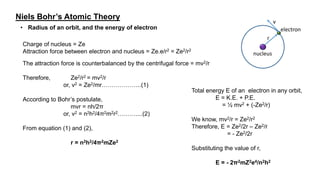
• Radius of an orbit, and the energy of electron
r
v
nucleus
electron
Charge of nucleus = Ze
Attraction force between electron and nucleus = Ze.e/r2 = Ze2/r2
The attraction force is counterbalanced by the centrifugal force = mv2/r
Therefore, Ze2/r2 = mv2/r
or, v2 = Ze2/mr………………..(1)
According to Bohr’s postulate,
mvr = nh/2π
or, v2 = n2h2/4π2m2r2………....(2)
From equation (1) and (2),
r = n2h2/4π2mZe2
Total energy E of an electron in any orbit,
E = K.E. + P.E.
= ½ mv2 + (-Ze2/r)
We know, mv2/r = Ze2/r2
Therefore, E = Ze2/2r – Ze2/r
= - Ze2/2r
Substituting the value of r,
E = - 2π2mZ2e4/n2h2
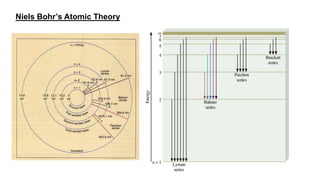
Niels Bohr’s Atomic Theory
Limitations of Bohr’s Atomic Theory
• It could not explain the spectra obtained from larger atoms.
• It violates the Heisenberg Uncertainty Principle.
• Failed to explain the Zeeman Effect (effect of magnetic field on the spectra of atoms) and Stark effect
(effect of electric field on the spectra of atoms).
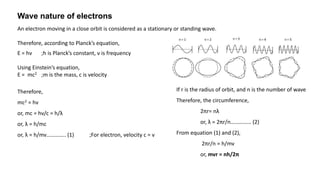
Wave nature of electrons
An electron moving in a close orbit is considered as a stationary or standing wave.
Therefore, according to Planck’s equation,
E = hν ;h is Planck’s constant, ν is frequency
Using Einstein’s equation,
E = mc2 ;m is the mass, c is velocity
Therefore,
mc2 = hν
or, mc = hν/c = h/λ
or, λ = h/mc
or, λ = h/mv………….. (1) ;For electron, velocity c = v
If r is the radius of orbit, and n is the number of wave
Therefore, the circumference,
2πr= nλ
or, λ = 2πr/n…………… (2)
From equation (1) and (2),
2πr/n = h/mv
or, mvr = nh/2π
Quantum Mechanical Model of Atomic Structure
• De Broglie: suggested that electrons have characteristics similar to those of waves.
• The Heisenberg Uncertainty Principle: it is impossible to precisely know both the
position and velocity of electron at the same time.
• The Schrödinger Wave Equation: the atomic model in which electrons are treated
as waves is known as the wave mechanical model or the quantum mechanical model
of the atom
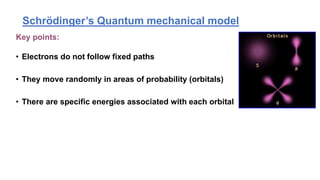
Schrödinger’s Quantum mechanical model
Key points:
• Electrons do not follow fixed paths
• They move randomly in areas of probability (orbitals)
• There are specific energies associated with each orbital
Quantum mechanical model
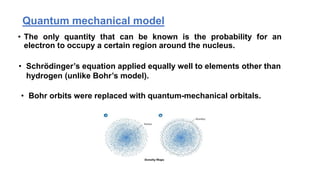
• The only quantity that can be known is the probability for an
electron to occupy a certain region around the nucleus.
• Schrödinger’s equation applied equally well to elements other than
hydrogen (unlike Bohr’s model).
• Bohr orbits were replaced with quantum-mechanical orbitals.
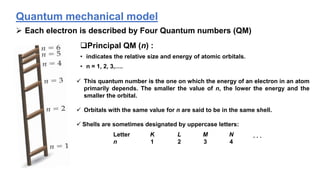
Principal QM (n) :
• indicates the relative size and energy of atomic orbitals.
• n = 1, 2, 3,….
Quantum mechanical model
 Each electron is described by Four Quantum numbers (QM)
 This quantum number is the one on which the energy of an electron in an atom
primarily depends. The smaller the value of n, the lower the energy and the
smaller the orbital.
 Orbitals with the same value for n are said to be in the same shell.
 Shells are sometimes designated by uppercase letters:
Letter
n
K
1
L
2
M
3
N
4
. . .
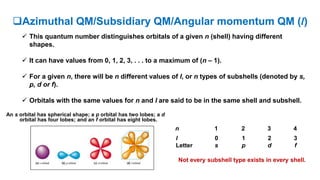
An s orbital has spherical shape; a p orbital has two lobes; a d
orbital has four lobes; and an f orbital has eight lobes.
Azimuthal QM/Subsidiary QM/Angular momentum QM (l)
 This quantum number distinguishes orbitals of a given n (shell) having different
shapes.
 It can have values from 0, 1, 2, 3, . . . to a maximum of (n – 1).
 For a given n, there will be n different values of l, or n types of subshells (denoted by s,
p, d or f).
 Orbitals with the same values for n and l are said to be in the same shell and subshell.
l
Letter
0
s
1
p
2
d
3
f
n 1 2 3 4
Not every subshell type exists in every shell.
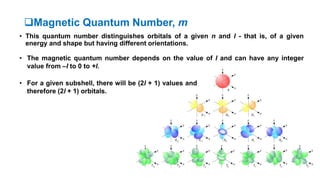
• This quantum number distinguishes orbitals of a given n and l - that is, of a given
energy and shape but having different orientations.
Magnetic Quantum Number, m
• The magnetic quantum number depends on the value of l and can have any integer
value from –l to 0 to +l.
• For a given subshell, there will be (2l + 1) values and
therefore (2l + 1) orbitals.
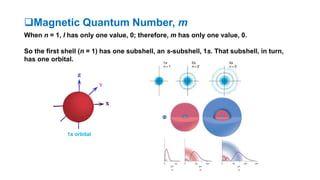
Magnetic Quantum Number, m
When n = 1, l has only one value, 0; therefore, m has only one value, 0.
So the first shell (n = 1) has one subshell, an s-subshell, 1s. That subshell, in turn,
has one orbital.
1s orbital
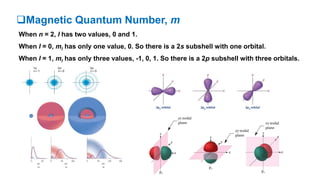
When n = 2, l has two values, 0 and 1.
Magnetic Quantum Number, m
When l = 0, ml has only one value, 0. So there is a 2s subshell with one orbital.
When l = 1, ml has only three values, -1, 0, 1. So there is a 2p subshell with three orbitals.
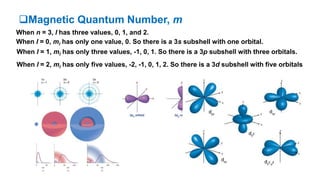
When n = 3, l has three values, 0, 1, and 2.
Magnetic Quantum Number, m
When l = 0, ml has only one value, 0. So there is a 3s subshell with one orbital.
When l = 2, ml has only five values, -2, -1, 0, 1, 2. So there is a 3d subshell with five orbitals
When l = 1, ml has only three values, -1, 0, 1. So there is a 3p subshell with three orbitals.
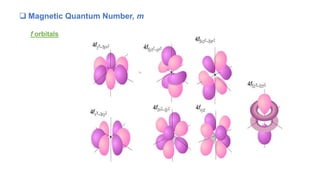
 Magnetic Quantum Number, m
f orbitals
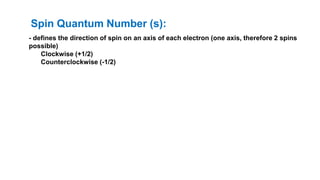
- defines the direction of spin on an axis of each electron (one axis, therefore 2 spins
possible)
Clockwise (+1/2)
Counterclockwise (-1/2)
Spin Quantum Number (s):
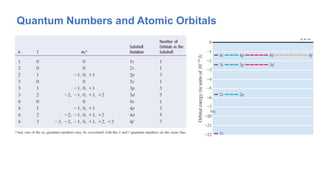
Quantum Numbers and Atomic Orbitals
Subshell arrangement
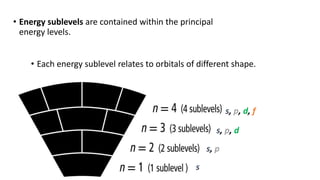
• Energy sublevels are contained within the principal
energy levels.
• Each energy sublevel relates to orbitals of different shape.
s
s, p
s, p, d
s, p, d, f
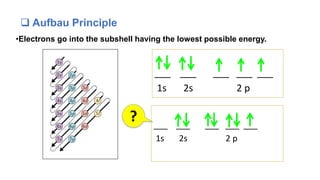
 Aufbau Principle
•Electrons go into the subshell having the lowest possible energy.
___ ___ ___ ___ ___
1s 2s 2 p
___ ___ ___ ___ ___
1s 2s 2 p
?
Exceptions to the Aufbau Rule
Cr [Ar] 3 d44s2 Cu [Ar] 3 d94s2
However, the actual electron configuration, determined
experimentally, are:
Cr [Ar] 3d54s1 Cu [Ar] 3d104s1
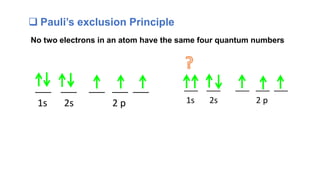
 Pauli’s exclusion Principle
No two electrons in an atom have the same four quantum numbers
___ ___ ___ ___ ___
1s 2s 2 p
___ ___ ___ ___ ___
1s 2s 2 p
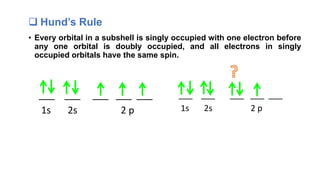
 Hund’s Rule
• Every orbital in a subshell is singly occupied with one electron before
any one orbital is doubly occupied, and all electrons in singly
occupied orbitals have the same spin.
___ ___ ___ ___ ___
1s 2s 2 p
___ ___ ___ ___ ___
1s 2s 2 p

Atomic Structures - Dr. Mahbub.pptx

  • 1.
    Atomic Structure The contentsof this presentation is made to give a brief idea about the topic, details will be discussed in the classes. Contents have been collected from multiple textbooks and internet. Dr. Md. Mahbub Alam Department of Chemistry BUET, Dhaka-1000
  • 2.
    Theories for AtomicStructure in History • Dalton’s • Thomson’s • Rutherford’s • Bohr’s • Quantum Mechanical (QM) • Heisenberg; Schrodinger; Planck; Einstein, etc.
  • 3.
    • All matteris made of atoms. Atoms are indivisible and indestructible. • All atoms of a given element are identical in mass and properties; atoms of different elements are different from each other. • Compounds are formed by a combination of two or more different kinds of atoms in simple whole number ratios. • A chemical reaction is a rearrangement of atoms. Postulates: John Dalton’s Atomic Theory • Background: - (1766-1844) - Born in England - Belonged to The Royal Society - Is said to one of the top 50 most influential persons in history. • Experiment- - Measured Atomic Weight, and came up with The Atomic Theory.
  • 4.
    Limitations of Dalton’sAtomic Theory • It was proved that an atom is not indivisible. As an atom can be subdivided into electrons, protons and neutrons. • According to Dalton Atomic Theory, atoms of an element are identical in mass, size and many other chemical or physical properties. But, practically we observe that atoms of several elements differ in their densities and masses. These atoms with the different masses are known as isotopes. For example, Chlorine (Cl) has 2 isotopes with the mass numbers of 35 and 37. • According to Dalton Atomic Theory, when atoms of different elements (atoms of two or more elements) combine in simple whole number ratios, we get chemical compounds. But this is not true in case of complex organic compounds. For example, sucrose (C12H22O11)
  • 5.
    Earnest Rutherford’s AtomicTheory • Background: - (1871-1937) - Born In New Zealand - Nobel prize in Chemistry - 1908 - Knighted – 1914 - Rutherfordium (Rf) was named after him • Experiment- - shot alpha particles at gold foil - noticed some went right through, and others came out at an angel or bounced directly back
  • 6.
    Earnest Rutherford’s AtomicTheory Rutherford’s Gold Foil Experiment • Very few α-particles had deflected at large angles or deflected back. Moreover, very few particles had deflected at 180o. Therefore, he concluded that the positively charged particles covered a small volume of an atom in comparison to the total volume of an atom. • Major space in an atom is empty – A large fraction of α-particles passed through the gold sheet without getting deflected. Therefore, the major part of an atom must be empty. • The positive charge in an atom is not distributed uniformly and it is concentrated in a very small volume.
  • 7.
    Earnest Rutherford’s AtomicTheory • An atom is composed of positively charged particles. Majority of the mass of an atom was concentrated in a very small region. This region of the atom was called as the nucleus of an atom. • Atoms nucleus is surrounded by negatively charged particles called electrons. The electrons revolve around the nucleus in a fixed circular path at very high speed. These fixed circular paths were termed as “orbits.” • An atom has no net charge or they are electrically neutral because electrons are negatively charged and the densely concentrated nucleus is positively charged. • The size of the nucleus of an atom is very small in comparison to the total size of an atom.
  • 8.
    Limitations of RutherfordAtomic Model • According to Rutherford’s postulate, electrons revolve at a very high speed around a nucleus of an atom in a fixed orbit. However, Maxwell explained accelerated charged particles release electromagnetic radiations. Therefore, electrons revolving around the nucleus will release electromagnetic radiation. • The electromagnetic radiation will have energy from the electronic motion as a result of which the orbits will gradually shrink. Finally, the orbits will shrink and collapse in the nucleus of an atom.
  • 9.
    Niels Bohr’s AtomicTheory • Background: - (1885-1962) - Born In Denmark - Nobel prize in Physics - 1922 - Founded the Institute of Theoretical Physics - 1920 - Introduced The Quantum Theory Bohr’s postulates • In an atom, electrons revolve around the positively charged nucleus in a definite circular path called as orbits or shells. • The angular momentum of an electron revolving around the nucleus in an orbit is integer multiple of h/2π. mvr = nh/2π n = 1, 2, 3, 4, …… • The electrons in an atom move from a lower energy level to a higher energy level by gaining the required energy and an electron moves from a higher energy level to lower energy level by losing energy. E = E1 − E2 = hν
  • 10.
    Niels Bohr’s AtomicTheory • Radius of an orbit, and the energy of electron r v nucleus electron Charge of nucleus = Ze Attraction force between electron and nucleus = Ze.e/r2 = Ze2/r2 The attraction force is counterbalanced by the centrifugal force = mv2/r Therefore, Ze2/r2 = mv2/r or, v2 = Ze2/mr………………..(1) According to Bohr’s postulate, mvr = nh/2π or, v2 = n2h2/4π2m2r2………....(2) From equation (1) and (2), r = n2h2/4π2mZe2 Total energy E of an electron in any orbit, E = K.E. + P.E. = ½ mv2 + (-Ze2/r) We know, mv2/r = Ze2/r2 Therefore, E = Ze2/2r – Ze2/r = - Ze2/2r Substituting the value of r, E = - 2π2mZ2e4/n2h2
  • 11.
  • 12.
    Limitations of Bohr’sAtomic Theory • It could not explain the spectra obtained from larger atoms. • It violates the Heisenberg Uncertainty Principle. • Failed to explain the Zeeman Effect (effect of magnetic field on the spectra of atoms) and Stark effect (effect of electric field on the spectra of atoms).
  • 13.
    Wave nature ofelectrons An electron moving in a close orbit is considered as a stationary or standing wave. Therefore, according to Planck’s equation, E = hν ;h is Planck’s constant, ν is frequency Using Einstein’s equation, E = mc2 ;m is the mass, c is velocity Therefore, mc2 = hν or, mc = hν/c = h/λ or, λ = h/mc or, λ = h/mv………….. (1) ;For electron, velocity c = v If r is the radius of orbit, and n is the number of wave Therefore, the circumference, 2πr= nλ or, λ = 2πr/n…………… (2) From equation (1) and (2), 2πr/n = h/mv or, mvr = nh/2π
  • 14.
    Quantum Mechanical Modelof Atomic Structure • De Broglie: suggested that electrons have characteristics similar to those of waves. • The Heisenberg Uncertainty Principle: it is impossible to precisely know both the position and velocity of electron at the same time. • The Schrödinger Wave Equation: the atomic model in which electrons are treated as waves is known as the wave mechanical model or the quantum mechanical model of the atom
  • 15.
    Schrödinger’s Quantum mechanicalmodel Key points: • Electrons do not follow fixed paths • They move randomly in areas of probability (orbitals) • There are specific energies associated with each orbital
  • 16.
    Quantum mechanical model •The only quantity that can be known is the probability for an electron to occupy a certain region around the nucleus. • Schrödinger’s equation applied equally well to elements other than hydrogen (unlike Bohr’s model). • Bohr orbits were replaced with quantum-mechanical orbitals.
  • 17.
    Principal QM (n): • indicates the relative size and energy of atomic orbitals. • n = 1, 2, 3,…. Quantum mechanical model  Each electron is described by Four Quantum numbers (QM)  This quantum number is the one on which the energy of an electron in an atom primarily depends. The smaller the value of n, the lower the energy and the smaller the orbital.  Orbitals with the same value for n are said to be in the same shell.  Shells are sometimes designated by uppercase letters: Letter n K 1 L 2 M 3 N 4 . . .
  • 18.
    An s orbitalhas spherical shape; a p orbital has two lobes; a d orbital has four lobes; and an f orbital has eight lobes. Azimuthal QM/Subsidiary QM/Angular momentum QM (l)  This quantum number distinguishes orbitals of a given n (shell) having different shapes.  It can have values from 0, 1, 2, 3, . . . to a maximum of (n – 1).  For a given n, there will be n different values of l, or n types of subshells (denoted by s, p, d or f).  Orbitals with the same values for n and l are said to be in the same shell and subshell. l Letter 0 s 1 p 2 d 3 f n 1 2 3 4 Not every subshell type exists in every shell.
  • 19.
    • This quantumnumber distinguishes orbitals of a given n and l - that is, of a given energy and shape but having different orientations. Magnetic Quantum Number, m • The magnetic quantum number depends on the value of l and can have any integer value from –l to 0 to +l. • For a given subshell, there will be (2l + 1) values and therefore (2l + 1) orbitals.
  • 20.
    Magnetic Quantum Number,m When n = 1, l has only one value, 0; therefore, m has only one value, 0. So the first shell (n = 1) has one subshell, an s-subshell, 1s. That subshell, in turn, has one orbital. 1s orbital
  • 21.
    When n =2, l has two values, 0 and 1. Magnetic Quantum Number, m When l = 0, ml has only one value, 0. So there is a 2s subshell with one orbital. When l = 1, ml has only three values, -1, 0, 1. So there is a 2p subshell with three orbitals.
  • 22.
    When n =3, l has three values, 0, 1, and 2. Magnetic Quantum Number, m When l = 0, ml has only one value, 0. So there is a 3s subshell with one orbital. When l = 2, ml has only five values, -2, -1, 0, 1, 2. So there is a 3d subshell with five orbitals When l = 1, ml has only three values, -1, 0, 1. So there is a 3p subshell with three orbitals.
  • 23.
     Magnetic QuantumNumber, m f orbitals
  • 24.
    - defines thedirection of spin on an axis of each electron (one axis, therefore 2 spins possible) Clockwise (+1/2) Counterclockwise (-1/2) Spin Quantum Number (s):
  • 25.
    Quantum Numbers andAtomic Orbitals
  • 26.
  • 27.
    • Energy sublevelsare contained within the principal energy levels. • Each energy sublevel relates to orbitals of different shape. s s, p s, p, d s, p, d, f
  • 28.
     Aufbau Principle •Electronsgo into the subshell having the lowest possible energy. ___ ___ ___ ___ ___ 1s 2s 2 p ___ ___ ___ ___ ___ 1s 2s 2 p ?
  • 29.
    Exceptions to theAufbau Rule Cr [Ar] 3 d44s2 Cu [Ar] 3 d94s2 However, the actual electron configuration, determined experimentally, are: Cr [Ar] 3d54s1 Cu [Ar] 3d104s1
  • 30.
     Pauli’s exclusionPrinciple No two electrons in an atom have the same four quantum numbers ___ ___ ___ ___ ___ 1s 2s 2 p ___ ___ ___ ___ ___ 1s 2s 2 p
  • 31.
     Hund’s Rule •Every orbital in a subshell is singly occupied with one electron before any one orbital is doubly occupied, and all electrons in singly occupied orbitals have the same spin. ___ ___ ___ ___ ___ 1s 2s 2 p ___ ___ ___ ___ ___ 1s 2s 2 p