Presentation Plus! Glencoe World Geography
Copyright © by The McGraw–Hill Companies, Inc.
Developed by FSCreations, Inc., Cincinnati, Ohio 45202
Send all inquiries to:
GLENCOE DIVISION
Glencoe/McGraw–Hill
8787 Orion Place
Columbus, Ohio 43240
Chapter Introduction
Section 1 Exploring Geography
Section 2 The Geographer’s Craft
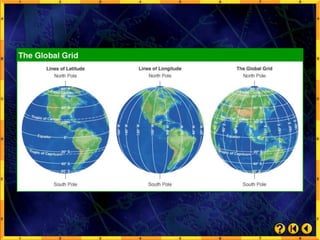
Chapter Summary & Study Guide
Chapter Assessment
Click on a hyperlink to view the corresponding slides.
Chapter Objectives
• Describe the elements of geography
and the topics geographers study. 
• Identify the tools and applications of
geography and its relationship to other
fields of study.
Click the mouse button or press the
Space Bar to display the information.
Write a journal entry describing the part
of the world in which you live–its physical
features, plant and animal life, and people.
Think about how your observations are
similar to and different from the ways a
geographer looks at the world.
Exploring Geography
• Describe the physical and human features
that geographers study. 
• Discuss how geography is used.
Objectives
Click the mouse button or press the
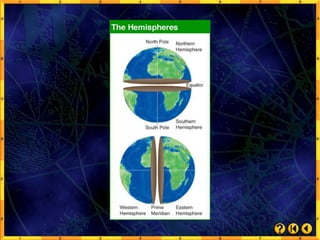
Space Bar to display the information.
• Explain how geographers describe the
earth’s features and their patterns. 
Click the mouse button or press the
Space Bar to display the information.
Terms to Know
Exploring Geography
• absolute location 
• hemisphere 
• grid system 
• relative location 
• place 
• region 
• formal region 
• functional region 
• perceptual region 
• ecosystem 
• movement 
• human-environment
interaction
• location 
Click the mouse button or press the
Space Bar to display the information.
• North Pole 
• South Pole 
• Prime Meridian
• Equator 
Places to Locate
Exploring Geography
Click the Speaker button
to listen to the audio again.
One of the major goals of ancient
geographers was to measure the size
and shape of Earth. The appearance
of Earth’s shadow on the eclipsing moon
proved to most people that Earth was
spherical. In the 200s B.C. Greek
geographer Eratosthenes used angles
of the sun over a specific distance to
calculate the circumference of Earth.
His estimate was off by only a few
hundred miles.
The Elements of Geography
• Geographers are specialists who
describe Earth’s physical and human
features and the interactions of people,
places, and environments.
(pages 19–20)
List some of the tools geographers
might use to describe the features of
Earth and the relationships between
them.
Geographers might use maps, atlases,
charts, measuring devices,
thermometers, and barometers to
describe the features of Earth and the
relationships between them.
Click the mouse button or press the
Space Bar to display the answer.
The Elements of Geography (cont.)
(pages 19–20)
• Absolute location The exact latitude
and longitude at which a place is found
on the globe is its absolute location. 
Click the mouse button or press the
Space Bar to display the information.
The World in Spatial Terms
Spatial relations means “relations in
space”: how places, people, and features
of the earth are connected because of
their locations. 
• Relative location Relative location
describes a place’s location in relation to
another place.
(pages 20–21)
When is it useful to know the absolute
location of a place? When is it useful to
know its relative location?
Absolute location is useful for a team of
explorers trying to find a ship that had
sunk, like the Titanic, for example.
Relative location is useful for giving
directions to travelers.
The World in Spatial Terms (cont.)
Click the mouse button or press the
Space Bar to display the answer.
(pages 20–21)
Click the mouse button or press the
Space Bar to display the information.
Places and Regions
• A region, larger than a place, is a group
of places that are united by shared
characteristics. 
• A formal region, or uniform region, is an
area defined by a common characteristic.
• A place is a particular space on Earth
with physical and human meaning. 
(page 21)
Click the mouse button or press the
Space Bar to display the information.
Places and Regions (cont.)
• A perceptual region is defined by
popular feelings and images rather than
by objective data.
• A functional region is a central place
and the outlying areas linked to it by
transit systems, for example. 
(page 21)
Give some examples of a place, a
uniform region, a functional region,
and a perceptual region.
Possible answer: The city of Philadelphia
is a place. The Pennsylvania anthracite
coal region is a uniform region. The
Delaware Valley is a functional region.
Pennsylvania–the Keystone State–is a
perceptual region.
Places and Regions (cont.)
Click the mouse button or press the
Space Bar to display the answer.
(page 21)
Physical Systems
• Physical systems–volcanoes, floods, and
hurricanes–shape the earth’s surface.
(pages 21–22)
What kinds of physical systems have
shaped the earth in the region where
you live?
Possible answers: Tornadoes, floods,
erosion, glaciation, hurricanes,
earthquakes, and volcanoes have
shaped the region.
Physical Systems (cont.)
Click the mouse button or press the
Space Bar to display the answer.
(pages 21–22)
Click the mouse button or press the
Space Bar to display the information.
Human Systems
• People affect the earth by settling it,
forming societies, and migrating. 
• People also move goods and ideas
to new places.
(page 22)
What historical movements of people and
ideas have changed the United States?
Possible answer: Native American societies
were greatly changed when Europeans began
to settle North and South America. Forced
migration of African Americans, waves of
European immigrants in the late 1800s, the
westward movement across North America,
legal and illegal immigrants from Latin
America, and Asian immigration following the
Vietnam War have also changed the United
States.
Human Systems (cont.)
Click the mouse button or press the
Space Bar to display the answer.
(page 22)
• People affect the environment by clearing
or planting forests, building industries
and cities, and hunting animals. 
• Features of the environment such as
mountain ranges and deserts often pose
barriers to human migration.
Click the mouse button or press the
Space Bar to display the information.
Environment and Society
(page 22)
How can people overcome the physical
obstacles of their environment?
People can fly planes over mountain
ranges. They can build tunnels through
mountains for roads or railroads. They
can clear paths and build roads
through forests. They can build
bridges, dams, and canals.
Environment and Society (cont.)
Click the mouse button or press the
Space Bar to display the answer.
(page 22)
The Uses of Geography
• Geographers provide important
information about the planet’s physical
features and processes, living things,
and human systems. Such information
describes the planet and contributes to
planning for future needs.
(page 22)
What can a geographer tell you about
your environment?
Possible answers: Geographers can
describe a place’s land [flat, mountainous]
and water [salt or fresh]. They can also give
the distances between all the places in a
region, and can describe the temperatures
and precipitation levels at different seasons
of the year. Geographers can also interpret
population patterns and explain cultural
relationships.
The Uses of Geography (cont.)
Click the mouse button or press the
Space Bar to display the answer.
(page 22)
Checking for Understanding
__ 1. the study of human activities
and their relationship to the
cultural and physical
environments
__ 2. a particular space with physical
and human meaning
__ 3. the exact position of a place on
the earth’s surface
__ 4. the complex community of
interdependent living things in a
given environment
__ 5. ongoing movement of people,
goods, and ideas
A. location
B. absolute location
C. hemisphere
D. grid system
E. relative location
F. place
G. region
H. formal region
I. functional region
J. perceptual region
K. ecosystem
L. movement
M. human
environment
interaction
Define Match each definition in the left column with the
appropriate term in the right column.
M
F
B
K
L
Click the mouse button or press the
Space Bar to display the answers.
Checking for Understanding
__ 6. half of a sphere or globe, as in
the earth’s Northern and
Southern Hemispheres
__ 7. a region defined by popular
feelings and images rather than
by objective data
__ 8. a central point and the
surrounding territory linked to it
__ 9. a specific place on the earth
__ 10. a region defined by a common
characteristic, such as
production of a product
Define Match each definition in the left column with the
appropriate term in the right column.
Click the mouse button or press the
Space Bar to display the answers.
A. location
B. absolute location
C. hemisphere
D. grid system
E. relative location
F. place
G. region
H. formal region
I. functional region
J. perceptual region
K. ecosystem
L. movement
M. human
environment
interaction
C
J
I
A
H
Checking for Understanding
__ 11. pattern formed as the lines of
latitude and longitude cross one
another
__ 12. place united by specific
characteristics
__ 13. location in relation to other
places
Click the mouse button or press the
Space Bar to display the answers.
Define Match each definition in the left column with the
appropriate term in the right column.
A. location
B. absolute location
C. hemisphere
D. grid system
E. relative location
F. place
G. region
H. formal region
I. functional region
J. perceptual region
K. ecosystem
L. movement
M. human
environment
interaction
D
G
E
Critical Thinking
Categorizing Information Consider the
physical and human factors that constitute
a region. Identify the differences among
formal, functional, and perceptual regions.
A formal region is defined by a common
feature. A functional region is a central place
and its surroundings. A perceptual region is
defined by an image.
Click the mouse button or press the
Space Bar to display the answer.
Click the mouse button or press the
Space Bar to display the answer.
Critical Thinking
Drawing Conclusions How might
geographers’ knowledge of human systems
benefit people?
Geographers’ knowledge of human systems
might lead to developing resources or
locating structures.
Click the mouse button or press the
Space Bar to display the answer.
Critical Thinking
Making Generalizations Explain how
knowing about the geography of a particular
city might influence your decision to move
there.
Knowledge of the climate, landforms,
population, or culture might influence your
decision to move to a particular city.
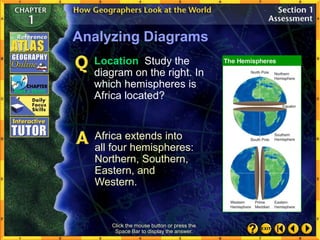
Analyzing Diagrams
Location Study the
diagram on the right. In
which hemispheres is
Africa located?
Click the mouse button or press the
Space Bar to display the answer.
Africa extends into
all four hemispheres:
Northern, Southern,
Eastern, and
Western.
Applying Geography
Relative Location Write a paragraph that
describes the relative location of your school
in at least five ways. In what instances might
relative location be more useful than absolute
location? In what instances might absolute
location be more useful?
Close
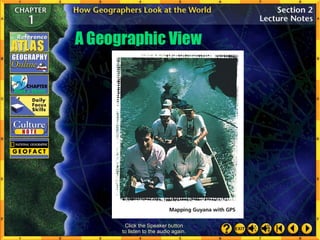
Write a paragraph to introduce geography
to younger students. Reread “A Geographic
View” on page 19 of your textbook as a model
for descriptive language that sparks interest.
The Geographer’s Craft
• Identify the major branches of geography and
the topics each branch studies. 
• Describe the research methods geographers
use. 
• Discuss the relationship of geography to other
subject areas. 
• List the kinds of geographic careers that are
available today.
Objectives
Click the mouse button or press the
Space Bar to display the information.
Click the mouse button or press the
Space Bar to display the information.
• human geography 
• meteorology 
• cartography 
• geographic information systems (GIS)
Terms to Know
• physical geography 
The Geographer’s Craft
Click the Speaker button
to listen to the audio again.
Cartography, or mapmaking, began
to develop in the Age of Exploration.
Explorers such as Christopher Columbus
and Ferdinand Magellan drew rough maps
of the lands they found across the Atlantic
Ocean. By the early 1500s, European
maps showed entire unexplored
continents between Europe and Asia.
Branches of Geography
• Human geography, or cultural
geography, studies human activities
and their relationship to the
environment.
• Physical geography focuses on the
study of Earth’s physical features. 
Click the mouse button or press the
Space Bar to display the information.
(pages 23–24)
What kinds of questions would you ask a
physical geographer? A cultural geographer?
Sample questions:
Physical: Where are the world’s tallest
mountains?
Cultural: Which languages are most
commonly spoken worldwide?
Record your questions and look for
answers as you study various world
regions.
Click the mouse button or press the
Space Bar to display the answer.
Branches of Geography (cont.)
(pages 23–24)
Click the mouse button or press the
Space Bar to display the information.
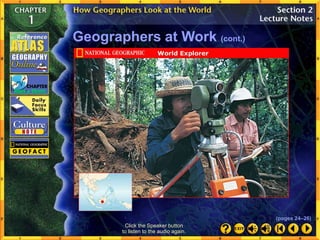
Geographers at Work
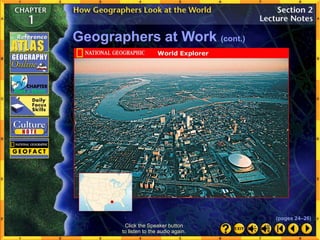
• Sometimes geographers rely on aerial
or satellite photographs. 
• Mapping Cartographers are people
who design and make maps–graphic
representations of places and regions
and more complicated information about
the relationships of people, places, and
things.
• Direct Observation Going to a
geographic location to see what it
is like is direct observation. 
(pages 24–26)
Click the Speaker button
to listen to the audio again.
Geographers at Work (cont.)
(pages 24–26)
Click the mouse button or press the
Space Bar to display the information.
Geographers at Work (cont.)
• Statistics Geographers use statistics
to present data, find patterns, and study
populations.
• Interviewing Cultural geographers often
interview the people whose activities they
study. 
(pages 24–26)
Click the Speaker button
to listen to the audio again.
Geographers at Work (cont.)
(pages 24–26)
Geographers at Work (cont.)
• Technology Geographers use
advanced technology–satellite photos,
radar, and geographic information
systems (GIS)–to study the
environment, the weather, and human
settlement patterns.
(pages 24–26)
Why do geographers often rely on maps
rather than on verbal descriptions?
Geographers rely on maps because
they can show a great deal of
information quickly. For example, maps
may show relative distances, elevation,
crops, population, and resources at a
glance. Verbal descriptions take much
longer to read.
Geographers at Work (cont.)
Click the mouse button or press the
Space Bar to display the answer.
(pages 24–26)
Click the mouse button or press the
Space Bar to display the information.
Geography and Other Disciplines
• Culture Human geographers study
sociology and anthropology to learn how
people have interacted with their
environment over time.
• History and Government Geographers
study history and government to
understand changes that have taken
place over time. 
(pages 26–27)
• Economics Geographers study
economics to understand how the
location of resources affects the ways
people make, transport, and use goods
and provide services.
Geography and Other Disciplines
(cont.)
(pages 26–27)
What other areas of study might be
useful to geographers? Explain.
Possible answers: Knowledge of
biology would help a physical or
cultural geographer interested in the
environment. Knowledge of literature,
especially travel diaries and journals,
would provide eyewitness accounts of
how places looked at certain times in
history.
Click the mouse button or press the
Space Bar to display the answer.
Geography and Other Disciplines
(cont.)
(pages 26–27)
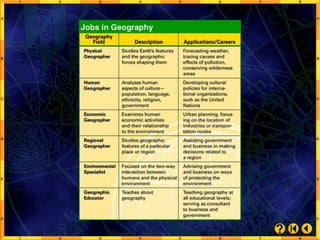
Geography as a Career
• Knowledge of geography helps people
who work in many other fields.
(page 27)
Name a job in which it would be helpful
to understand geography. Explain.
Possible answers: A travel agent
needs to inform clients about climates
and weather so they can make the
best travel plans. A director who wants
to shoot a film in the desert needs to
know what access he or she will have
to necessary supplies and housing
and to weather information.
Geography as a Career (cont.)
Click the mouse button or press the
Space Bar to display the answer.
(page 27)
Checking for Understanding
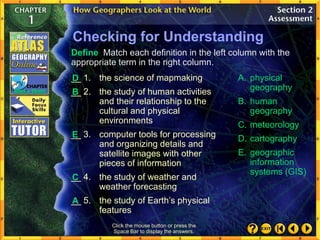
__ 1. the science of mapmaking
__ 2. the study of human activities
and their relationship to the
cultural and physical
environments
__ 3. computer tools for processing
and organizing details and
satellite images with other
pieces of information
__ 4. the study of weather and
weather forecasting
__ 5. the study of Earth’s physical
features
A. physical
geography
B. human
geography
C. meteorology
D. cartography
E. geographic
information
systems (GIS)
Define Match each definition in the left column with the
appropriate term in the right column.
Click the mouse button or press the
Space Bar to display the answers.
D
B
E
C
A
Critical Thinking
Predicting Consequences What might
happen if an economic geographer did not
interview citizens when preparing a city
transportation plan?
Click the mouse button or press the
Space Bar to display the answer.
The plan may not reflect the needs and
travel patterns of the citizens and may
be unsuccessful.
Click the mouse button or press the
Space Bar to display the answer.
Critical Thinking
Making Inferences What kinds of
geographers might be employed by
a manufacturing company?
A manufacturing company might employ
economic geographers or environmental
specialists.
Click the mouse button or press the
Space Bar to display the answer.
Critical Thinking
Making Generalizations How does the
study of other disciplines help geographers
in their work as countries become
increasingly interdependent?
Using many disciplines helps geographers
contribute effective solutions.
Analyzing Maps
Place Study the map of the United
States in the Reference Atlas on
pages RA6–RA7 of your textbook.
What kinds of information can you
learn from this map? How does the
information on this map differ from
the map on pages RA8–RA9 of your
textbook?
Applying Geography
Research Methods As a geographer
working on a plan for a new community
center, what research methods would you
use? Explain your choices in a paragraph.
Close
Write an employment ad describing your
dream job in the field of geography.
• Geographers study the earth’s physical and
human features and their interrelationships. 
• Geographers use absolute and relative
locations as reference points. 
• Geographers identify three types of regions–
formal, functional, and perceptual. 
• Geography contributes knowledge about the
relationships among human activities, the
earth’s physical systems, and the environment
in order to develop a better future.
Key Points
Click the mouse button or press the
Space Bar to display the information.
Section 1: Exploring Geography
(pages 19–22)
• Geographers use special research skills, such
as direct observation, mapping, interviewing,
statistics, and technology. 
• Studying other social sciences helps
geographers analyze the patterns and
relationships among these different fields. 
• Geographers can specialize and may work in
government, business, science, planning, or
education.
Click the mouse button or press the
Space Bar to display the information.
Key Points
Section 2: The Geographer’s Craft
(pages 23–27)
Click the mouse button or press the
Space Bar to display the answers.
Reviewing Key Terms
Insert the key term that best completes each of the
following sentences.
1. Plants and animals depend on one another in a(n)
___________________.
2. Geographers use a(n) ___________________
formed by lines of latitude and longitude to
determine ___________________ .
ecosystem
grid system
absolute location
absolute location cartography
ecosystem formal region
grid system human geography
physical geography relative location
geographic information systems (GIS)
Click the mouse button or press the
Space Bar to display the answers.
Reviewing Key Terms
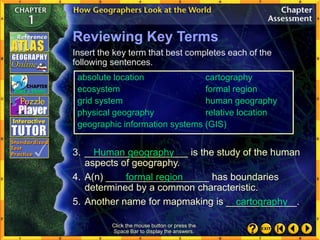
3. ___________________ is the study of the human
aspects of geography.
4. A(n) ___________________ has boundaries
determined by a common characteristic.
5. Another name for mapmaking is _____________.
formal region
cartography
Insert the key term that best completes each of the
following sentences.
Human geography
absolute location cartography
ecosystem formal region
grid system human geography
physical geography relative location
geographic information systems (GIS)
Click the mouse button or press the
Space Bar to display the answers.
Reviewing Key Terms
Insert the key term that best completes each of the
following sentences.
6. ________________ is expressed in relation to
other places.
7. Computer tools that process data and satellite
images with other pieces of geographic information
are called ________________________________.
Relative location
geographic information systems (GIS)
absolute location cartography
ecosystem formal region
grid system human geography
physical geography relative location
geographic information systems (GIS)
Click the mouse button or press the
Space Bar to display the answer.
Reviewing Key Terms
Insert the key term that best completes each of the
following sentences.
8. _________________ focuses on the study of the
earth’s physical features.
Physical geography
absolute location cartography
ecosystem formal region
grid system human geography
physical geography relative location
geographic information systems (GIS)
Click the mouse button or press the
Space Bar to display the answer.
How do geographers determine the
locations of places?
Geographers determine the location of
places by using the latitude/longitude grid
or by locating places in relation to other
places.
Reviewing Facts
Section 1: Exploring Geography
Click the mouse button or press the
Space Bar to display the answer.
What are the three types of regions
identified by geographers?
The three types of regions are formal,
functional, and perceptual regions.
Reviewing Facts
Section 1: Exploring Geography
Click the mouse button or press the
Space Bar to display the answer.
Why do geographers study human systems
and human-environment relationships?
Geographers study human systems and
human-environment relationships to
understand how the earth affects and is
affected by human activity so that informed
decisions can be made.
Reviewing Facts
Section 1: Exploring Geography
Click the mouse button or press the
Space Bar to display the answer.
What are two ways that every place on the
earth can be located?
Reviewing Facts
Section 1: Exploring Geography
The two ways every place on the earth can
be located are by describing its absolute
location or its relative location.
Click the mouse button or press the
Space Bar to display the answer.
How do physical and human geography
differ?
Physical geography is the study of the
earth’s physical features. Human
geography focuses on human activities
in relation to the physical world.
Reviewing Facts
Section 2: The Geographer’s Craft
Click the mouse button or press the
Space Bar to display the answer.
What research methods do geographers use?
Geographers use direct observation,
mapping, interviewing, statistics, and
technology as research methods.
Reviewing Facts
Section 2: The Geographer’s Craft
Click the mouse button or press the
Space Bar to display the answer.
What other subjects do geographers study?
Geographers also study history and
government, culture, and economics.
Reviewing Facts
Section 2: The Geographer’s Craft
Click the mouse button or press the
Space Bar to display the answer.
Critical Thinking
Summarizing the Main Idea How
do geographers use the elements
of geography to study the earth?
The elements of geography help
geographers organize information about
the earth and learn about geographic
events and patterns.
Click the mouse button or press the
Space Bar to display the answer.
Critical Thinking
Making Inferences What subjects might
you study in order to become an urban
planner? Explain.
Possible answer: One might study
geography, statistics, economics,
architecture, and urban design to
become an urban planner.
Critical Thinking
Predicting Consequences Consider the
many ways that technology has affected
the way people live and work. Then
imagine that you have become a
geographer of the future. How do you
think technology will change the way you
work?
Click the mouse button or press the
Space Bar to display the answers.
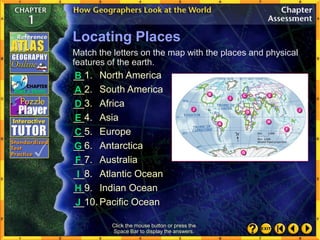
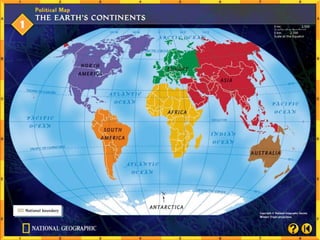
Locating Places
Match the letters on the map with the places and physical
features of the earth.
__1. North America
__2. South America
__3. Africa
__4. Asia
__5. Europe
__6. Antarctica
__7. Australia
__8. Atlantic Ocean
__9. Indian Ocean
__10. Pacific Ocean
B
A
D
E
C
G
F
I
H
J
Click the mouse button or press the
Space Bar to display the answer.
Why are international time zones
determined from the time at the Royal
Naval Observatory at Greenwich,
England (Greenwich Mean Time)?
Time zones are determined at the Royal
Naval Observatory because the Prime
Meridian passes through Greenwich.
Explore online information about the topics
introduced in this chapter.
Click on the Connect button to launch your browser and go to the
Glencoe World Geography Web site. At this site, you will find
interactive activities, current events information, and Web sites
correlated with the chapters and units in the textbook. When you
finish exploring, exit the browser program to return to this
presentation. If you experience difficulty connecting to the Web
site, manually launch your Web browser and go to
http://geography.glencoe.com
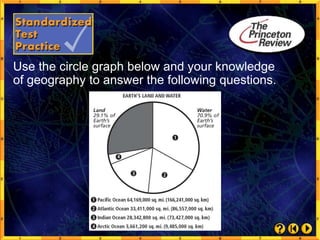
Use the circle graph below and your knowledge
of geography to answer the following questions.
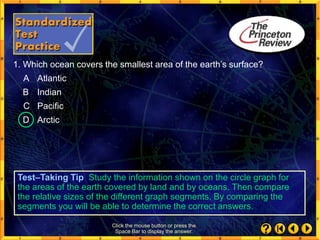
1. Which ocean covers the smallest area of the earth’s surface?
A Atlantic
B Indian
C Pacific
D Arctic
Click the mouse button or press the
Space Bar to display the answer.
Test–Taking Tip Study the information shown on the circle graph for
the areas of the earth covered by land and by oceans. Then compare
the relative sizes of the different graph segments. By comparing the
segments you will be able to determine the correct answers.
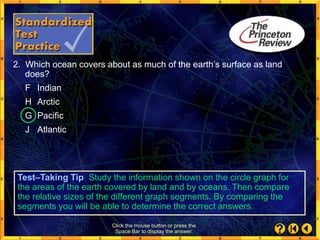
2. Which ocean covers about as much of the earth’s surface as land
does?
F Indian
H Arctic
G Pacific
J Atlantic
Click the mouse button or press the
Space Bar to display the answer.
Test–Taking Tip Study the information shown on the circle graph for
the areas of the earth covered by land and by oceans. Then compare
the relative sizes of the different graph segments. By comparing the
segments you will be able to determine the correct answers.
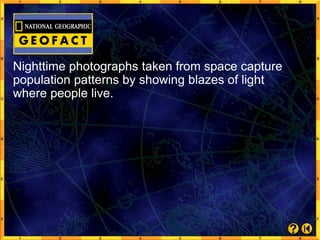
Nighttime photographs taken from space capture
population patterns by showing blazes of light
where people live.
Saving Ecosystems with Maps Scientists show
habitat loss and endangered species on color-coded
maps that can be used to convince individuals,
corporations, and politicians to support conservation
and preservation efforts.
Global Culture Music, food, and entertainment are
crossing traditional boundaries. “World Music” is a
growing musical category, and new “fusion” cuisines
blend foods from different countries.
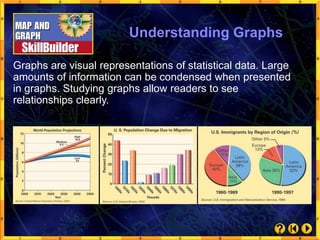
Understanding Graphs
Graphs are visual representations of statistical data. Large
amounts of information can be condensed when presented
in graphs. Studying graphs allow readers to see
relationships clearly.
Learning the Skill
The three main types of graphs present numerical information.
Line graphs record changes in data over time. The vertical axis
(y–axis) shows units of measurement, and the horizontal axis
(x–axis) shows intervals of time. Bar graphs use bars of
different lengths to compare different quantities. Circle graphs
show the relationship of parts to a whole as percentages. To
understand a graph: 
• Read the graph title to identify the subject. 
• Study the labels to understand the numerical information
presented.
Click the mouse button or press the
Space Bar to display the information.
Understanding Graphs
Learning the Skill
Click the mouse button or press the
Space Bar to display the information.
The three main types of graphs present numerical information.
Line graphs record changes in data over time. The vertical axis
(y–axis) shows units of measurement, and the horizontal axis
(x–axis) shows intervals of time. Bar graphs use bars of
different lengths to compare different quantities. Circle graphs
show the relationship of parts to a whole as percentages. To
understand a graph: 
• Study the information presented and the use of colors and
patterns. 
• Compare the lines, bars, or segments, and look for
relationships in order to draw conclusions.
Understanding Graphs
Practicing the Skill
Study the graphs to answer these questions.
1. Line graph What is the difference in population between
the low and high projections?
2. Bar graph In which decade did migration cause the least
change in population.
The difference between low and high projections is
three.
Migration caused the least change in population during the
1930s.
Click the mouse button or press the
Space Bar to display possible answers.
Understanding Graphs
Practicing the Skill
3. Circle graph What percent of immigrants to the United
States in the 1990s came from Europe?
4. What general population trends do the three graphs show?
Thirteen percent of immigrants to the United States in
the 1990s came from Europe.
Study the graphs to answer these questions.
The graphs show an increase in world population, a
growing effect of migration on population change, and
growing numbers of Asian and Latin American immigrants
to the United States.
Click the mouse button or press the
Space Bar to display possible answers.
Understanding Graphs
Charts
The Hemispheres
The Global Grid
Jobs in Geography
Click on a hyperlink to view the corresponding slide.
Click the mouse button or press the
Space Bar to display the answer.
Click the mouse button or press the
Space Bar to display the answer.
End of Custom Shows
WARNING! Do Not Remove
This slide is intentionally blank and is set to auto–advance to end custom
shows and return to the main presentation.
gwg_chapter_01 (1).ppt

gwg_chapter_01 (1).ppt

  • 1.
    Presentation Plus! GlencoeWorld Geography Copyright © by The McGraw–Hill Companies, Inc. Developed by FSCreations, Inc., Cincinnati, Ohio 45202 Send all inquiries to: GLENCOE DIVISION Glencoe/McGraw–Hill 8787 Orion Place Columbus, Ohio 43240
  • 3.
    Chapter Introduction Section 1Exploring Geography Section 2 The Geographer’s Craft Chapter Summary & Study Guide Chapter Assessment Click on a hyperlink to view the corresponding slides.
  • 5.
    Chapter Objectives • Describethe elements of geography and the topics geographers study.  • Identify the tools and applications of geography and its relationship to other fields of study. Click the mouse button or press the Space Bar to display the information.
  • 6.
    Write a journalentry describing the part of the world in which you live–its physical features, plant and animal life, and people. Think about how your observations are similar to and different from the ways a geographer looks at the world.
  • 8.
    Exploring Geography • Describethe physical and human features that geographers study.  • Discuss how geography is used. Objectives Click the mouse button or press the Space Bar to display the information. • Explain how geographers describe the earth’s features and their patterns. 
  • 9.
    Click the mousebutton or press the Space Bar to display the information. Terms to Know Exploring Geography • absolute location  • hemisphere  • grid system  • relative location  • place  • region  • formal region  • functional region  • perceptual region  • ecosystem  • movement  • human-environment interaction • location 
  • 10.
    Click the mousebutton or press the Space Bar to display the information. • North Pole  • South Pole  • Prime Meridian • Equator  Places to Locate Exploring Geography
  • 11.
    Click the Speakerbutton to listen to the audio again.
  • 12.
    One of themajor goals of ancient geographers was to measure the size and shape of Earth. The appearance of Earth’s shadow on the eclipsing moon proved to most people that Earth was spherical. In the 200s B.C. Greek geographer Eratosthenes used angles of the sun over a specific distance to calculate the circumference of Earth. His estimate was off by only a few hundred miles.
  • 13.
    The Elements ofGeography • Geographers are specialists who describe Earth’s physical and human features and the interactions of people, places, and environments. (pages 19–20)
  • 14.
    List some ofthe tools geographers might use to describe the features of Earth and the relationships between them. Geographers might use maps, atlases, charts, measuring devices, thermometers, and barometers to describe the features of Earth and the relationships between them. Click the mouse button or press the Space Bar to display the answer. The Elements of Geography (cont.) (pages 19–20)
  • 15.
    • Absolute locationThe exact latitude and longitude at which a place is found on the globe is its absolute location.  Click the mouse button or press the Space Bar to display the information. The World in Spatial Terms Spatial relations means “relations in space”: how places, people, and features of the earth are connected because of their locations.  • Relative location Relative location describes a place’s location in relation to another place. (pages 20–21)
  • 16.
    When is ituseful to know the absolute location of a place? When is it useful to know its relative location? Absolute location is useful for a team of explorers trying to find a ship that had sunk, like the Titanic, for example. Relative location is useful for giving directions to travelers. The World in Spatial Terms (cont.) Click the mouse button or press the Space Bar to display the answer. (pages 20–21)
  • 17.
    Click the mousebutton or press the Space Bar to display the information. Places and Regions • A region, larger than a place, is a group of places that are united by shared characteristics.  • A formal region, or uniform region, is an area defined by a common characteristic. • A place is a particular space on Earth with physical and human meaning.  (page 21)
  • 18.
    Click the mousebutton or press the Space Bar to display the information. Places and Regions (cont.) • A perceptual region is defined by popular feelings and images rather than by objective data. • A functional region is a central place and the outlying areas linked to it by transit systems, for example.  (page 21)
  • 19.
    Give some examplesof a place, a uniform region, a functional region, and a perceptual region. Possible answer: The city of Philadelphia is a place. The Pennsylvania anthracite coal region is a uniform region. The Delaware Valley is a functional region. Pennsylvania–the Keystone State–is a perceptual region. Places and Regions (cont.) Click the mouse button or press the Space Bar to display the answer. (page 21)
  • 20.
    Physical Systems • Physicalsystems–volcanoes, floods, and hurricanes–shape the earth’s surface. (pages 21–22)
  • 21.
    What kinds ofphysical systems have shaped the earth in the region where you live? Possible answers: Tornadoes, floods, erosion, glaciation, hurricanes, earthquakes, and volcanoes have shaped the region. Physical Systems (cont.) Click the mouse button or press the Space Bar to display the answer. (pages 21–22)
  • 22.
    Click the mousebutton or press the Space Bar to display the information. Human Systems • People affect the earth by settling it, forming societies, and migrating.  • People also move goods and ideas to new places. (page 22)
  • 23.
    What historical movementsof people and ideas have changed the United States? Possible answer: Native American societies were greatly changed when Europeans began to settle North and South America. Forced migration of African Americans, waves of European immigrants in the late 1800s, the westward movement across North America, legal and illegal immigrants from Latin America, and Asian immigration following the Vietnam War have also changed the United States. Human Systems (cont.) Click the mouse button or press the Space Bar to display the answer. (page 22)
  • 24.
    • People affectthe environment by clearing or planting forests, building industries and cities, and hunting animals.  • Features of the environment such as mountain ranges and deserts often pose barriers to human migration. Click the mouse button or press the Space Bar to display the information. Environment and Society (page 22)
  • 25.
    How can peopleovercome the physical obstacles of their environment? People can fly planes over mountain ranges. They can build tunnels through mountains for roads or railroads. They can clear paths and build roads through forests. They can build bridges, dams, and canals. Environment and Society (cont.) Click the mouse button or press the Space Bar to display the answer. (page 22)
  • 26.
    The Uses ofGeography • Geographers provide important information about the planet’s physical features and processes, living things, and human systems. Such information describes the planet and contributes to planning for future needs. (page 22)
  • 27.
    What can ageographer tell you about your environment? Possible answers: Geographers can describe a place’s land [flat, mountainous] and water [salt or fresh]. They can also give the distances between all the places in a region, and can describe the temperatures and precipitation levels at different seasons of the year. Geographers can also interpret population patterns and explain cultural relationships. The Uses of Geography (cont.) Click the mouse button or press the Space Bar to display the answer. (page 22)
  • 28.
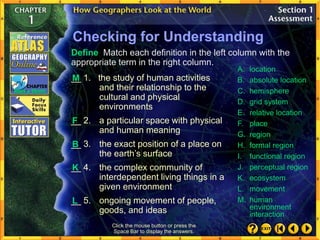
    Checking for Understanding __1. the study of human activities and their relationship to the cultural and physical environments __ 2. a particular space with physical and human meaning __ 3. the exact position of a place on the earth’s surface __ 4. the complex community of interdependent living things in a given environment __ 5. ongoing movement of people, goods, and ideas A. location B. absolute location C. hemisphere D. grid system E. relative location F. place G. region H. formal region I. functional region J. perceptual region K. ecosystem L. movement M. human environment interaction Define Match each definition in the left column with the appropriate term in the right column. M F B K L Click the mouse button or press the Space Bar to display the answers.
  • 29.
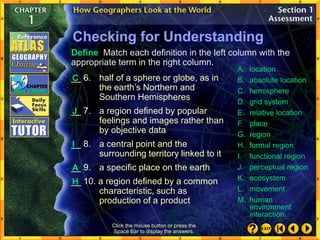
    Checking for Understanding __6. half of a sphere or globe, as in the earth’s Northern and Southern Hemispheres __ 7. a region defined by popular feelings and images rather than by objective data __ 8. a central point and the surrounding territory linked to it __ 9. a specific place on the earth __ 10. a region defined by a common characteristic, such as production of a product Define Match each definition in the left column with the appropriate term in the right column. Click the mouse button or press the Space Bar to display the answers. A. location B. absolute location C. hemisphere D. grid system E. relative location F. place G. region H. formal region I. functional region J. perceptual region K. ecosystem L. movement M. human environment interaction C J I A H
  • 30.
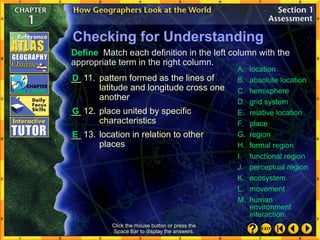
    Checking for Understanding __11. pattern formed as the lines of latitude and longitude cross one another __ 12. place united by specific characteristics __ 13. location in relation to other places Click the mouse button or press the Space Bar to display the answers. Define Match each definition in the left column with the appropriate term in the right column. A. location B. absolute location C. hemisphere D. grid system E. relative location F. place G. region H. formal region I. functional region J. perceptual region K. ecosystem L. movement M. human environment interaction D G E
  • 31.
    Critical Thinking Categorizing InformationConsider the physical and human factors that constitute a region. Identify the differences among formal, functional, and perceptual regions. A formal region is defined by a common feature. A functional region is a central place and its surroundings. A perceptual region is defined by an image. Click the mouse button or press the Space Bar to display the answer.
  • 32.
    Click the mousebutton or press the Space Bar to display the answer. Critical Thinking Drawing Conclusions How might geographers’ knowledge of human systems benefit people? Geographers’ knowledge of human systems might lead to developing resources or locating structures.
  • 33.
    Click the mousebutton or press the Space Bar to display the answer. Critical Thinking Making Generalizations Explain how knowing about the geography of a particular city might influence your decision to move there. Knowledge of the climate, landforms, population, or culture might influence your decision to move to a particular city.
  • 34.
    Analyzing Diagrams Location Studythe diagram on the right. In which hemispheres is Africa located? Click the mouse button or press the Space Bar to display the answer. Africa extends into all four hemispheres: Northern, Southern, Eastern, and Western.
  • 35.
    Applying Geography Relative LocationWrite a paragraph that describes the relative location of your school in at least five ways. In what instances might relative location be more useful than absolute location? In what instances might absolute location be more useful?
  • 36.
    Close Write a paragraphto introduce geography to younger students. Reread “A Geographic View” on page 19 of your textbook as a model for descriptive language that sparks interest.
  • 38.
    The Geographer’s Craft •Identify the major branches of geography and the topics each branch studies.  • Describe the research methods geographers use.  • Discuss the relationship of geography to other subject areas.  • List the kinds of geographic careers that are available today. Objectives Click the mouse button or press the Space Bar to display the information.
  • 39.
    Click the mousebutton or press the Space Bar to display the information. • human geography  • meteorology  • cartography  • geographic information systems (GIS) Terms to Know • physical geography  The Geographer’s Craft
  • 40.
    Click the Speakerbutton to listen to the audio again.
  • 41.
    Cartography, or mapmaking,began to develop in the Age of Exploration. Explorers such as Christopher Columbus and Ferdinand Magellan drew rough maps of the lands they found across the Atlantic Ocean. By the early 1500s, European maps showed entire unexplored continents between Europe and Asia.
  • 42.
    Branches of Geography •Human geography, or cultural geography, studies human activities and their relationship to the environment. • Physical geography focuses on the study of Earth’s physical features.  Click the mouse button or press the Space Bar to display the information. (pages 23–24)
  • 43.
    What kinds ofquestions would you ask a physical geographer? A cultural geographer? Sample questions: Physical: Where are the world’s tallest mountains? Cultural: Which languages are most commonly spoken worldwide? Record your questions and look for answers as you study various world regions. Click the mouse button or press the Space Bar to display the answer. Branches of Geography (cont.) (pages 23–24)
  • 44.
    Click the mousebutton or press the Space Bar to display the information. Geographers at Work • Sometimes geographers rely on aerial or satellite photographs.  • Mapping Cartographers are people who design and make maps–graphic representations of places and regions and more complicated information about the relationships of people, places, and things. • Direct Observation Going to a geographic location to see what it is like is direct observation.  (pages 24–26)
  • 45.
    Click the Speakerbutton to listen to the audio again. Geographers at Work (cont.) (pages 24–26)
  • 46.
    Click the mousebutton or press the Space Bar to display the information. Geographers at Work (cont.) • Statistics Geographers use statistics to present data, find patterns, and study populations. • Interviewing Cultural geographers often interview the people whose activities they study.  (pages 24–26)
  • 47.
    Click the Speakerbutton to listen to the audio again. Geographers at Work (cont.) (pages 24–26)
  • 48.
    Geographers at Work(cont.) • Technology Geographers use advanced technology–satellite photos, radar, and geographic information systems (GIS)–to study the environment, the weather, and human settlement patterns. (pages 24–26)
  • 49.
    Why do geographersoften rely on maps rather than on verbal descriptions? Geographers rely on maps because they can show a great deal of information quickly. For example, maps may show relative distances, elevation, crops, population, and resources at a glance. Verbal descriptions take much longer to read. Geographers at Work (cont.) Click the mouse button or press the Space Bar to display the answer. (pages 24–26)
  • 50.
    Click the mousebutton or press the Space Bar to display the information. Geography and Other Disciplines • Culture Human geographers study sociology and anthropology to learn how people have interacted with their environment over time. • History and Government Geographers study history and government to understand changes that have taken place over time.  (pages 26–27)
  • 51.
    • Economics Geographersstudy economics to understand how the location of resources affects the ways people make, transport, and use goods and provide services. Geography and Other Disciplines (cont.) (pages 26–27)
  • 52.
    What other areasof study might be useful to geographers? Explain. Possible answers: Knowledge of biology would help a physical or cultural geographer interested in the environment. Knowledge of literature, especially travel diaries and journals, would provide eyewitness accounts of how places looked at certain times in history. Click the mouse button or press the Space Bar to display the answer. Geography and Other Disciplines (cont.) (pages 26–27)
  • 53.
    Geography as aCareer • Knowledge of geography helps people who work in many other fields. (page 27)
  • 54.
    Name a jobin which it would be helpful to understand geography. Explain. Possible answers: A travel agent needs to inform clients about climates and weather so they can make the best travel plans. A director who wants to shoot a film in the desert needs to know what access he or she will have to necessary supplies and housing and to weather information. Geography as a Career (cont.) Click the mouse button or press the Space Bar to display the answer. (page 27)
  • 55.
    Checking for Understanding __1. the science of mapmaking __ 2. the study of human activities and their relationship to the cultural and physical environments __ 3. computer tools for processing and organizing details and satellite images with other pieces of information __ 4. the study of weather and weather forecasting __ 5. the study of Earth’s physical features A. physical geography B. human geography C. meteorology D. cartography E. geographic information systems (GIS) Define Match each definition in the left column with the appropriate term in the right column. Click the mouse button or press the Space Bar to display the answers. D B E C A
  • 56.
    Critical Thinking Predicting ConsequencesWhat might happen if an economic geographer did not interview citizens when preparing a city transportation plan? Click the mouse button or press the Space Bar to display the answer. The plan may not reflect the needs and travel patterns of the citizens and may be unsuccessful.
  • 57.
    Click the mousebutton or press the Space Bar to display the answer. Critical Thinking Making Inferences What kinds of geographers might be employed by a manufacturing company? A manufacturing company might employ economic geographers or environmental specialists.
  • 58.
    Click the mousebutton or press the Space Bar to display the answer. Critical Thinking Making Generalizations How does the study of other disciplines help geographers in their work as countries become increasingly interdependent? Using many disciplines helps geographers contribute effective solutions.
  • 59.
    Analyzing Maps Place Studythe map of the United States in the Reference Atlas on pages RA6–RA7 of your textbook. What kinds of information can you learn from this map? How does the information on this map differ from the map on pages RA8–RA9 of your textbook?
  • 60.
    Applying Geography Research MethodsAs a geographer working on a plan for a new community center, what research methods would you use? Explain your choices in a paragraph.
  • 61.
    Close Write an employmentad describing your dream job in the field of geography.
  • 63.
    • Geographers studythe earth’s physical and human features and their interrelationships.  • Geographers use absolute and relative locations as reference points.  • Geographers identify three types of regions– formal, functional, and perceptual.  • Geography contributes knowledge about the relationships among human activities, the earth’s physical systems, and the environment in order to develop a better future. Key Points Click the mouse button or press the Space Bar to display the information. Section 1: Exploring Geography (pages 19–22)
  • 64.
    • Geographers usespecial research skills, such as direct observation, mapping, interviewing, statistics, and technology.  • Studying other social sciences helps geographers analyze the patterns and relationships among these different fields.  • Geographers can specialize and may work in government, business, science, planning, or education. Click the mouse button or press the Space Bar to display the information. Key Points Section 2: The Geographer’s Craft (pages 23–27)
  • 66.
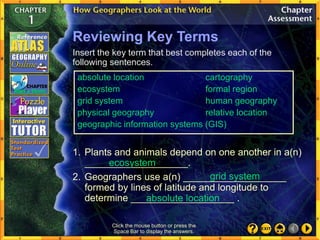
    Click the mousebutton or press the Space Bar to display the answers. Reviewing Key Terms Insert the key term that best completes each of the following sentences. 1. Plants and animals depend on one another in a(n) ___________________. 2. Geographers use a(n) ___________________ formed by lines of latitude and longitude to determine ___________________ . ecosystem grid system absolute location absolute location cartography ecosystem formal region grid system human geography physical geography relative location geographic information systems (GIS)
  • 67.
    Click the mousebutton or press the Space Bar to display the answers. Reviewing Key Terms 3. ___________________ is the study of the human aspects of geography. 4. A(n) ___________________ has boundaries determined by a common characteristic. 5. Another name for mapmaking is _____________. formal region cartography Insert the key term that best completes each of the following sentences. Human geography absolute location cartography ecosystem formal region grid system human geography physical geography relative location geographic information systems (GIS)
  • 68.
    Click the mousebutton or press the Space Bar to display the answers. Reviewing Key Terms Insert the key term that best completes each of the following sentences. 6. ________________ is expressed in relation to other places. 7. Computer tools that process data and satellite images with other pieces of geographic information are called ________________________________. Relative location geographic information systems (GIS) absolute location cartography ecosystem formal region grid system human geography physical geography relative location geographic information systems (GIS)
  • 69.
    Click the mousebutton or press the Space Bar to display the answer. Reviewing Key Terms Insert the key term that best completes each of the following sentences. 8. _________________ focuses on the study of the earth’s physical features. Physical geography absolute location cartography ecosystem formal region grid system human geography physical geography relative location geographic information systems (GIS)
  • 70.
    Click the mousebutton or press the Space Bar to display the answer. How do geographers determine the locations of places? Geographers determine the location of places by using the latitude/longitude grid or by locating places in relation to other places. Reviewing Facts Section 1: Exploring Geography
  • 71.
    Click the mousebutton or press the Space Bar to display the answer. What are the three types of regions identified by geographers? The three types of regions are formal, functional, and perceptual regions. Reviewing Facts Section 1: Exploring Geography
  • 72.
    Click the mousebutton or press the Space Bar to display the answer. Why do geographers study human systems and human-environment relationships? Geographers study human systems and human-environment relationships to understand how the earth affects and is affected by human activity so that informed decisions can be made. Reviewing Facts Section 1: Exploring Geography
  • 73.
    Click the mousebutton or press the Space Bar to display the answer. What are two ways that every place on the earth can be located? Reviewing Facts Section 1: Exploring Geography The two ways every place on the earth can be located are by describing its absolute location or its relative location.
  • 74.
    Click the mousebutton or press the Space Bar to display the answer. How do physical and human geography differ? Physical geography is the study of the earth’s physical features. Human geography focuses on human activities in relation to the physical world. Reviewing Facts Section 2: The Geographer’s Craft
  • 75.
    Click the mousebutton or press the Space Bar to display the answer. What research methods do geographers use? Geographers use direct observation, mapping, interviewing, statistics, and technology as research methods. Reviewing Facts Section 2: The Geographer’s Craft
  • 76.
    Click the mousebutton or press the Space Bar to display the answer. What other subjects do geographers study? Geographers also study history and government, culture, and economics. Reviewing Facts Section 2: The Geographer’s Craft
  • 77.
    Click the mousebutton or press the Space Bar to display the answer. Critical Thinking Summarizing the Main Idea How do geographers use the elements of geography to study the earth? The elements of geography help geographers organize information about the earth and learn about geographic events and patterns.
  • 78.
    Click the mousebutton or press the Space Bar to display the answer. Critical Thinking Making Inferences What subjects might you study in order to become an urban planner? Explain. Possible answer: One might study geography, statistics, economics, architecture, and urban design to become an urban planner.
  • 79.
    Critical Thinking Predicting ConsequencesConsider the many ways that technology has affected the way people live and work. Then imagine that you have become a geographer of the future. How do you think technology will change the way you work?
  • 80.
    Click the mousebutton or press the Space Bar to display the answers. Locating Places Match the letters on the map with the places and physical features of the earth. __1. North America __2. South America __3. Africa __4. Asia __5. Europe __6. Antarctica __7. Australia __8. Atlantic Ocean __9. Indian Ocean __10. Pacific Ocean B A D E C G F I H J
  • 81.
    Click the mousebutton or press the Space Bar to display the answer. Why are international time zones determined from the time at the Royal Naval Observatory at Greenwich, England (Greenwich Mean Time)? Time zones are determined at the Royal Naval Observatory because the Prime Meridian passes through Greenwich.
  • 83.
    Explore online informationabout the topics introduced in this chapter. Click on the Connect button to launch your browser and go to the Glencoe World Geography Web site. At this site, you will find interactive activities, current events information, and Web sites correlated with the chapters and units in the textbook. When you finish exploring, exit the browser program to return to this presentation. If you experience difficulty connecting to the Web site, manually launch your Web browser and go to http://geography.glencoe.com
  • 84.
    Use the circlegraph below and your knowledge of geography to answer the following questions.
  • 85.
    1. Which oceancovers the smallest area of the earth’s surface? A Atlantic B Indian C Pacific D Arctic Click the mouse button or press the Space Bar to display the answer. Test–Taking Tip Study the information shown on the circle graph for the areas of the earth covered by land and by oceans. Then compare the relative sizes of the different graph segments. By comparing the segments you will be able to determine the correct answers.
  • 86.
    2. Which oceancovers about as much of the earth’s surface as land does? F Indian H Arctic G Pacific J Atlantic Click the mouse button or press the Space Bar to display the answer. Test–Taking Tip Study the information shown on the circle graph for the areas of the earth covered by land and by oceans. Then compare the relative sizes of the different graph segments. By comparing the segments you will be able to determine the correct answers.
  • 87.
    Nighttime photographs takenfrom space capture population patterns by showing blazes of light where people live.
  • 88.
    Saving Ecosystems withMaps Scientists show habitat loss and endangered species on color-coded maps that can be used to convince individuals, corporations, and politicians to support conservation and preservation efforts.
  • 89.
    Global Culture Music,food, and entertainment are crossing traditional boundaries. “World Music” is a growing musical category, and new “fusion” cuisines blend foods from different countries.
  • 90.
    Understanding Graphs Graphs arevisual representations of statistical data. Large amounts of information can be condensed when presented in graphs. Studying graphs allow readers to see relationships clearly.
  • 91.
    Learning the Skill Thethree main types of graphs present numerical information. Line graphs record changes in data over time. The vertical axis (y–axis) shows units of measurement, and the horizontal axis (x–axis) shows intervals of time. Bar graphs use bars of different lengths to compare different quantities. Circle graphs show the relationship of parts to a whole as percentages. To understand a graph:  • Read the graph title to identify the subject.  • Study the labels to understand the numerical information presented. Click the mouse button or press the Space Bar to display the information. Understanding Graphs
  • 92.
    Learning the Skill Clickthe mouse button or press the Space Bar to display the information. The three main types of graphs present numerical information. Line graphs record changes in data over time. The vertical axis (y–axis) shows units of measurement, and the horizontal axis (x–axis) shows intervals of time. Bar graphs use bars of different lengths to compare different quantities. Circle graphs show the relationship of parts to a whole as percentages. To understand a graph:  • Study the information presented and the use of colors and patterns.  • Compare the lines, bars, or segments, and look for relationships in order to draw conclusions. Understanding Graphs
  • 93.
    Practicing the Skill Studythe graphs to answer these questions. 1. Line graph What is the difference in population between the low and high projections? 2. Bar graph In which decade did migration cause the least change in population. The difference between low and high projections is three. Migration caused the least change in population during the 1930s. Click the mouse button or press the Space Bar to display possible answers. Understanding Graphs
  • 94.
    Practicing the Skill 3.Circle graph What percent of immigrants to the United States in the 1990s came from Europe? 4. What general population trends do the three graphs show? Thirteen percent of immigrants to the United States in the 1990s came from Europe. Study the graphs to answer these questions. The graphs show an increase in world population, a growing effect of migration on population change, and growing numbers of Asian and Latin American immigrants to the United States. Click the mouse button or press the Space Bar to display possible answers. Understanding Graphs
  • 95.
    Charts The Hemispheres The GlobalGrid Jobs in Geography Click on a hyperlink to view the corresponding slide.
  • 100.
    Click the mousebutton or press the Space Bar to display the answer.
  • 101.
    Click the mousebutton or press the Space Bar to display the answer.
  • 102.
    End of CustomShows WARNING! Do Not Remove This slide is intentionally blank and is set to auto–advance to end custom shows and return to the main presentation.