CS261
DATA STRUCTURES & ALGORITHMS
(WEEK-8)
LECTURE-15 & 16
INTRODUCTION TO DATA STRUCTURES &
ALGORITHMS
Lecturer
Azka Aziz
Azka.a@scocs.edu.pk
Data structures & Algorithms
Lecture#15 Merge Sort
Lecture Contents
Divide & Conquer
Divide & Conquer ….. Application (Merge Sort)
mergeSort()
Merge()
Analysis
Divide & Conquer
Idea
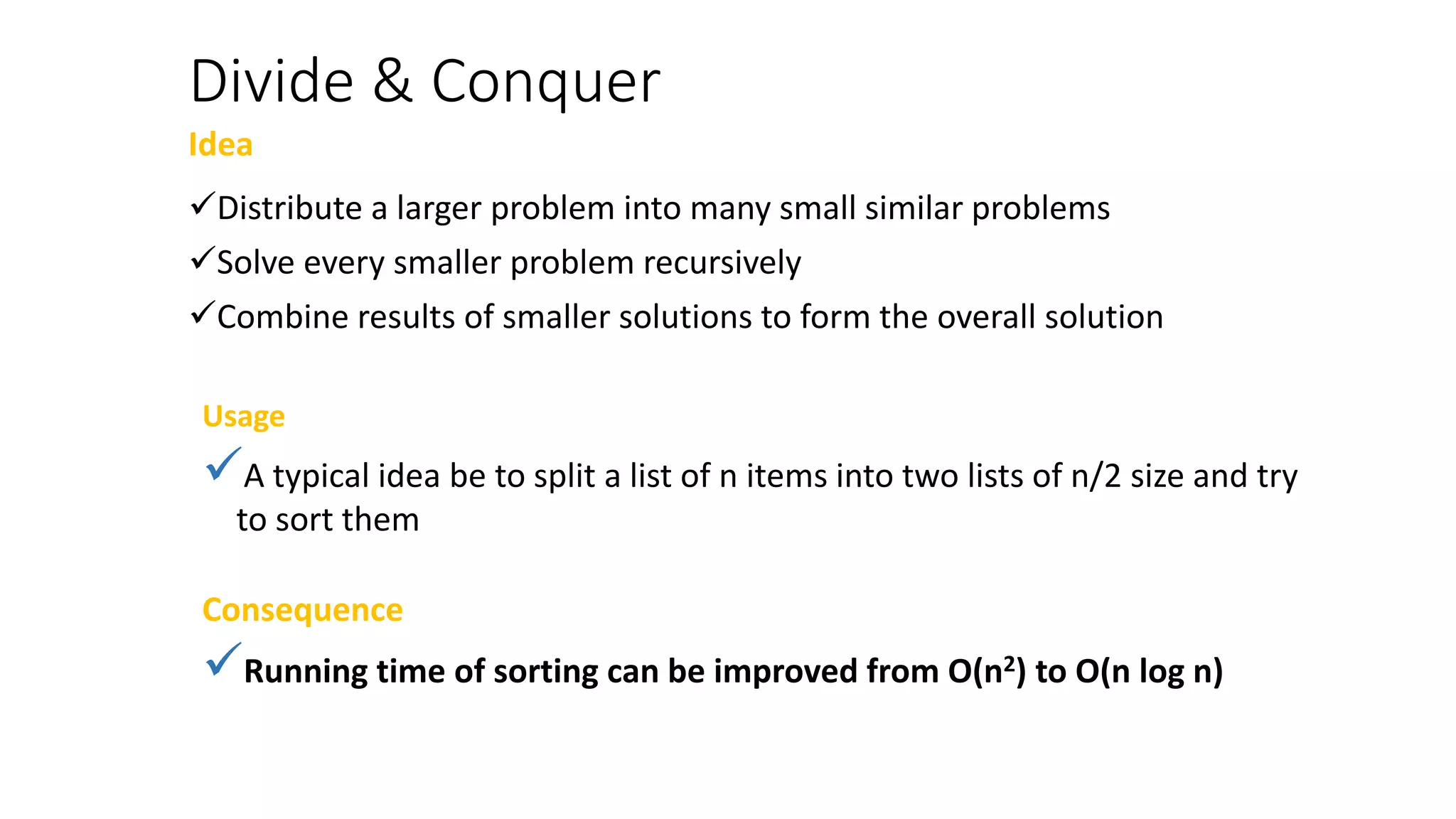
Distribute a larger problem into many small similar problems
Solve every smaller problem recursively
Combine results of smaller solutions to form the overall solution
Usage
A typical idea be to split a list of n items into two lists of n/2 size and try
to sort them
Consequence
Running time of sorting can be improved from O(n2) to O(n log n)
Divide & Conquer ….. Application (Merge
Sort)
Divide and conquer strategy is applicable in a huge number of computational
problems.
The first application of divide and conquer strategy is a simple and efficient
sorting procedure called Merge Sort
Input: a list of n numbers is provided as an array A[1…n]
Output: a permutation of this sequence sorted in increasing order
Method: Split Recursively, Sort, Merge
Merge Sort Algorithm
proc mergeSort(arr[1…n], p, r)
if p < r then
q  (p+r)/2
mergeSort(arr, p, q)
mergeSort(arr, q+1, r)
merge(arr, p, q, r)
end if
end proc
Every pass of mergeSort()
procedure consists of two
recursive function calls followed by
one call to merge
Merge Sort Algorithm
proc mergeSort(arr[1…n], p, r)
if p < r then
q  (p+r)/2
mergeSort(arr, p, q)
mergeSort(arr, q+1, r)
merge(arr, p, q, r)
end if
end proc
mergeSort(arr, p, r) function checks
whether p (index) is less than r (index)
If it is so, it makes two calls to itself
splitting the array into two halves
Every further call splits array into further
two halves with available indexes until p is
not less than r (when will this happen?)
Merge Sort Algorithm
proc mergeSort(arr[1…n], p, r)
if p < r then
q  (p+r)/2
mergeSort(arr, p, q)
mergeSort(arr, q+1, r)
merge(arr, p, q, r)
end if
end proc
Every further call splits array into further
two halves with available indexes until p is
not less than r (when will this happen?)
At this point a merge(arr, p, q, r) call will
me made to merge two halves into a
sorted chunk
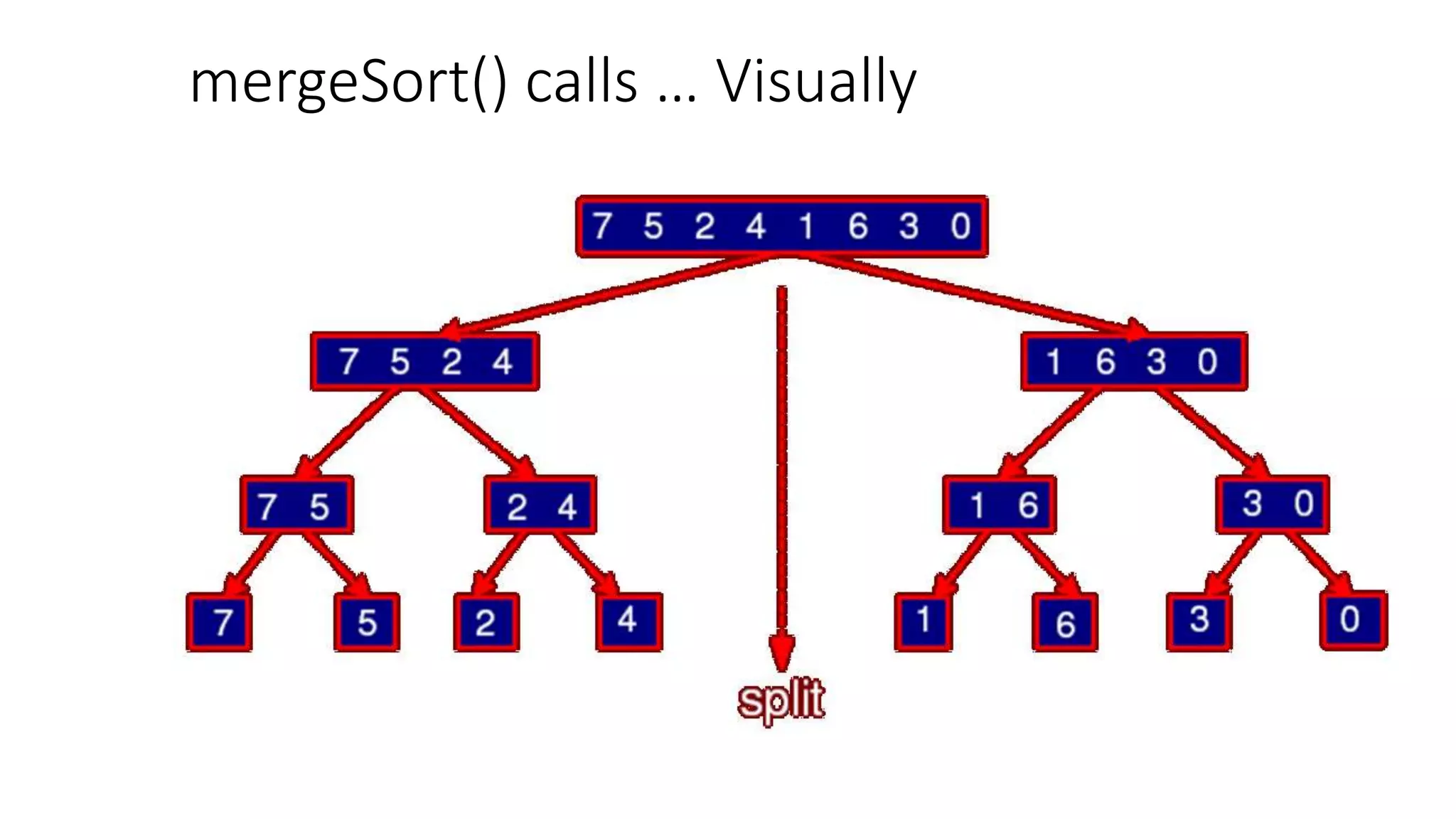
mergeSort() calls … Visually
merge() call
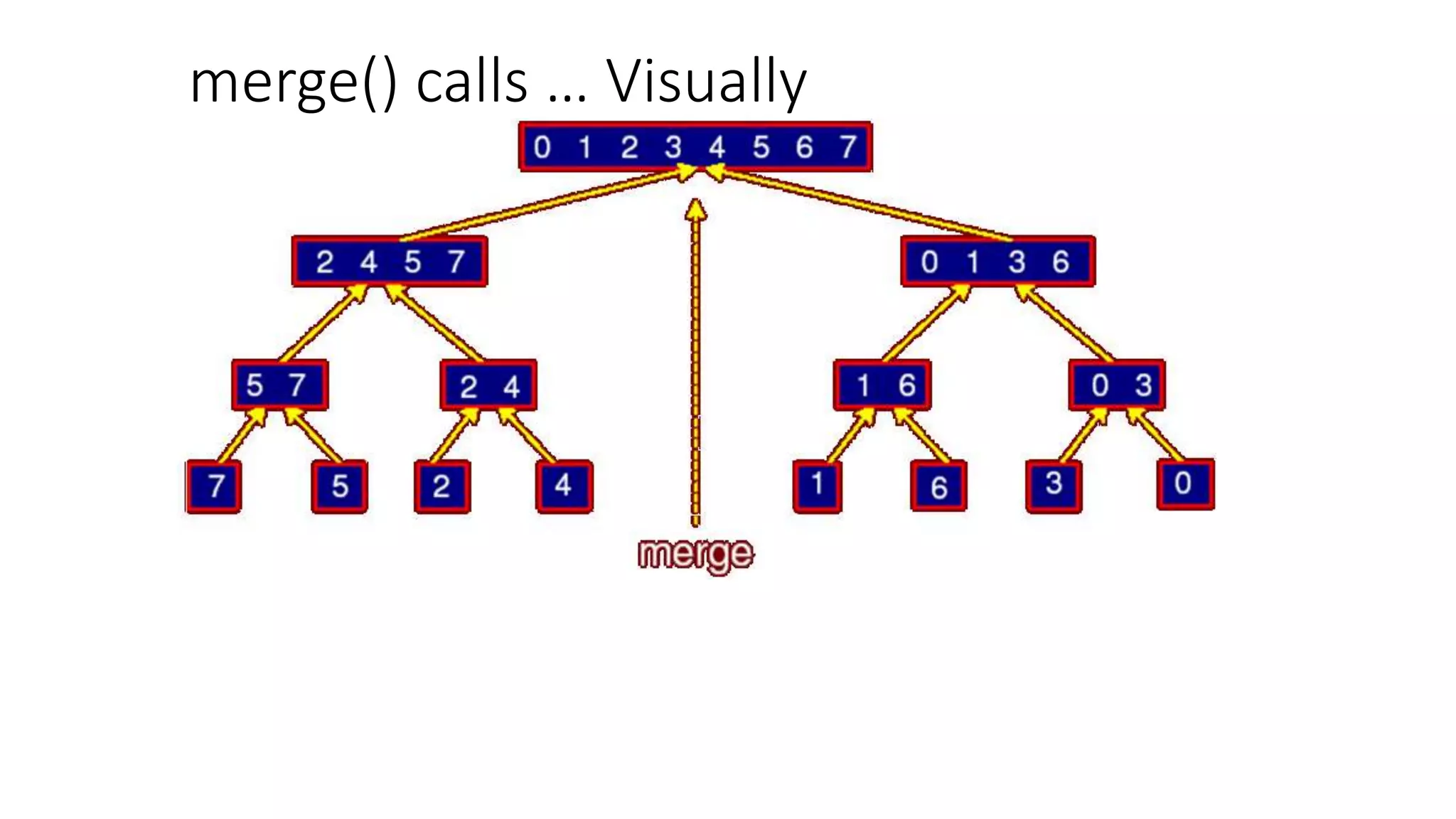
merge(arr, p, q, r) assumes that two halves of array [p….q], [q+1….r]
are sorted (Why is it? We have not sorted anything yet? Is there
some statement in mergeSort() procedure that does the sorting
part?)
proc mergeSort(arr[1…n], p, r)
if p < r then
q  (p+r)/2
mergeSort(arr, p, q)
mergeSort(arr, q+1, r)
merge(arr, p, q, r)
end if
end proc
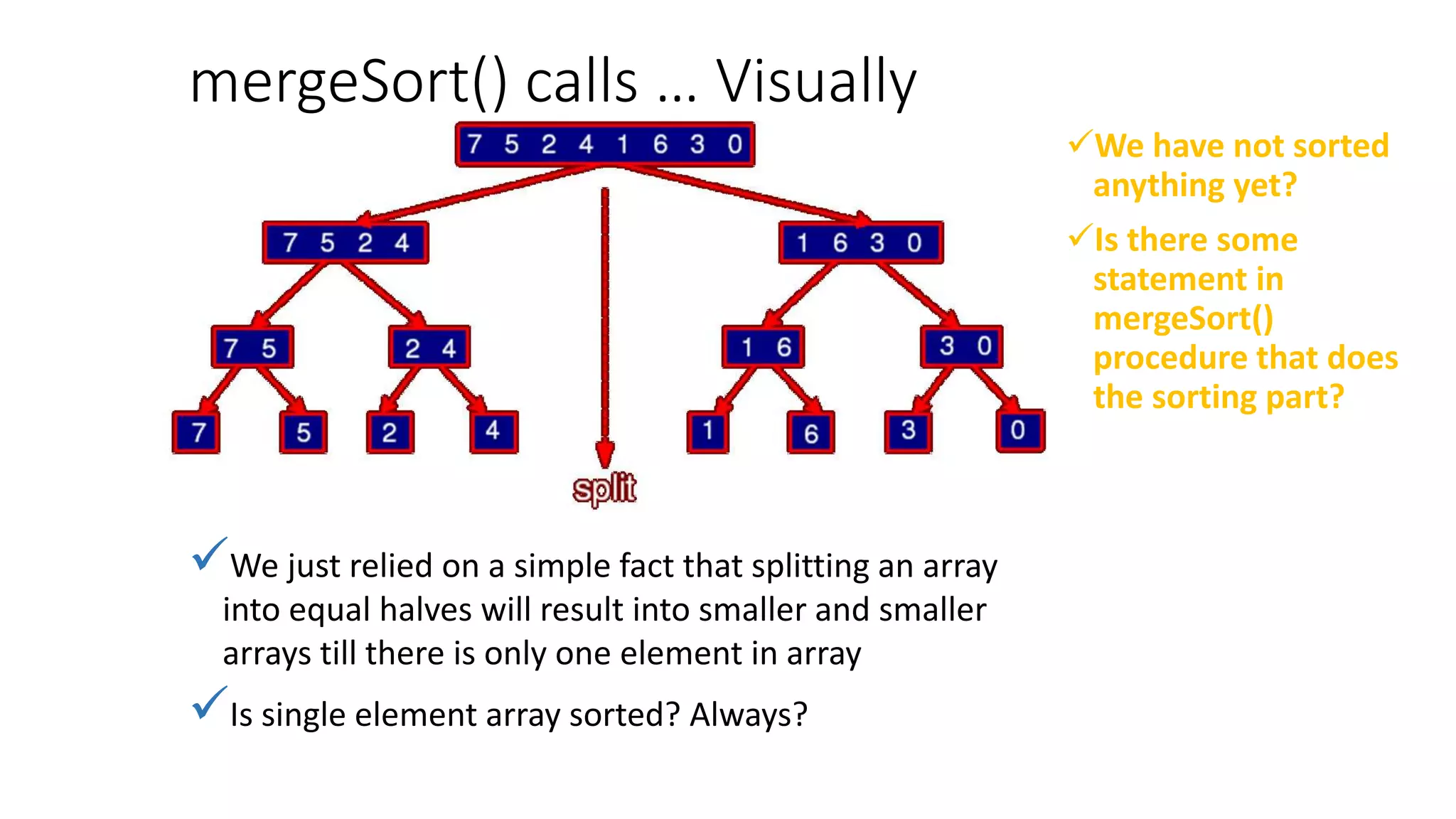
mergeSort() calls … Visually
We have not sorted
anything yet?
Is there some
statement in
mergeSort()
procedure that does
the sorting part?
We just relied on a simple fact that splitting an array
into equal halves will result into smaller and smaller
arrays till there is only one element in array
Is single element array sorted? Always?
merge(arr, p, q, r) calls …
Every merge() call receives three parameters (except the data
array) i.e. p, q, r
Values between indexes p….q and q+1……r are sorted
(independent of each other)
Having two sorted sub-arrays, merging part is easier:::
merge(arr, p, q, r) calls …
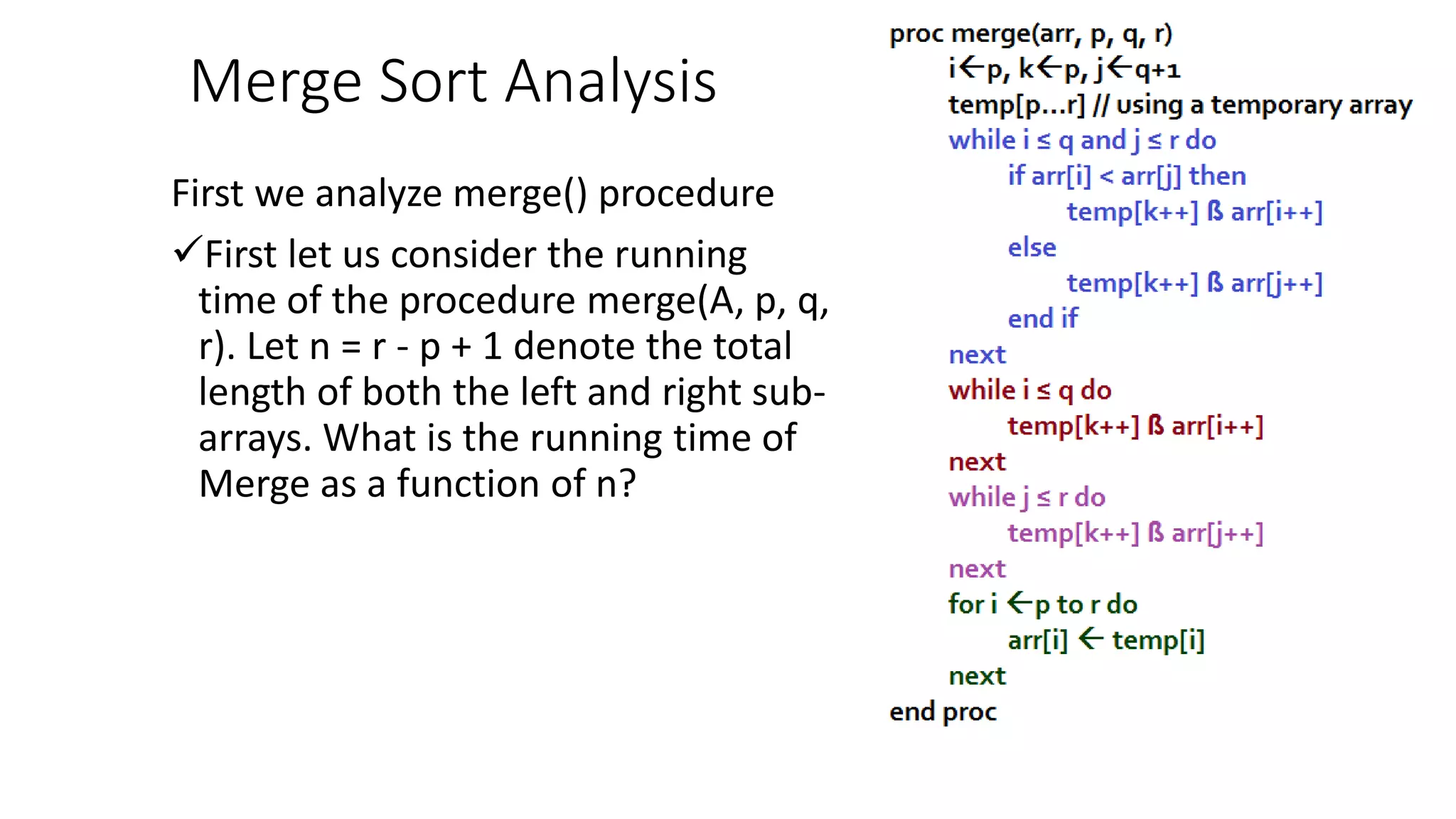
proc merge(arr, p, q, r)
ip, kp, jq+1
temp[p…r] // using a temporary array
while i ≤ q and j ≤ r do
if arr[i] < arr[j] then
temp[k++]  arr[i++]
else
temp[k++]  arr[j++]
end if
next
merge(arr, p, q, r) calls … continued
while i ≤ q do
temp[k++]  arr[i++]
next
while j ≤ r do
temp[k++]  arr[j++]
next
for i p to r do
arr[i]  temp[i]
next
end proc
merge() calls … Visually
Merge Sort Analysis
First we analyze merge() procedure
First let us consider the running
time of the procedure merge(A, p, q,
r). Let n = r - p + 1 denote the total
length of both the left and right sub-
arrays. What is the running time of
Merge as a function of n?
Merge Sort Analysis
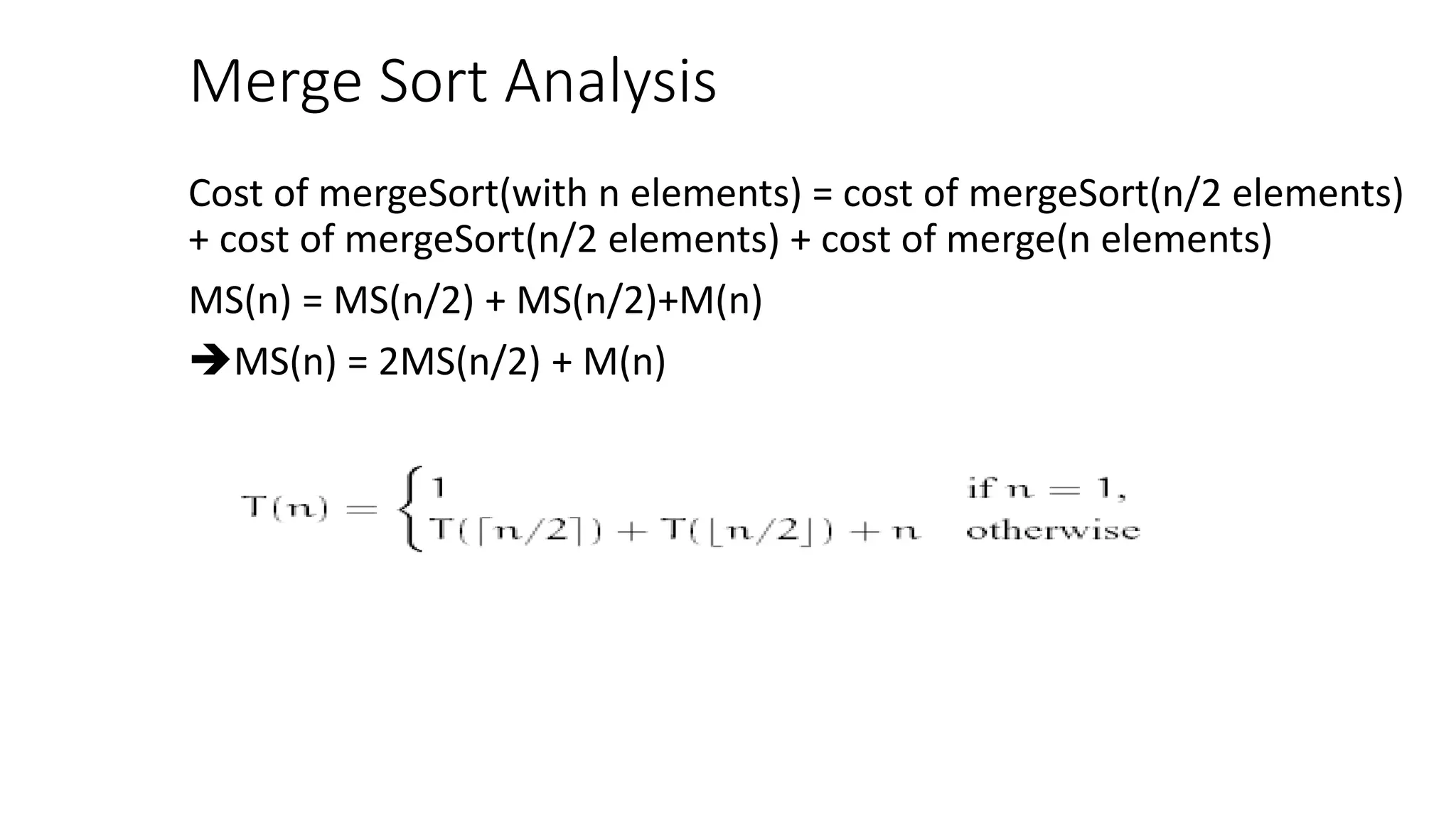
Cost of mergeSort(with n elements) = cost of mergeSort(n/2 elements)
+ cost of mergeSort(n/2 elements) + cost of merge(n elements)
MS(n) = MS(n/2) + MS(n/2)+M(n)
MS(n) = 2MS(n/2) + M(n)
Merge Sort Analysis
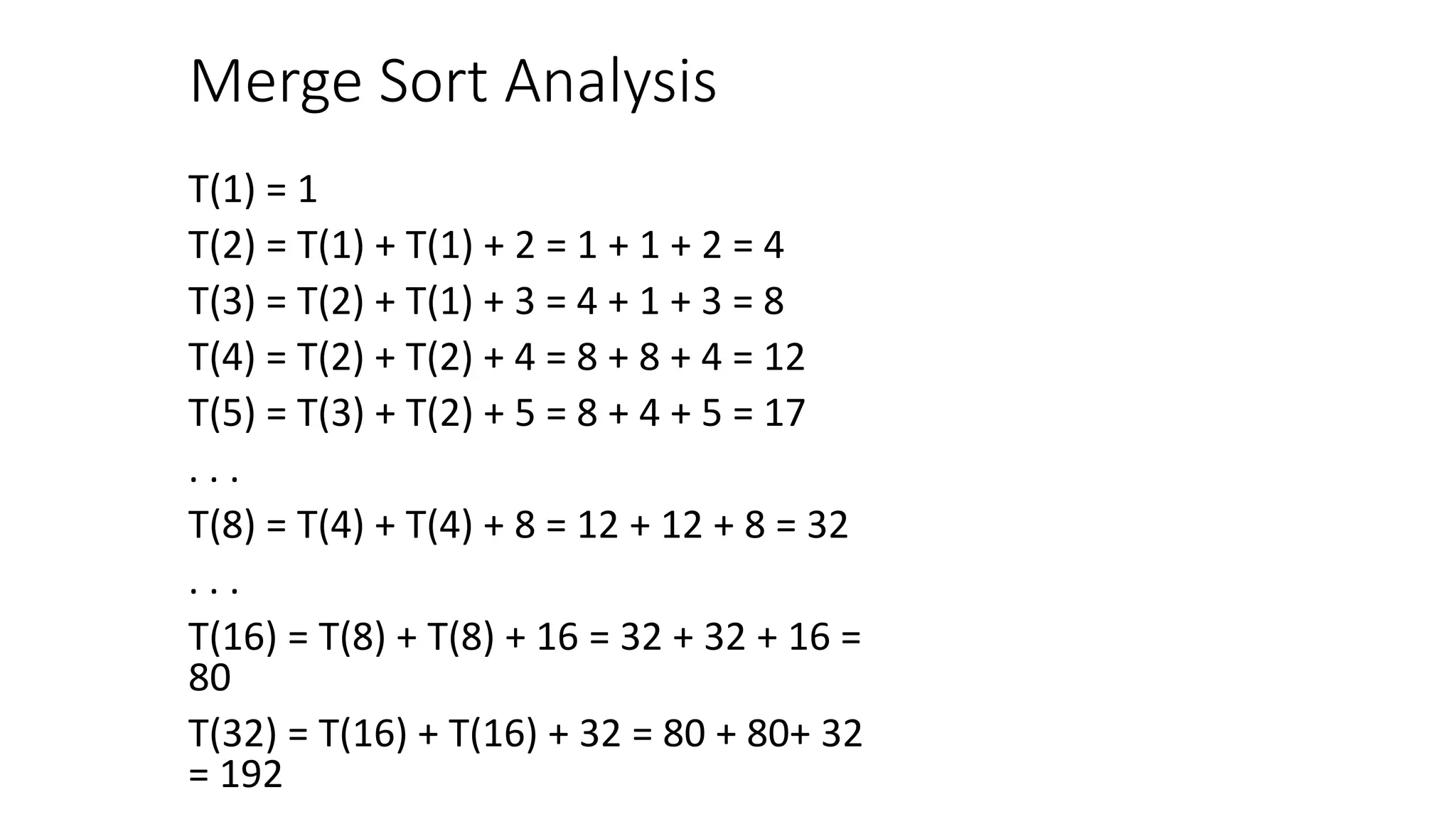
T(1) = 1
T(2) = T(1) + T(1) + 2 = 1 + 1 + 2 = 4
T(3) = T(2) + T(1) + 3 = 4 + 1 + 3 = 8
T(4) = T(2) + T(2) + 4 = 8 + 8 + 4 = 12
T(5) = T(3) + T(2) + 5 = 8 + 4 + 5 = 17
. . .
T(8) = T(4) + T(4) + 8 = 12 + 12 + 8 = 32
. . .
T(16) = T(8) + T(8) + 16 = 32 + 32 + 16 =
80
T(32) = T(16) + T(16) + 32 = 80 + 80+ 32
= 192
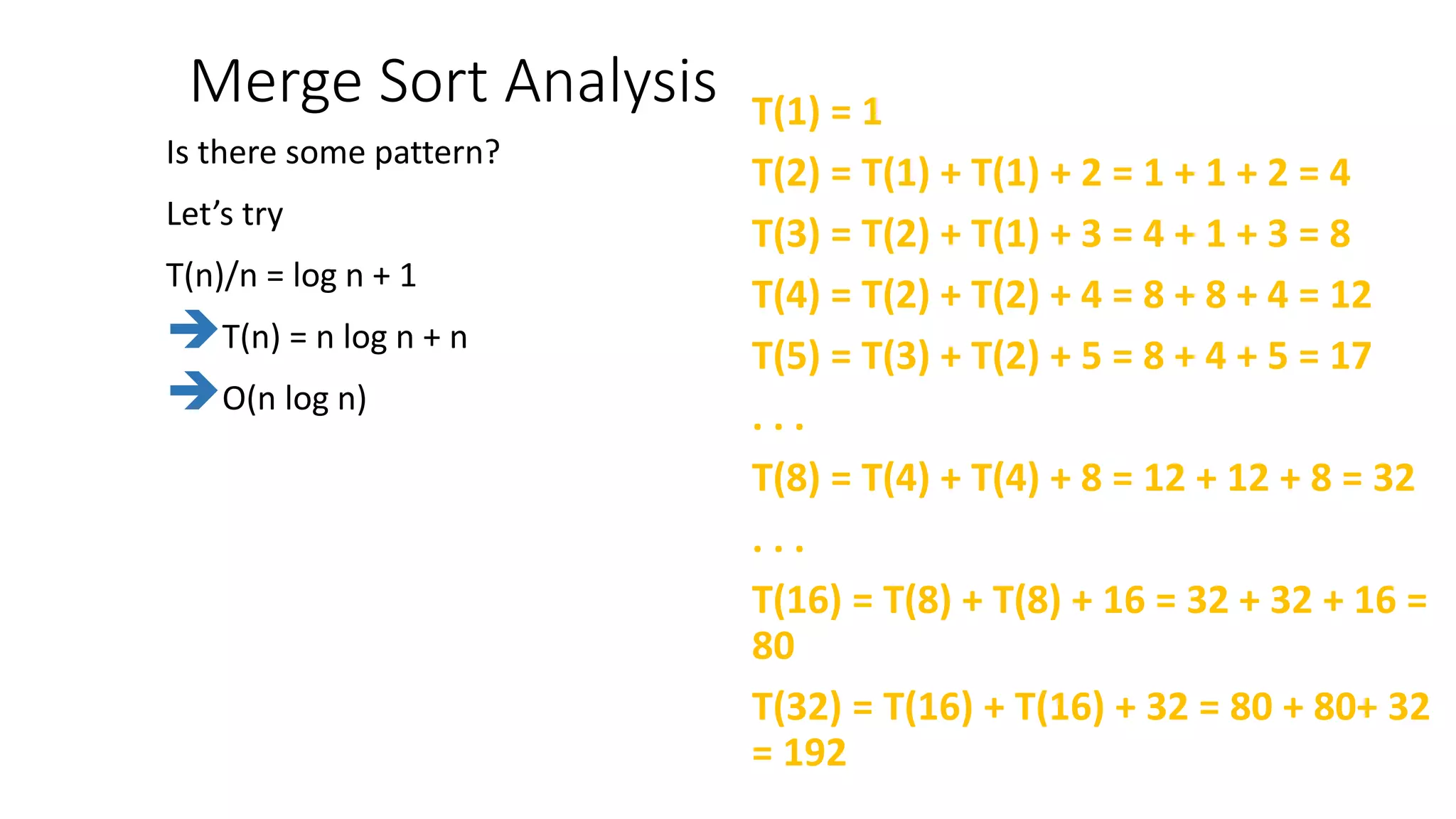
Merge Sort Analysis T(1) = 1
T(2) = T(1) + T(1) + 2 = 1 + 1 + 2 = 4
T(3) = T(2) + T(1) + 3 = 4 + 1 + 3 = 8
T(4) = T(2) + T(2) + 4 = 8 + 8 + 4 = 12
T(5) = T(3) + T(2) + 5 = 8 + 4 + 5 = 17
. . .
T(8) = T(4) + T(4) + 8 = 12 + 12 + 8 = 32
. . .
T(16) = T(8) + T(8) + 16 = 32 + 32 + 16 =
80
T(32) = T(16) + T(16) + 32 = 80 + 80+ 32
= 192
Is there some pattern?
Let’s try
T(n)/n = log n + 1
T(n) = n log n + n
O(n log n)
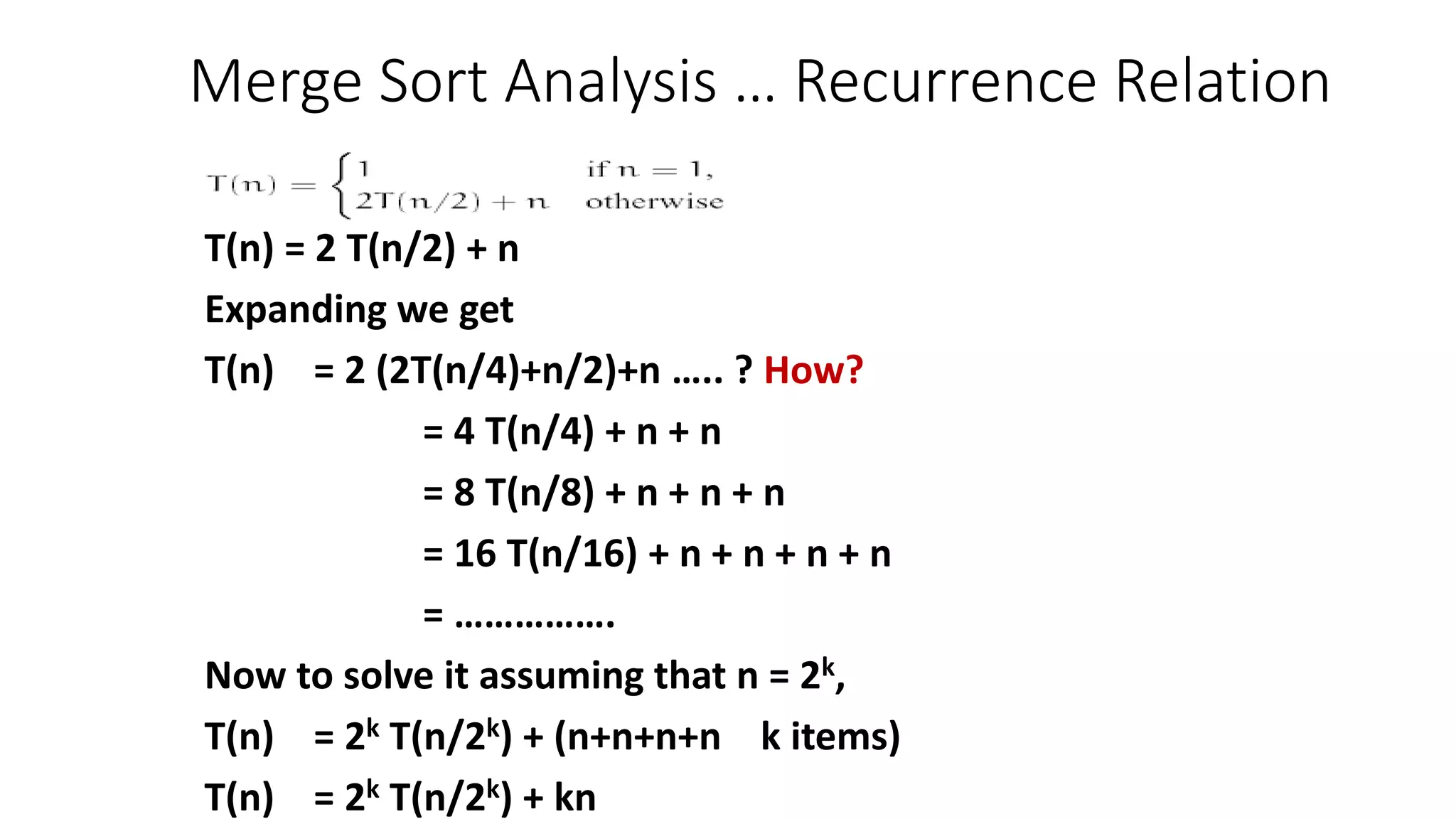
Merge Sort Analysis … Recurrence Relation
T(n) = 2 T(n/2) + n
Expanding we get
T(n) = 2 (2T(n/4)+n/2)+n ….. ? How?
= 4 T(n/4) + n + n
= 8 T(n/8) + n + n + n
= 16 T(n/16) + n + n + n + n
= …………….
Now to solve it assuming that n = 2k,
T(n) = 2k T(n/2k) + (n+n+n+n k items)
T(n) = 2k T(n/2k) + kn
Merge Sort Analysis … Recurrence Relation
T(n) = 2 T(n/2) + n
Expanding we get
T(n) = 2 (2T(n/4)+n/2)+n
= 4 T(n/4) + n + n
= 8 T(n/8) + n + n + n
= 16 T(n/16) + n + n +
n + n
= …………….
Now to solve it assuming that n =
2k,
T(n) = 2k T(n/2k) + (n+n+n+n k
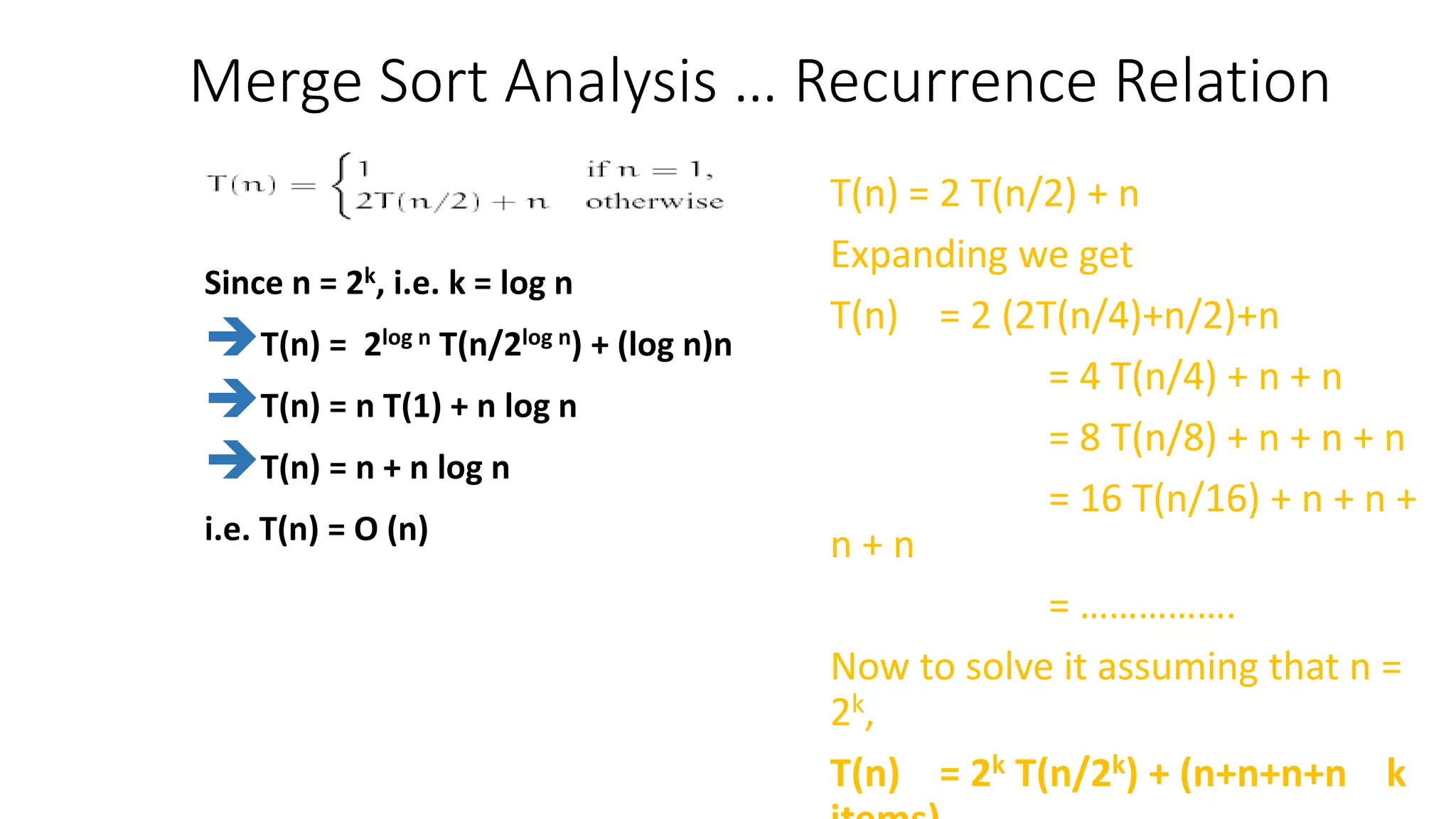
Since n = 2k, i.e. k = log n
T(n) = 2log n T(n/2log n) + (log n)n
T(n) = n T(1) + n log n
T(n) = n + n log n
i.e. T(n) = O (n)
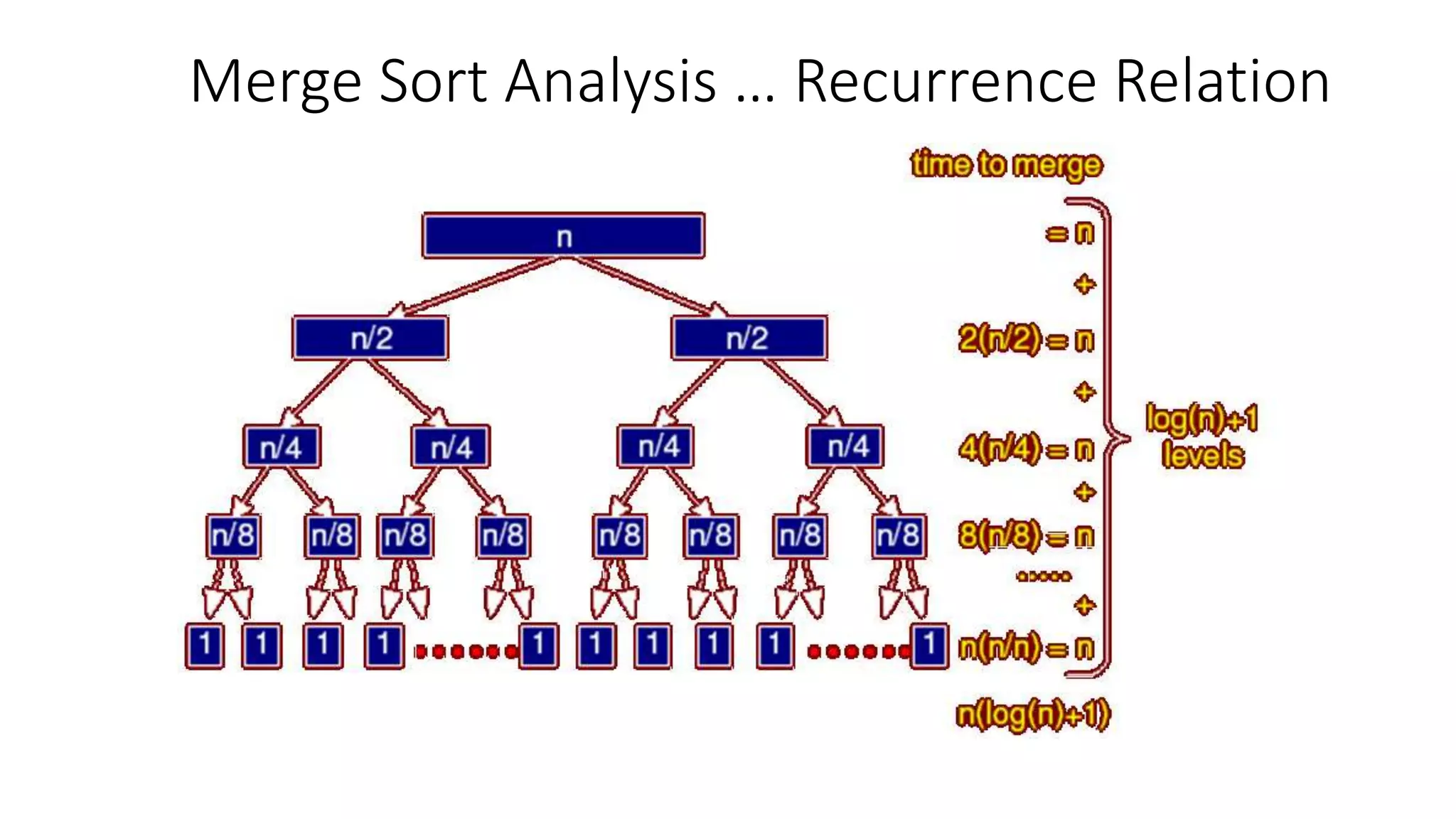
Merge Sort Analysis … Recurrence Relation
Data structures & Algorithms
Lecture#16 Queue
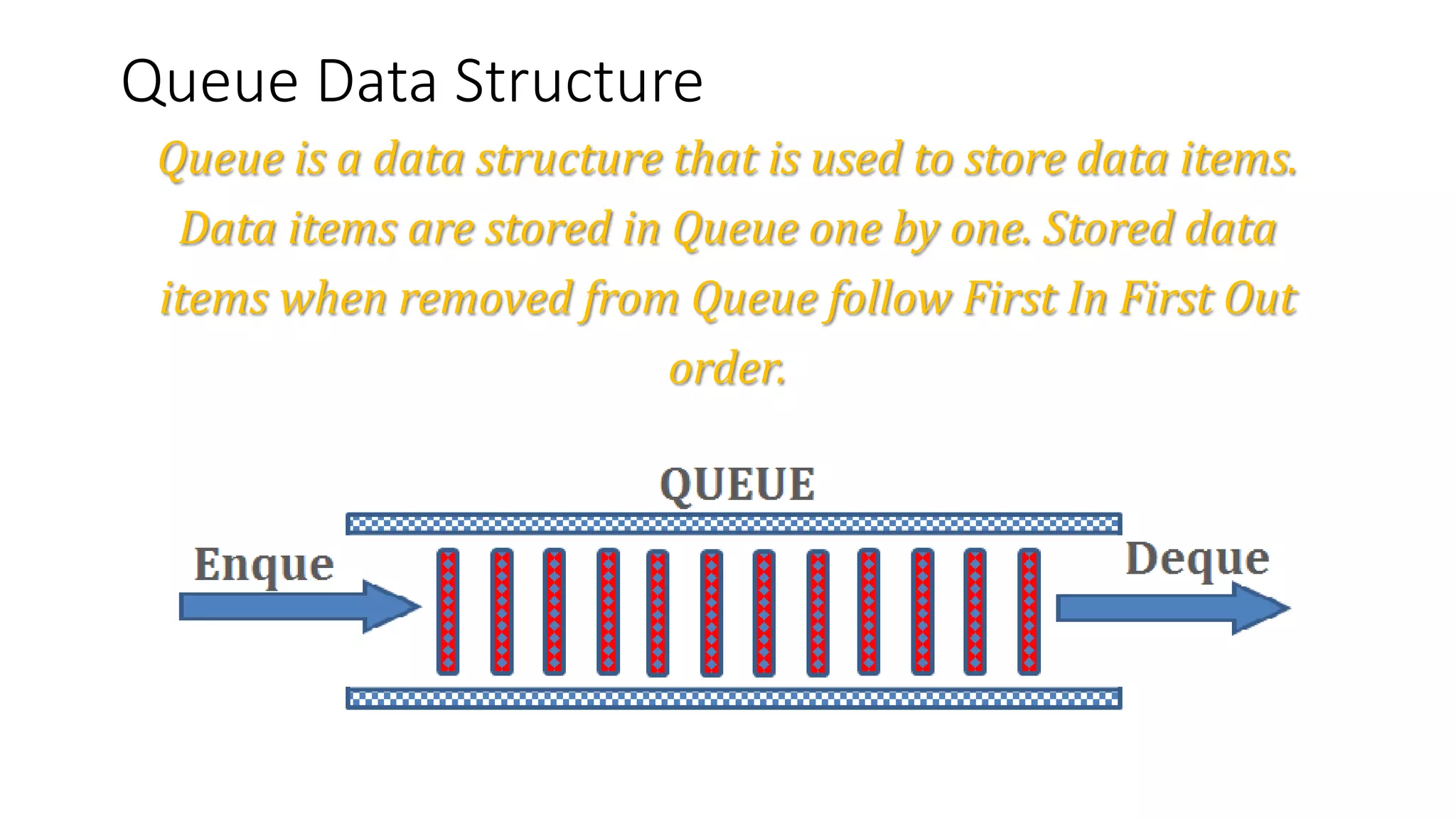
Queue Data Structure
Queue is a data structure that is used to store data items.
Data items are stored in Queue one by one. Stored data
items when removed from Queue follow First In First Out
order.
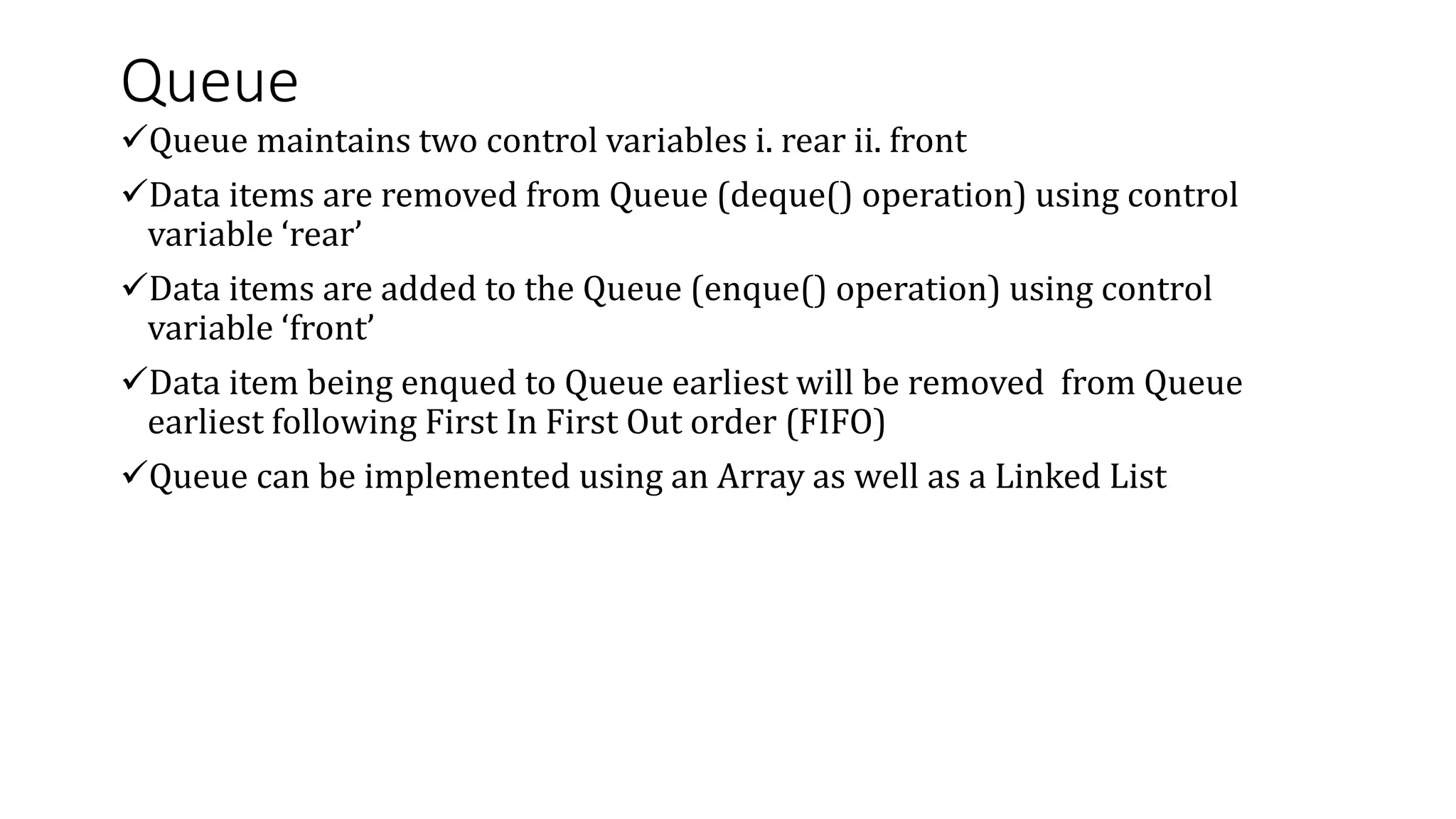
Queue
Queue maintains two control variables i. rear ii. front
Data items are removed from Queue (deque() operation) using control
variable ‘rear’
Data items are added to the Queue (enque() operation) using control
variable ‘front’
Data item being enqued to Queue earliest will be removed from Queue
earliest following First In First Out order (FIFO)
Queue can be implemented using an Array as well as a Linked List
Queue Operations …
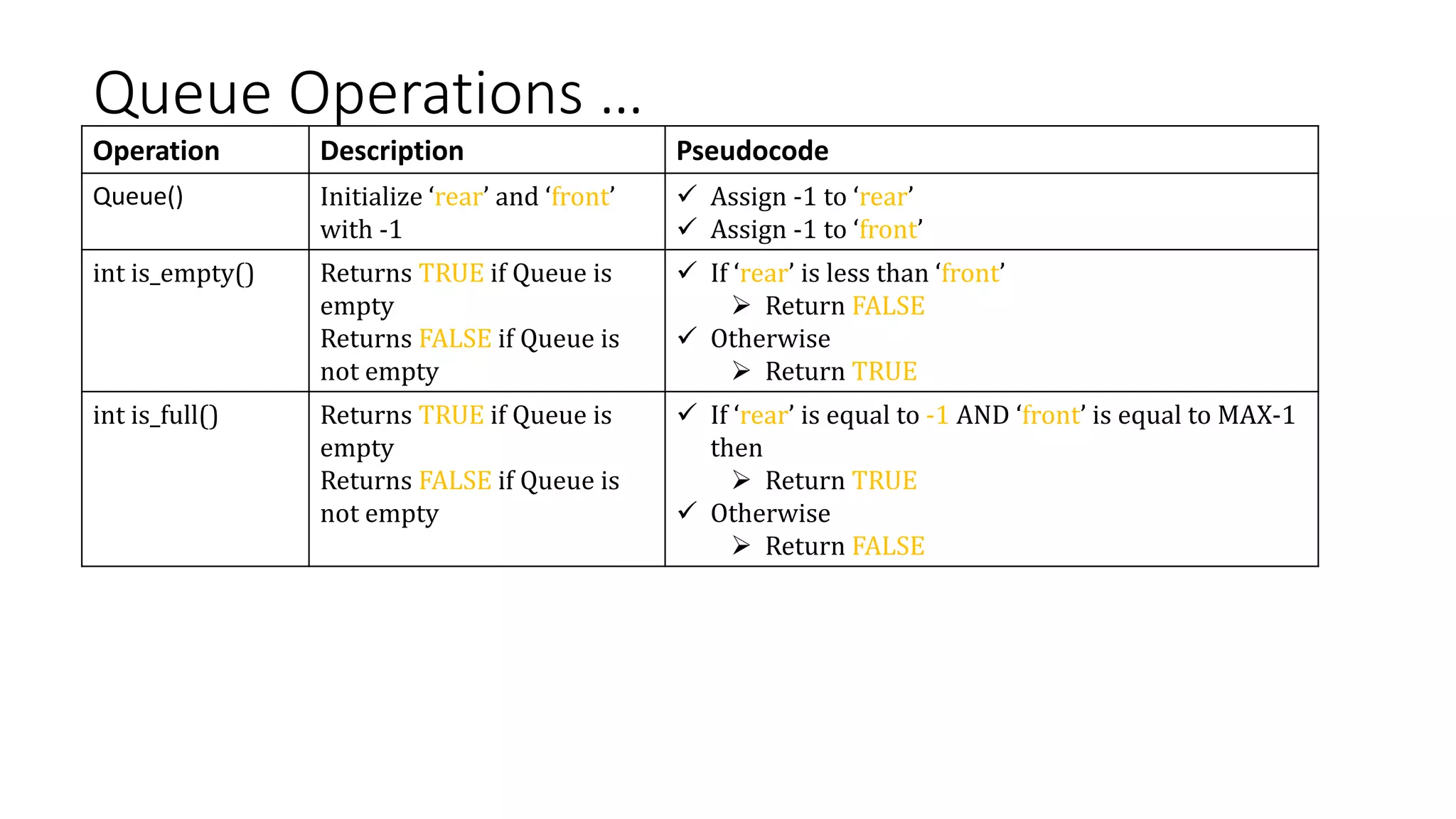
Operation Description Pseudocode
Queue() Initialize ‘rear’ and ‘front’
with -1
 Assign -1 to ‘rear’
 Assign -1 to ‘front’
int is_empty() Returns TRUE if Queue is
empty
Returns FALSE if Queue is
not empty
 If ‘rear’ is less than ‘front’
 Return FALSE
 Otherwise
 Return TRUE
int is_full() Returns TRUE if Queue is
empty
Returns FALSE if Queue is
not empty
 If ‘rear’ is equal to -1 AND ‘front’ is equal to MAX-1
then
 Return TRUE
 Otherwise
 Return FALSE
Queue Operations …
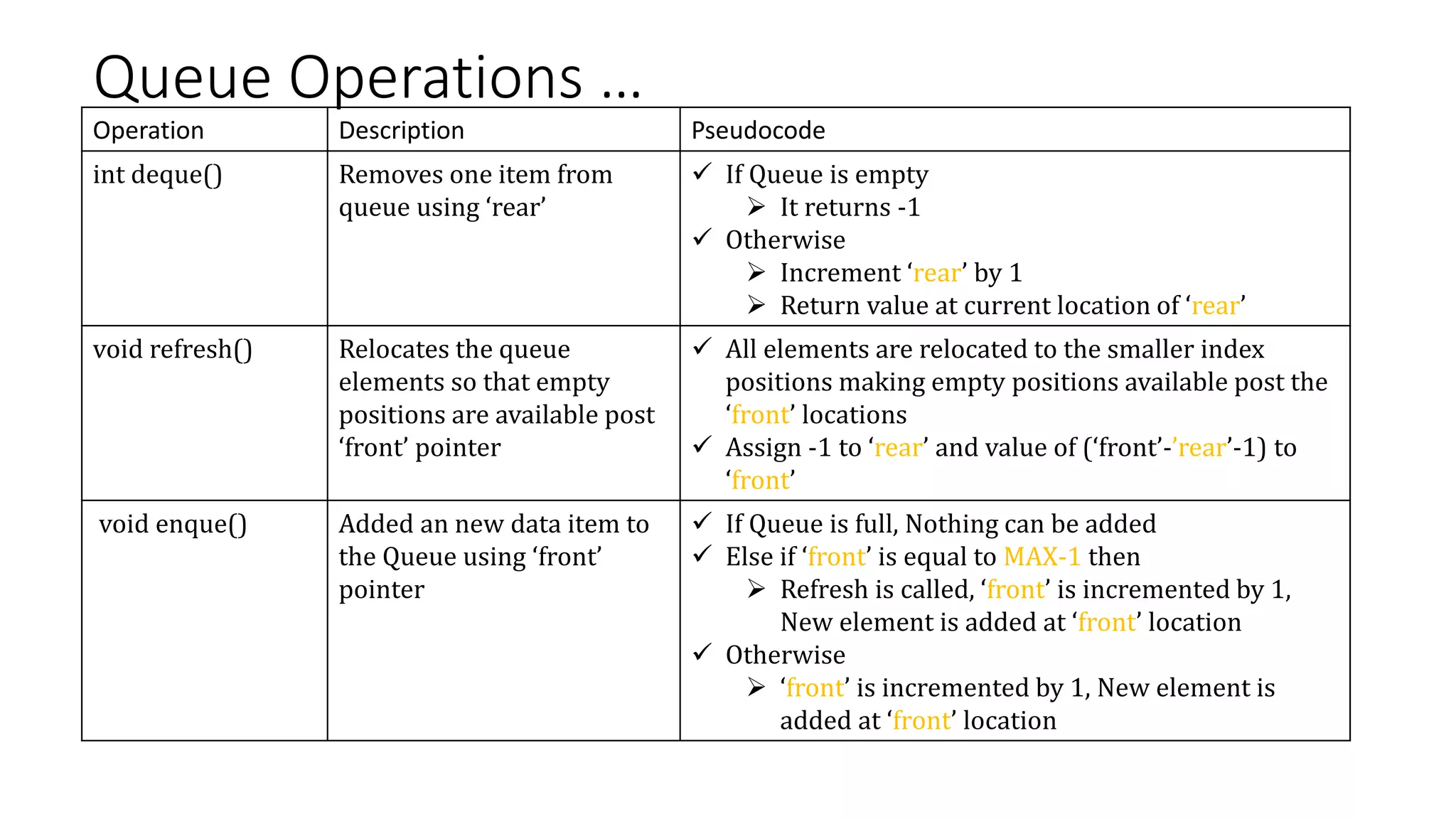
Operation Description Pseudocode
int deque() Removes one item from
queue using ‘rear’
 If Queue is empty
 It returns -1
 Otherwise
 Increment ‘rear’ by 1
 Return value at current location of ‘rear’
void refresh() Relocates the queue
elements so that empty
positions are available post
‘front’ pointer
 All elements are relocated to the smaller index
positions making empty positions available post the
‘front’ locations
 Assign -1 to ‘rear’ and value of (‘front’-’rear’-1) to
‘front’
void enque() Added an new data item to
the Queue using ‘front’
pointer
 If Queue is full, Nothing can be added
 Else if ‘front’ is equal to MAX-1 then
 Refresh is called, ‘front’ is incremented by 1,
New element is added at ‘front’ location
 Otherwise
 ‘front’ is incremented by 1, New element is
added at ‘front’ location
Queue using array … implementation
Implementation details and issues have been discussed during
class
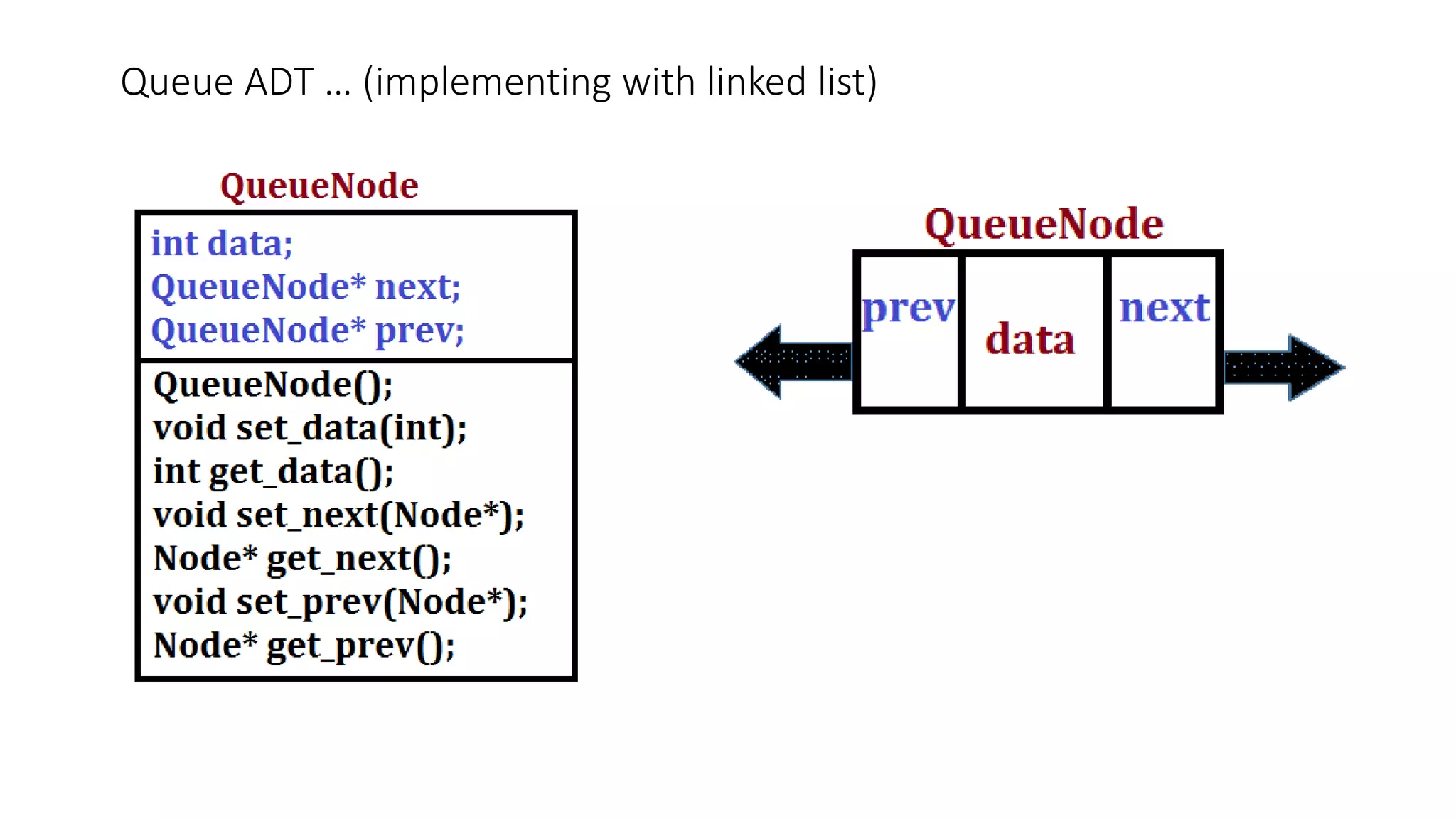
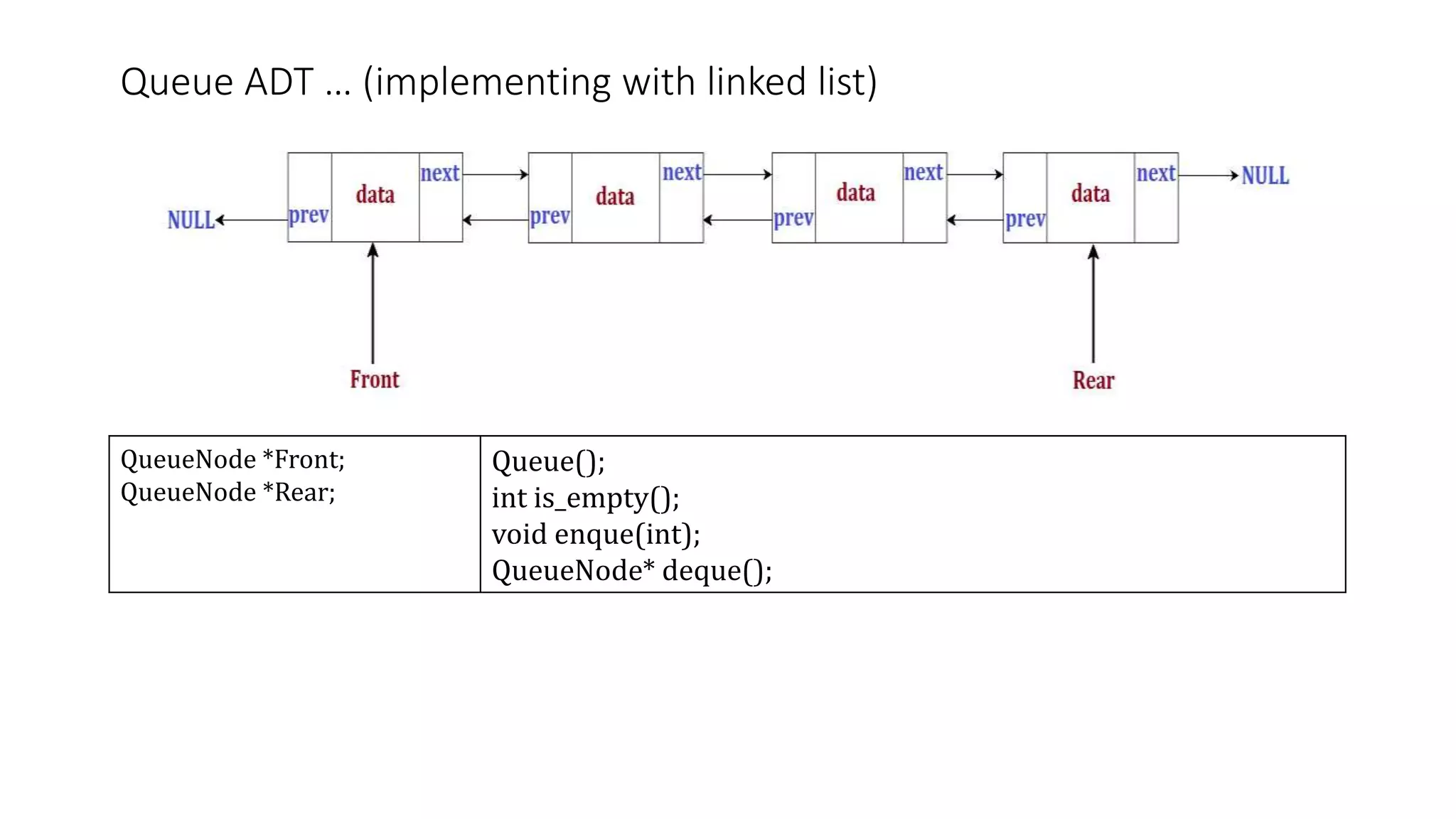
Queue ADT … (implementing with linked list)
QueueNode *Front;
QueueNode *Rear;
Queue();
int is_empty();
void enque(int);
QueueNode* deque();
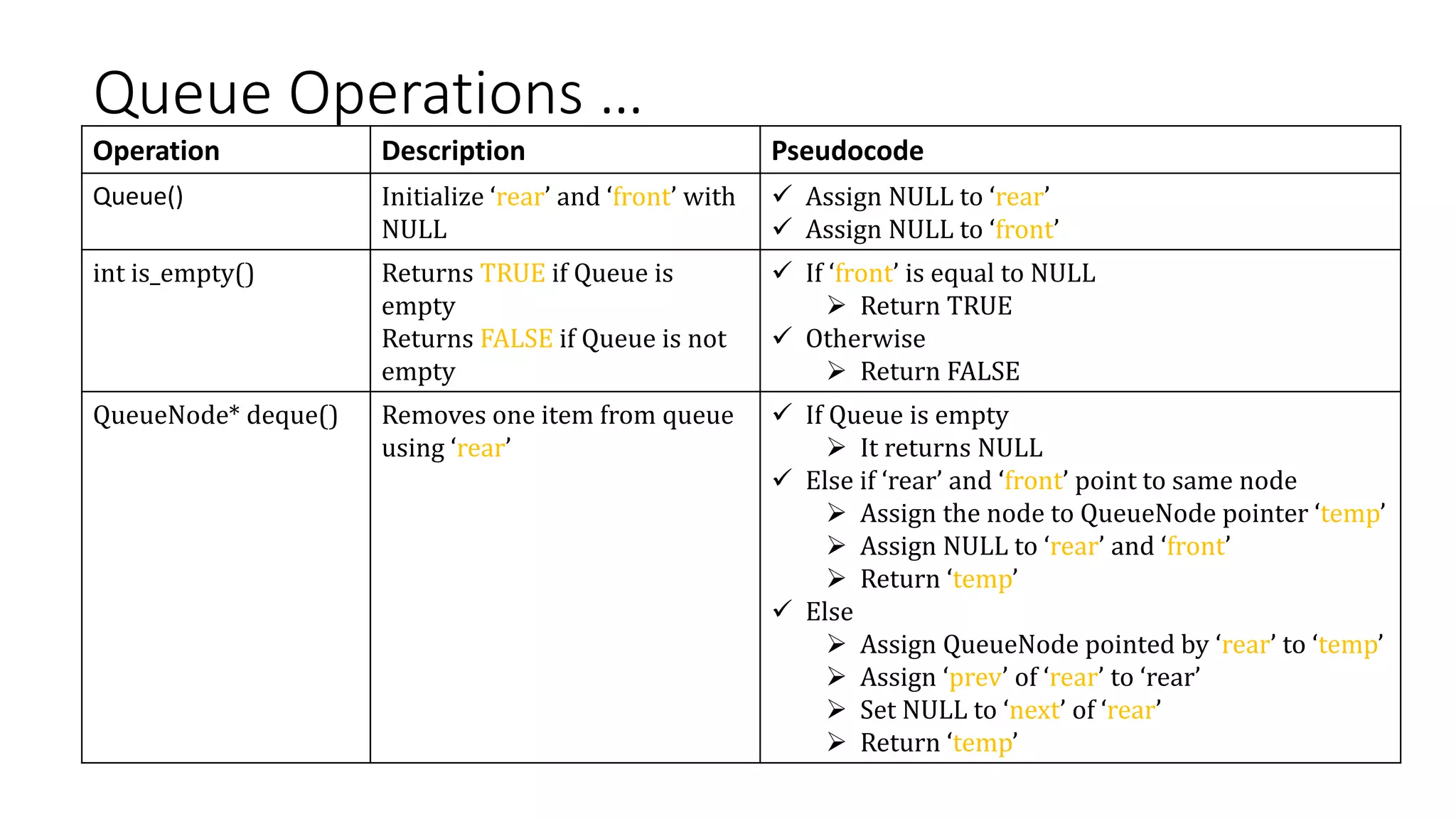
Queue Operations …
Operation Description Pseudocode
Queue() Initialize ‘rear’ and ‘front’ with
NULL
 Assign NULL to ‘rear’
 Assign NULL to ‘front’
int is_empty() Returns TRUE if Queue is
empty
Returns FALSE if Queue is not
empty
 If ‘front’ is equal to NULL
 Return TRUE
 Otherwise
 Return FALSE
QueueNode* deque() Removes one item from queue
using ‘rear’
 If Queue is empty
 It returns NULL
 Else if ‘rear’ and ‘front’ point to same node
 Assign the node to QueueNode pointer ‘temp’
 Assign NULL to ‘rear’ and ‘front’
 Return ‘temp’
 Else
 Assign QueueNode pointed by ‘rear’ to ‘temp’
 Assign ‘prev’ of ‘rear’ to ‘rear’
 Set NULL to ‘next’ of ‘rear’
 Return ‘temp’
Queue Operations …
Operation Description Pseudocode
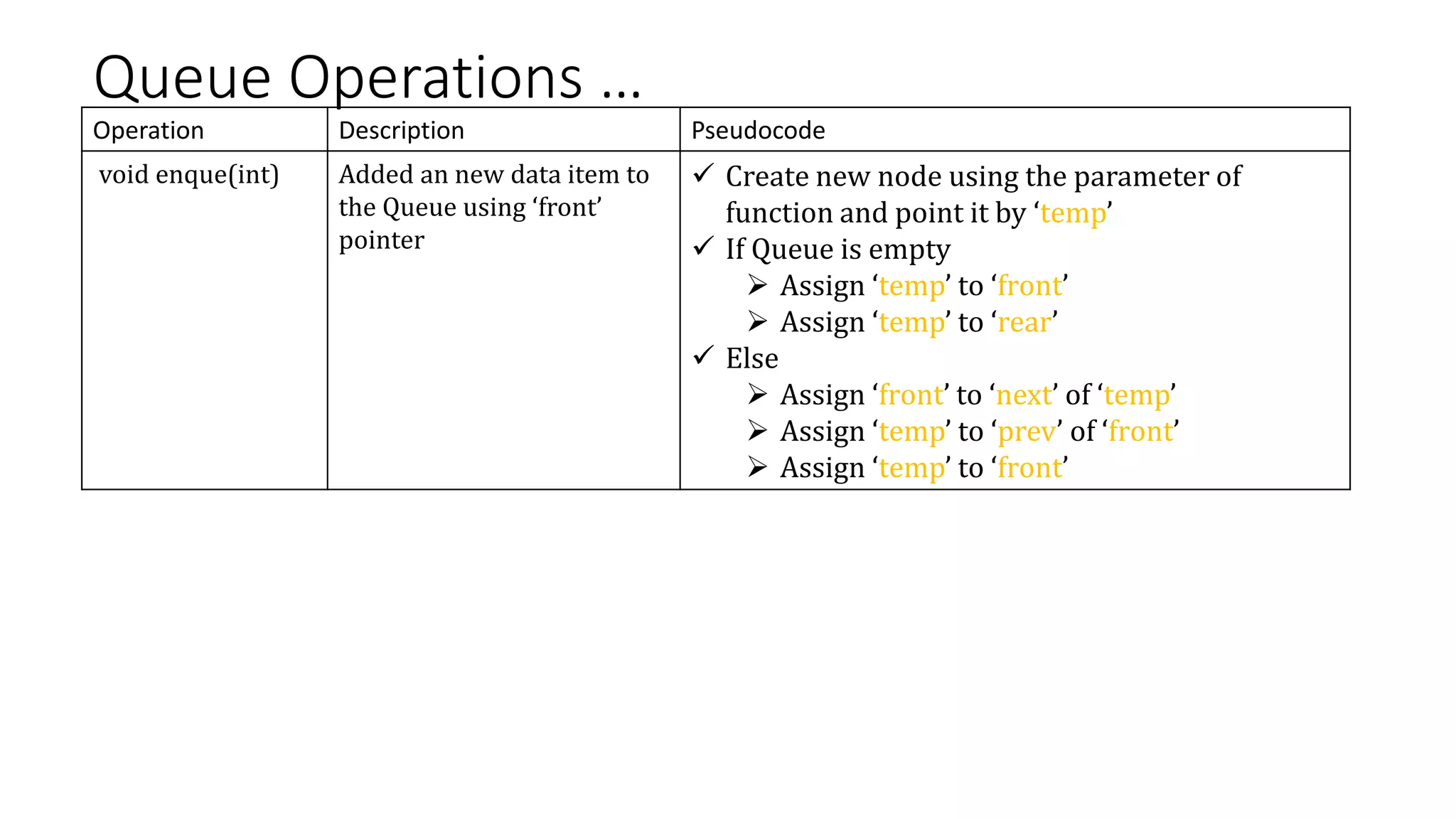
void enque(int) Added an new data item to
the Queue using ‘front’
pointer
 Create new node using the parameter of
function and point it by ‘temp’
 If Queue is empty
 Assign ‘temp’ to ‘front’
 Assign ‘temp’ to ‘rear’
 Else
 Assign ‘front’ to ‘next’ of ‘temp’
 Assign ‘temp’ to ‘prev’ of ‘front’
 Assign ‘temp’ to ‘front’
Queue using array … implementation
Implementation details and issues have been discussed during
class
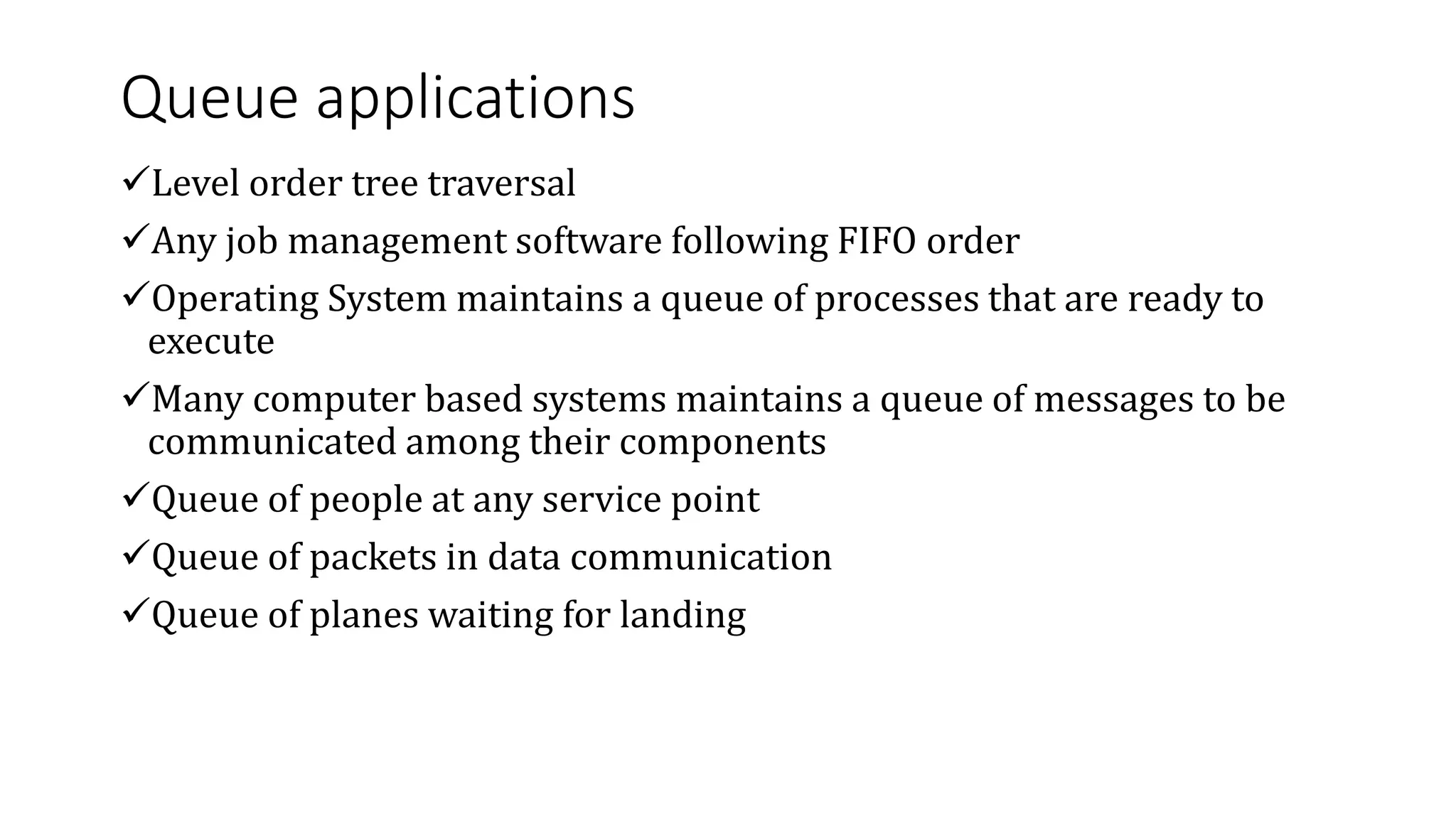
Queue applications
Level order tree traversal
Any job management software following FIFO order
Operating System maintains a queue of processes that are ready to
execute
Many computer based systems maintains a queue of messages to be
communicated among their components
Queue of people at any service point
Queue of packets in data communication
Queue of planes waiting for landing

Data structure 8.pptx

  • 1.
    CS261 DATA STRUCTURES &ALGORITHMS (WEEK-8) LECTURE-15 & 16 INTRODUCTION TO DATA STRUCTURES & ALGORITHMS Lecturer Azka Aziz Azka.a@scocs.edu.pk
  • 2.
    Data structures &Algorithms Lecture#15 Merge Sort
  • 3.
    Lecture Contents Divide &Conquer Divide & Conquer ….. Application (Merge Sort) mergeSort() Merge() Analysis
  • 4.
    Divide & Conquer Idea Distributea larger problem into many small similar problems Solve every smaller problem recursively Combine results of smaller solutions to form the overall solution Usage A typical idea be to split a list of n items into two lists of n/2 size and try to sort them Consequence Running time of sorting can be improved from O(n2) to O(n log n)
  • 5.
    Divide & Conquer….. Application (Merge Sort) Divide and conquer strategy is applicable in a huge number of computational problems. The first application of divide and conquer strategy is a simple and efficient sorting procedure called Merge Sort Input: a list of n numbers is provided as an array A[1…n] Output: a permutation of this sequence sorted in increasing order Method: Split Recursively, Sort, Merge
  • 6.
    Merge Sort Algorithm procmergeSort(arr[1…n], p, r) if p < r then q  (p+r)/2 mergeSort(arr, p, q) mergeSort(arr, q+1, r) merge(arr, p, q, r) end if end proc Every pass of mergeSort() procedure consists of two recursive function calls followed by one call to merge
  • 7.
    Merge Sort Algorithm procmergeSort(arr[1…n], p, r) if p < r then q  (p+r)/2 mergeSort(arr, p, q) mergeSort(arr, q+1, r) merge(arr, p, q, r) end if end proc mergeSort(arr, p, r) function checks whether p (index) is less than r (index) If it is so, it makes two calls to itself splitting the array into two halves Every further call splits array into further two halves with available indexes until p is not less than r (when will this happen?)
  • 8.
    Merge Sort Algorithm procmergeSort(arr[1…n], p, r) if p < r then q  (p+r)/2 mergeSort(arr, p, q) mergeSort(arr, q+1, r) merge(arr, p, q, r) end if end proc Every further call splits array into further two halves with available indexes until p is not less than r (when will this happen?) At this point a merge(arr, p, q, r) call will me made to merge two halves into a sorted chunk
  • 9.
  • 10.
    merge() call merge(arr, p,q, r) assumes that two halves of array [p….q], [q+1….r] are sorted (Why is it? We have not sorted anything yet? Is there some statement in mergeSort() procedure that does the sorting part?) proc mergeSort(arr[1…n], p, r) if p < r then q  (p+r)/2 mergeSort(arr, p, q) mergeSort(arr, q+1, r) merge(arr, p, q, r) end if end proc
  • 11.
    mergeSort() calls …Visually We have not sorted anything yet? Is there some statement in mergeSort() procedure that does the sorting part? We just relied on a simple fact that splitting an array into equal halves will result into smaller and smaller arrays till there is only one element in array Is single element array sorted? Always?
  • 12.
    merge(arr, p, q,r) calls … Every merge() call receives three parameters (except the data array) i.e. p, q, r Values between indexes p….q and q+1……r are sorted (independent of each other) Having two sorted sub-arrays, merging part is easier:::
  • 13.
    merge(arr, p, q,r) calls … proc merge(arr, p, q, r) ip, kp, jq+1 temp[p…r] // using a temporary array while i ≤ q and j ≤ r do if arr[i] < arr[j] then temp[k++]  arr[i++] else temp[k++]  arr[j++] end if next
  • 14.
    merge(arr, p, q,r) calls … continued while i ≤ q do temp[k++]  arr[i++] next while j ≤ r do temp[k++]  arr[j++] next for i p to r do arr[i]  temp[i] next end proc
  • 15.
  • 16.
    Merge Sort Analysis Firstwe analyze merge() procedure First let us consider the running time of the procedure merge(A, p, q, r). Let n = r - p + 1 denote the total length of both the left and right sub- arrays. What is the running time of Merge as a function of n?
  • 17.
    Merge Sort Analysis Costof mergeSort(with n elements) = cost of mergeSort(n/2 elements) + cost of mergeSort(n/2 elements) + cost of merge(n elements) MS(n) = MS(n/2) + MS(n/2)+M(n) MS(n) = 2MS(n/2) + M(n)
  • 18.
    Merge Sort Analysis T(1)= 1 T(2) = T(1) + T(1) + 2 = 1 + 1 + 2 = 4 T(3) = T(2) + T(1) + 3 = 4 + 1 + 3 = 8 T(4) = T(2) + T(2) + 4 = 8 + 8 + 4 = 12 T(5) = T(3) + T(2) + 5 = 8 + 4 + 5 = 17 . . . T(8) = T(4) + T(4) + 8 = 12 + 12 + 8 = 32 . . . T(16) = T(8) + T(8) + 16 = 32 + 32 + 16 = 80 T(32) = T(16) + T(16) + 32 = 80 + 80+ 32 = 192
  • 19.
    Merge Sort AnalysisT(1) = 1 T(2) = T(1) + T(1) + 2 = 1 + 1 + 2 = 4 T(3) = T(2) + T(1) + 3 = 4 + 1 + 3 = 8 T(4) = T(2) + T(2) + 4 = 8 + 8 + 4 = 12 T(5) = T(3) + T(2) + 5 = 8 + 4 + 5 = 17 . . . T(8) = T(4) + T(4) + 8 = 12 + 12 + 8 = 32 . . . T(16) = T(8) + T(8) + 16 = 32 + 32 + 16 = 80 T(32) = T(16) + T(16) + 32 = 80 + 80+ 32 = 192 Is there some pattern? Let’s try T(n)/n = log n + 1 T(n) = n log n + n O(n log n)
  • 20.
    Merge Sort Analysis… Recurrence Relation T(n) = 2 T(n/2) + n Expanding we get T(n) = 2 (2T(n/4)+n/2)+n ….. ? How? = 4 T(n/4) + n + n = 8 T(n/8) + n + n + n = 16 T(n/16) + n + n + n + n = ……………. Now to solve it assuming that n = 2k, T(n) = 2k T(n/2k) + (n+n+n+n k items) T(n) = 2k T(n/2k) + kn
  • 21.
    Merge Sort Analysis… Recurrence Relation T(n) = 2 T(n/2) + n Expanding we get T(n) = 2 (2T(n/4)+n/2)+n = 4 T(n/4) + n + n = 8 T(n/8) + n + n + n = 16 T(n/16) + n + n + n + n = ……………. Now to solve it assuming that n = 2k, T(n) = 2k T(n/2k) + (n+n+n+n k Since n = 2k, i.e. k = log n T(n) = 2log n T(n/2log n) + (log n)n T(n) = n T(1) + n log n T(n) = n + n log n i.e. T(n) = O (n)
  • 22.
    Merge Sort Analysis… Recurrence Relation
  • 23.
    Data structures &Algorithms Lecture#16 Queue
  • 24.
    Queue Data Structure Queueis a data structure that is used to store data items. Data items are stored in Queue one by one. Stored data items when removed from Queue follow First In First Out order.
  • 25.
    Queue Queue maintains twocontrol variables i. rear ii. front Data items are removed from Queue (deque() operation) using control variable ‘rear’ Data items are added to the Queue (enque() operation) using control variable ‘front’ Data item being enqued to Queue earliest will be removed from Queue earliest following First In First Out order (FIFO) Queue can be implemented using an Array as well as a Linked List
  • 26.
    Queue Operations … OperationDescription Pseudocode Queue() Initialize ‘rear’ and ‘front’ with -1  Assign -1 to ‘rear’  Assign -1 to ‘front’ int is_empty() Returns TRUE if Queue is empty Returns FALSE if Queue is not empty  If ‘rear’ is less than ‘front’  Return FALSE  Otherwise  Return TRUE int is_full() Returns TRUE if Queue is empty Returns FALSE if Queue is not empty  If ‘rear’ is equal to -1 AND ‘front’ is equal to MAX-1 then  Return TRUE  Otherwise  Return FALSE
  • 27.
    Queue Operations … OperationDescription Pseudocode int deque() Removes one item from queue using ‘rear’  If Queue is empty  It returns -1  Otherwise  Increment ‘rear’ by 1  Return value at current location of ‘rear’ void refresh() Relocates the queue elements so that empty positions are available post ‘front’ pointer  All elements are relocated to the smaller index positions making empty positions available post the ‘front’ locations  Assign -1 to ‘rear’ and value of (‘front’-’rear’-1) to ‘front’ void enque() Added an new data item to the Queue using ‘front’ pointer  If Queue is full, Nothing can be added  Else if ‘front’ is equal to MAX-1 then  Refresh is called, ‘front’ is incremented by 1, New element is added at ‘front’ location  Otherwise  ‘front’ is incremented by 1, New element is added at ‘front’ location
  • 28.
    Queue using array… implementation Implementation details and issues have been discussed during class
  • 29.
    Queue ADT …(implementing with linked list)
  • 30.
    Queue ADT …(implementing with linked list) QueueNode *Front; QueueNode *Rear; Queue(); int is_empty(); void enque(int); QueueNode* deque();
  • 31.
    Queue Operations … OperationDescription Pseudocode Queue() Initialize ‘rear’ and ‘front’ with NULL  Assign NULL to ‘rear’  Assign NULL to ‘front’ int is_empty() Returns TRUE if Queue is empty Returns FALSE if Queue is not empty  If ‘front’ is equal to NULL  Return TRUE  Otherwise  Return FALSE QueueNode* deque() Removes one item from queue using ‘rear’  If Queue is empty  It returns NULL  Else if ‘rear’ and ‘front’ point to same node  Assign the node to QueueNode pointer ‘temp’  Assign NULL to ‘rear’ and ‘front’  Return ‘temp’  Else  Assign QueueNode pointed by ‘rear’ to ‘temp’  Assign ‘prev’ of ‘rear’ to ‘rear’  Set NULL to ‘next’ of ‘rear’  Return ‘temp’
  • 32.
    Queue Operations … OperationDescription Pseudocode void enque(int) Added an new data item to the Queue using ‘front’ pointer  Create new node using the parameter of function and point it by ‘temp’  If Queue is empty  Assign ‘temp’ to ‘front’  Assign ‘temp’ to ‘rear’  Else  Assign ‘front’ to ‘next’ of ‘temp’  Assign ‘temp’ to ‘prev’ of ‘front’  Assign ‘temp’ to ‘front’
  • 33.
    Queue using array… implementation Implementation details and issues have been discussed during class
  • 34.
    Queue applications Level ordertree traversal Any job management software following FIFO order Operating System maintains a queue of processes that are ready to execute Many computer based systems maintains a queue of messages to be communicated among their components Queue of people at any service point Queue of packets in data communication Queue of planes waiting for landing