Biomaterial refers to any non-vital material 
intended to interact with biological system 
within or on the human body. 
Dental materials inserted into the oral cavity 
therefore belongs into the group of 
biomaterials. 
Biocompatibility of Dental materials – Schmalz & Bindslev .
 Biomechanics is the study of the structure 
and function of biological systems such 
as humans, animals, plants, organs, 
and cells by means of the methods of 
mechanics. 
The relationship between the biologic 
behaviour of oral structures and the physical 
influence of a dental restoration. 
GPT, 2008
 Joint replacements 
 Bone plates 
 Bone cement 
 Artificial ligaments and tendons 
 Dental implants for tooth fixation 
 Blood vessel prostheses 
 Heart valves 
 Skin repair devices 
 Cochlear replacements 
 Contact lenses 
International Journal of Pharmacy and Pharmaceutical Sciences
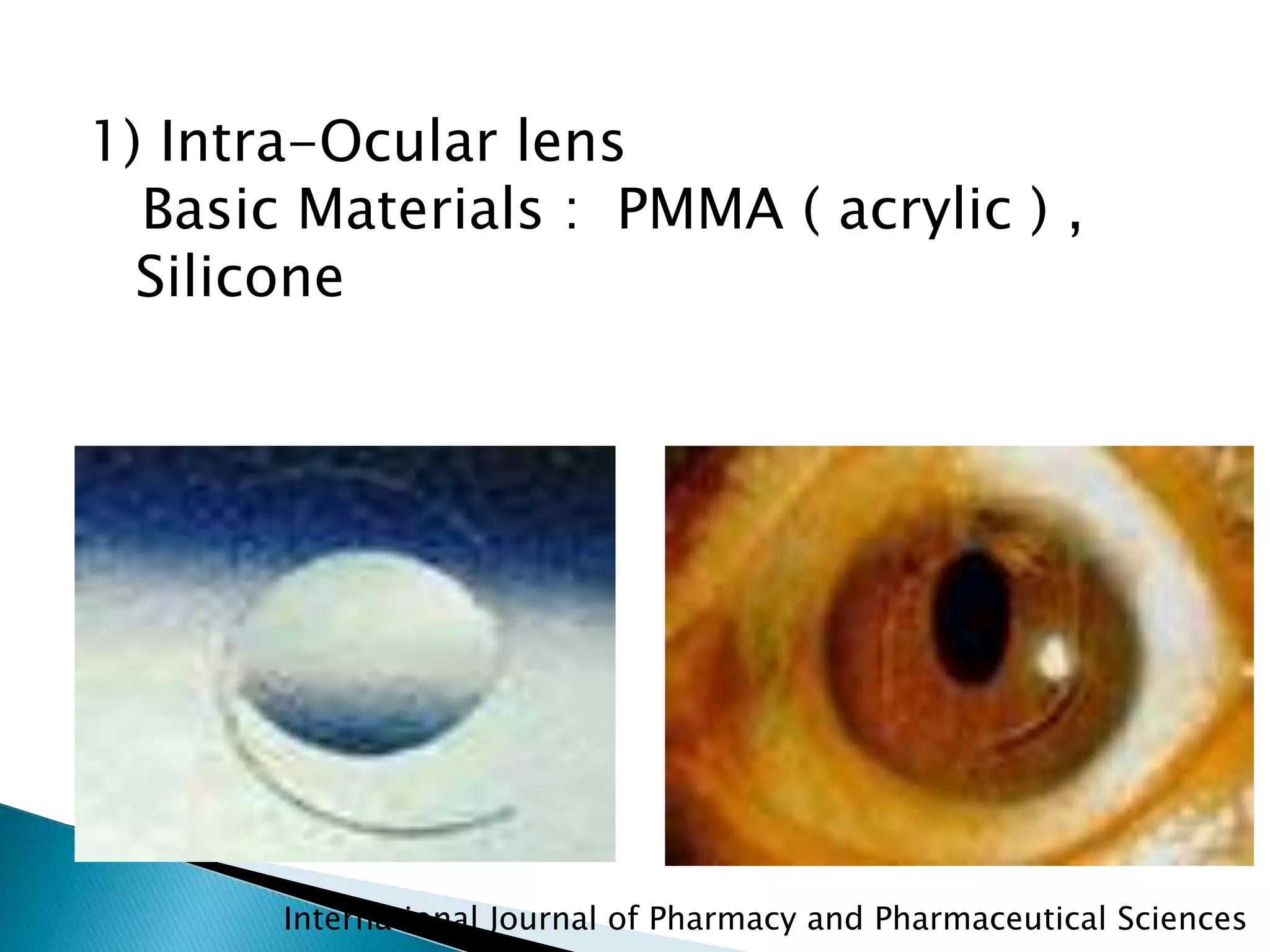
1) Intra-Ocular lens 
Basic Materials : PMMA ( acrylic ) , 
Silicone 
International Journal of Pharmacy and Pharmaceutical Sciences
2) Artificial hip joints 
Basic materials : Stainless steel , 
Titanium and its alloy ,& UHMWPE 
International Journal of Pharmacy and Pharmaceutical Sciences
3) Substitute heart valve 
4) Indian chitra heart valve 
International Journal of Pharmacy and Pharmaceutical Sciences
5) Vascular graft 
Basic materials : Polyurethane , 
Teflon & Dacron 
International Journal of Pharmacy and Pharmaceutical Sciences
 Some commonly used biomaterials 
 1. Silicone rubber 
 2. Dacron 
 3. Cellulose 
 4. Poly( methyl methacrylate ) 
 5. Polyurethanes 
 6. Hydrogels 
 7. Stainless steel 
 8. titanium 
 9. Alumina 
 10. Hydroxyapatite 
 11. Collagen (reprocessed) 
International Journal of Pharmacy and Pharmaceutical Sciences
Applications 
• Catheters, tubing 
• Vascular grafts 
• Dialysis membrane 
• Intraocular lenses, bone cement 
• catheters, Pacemaker leads 
• Ophthalmological devices, Drug delivery 
• Orthopaedic devices, stents 
• Orthopaedic & Dental devices 
• Ophthalmologic applications, wound 
dressings 
International Journal of Pharmacy and Pharmaceutical Sciences
Three types 
 Preventive materials. 
 Restorative materials. 
 Auxiliary materials. 
Dental Materials - Anusavice
Preventive materials 
 Compomer 
 Hybrid ionomer 
 Glass ionomer cement 
 zinc silicophosphate cement 
Dental Materials - Anusavice
Restorative materials: 
 Cement 
 Bases 
 Amalgams 
 Resin-based composites 
 Compomers 
 Hybrid ionomers, 
 Cast metals, 
 Metal-ceramics 
 Ceramics 
 Denture polymers. 
Dental Materials - Anusavice
 Auxiliary dental materials are substances that 
are used in the process of fabricating dental 
prostheses. 
e.g. acid etching solutions ,impression 
materials, casting investments, gypsum cast 
and model materials, dental waxes, acrylic 
resins etc. 
Dental Materials - Anusavice
Tribology is the “science and technology of 
interacting surfaces in relative motion” and 
encompasses the study of friction, wear and 
lubrication. By extension biotribology is 
usually defined as the tribological 
phenomena occurring in either the human 
body or in animals. 
Biotribology J. Paulo DavimJ.
 Biocompatibility (biomedical therapy): Ability 
of a material to perform with 
an appropriate host response in a specific 
application. 
 Biocompatibility: Ability to be in contact with 
a living system without producing 
an adverse effect. 
GPT 2005
 Implant : To graft or insert a material such 
as an alloplastic substance, an encapsulated 
drug, or tissue into the body of a recipient. 
GPT 2005 
 Material used for fabrication of implant are 
characterized into 
 >Chemical point : metals and ceramic. 
 > Biological point : biodynamic materials : 
biotolorent , bioinhert, and bioactive. 
Biomaterial for dental implant : An overview
Metals and alloys 
 Titanium 
 Titanium alloy 
>Ti-6Al-V 
>Ti-30Pd 
 Cobalt-chromium-Molybdenum alloy 
 Iron-Chromium-Nickel based alloy 
 Alloys of gold , platinum , & palladium 
Biomaterial for dental implant : An overview
Ceramic : 
 Bioactive ceramic 
Bioglass , Glass ceramic 
 Bioresorble ceramic 
Calcium phosphate 
 Bioinhert ceramic 
Alumina , Zirconia and carbon 
Biomaterial for dental implant : An overview
Polymers 
 Polytetrafluroethylene ( PTFE) 
 Polyethyleneterephthalate (PET) 
 Polymethylmethacrylate ( PMMA) 
Biomaterial for dental implant : An overview
1. The material must be biocompatible 
 Nontoxic, nonirritating 
 Nonallergenic, noncarcinogenic 
 Chemically minimally degradable or its degradation 
process are biocompatible 
2. Should possess appropriate optimal physical 
property 
 Adequate mechanical properties such as hardness, 
elasticity, and strength. 
 Adequate wear resistance. 
Prosthodontic treatment for edentulous patient
 Adequate thermal coefficient of expansion and 
conductivity properties. 
 Adequate esthetic properties. 
 Ease of cleansing. 
 Relative ease of fabrication and manipulation. 
 Readily available and economical to use. 
 Allow for easy and inexpensive maintenance 
such as repair and addition. 
Prosthodontic treatment for edentulous patient
1. They should have low enough viscosity to adapt 
to the oral tissue, yet viscous enough to be 
contained in the impression tray. 
2. The materials should have adequate wettability 
of the oral tissue to allow for the accurate 
adaptation and capturing of the oral structure 
and tissues. 
3. Material must have pleasant taste and odor. 
4. In mouth the material should set into a rubbery 
or rigid solid in reasonable amount of time. 
5. Upon removal from the mouth, the set 
impression should show adequate elastic 
recovery with no permanent deformation.
6. The material must have adequate strength to 
avoid tear or breakage upon removal from 
the mouth. 
7. The material must be dimensionally stable 
after setting and until pouring of the cast. 
8. The impression can remain dimensionally 
stable to be repoured after removal from the 
cast. 
9. The material must be compatible with the 
cast material. 
10. The material must be biocompatible , 
nontoxic, and without irritant constituents.
11. The material must be of a colour and opacity 
that allow for proper evaluation of the 
impression by the dentist. 
12. The material could be readily disinfected 
without significant loss of accuracy or loss of 
mechanical properties. 
13. The materials must have adequate shelf life 
for storage. 
14. The materials associated processing time 
and equipments should be cost-effective.
 Non-elastic 
 Elastic 
◦ Aqueous hydrocolloids 
 Agar 
 Alginate 
◦ Non-aqueous elastomers 
 Polysulfide 
 Silicones 
 Condensation 
 Addition 
 Polyether
 Diagnostic casts 
◦ preliminary 
◦ opposing 
 Indirect 
reconstruction 
◦ fixed 
◦ removable 
 Bite registration
Impression materials 
1) Non-elastic 
a) Plaster 
b) Compound 
c) Waxes 
d) Zinc oxide eugenol
2) Elastic materials 
a) Aqueous hydrocolloids 
> Reversible ( Agar) 
> Irreversible( Alginate ) 
b) Non-aqueous elastomer 
>Polysulfide 
>silicone 
1) Condensation silicone 
2) Addition silicone 
> Polyether
Impression plaster 
 It was used as a “mucostatic’’ impression 
material. 
 It does not compress and displace tissue 
during seating of the tray. 
 Applicable to patient with displaceable soft 
tissue that should de recorded in a passive 
state. 
Components : calcium sulphate hemihydrate 
which reacts with water to form calcium 
sulphate dihydrate which is homogenous in 
consistency.
Properties: 
 Dimensionally stable 
 It has low viscosity before setting 
 It is nonelastic, fracture may come across 
when their is an undercut
1. Mainly used for final impression of 
edentulous ridge with minor or no 
undercuts. 
2. As a wash impression with other materials 
such as impression compound. 
3. As an occlusal registration materials. 
4. Used as a temporary liner material for 
denture. 
5. Used as a surgical dressing.
Types of impression compound: 
1. Type I ( lower fusing material) 
e.g. Impression cakes , green stick. 
2. Type II ( Higher fusing material) : It is used 
as a tray adaptation material. It is used for 
making a primary impression and used as a 
tray to support a thin layer of a second 
impression materials.
1. Thermoplastic resin. 
2. Waxes. 
3. Fillers ( for viscosity ). 
4. Shellac. 
5. Stearic acid. 
6. Gutta percha. ( plasticity and workability )
Reversible Hydrocolloid 
(Agar) 
 Indications 
They are considered one of the most 
accurate materials for recording fine details 
because of its low viscosity. 
 Example 
◦ Slate Hydrocolloid (Van R)
 Agar 
◦ complex polysaccharide 
 seaweed 
◦ gelling agent 
 Borax 
◦ strength 
 Potassium sulfate 
◦ improves gypsum surface 
 Water (85%)
 Dimensionally accurate 
 Hydrophilic 
◦ displaces moisture, blood, fluids 
 Inexpensive 
◦ after initial equipment 
 No custom tray or adhesives 
 Pleasant flavor 
 No mixing required
 Initial expense 
◦ special equipment 
 Material must be prepared in advanced 
 Tears easily 
 Dimensionally unstable 
◦ Must be poured immediately 
◦ Can only be used for a single cast 
 Difficult to disinfect
 Setting process of hydrocolloids is called 
gelation. 
 It is a solidification process that involves 
phase changes from sol to gel states. 
 The gel transforms into sol condition when 
heated to 70˚ to 100˚ C is called liquefaction 
temperature. 
 When cooled to (between 37˚and50˚ C) the 
gel transfer to sol and is called gelation 
temperature.
Irreversible hydrocolloid 
Alginate 
 Indications 
study models 
removable fixed partial dentures 
 Framework 
Preliminary impression of the edentulous patient 
 Examples 
◦ Jeltrate (Dentsply/Caulk) 
◦ Coe Alginate (GC America)
Component 
 Potassium alginate : Soluble alginate 
 Calcium sulphate dihydrate : Reactor 
 Zinc oxide : Filler particles 
 Potassium titanium fluoride : Accelerator 
 Diatomaceous earth : Filler particles 
 Sodium phosphate : Retarder
 Inexpensive 
 Easy to use 
 Hydrophilic 
◦ displace moisture, blood, fluids 
 Stock trays
 Tears easily 
 Dimensionally unstable 
◦ immediate pour 
◦ single cast 
 Lower detail reproduction 
 High permanent deformation
 First dental elastomers 
 Indications 
◦ complete denture 
◦ removable fixed partial denture 
 tissue 
◦ crown and bridge 
 Examples 
◦ Permlastic (Kerr) 
◦ Omni-Flex (GC America)
 Base 
◦ polysulfide polymers 
◦ fillers 
◦ plasticizers 
 Catalyst 
◦ lead dioxide (or copper) 
◦ fillers 
 By-product 
◦ water
 Lower cost 
◦ compared to silicones and polyethers 
 Long working time 
 High tear strength 
 High flexibility 
 Good detail reproduction
 Poor dimensional stability 
◦ water by-product 
◦ pour within one hour 
◦ single pour 
 Custom trays 
 Messy 
◦ paste-paste mix 
◦ bad odor 
◦ may stain clothing 
 Long setting time
 Indications 
◦ complete dentures 
◦ crown and bridge 
 Examples 
◦ Speedex (Coltene/Whaledent) 
◦ Primasil (TISS Dental)
 Base 
◦ poly(dimethylsiloxane) 
◦ tetraethylorthosilicate 
◦ filler 
 Catalyst 
◦ metal organic ester 
 By-product 
◦ ethyl alcohol
 Better elastic properties 
 Clean, pleasant 
 Stock tray 
◦ putty-wash 
 Good working and setting time
 Poor dimensional stability 
◦ high shrinkage 
 polymerization 
 evaporation of ethanol 
◦ pour immediately 
 within 30 minutes 
 Hydrophobic 
◦ poor wettability
 AKA: Vinyl polysiloxane 
 Indications 
crown and bridge 
denture 
bite registration 
 Examples 
Extrude (Kerr) 
Express (3M/ESPE) 
Aquasil (Dentsply Caulk) 
Genie (Sultan Chemists) 
Virtual (Ivoclar Vivadent)
 Improvement over condensation silicones 
◦ no by-product 
 First paste 
◦ vinyl poly(dimethylsiloxane) 
prepolymer 
 Second paste 
◦ siloxane prepolymer 
 Catalyst 
◦ chloroplatinic acid
 Highly accurate 
 High dimensional stability 
◦ pour up to one week 
 Stock or custom trays 
 Multiple casts 
 Easy to mix 
 Pleasant odor
 Expensive 
 Pumice teeth before 
impression 
 Short working time 
 Lower tear strength 
 Possible hydrogen gas release 
bubbles on die 
palladium added to absorb
 Indications 
◦ crown and bridge 
◦ bite registration 
 Examples 
◦ Impregum F (3M/ESPE) 
◦ Permadyne (3M/ESPE) 
◦ Pentamix (3M/ESPE) 
◦ P2 (Heraeus Kulzer) 
◦ Polygel (Dentsply Caulk)
 Highly accurate 
 Good dimensional stability 
 Stock or dual-arch trays 
 Good surface detail 
 Pour within one week 
◦ kept dry 
 Multiple casts 
 Good wettability
 Expensive 
 Short working time 
 Rigid 
◦ difficult to remove from undercuts 
 Bitter taste 
 Low tear strength 
 Absorbs water 
◦ changes dimension
 Zinc oxide eugenol impression can be 
disinfected by immersion in a 2% alkaline 
glutaraldehyde solution then rinsed and 
poured . 
 Impression compound can be safely 
disinfected by immersion in sodium 
hypochlorite, iodophors, or phenolic 
glutaraldehydes.
 Agar can be disinfected by immersion in 
sodium hypochlorite, iodophor, and 
glutaraldehyde , rinsed and then poured in 
stone. 
 To control infection and microbial 
contamination in alginate, disinfectant 
materials, such as chlorhexidine acetate or 
quaternary ammonium are added.
 Elastomeric impressions 
Disinfected adequately by immersion in an 
iodophor, diluted hypochlorite solution, 
chlorine dioxide, glutaraldehyde, or complex 
phenol for the time required for 
tuberculocidal activity.
 Crown & Bridge 
◦ vinylpolysiloxane 81% 
◦ alginate 38% 
◦ polyether 28% 
 Inlays and Onlays 
◦ vinylpolysiloxane 71% 
◦ polyether 22% 
◦ alginate 20%
 Complete dentures 
◦ Alginate 58% 
◦ Vinylpolysiloxane 55% 
◦ Polyether 27% 
 Partial dentures 
◦ Alginate 78% 
◦ Vinylpolysiloxane 43% 
◦ Polyether 15%
 Working time 
◦ longest to shortest 
 agar > polysulfide > silicones > alginate= polyether 
 Setting time 
◦ shortest to longest 
 alginate < polyether < agar < silicones < polysulfide
 Stiffness 
◦ most to least 
 polyether > addition silicone > condensation silicone 
> polysulfide = hydrocolloids 
 Tear strength 
◦ greatest to least 
 polysulfide > addition silicone > polyether > 
condensation silicone >> hydrocolloids
 Cost 
◦ lowest to highest 
 alginate < agar = polysulfide <condensation silicone 
< addition silicone < polyether 
 Dimensional stability 
◦ best to worst 
 addition silicone > polyether > polysulfide > 
condensation silicone > hydrocolloid
 Wettability 
◦ best to worst 
 hydrocolloids > polyether > hydrophilic addition 
silicone > polysulfide > hydrophobic addition silicone 
= condensation silicone 
 Castability 
◦ best to worst 
 hydrocolloids > hydrophilic addition silicone > 
polyether > polysulfide > hydrophobic addition 
silicone = condensation silicone
 Alginate 88% 
 Polyvinyl Siloxane 85% 
 Polyether 27% 
 Other 6%

01 biomaterials and impressions- dr. ritesh

  • 1.
    Biomaterial refers toany non-vital material intended to interact with biological system within or on the human body. Dental materials inserted into the oral cavity therefore belongs into the group of biomaterials. Biocompatibility of Dental materials – Schmalz & Bindslev .
  • 2.
     Biomechanics isthe study of the structure and function of biological systems such as humans, animals, plants, organs, and cells by means of the methods of mechanics. The relationship between the biologic behaviour of oral structures and the physical influence of a dental restoration. GPT, 2008
  • 3.
     Joint replacements  Bone plates  Bone cement  Artificial ligaments and tendons  Dental implants for tooth fixation  Blood vessel prostheses  Heart valves  Skin repair devices  Cochlear replacements  Contact lenses International Journal of Pharmacy and Pharmaceutical Sciences
  • 4.
    1) Intra-Ocular lens Basic Materials : PMMA ( acrylic ) , Silicone International Journal of Pharmacy and Pharmaceutical Sciences
  • 5.
    2) Artificial hipjoints Basic materials : Stainless steel , Titanium and its alloy ,& UHMWPE International Journal of Pharmacy and Pharmaceutical Sciences
  • 6.
    3) Substitute heartvalve 4) Indian chitra heart valve International Journal of Pharmacy and Pharmaceutical Sciences
  • 7.
    5) Vascular graft Basic materials : Polyurethane , Teflon & Dacron International Journal of Pharmacy and Pharmaceutical Sciences
  • 8.
     Some commonlyused biomaterials  1. Silicone rubber  2. Dacron  3. Cellulose  4. Poly( methyl methacrylate )  5. Polyurethanes  6. Hydrogels  7. Stainless steel  8. titanium  9. Alumina  10. Hydroxyapatite  11. Collagen (reprocessed) International Journal of Pharmacy and Pharmaceutical Sciences
  • 9.
    Applications • Catheters,tubing • Vascular grafts • Dialysis membrane • Intraocular lenses, bone cement • catheters, Pacemaker leads • Ophthalmological devices, Drug delivery • Orthopaedic devices, stents • Orthopaedic & Dental devices • Ophthalmologic applications, wound dressings International Journal of Pharmacy and Pharmaceutical Sciences
  • 10.
    Three types Preventive materials.  Restorative materials.  Auxiliary materials. Dental Materials - Anusavice
  • 11.
    Preventive materials Compomer  Hybrid ionomer  Glass ionomer cement  zinc silicophosphate cement Dental Materials - Anusavice
  • 12.
    Restorative materials: Cement  Bases  Amalgams  Resin-based composites  Compomers  Hybrid ionomers,  Cast metals,  Metal-ceramics  Ceramics  Denture polymers. Dental Materials - Anusavice
  • 13.
     Auxiliary dentalmaterials are substances that are used in the process of fabricating dental prostheses. e.g. acid etching solutions ,impression materials, casting investments, gypsum cast and model materials, dental waxes, acrylic resins etc. Dental Materials - Anusavice
  • 14.
    Tribology is the“science and technology of interacting surfaces in relative motion” and encompasses the study of friction, wear and lubrication. By extension biotribology is usually defined as the tribological phenomena occurring in either the human body or in animals. Biotribology J. Paulo DavimJ.
  • 15.
     Biocompatibility (biomedicaltherapy): Ability of a material to perform with an appropriate host response in a specific application.  Biocompatibility: Ability to be in contact with a living system without producing an adverse effect. GPT 2005
  • 16.
     Implant :To graft or insert a material such as an alloplastic substance, an encapsulated drug, or tissue into the body of a recipient. GPT 2005  Material used for fabrication of implant are characterized into  >Chemical point : metals and ceramic.  > Biological point : biodynamic materials : biotolorent , bioinhert, and bioactive. Biomaterial for dental implant : An overview
  • 17.
    Metals and alloys  Titanium  Titanium alloy >Ti-6Al-V >Ti-30Pd  Cobalt-chromium-Molybdenum alloy  Iron-Chromium-Nickel based alloy  Alloys of gold , platinum , & palladium Biomaterial for dental implant : An overview
  • 18.
    Ceramic : Bioactive ceramic Bioglass , Glass ceramic  Bioresorble ceramic Calcium phosphate  Bioinhert ceramic Alumina , Zirconia and carbon Biomaterial for dental implant : An overview
  • 19.
    Polymers  Polytetrafluroethylene( PTFE)  Polyethyleneterephthalate (PET)  Polymethylmethacrylate ( PMMA) Biomaterial for dental implant : An overview
  • 20.
    1. The materialmust be biocompatible  Nontoxic, nonirritating  Nonallergenic, noncarcinogenic  Chemically minimally degradable or its degradation process are biocompatible 2. Should possess appropriate optimal physical property  Adequate mechanical properties such as hardness, elasticity, and strength.  Adequate wear resistance. Prosthodontic treatment for edentulous patient
  • 21.
     Adequate thermalcoefficient of expansion and conductivity properties.  Adequate esthetic properties.  Ease of cleansing.  Relative ease of fabrication and manipulation.  Readily available and economical to use.  Allow for easy and inexpensive maintenance such as repair and addition. Prosthodontic treatment for edentulous patient
  • 22.
    1. They shouldhave low enough viscosity to adapt to the oral tissue, yet viscous enough to be contained in the impression tray. 2. The materials should have adequate wettability of the oral tissue to allow for the accurate adaptation and capturing of the oral structure and tissues. 3. Material must have pleasant taste and odor. 4. In mouth the material should set into a rubbery or rigid solid in reasonable amount of time. 5. Upon removal from the mouth, the set impression should show adequate elastic recovery with no permanent deformation.
  • 23.
    6. The materialmust have adequate strength to avoid tear or breakage upon removal from the mouth. 7. The material must be dimensionally stable after setting and until pouring of the cast. 8. The impression can remain dimensionally stable to be repoured after removal from the cast. 9. The material must be compatible with the cast material. 10. The material must be biocompatible , nontoxic, and without irritant constituents.
  • 24.
    11. The materialmust be of a colour and opacity that allow for proper evaluation of the impression by the dentist. 12. The material could be readily disinfected without significant loss of accuracy or loss of mechanical properties. 13. The materials must have adequate shelf life for storage. 14. The materials associated processing time and equipments should be cost-effective.
  • 25.
     Non-elastic Elastic ◦ Aqueous hydrocolloids  Agar  Alginate ◦ Non-aqueous elastomers  Polysulfide  Silicones  Condensation  Addition  Polyether
  • 26.
     Diagnostic casts ◦ preliminary ◦ opposing  Indirect reconstruction ◦ fixed ◦ removable  Bite registration
  • 27.
    Impression materials 1)Non-elastic a) Plaster b) Compound c) Waxes d) Zinc oxide eugenol
  • 28.
    2) Elastic materials a) Aqueous hydrocolloids > Reversible ( Agar) > Irreversible( Alginate ) b) Non-aqueous elastomer >Polysulfide >silicone 1) Condensation silicone 2) Addition silicone > Polyether
  • 29.
    Impression plaster It was used as a “mucostatic’’ impression material.  It does not compress and displace tissue during seating of the tray.  Applicable to patient with displaceable soft tissue that should de recorded in a passive state. Components : calcium sulphate hemihydrate which reacts with water to form calcium sulphate dihydrate which is homogenous in consistency.
  • 30.
    Properties:  Dimensionallystable  It has low viscosity before setting  It is nonelastic, fracture may come across when their is an undercut
  • 31.
    1. Mainly usedfor final impression of edentulous ridge with minor or no undercuts. 2. As a wash impression with other materials such as impression compound. 3. As an occlusal registration materials. 4. Used as a temporary liner material for denture. 5. Used as a surgical dressing.
  • 32.
    Types of impressioncompound: 1. Type I ( lower fusing material) e.g. Impression cakes , green stick. 2. Type II ( Higher fusing material) : It is used as a tray adaptation material. It is used for making a primary impression and used as a tray to support a thin layer of a second impression materials.
  • 33.
    1. Thermoplastic resin. 2. Waxes. 3. Fillers ( for viscosity ). 4. Shellac. 5. Stearic acid. 6. Gutta percha. ( plasticity and workability )
  • 34.
    Reversible Hydrocolloid (Agar)  Indications They are considered one of the most accurate materials for recording fine details because of its low viscosity.  Example ◦ Slate Hydrocolloid (Van R)
  • 35.
     Agar ◦complex polysaccharide  seaweed ◦ gelling agent  Borax ◦ strength  Potassium sulfate ◦ improves gypsum surface  Water (85%)
  • 36.
     Dimensionally accurate  Hydrophilic ◦ displaces moisture, blood, fluids  Inexpensive ◦ after initial equipment  No custom tray or adhesives  Pleasant flavor  No mixing required
  • 37.
     Initial expense ◦ special equipment  Material must be prepared in advanced  Tears easily  Dimensionally unstable ◦ Must be poured immediately ◦ Can only be used for a single cast  Difficult to disinfect
  • 38.
     Setting processof hydrocolloids is called gelation.  It is a solidification process that involves phase changes from sol to gel states.  The gel transforms into sol condition when heated to 70˚ to 100˚ C is called liquefaction temperature.  When cooled to (between 37˚and50˚ C) the gel transfer to sol and is called gelation temperature.
  • 39.
    Irreversible hydrocolloid Alginate  Indications study models removable fixed partial dentures  Framework Preliminary impression of the edentulous patient  Examples ◦ Jeltrate (Dentsply/Caulk) ◦ Coe Alginate (GC America)
  • 40.
    Component  Potassiumalginate : Soluble alginate  Calcium sulphate dihydrate : Reactor  Zinc oxide : Filler particles  Potassium titanium fluoride : Accelerator  Diatomaceous earth : Filler particles  Sodium phosphate : Retarder
  • 41.
     Inexpensive Easy to use  Hydrophilic ◦ displace moisture, blood, fluids  Stock trays
  • 42.
     Tears easily  Dimensionally unstable ◦ immediate pour ◦ single cast  Lower detail reproduction  High permanent deformation
  • 43.
     First dentalelastomers  Indications ◦ complete denture ◦ removable fixed partial denture  tissue ◦ crown and bridge  Examples ◦ Permlastic (Kerr) ◦ Omni-Flex (GC America)
  • 44.
     Base ◦polysulfide polymers ◦ fillers ◦ plasticizers  Catalyst ◦ lead dioxide (or copper) ◦ fillers  By-product ◦ water
  • 45.
     Lower cost ◦ compared to silicones and polyethers  Long working time  High tear strength  High flexibility  Good detail reproduction
  • 46.
     Poor dimensionalstability ◦ water by-product ◦ pour within one hour ◦ single pour  Custom trays  Messy ◦ paste-paste mix ◦ bad odor ◦ may stain clothing  Long setting time
  • 47.
     Indications ◦complete dentures ◦ crown and bridge  Examples ◦ Speedex (Coltene/Whaledent) ◦ Primasil (TISS Dental)
  • 48.
     Base ◦poly(dimethylsiloxane) ◦ tetraethylorthosilicate ◦ filler  Catalyst ◦ metal organic ester  By-product ◦ ethyl alcohol
  • 49.
     Better elasticproperties  Clean, pleasant  Stock tray ◦ putty-wash  Good working and setting time
  • 50.
     Poor dimensionalstability ◦ high shrinkage  polymerization  evaporation of ethanol ◦ pour immediately  within 30 minutes  Hydrophobic ◦ poor wettability
  • 51.
     AKA: Vinylpolysiloxane  Indications crown and bridge denture bite registration  Examples Extrude (Kerr) Express (3M/ESPE) Aquasil (Dentsply Caulk) Genie (Sultan Chemists) Virtual (Ivoclar Vivadent)
  • 52.
     Improvement overcondensation silicones ◦ no by-product  First paste ◦ vinyl poly(dimethylsiloxane) prepolymer  Second paste ◦ siloxane prepolymer  Catalyst ◦ chloroplatinic acid
  • 53.
     Highly accurate  High dimensional stability ◦ pour up to one week  Stock or custom trays  Multiple casts  Easy to mix  Pleasant odor
  • 54.
     Expensive Pumice teeth before impression  Short working time  Lower tear strength  Possible hydrogen gas release bubbles on die palladium added to absorb
  • 55.
     Indications ◦crown and bridge ◦ bite registration  Examples ◦ Impregum F (3M/ESPE) ◦ Permadyne (3M/ESPE) ◦ Pentamix (3M/ESPE) ◦ P2 (Heraeus Kulzer) ◦ Polygel (Dentsply Caulk)
  • 56.
     Highly accurate  Good dimensional stability  Stock or dual-arch trays  Good surface detail  Pour within one week ◦ kept dry  Multiple casts  Good wettability
  • 57.
     Expensive Short working time  Rigid ◦ difficult to remove from undercuts  Bitter taste  Low tear strength  Absorbs water ◦ changes dimension
  • 58.
     Zinc oxideeugenol impression can be disinfected by immersion in a 2% alkaline glutaraldehyde solution then rinsed and poured .  Impression compound can be safely disinfected by immersion in sodium hypochlorite, iodophors, or phenolic glutaraldehydes.
  • 59.
     Agar canbe disinfected by immersion in sodium hypochlorite, iodophor, and glutaraldehyde , rinsed and then poured in stone.  To control infection and microbial contamination in alginate, disinfectant materials, such as chlorhexidine acetate or quaternary ammonium are added.
  • 60.
     Elastomeric impressions Disinfected adequately by immersion in an iodophor, diluted hypochlorite solution, chlorine dioxide, glutaraldehyde, or complex phenol for the time required for tuberculocidal activity.
  • 61.
     Crown &Bridge ◦ vinylpolysiloxane 81% ◦ alginate 38% ◦ polyether 28%  Inlays and Onlays ◦ vinylpolysiloxane 71% ◦ polyether 22% ◦ alginate 20%
  • 62.
     Complete dentures ◦ Alginate 58% ◦ Vinylpolysiloxane 55% ◦ Polyether 27%  Partial dentures ◦ Alginate 78% ◦ Vinylpolysiloxane 43% ◦ Polyether 15%
  • 63.
     Working time ◦ longest to shortest  agar > polysulfide > silicones > alginate= polyether  Setting time ◦ shortest to longest  alginate < polyether < agar < silicones < polysulfide
  • 64.
     Stiffness ◦most to least  polyether > addition silicone > condensation silicone > polysulfide = hydrocolloids  Tear strength ◦ greatest to least  polysulfide > addition silicone > polyether > condensation silicone >> hydrocolloids
  • 65.
     Cost ◦lowest to highest  alginate < agar = polysulfide <condensation silicone < addition silicone < polyether  Dimensional stability ◦ best to worst  addition silicone > polyether > polysulfide > condensation silicone > hydrocolloid
  • 66.
     Wettability ◦best to worst  hydrocolloids > polyether > hydrophilic addition silicone > polysulfide > hydrophobic addition silicone = condensation silicone  Castability ◦ best to worst  hydrocolloids > hydrophilic addition silicone > polyether > polysulfide > hydrophobic addition silicone = condensation silicone
  • 67.
     Alginate 88%  Polyvinyl Siloxane 85%  Polyether 27%  Other 6%