CHARACTERIZATION OF THE ADHESIVE
INTERACTIONS BETWEEN CELLS AND
BIOMATERIALSHTTPS://WWW.RESEARCHGATE.NET/PROFILE/SITANSU_NANDA3
HTTP://SCHOLAR.GOOGLE.CO.KR/CITATIONS?USER=EPAML2OAAAAJ&HL=EN
INTRODUCTION
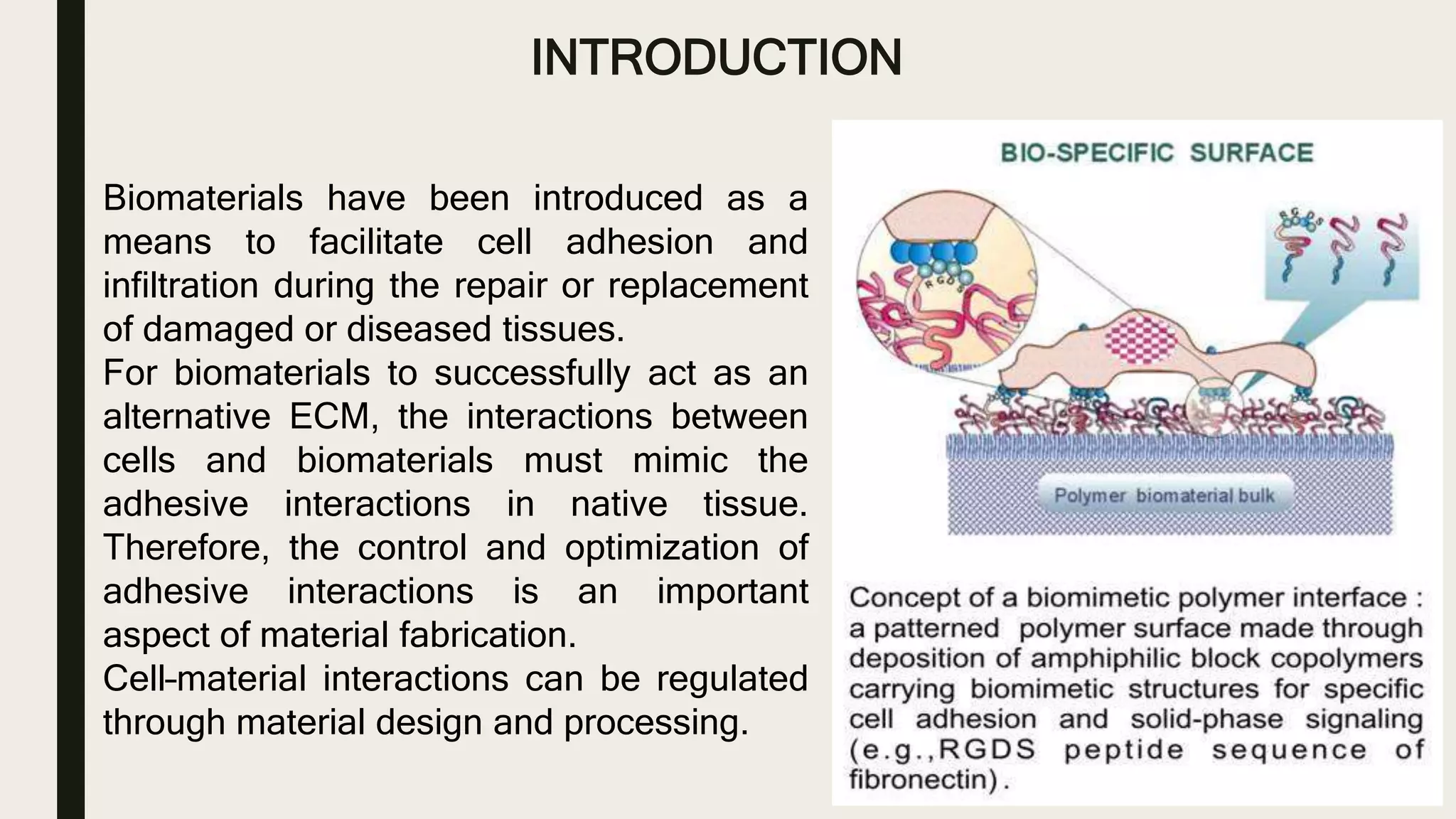
Biomaterials have been introduced as a
means to facilitate cell adhesion and
infiltration during the repair or replacement
of damaged or diseased tissues.
For biomaterials to successfully act as an
alternative ECM, the interactions between
cells and biomaterials must mimic the
adhesive interactions in native tissue.
Therefore, the control and optimization of
adhesive interactions is an important
aspect of material fabrication.
Cell–material interactions can be regulated
through material design and processing.
ADHESION RECEPTORS IN NATIVE TISSUE
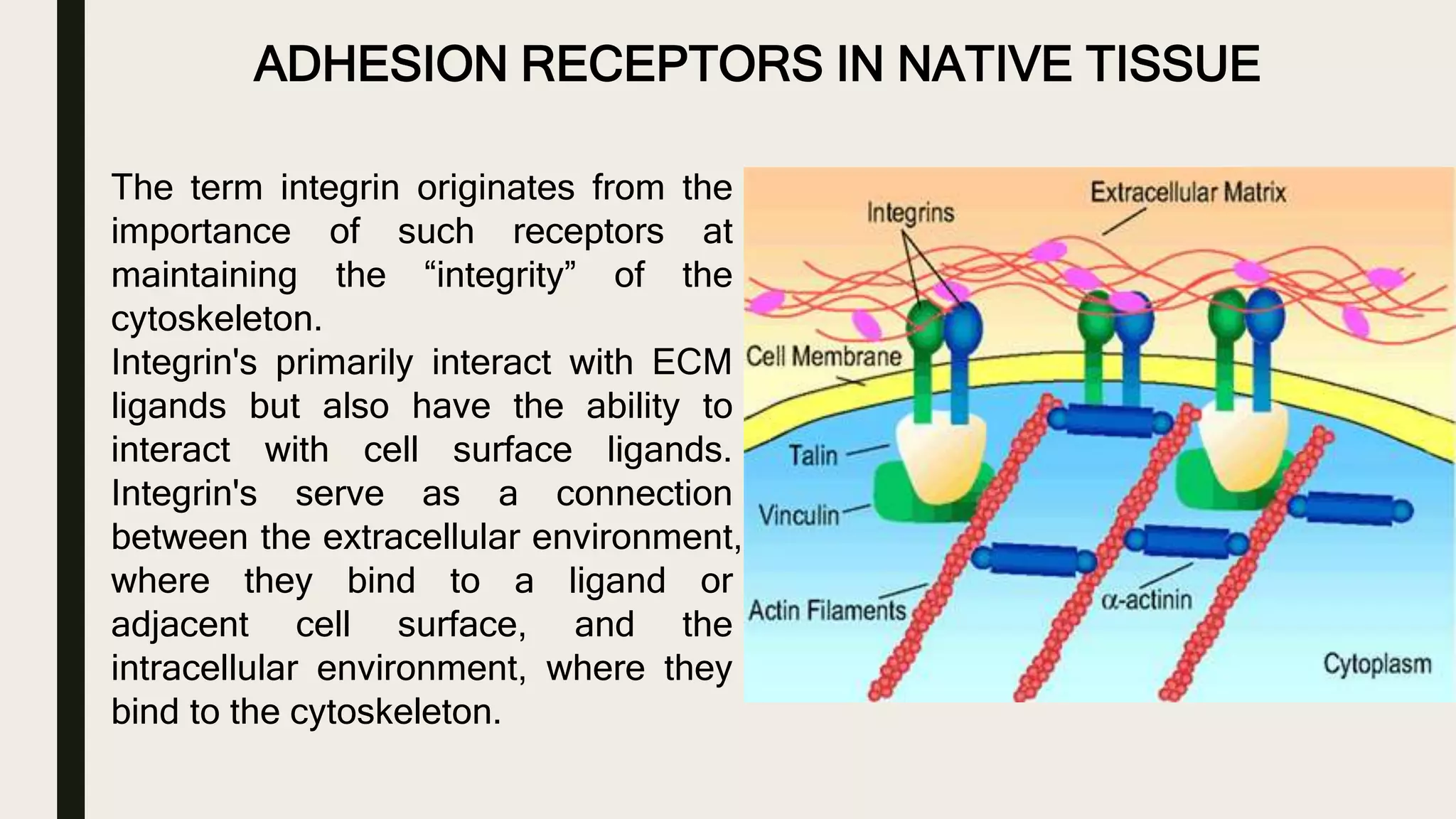
The term integrin originates from the
importance of such receptors at
maintaining the “integrity” of the
cytoskeleton.
Integrin's primarily interact with ECM
ligands but also have the ability to
interact with cell surface ligands.
Integrin's serve as a connection
between the extracellular environment,
where they bind to a ligand or
adjacent cell surface, and the
intracellular environment, where they
bind to the cytoskeleton.
CLASSIFICATION
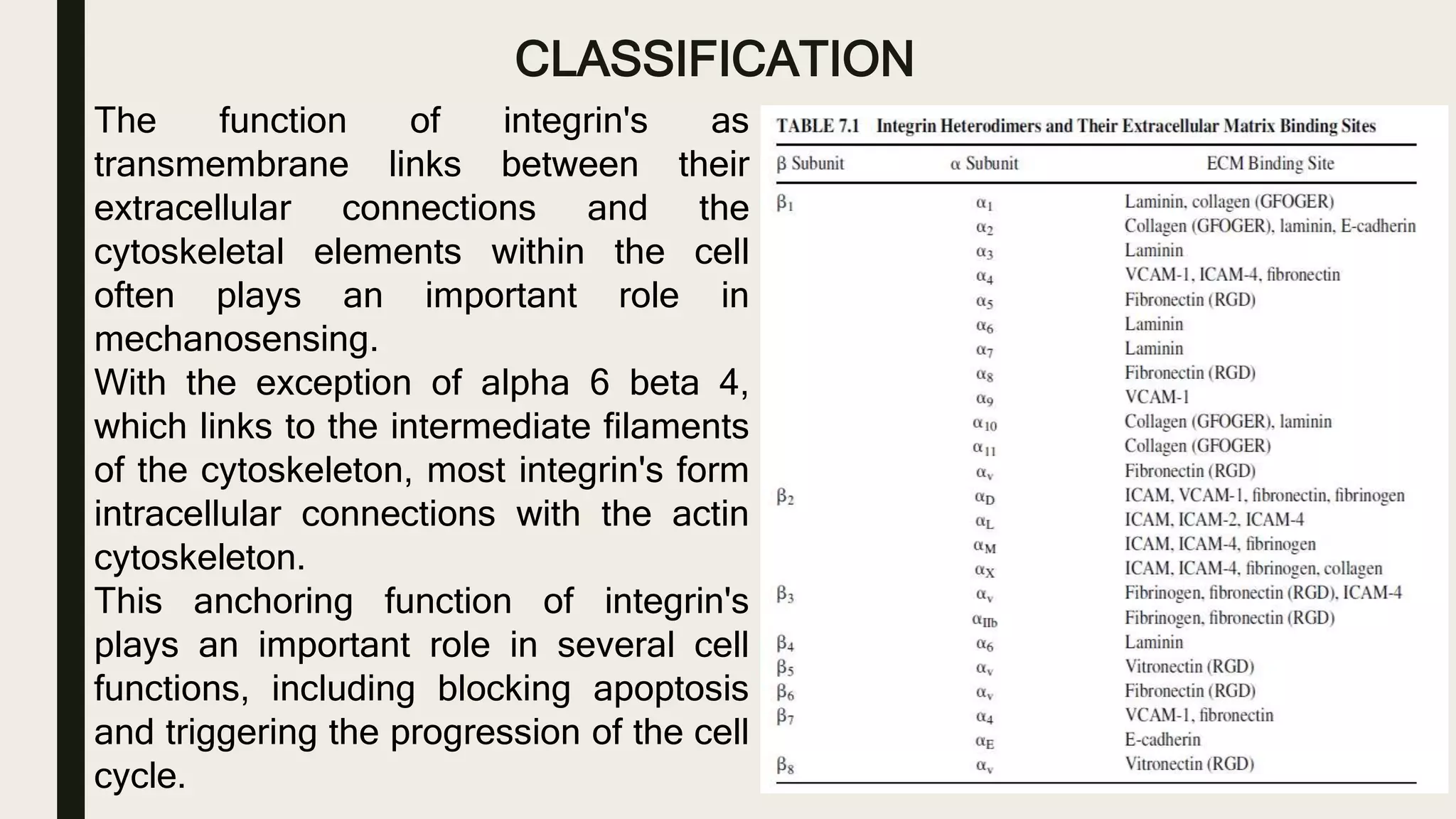
The function of integrin's as
transmembrane links between their
extracellular connections and the
cytoskeletal elements within the cell
often plays an important role in
mechanosensing.
With the exception of alpha 6 beta 4,
which links to the intermediate filaments
of the cytoskeleton, most integrin's form
intracellular connections with the actin
cytoskeleton.
This anchoring function of integrin's
plays an important role in several cell
functions, including blocking apoptosis
and triggering the progression of the cell
cycle.
Nanoparticles that contain integrin-like particles within their membranes could bind
to ligands on the ECM and prevent ECM ligand binding to integrin's on the cell
membrane, inhibiting integrin activation and the associated downstream effects.
Additional studies on the signaling pathways involved in cancer progression may
also reveal how to counteract integrin activation intracellularly. If there is an
antagonistic signaling pathway that can be activated to stop downstream signaling
or reverse ECM remodeling, therapeutic mechanisms could be designed to target
the activation of those antagonist receptors.
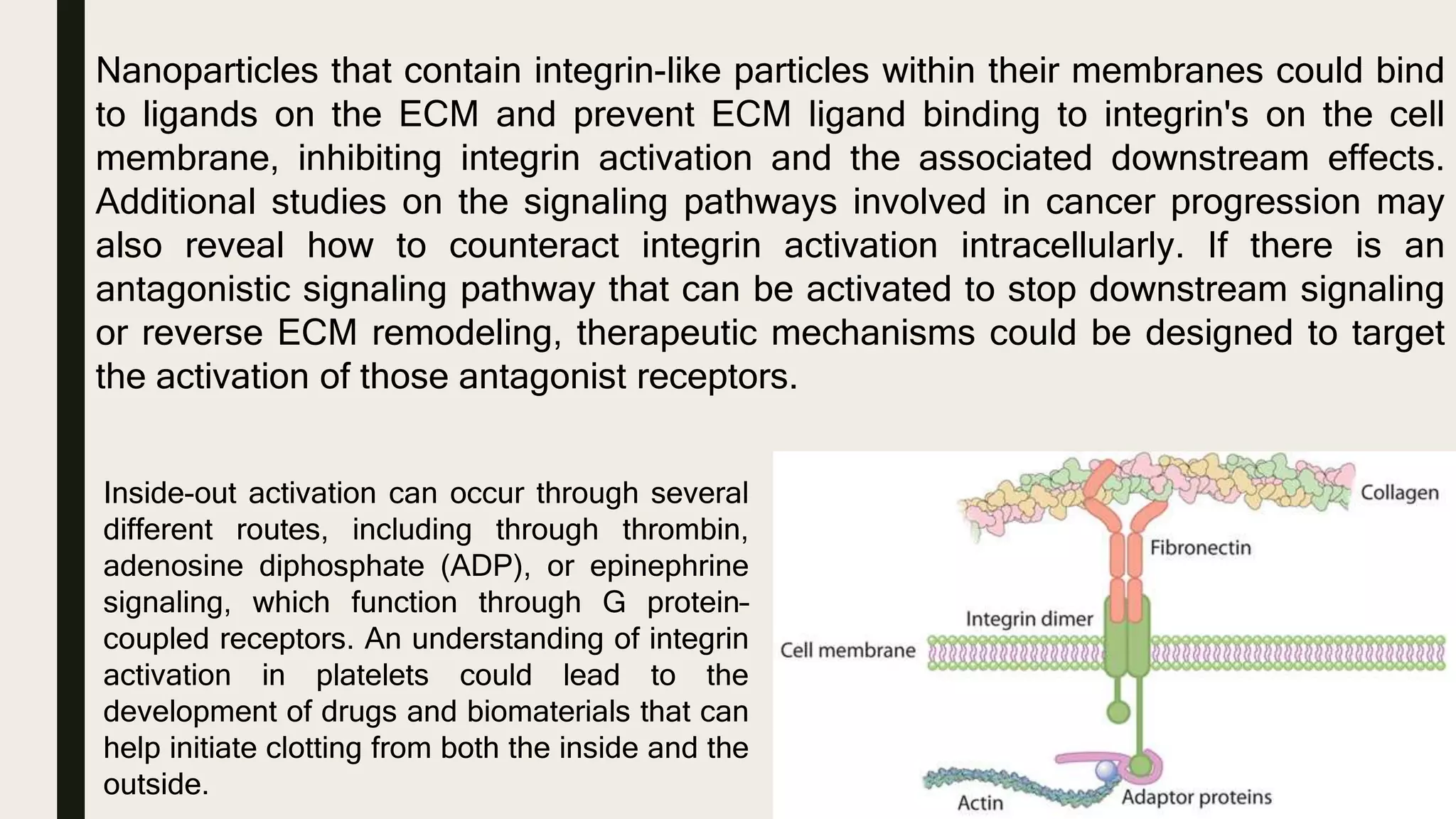
Inside-out activation can occur through several
different routes, including through thrombin,
adenosine diphosphate (ADP), or epinephrine
signaling, which function through G protein–
coupled receptors. An understanding of integrin
activation in platelets could lead to the
development of drugs and biomaterials that can
help initiate clotting from both the inside and the
outside.
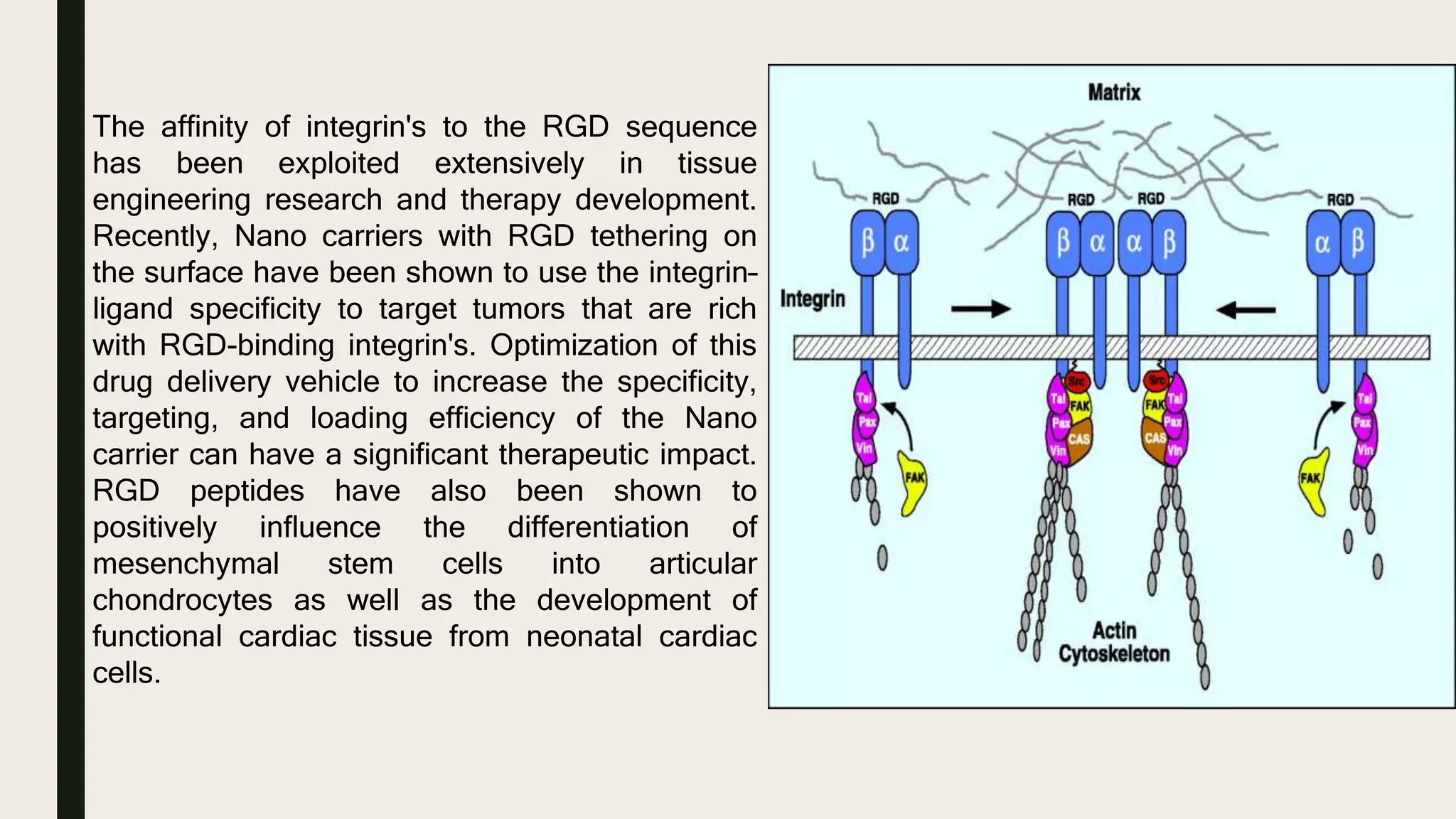
The affinity of integrin's to the RGD sequence
has been exploited extensively in tissue
engineering research and therapy development.
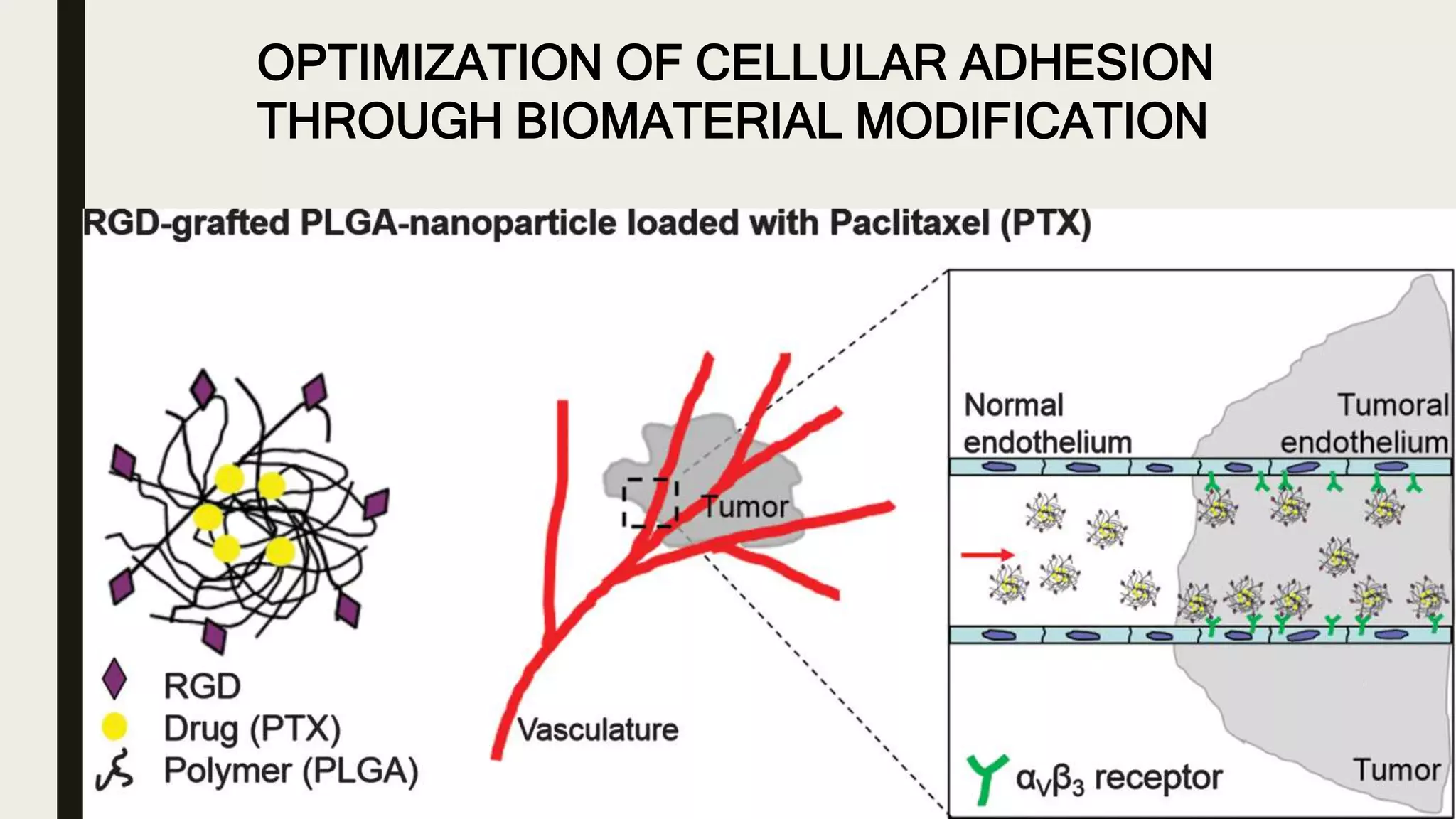
Recently, Nano carriers with RGD tethering on
the surface have been shown to use the integrin–
ligand specificity to target tumors that are rich
with RGD-binding integrin's. Optimization of this
drug delivery vehicle to increase the specificity,
targeting, and loading efficiency of the Nano
carrier can have a significant therapeutic impact.
RGD peptides have also been shown to
positively influence the differentiation of
mesenchymal stem cells into articular
chondrocytes as well as the development of
functional cardiac tissue from neonatal cardiac
cells.
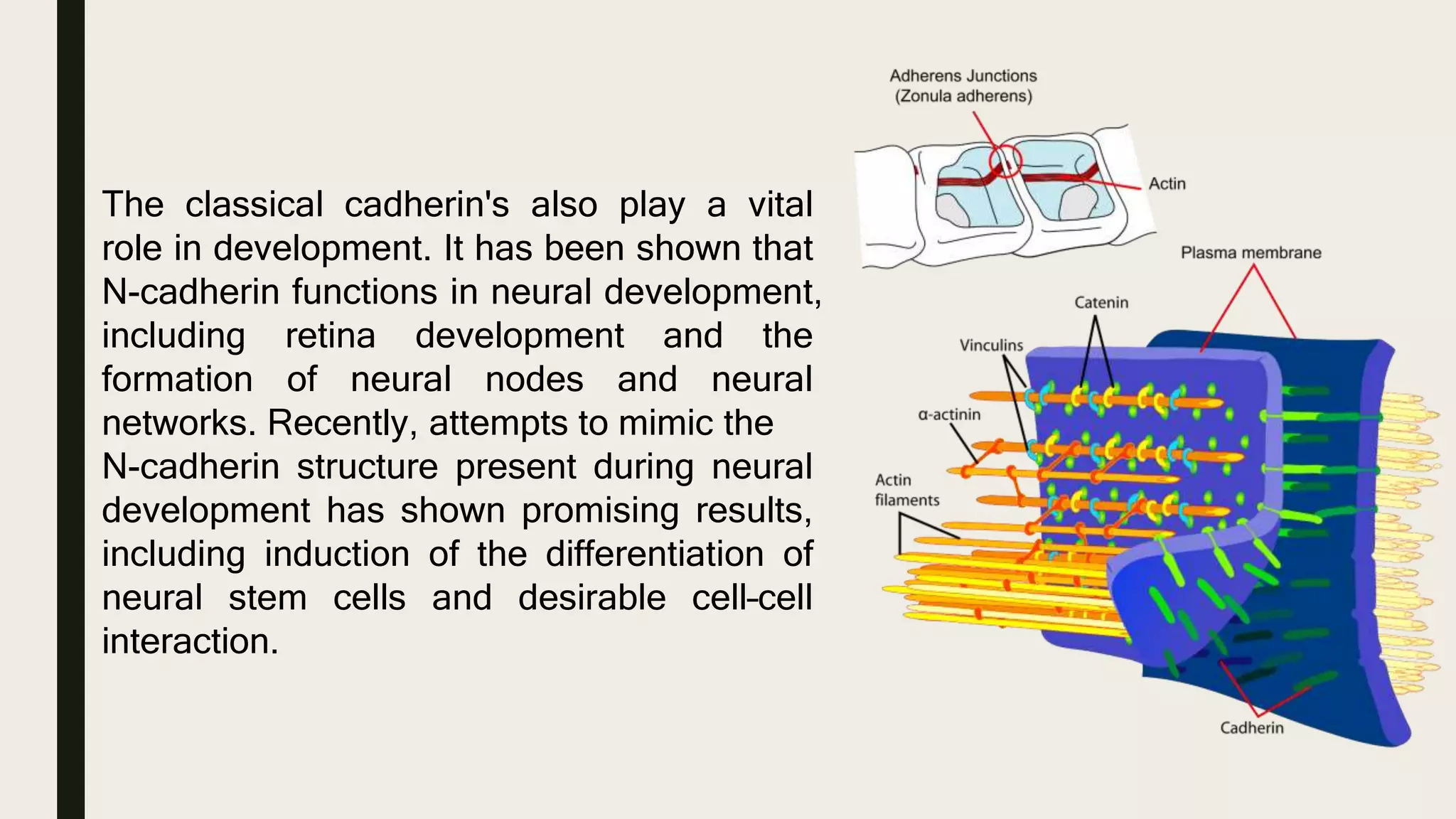
The classical cadherin's also play a vital
role in development. It has been shown that
N-cadherin functions in neural development,
including retina development and the
formation of neural nodes and neural
networks. Recently, attempts to mimic the
N-cadherin structure present during neural
development has shown promising results,
including induction of the differentiation of
neural stem cells and desirable cell–cell
interaction.
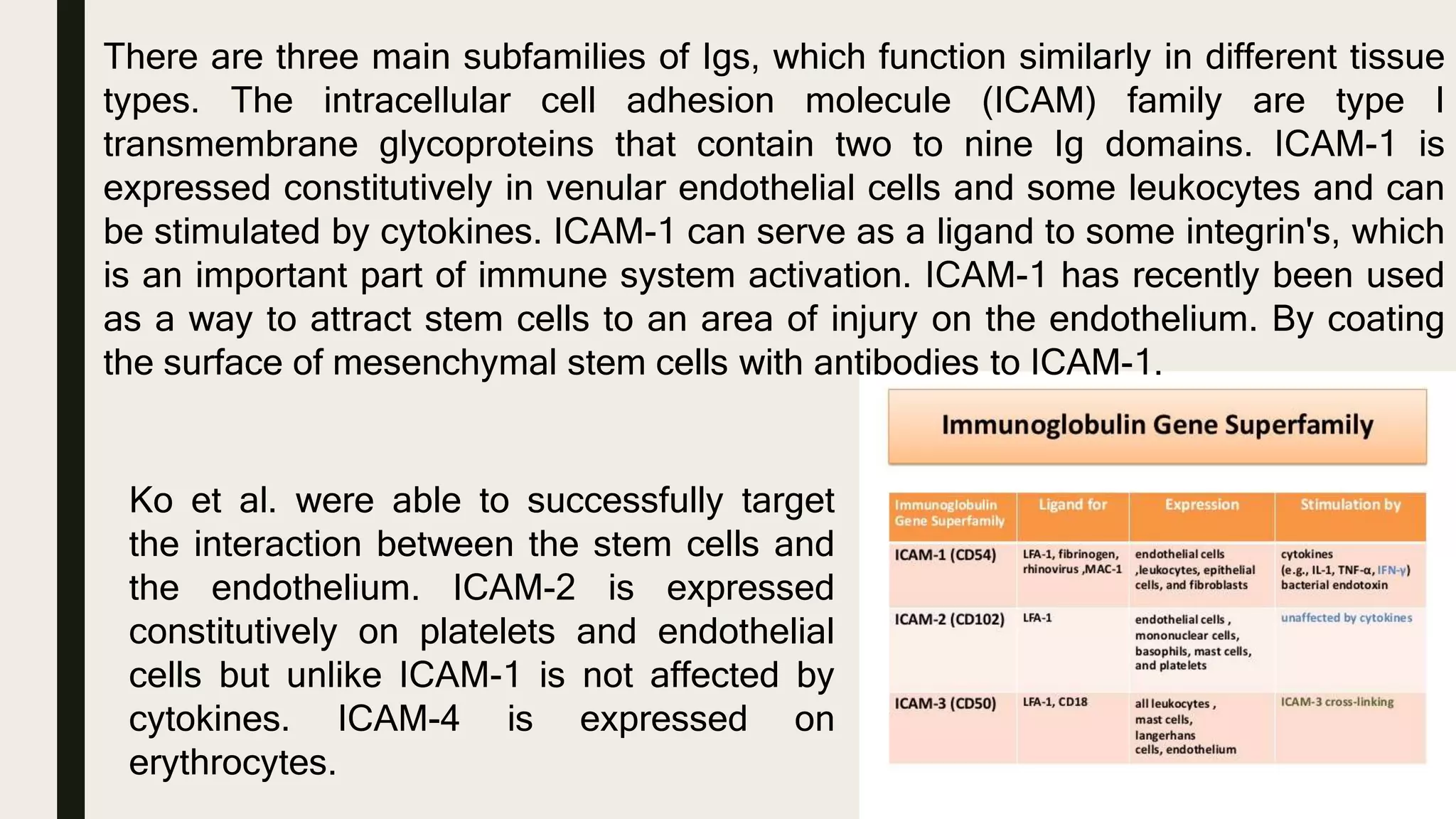
There are three main subfamilies of Igs, which function similarly in different tissue
types. The intracellular cell adhesion molecule (ICAM) family are type I
transmembrane glycoproteins that contain two to nine Ig domains. ICAM-1 is
expressed constitutively in venular endothelial cells and some leukocytes and can
be stimulated by cytokines. ICAM-1 can serve as a ligand to some integrin's, which
is an important part of immune system activation. ICAM-1 has recently been used
as a way to attract stem cells to an area of injury on the endothelium. By coating
the surface of mesenchymal stem cells with antibodies to ICAM-1.
Ko et al. were able to successfully target
the interaction between the stem cells and
the endothelium. ICAM-2 is expressed
constitutively on platelets and endothelial
cells but unlike ICAM-1 is not affected by
cytokines. ICAM-4 is expressed on
erythrocytes.
OPTIMIZATION OF CELLULAR ADHESION
THROUGH BIOMATERIAL MODIFICATION
MEASUREMENT OF CELL ADHESION
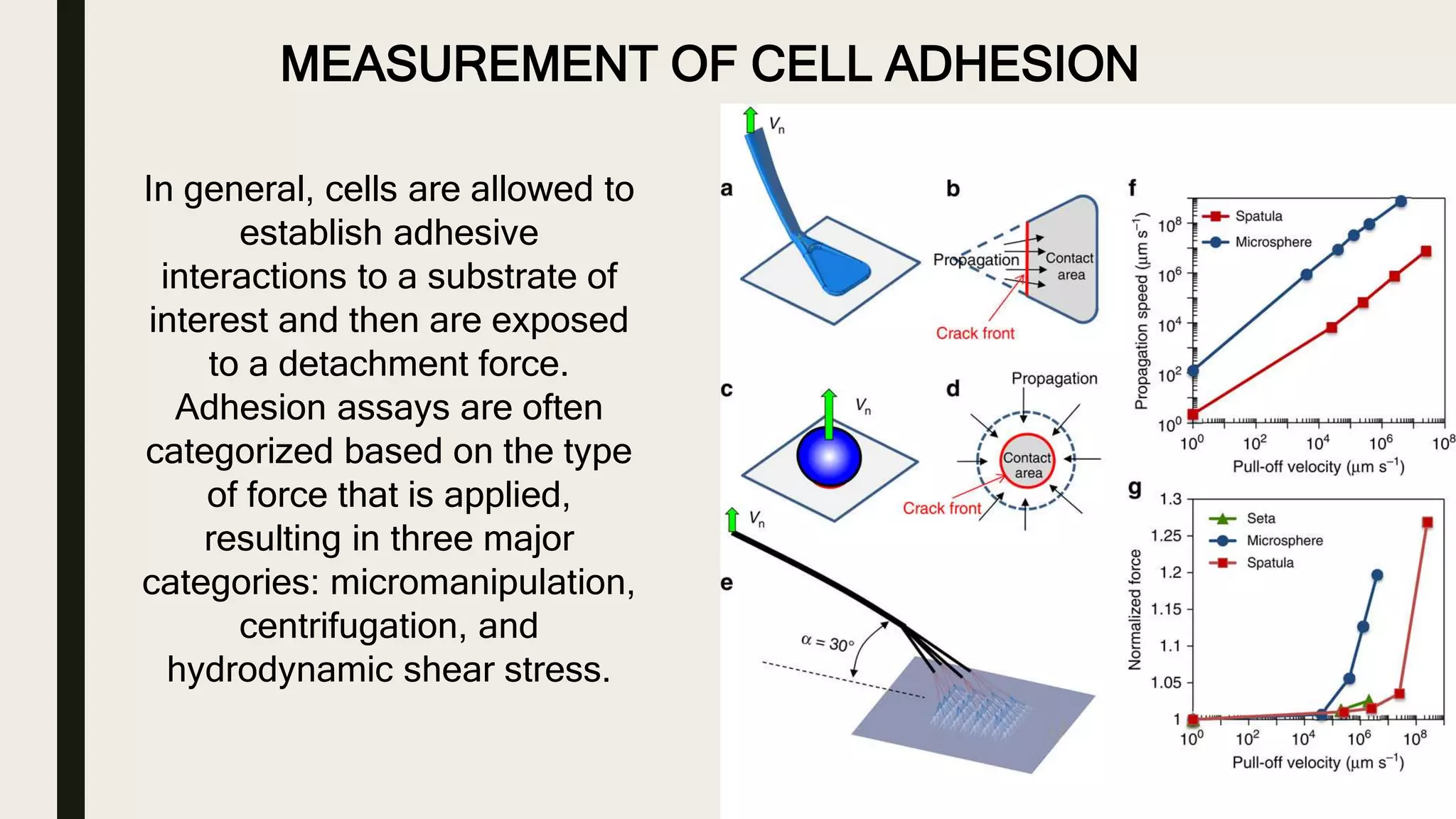
In general, cells are allowed to
establish adhesive
interactions to a substrate of
interest and then are exposed
to a detachment force.
Adhesion assays are often
categorized based on the type
of force that is applied,
resulting in three major
categories: micromanipulation,
centrifugation, and
hydrodynamic shear stress.
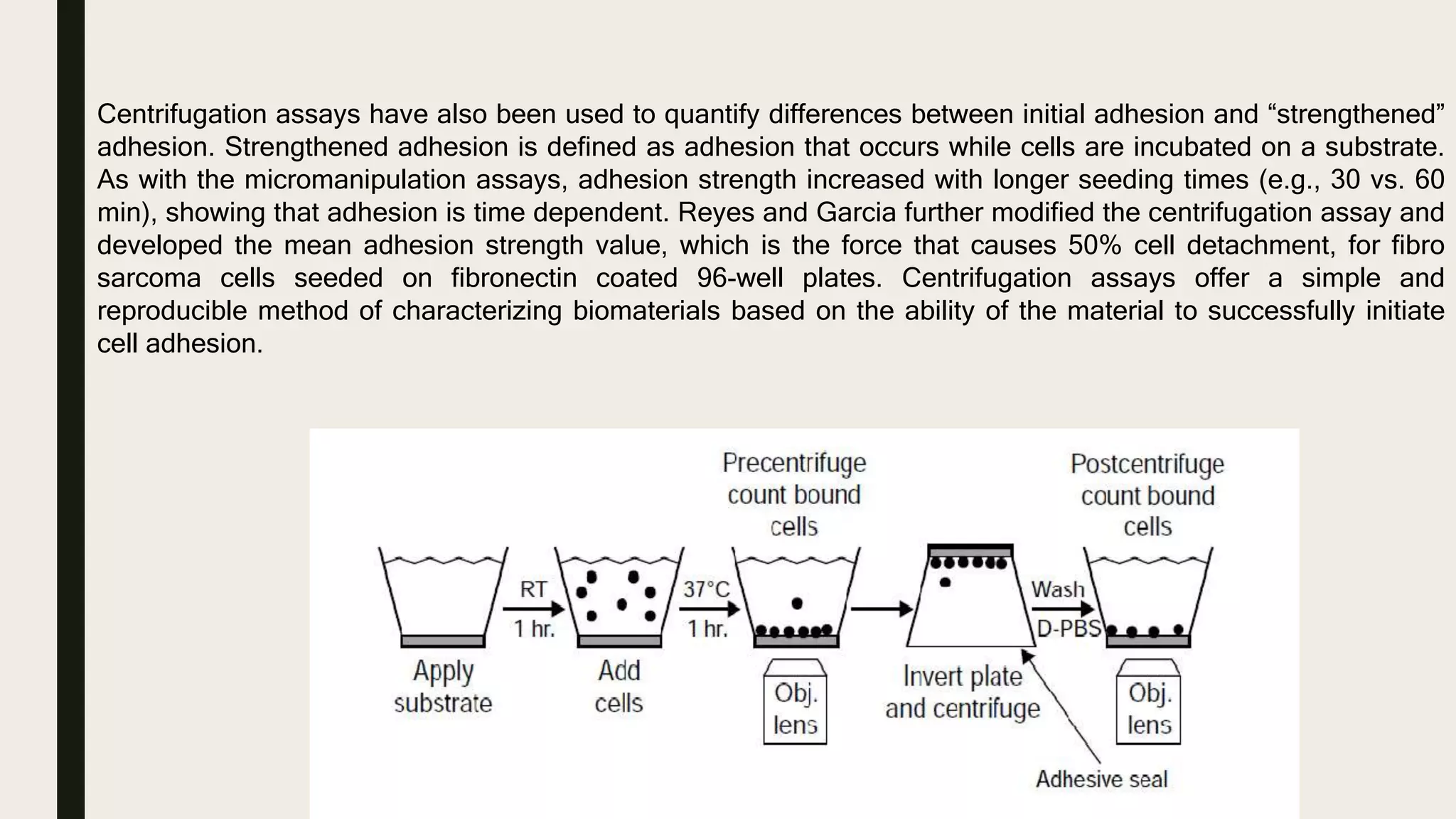
Centrifugation assays have also been used to quantify differences between initial adhesion and “strengthened”
adhesion. Strengthened adhesion is defined as adhesion that occurs while cells are incubated on a substrate.
As with the micromanipulation assays, adhesion strength increased with longer seeding times (e.g., 30 vs. 60
min), showing that adhesion is time dependent. Reyes and Garcia further modified the centrifugation assay and
developed the mean adhesion strength value, which is the force that causes 50% cell detachment, for fibro
sarcoma cells seeded on fibronectin coated 96-well plates. Centrifugation assays offer a simple and
reproducible method of characterizing biomaterials based on the ability of the material to successfully initiate
cell adhesion.
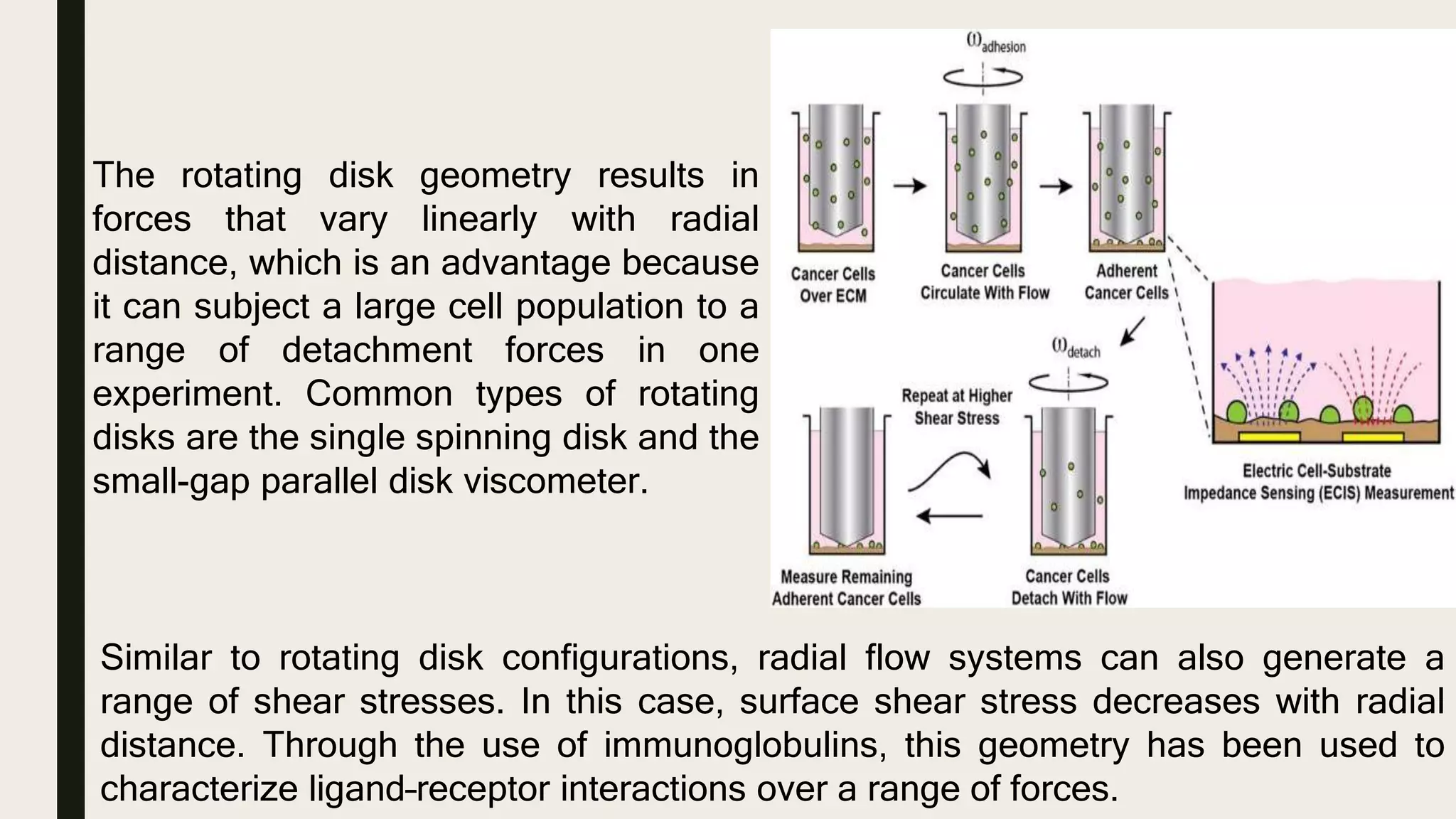
The rotating disk geometry results in
forces that vary linearly with radial
distance, which is an advantage because
it can subject a large cell population to a
range of detachment forces in one
experiment. Common types of rotating
disks are the single spinning disk and the
small-gap parallel disk viscometer.
Similar to rotating disk configurations, radial flow systems can also generate a
range of shear stresses. In this case, surface shear stress decreases with radial
distance. Through the use of immunoglobulins, this geometry has been used to
characterize ligand–receptor interactions over a range of forces.
CONCLUSION
Microfluidic Formation of Cell-Laden Hydrogel Modules for Tissue Engineering
Research involving the modification of biomaterials to optimize cellular adhesion
has made strides including bioactive molecules on the material surface to
control cell phenotype and induce changes such as increased spreading,
proliferation, and differentiation. Patterning techniques have allowed for control
over adhesive domain inclusion on the surface of biomaterials at the micro- and
nanoscale. Optimizing biomaterial design to mimic the native adhesive
interactions of a cell population provides a method for controlling downstream
cell responses and could have significant impacts for therapeutic applications.

Characterization of the adhesive interactions between cells and biomaterials

  • 1.
    CHARACTERIZATION OF THEADHESIVE INTERACTIONS BETWEEN CELLS AND BIOMATERIALSHTTPS://WWW.RESEARCHGATE.NET/PROFILE/SITANSU_NANDA3 HTTP://SCHOLAR.GOOGLE.CO.KR/CITATIONS?USER=EPAML2OAAAAJ&HL=EN
  • 2.
    INTRODUCTION Biomaterials have beenintroduced as a means to facilitate cell adhesion and infiltration during the repair or replacement of damaged or diseased tissues. For biomaterials to successfully act as an alternative ECM, the interactions between cells and biomaterials must mimic the adhesive interactions in native tissue. Therefore, the control and optimization of adhesive interactions is an important aspect of material fabrication. Cell–material interactions can be regulated through material design and processing.
  • 3.
    ADHESION RECEPTORS INNATIVE TISSUE The term integrin originates from the importance of such receptors at maintaining the “integrity” of the cytoskeleton. Integrin's primarily interact with ECM ligands but also have the ability to interact with cell surface ligands. Integrin's serve as a connection between the extracellular environment, where they bind to a ligand or adjacent cell surface, and the intracellular environment, where they bind to the cytoskeleton.
  • 4.
    CLASSIFICATION The function ofintegrin's as transmembrane links between their extracellular connections and the cytoskeletal elements within the cell often plays an important role in mechanosensing. With the exception of alpha 6 beta 4, which links to the intermediate filaments of the cytoskeleton, most integrin's form intracellular connections with the actin cytoskeleton. This anchoring function of integrin's plays an important role in several cell functions, including blocking apoptosis and triggering the progression of the cell cycle.
  • 5.
    Nanoparticles that containintegrin-like particles within their membranes could bind to ligands on the ECM and prevent ECM ligand binding to integrin's on the cell membrane, inhibiting integrin activation and the associated downstream effects. Additional studies on the signaling pathways involved in cancer progression may also reveal how to counteract integrin activation intracellularly. If there is an antagonistic signaling pathway that can be activated to stop downstream signaling or reverse ECM remodeling, therapeutic mechanisms could be designed to target the activation of those antagonist receptors. Inside-out activation can occur through several different routes, including through thrombin, adenosine diphosphate (ADP), or epinephrine signaling, which function through G protein– coupled receptors. An understanding of integrin activation in platelets could lead to the development of drugs and biomaterials that can help initiate clotting from both the inside and the outside.
  • 6.
    The affinity ofintegrin's to the RGD sequence has been exploited extensively in tissue engineering research and therapy development. Recently, Nano carriers with RGD tethering on the surface have been shown to use the integrin– ligand specificity to target tumors that are rich with RGD-binding integrin's. Optimization of this drug delivery vehicle to increase the specificity, targeting, and loading efficiency of the Nano carrier can have a significant therapeutic impact. RGD peptides have also been shown to positively influence the differentiation of mesenchymal stem cells into articular chondrocytes as well as the development of functional cardiac tissue from neonatal cardiac cells.
  • 7.
    The classical cadherin'salso play a vital role in development. It has been shown that N-cadherin functions in neural development, including retina development and the formation of neural nodes and neural networks. Recently, attempts to mimic the N-cadherin structure present during neural development has shown promising results, including induction of the differentiation of neural stem cells and desirable cell–cell interaction.
  • 8.
    There are threemain subfamilies of Igs, which function similarly in different tissue types. The intracellular cell adhesion molecule (ICAM) family are type I transmembrane glycoproteins that contain two to nine Ig domains. ICAM-1 is expressed constitutively in venular endothelial cells and some leukocytes and can be stimulated by cytokines. ICAM-1 can serve as a ligand to some integrin's, which is an important part of immune system activation. ICAM-1 has recently been used as a way to attract stem cells to an area of injury on the endothelium. By coating the surface of mesenchymal stem cells with antibodies to ICAM-1. Ko et al. were able to successfully target the interaction between the stem cells and the endothelium. ICAM-2 is expressed constitutively on platelets and endothelial cells but unlike ICAM-1 is not affected by cytokines. ICAM-4 is expressed on erythrocytes.
  • 9.
    OPTIMIZATION OF CELLULARADHESION THROUGH BIOMATERIAL MODIFICATION
  • 10.
    MEASUREMENT OF CELLADHESION In general, cells are allowed to establish adhesive interactions to a substrate of interest and then are exposed to a detachment force. Adhesion assays are often categorized based on the type of force that is applied, resulting in three major categories: micromanipulation, centrifugation, and hydrodynamic shear stress.
  • 11.
    Centrifugation assays havealso been used to quantify differences between initial adhesion and “strengthened” adhesion. Strengthened adhesion is defined as adhesion that occurs while cells are incubated on a substrate. As with the micromanipulation assays, adhesion strength increased with longer seeding times (e.g., 30 vs. 60 min), showing that adhesion is time dependent. Reyes and Garcia further modified the centrifugation assay and developed the mean adhesion strength value, which is the force that causes 50% cell detachment, for fibro sarcoma cells seeded on fibronectin coated 96-well plates. Centrifugation assays offer a simple and reproducible method of characterizing biomaterials based on the ability of the material to successfully initiate cell adhesion.
  • 12.
    The rotating diskgeometry results in forces that vary linearly with radial distance, which is an advantage because it can subject a large cell population to a range of detachment forces in one experiment. Common types of rotating disks are the single spinning disk and the small-gap parallel disk viscometer. Similar to rotating disk configurations, radial flow systems can also generate a range of shear stresses. In this case, surface shear stress decreases with radial distance. Through the use of immunoglobulins, this geometry has been used to characterize ligand–receptor interactions over a range of forces.
  • 13.
    CONCLUSION Microfluidic Formation ofCell-Laden Hydrogel Modules for Tissue Engineering Research involving the modification of biomaterials to optimize cellular adhesion has made strides including bioactive molecules on the material surface to control cell phenotype and induce changes such as increased spreading, proliferation, and differentiation. Patterning techniques have allowed for control over adhesive domain inclusion on the surface of biomaterials at the micro- and nanoscale. Optimizing biomaterial design to mimic the native adhesive interactions of a cell population provides a method for controlling downstream cell responses and could have significant impacts for therapeutic applications.