Impression materials
Adam Bilski
Department of Dentistry
Palacky University, Olomouc
2020
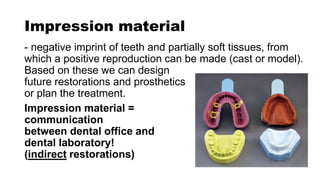
Impression material
- negative imprint of teeth and partially soft tissues, from
which a positive reproduction can be made (cast or model).
Based on these we can design
future restorations and prosthetics
or plan the treatment.
Impression material =
communication
between dental office and
dental laboratory!
(indirect restorations)
Use of impressions
Examples of use of impression
materials are:
- Diagnosis + treatment planning
- Prosthodontics and restorative
dentistry
- Orthodontics
- Oral surgery (e.g. implants)
Impression trays
- Rigid,
- Quadrant, section, full
- Perforated / non-perforated
- Rimlock, Schreinemaker
- Sizes – 1, 2, 3, 4, children
- Extension – 2/3 mm behind 3rd molar,
2-3 mm (or 5-7?) of material between
tray and occlusal, incisal edge
surfaces
Tray adhesives
VPS adhesives (blue) for polyether impression materials
Silicone adhesive (orange/pink) for silicone impression materials
Impression classification
- Preliminary impressions:
By dentist / dental assistant
Uses – diagnostic models, custom trays, provisional
coverage, orthodontic appliances, pre-treatment, post-
treatment records
- Final (master) impressions:
By dentist
Uses – indirect restorations, partial / full dentures, implants
- Bite registration:
By dentist / assistant
Uses – occlusal relationship, centric relation, maximal
intercuspation
Setting and working time
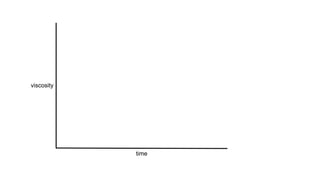
Setting time – time from mixing to being elastic
enough to resist deformations during taking the material
out of the oral cavity
Working time – time from mixing to just before the
elastic properties develop, so the final time when
impression can be seated in the mouth without distortion
viscosity
time
viscosity
time
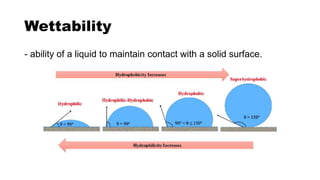
Wettability
- ability of a liquid to maintain contact with a solid surface.
Wettability classification
Materials that are:
(easiest to pour)
hydrophilic – alginate, agar, polyether
(resistant to wetting)
hydrophobic – polysulphide, polyvinyl siloxanes (PVS), silicones
Viscosity etc
Shear rate – speed at which luquid flows under external forces
Thixotropic – when its runny under pressure (increases with time
after mix)
High fluidity – low viscosity
Putty – very high viscosity
Heavy body – high viscosity
Medium / regular body – low viscosity
Light body – very low viscosity
Monophases – polyether and A-
silicone - decrease their viscosity
after applying external forces
(thixotropic)
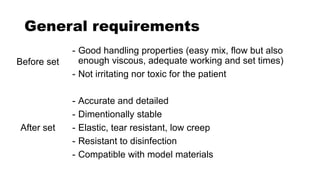
General requirements
- Good handling properties (easy mix, flow but also
enough viscous, adequate working and set times)
- Not irritating nor toxic for the patient
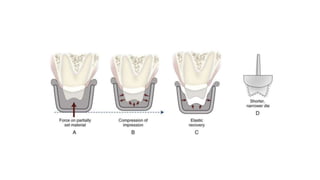
- Accurate and detailed
- Dimentionally stable
- Elastic, tear resistant, low creep
- Resistant to disinfection
- Compatible with model materials
Before set
After set
Preliminary and final
• Preliminary (first/anatomical) impression is used to
make reproduction of teeth for diagnostic models,
custom trays, orthodontics, provisional coverage, pre-
and post-treatment records.
• Final impression is more accurate than preliminary and
used to make indirect restorations, partial/full dentures,
implants
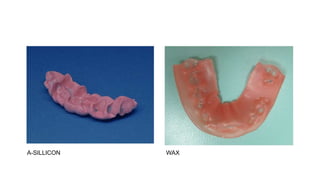
Bite registration
• Impression materials can
also be used for registration
of patient’s occlusion.
• Patient’s occlusion can be
described in Eichner
classification
• Group C: (No OSZs)
C1: teeth in both arches.
C2: teeth in one arch.
C3: edentulous.
(A-silicon, Wax, PMMA)
A-SILLICON WAX
Different imprinting techniques:
a) 1 step 1 phase
- polyethers, C-silicones (for die cast), alginate
- 1 consistency and we do it once
b) 1 step 2 phases
- putty to the spoon
- light body on teeth
- silicones, polyethers
c) 2 steps 2 phases
- create drainage on initial putty impression, for light body
- A and C silicones
- use retraction cord for first impression, remove for 2nd
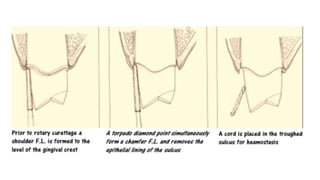
Methods of retracting gingiva:
- Retraction cords – 100% cotton,
braded,
sizes 000, 00, 0, 1, 2, 3,
can be with aluminium chloride,
aluminium sulphate, ferric sulfate,
adrenaline
- Eletrocauter – stops bleeding,
WATCH OUT FOR PACEMAKER
- rotary curretage
(reversible)
+ impression wax
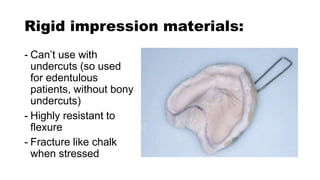
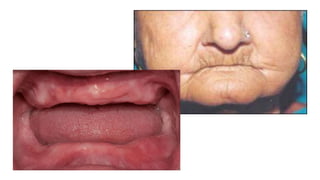
Rigid impression materials:
- Can’t use with
undercuts (so used
for edentulous
patients, without bony
undercuts)
- Highly resistant to
flexure
- Fracture like chalk
when stressed
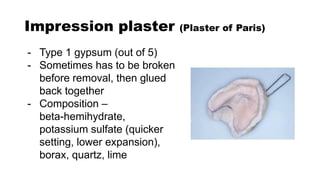
Impression plaster (Plaster of Paris)
- Type 1 gypsum (out of 5)
- Sometimes has to be broken
before removal, then glued
back together
- Composition –
beta-hemihydrate,
potassium sulfate (quicker
setting, lower expansion),
borax, quartz, lime
+ cheap
+ good details
+ great dimensional stability
+ non toxic
- crazy rigid
- dries out soft tissues
- heats up and can burn patient
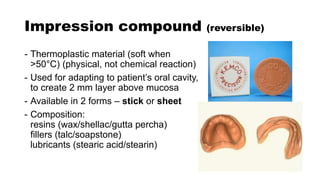
Impression compound (reversible)
- Thermoplastic material (soft when
>50°C) (physical, not chemical reaction)
- Used for adapting to patient’s oral cavity,
to create 2 mm layer above mucosa
- Available in 2 forms – stick or sheet
- Composition:
resins (wax/shellac/gutta percha)
fillers (talc/soapstone)
lubricants (stearic acid/stearin)
+ non-irritant, non-toxic
+ can be reused
+ can be readapted
+ mucocompressive
- poor dimentional stability
- poor details
- high coefficient of thermal expansion (contracts when removed
from mouth)
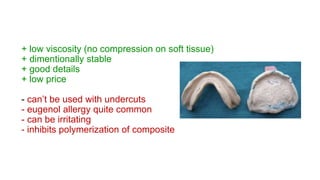
Zink-Oxide Eugenol (ZOE)
- Used for edentulous patients’ registration (master impression)
- Mixed in 1:1 paste ratio
- Used in wash impression (this is a very thin layer of low viscosity impression
material which is used to record fine details. Usually it is the second stage, where the
runny impression material is used after an initial impression taken with a more viscous
material)
- Inhibits polymerization of composite!
- 2 pastes mixing:
Paste A – ZnO/oil as a plasticizer
Paste B – oil with min. 85% of eugenol, fillers, resins,
accelerators
+ low viscosity (no compression on soft tissue)
+ dimentionally stable
+ good details
+ low price
- can’t be used with undercuts
- eugenol allergy quite common
- can be irritating
- inhibits polymerization of composite
Impression Wax
- Flow in mouth temperature, soft at room temperature
- Used to correct imperfections in other impressions, for occlusal
rims creation and max. intercuspation record
- Mix of low melting paraffin x beeswax (3:1)
- Cast has to be poured immediately
Elastic impression materials:
- Divided into hydrocolloids and elastomers
- Can be stretched and bent to a certain degree
- Undercuts are not a problem
- Uses include partial denture, overdentures, implants, prosthetic
impressions
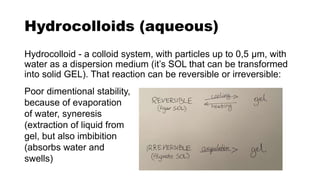
Hydrocolloids (aqueous)
Hydrocolloid - a colloid system, with particles up to 0,5 µm, with
water as a dispersion medium (it’s SOL that can be transformed
into solid GEL). That reaction can be reversible or irreversible:
Poor dimentional stability,
because of evaporation
of water, syneresis
(extraction of liquid from
gel, but also imbibition
(absorbs water and
swells)
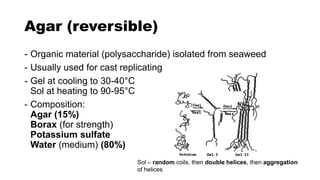
Agar (reversible)
- Organic material (polysaccharide) isolated from seaweed
- Usually used for cast replicating
- Gel at cooling to 30-40°C
Sol at heating to 90-95°C
- Composition:
Agar (15%)
Borax (for strength)
Potassium sulfate
Water (medium) (80%)
Sol – random coils, then double helices, then aggregation
of helices
+ very good biological properties
+ great details reproduction (hydrophilic)
+ low cost (but the machines)
+ no custom tray, adhesives, no need for
mixing
+ nice flavor
- need special equipment
- dimentionally unstable
- low strength and tear resistance
- slow setting time
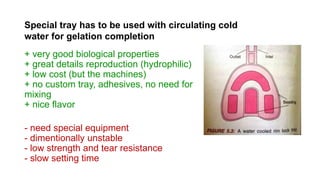
Special tray has to be used with circulating cold
water for gelation completion
Alginate (irreversible)
- Like agar – natural hydrophilic polysaccharide from seaweed
Most widely used impression material.
- Can’t return to solution after becoming gel
- Used for:
1. Antagonist jaw impressions
2. Prelimenary (primary) impressions
3. Orthodontic impressions
4. Study casts
- Developed as Agar became unobtainable during WW2
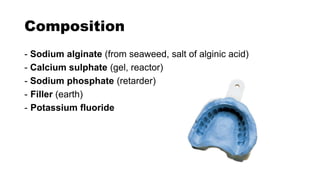
Composition
- Sodium alginate (from seaweed, salt of alginic acid)
- Calcium sulphate (gel, reactor)
- Sodium phosphate (retarder)
- Filler (earth)
- Potassium fluoride
- Stored in containers, premeasured packages (more expensive,
but save time), shelf life approx. 1 year
- For prolonging storage of already made impression during
transport, we transport it in water or with very wet towel
(imbibition)
+ inexpensive
+ easy to use
+ hydrophilic (displaces moisture, blood)
+ stock trays used
+ very biologically tolerant
- easly tears
- dimentionally unstable (immediate pour, for single cast)
- low detail reproduction
- high permanent deformation
- difficult to disinfect
Types of alginate
Normal set alginate:
Working time - 2 mins
Setting time – 4,5 mins
Fast set alginate:
Working time – 1,25 mins
Setting time – 1-2 mins
For modifying – cold water to increase setting time, warm to
decrease (good for children)
RATIOS OF WATER TO POWDER:
Mandible – 2:2
Maxilla – 3:3
Procedure
1. Choose the tray
2. Mix material (around 45 sec)
3. Put into the tray
4. Put into mouth
5. Centre
6. Wait for approx. 3 minutes
7. Remove, disinfect, rinse with water
8. Put in the box/bag, label it, send it to lab
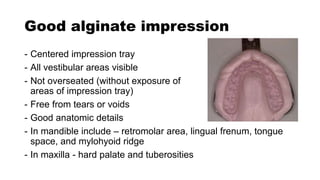
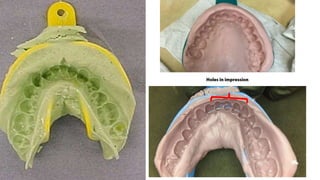
Good alginate impression
- Centered impression tray
- All vestibular areas visible
- Not overseated (without exposure of
areas of impression tray)
- Free from tears or voids
- Good anatomic details
- In mandible include – retromolar area, lingual frenum, tongue
space, and mylohyoid ridge
- In maxilla - hard palate and tuberosities
Elastomers (non-aqueous)
Synthetic polymers with rubber-like
qualities.
- Extreme accuracy
- Elastic
- Dimensionally stable
- Good tear resistance
- Mainly hydrophobic
- Different viscosities – different
techniques
Composition
They are made of BASE and CATALYST
Base:
- paste in tube
- cartridge
- putty in a jar
Catalyst (accelerator):
- paste in tube
- cartridge
- liquid in a bottle
Forms:
Light-body (syringe type/wash type):
- in a syringe/extruder
- flows
- for the finest details
- we place it on and around the prepared
teeth
Regular/Heavy-body (tray-type):
- into the tray
- T H I C C
- used to force the light body into close
contact with the prepared teeth
Stages of curing elastomers:
1. Initial set:
- stiffness of paste
- here we can manipulate material
2. Final set:
- appearance of elasticity
- must be already in the mouth
3. Final cure:
- 1 – 24 hours
Polysulphide
- The first elastomeric impression material (1950)
- Used for complete dentures, removable or fixed partial
dentures, crowns, bridges (not often nowadays)
- Composition:
Base – polysulphide polymers, fillers, plasticiers (dibutyl
phthalate)
Catalyst – lead dioxide, sulfur, copper hydroxide,
By-product - water
- We need to put a layer of adhesive on the custom tray
- Mix 1 min (1:1), setting time 8-12 mins, pour within 1 hour
+ cheap
+ long working time
+ high flexibility
+ good accuracy
- poor dimentional stability
- custom trays
- messy (bad smell)
- long setting time
- may be toxic (due to lead)
Polyether
- Used for crowns, bridges, implants, overdentures, bite
registration and removable denture impressions
- Special or stock stiff trays, with adhesive
- Setting time around 6 minutes, best if poured within 24 hours
- Composition:
Base – prepolymer, silica, plasticizer
Catalyst – sulfonic acid ester (for polymerization), fillers
- Polymeryzation is cationic (ring is opening, chain is extending)
- Usually 1 composition (regular body), but can be 2
+ accurate
+ good dimensional stability
+ good surface detail
+ can do multiple casts (for 1 week)
+ wettable
- expensive
- short working time
- rigid (undercuts!)
- bitter taste
- imbibition (dimensional change)
C-silicone (Condensation)
- First type of silicone impression
material
- Composition:
Base – poly(dimethylsiloxane),
tetraethyloorthosilicate, fillers
Catalyst – metal organic ester
By-product – ethyl or methyl alcohol
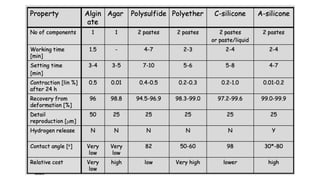
- 0,5-0,6% contraction
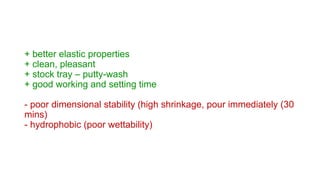
+ better elastic properties
+ clean, pleasant
+ stock tray – putty-wash
+ good working and setting time
- poor dimensional stability (high shrinkage, pour immediately (30
mins)
- hydrophobic (poor wettability)
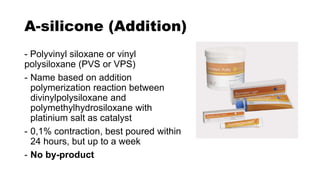
A-silicone (Addition)
- Polyvinyl siloxane or vinyl
polysiloxane (PVS or VPS)
- Name based on addition
polymerization reaction between
divinylpolysiloxane and
polymethylhydrosiloxane with
platinium salt as catalyst
- 0,1% contraction, best poured within
24 hours, but up to a week
- No by-product
Composition
2 pastes:
1st – polydimetylsiloxane  terminal silane hydrogen group,
fillers
2nd – silicone with terminal vinyl gr., chloroplatinic acid – catalyst
Easier:
1st paste – vinyl prepolymer
2nd paste – siloxane prepolymer + chloroplatinic acid (catalyst)
Surfactants (hydrophobic  hydrophilic)
- Reduce contact angle
- Can even use diluted soap
- Better castability and wettability
Contact angle:
+ accurate
+ high dimensional stability
+ stock/custom tray
+ easy to mix
+ multiple casts
+ pleasant smell
- expensive
- no latex gloves
- short working time
- lower tear strength
After the impression is taken
On impression can be
- Bacteria – Staph. epidermidis, Strep.
mutans, Staph. aureus, Actinomycis
israeli
- Viruses – herpes, adenoviruses
- Mycoorganisms – candida,
histoplasma
Disinfectants
- With hydrocolloids we can’t use alcohol
- Have to be biocompatible, and not cause shrinkage
- Method – dip into solution (5-10 mins max), use spray, use
vapor
- For agar – dip into 2% K2SO4 for 10 mins
- For high-risk patients – 3 hours in 2% glutaraldehyde
Sources
https://dentistryandmedicine.blogspot.com/2011/07/elastic-impression-materials-
elastomers.html
https://ulbld.lf1.cuni.cz/file/3631/impression-materials-2019-anglicky-pro-web.pdf
https://pocketdentistry.com/8-impression-materials-2/#s0010
https://pocketdentistry.com/11-dental-impression-materials/
https://en.wikipedia.org/wiki/Dental_impression#Polysulphides
https://semmelweis.hu/fogpotlastan/files/2017/12/Impression-taking-f-f.pdf
and presentations of Dr. Foukalova, Dr Voborna and Dr Azar

Impression Materials - Adam Bilski

  • 1.
    Impression materials Adam Bilski Departmentof Dentistry Palacky University, Olomouc 2020
  • 2.
    Impression material - negativeimprint of teeth and partially soft tissues, from which a positive reproduction can be made (cast or model). Based on these we can design future restorations and prosthetics or plan the treatment. Impression material = communication between dental office and dental laboratory! (indirect restorations)
  • 3.
    Use of impressions Examplesof use of impression materials are: - Diagnosis + treatment planning - Prosthodontics and restorative dentistry - Orthodontics - Oral surgery (e.g. implants)
  • 4.
    Impression trays - Rigid, -Quadrant, section, full - Perforated / non-perforated - Rimlock, Schreinemaker - Sizes – 1, 2, 3, 4, children - Extension – 2/3 mm behind 3rd molar, 2-3 mm (or 5-7?) of material between tray and occlusal, incisal edge surfaces
  • 5.
    Tray adhesives VPS adhesives(blue) for polyether impression materials Silicone adhesive (orange/pink) for silicone impression materials
  • 6.
    Impression classification - Preliminaryimpressions: By dentist / dental assistant Uses – diagnostic models, custom trays, provisional coverage, orthodontic appliances, pre-treatment, post- treatment records - Final (master) impressions: By dentist Uses – indirect restorations, partial / full dentures, implants - Bite registration: By dentist / assistant Uses – occlusal relationship, centric relation, maximal intercuspation
  • 7.
    Setting and workingtime Setting time – time from mixing to being elastic enough to resist deformations during taking the material out of the oral cavity Working time – time from mixing to just before the elastic properties develop, so the final time when impression can be seated in the mouth without distortion
  • 8.
  • 9.
  • 11.
    Wettability - ability ofa liquid to maintain contact with a solid surface.
  • 12.
    Wettability classification Materials thatare: (easiest to pour) hydrophilic – alginate, agar, polyether (resistant to wetting) hydrophobic – polysulphide, polyvinyl siloxanes (PVS), silicones
  • 13.
    Viscosity etc Shear rate– speed at which luquid flows under external forces Thixotropic – when its runny under pressure (increases with time after mix) High fluidity – low viscosity Putty – very high viscosity Heavy body – high viscosity Medium / regular body – low viscosity Light body – very low viscosity Monophases – polyether and A- silicone - decrease their viscosity after applying external forces (thixotropic)
  • 14.
    General requirements - Goodhandling properties (easy mix, flow but also enough viscous, adequate working and set times) - Not irritating nor toxic for the patient - Accurate and detailed - Dimentionally stable - Elastic, tear resistant, low creep - Resistant to disinfection - Compatible with model materials Before set After set
  • 15.
    Preliminary and final •Preliminary (first/anatomical) impression is used to make reproduction of teeth for diagnostic models, custom trays, orthodontics, provisional coverage, pre- and post-treatment records. • Final impression is more accurate than preliminary and used to make indirect restorations, partial/full dentures, implants
  • 16.
    Bite registration • Impressionmaterials can also be used for registration of patient’s occlusion. • Patient’s occlusion can be described in Eichner classification • Group C: (No OSZs) C1: teeth in both arches. C2: teeth in one arch. C3: edentulous. (A-silicon, Wax, PMMA)
  • 17.
  • 18.
    Different imprinting techniques: a)1 step 1 phase - polyethers, C-silicones (for die cast), alginate - 1 consistency and we do it once b) 1 step 2 phases - putty to the spoon - light body on teeth - silicones, polyethers c) 2 steps 2 phases - create drainage on initial putty impression, for light body - A and C silicones - use retraction cord for first impression, remove for 2nd
  • 19.
    Methods of retractinggingiva: - Retraction cords – 100% cotton, braded, sizes 000, 00, 0, 1, 2, 3, can be with aluminium chloride, aluminium sulphate, ferric sulfate, adrenaline - Eletrocauter – stops bleeding, WATCH OUT FOR PACEMAKER - rotary curretage
  • 21.
  • 22.
    Rigid impression materials: -Can’t use with undercuts (so used for edentulous patients, without bony undercuts) - Highly resistant to flexure - Fracture like chalk when stressed
  • 24.
    Impression plaster (Plasterof Paris) - Type 1 gypsum (out of 5) - Sometimes has to be broken before removal, then glued back together - Composition – beta-hemihydrate, potassium sulfate (quicker setting, lower expansion), borax, quartz, lime
  • 25.
    + cheap + gooddetails + great dimensional stability + non toxic - crazy rigid - dries out soft tissues - heats up and can burn patient
  • 26.
    Impression compound (reversible) -Thermoplastic material (soft when >50°C) (physical, not chemical reaction) - Used for adapting to patient’s oral cavity, to create 2 mm layer above mucosa - Available in 2 forms – stick or sheet - Composition: resins (wax/shellac/gutta percha) fillers (talc/soapstone) lubricants (stearic acid/stearin)
  • 27.
    + non-irritant, non-toxic +can be reused + can be readapted + mucocompressive - poor dimentional stability - poor details - high coefficient of thermal expansion (contracts when removed from mouth)
  • 28.
    Zink-Oxide Eugenol (ZOE) -Used for edentulous patients’ registration (master impression) - Mixed in 1:1 paste ratio - Used in wash impression (this is a very thin layer of low viscosity impression material which is used to record fine details. Usually it is the second stage, where the runny impression material is used after an initial impression taken with a more viscous material) - Inhibits polymerization of composite! - 2 pastes mixing: Paste A – ZnO/oil as a plasticizer Paste B – oil with min. 85% of eugenol, fillers, resins, accelerators
  • 29.
    + low viscosity(no compression on soft tissue) + dimentionally stable + good details + low price - can’t be used with undercuts - eugenol allergy quite common - can be irritating - inhibits polymerization of composite
  • 30.
    Impression Wax - Flowin mouth temperature, soft at room temperature - Used to correct imperfections in other impressions, for occlusal rims creation and max. intercuspation record - Mix of low melting paraffin x beeswax (3:1) - Cast has to be poured immediately
  • 31.
    Elastic impression materials: -Divided into hydrocolloids and elastomers - Can be stretched and bent to a certain degree - Undercuts are not a problem - Uses include partial denture, overdentures, implants, prosthetic impressions
  • 32.
    Hydrocolloids (aqueous) Hydrocolloid -a colloid system, with particles up to 0,5 µm, with water as a dispersion medium (it’s SOL that can be transformed into solid GEL). That reaction can be reversible or irreversible: Poor dimentional stability, because of evaporation of water, syneresis (extraction of liquid from gel, but also imbibition (absorbs water and swells)
  • 33.
    Agar (reversible) - Organicmaterial (polysaccharide) isolated from seaweed - Usually used for cast replicating - Gel at cooling to 30-40°C Sol at heating to 90-95°C - Composition: Agar (15%) Borax (for strength) Potassium sulfate Water (medium) (80%) Sol – random coils, then double helices, then aggregation of helices
  • 34.
    + very goodbiological properties + great details reproduction (hydrophilic) + low cost (but the machines) + no custom tray, adhesives, no need for mixing + nice flavor - need special equipment - dimentionally unstable - low strength and tear resistance - slow setting time Special tray has to be used with circulating cold water for gelation completion
  • 35.
    Alginate (irreversible) - Likeagar – natural hydrophilic polysaccharide from seaweed Most widely used impression material. - Can’t return to solution after becoming gel - Used for: 1. Antagonist jaw impressions 2. Prelimenary (primary) impressions 3. Orthodontic impressions 4. Study casts - Developed as Agar became unobtainable during WW2
  • 36.
    Composition - Sodium alginate(from seaweed, salt of alginic acid) - Calcium sulphate (gel, reactor) - Sodium phosphate (retarder) - Filler (earth) - Potassium fluoride
  • 37.
    - Stored incontainers, premeasured packages (more expensive, but save time), shelf life approx. 1 year - For prolonging storage of already made impression during transport, we transport it in water or with very wet towel (imbibition)
  • 38.
    + inexpensive + easyto use + hydrophilic (displaces moisture, blood) + stock trays used + very biologically tolerant - easly tears - dimentionally unstable (immediate pour, for single cast) - low detail reproduction - high permanent deformation - difficult to disinfect
  • 39.
    Types of alginate Normalset alginate: Working time - 2 mins Setting time – 4,5 mins Fast set alginate: Working time – 1,25 mins Setting time – 1-2 mins For modifying – cold water to increase setting time, warm to decrease (good for children) RATIOS OF WATER TO POWDER: Mandible – 2:2 Maxilla – 3:3
  • 40.
    Procedure 1. Choose thetray 2. Mix material (around 45 sec) 3. Put into the tray 4. Put into mouth 5. Centre 6. Wait for approx. 3 minutes 7. Remove, disinfect, rinse with water 8. Put in the box/bag, label it, send it to lab
  • 41.
    Good alginate impression -Centered impression tray - All vestibular areas visible - Not overseated (without exposure of areas of impression tray) - Free from tears or voids - Good anatomic details - In mandible include – retromolar area, lingual frenum, tongue space, and mylohyoid ridge - In maxilla - hard palate and tuberosities
  • 43.
    Elastomers (non-aqueous) Synthetic polymerswith rubber-like qualities. - Extreme accuracy - Elastic - Dimensionally stable - Good tear resistance - Mainly hydrophobic - Different viscosities – different techniques
  • 44.
    Composition They are madeof BASE and CATALYST Base: - paste in tube - cartridge - putty in a jar Catalyst (accelerator): - paste in tube - cartridge - liquid in a bottle
  • 45.
    Forms: Light-body (syringe type/washtype): - in a syringe/extruder - flows - for the finest details - we place it on and around the prepared teeth Regular/Heavy-body (tray-type): - into the tray - T H I C C - used to force the light body into close contact with the prepared teeth
  • 46.
    Stages of curingelastomers: 1. Initial set: - stiffness of paste - here we can manipulate material 2. Final set: - appearance of elasticity - must be already in the mouth 3. Final cure: - 1 – 24 hours
  • 47.
    Polysulphide - The firstelastomeric impression material (1950) - Used for complete dentures, removable or fixed partial dentures, crowns, bridges (not often nowadays) - Composition: Base – polysulphide polymers, fillers, plasticiers (dibutyl phthalate) Catalyst – lead dioxide, sulfur, copper hydroxide, By-product - water - We need to put a layer of adhesive on the custom tray - Mix 1 min (1:1), setting time 8-12 mins, pour within 1 hour
  • 48.
    + cheap + longworking time + high flexibility + good accuracy - poor dimentional stability - custom trays - messy (bad smell) - long setting time - may be toxic (due to lead)
  • 49.
    Polyether - Used forcrowns, bridges, implants, overdentures, bite registration and removable denture impressions - Special or stock stiff trays, with adhesive - Setting time around 6 minutes, best if poured within 24 hours - Composition: Base – prepolymer, silica, plasticizer Catalyst – sulfonic acid ester (for polymerization), fillers - Polymeryzation is cationic (ring is opening, chain is extending) - Usually 1 composition (regular body), but can be 2
  • 50.
    + accurate + gooddimensional stability + good surface detail + can do multiple casts (for 1 week) + wettable - expensive - short working time - rigid (undercuts!) - bitter taste - imbibition (dimensional change)
  • 51.
    C-silicone (Condensation) - Firsttype of silicone impression material - Composition: Base – poly(dimethylsiloxane), tetraethyloorthosilicate, fillers Catalyst – metal organic ester By-product – ethyl or methyl alcohol - 0,5-0,6% contraction
  • 52.
    + better elasticproperties + clean, pleasant + stock tray – putty-wash + good working and setting time - poor dimensional stability (high shrinkage, pour immediately (30 mins) - hydrophobic (poor wettability)
  • 53.
    A-silicone (Addition) - Polyvinylsiloxane or vinyl polysiloxane (PVS or VPS) - Name based on addition polymerization reaction between divinylpolysiloxane and polymethylhydrosiloxane with platinium salt as catalyst - 0,1% contraction, best poured within 24 hours, but up to a week - No by-product
  • 54.
    Composition 2 pastes: 1st –polydimetylsiloxane  terminal silane hydrogen group, fillers 2nd – silicone with terminal vinyl gr., chloroplatinic acid – catalyst Easier: 1st paste – vinyl prepolymer 2nd paste – siloxane prepolymer + chloroplatinic acid (catalyst)
  • 55.
    Surfactants (hydrophobic hydrophilic) - Reduce contact angle - Can even use diluted soap - Better castability and wettability Contact angle:
  • 56.
    + accurate + highdimensional stability + stock/custom tray + easy to mix + multiple casts + pleasant smell - expensive - no latex gloves - short working time - lower tear strength
  • 58.
    After the impressionis taken On impression can be - Bacteria – Staph. epidermidis, Strep. mutans, Staph. aureus, Actinomycis israeli - Viruses – herpes, adenoviruses - Mycoorganisms – candida, histoplasma
  • 59.
    Disinfectants - With hydrocolloidswe can’t use alcohol - Have to be biocompatible, and not cause shrinkage - Method – dip into solution (5-10 mins max), use spray, use vapor - For agar – dip into 2% K2SO4 for 10 mins - For high-risk patients – 3 hours in 2% glutaraldehyde
  • 61.