UNIT 2
HARMONY IN THE HUMAN BEING
HUMAN BEING AS CO-EXISTENCE OF
SELF (“I”) AND BODY
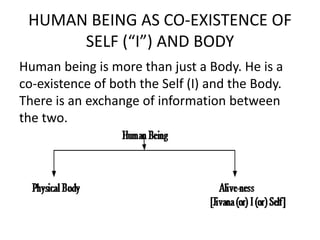
Human being is more than just a Body. He is a
co-existence of both the Self (I) and the Body.
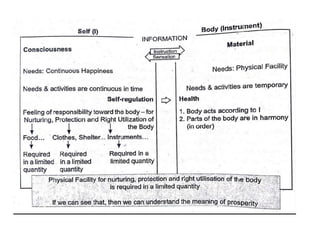
There is an exchange of information between
the two.
NEEDS OF THE SELF AND THE BODY
• All the human feelings of happiness, sorrow,
pain, excitement etc. are all experienced by “I”
and not the “Body”. Having Physical Facilities
ensures the fulfillment of the needs of the
body, but it does not fulfill the needs of the
“I”.
• Hence, for every human being, we need to
fulfill the needs of both:
• “I” = Happiness
• “Body” = Physical Facilities
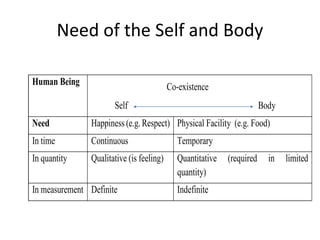
Need of the Self and Body
Human Being
Co-existence
Self Body
Need Happiness (e.g. Respect) Physical Facility (e.g. Food)
In time Continuous Temporary
In quantity Qualitative (is feeling) Quantitative (required in limited
quantity)
In measurement Definite Indefinite
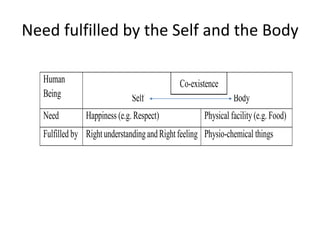
Need fulfilled by the Self and the Body
Human
Being
Co-existence
Self Body
Need Happiness (e.g. Respect) Physical facility (e.g. Food)
Fulfilled by RightunderstandingandRightfeeling Physio-chemical things
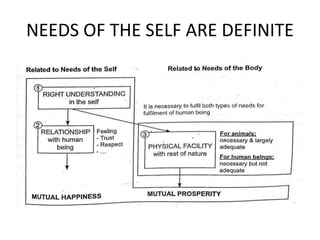
NEEDS OF THE SELF ARE DEFINITE
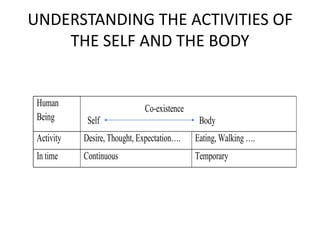
UNDERSTANDING THE ACTIVITIES OF
THE SELF AND THE BODY
Human
Being
Co-existence
Self Body
Activity Desire, Thought, Expectation…. Eating, Walking ….
In time Continuous Temporary
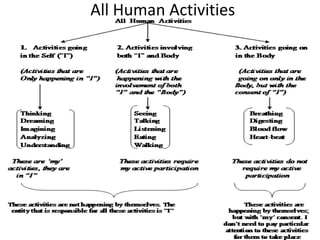
All human activities can be put under three
categories –
• Activities that are going on in the Self (Sentient
Activities)
• Activities that are going on in the Body (Material
Activities)
• Activities involving both the Self and the Body
All Human Activities
Bodily functions / Activities in the
Body
•The body is a set of “Self-organized activities”
that occur with my (I) consent but without my (I)
participation.
e.g.: the functions like breathing, digestion,
organ functions.
However some of these activities can be
stopped by me (I) if I want.
e.g.: breathing
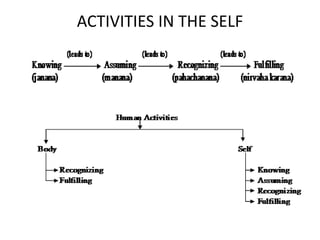
ACTIVITIES IN THE SELF
UNDERSTANDING THE RESPONSE OF
THE SELF AND THE BODY
• The response of the Body is based on
recognizing and fulfilling whereas the
response of the self is based on knowing,
assuming, recognizing and fulfilling.
Human
Being
Co-existence
Self Body
Response Knowing, Assuming,
Recognizing, Fulfilling
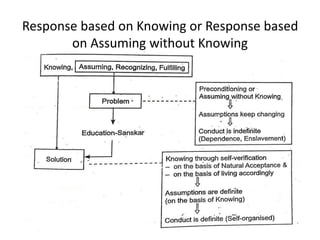
Response based on Knowing or Response based
on Assuming without Knowing
THE SELF AS THE CONSCIOUSNESS ENTITY, THE
BODY AS THE MATERIAL ENTITY
HARMONY IN THE SELF (“I”) –
UNDERSTANDING MYSELF
• We spend most of our time ‘with’ ourselves,
‘in’ ourselves but we spend most of our time
thinking about other things and neglect
ourselves.
• The Self (I) is the basis of everything we do. All
our desires, expectations, thoughts, feelings,
understanding etc. come from the “I”.
Activities in Self (I):
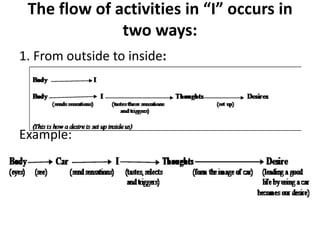
The flow of activities in “I” occurs in
two ways:
1. From outside to inside:
Example:
2.From inside to outside:
Example:
THE ACTIVITIES OF REALIZATION AND UNDERSTANDING
These are the two activities in the Self.
• Realization: It means to be able to see the
reality as it is.
• Understanding: It means to be able to
understand the self-organization in all entities
of Nature/Existence and their inter-
connectedness at all the levels of our living.
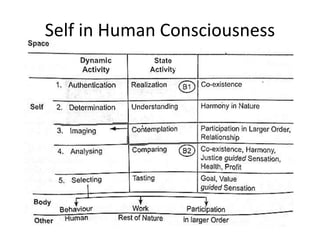
Self in Human Consciousness
Definite Human Conduct
UNDERSTANDING THE BODY AS AN
INSTRUMENT OF “I”:
• The Self is a unit of consciousness and it is in
coexistence with the material Body. It is the
self that makes all the decisions and uses the
Body to execute them as and when required.
Role of the Self and the Body
(Instrument)
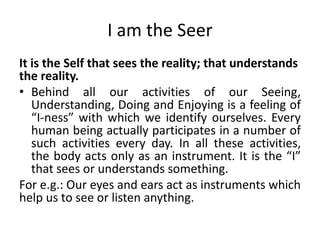
I am the Seer
It is the Self that sees the reality; that understands
the reality.
• Behind all our activities of our Seeing,
Understanding, Doing and Enjoying is a feeling of
“I-ness” with which we identify ourselves. Every
human being actually participates in a number of
such activities every day. In all these activities,
the body acts only as an instrument. It is the “I”
that sees or understands something.
For e.g.: Our eyes and ears act as instruments which
help us to see or listen anything.
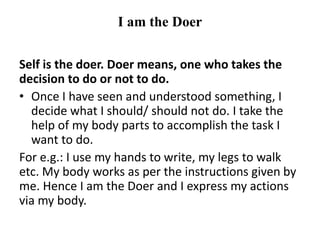
I am the Doer
Self is the doer. Doer means, one who takes the
decision to do or not to do.
• Once I have seen and understood something, I
decide what I should/ should not do. I take the
help of my body parts to accomplish the task I
want to do.
For e.g.: I use my hands to write, my legs to walk
etc. My body works as per the instructions given by
me. Hence I am the Doer and I express my actions
via my body.
I am the Enjoyer
It is the Self that feels enthused or depressed
or angry or delighted.
• I use my body as an instrument to perform
various activities. It is I who enjoy the pleasure
derived out of those activities.
For e.g.: mouth helps to chew and the tongue to
taste, but I enjoy the taste and flavour. I am the
one feeling excited, angry, sad, happy etc. my
body is only one instrument.
HARMONY OF THE SELF WITH THE
BODY
Our Body – A Self-Organized Unit:
• The human body is a self-organized unit with a highly
sophisticated mechanism. It is made up of several
organs such as the heart, lungs etc. and various glands,
all of which work in a close co-ordination.
• The body is made up of cells and each cell of the body
has a role to play in the overall working of the body.
Each cell is Self-organized and participates in the Self-
organization of the body as a whole.
• All the activities in the body keep the body fit for the
use of “I”.
Harmony of the “I” with the Body:
The harmony of “I” with the body is:
• In the form of Sanyama (Self-Regulation) on
part of “I
• In the form of Svasthya (Health) on part of the
Body
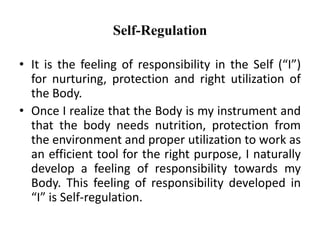
Self-Regulation
• It is the feeling of responsibility in the Self (“I”)
for nurturing, protection and right utilization of
the Body.
• Once I realize that the Body is my instrument and
that the body needs nutrition, protection from
the environment and proper utilization to work as
an efficient tool for the right purpose, I naturally
develop a feeling of responsibility towards my
Body. This feeling of responsibility developed in
“I” is Self-regulation.
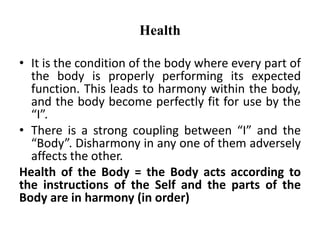
Health
• It is the condition of the body where every part of
the body is properly performing its expected
function. This leads to harmony within the body,
and the body become perfectly fit for use by the
“I”.
• There is a strong coupling between “I” and the
“Body”. Disharmony in any one of them adversely
affects the other.
Health of the Body = the Body acts according to
the instructions of the Self and the parts of the
Body are in harmony (in order)
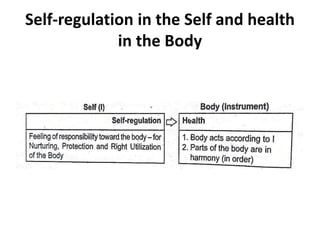
Self-regulation in the Self and health
in the Body
PROGRAM FOR SELF-REGULATION
AND HEALTH
1. To understand and live with Self-regulation:
– It implies that the “Self” takes the responsibility
for proper nurturing, protection and right
utilization of the body.
– It also implies that the “Self” should understand
that the body is an instrument and has a limited
life span and undergoes a pattern of growth and
decay.
– The “Self” should also understand the right
purpose for which this instrument has to be used.
2. To understand the self-organization of the body and ensure overall
health of the body in the following ways:
• Nurturing the Body
• Nurturing involves providing proper food, air, water etc. to the
body.
• The selection of food should be such that it gives required nutrients
and energy to the body following the program below:
– Ingestion: This involves taking the food into the mouth and chewing it
well for easy digestion.
– Digestion: Digestion starts after swallowing the food. Digestion also
depends on proper rest and exercise of the body. Food consumed
should be at proper intervals and with proper posture and right
quantity.
– Excretion: After digestion, the necessary nutrients are absorbed by
the body and the unnecessary or undigested part needs to be thrown
out or excreted.
If any of the above three activities are not performed properly, it
affects the body adversely and causes several health problems.
• Protecting the Body:
This involves the selection of proper clothes and
shelter for protecting the body from extreme climatic
conditions and to provide the right amount of
exposure of the body to air, water, sunlight etc. to
ensure proper functioning of the body.
To ensure the health of the Body, we need to take
care of the following:
• Ahara – Vihara (Food – Upkeep)
• Shrama – Vyayama (Physical labour – Exercise)
• Asana – Pranayama ( Yogasana – Pranayam)
• Ausadhi – Chikitsa (Medicine – Treatment)
Right Utilization of the Body
• It is normally believed that our body is an
instrument for sensory enjoyment. This is a
wrong notion. We also use our body to exploit
others and to exploit Nature as well.
For e.g.: fighting, sealing, quarrelling etc.
• Human Body should be used only for the right
behaviour and right work. Otherwise it leads
to disharmony in the Self which has adverse
effects on the Body.
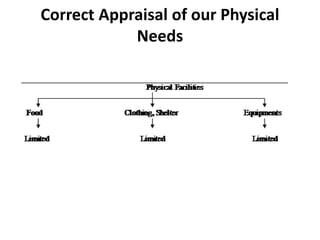
Correct Appraisal of our Physical
Needs
• In Nature, the availability of facilities like water,
oxygen etc. is more than our needs. Once we
realize that the needs of our Body are limited
and can be easily fulfilled, there emerges a
possibility of prosperity in our minds.
HARMONY IN THE HUMAN BEING - Unit-II UHV-2

HARMONY IN THE HUMAN BEING - Unit-II UHV-2

  • 1.
    UNIT 2 HARMONY INTHE HUMAN BEING
  • 2.
    HUMAN BEING ASCO-EXISTENCE OF SELF (“I”) AND BODY Human being is more than just a Body. He is a co-existence of both the Self (I) and the Body. There is an exchange of information between the two.
  • 3.
    NEEDS OF THESELF AND THE BODY • All the human feelings of happiness, sorrow, pain, excitement etc. are all experienced by “I” and not the “Body”. Having Physical Facilities ensures the fulfillment of the needs of the body, but it does not fulfill the needs of the “I”. • Hence, for every human being, we need to fulfill the needs of both: • “I” = Happiness • “Body” = Physical Facilities
  • 4.
    Need of theSelf and Body Human Being Co-existence Self Body Need Happiness (e.g. Respect) Physical Facility (e.g. Food) In time Continuous Temporary In quantity Qualitative (is feeling) Quantitative (required in limited quantity) In measurement Definite Indefinite
  • 5.
    Need fulfilled bythe Self and the Body Human Being Co-existence Self Body Need Happiness (e.g. Respect) Physical facility (e.g. Food) Fulfilled by RightunderstandingandRightfeeling Physio-chemical things
  • 6.
    NEEDS OF THESELF ARE DEFINITE
  • 7.
    UNDERSTANDING THE ACTIVITIESOF THE SELF AND THE BODY Human Being Co-existence Self Body Activity Desire, Thought, Expectation…. Eating, Walking …. In time Continuous Temporary
  • 8.
    All human activitiescan be put under three categories – • Activities that are going on in the Self (Sentient Activities) • Activities that are going on in the Body (Material Activities) • Activities involving both the Self and the Body
  • 9.
  • 10.
    Bodily functions /Activities in the Body •The body is a set of “Self-organized activities” that occur with my (I) consent but without my (I) participation. e.g.: the functions like breathing, digestion, organ functions. However some of these activities can be stopped by me (I) if I want. e.g.: breathing
  • 11.
  • 12.
    UNDERSTANDING THE RESPONSEOF THE SELF AND THE BODY • The response of the Body is based on recognizing and fulfilling whereas the response of the self is based on knowing, assuming, recognizing and fulfilling. Human Being Co-existence Self Body Response Knowing, Assuming, Recognizing, Fulfilling Recognizing, Fulfilling
  • 13.
    Response based onKnowing or Response based on Assuming without Knowing
  • 14.
    THE SELF ASTHE CONSCIOUSNESS ENTITY, THE BODY AS THE MATERIAL ENTITY
  • 15.
    HARMONY IN THESELF (“I”) – UNDERSTANDING MYSELF • We spend most of our time ‘with’ ourselves, ‘in’ ourselves but we spend most of our time thinking about other things and neglect ourselves. • The Self (I) is the basis of everything we do. All our desires, expectations, thoughts, feelings, understanding etc. come from the “I”.
  • 16.
  • 17.
    The flow ofactivities in “I” occurs in two ways: 1. From outside to inside: Example:
  • 18.
    2.From inside tooutside: Example:
  • 19.
    THE ACTIVITIES OFREALIZATION AND UNDERSTANDING These are the two activities in the Self. • Realization: It means to be able to see the reality as it is. • Understanding: It means to be able to understand the self-organization in all entities of Nature/Existence and their inter- connectedness at all the levels of our living.
  • 20.
    Self in HumanConsciousness
  • 21.
  • 22.
    UNDERSTANDING THE BODYAS AN INSTRUMENT OF “I”: • The Self is a unit of consciousness and it is in coexistence with the material Body. It is the self that makes all the decisions and uses the Body to execute them as and when required.
  • 23.
    Role of theSelf and the Body (Instrument)
  • 24.
    I am theSeer It is the Self that sees the reality; that understands the reality. • Behind all our activities of our Seeing, Understanding, Doing and Enjoying is a feeling of “I-ness” with which we identify ourselves. Every human being actually participates in a number of such activities every day. In all these activities, the body acts only as an instrument. It is the “I” that sees or understands something. For e.g.: Our eyes and ears act as instruments which help us to see or listen anything.
  • 25.
    I am theDoer Self is the doer. Doer means, one who takes the decision to do or not to do. • Once I have seen and understood something, I decide what I should/ should not do. I take the help of my body parts to accomplish the task I want to do. For e.g.: I use my hands to write, my legs to walk etc. My body works as per the instructions given by me. Hence I am the Doer and I express my actions via my body.
  • 26.
    I am theEnjoyer It is the Self that feels enthused or depressed or angry or delighted. • I use my body as an instrument to perform various activities. It is I who enjoy the pleasure derived out of those activities. For e.g.: mouth helps to chew and the tongue to taste, but I enjoy the taste and flavour. I am the one feeling excited, angry, sad, happy etc. my body is only one instrument.
  • 27.
    HARMONY OF THESELF WITH THE BODY Our Body – A Self-Organized Unit: • The human body is a self-organized unit with a highly sophisticated mechanism. It is made up of several organs such as the heart, lungs etc. and various glands, all of which work in a close co-ordination. • The body is made up of cells and each cell of the body has a role to play in the overall working of the body. Each cell is Self-organized and participates in the Self- organization of the body as a whole. • All the activities in the body keep the body fit for the use of “I”.
  • 28.
    Harmony of the“I” with the Body: The harmony of “I” with the body is: • In the form of Sanyama (Self-Regulation) on part of “I • In the form of Svasthya (Health) on part of the Body
  • 29.
    Self-Regulation • It isthe feeling of responsibility in the Self (“I”) for nurturing, protection and right utilization of the Body. • Once I realize that the Body is my instrument and that the body needs nutrition, protection from the environment and proper utilization to work as an efficient tool for the right purpose, I naturally develop a feeling of responsibility towards my Body. This feeling of responsibility developed in “I” is Self-regulation.
  • 30.
    Health • It isthe condition of the body where every part of the body is properly performing its expected function. This leads to harmony within the body, and the body become perfectly fit for use by the “I”. • There is a strong coupling between “I” and the “Body”. Disharmony in any one of them adversely affects the other. Health of the Body = the Body acts according to the instructions of the Self and the parts of the Body are in harmony (in order)
  • 31.
    Self-regulation in theSelf and health in the Body
  • 32.
    PROGRAM FOR SELF-REGULATION ANDHEALTH 1. To understand and live with Self-regulation: – It implies that the “Self” takes the responsibility for proper nurturing, protection and right utilization of the body. – It also implies that the “Self” should understand that the body is an instrument and has a limited life span and undergoes a pattern of growth and decay. – The “Self” should also understand the right purpose for which this instrument has to be used.
  • 33.
    2. To understandthe self-organization of the body and ensure overall health of the body in the following ways: • Nurturing the Body • Nurturing involves providing proper food, air, water etc. to the body. • The selection of food should be such that it gives required nutrients and energy to the body following the program below: – Ingestion: This involves taking the food into the mouth and chewing it well for easy digestion. – Digestion: Digestion starts after swallowing the food. Digestion also depends on proper rest and exercise of the body. Food consumed should be at proper intervals and with proper posture and right quantity. – Excretion: After digestion, the necessary nutrients are absorbed by the body and the unnecessary or undigested part needs to be thrown out or excreted. If any of the above three activities are not performed properly, it affects the body adversely and causes several health problems.
  • 34.
    • Protecting theBody: This involves the selection of proper clothes and shelter for protecting the body from extreme climatic conditions and to provide the right amount of exposure of the body to air, water, sunlight etc. to ensure proper functioning of the body. To ensure the health of the Body, we need to take care of the following: • Ahara – Vihara (Food – Upkeep) • Shrama – Vyayama (Physical labour – Exercise) • Asana – Pranayama ( Yogasana – Pranayam) • Ausadhi – Chikitsa (Medicine – Treatment)
  • 35.
    Right Utilization ofthe Body • It is normally believed that our body is an instrument for sensory enjoyment. This is a wrong notion. We also use our body to exploit others and to exploit Nature as well. For e.g.: fighting, sealing, quarrelling etc. • Human Body should be used only for the right behaviour and right work. Otherwise it leads to disharmony in the Self which has adverse effects on the Body.
  • 36.
    Correct Appraisal ofour Physical Needs
  • 37.
    • In Nature,the availability of facilities like water, oxygen etc. is more than our needs. Once we realize that the needs of our Body are limited and can be easily fulfilled, there emerges a possibility of prosperity in our minds.