Background to language
teaching methodology
Silvia Bautista Martín
Oral communication in Early Language Learning Environments
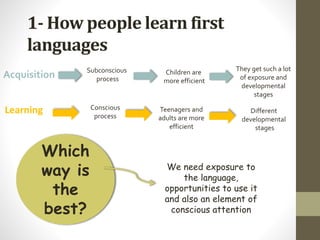
1- How people learn first
languages
Acquisition
Learning
Subconscious
process
Conscious
process
Children are
more efficient
Teenagers and
adults are more
efficient
They get such a lot
of exposure and
developmental
stages
Different
developmental
stages
Which
way is
the
best?
We need exposure to
the language,
opportunities to use it
and also an element of
conscious attention
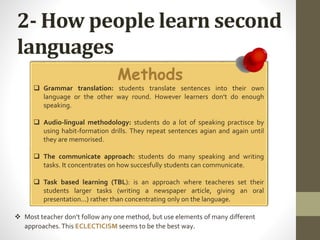
2- How people learn second
languages
Methods
 Grammar translation: students translate sentences into their own
language or the other way round. However learners don’t do enough
speaking.
 Audio-lingual methodology: students do a lot of speaking practisce by
using habit-formation drills. They repeat sentences agian and again until
they are memorised.
 The communicate approach: students do many speaking and writing
tasks. It concentrates on how succesfully students can communicate.
 Task based learning (TBL): is an approach where teacheres set their
students larger tasks (writing a newspaper article, giving an oral
presentation…) rather than concentrating only on the language.
 Most teacher don’t follow any one method, but use elements of many different
approaches.This ECLECTICISM seems to be the best way.
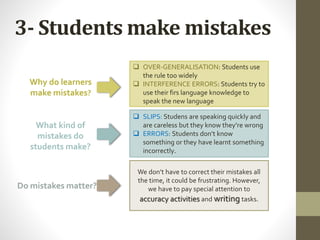
3- Students make mistakes
Why do learners
make mistakes?
What kind of
mistakes do
students make?
Do mistakes matter?
 OVER-GENERALISATION: Students use
the rule too widely
 INTERFERENCE ERRORS: Students try to
use their firs language knowledge to
speak the new language
 SLIPS: Studens are speaking quickly and
are careless but they know they’re wrong
 ERRORS: Students don’t know
something or they have learnt something
incorrectly.
We don’t have to correct their mistakes all
the time, it could be frustrating. However,
we have to pay special attention to
accuracy activities and writing tasks.
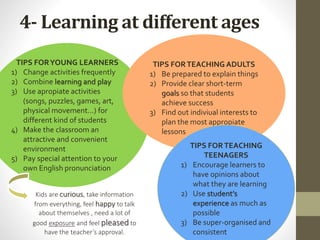
4- Learning at different ages
TIPS FORYOUNG LEARNERS
1) Change activities frequently
2) Combine learning and play
3) Use apropiate activities
(songs, puzzles, games, art,
physical movement…) for
different kind of students
4) Make the classroom an
attractive and convenient
environment
5) Pay special attention to your
own English pronunciation
TIPS FORTEACHING ADULTS
1) Be prepared to explain things
2) Provide clear short-term
goals so that students
achieve success
3) Find out indiviual interests to
plan the most appropiate
lessons
TIPS FORTEACHING
TEENAGERS
1) Encourage learners to
have opinions about
what they are learning
2) Use student’s
experience as much as
possible
3) Be super-organised and
consistent
Kids are curious, take information
from everything, feel happy to talk
about themselves , need a lot of
good exposure and feel pleased to
have the teacher’s approval.
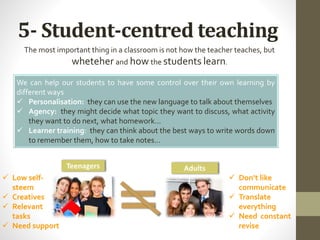
5- Student-centred teaching
The most important thing in a classroom is not how the teacher teaches, but
wheteher and how the students learn.
We can help our students to have some control over their own learning by
different ways
 Personalisation: they can use the new language to talk about themselves
 Agency: they might decide what topic they want to discuss, what activity
they want to do next, what homework…
 Learner training: they can think about the best ways to write words down
to remember them, how to take notes…
 Low self-
steem
 Creatives
 Relevant
tasks
 Need support
 Don’t like
communicate
 Translate
everything
 Need constant
revise
Teenagers Adults
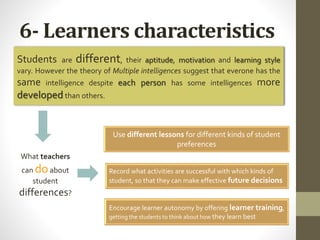
6- Learners characteristics
Students are different, their aptitude, motivation and learning style
vary. However the theory of Multiple intelligences suggest that everone has the
same intelligence despite each person has some intelligences more
developed than others.
What teachers
can doabout
student
differences?
Use different lessons for different kinds of student
preferences
Record what activities are successful with which kinds of
student, so that they can make effective future decisions
Encourage learner autonomy by offering learner training,
getting the students to think about how they learn best
7- Different contexts,
different levels
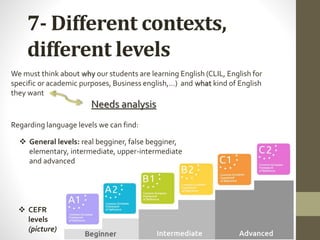
 CEFR
levels
(picture)
 General levels: real begginer, false begginer,
elementary, intermediate, upper-intermediate
and advanced
We must think about why our students are learning English (CLIL, English for
specific or academic purposes, Business english,…) and what kind of English
they want
Needs analysis
Regarding language levels we can find:
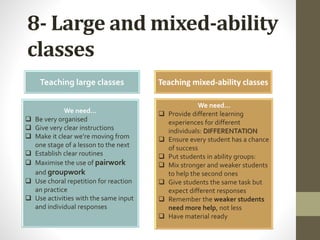
8- Large and mixed-ability
classes
Teaching large classes Teaching mixed-ability classes
We need…
 Be very organised
 Give very clear instructions
 Make it clear we’re moving from
one stage of a lesson to the next
 Establish clear routines
 Maximise the use of pairwork
and groupwork
 Use choral repetition for reaction
an practice
 Use activities with the same input
and individual responses
We need…
 Provide different learning
experiences for different
individuals: DIFFERENTATION
 Ensure every student has a chance
of success
 Put students in ability groups:
 Mix stronger and weaker students
to help the second ones
 Give students the same task but
expect different responses
 Remember the weaker students
need more help, not less
 Have material ready
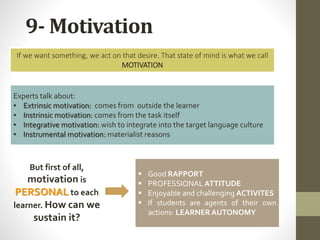
9- Motivation
If we want something, we act on that desire. That state of mind is what we call
MOTIVATION
Experts talk about:
• Extrinsic motivation: comes from outside the learner
• Instrinsic motivation: comes from the task itself
• Integrative motivation: wish to integrate into the target language culture
• Instrumental motivation: materialist reasons
 Good RAPPORT
 PROFESSIONAL ATTITUDE
 Enjoyable and challenging ACTIVITES
 If students are agents of their own
actions: LEARNERAUTONOMY
But first of all,
motivation is
PERSONAL to each
learner. How can we
sustain it?

Background to language teaching methodology

  • 1.
    Background to language teachingmethodology Silvia Bautista Martín Oral communication in Early Language Learning Environments
  • 2.
    1- How peoplelearn first languages Acquisition Learning Subconscious process Conscious process Children are more efficient Teenagers and adults are more efficient They get such a lot of exposure and developmental stages Different developmental stages Which way is the best? We need exposure to the language, opportunities to use it and also an element of conscious attention
  • 3.
    2- How peoplelearn second languages Methods  Grammar translation: students translate sentences into their own language or the other way round. However learners don’t do enough speaking.  Audio-lingual methodology: students do a lot of speaking practisce by using habit-formation drills. They repeat sentences agian and again until they are memorised.  The communicate approach: students do many speaking and writing tasks. It concentrates on how succesfully students can communicate.  Task based learning (TBL): is an approach where teacheres set their students larger tasks (writing a newspaper article, giving an oral presentation…) rather than concentrating only on the language.  Most teacher don’t follow any one method, but use elements of many different approaches.This ECLECTICISM seems to be the best way.
  • 4.
    3- Students makemistakes Why do learners make mistakes? What kind of mistakes do students make? Do mistakes matter?  OVER-GENERALISATION: Students use the rule too widely  INTERFERENCE ERRORS: Students try to use their firs language knowledge to speak the new language  SLIPS: Studens are speaking quickly and are careless but they know they’re wrong  ERRORS: Students don’t know something or they have learnt something incorrectly. We don’t have to correct their mistakes all the time, it could be frustrating. However, we have to pay special attention to accuracy activities and writing tasks.
  • 5.
    4- Learning atdifferent ages TIPS FORYOUNG LEARNERS 1) Change activities frequently 2) Combine learning and play 3) Use apropiate activities (songs, puzzles, games, art, physical movement…) for different kind of students 4) Make the classroom an attractive and convenient environment 5) Pay special attention to your own English pronunciation TIPS FORTEACHING ADULTS 1) Be prepared to explain things 2) Provide clear short-term goals so that students achieve success 3) Find out indiviual interests to plan the most appropiate lessons TIPS FORTEACHING TEENAGERS 1) Encourage learners to have opinions about what they are learning 2) Use student’s experience as much as possible 3) Be super-organised and consistent Kids are curious, take information from everything, feel happy to talk about themselves , need a lot of good exposure and feel pleased to have the teacher’s approval.
  • 6.
    5- Student-centred teaching Themost important thing in a classroom is not how the teacher teaches, but wheteher and how the students learn. We can help our students to have some control over their own learning by different ways  Personalisation: they can use the new language to talk about themselves  Agency: they might decide what topic they want to discuss, what activity they want to do next, what homework…  Learner training: they can think about the best ways to write words down to remember them, how to take notes…  Low self- steem  Creatives  Relevant tasks  Need support  Don’t like communicate  Translate everything  Need constant revise Teenagers Adults
  • 7.
    6- Learners characteristics Studentsare different, their aptitude, motivation and learning style vary. However the theory of Multiple intelligences suggest that everone has the same intelligence despite each person has some intelligences more developed than others. What teachers can doabout student differences? Use different lessons for different kinds of student preferences Record what activities are successful with which kinds of student, so that they can make effective future decisions Encourage learner autonomy by offering learner training, getting the students to think about how they learn best
  • 8.
    7- Different contexts, differentlevels  CEFR levels (picture)  General levels: real begginer, false begginer, elementary, intermediate, upper-intermediate and advanced We must think about why our students are learning English (CLIL, English for specific or academic purposes, Business english,…) and what kind of English they want Needs analysis Regarding language levels we can find:
  • 9.
    8- Large andmixed-ability classes Teaching large classes Teaching mixed-ability classes We need…  Be very organised  Give very clear instructions  Make it clear we’re moving from one stage of a lesson to the next  Establish clear routines  Maximise the use of pairwork and groupwork  Use choral repetition for reaction an practice  Use activities with the same input and individual responses We need…  Provide different learning experiences for different individuals: DIFFERENTATION  Ensure every student has a chance of success  Put students in ability groups:  Mix stronger and weaker students to help the second ones  Give students the same task but expect different responses  Remember the weaker students need more help, not less  Have material ready
  • 10.
    9- Motivation If wewant something, we act on that desire. That state of mind is what we call MOTIVATION Experts talk about: • Extrinsic motivation: comes from outside the learner • Instrinsic motivation: comes from the task itself • Integrative motivation: wish to integrate into the target language culture • Instrumental motivation: materialist reasons  Good RAPPORT  PROFESSIONAL ATTITUDE  Enjoyable and challenging ACTIVITES  If students are agents of their own actions: LEARNERAUTONOMY But first of all, motivation is PERSONAL to each learner. How can we sustain it?