RENEWABLE TEACHERS
ERASMUS PLUS KA1 2016
DISSEMINAZIONE DIPARTIMENTO LINGUISTICO
SCUOLA SECONDARIA DI PRIMO GRADO «BERNACCHIA-BRIGIDA»
22 DICEMBRE 2016 ORE 16: 45
LONDON 3rd -7th OCTOBER 2016
LANGUAGE LINK SCHOOL OF ENGLISH
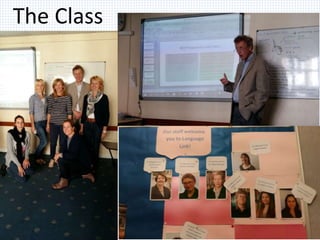
The Class
Problems with methodologies 
sharing experiences
The questions below are only dumb at first sight an attempt to answer them
may make you go ‘hmmm’
• Do most methodologies address teaching or learning? What’s your
understanding?
• Is it possible that teachers are involved in Professional Development activities
for the wrong reasons, and they don’t necessarily have their students in mind as
the ultimate reason why they want to be better teachers?
• Do you choose/plan activities to demonstrate your knowledge/teaching skills or
do you plan activities with your students in mind?
• Detailed attention to the teaching going on in the teacher as opposed to the
learning going on in the learner- which option should be our priority?
• Should we be theorising about methods or theorising about learning?
• When planning a lesson do you fall victim to the infinite choice of resources? Or
do you start with thinking about your learners and what they need? How do you
choose your activities knowing that every choice we make has the ‘opportunity
cost’ of the myriad of other options not taken?
• Teaching differently means loss of identity and wish
for failure. Do you agree?
• How often do you do something new?
• Do you sometimes feel stuck? Are you in a rut?
What do you do to get out of it?
• What keeps us from trying out new ideas?
Bored teacher
=
Bored students
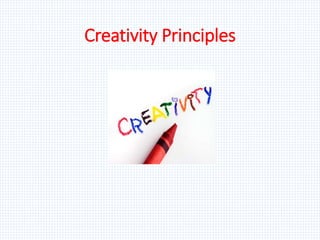
Creativity Principles
• Do the opposite
• Reverse the order
• Expand or reduce something
• Use the random principle
• Use the association principle
• Use the constraints principle
DO THE OPPOSITE
• Essentially it involves observing the routines and
activities we consciously or unconsciously follow,
doing the opposite and then observing what
happens. Examples would be: if you always stand up
to teach, sit down; if you teach from the front of the
class, teach from the back; if you usually talk a lot,
try silence.
REVERSE THE ORDER
• Here you would do things backwards. For example: in
dictation, instead of giving out the text at the end,
you would give it out at the beginning, allow
students to read it then take it away, then give the
dictation. If you normally read texts from beginning
to end, try reading them starting at the end; if you
normally set homework after a lesson, try setting it
before; if you usually give a grammar rule, asking
them to find examples, try giving examples and
asking them to derive the rule.
EXPAND OR REDUCE
• For example increase (or decrease) the lenght of a
text in various way; increase (or decrease) the time
allotted to a task; increase the number of questions
on a text; increase or decrease the number of times
you do a particular activity.
• (Maley’s books Short and Sweet suggest 12 different
generic procedures including this to develop more
interesting materials).
USE THE RANDOM PRINCIPLE
This is essentially using bisociation-putting two or more
things together that do not belong together-and finding
connections. For example:
• Students work in pairs- all the As write ten adjectives
on slips of paper, all the Bs write ten nouns. The slips
are put in two boxes. Students take turns to draw a
slip from each box, making an unusual combination,
e.g. a broken birthday. When they have ten new
phrases they combine them into a text.
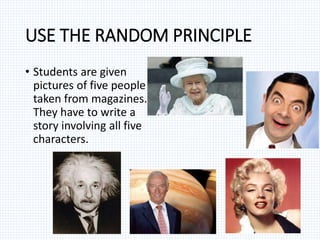
USE THE RANDOM PRINCIPLE
• Students are given
pictures of five people
taken from magazines.
They have to write a
story involving all five
characters.
USE THE ASSOCIATION PRINCIPLE
This involves using evocative stimuli for students to
react to. For example:
• Students listen to a sequence of sounds, then
describe their feelings or tell a story suggested by
the sound.
• Students are given a set of character descriptions
and a set of fragments of dialogue-they match the
characters with what they might have said.
• Students are given a natural object ( a stone, a leaf
etc.). They then write a text as if they were their
object.
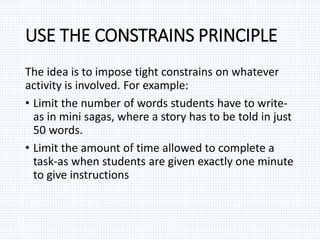
USE THE CONSTRAINS PRINCIPLE
The idea is to impose tight constrains on whatever
activity is involved. For example:
• Limit the number of words students have to write-
as in mini sagas, where a story has to be told in just
50 words.
• Limit the amount of time allowed to complete a
task-as when students are given exactly one minute
to give instructions
Neuro-Linguistic Programming
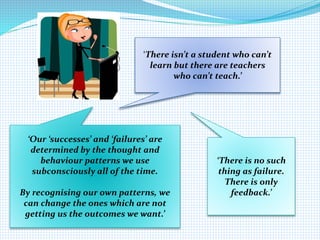
‘There is no such
thing as failure.
There is only
feedback.’
‘Our ‘successes’ and ‘failures’ are
determined by the thought and
behaviour patterns we use
subconsciously all of the time.
By recognising our own patterns, we
can change the ones which are not
getting us the outcomes we want.’
‘There isn’t a student who can’t
learn but there are teachers
who can’t teach.’
How to integrate different learning styles into
your lesson...
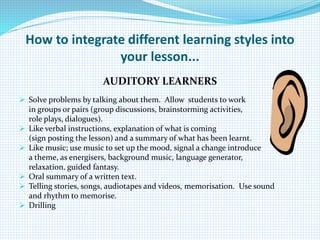
AUDITORY LEARNERS
 Solve problems by talking about them. Allow students to work
in groups or pairs (group discussions, brainstorming activities,
role plays, dialogues).
 Like verbal instructions, explanation of what is coming
(sign posting the lesson) and a summary of what has been learnt.
 Like music; use music to set up the mood, signal a change introduce
a theme, as energisers, background music, language generator,
relaxation, guided fantasy.
 Oral summary of a written text.
 Telling stories, songs, audiotapes and videos, memorisation. Use sound
and rhythm to memorise.
 Drilling
How to integrate different learning styles into
your lesson...
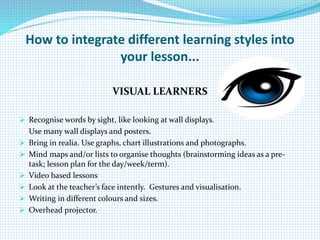
VISUAL LEARNERS
 Recognise words by sight, like looking at wall displays.
Use many wall displays and posters.
 Bring in realia. Use graphs, chart illustrations and photographs.
 Mind maps and/or lists to organise thoughts (brainstorming ideas as a pre-
task; lesson plan for the day/week/term).
 Video based lessons
 Look at the teacher’s face intently. Gestures and visualisation.
 Writing in different colours and sizes.
 Overhead projector.
How to integrate different learning styles
into your lesson...
KINESTHETIC LEARNERS
 Like to move around while learning and work in different
groups/pairs. Intersperse activities which require students to sit
quietly with activities that allow them to move around.
 Plan energising activities that serve as punctuations not language- learning
activities in their own right (stand up, change partners, come up to the board,
mingles, write our name in the air, mime a word that someone calls out).
 Bring in realia to hold or touch.
 Use demonstrations, mime, act things out.
 Learn best when involved and active; use physical activities, competitions,
board games, role plays, questionnaires, surveys.
‘C’ Group:
Creativity for Change in Language
Education
http://thecreativitygroup.weebly.com/
CREATIVITY IN ENGLISH LANGUAGE TEACHING
edited by Daniel Xerri and Odette Vassallo.

P.point erasmus

  • 1.
    RENEWABLE TEACHERS ERASMUS PLUSKA1 2016 DISSEMINAZIONE DIPARTIMENTO LINGUISTICO SCUOLA SECONDARIA DI PRIMO GRADO «BERNACCHIA-BRIGIDA» 22 DICEMBRE 2016 ORE 16: 45
  • 2.
    LONDON 3rd -7thOCTOBER 2016 LANGUAGE LINK SCHOOL OF ENGLISH
  • 3.
  • 9.
    Problems with methodologies sharing experiences The questions below are only dumb at first sight an attempt to answer them may make you go ‘hmmm’ • Do most methodologies address teaching or learning? What’s your understanding? • Is it possible that teachers are involved in Professional Development activities for the wrong reasons, and they don’t necessarily have their students in mind as the ultimate reason why they want to be better teachers? • Do you choose/plan activities to demonstrate your knowledge/teaching skills or do you plan activities with your students in mind? • Detailed attention to the teaching going on in the teacher as opposed to the learning going on in the learner- which option should be our priority? • Should we be theorising about methods or theorising about learning? • When planning a lesson do you fall victim to the infinite choice of resources? Or do you start with thinking about your learners and what they need? How do you choose your activities knowing that every choice we make has the ‘opportunity cost’ of the myriad of other options not taken?
  • 10.
    • Teaching differentlymeans loss of identity and wish for failure. Do you agree? • How often do you do something new? • Do you sometimes feel stuck? Are you in a rut? What do you do to get out of it? • What keeps us from trying out new ideas? Bored teacher = Bored students
  • 11.
  • 12.
    Creativity Principles • Dothe opposite • Reverse the order • Expand or reduce something • Use the random principle • Use the association principle • Use the constraints principle
  • 13.
    DO THE OPPOSITE •Essentially it involves observing the routines and activities we consciously or unconsciously follow, doing the opposite and then observing what happens. Examples would be: if you always stand up to teach, sit down; if you teach from the front of the class, teach from the back; if you usually talk a lot, try silence.
  • 14.
    REVERSE THE ORDER •Here you would do things backwards. For example: in dictation, instead of giving out the text at the end, you would give it out at the beginning, allow students to read it then take it away, then give the dictation. If you normally read texts from beginning to end, try reading them starting at the end; if you normally set homework after a lesson, try setting it before; if you usually give a grammar rule, asking them to find examples, try giving examples and asking them to derive the rule.
  • 15.
    EXPAND OR REDUCE •For example increase (or decrease) the lenght of a text in various way; increase (or decrease) the time allotted to a task; increase the number of questions on a text; increase or decrease the number of times you do a particular activity. • (Maley’s books Short and Sweet suggest 12 different generic procedures including this to develop more interesting materials).
  • 16.
    USE THE RANDOMPRINCIPLE This is essentially using bisociation-putting two or more things together that do not belong together-and finding connections. For example: • Students work in pairs- all the As write ten adjectives on slips of paper, all the Bs write ten nouns. The slips are put in two boxes. Students take turns to draw a slip from each box, making an unusual combination, e.g. a broken birthday. When they have ten new phrases they combine them into a text.
  • 17.
    USE THE RANDOMPRINCIPLE • Students are given pictures of five people taken from magazines. They have to write a story involving all five characters.
  • 18.
    USE THE ASSOCIATIONPRINCIPLE This involves using evocative stimuli for students to react to. For example: • Students listen to a sequence of sounds, then describe their feelings or tell a story suggested by the sound. • Students are given a set of character descriptions and a set of fragments of dialogue-they match the characters with what they might have said. • Students are given a natural object ( a stone, a leaf etc.). They then write a text as if they were their object.
  • 19.
    USE THE CONSTRAINSPRINCIPLE The idea is to impose tight constrains on whatever activity is involved. For example: • Limit the number of words students have to write- as in mini sagas, where a story has to be told in just 50 words. • Limit the amount of time allowed to complete a task-as when students are given exactly one minute to give instructions
  • 20.
  • 21.
    ‘There is nosuch thing as failure. There is only feedback.’ ‘Our ‘successes’ and ‘failures’ are determined by the thought and behaviour patterns we use subconsciously all of the time. By recognising our own patterns, we can change the ones which are not getting us the outcomes we want.’ ‘There isn’t a student who can’t learn but there are teachers who can’t teach.’
  • 22.
    How to integratedifferent learning styles into your lesson... AUDITORY LEARNERS  Solve problems by talking about them. Allow students to work in groups or pairs (group discussions, brainstorming activities, role plays, dialogues).  Like verbal instructions, explanation of what is coming (sign posting the lesson) and a summary of what has been learnt.  Like music; use music to set up the mood, signal a change introduce a theme, as energisers, background music, language generator, relaxation, guided fantasy.  Oral summary of a written text.  Telling stories, songs, audiotapes and videos, memorisation. Use sound and rhythm to memorise.  Drilling
  • 23.
    How to integratedifferent learning styles into your lesson... VISUAL LEARNERS  Recognise words by sight, like looking at wall displays. Use many wall displays and posters.  Bring in realia. Use graphs, chart illustrations and photographs.  Mind maps and/or lists to organise thoughts (brainstorming ideas as a pre- task; lesson plan for the day/week/term).  Video based lessons  Look at the teacher’s face intently. Gestures and visualisation.  Writing in different colours and sizes.  Overhead projector.
  • 24.
    How to integratedifferent learning styles into your lesson... KINESTHETIC LEARNERS  Like to move around while learning and work in different groups/pairs. Intersperse activities which require students to sit quietly with activities that allow them to move around.  Plan energising activities that serve as punctuations not language- learning activities in their own right (stand up, change partners, come up to the board, mingles, write our name in the air, mime a word that someone calls out).  Bring in realia to hold or touch.  Use demonstrations, mime, act things out.  Learn best when involved and active; use physical activities, competitions, board games, role plays, questionnaires, surveys.
  • 25.
    ‘C’ Group: Creativity forChange in Language Education http://thecreativitygroup.weebly.com/ CREATIVITY IN ENGLISH LANGUAGE TEACHING edited by Daniel Xerri and Odette Vassallo.