Chapter 16:
Class size and different
abilities
Course:
Applied Linguistics for
Language Teachers
Mr. VATH VARY
1
Master of
Education
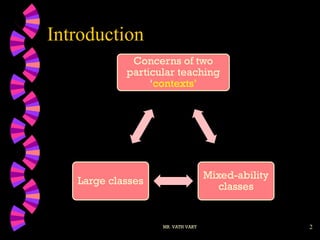
Introduction
MR. VATH VARY 2
Concerns of two
particular teaching
‘contexts’
Mixed-ability
classes
Large classes
3
Class size: two extremes
• Classes greatly vary in size:
• Class size of some private language
schools:
• 10 and 15 learners
• 60, 80, 100 or even 200 learners
• A typical class size in a lot of primary and
secondary education around the world
comprises some 30–40 students.

MR. VATH VARY
4
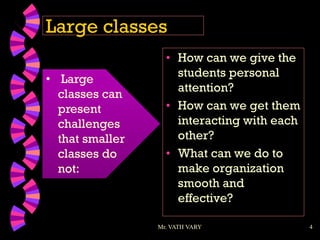
Large classes
• How can we give the
students personal
attention?
• How can we get them
interacting with each
other?
• What can we do to
make organization
smooth and
effective?
Mr. VATH VARY
• Large
classes can
present
challenges
that smaller
classes do
not:
5
Key elements in successful large-
group teaching
 Be organized
 Establish and use routines
 Use a different pace for different activities
 Maximise individual work
 Use the students
 Use worksheets
 Use pairwork and groupwork
 Use choral repetition, choral reaction
 Use the room
 Use the size of the class to your advantage
Mr. VATH VARY
6
Be organized
• The bigger the group, the more organised we
have to be, and the more we need to know what
we are going to do before the lesson starts:
• Tell the students what is going to happen in a
lesson:
• Show a board plan of the lesson to come, and tick off
the different stages as they are achieved.
• Summarise what has happened when it has
ended:
• write (on the board) a summary of what actually
happened and give one orally
MR. VATH VARY
7
• The daily management of a large class will be greatly enhanced if
we establish routines that we and our students recognise
straightaway:
 take the register, set and collect homework, get into pairs
and groups, etc.
 Hand out books or worksheets: (e.g. have one S from each row
coming to the front and collect that row’s handouts)
MR. VATH VARY
• “Use Quiet Sign”,
• raise an arm,
• ring a bell or blow a whistle,
• turn lights on and off,
• count backwards from ten,
• wave some kind of distinctive object in the
air,
• move to a particular part of the room,
• stand quietly so that the students notice
and gradually quieten down
Techniques to
attract the
students’
attention and
quieten
everyone down
Establish and use routines:
8
Use a different
pace for
different
activities
MR. VATH VARY
• Have SS to us Graded readers as
personal reading programme and
make individual choices about what to
read
• Have Ss to build Portfolio of work: Ask
Ss to write individually – offering their
own responses to what they read and
hear.
• Encourage Ss to make full use of a
school library or self access centre or
direct Ss to language learning
websites
Maximise
individual
work
• Give Ss time to respond when
asking them to say
• Have Ss to work at quite a fast
pace when conducting drills
• Slow Ss down when asking them
to think about sth
9
Use students
MR. VATH VARY
• T hands out worksheets and have Ss
use them for many of the tasks in
pairs, groups or whole class
• Ss will get benefits when feedback
can be done with the whole class
Use worksheets
• Appoint class monitors to:
• collect homework or hand out
worksheets
• take the register (under our
supervision)
• organise their classmates into
groups
• Ask Ss to teach the others
10
• Use pairwork
and
groupwork
MR. VATH VARY
• Have the students repeat or speak in chorus
‘provides a screen behind which “quieter”
students can hide and build up their confidence
• The class can be divided into two halves – the
front five rows and the back five rows or the left-
hand and right-hand sides of the classroom. Each
row/half can then speak a part in a dialogue, ask
or answer a question or repeat sentences or
words.
• To maximise student participation
• Non-moveable chairs: first rows
turn to face second rows, third rows
to face fourth rows, etc.
• Think–pair–share activities:
• Ask Ss to think (individually), then
pair up with a colleague, before the
pairs share what they have done
with other pairs and groups.
Use choral
repetition,
choral
reaction
11
• Use the
room
MR. VATH VARY
 The bigger, the funnier
 Drama is more dramatic and a good class
feeling is warmer and more enveloping
 We can divide the class into two teams:
• Each S has to choose one word from a text
we are going to use, but which they haven’t
yet seen (list the words on the board).
• All Ss stand up.We read the text aloud and
each individual can sit down when they hear
the word they have chosen. Which team has
all its members sitting down first?
• Ensure that what we show or write
can be seen (Board or slides,
pictures)
• Ensure what we say or play to the
whole class (from an audio track or
film clip) can be heard.
Use the size
of the class
to your
advantage
12
Teaching one-to-one (private classes)
MR. VATH VARY
is extremely popular, especially for business students;
also ideal for students who cannot fit into normal school
schedules or who are keen to have individual attention rather
than being part of a class.
counsellor,
communicator
, coach and
tutor (Tomalin
2011).
teachers,
interlocutors,
therapists,
mother/father
figures, friends and
confidant(e)s
(Osborne 2007),
Conversation
partner, observer
and listener,
feedback
provider, mentor,
guide and
learner to the list
(Wisniewska
2010).
Teacher Roles
13
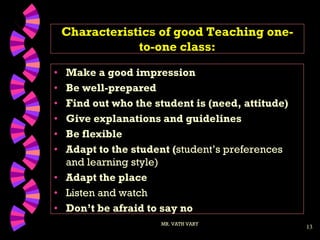
Characteristics of good Teaching one-
to-one class:
• Make a good impression
• Be well-prepared
• Find out who the student is (need, attitude)
• Give explanations and guidelines
• Be flexible
• Adapt to the student (student’s preferences
and learning style)
• Adapt the place
• Listen and watch
• Don’t be afraid to say no
MR. VATH VARY
14
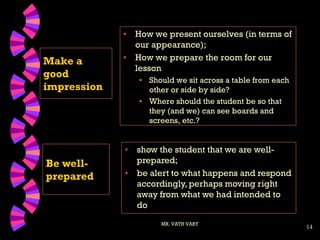
Make a
good
impression
• How we present ourselves (in terms of
our appearance);
• How we prepare the room for our
lesson
• Should we sit across a table from each
other or side by side?
• Where should the student be so that
they (and we) can see boards and
screens, etc.?
MR. VATH VARY
Be well-
prepared
• show the student that we are well-
prepared;
• be alert to what happens and respond
accordingly, perhaps moving right
away from what we had intended to
do
15
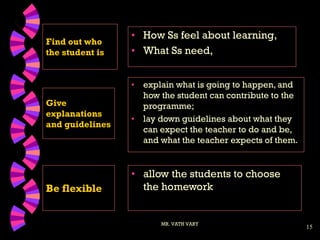
Find out who
the student is
• How Ss feel about learning,
• What Ss need,
MR. VATH VARY
Give
explanations
and guidelines
• explain what is going to happen, and
how the student can contribute to the
programme;
• lay down guidelines about what they
can expect the teacher to do and be,
and what the teacher expects of them.
Be flexible
• allow the students to choose
the homework
16
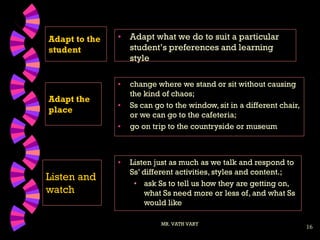
Adapt to the
student
• Adapt what we do to suit a particular
student’s preferences and learning
style
MR. VATH VARY
Adapt the
place
• change where we stand or sit without causing
the kind of chaos;
• Ss can go to the window, sit in a different chair,
or we can go to the cafeteria;
• go on trip to the countryside or museum
Listen and
watch
• Listen just as much as we talk and respond to
Ss’ different activities, styles and content.;
• ask Ss to tell us how they are getting on,
what Ss need more or less of, and what Ss
would like
17
Don’t be afraid to say no
• One-to-one teachers should not be afraid to
say no in two specific situations:
• Firstly, the personality match with S is sometimes,
unfortunately, completely unsuccessful. Normally
we can get over this by being extremely
professional, maintaining a distance between
ourselves and the student, and letting the content of
our lessons drive matters forward successfully.
• Ts should be prepared to terminate the classes (if
they are working for themselves) or expect that the
institution they work for will make alternative
arrangements for themselves and the S.
MR. VATH VARY
18
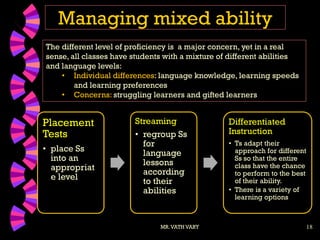
Managing mixed ability
MR.VATH VARY
Placement
Tests
• place Ss
into an
appropriat
e level
Streaming
• regroup Ss
for
language
lessons
according
to their
abilities
Differentiated
Instruction
• Ts adapt their
approach for different
Ss so that the entire
class have the chance
to perform to the best
of their ability.
• There is a variety of
learning options
The different level of proficiency is a major concern, yet in a real
sense, all classes have students with a mixture of different abilities
and language levels:
• Individual differences: language knowledge, learning speeds
and learning preferences
• Concerns: struggling learners and gifted learners
19
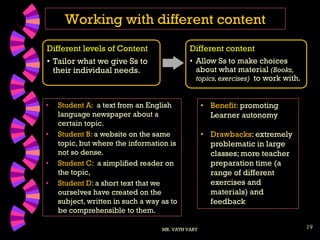
Working with different content
MR. VATH VARY
Different levels of Content
• Tailor what we give Ss to
their individual needs.
Different content
• Allow Ss to make choices
about what material (Books,
topics, exercises) to work with.
• Student A: a text from an English
language newspaper about a
certain topic.
• Student B: a website on the same
topic, but where the information is
not so dense.
• Student C: a simplified reader on
the topic,
• Student D: a short text that we
ourselves have created on the
subject, written in such a way as to
be comprehensible to them.
• Benefit: promoting
Learner autonomy
• Drawbacks: extremely
problematic in large
classes; more teacher
preparation time (a
range of different
exercises and
materials) and
feedback
20
MR. VATH VARY
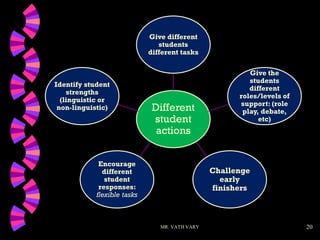
Different
student
actions
Give different
students
different tasks
Give the
students
different
roles/levels of
support: (role
play, debate,
etc)
Challenge
early
finishers
Encourage
different
student
responses:
flexible tasks
Identify student
strengths
(linguistic or
non-linguistic)
21
Working with different content
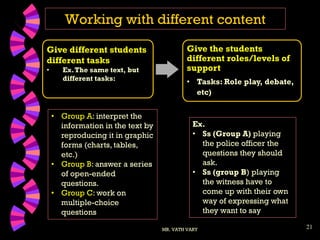
MR. VATH VARY
Give different students
different tasks
• Ex.The same text, but
different tasks:
Give the students
different roles/levels of
support
• Tasks: Role play, debate,
etc)
Ex.
• Ss (Group A) playing
the police officer the
questions they should
ask.
• Ss (group B) playing
the witness have to
come up with their own
way of expressing what
they want to say
• Group A: interpret the
information in the text by
reproducing it in graphic
forms (charts, tables,
etc.)
• Group B: answer a series
of open-ended
questions.
• Group C: work on
multiple-choice
questions
22
Different student actions
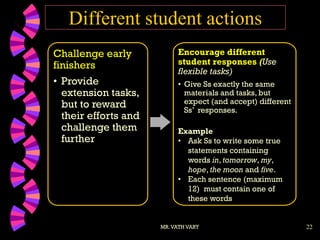
MR.VATH VARY
Challenge early
finishers
• Provide
extension tasks,
but to reward
their efforts and
challenge them
further
Encourage different
student responses (Use
flexible tasks)
• Give Ss exactly the same
materials and tasks, but
expect (and accept) different
Ss’ responses.
Example
• Ask Ss to write some true
statements containing
words in, tomorrow, my,
hope, the moon and five.
• Each sentence (maximum
12) must contain one of
these words
23
Different student actions
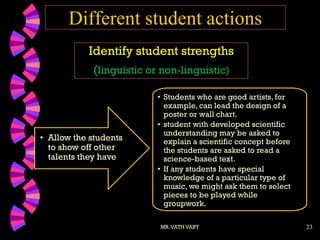
MR.VATH VARY
• Allow the students
to show off other
talents they have
• Students who are good artists, for
example, can lead the design of a
poster or wall chart.
• student with developed scientific
understanding may be asked to
explain a scientific concept before
the students are asked to read a
science-based text.
• If any students have special
knowledge of a particular type of
music, we might ask them to select
pieces to be played while
groupwork.
Identify student strengths
(linguistic or non-linguistic)
24
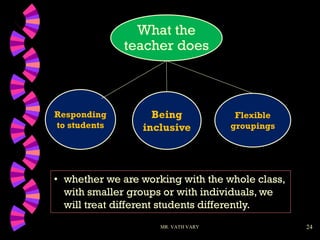
MR. VATH VARY
What the
teacher does
Flexible
groupings
Being
inclusive
Responding
to students
• whether we are working with the whole class,
with smaller groups or with individuals, we
will treat different students differently.
25
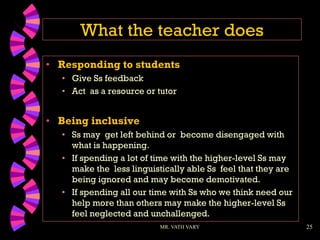
What the teacher does
• Responding to students
• Give Ss feedback
• Act as a resource or tutor
• Being inclusive
• Ss may get left behind or become disengaged with
what is happening.
• If spending a lot of time with the higher-level Ss may
make the less linguistically able Ss feel that they are
being ignored and may become demotivated.
• If spending all our time with Ss who we think need our
help more than others may make the higher-level Ss
feel neglected and unchallenged.
MR. VATH VARY
26
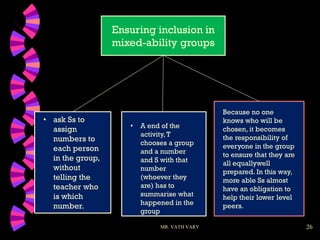
MR. VATH VARY
Ensuring inclusion in
mixed-ability groups
Because no one
knows who will be
chosen, it becomes
the responsibility of
everyone in the group
to ensure that they are
all equallywell
prepared. In this way,
more able Ss almost
have an obligation to
help their lower level
peers.
• A end of the
activity,T
chooses a group
and a number
and S with that
number
(whoever they
are) has to
summarise what
happened in the
group
• ask Ss to
assign
numbers to
each person
in the group,
without
telling the
teacher who
is which
number.
27
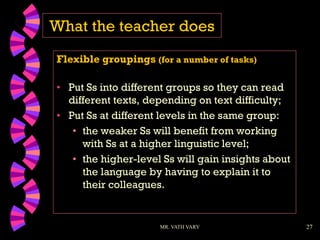
What the teacher does
Flexible groupings (for a number of tasks)
• Put Ss into different groups so they can read
different texts, depending on text difficulty;
• Put Ss at different levels in the same group:
• the weaker Ss will benefit from working
with Ss at a higher linguistic level;
• the higher-level Ss will gain insights about
the language by having to explain it to
their colleagues.
MR. VATH VARY
28
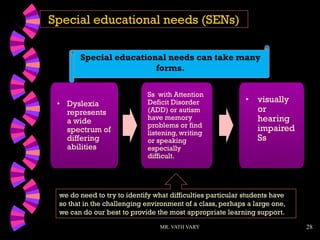
Special educational needs (SENs)
Special educational needs can take many
forms.
MR. VATH VARY
we do need to try to identify what difficulties particular students have
so that in the challenging environment of a class, perhaps a large one,
we can do our best to provide the most appropriate learning support.
• Dyslexia
represents
a wide
spectrum of
differing
abilities
Ss with Attention
Deficit Disorder
(ADD) or autism
have memory
problems or find
listening, writing
or speaking
especially
difficult.
• visually
or
hearing
impaired
Ss
29
Techniques teachers used with SENs in the
classroom:
• Learners are learners
• look for student’s strengths, not their weaknesses and make
the most of those.
• Find out what is going on
• Be inclusive
• Calm and safe learning environments
• Memory tricks
• previewing and summarising, repetition (reviewing and
recycling of vocabulary and grammar), and rehearsal
• Be enabling
• adjust what we normally do so that everyone can be
included. A3-size versions of texts, speakers, nvolve the
students mingling in the middle of the room
Mr. VATH VARY
30
Techniques teachers used with SENs in
the classroom:
Multi-sensory experience
• Dyslexia And Memory Problems
• highlight difficult parts of words by using different
colours;
• Get younger learners to write words and letters in sand;
• use pictures to show particular sounds and combinations of
sounds, and diagrams to show stressed syllables;
• give individual Ss words and then ask them to join other
Ss who have words with the same sound.
• Reading or Sequencing: cut a text into strips and have them
manipulate these into the correct order.
Mr. VATH VARY
31
Techniques teachers used with SENs in
the classroom:
• Personalise
• assess (use observation) what Ss are having trouble with.
• ask the students to explain to us what they are having special
difficulties with;
• ask Ss what the five most difficult things about listening are
and vice versa.
• Avoid unnecessary distractions
• Minimise outside factors and try to quieten obtrusive noise by
shutting windows and doors;
• Tasks should be neither too easy or difficult;
• Scaffolding
Mr. VATH VARY
32
Techniques teachers used with SENs in the
classroom:
• Scaffolding
• Refers to a particular concept of learner
support which involves breaking tasks
down into their component parts.
• Techniques
• Be clear,
• Break things down into their constituent ‘do-able’
parts, and
• help Ss understand things through any means
possible (including highlighting, diagrams,
movement, etc.)
Mr. VATH VARY
33
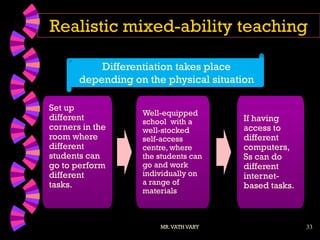
Realistic mixed-ability teaching
MR.VATH VARY
Set up
different
corners in the
room where
different
students can
go to perform
different
tasks.
Well-equipped
school with a
well-stocked
self-access
centre, where
the students can
go and work
individually on
a range of
materials
If having
access to
different
computers,
Ss can do
different
internet-
based tasks.
Differentiation takes place
depending on the physical situation
34

CH 16_Class Sizes and Different Abilities-vary march 2023.pdf

  • 1.
    Chapter 16: Class sizeand different abilities Course: Applied Linguistics for Language Teachers Mr. VATH VARY 1 Master of Education
  • 2.
    Introduction MR. VATH VARY2 Concerns of two particular teaching ‘contexts’ Mixed-ability classes Large classes
  • 3.
    3 Class size: twoextremes • Classes greatly vary in size: • Class size of some private language schools: • 10 and 15 learners • 60, 80, 100 or even 200 learners • A typical class size in a lot of primary and secondary education around the world comprises some 30–40 students. MR. VATH VARY
  • 4.
    4 Large classes • Howcan we give the students personal attention? • How can we get them interacting with each other? • What can we do to make organization smooth and effective? Mr. VATH VARY • Large classes can present challenges that smaller classes do not:
  • 5.
    5 Key elements insuccessful large- group teaching  Be organized  Establish and use routines  Use a different pace for different activities  Maximise individual work  Use the students  Use worksheets  Use pairwork and groupwork  Use choral repetition, choral reaction  Use the room  Use the size of the class to your advantage Mr. VATH VARY
  • 6.
    6 Be organized • Thebigger the group, the more organised we have to be, and the more we need to know what we are going to do before the lesson starts: • Tell the students what is going to happen in a lesson: • Show a board plan of the lesson to come, and tick off the different stages as they are achieved. • Summarise what has happened when it has ended: • write (on the board) a summary of what actually happened and give one orally MR. VATH VARY
  • 7.
    7 • The dailymanagement of a large class will be greatly enhanced if we establish routines that we and our students recognise straightaway:  take the register, set and collect homework, get into pairs and groups, etc.  Hand out books or worksheets: (e.g. have one S from each row coming to the front and collect that row’s handouts) MR. VATH VARY • “Use Quiet Sign”, • raise an arm, • ring a bell or blow a whistle, • turn lights on and off, • count backwards from ten, • wave some kind of distinctive object in the air, • move to a particular part of the room, • stand quietly so that the students notice and gradually quieten down Techniques to attract the students’ attention and quieten everyone down Establish and use routines:
  • 8.
    8 Use a different pacefor different activities MR. VATH VARY • Have SS to us Graded readers as personal reading programme and make individual choices about what to read • Have Ss to build Portfolio of work: Ask Ss to write individually – offering their own responses to what they read and hear. • Encourage Ss to make full use of a school library or self access centre or direct Ss to language learning websites Maximise individual work • Give Ss time to respond when asking them to say • Have Ss to work at quite a fast pace when conducting drills • Slow Ss down when asking them to think about sth
  • 9.
    9 Use students MR. VATHVARY • T hands out worksheets and have Ss use them for many of the tasks in pairs, groups or whole class • Ss will get benefits when feedback can be done with the whole class Use worksheets • Appoint class monitors to: • collect homework or hand out worksheets • take the register (under our supervision) • organise their classmates into groups • Ask Ss to teach the others
  • 10.
    10 • Use pairwork and groupwork MR.VATH VARY • Have the students repeat or speak in chorus ‘provides a screen behind which “quieter” students can hide and build up their confidence • The class can be divided into two halves – the front five rows and the back five rows or the left- hand and right-hand sides of the classroom. Each row/half can then speak a part in a dialogue, ask or answer a question or repeat sentences or words. • To maximise student participation • Non-moveable chairs: first rows turn to face second rows, third rows to face fourth rows, etc. • Think–pair–share activities: • Ask Ss to think (individually), then pair up with a colleague, before the pairs share what they have done with other pairs and groups. Use choral repetition, choral reaction
  • 11.
    11 • Use the room MR.VATH VARY  The bigger, the funnier  Drama is more dramatic and a good class feeling is warmer and more enveloping  We can divide the class into two teams: • Each S has to choose one word from a text we are going to use, but which they haven’t yet seen (list the words on the board). • All Ss stand up.We read the text aloud and each individual can sit down when they hear the word they have chosen. Which team has all its members sitting down first? • Ensure that what we show or write can be seen (Board or slides, pictures) • Ensure what we say or play to the whole class (from an audio track or film clip) can be heard. Use the size of the class to your advantage
  • 12.
    12 Teaching one-to-one (privateclasses) MR. VATH VARY is extremely popular, especially for business students; also ideal for students who cannot fit into normal school schedules or who are keen to have individual attention rather than being part of a class. counsellor, communicator , coach and tutor (Tomalin 2011). teachers, interlocutors, therapists, mother/father figures, friends and confidant(e)s (Osborne 2007), Conversation partner, observer and listener, feedback provider, mentor, guide and learner to the list (Wisniewska 2010). Teacher Roles
  • 13.
    13 Characteristics of goodTeaching one- to-one class: • Make a good impression • Be well-prepared • Find out who the student is (need, attitude) • Give explanations and guidelines • Be flexible • Adapt to the student (student’s preferences and learning style) • Adapt the place • Listen and watch • Don’t be afraid to say no MR. VATH VARY
  • 14.
    14 Make a good impression • Howwe present ourselves (in terms of our appearance); • How we prepare the room for our lesson • Should we sit across a table from each other or side by side? • Where should the student be so that they (and we) can see boards and screens, etc.? MR. VATH VARY Be well- prepared • show the student that we are well- prepared; • be alert to what happens and respond accordingly, perhaps moving right away from what we had intended to do
  • 15.
    15 Find out who thestudent is • How Ss feel about learning, • What Ss need, MR. VATH VARY Give explanations and guidelines • explain what is going to happen, and how the student can contribute to the programme; • lay down guidelines about what they can expect the teacher to do and be, and what the teacher expects of them. Be flexible • allow the students to choose the homework
  • 16.
    16 Adapt to the student •Adapt what we do to suit a particular student’s preferences and learning style MR. VATH VARY Adapt the place • change where we stand or sit without causing the kind of chaos; • Ss can go to the window, sit in a different chair, or we can go to the cafeteria; • go on trip to the countryside or museum Listen and watch • Listen just as much as we talk and respond to Ss’ different activities, styles and content.; • ask Ss to tell us how they are getting on, what Ss need more or less of, and what Ss would like
  • 17.
    17 Don’t be afraidto say no • One-to-one teachers should not be afraid to say no in two specific situations: • Firstly, the personality match with S is sometimes, unfortunately, completely unsuccessful. Normally we can get over this by being extremely professional, maintaining a distance between ourselves and the student, and letting the content of our lessons drive matters forward successfully. • Ts should be prepared to terminate the classes (if they are working for themselves) or expect that the institution they work for will make alternative arrangements for themselves and the S. MR. VATH VARY
  • 18.
    18 Managing mixed ability MR.VATHVARY Placement Tests • place Ss into an appropriat e level Streaming • regroup Ss for language lessons according to their abilities Differentiated Instruction • Ts adapt their approach for different Ss so that the entire class have the chance to perform to the best of their ability. • There is a variety of learning options The different level of proficiency is a major concern, yet in a real sense, all classes have students with a mixture of different abilities and language levels: • Individual differences: language knowledge, learning speeds and learning preferences • Concerns: struggling learners and gifted learners
  • 19.
    19 Working with differentcontent MR. VATH VARY Different levels of Content • Tailor what we give Ss to their individual needs. Different content • Allow Ss to make choices about what material (Books, topics, exercises) to work with. • Student A: a text from an English language newspaper about a certain topic. • Student B: a website on the same topic, but where the information is not so dense. • Student C: a simplified reader on the topic, • Student D: a short text that we ourselves have created on the subject, written in such a way as to be comprehensible to them. • Benefit: promoting Learner autonomy • Drawbacks: extremely problematic in large classes; more teacher preparation time (a range of different exercises and materials) and feedback
  • 20.
    20 MR. VATH VARY Different student actions Givedifferent students different tasks Give the students different roles/levels of support: (role play, debate, etc) Challenge early finishers Encourage different student responses: flexible tasks Identify student strengths (linguistic or non-linguistic)
  • 21.
    21 Working with differentcontent MR. VATH VARY Give different students different tasks • Ex.The same text, but different tasks: Give the students different roles/levels of support • Tasks: Role play, debate, etc) Ex. • Ss (Group A) playing the police officer the questions they should ask. • Ss (group B) playing the witness have to come up with their own way of expressing what they want to say • Group A: interpret the information in the text by reproducing it in graphic forms (charts, tables, etc.) • Group B: answer a series of open-ended questions. • Group C: work on multiple-choice questions
  • 22.
    22 Different student actions MR.VATHVARY Challenge early finishers • Provide extension tasks, but to reward their efforts and challenge them further Encourage different student responses (Use flexible tasks) • Give Ss exactly the same materials and tasks, but expect (and accept) different Ss’ responses. Example • Ask Ss to write some true statements containing words in, tomorrow, my, hope, the moon and five. • Each sentence (maximum 12) must contain one of these words
  • 23.
    23 Different student actions MR.VATHVARY • Allow the students to show off other talents they have • Students who are good artists, for example, can lead the design of a poster or wall chart. • student with developed scientific understanding may be asked to explain a scientific concept before the students are asked to read a science-based text. • If any students have special knowledge of a particular type of music, we might ask them to select pieces to be played while groupwork. Identify student strengths (linguistic or non-linguistic)
  • 24.
    24 MR. VATH VARY Whatthe teacher does Flexible groupings Being inclusive Responding to students • whether we are working with the whole class, with smaller groups or with individuals, we will treat different students differently.
  • 25.
    25 What the teacherdoes • Responding to students • Give Ss feedback • Act as a resource or tutor • Being inclusive • Ss may get left behind or become disengaged with what is happening. • If spending a lot of time with the higher-level Ss may make the less linguistically able Ss feel that they are being ignored and may become demotivated. • If spending all our time with Ss who we think need our help more than others may make the higher-level Ss feel neglected and unchallenged. MR. VATH VARY
  • 26.
    26 MR. VATH VARY Ensuringinclusion in mixed-ability groups Because no one knows who will be chosen, it becomes the responsibility of everyone in the group to ensure that they are all equallywell prepared. In this way, more able Ss almost have an obligation to help their lower level peers. • A end of the activity,T chooses a group and a number and S with that number (whoever they are) has to summarise what happened in the group • ask Ss to assign numbers to each person in the group, without telling the teacher who is which number.
  • 27.
    27 What the teacherdoes Flexible groupings (for a number of tasks) • Put Ss into different groups so they can read different texts, depending on text difficulty; • Put Ss at different levels in the same group: • the weaker Ss will benefit from working with Ss at a higher linguistic level; • the higher-level Ss will gain insights about the language by having to explain it to their colleagues. MR. VATH VARY
  • 28.
    28 Special educational needs(SENs) Special educational needs can take many forms. MR. VATH VARY we do need to try to identify what difficulties particular students have so that in the challenging environment of a class, perhaps a large one, we can do our best to provide the most appropriate learning support. • Dyslexia represents a wide spectrum of differing abilities Ss with Attention Deficit Disorder (ADD) or autism have memory problems or find listening, writing or speaking especially difficult. • visually or hearing impaired Ss
  • 29.
    29 Techniques teachers usedwith SENs in the classroom: • Learners are learners • look for student’s strengths, not their weaknesses and make the most of those. • Find out what is going on • Be inclusive • Calm and safe learning environments • Memory tricks • previewing and summarising, repetition (reviewing and recycling of vocabulary and grammar), and rehearsal • Be enabling • adjust what we normally do so that everyone can be included. A3-size versions of texts, speakers, nvolve the students mingling in the middle of the room Mr. VATH VARY
  • 30.
    30 Techniques teachers usedwith SENs in the classroom: Multi-sensory experience • Dyslexia And Memory Problems • highlight difficult parts of words by using different colours; • Get younger learners to write words and letters in sand; • use pictures to show particular sounds and combinations of sounds, and diagrams to show stressed syllables; • give individual Ss words and then ask them to join other Ss who have words with the same sound. • Reading or Sequencing: cut a text into strips and have them manipulate these into the correct order. Mr. VATH VARY
  • 31.
    31 Techniques teachers usedwith SENs in the classroom: • Personalise • assess (use observation) what Ss are having trouble with. • ask the students to explain to us what they are having special difficulties with; • ask Ss what the five most difficult things about listening are and vice versa. • Avoid unnecessary distractions • Minimise outside factors and try to quieten obtrusive noise by shutting windows and doors; • Tasks should be neither too easy or difficult; • Scaffolding Mr. VATH VARY
  • 32.
    32 Techniques teachers usedwith SENs in the classroom: • Scaffolding • Refers to a particular concept of learner support which involves breaking tasks down into their component parts. • Techniques • Be clear, • Break things down into their constituent ‘do-able’ parts, and • help Ss understand things through any means possible (including highlighting, diagrams, movement, etc.) Mr. VATH VARY
  • 33.
    33 Realistic mixed-ability teaching MR.VATHVARY Set up different corners in the room where different students can go to perform different tasks. Well-equipped school with a well-stocked self-access centre, where the students can go and work individually on a range of materials If having access to different computers, Ss can do different internet- based tasks. Differentiation takes place depending on the physical situation
  • 34.