Seminar Guest lecture
Presentation
AMITY SCHOOL OF ARCHITECTURE AND PLANNING
Modern Construction Technology
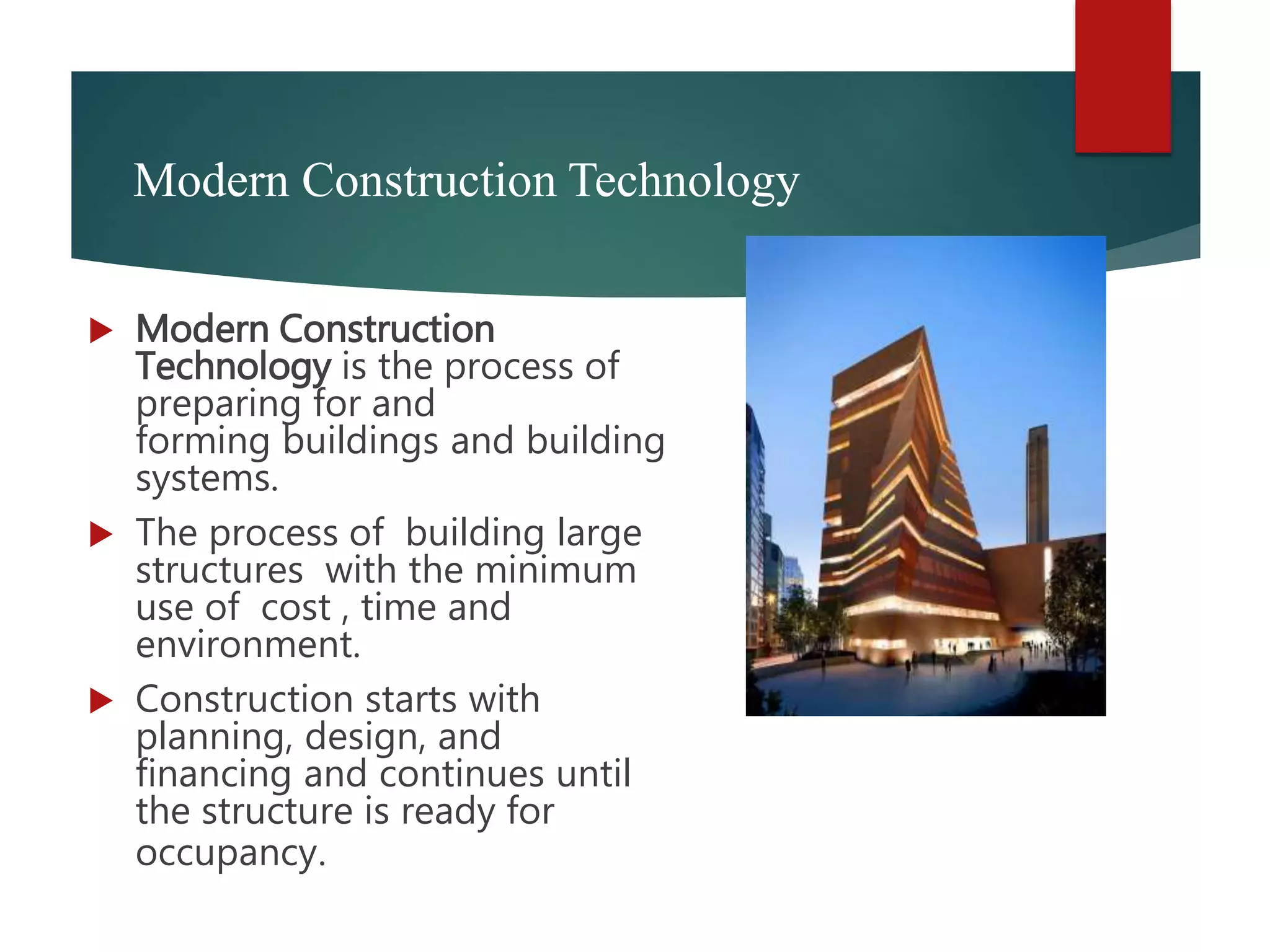
 Modern Construction
Technology is the process of
preparing for and
forming buildings and building
systems.
 The process of building large
structures with the minimum
use of cost , time and
environment.
 Construction starts with
planning, design, and
financing and continues until
the structure is ready for
occupancy.
Concrete walls and floors
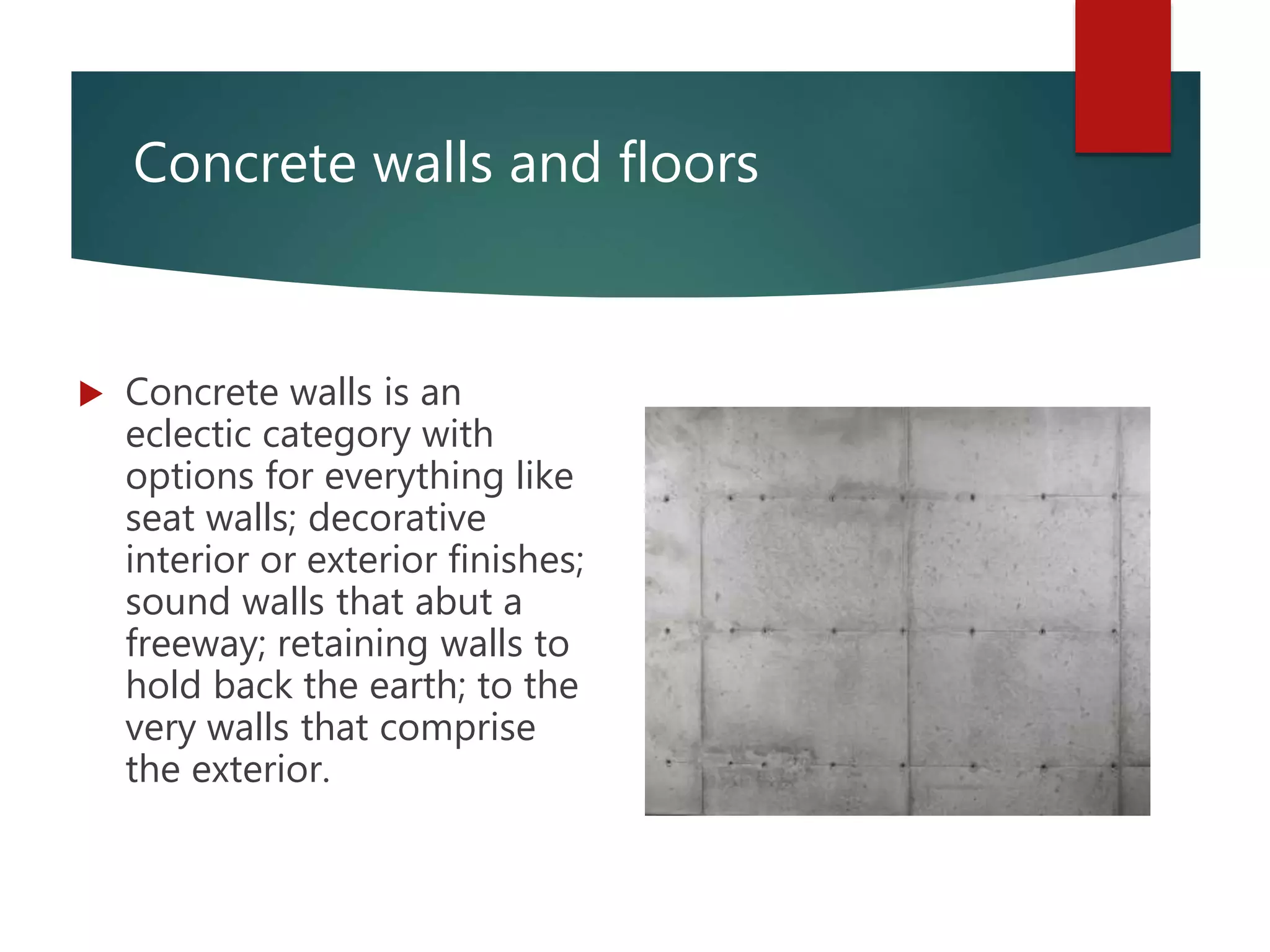
 Concrete walls is an
eclectic category with
options for everything like
seat walls; decorative
interior or exterior finishes;
sound walls that abut a
freeway; retaining walls to
hold back the earth; to the
very walls that comprise
the exterior.
 Concrete has become the
new flooring material of the
latest technology.
 Whether it's acid-stained,
painted, overlays,
microtoppings, radiant
floors, or a unique personal
floor, concrete floors offer a
range unlike any other
material
 Concrete flooring,
sometimes referred to as
cement flooring.
 One of the major benefits of
concrete floors is their
affordability compared to
other flooring options.
 concrete flooring is ease of
maintenance.
 When properly sealed
concrete floors can be cleaned
with a quick pass of a dust
mop.
Precast cladding panels
 Cladding is the application of
one material over another to
provide skin or layer intended to
control the infiltration of weather
elements, or for aesthetic
purposes
 Cladding does not necessarily
have to provide
a waterproof condition but is
instead a control element.
 This control element may only
serve to safely direct water or
wind in order to control run-
off and prevent infiltration into
the building structure.
Precast flat panel system
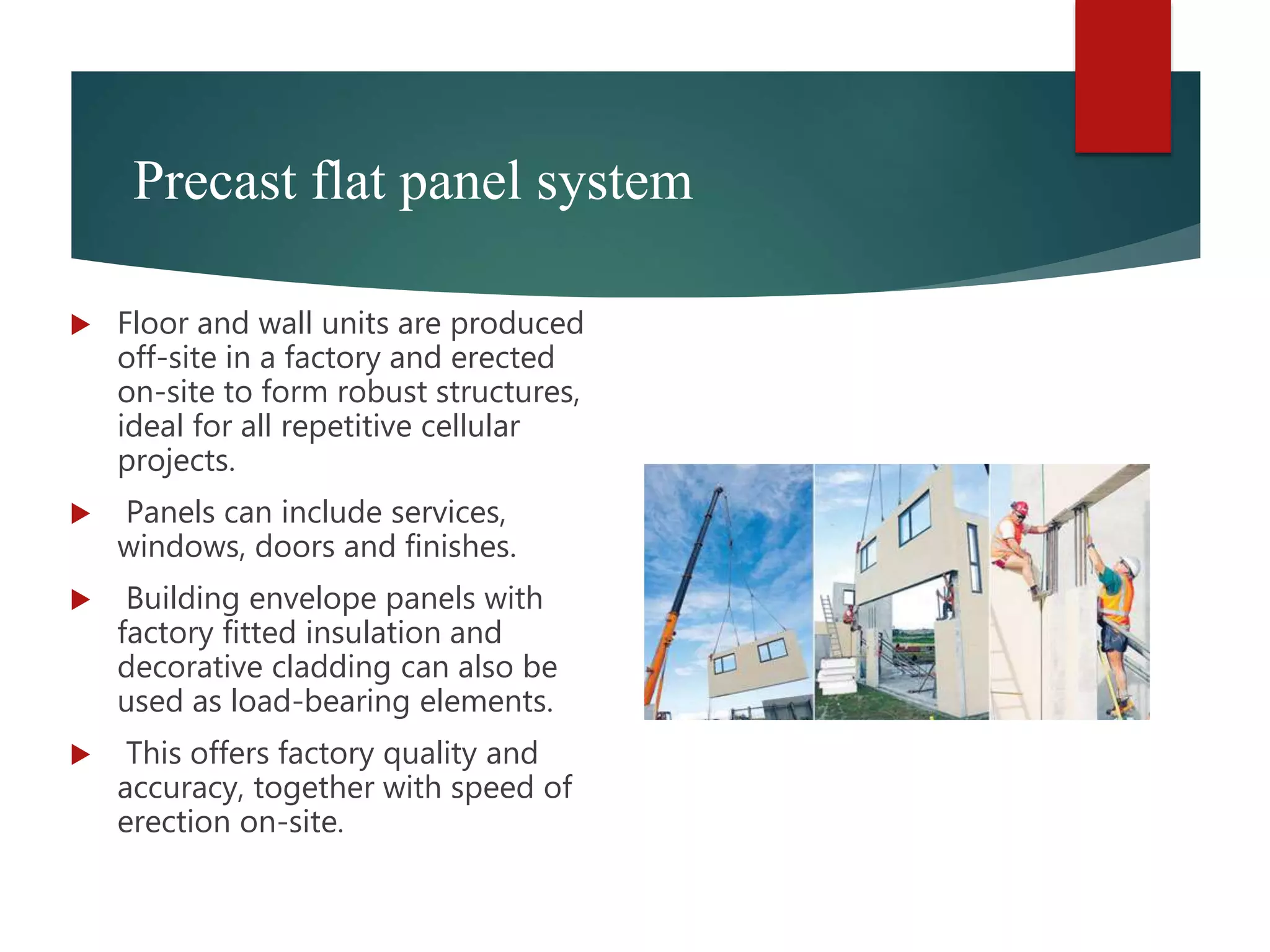
 Floor and wall units are produced
off-site in a factory and erected
on-site to form robust structures,
ideal for all repetitive cellular
projects.
 Panels can include services,
windows, doors and finishes.
 Building envelope panels with
factory fitted insulation and
decorative cladding can also be
used as load-bearing elements.
 This offers factory quality and
accuracy, together with speed of
erection on-site.
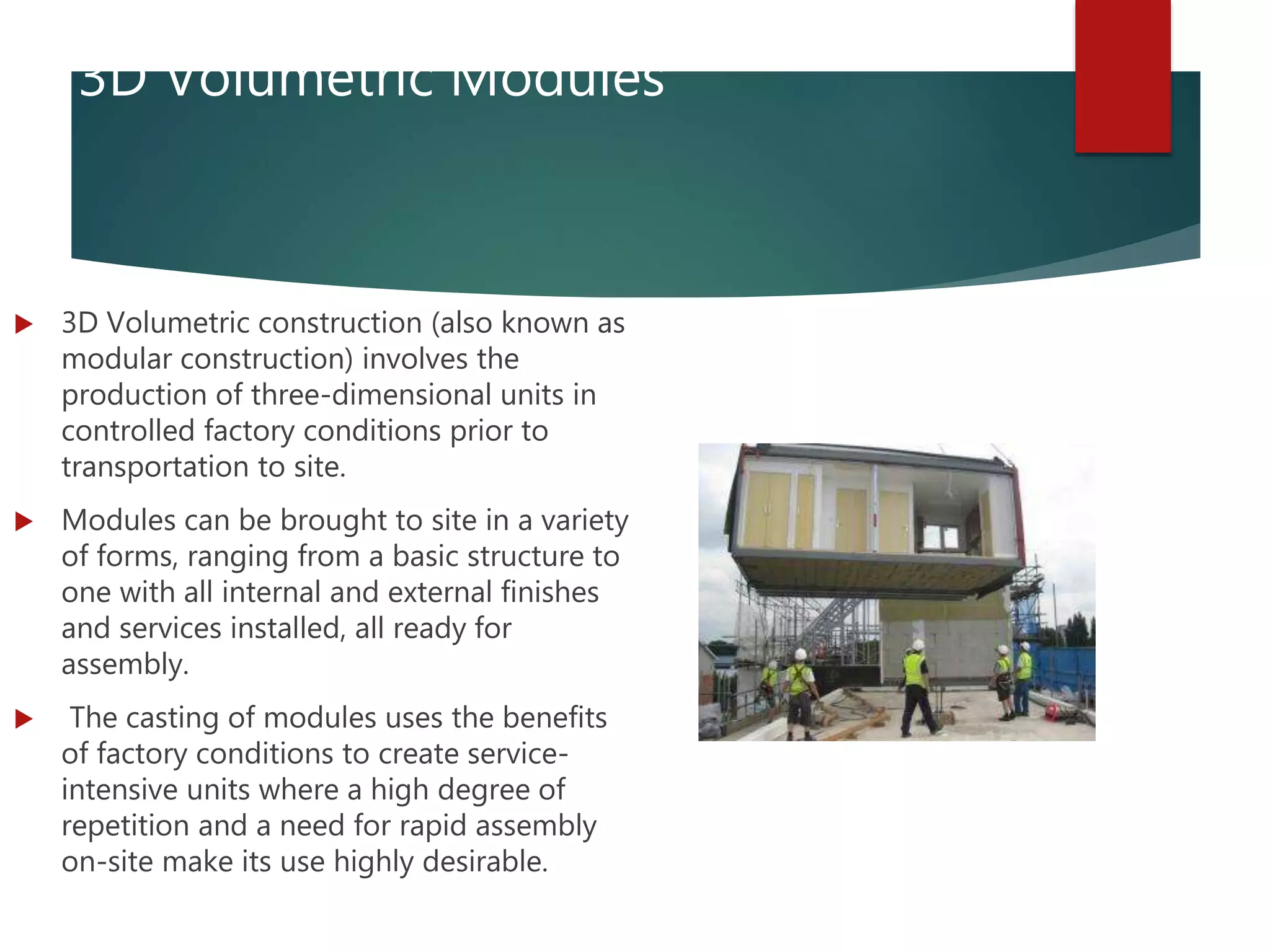
3D Volumetric Modules
 3D Volumetric construction (also known as
modular construction) involves the
production of three-dimensional units in
controlled factory conditions prior to
transportation to site.
 Modules can be brought to site in a variety
of forms, ranging from a basic structure to
one with all internal and external finishes
and services installed, all ready for
assembly.
 The casting of modules uses the benefits
of factory conditions to create service-
intensive units where a high degree of
repetition and a need for rapid assembly
on-site make its use highly desirable.
Twin wall Technology
 Twin wall construction is a walling system that
combines the speed of erection and quality of
precast concrete with the structural integrity of
in-situ concrete to provide a hybrid solution.
 Twin wall is an adaptable wall system that
provides the speed and quality of precast
concrete with the structural and waterproof
reliability .
 The prefabricated panels comprise two slabs
separated and connected by cast-in lattice
girders.
 The units are placed, temporarily propped,
then joined by reinforcing and concreting the
cavity on site.
 Twin wall is usually employed in association
with precast flooring systems.
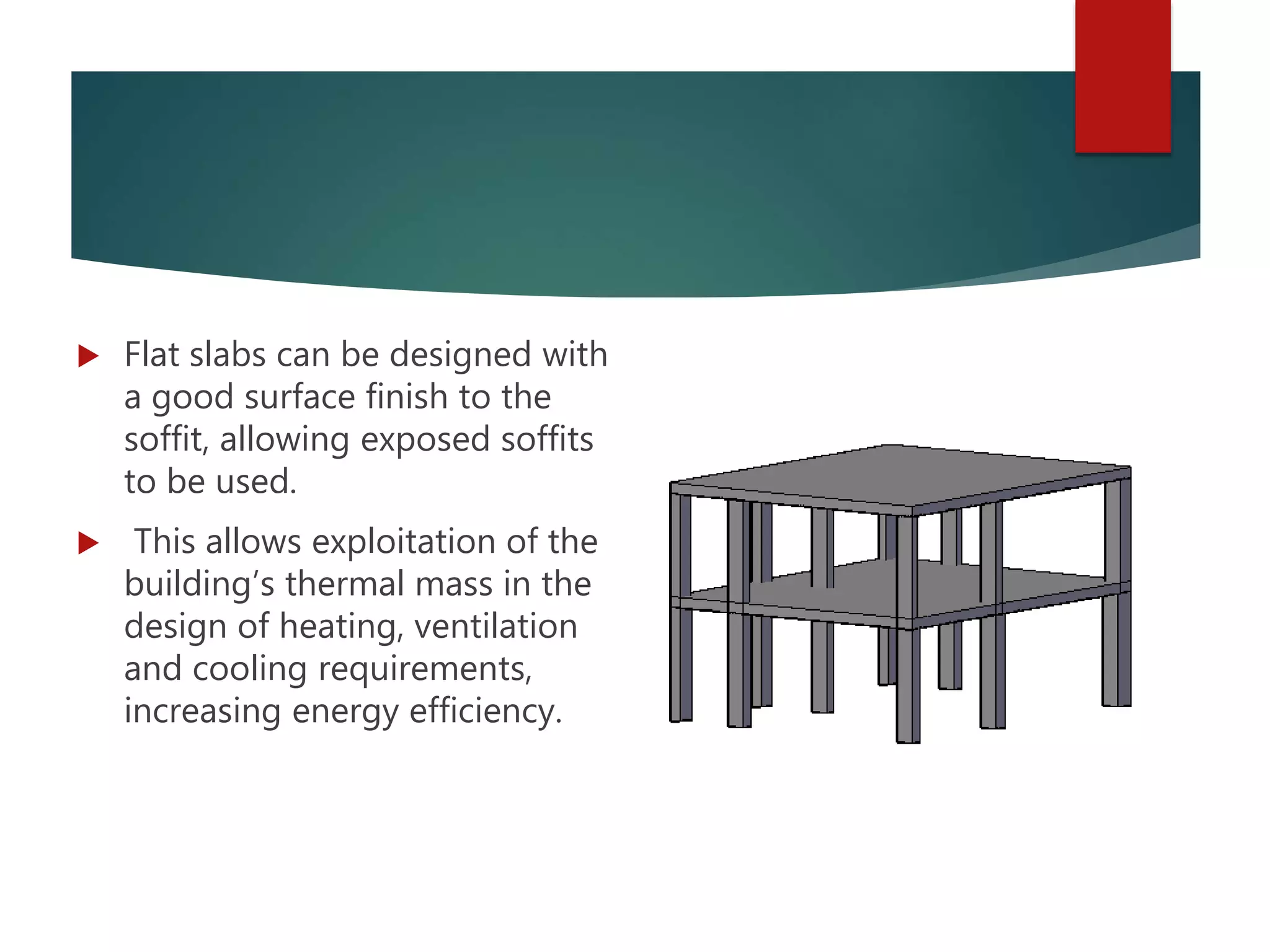
Flat Slabs
 Flat slabs are highly versatile
elements widely used in
construction, providing minimum
depth, fast construction and
allowing flexible column grids.
 Flat slabs are particularly appropriate
for areas where tops of partitions
need to be sealed to the slab soffit
for acoustic or fire reasons.
 Flat slabs are considered to be
faster and more economic than
other forms of construction.
 Flat slabs can be designed with
a good surface finish to the
soffit, allowing exposed soffits
to be used.
 This allows exploitation of the
building’s thermal mass in the
design of heating, ventilation
and cooling requirements,
increasing energy efficiency.
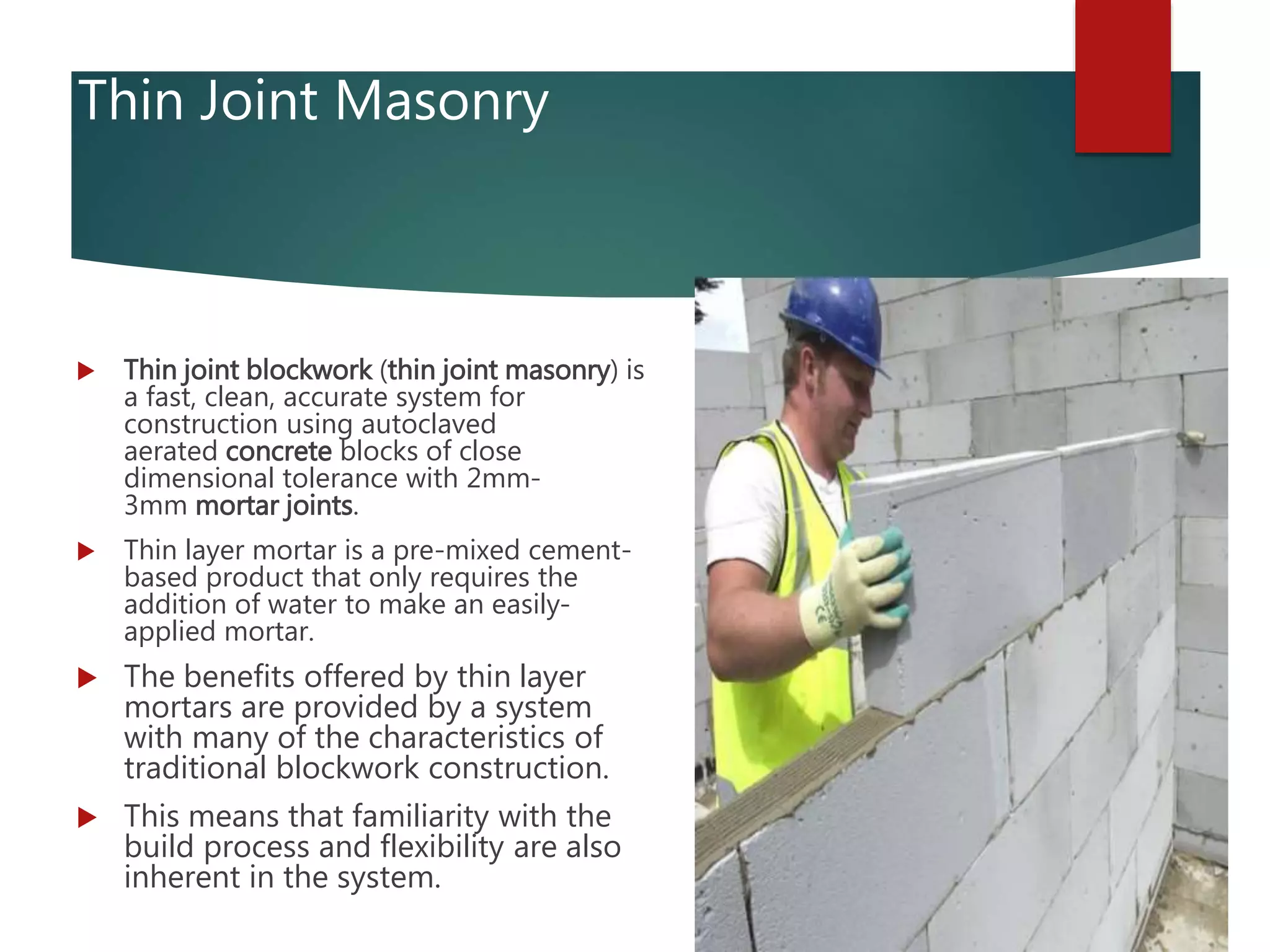
Thin Joint Masonry
 Thin joint blockwork (thin joint masonry) is
a fast, clean, accurate system for
construction using autoclaved
aerated concrete blocks of close
dimensional tolerance with 2mm-
3mm mortar joints.
 Thin layer mortar is a pre-mixed cement-
based product that only requires the
addition of water to make an easily-
applied mortar.
 The benefits offered by thin layer
mortars are provided by a system
with many of the characteristics of
traditional blockwork construction.
 This means that familiarity with the
build process and flexibility are also
inherent in the system.
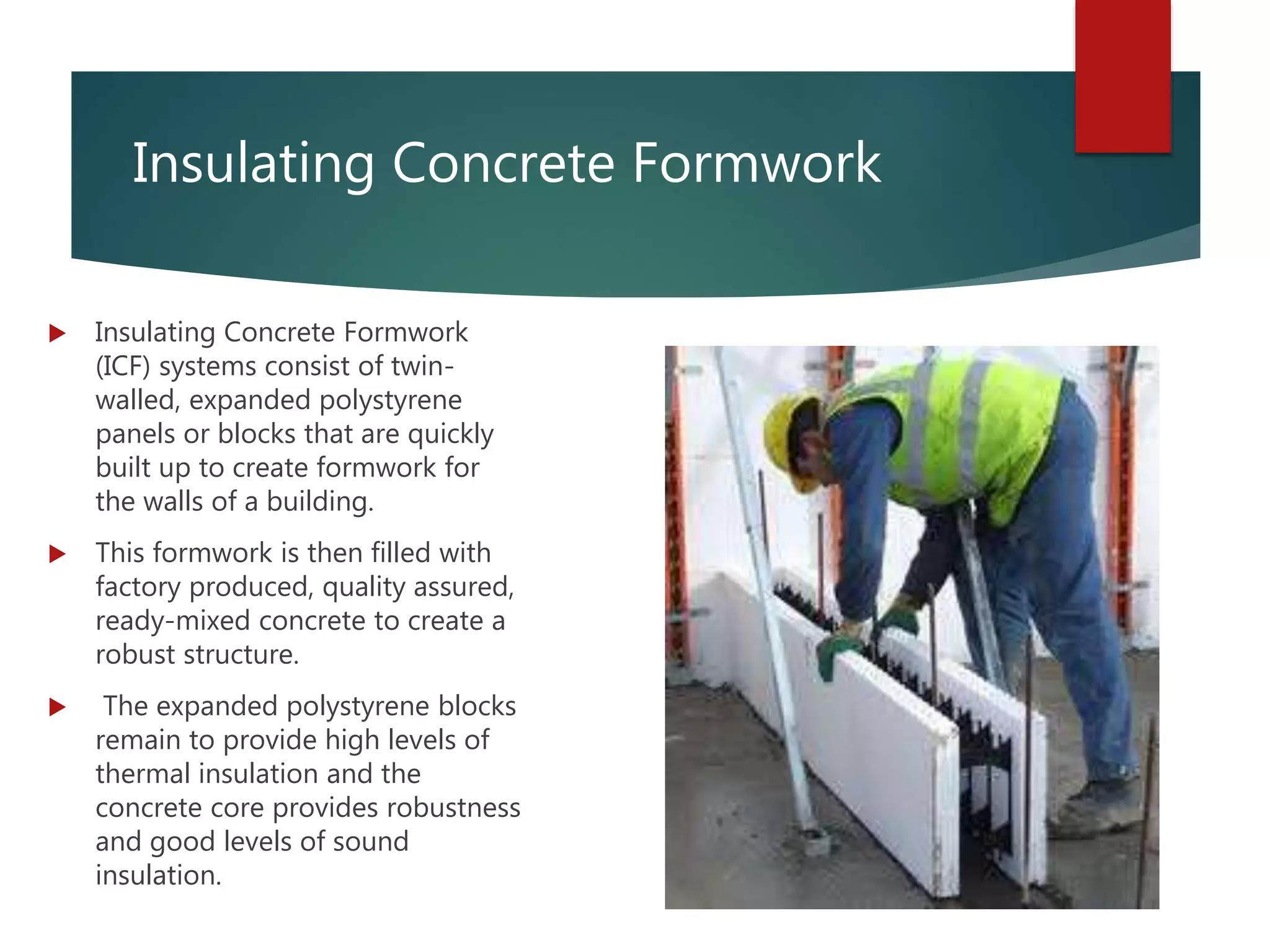
Insulating Concrete Formwork
 Insulating Concrete Formwork
(ICF) systems consist of twin-
walled, expanded polystyrene
panels or blocks that are quickly
built up to create formwork for
the walls of a building.
 This formwork is then filled with
factory produced, quality assured,
ready-mixed concrete to create a
robust structure.
 The expanded polystyrene blocks
remain to provide high levels of
thermal insulation and the
concrete core provides robustness
and good levels of sound
insulation.
Precast Concrete Foundation
 Precast concrete systems can be used to
rapidly construct foundations.
 The elements are usually to a bespoke
design and cast in a factory
environment, giving assured quality for
the finished product.
 The foundations are often supported by
concrete piles and connected together.
 These systems improve productivity,
especially in adverse weather
conditions, and reduces the amount of
excavation required - particularly
advantageous when dealing with
contaminated ground.
MODERN CONSTRUCTION METHODS

MODERN CONSTRUCTION METHODS

  • 1.
    Seminar Guest lecture Presentation AMITYSCHOOL OF ARCHITECTURE AND PLANNING
  • 2.
    Modern Construction Technology Modern Construction Technology is the process of preparing for and forming buildings and building systems.  The process of building large structures with the minimum use of cost , time and environment.  Construction starts with planning, design, and financing and continues until the structure is ready for occupancy.
  • 3.
    Concrete walls andfloors  Concrete walls is an eclectic category with options for everything like seat walls; decorative interior or exterior finishes; sound walls that abut a freeway; retaining walls to hold back the earth; to the very walls that comprise the exterior.
  • 4.
     Concrete hasbecome the new flooring material of the latest technology.  Whether it's acid-stained, painted, overlays, microtoppings, radiant floors, or a unique personal floor, concrete floors offer a range unlike any other material  Concrete flooring, sometimes referred to as cement flooring.
  • 5.
     One ofthe major benefits of concrete floors is their affordability compared to other flooring options.  concrete flooring is ease of maintenance.  When properly sealed concrete floors can be cleaned with a quick pass of a dust mop.
  • 6.
    Precast cladding panels Cladding is the application of one material over another to provide skin or layer intended to control the infiltration of weather elements, or for aesthetic purposes  Cladding does not necessarily have to provide a waterproof condition but is instead a control element.  This control element may only serve to safely direct water or wind in order to control run- off and prevent infiltration into the building structure.
  • 7.
    Precast flat panelsystem  Floor and wall units are produced off-site in a factory and erected on-site to form robust structures, ideal for all repetitive cellular projects.  Panels can include services, windows, doors and finishes.  Building envelope panels with factory fitted insulation and decorative cladding can also be used as load-bearing elements.  This offers factory quality and accuracy, together with speed of erection on-site.
  • 8.
    3D Volumetric Modules 3D Volumetric construction (also known as modular construction) involves the production of three-dimensional units in controlled factory conditions prior to transportation to site.  Modules can be brought to site in a variety of forms, ranging from a basic structure to one with all internal and external finishes and services installed, all ready for assembly.  The casting of modules uses the benefits of factory conditions to create service- intensive units where a high degree of repetition and a need for rapid assembly on-site make its use highly desirable.
  • 9.
    Twin wall Technology Twin wall construction is a walling system that combines the speed of erection and quality of precast concrete with the structural integrity of in-situ concrete to provide a hybrid solution.  Twin wall is an adaptable wall system that provides the speed and quality of precast concrete with the structural and waterproof reliability .  The prefabricated panels comprise two slabs separated and connected by cast-in lattice girders.  The units are placed, temporarily propped, then joined by reinforcing and concreting the cavity on site.  Twin wall is usually employed in association with precast flooring systems.
  • 10.
    Flat Slabs  Flatslabs are highly versatile elements widely used in construction, providing minimum depth, fast construction and allowing flexible column grids.  Flat slabs are particularly appropriate for areas where tops of partitions need to be sealed to the slab soffit for acoustic or fire reasons.  Flat slabs are considered to be faster and more economic than other forms of construction.
  • 11.
     Flat slabscan be designed with a good surface finish to the soffit, allowing exposed soffits to be used.  This allows exploitation of the building’s thermal mass in the design of heating, ventilation and cooling requirements, increasing energy efficiency.
  • 12.
    Thin Joint Masonry Thin joint blockwork (thin joint masonry) is a fast, clean, accurate system for construction using autoclaved aerated concrete blocks of close dimensional tolerance with 2mm- 3mm mortar joints.  Thin layer mortar is a pre-mixed cement- based product that only requires the addition of water to make an easily- applied mortar.  The benefits offered by thin layer mortars are provided by a system with many of the characteristics of traditional blockwork construction.  This means that familiarity with the build process and flexibility are also inherent in the system.
  • 13.
    Insulating Concrete Formwork Insulating Concrete Formwork (ICF) systems consist of twin- walled, expanded polystyrene panels or blocks that are quickly built up to create formwork for the walls of a building.  This formwork is then filled with factory produced, quality assured, ready-mixed concrete to create a robust structure.  The expanded polystyrene blocks remain to provide high levels of thermal insulation and the concrete core provides robustness and good levels of sound insulation.
  • 14.
    Precast Concrete Foundation Precast concrete systems can be used to rapidly construct foundations.  The elements are usually to a bespoke design and cast in a factory environment, giving assured quality for the finished product.  The foundations are often supported by concrete piles and connected together.  These systems improve productivity, especially in adverse weather conditions, and reduces the amount of excavation required - particularly advantageous when dealing with contaminated ground.