CONSTRUCTION
TECHNOLOGY AND
MANAGEMENT
CET309
MODULE 3- CONSTRUCTION TECHNOLOGY
Cost effective construction
• Construction of a particular building with all the comforts and standards specified
with minimum cost
• Cost is directly proportional to built up area and to build a low cost house, built up
area to be reduced
• Rapid wall construction, soil-cement block masonry, voided slab technology, filler
slab technology are some construction techniques to reduce cost
Rapid wall construction
• Rapid wall is a load bearing building panel with a multiple of uses for the
construction industry.
• Rapid wall is a low cost, load bearing prefabricated walling system.
• It is ideal for construction of single, double or multistory housing, as well as for
commercial and industrial development.
• Rapid wall eliminates the need for bricks, timber wall frames and plasterboard as
it serves as both the internal and external load bearing wall.
Rapid wall construction
• Rapid wall also called as GFRG panel (Glass Fibre Reinforced Gypsum) or
gypcrete panel is an energy efficient green building material with huge potential
for use as load bearing and non load bearing wall panels.
• Rapid wall is a large load bearing panel with modular cavities suitable for both
external and internal walls.
• It can also be used as intermediary floor slab or roof slab in combination with
RCC as a composite material.
Rapid wall construction
• Rapid wall is manufactured in a molding process using glass fibre reinforced,
water-resistant gypsum plaster.
• All panels are 12m long , 3m high, 123 mm thick and cellular in construction.
• The formed cells can be used to accommodate building services such as plumbing
and wiring works and can be filled with insulation for increased thermal
performance or concrete for increased structural capacity.
Benefits of Rapid wall
• Prefabricated rapid wall means faster overall construction time
• Reduced workforce gives safer working environment
• Reduces labour cost and speedy construction.
• Clean construction reduces potential damage and finishing time reduced radically.
• It has very high level of resistances to fire, heat, water, termites, corrosion, sound resistant.
• Concrete infill with vertical reinforcement rods enhances its vertical and lateral load
capabilities
• Rapid wall building are resistant to earthquakes, cyclones and fire.
Benefits of Rapid wall
• Rapid wall panels are 100% recyclable and environmentally friendly.
• Eliminates the need of bricks, blocks, timber wall frames
• Light weighted rapid wall has high compressive strength, shearing strength,
flexural strength and ductility.
Soil-Cement Block Masonry
• Soil-cement blocks are cost effective and energy effective alternative building to the
normal burnt clay bricks used for construction of building.
• Soil cement blocks are also known as stabilized mud blocks (SMB) or stabilized
compressed earth blocks (SCEB)
• These blocks can be produced in a decentralized fashion employing simple manually
operated or semi- mechanized presses utilizing local soil
• Also, these blocks are economical and consume less thermal energy during production.
Soil-Cement Block Masonry
• This is prepared by adding stabilizers to the mud.
• White cement is the most usual stabilizer added 5 to10% by weight to the soil.
Other stabilizers like lime, pozzolana or a combination of cement and lime are
also added.
• Soil cement blocks being usually 2½ times larger in size than the normal burnt
clay bricks, construction is faster and the joints are consequence reduced
Voided Slab Technology
• The void slab are reinforced concrete slab in which voids allow to reduce the amount
of concrete.
• A voided slab is a concept that simply removes the excess concrete from the
expensive part of the structural slab.
• In building construction the slab is a very important structural member to make a
space. And the slab is one of the largest member consuming concrete.
• The main obstacle with concrete construction in case of horizontal slabs, is the high
weight, which limits the span.
Voided Slab Technology
• As the span is increased the deflection of the slab is also increased.
• Therefore the slab thickness should be increased
• Increasing the slab thickness makes the slabs heavier, and will increased column
and foundation size.
• Thus it makes building consuming more materials such as concrete and steel
reinforcement
• To avoid these disadvantages which were caused by increasing of self-weight of
slab, the voided slab system is adopted.
Voided Slab Technology
• The idea of creating engineered void within a solid slab system helps to reduce the
overall weight of the slab system.
• The voided slab system provides a huge opportunity to reduce the cost an
environmental impact without compromising with the performance of the structure.
• Void formers are employed to make voided slabs to eliminate unnecessary concrete.
It hence reduce the weight of the slab and improves the structural capacity and span
length of the slab.
Voided Slab Technology
• Voided slab incorporates an array of rigid void formers that contain air.
• These voids formers are usually made out of plastic or any recycled material. The
voided slabs rely on these voids created within the concrete during time of casting.
• The arrangement creates an array of hollow boxes in the slab that support the flat
surface.
• The system hence provides support in both direstions and safely transfers the load
to the vertical member. It is hence called voided biaxial slabs.
Voided Slab Technology
• The void formers are placed in the slab in a grid arrangement. It is arranged using
temporary supports. Steel mesh is commonly used to create a formwork as they
create optimal geometric proportions between the voids, concrete, and the
reinforcement.
• A voided concrete slab system can be constructed using either of the following
void formers- bubble deck, cobiax, U-Boot beton, bee plate system, airdeck
Voided Slab Technology
• Bubble Deck: is an innovative new technology that replaces a significant
percentage of a concrete slabs mass with hollow or foam filled plastic balls.
Voided Slab Technology
• Cobiax: is an internationally accepted technology that reduces unnecessary
deadweight in concrete slabs by positioning hollow void formers within the slab.
This can reduse the weight of the concrete slab by up to as much as 30% without
compromising on its structural integrity.
Voided Slab Technology
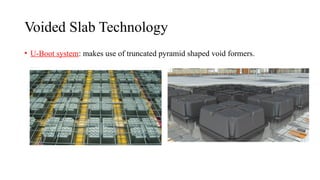
• U-Boot system: makes use of truncated pyramid shaped void formers.
Advantages
• Weight reduction of slab is achieved by the voided slab system. This would help
to achieve longer spans, lighter foundation and smaller columns.
• It helps to improve an open floor plate with lesser numbers of columns and beams.
The system hence prepares the building to adapt to future changes.
• A voided slab system reduces the amount of concrete and steel reinforcement
consumed by the building. This system brings savings in the form of material and
cost.
Advantages
• This system simplifies formwork by the elimination of the beams and related
labor. This hence saves time and brings a postive impact to the project
schedules.
• The void formers used to construct voided concrete slabs are recycled materials.
Hence this construction can contribute towards LEED certification.
• Voided concrete slab system helps to achieve life cycle benefits by increasing the
flexibility of the building
Filler Slab Technology
• Variation from conventional R.C.C slabs
• When force applied on slabs, it undergoes sagging
• Upper portion- compressive
• Lower portion- tensile
• Steel is provided in lower portion , concrete is too weak to resist tension and it cracks
• Filler slab is one in which concrete at lower portion replaced by filler materials
Filler Slab Technology
• Principle of filler slab construction is- to replace concrete in tensile zone with
cheaper and lighter materials.
• Filler materials must be light materials, cheaper, inert, size should that it fits
bottom half of the slab and structural grid of reinforcement, water absorption
should be less, should have good finishing.
• Commonly used filler materials: burnt clay bricks, hollow concrete blocks,
stabilized mud blocks, clay pots, coconut shells etc.
Filler Slab Technology
• The filler materials are laid in grids of steel reinforcement and over them concreting is
done
• Reinforcement spacing depends on size of filler materials
• First fix size of the filler materials and then RCC design is carried out.
• Filler materials should be soaked in water so that it does not absorb any water from the
concrete
• Filler materials can be arranged in two layers to entrap air from cavity between the
layers.
• Entrapped air improves thermal comfort of the room.
Filler Slab Technology- Advantages
• 5 to 10% concrete cost is saved in the materials
• Cost effective method
• Provide thermal comfort to building
• Aesthetically pleasing ceiling
• Load on columns and foundation is reduced
• Promoting sustainability
• Cost of plastering can be avoided by exposing filler materials
Scaffolding
• It is temporary structure to support the original structure
• It is also called as staging.
• To support workmen – used it as a platform to work at height more than 1.5m
• If there is chance of worker falling from a height more then 2m, platform to be
provided with guard rails.
• Scaffolding is made up of timber or steel
Scaffolding
• It should be stable and strong to support workmen and other construction
materials placed on it.
Scaffolding- Parts
• Standards
• Ledgers
• Braces
• Putlogs
• Boarding
• Transome
• Guard rail
Scaffolding- Types
• Single scaffolding
• Also called as brick layer scaffolding
• It is used for brick masonry
• Consist of only one row of standards
• It consist of standards, ledgers, putlogs etc.
• Distance between the standards about 2 to2.5m
• Ledgers connect the standards at vertical interval of 1.2 to 1.5m
• Putlogs at an interval of 1.2 to 1.5m (rest on ledger at one end and hole in the wall at
the other end)
Scaffolding- Types
• Single scaffolding
Scaffolding- Types
• Double scaffolding
• Also called as mason’s scaffolding
• Used for stone masonry (since not possible to leave holes in the walls to receive
putlogs
• First row is at a distance of 20 to 30cm from wall
• To make it more strong cross braces are provided
• This is also called as independent scaffolding
Scaffolding- Types
• Double scaffolding
Scaffolding- Types
• Cantilever scaffolding
• Can be single frame type and double frame type
• For single frame type scaffolding, standards are supported on series of needles and
these needles are taken out through holes in the wall
• For double frame type scaffolding, needles are strutted inside the floor through the
opening.
• For construction in the upper part of multi story buildings
• If ground is too weak to receive strands
• Space at ground level is required to be free of construction
Scaffolding- Types
• Cantilever scaffolding
Scaffolding- Types
• Suspended scaffolding
• Working platform is suspended from roofs with the help of wire or chain etc.
• Mainly used for white washing, colour washing or painting
• Platform can be moved vertically or horizontally
Scaffolding- Types
• Trestle scaffolding
• The working platform is supported on movable tripods or ladders
• Up to height of 5m
• Used for inside works
Scaffolding- Types
• Steel scaffolding
• It is very easy to construct or dismantle
• It has greater strength, greater durability and higher fire resistance
• It is not economical
Scaffolding- Types
• Patented scaffolding
• Working platform is arranged on brackets which can be adjustable to our required
level
• Available in markets
Formwork
• Temporary work- to mould concrete elements like slabs, beams, foundation etc.
• 90% failure of structures due to failure of formworks.
• Requirement of good formwork- strength, rigidity, should rest on non yielding
surface, easy to strip, smooth top surface, minimum leakage, economical.
Formwork -Materials
• Timber formwork
• Well seasoned, easily workable timber and plywood-skin of framework
• Disadvantage: there is possibility of warping, swelling and shrinkage.
• Advantage: easily available and cheap
Formwork -Materials
• Steel formwork
• Can be reused
• No shrinkage
• Does not absorb water from concrete
• Erection and stripping is easy
• Desired strength
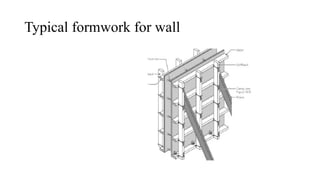
Typical formwork for wall
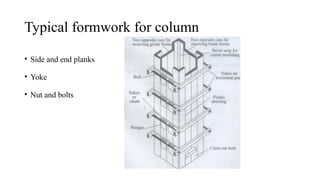
Typical formwork for column
• Side and end planks
• Yoke
• Nut and bolts
Typical formwork for beam and slab
• Sole plates
• Wedges
• Props
• Head tree
• Planks
• Battens
• ledgers
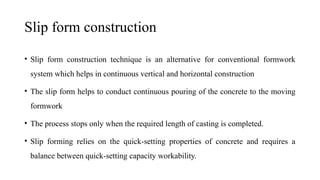
Slip form construction
• Slip form construction technique is an alternative for conventional formwork
system which helps in continuous vertical and horizontal construction
• The slip form helps to conduct continuous pouring of the concrete to the moving
formwork
• The process stops only when the required length of casting is completed.
• Slip forming relies on the quick-setting properties of concrete and requires a
balance between quick-setting capacity workability.
Slip form construction-types
• Vertical slip form
• In vertical slip forming the concrete form is surrounded by platform in which
workers stand placing steel reinforcing in to the concrete and ensuring a smooth
pour.
Slip form construction-types
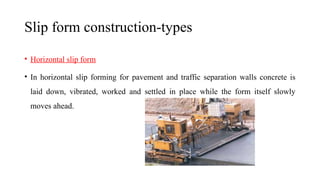
• Horizontal slip form
• In horizontal slip forming for pavement and traffic separation walls concrete is
laid down, vibrated, worked and settled in place while the form itself slowly
moves ahead.
Slip form construction-types
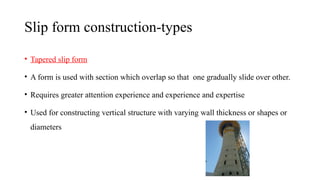
• Tapered slip form
• A form is used with section which overlap so that one gradually slide over other.
• Requires greater attention experience and experience and expertise
• Used for constructing vertical structure with varying wall thickness or shapes or
diameters
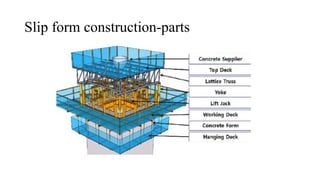
Slip form construction-parts
Construction procedure
• Alignment of slip form shutter with the help of yokes
• Attachment of horizontal beams and hydraulic jacks
• Construction of platform hand rills, scaffolding
• Construction starts
Advantages
• Continuous process easy to set up
• Un interrupted construction
• Reduction of manpower
• Mobility
• Less time consuming
• Good quality finish
• Very safe
• Cost effective
Prefabricated construction
• Prefabrication is the practice of assembling components of a structure in a factory
or other manufacturing site and transporting complete assemblies to the
construction site where the structure is to be located.
• Prefabrication construction is a new technique and is desirable for large scale
housing programmers, yet this has to take a firm hold in the country.
Prefabricated construction- Aim
• Is used to effect economy in cost.
• Components manufactured under controlled condition
• The speed of construction is increased since no curing period is necessary
• Prefabrication helps in the use of locally available materials with required
characteristics like light weight, easy, workability, thermal insulation, non-
combustibility, etc.
Prefabricated construction- Advantages
• High quality product
• Labour related saving
• Saving in time
• Overall efficiency is greatly increased
• Mass production is easier and quick
• Protected and controlled production environment
• Potential for lower production costs and other cost saving
• Independence of climate conditions
• Ensures high degree of safety
Prefabricated construction- characteristics are
to considered
• Easy availability
• Light weight for easy handling and transport and to economic on sections and size of
foundation
• Thermal insulation property
• Easy workability
• Durability in all weather conditions
• Non combustibility
• Economy in cost
• Sound insulation
Prefabricated construction-Disadvantages
• Careful handling of prefabricated components such as concrete panels or steel and
glass panels is required
• Attention has to be paid to the strength and corrosion –resistance of the joining of
prefabricated section to avoid failure of the joint
• Similarly leakage can be formed at joints in prefabricated components
• Transportation cost may be higher for voluminous prefabricated section than for the
materials of which they are made, which can often be packed more compactly.
• Large prefabricated sections require heavy-duty cranes and precision measurement
and handling to place in position.
Prefabricated construction-Materials
• Concrete
• Steel
• Treated wood
• Aluminium
• Cellular concrete
• Light weight elements
• Ceramic products
Prefabricated construction-construction
components
• Flooring and roofing scheme
• Beams
• Columns
• Staircase
• Lintels
• Sunshade
Prefabricated construction- stages
• Manufacturing of components in a place
• Erection in position
Prefabricated construction-components
• Roof/slab
• Placing slab segments over beams and grouted by concrete
• Different types are – solid slab, hollow core slab, single tee slab double tee slab
Prefabricated construction-components
• Beam
• Different types of beam : cellular beam, l shaped beam
• Columns
• The main principle involved in making columns connections is to ensure
continuity
Prefabricated construction- Limitation
• Small number of units required may prove to un economical
• Special connection , such as special bearing to transmit the vertical and horizontal
loads, can add cost to the system.
• Waterproofing at joints
• Transportation difficulties
• Need for cranes
Prestressed construction
• Prestressed concrete is structural concrete in which internal stresses have been
introduced to reduce potential; tensile stresses in the concrete resulting from loads
• This introduction of internal stresses is called prestressing and is usually
accomplished through the use of tendons that are tensioned or pulled tight prior to
being anchored to the concrete
• The initial load or prestress is applied to the structure to counter the stresses
arising during its service period
Prestressed construction
• In prestressed concrete, internal stresses are introduced in a planned manner to
counter the stresses resulting from the superimposed load to the desired strength
• A prestressed concrete structure is different from a simply reinforced concrete
structure due to the application of an initial load on the structure before its use.
• Prestressed concrete components are similar to normal concrete but it has high
strength concrete and high tensile steel wires
Prestressed construction
• High-grade concrete is used in prestressed concrete because reinforcement
improves large pressure forces for members causing high stresses at the ends to
be developed by anchoring equipment
• The stress generated at the end of the beam can only be resisted by high strength
concrete.
• Due to the high strength concrete, the cross sectional area required for the member
will decrease, reducing the dead load of the member
Prestressed construction
• Tendon: a stretched element used in a concrete member of structure to impart pre
stress to the concrete
• Cable: a group of tendons form a prestressing cable
• Bars: a tendon can be made up of a single steel bar. The diameter of a bar is much
larger than that of wire
• Anchorage: a device generally used to enable the tendon to impart and maintain
prestress in concrete.
Prestressed construction- methods
• External prestressing: when the prestressing is achieved by providing elements
outside the concrete, it is called external prestressing. The tendons are provided
outside the member.
• In this method, the prestressing is done by adjusting the external reaction ( by
introducing different support conditions)
• This technique is adopted in bridges and the strengthening of building
Prestressed construction
• Internal prestressing: when the prestressing is achieved by providing prestressing
element inside the concrete member (commonly, by embedded tendons), it is
called internal prestressing
• Most of the application of prestressing are internal prestressing
• In this system, a prestressing force is applied to the high tensile steel, ie the steel
reinforcement. It induces internal compressive stresses in concrete
Prestressed construction
• Internal prestressing is can be done by two different methods
• Pre-tensioning
• Post- tensioning
Prestressed construction
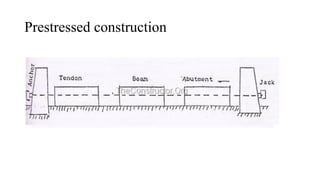
• Pre-tensioning
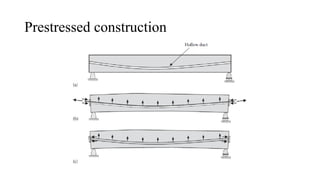
• In pre tensioning the steel tendons are tensioned before the concrete is cast. The
tendons are temporarily anchored against some abutments and then cut or released
after the concrete has been placed and hardened.
• In pre-tensioning the tension is applied to the tendons before casting the concrete
of any structure. The pre compression is transmitted from steel to concrete
through a bond over the transmission length near the ends
Prestressed construction
• Post- tensioning
• In post tensioning the tension is applied to the tendons which are located in a duct
after achieving the desired strength of the concrete. The pre- compression is
transmitted from steel to concrete by the anchorage device (at the end blocks)
• In post tensioning the steel tendons are tensioned after the concretehas been cast
and hardened.
Prestressed construction
• Post tensioning is performed by two main operation: tensioning the steel wires or
strands by hydraulic jacks that stretch the strands while bearing against the ends of
the member and then replacing the jack by permanent anchorages that bear on the
member and maintain the steel strands in tension.
Prestressed construction
• In this methods the concrete has already set but has ducts cast into it
• The strands or tendons are fed through the duct (stage1)
• Then tensioned (stage 2)
• And then anchored to the concrete (stage3)
Prestressed construction- Advantages
• The prestressing system works for a span grater than 35m
• Prestressing will increase the shear strength and resistance of concrete
• Dense concrete is provided by a prestressing system, thereby bettering durability
• The best choice for construction smooth and thin buildings
• Pretressing concrete remains uncontrolled even below service load condition
which proves structural effectivity
• Composite construction using this concrete unit and cast-in-unit achieves
economic structure
Prestressed construction- Disadvantages
• This concrete has high material cost
• Skilled labours are required
• Heavy equipment are required
• Formwork is extra complicated than normal formwork
Prestressed construction-Use
• In bridges, prestressed concrete is used to increase the potential span of the bridge
and to make the bridge more durable under moving traffic condition
• The types of concrete are used to reduce the overall weight of the building thus
reducing seismic forces and making the building economical
• These slabs can also span large distances which can reduce the number of
columns in the building
• They are used in construction work such as factories and warehouses
• They are durable and can travel great distances
Construction3D printing
• 3D printing is a computer controlled sequential layer of materials to create three
dimensional shapes
• Useful for manufacturing of geometrically complex components
• A 3D digital model of the item is created either by computer aided design
(CAD)or using 3D scanner.
• The most common type of printer is based on a robotic arm that moves back and
forth while extruding concrete
• Other methods for 3D printing include powder binding and additive welding.
Construction3D printing
• Powder binding is 3Dprinting within a basin of powder, solidifying powder layer
by layer to create the desired object
• Additive welding that uses to create metal parts
Construction3D printing- benefits
• Faster construction
• Lower labour cost
• Fewer people means more safe construction
• Less material used
• New design are possible as the 3D printer can create complex surfaces
• click here
construction management and technology.pptx

construction management and technology.pptx

  • 1.
  • 2.
  • 3.
    Cost effective construction •Construction of a particular building with all the comforts and standards specified with minimum cost • Cost is directly proportional to built up area and to build a low cost house, built up area to be reduced • Rapid wall construction, soil-cement block masonry, voided slab technology, filler slab technology are some construction techniques to reduce cost
  • 4.
    Rapid wall construction •Rapid wall is a load bearing building panel with a multiple of uses for the construction industry. • Rapid wall is a low cost, load bearing prefabricated walling system. • It is ideal for construction of single, double or multistory housing, as well as for commercial and industrial development. • Rapid wall eliminates the need for bricks, timber wall frames and plasterboard as it serves as both the internal and external load bearing wall.
  • 6.
    Rapid wall construction •Rapid wall also called as GFRG panel (Glass Fibre Reinforced Gypsum) or gypcrete panel is an energy efficient green building material with huge potential for use as load bearing and non load bearing wall panels. • Rapid wall is a large load bearing panel with modular cavities suitable for both external and internal walls. • It can also be used as intermediary floor slab or roof slab in combination with RCC as a composite material.
  • 7.
    Rapid wall construction •Rapid wall is manufactured in a molding process using glass fibre reinforced, water-resistant gypsum plaster. • All panels are 12m long , 3m high, 123 mm thick and cellular in construction. • The formed cells can be used to accommodate building services such as plumbing and wiring works and can be filled with insulation for increased thermal performance or concrete for increased structural capacity.
  • 8.
    Benefits of Rapidwall • Prefabricated rapid wall means faster overall construction time • Reduced workforce gives safer working environment • Reduces labour cost and speedy construction. • Clean construction reduces potential damage and finishing time reduced radically. • It has very high level of resistances to fire, heat, water, termites, corrosion, sound resistant. • Concrete infill with vertical reinforcement rods enhances its vertical and lateral load capabilities • Rapid wall building are resistant to earthquakes, cyclones and fire.
  • 9.
    Benefits of Rapidwall • Rapid wall panels are 100% recyclable and environmentally friendly. • Eliminates the need of bricks, blocks, timber wall frames • Light weighted rapid wall has high compressive strength, shearing strength, flexural strength and ductility.
  • 10.
    Soil-Cement Block Masonry •Soil-cement blocks are cost effective and energy effective alternative building to the normal burnt clay bricks used for construction of building. • Soil cement blocks are also known as stabilized mud blocks (SMB) or stabilized compressed earth blocks (SCEB) • These blocks can be produced in a decentralized fashion employing simple manually operated or semi- mechanized presses utilizing local soil • Also, these blocks are economical and consume less thermal energy during production.
  • 11.
    Soil-Cement Block Masonry •This is prepared by adding stabilizers to the mud. • White cement is the most usual stabilizer added 5 to10% by weight to the soil. Other stabilizers like lime, pozzolana or a combination of cement and lime are also added. • Soil cement blocks being usually 2½ times larger in size than the normal burnt clay bricks, construction is faster and the joints are consequence reduced
  • 13.
    Voided Slab Technology •The void slab are reinforced concrete slab in which voids allow to reduce the amount of concrete. • A voided slab is a concept that simply removes the excess concrete from the expensive part of the structural slab. • In building construction the slab is a very important structural member to make a space. And the slab is one of the largest member consuming concrete. • The main obstacle with concrete construction in case of horizontal slabs, is the high weight, which limits the span.
  • 14.
    Voided Slab Technology •As the span is increased the deflection of the slab is also increased. • Therefore the slab thickness should be increased • Increasing the slab thickness makes the slabs heavier, and will increased column and foundation size. • Thus it makes building consuming more materials such as concrete and steel reinforcement • To avoid these disadvantages which were caused by increasing of self-weight of slab, the voided slab system is adopted.
  • 15.
    Voided Slab Technology •The idea of creating engineered void within a solid slab system helps to reduce the overall weight of the slab system. • The voided slab system provides a huge opportunity to reduce the cost an environmental impact without compromising with the performance of the structure. • Void formers are employed to make voided slabs to eliminate unnecessary concrete. It hence reduce the weight of the slab and improves the structural capacity and span length of the slab.
  • 16.
    Voided Slab Technology •Voided slab incorporates an array of rigid void formers that contain air. • These voids formers are usually made out of plastic or any recycled material. The voided slabs rely on these voids created within the concrete during time of casting. • The arrangement creates an array of hollow boxes in the slab that support the flat surface. • The system hence provides support in both direstions and safely transfers the load to the vertical member. It is hence called voided biaxial slabs.
  • 18.
    Voided Slab Technology •The void formers are placed in the slab in a grid arrangement. It is arranged using temporary supports. Steel mesh is commonly used to create a formwork as they create optimal geometric proportions between the voids, concrete, and the reinforcement. • A voided concrete slab system can be constructed using either of the following void formers- bubble deck, cobiax, U-Boot beton, bee plate system, airdeck
  • 19.
    Voided Slab Technology •Bubble Deck: is an innovative new technology that replaces a significant percentage of a concrete slabs mass with hollow or foam filled plastic balls.
  • 20.
    Voided Slab Technology •Cobiax: is an internationally accepted technology that reduces unnecessary deadweight in concrete slabs by positioning hollow void formers within the slab. This can reduse the weight of the concrete slab by up to as much as 30% without compromising on its structural integrity.
  • 21.
    Voided Slab Technology •U-Boot system: makes use of truncated pyramid shaped void formers.
  • 22.
    Advantages • Weight reductionof slab is achieved by the voided slab system. This would help to achieve longer spans, lighter foundation and smaller columns. • It helps to improve an open floor plate with lesser numbers of columns and beams. The system hence prepares the building to adapt to future changes. • A voided slab system reduces the amount of concrete and steel reinforcement consumed by the building. This system brings savings in the form of material and cost.
  • 23.
    Advantages • This systemsimplifies formwork by the elimination of the beams and related labor. This hence saves time and brings a postive impact to the project schedules. • The void formers used to construct voided concrete slabs are recycled materials. Hence this construction can contribute towards LEED certification. • Voided concrete slab system helps to achieve life cycle benefits by increasing the flexibility of the building
  • 24.
    Filler Slab Technology •Variation from conventional R.C.C slabs • When force applied on slabs, it undergoes sagging • Upper portion- compressive • Lower portion- tensile • Steel is provided in lower portion , concrete is too weak to resist tension and it cracks • Filler slab is one in which concrete at lower portion replaced by filler materials
  • 26.
    Filler Slab Technology •Principle of filler slab construction is- to replace concrete in tensile zone with cheaper and lighter materials. • Filler materials must be light materials, cheaper, inert, size should that it fits bottom half of the slab and structural grid of reinforcement, water absorption should be less, should have good finishing. • Commonly used filler materials: burnt clay bricks, hollow concrete blocks, stabilized mud blocks, clay pots, coconut shells etc.
  • 27.
    Filler Slab Technology •The filler materials are laid in grids of steel reinforcement and over them concreting is done • Reinforcement spacing depends on size of filler materials • First fix size of the filler materials and then RCC design is carried out. • Filler materials should be soaked in water so that it does not absorb any water from the concrete • Filler materials can be arranged in two layers to entrap air from cavity between the layers. • Entrapped air improves thermal comfort of the room.
  • 28.
    Filler Slab Technology-Advantages • 5 to 10% concrete cost is saved in the materials • Cost effective method • Provide thermal comfort to building • Aesthetically pleasing ceiling • Load on columns and foundation is reduced • Promoting sustainability • Cost of plastering can be avoided by exposing filler materials
  • 29.
    Scaffolding • It istemporary structure to support the original structure • It is also called as staging. • To support workmen – used it as a platform to work at height more than 1.5m • If there is chance of worker falling from a height more then 2m, platform to be provided with guard rails. • Scaffolding is made up of timber or steel
  • 30.
    Scaffolding • It shouldbe stable and strong to support workmen and other construction materials placed on it.
  • 31.
    Scaffolding- Parts • Standards •Ledgers • Braces • Putlogs • Boarding • Transome • Guard rail
  • 33.
    Scaffolding- Types • Singlescaffolding • Also called as brick layer scaffolding • It is used for brick masonry • Consist of only one row of standards • It consist of standards, ledgers, putlogs etc. • Distance between the standards about 2 to2.5m • Ledgers connect the standards at vertical interval of 1.2 to 1.5m • Putlogs at an interval of 1.2 to 1.5m (rest on ledger at one end and hole in the wall at the other end)
  • 34.
  • 35.
    Scaffolding- Types • Doublescaffolding • Also called as mason’s scaffolding • Used for stone masonry (since not possible to leave holes in the walls to receive putlogs • First row is at a distance of 20 to 30cm from wall • To make it more strong cross braces are provided • This is also called as independent scaffolding
  • 36.
  • 37.
    Scaffolding- Types • Cantileverscaffolding • Can be single frame type and double frame type • For single frame type scaffolding, standards are supported on series of needles and these needles are taken out through holes in the wall • For double frame type scaffolding, needles are strutted inside the floor through the opening. • For construction in the upper part of multi story buildings • If ground is too weak to receive strands • Space at ground level is required to be free of construction
  • 38.
  • 39.
    Scaffolding- Types • Suspendedscaffolding • Working platform is suspended from roofs with the help of wire or chain etc. • Mainly used for white washing, colour washing or painting • Platform can be moved vertically or horizontally
  • 40.
    Scaffolding- Types • Trestlescaffolding • The working platform is supported on movable tripods or ladders • Up to height of 5m • Used for inside works
  • 41.
    Scaffolding- Types • Steelscaffolding • It is very easy to construct or dismantle • It has greater strength, greater durability and higher fire resistance • It is not economical
  • 42.
    Scaffolding- Types • Patentedscaffolding • Working platform is arranged on brackets which can be adjustable to our required level • Available in markets
  • 43.
    Formwork • Temporary work-to mould concrete elements like slabs, beams, foundation etc. • 90% failure of structures due to failure of formworks. • Requirement of good formwork- strength, rigidity, should rest on non yielding surface, easy to strip, smooth top surface, minimum leakage, economical.
  • 44.
    Formwork -Materials • Timberformwork • Well seasoned, easily workable timber and plywood-skin of framework • Disadvantage: there is possibility of warping, swelling and shrinkage. • Advantage: easily available and cheap
  • 45.
    Formwork -Materials • Steelformwork • Can be reused • No shrinkage • Does not absorb water from concrete • Erection and stripping is easy • Desired strength
  • 46.
  • 47.
    Typical formwork forcolumn • Side and end planks • Yoke • Nut and bolts
  • 48.
    Typical formwork forbeam and slab • Sole plates • Wedges • Props • Head tree • Planks • Battens • ledgers
  • 49.
    Slip form construction •Slip form construction technique is an alternative for conventional formwork system which helps in continuous vertical and horizontal construction • The slip form helps to conduct continuous pouring of the concrete to the moving formwork • The process stops only when the required length of casting is completed. • Slip forming relies on the quick-setting properties of concrete and requires a balance between quick-setting capacity workability.
  • 50.
    Slip form construction-types •Vertical slip form • In vertical slip forming the concrete form is surrounded by platform in which workers stand placing steel reinforcing in to the concrete and ensuring a smooth pour.
  • 51.
    Slip form construction-types •Horizontal slip form • In horizontal slip forming for pavement and traffic separation walls concrete is laid down, vibrated, worked and settled in place while the form itself slowly moves ahead.
  • 52.
    Slip form construction-types •Tapered slip form • A form is used with section which overlap so that one gradually slide over other. • Requires greater attention experience and experience and expertise • Used for constructing vertical structure with varying wall thickness or shapes or diameters
  • 53.
  • 54.
    Construction procedure • Alignmentof slip form shutter with the help of yokes • Attachment of horizontal beams and hydraulic jacks • Construction of platform hand rills, scaffolding • Construction starts
  • 55.
    Advantages • Continuous processeasy to set up • Un interrupted construction • Reduction of manpower • Mobility • Less time consuming • Good quality finish • Very safe • Cost effective
  • 56.
    Prefabricated construction • Prefabricationis the practice of assembling components of a structure in a factory or other manufacturing site and transporting complete assemblies to the construction site where the structure is to be located. • Prefabrication construction is a new technique and is desirable for large scale housing programmers, yet this has to take a firm hold in the country.
  • 57.
    Prefabricated construction- Aim •Is used to effect economy in cost. • Components manufactured under controlled condition • The speed of construction is increased since no curing period is necessary • Prefabrication helps in the use of locally available materials with required characteristics like light weight, easy, workability, thermal insulation, non- combustibility, etc.
  • 58.
    Prefabricated construction- Advantages •High quality product • Labour related saving • Saving in time • Overall efficiency is greatly increased • Mass production is easier and quick • Protected and controlled production environment • Potential for lower production costs and other cost saving • Independence of climate conditions • Ensures high degree of safety
  • 59.
    Prefabricated construction- characteristicsare to considered • Easy availability • Light weight for easy handling and transport and to economic on sections and size of foundation • Thermal insulation property • Easy workability • Durability in all weather conditions • Non combustibility • Economy in cost • Sound insulation
  • 60.
    Prefabricated construction-Disadvantages • Carefulhandling of prefabricated components such as concrete panels or steel and glass panels is required • Attention has to be paid to the strength and corrosion –resistance of the joining of prefabricated section to avoid failure of the joint • Similarly leakage can be formed at joints in prefabricated components • Transportation cost may be higher for voluminous prefabricated section than for the materials of which they are made, which can often be packed more compactly. • Large prefabricated sections require heavy-duty cranes and precision measurement and handling to place in position.
  • 61.
    Prefabricated construction-Materials • Concrete •Steel • Treated wood • Aluminium • Cellular concrete • Light weight elements • Ceramic products
  • 62.
    Prefabricated construction-construction components • Flooringand roofing scheme • Beams • Columns • Staircase • Lintels • Sunshade
  • 63.
    Prefabricated construction- stages •Manufacturing of components in a place • Erection in position
  • 64.
    Prefabricated construction-components • Roof/slab •Placing slab segments over beams and grouted by concrete • Different types are – solid slab, hollow core slab, single tee slab double tee slab
  • 65.
    Prefabricated construction-components • Beam •Different types of beam : cellular beam, l shaped beam • Columns • The main principle involved in making columns connections is to ensure continuity
  • 66.
    Prefabricated construction- Limitation •Small number of units required may prove to un economical • Special connection , such as special bearing to transmit the vertical and horizontal loads, can add cost to the system. • Waterproofing at joints • Transportation difficulties • Need for cranes
  • 67.
    Prestressed construction • Prestressedconcrete is structural concrete in which internal stresses have been introduced to reduce potential; tensile stresses in the concrete resulting from loads • This introduction of internal stresses is called prestressing and is usually accomplished through the use of tendons that are tensioned or pulled tight prior to being anchored to the concrete • The initial load or prestress is applied to the structure to counter the stresses arising during its service period
  • 68.
    Prestressed construction • Inprestressed concrete, internal stresses are introduced in a planned manner to counter the stresses resulting from the superimposed load to the desired strength • A prestressed concrete structure is different from a simply reinforced concrete structure due to the application of an initial load on the structure before its use. • Prestressed concrete components are similar to normal concrete but it has high strength concrete and high tensile steel wires
  • 69.
    Prestressed construction • High-gradeconcrete is used in prestressed concrete because reinforcement improves large pressure forces for members causing high stresses at the ends to be developed by anchoring equipment • The stress generated at the end of the beam can only be resisted by high strength concrete. • Due to the high strength concrete, the cross sectional area required for the member will decrease, reducing the dead load of the member
  • 70.
    Prestressed construction • Tendon:a stretched element used in a concrete member of structure to impart pre stress to the concrete • Cable: a group of tendons form a prestressing cable • Bars: a tendon can be made up of a single steel bar. The diameter of a bar is much larger than that of wire • Anchorage: a device generally used to enable the tendon to impart and maintain prestress in concrete.
  • 71.
    Prestressed construction- methods •External prestressing: when the prestressing is achieved by providing elements outside the concrete, it is called external prestressing. The tendons are provided outside the member. • In this method, the prestressing is done by adjusting the external reaction ( by introducing different support conditions) • This technique is adopted in bridges and the strengthening of building
  • 72.
    Prestressed construction • Internalprestressing: when the prestressing is achieved by providing prestressing element inside the concrete member (commonly, by embedded tendons), it is called internal prestressing • Most of the application of prestressing are internal prestressing • In this system, a prestressing force is applied to the high tensile steel, ie the steel reinforcement. It induces internal compressive stresses in concrete
  • 73.
    Prestressed construction • Internalprestressing is can be done by two different methods • Pre-tensioning • Post- tensioning
  • 74.
    Prestressed construction • Pre-tensioning •In pre tensioning the steel tendons are tensioned before the concrete is cast. The tendons are temporarily anchored against some abutments and then cut or released after the concrete has been placed and hardened. • In pre-tensioning the tension is applied to the tendons before casting the concrete of any structure. The pre compression is transmitted from steel to concrete through a bond over the transmission length near the ends
  • 75.
  • 76.
  • 77.
    Prestressed construction • Post-tensioning • In post tensioning the tension is applied to the tendons which are located in a duct after achieving the desired strength of the concrete. The pre- compression is transmitted from steel to concrete by the anchorage device (at the end blocks) • In post tensioning the steel tendons are tensioned after the concretehas been cast and hardened.
  • 78.
    Prestressed construction • Posttensioning is performed by two main operation: tensioning the steel wires or strands by hydraulic jacks that stretch the strands while bearing against the ends of the member and then replacing the jack by permanent anchorages that bear on the member and maintain the steel strands in tension.
  • 79.
  • 80.
    Prestressed construction • Inthis methods the concrete has already set but has ducts cast into it • The strands or tendons are fed through the duct (stage1) • Then tensioned (stage 2) • And then anchored to the concrete (stage3)
  • 81.
    Prestressed construction- Advantages •The prestressing system works for a span grater than 35m • Prestressing will increase the shear strength and resistance of concrete • Dense concrete is provided by a prestressing system, thereby bettering durability • The best choice for construction smooth and thin buildings • Pretressing concrete remains uncontrolled even below service load condition which proves structural effectivity • Composite construction using this concrete unit and cast-in-unit achieves economic structure
  • 82.
    Prestressed construction- Disadvantages •This concrete has high material cost • Skilled labours are required • Heavy equipment are required • Formwork is extra complicated than normal formwork
  • 83.
    Prestressed construction-Use • Inbridges, prestressed concrete is used to increase the potential span of the bridge and to make the bridge more durable under moving traffic condition • The types of concrete are used to reduce the overall weight of the building thus reducing seismic forces and making the building economical • These slabs can also span large distances which can reduce the number of columns in the building • They are used in construction work such as factories and warehouses • They are durable and can travel great distances
  • 84.
    Construction3D printing • 3Dprinting is a computer controlled sequential layer of materials to create three dimensional shapes • Useful for manufacturing of geometrically complex components • A 3D digital model of the item is created either by computer aided design (CAD)or using 3D scanner. • The most common type of printer is based on a robotic arm that moves back and forth while extruding concrete • Other methods for 3D printing include powder binding and additive welding.
  • 85.
    Construction3D printing • Powderbinding is 3Dprinting within a basin of powder, solidifying powder layer by layer to create the desired object • Additive welding that uses to create metal parts
  • 86.
    Construction3D printing- benefits •Faster construction • Lower labour cost • Fewer people means more safe construction • Less material used • New design are possible as the 3D printer can create complex surfaces • click here