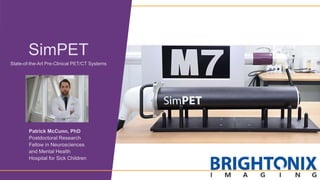
SimPET
State-of-the-Art Pre-Clinical PET/CT Systems
Patrick McCunn, PhD
Postdoctoral Research
Fellow in Neurosciences
and Mental Health
Hospital for Sick Children
Audience Poll
Outline

• Positron Emission Tomography
• Brightonix and the SimPET System
• SimPET Technical Specifications
• SimPET Performance Capabilities
• SimPET and Aspect M7 MRI
• SimPET in Action
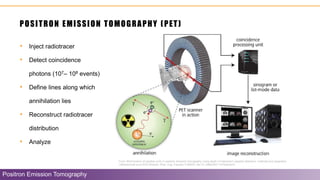
Positron Emission Tomography
From: Minimization of parallax error in positron emission tomography using depth of interaction capable detectors: methods and apparatus
I Mohammadi et al 2019 Biomed. Phys. Eng. Express 5 062001 doi:10.1088/2057-1976/ab4a1b
POSITRON EMISSION TOMOGRAPHY (PET)
Positron Emission Tomography
• Inject radiotracer
• Detect coincidence
photons (107– 108 events)
• Define lines along which

annihilation lies
• Reconstruct radiotracer
distribution
• Analyze
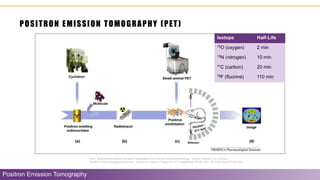
From: Small-animal positron emission tomography as a tool for neuropharmacology. Sophie Lancelot, Luc Zimmer.
Trends in Pharmacological Sciences ; Volume 31, Issue 9, Pages 411-417 (September 2010); DOI: 10.1016/j.tips.2010.06.002
Isotope Half-Life
15O (oxygen) 2 min
13N (nitrogen) 10 min
11C (carbon) 20 min
18F (fluorine) 110 min
POSITRON EMISSION TOMOGRAPHY (PET)
Positron Emission Tomography
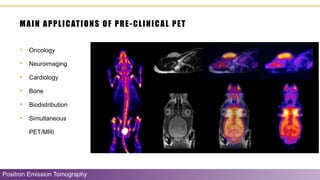
MAIN APPLICATIONS OF PRE-CLINICAL PET
• Oncology
• Neuroimaging
• Cardiology
• Bone
• Biodistribution
• Simultaneous
PET/MRI
Positron Emission Tomography
Brightonix and the SimPET System
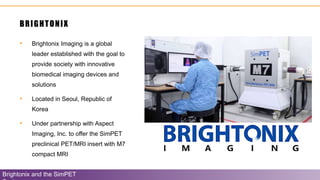
BRIGHTONIX
• Brightonix Imaging is a global
leader established with the goal to
provide society with innovative
biomedical imaging devices and
solutions
• Located in Seoul, Republic of
Korea
• Under partnership with Aspect
Imaging, Inc. to offer the SimPET
preclinical PET/MRI insert with M7
compact MRI
Brightonix and the SimPET
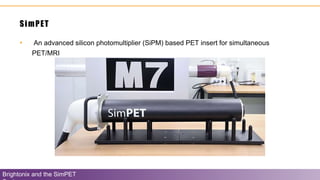
SimPET
Brightonix and the SimPET
• An advanced silicon photomultiplier (SiPM) based PET insert for simultaneous
PET/MRI
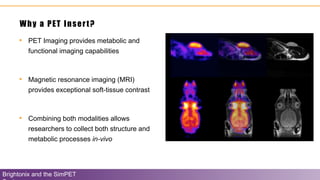
• PET Imaging provides metabolic and
functional imaging capabilities
• Magnetic resonance imaging (MRI)
provides exceptional soft-tissue contrast
• Combining both modalities allows
researchers to collect both structure and
metabolic processes in-vivo
Why a PET Insert?
Brightonix and the SimPET
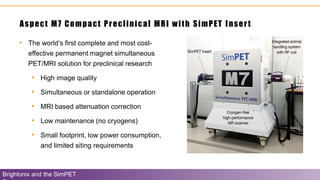
• The world’s first complete and most cost-
effective permanent magnet simultaneous
PET/MRI solution for preclinical research
• High image quality
• Simultaneous or standalone operation
• MRI based attenuation correction
• Low maintenance (no cryogens)
• Small footprint, low power consumption,
and limited siting requirements
Aspect M7 Compact Preclinical MRI with SimPET Insert
Brightonix and the SimPET
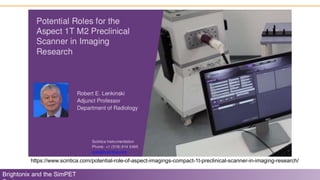
https://www.scintica.com/potential-role-of-aspect-imagings-compact-1t-preclinical-scanner-in-imaging-research/
Brightonix and the SimPET
www.scintica.com
SimPET Technical Specifications
PET Detectors
SimPET Technical
Detector Ring Detector Block
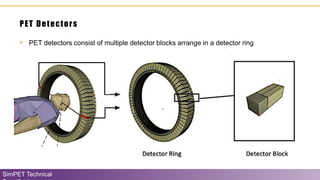
• PET detectors consist of multiple detector blocks arrange in a detector ring
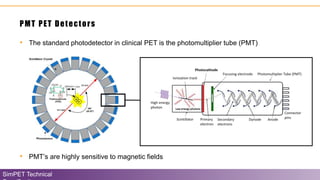
• The standard photodetector in clinical PET is the photomultiplier tube (PMT)
PMT PET Detectors
SimPET Technical
• PMT’s are highly sensitive to magnetic fields
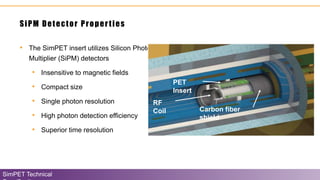
• The SimPET insert utilizes Silicon Photo
Multiplier (SiPM) detectors
• Insensitive to magnetic fields
• Compact size
• Single photon resolution
• High photon detection efficiency
• Superior time resolution
SiPM Detector Properties
SimPET Technical
RF
Coil
PET
Insert
Carbon fiber
shield
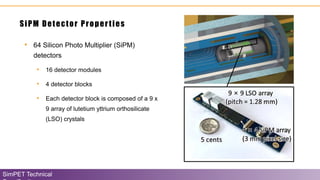
• 64 Silicon Photo Multiplier (SiPM)
detectors
• 16 detector modules
• 4 detector blocks
• Each detector block is composed of a 9 x
9 array of lutetium yttrium orthosilicate
(LSO) crystals
SiPM Detector Properties
SimPET Technical
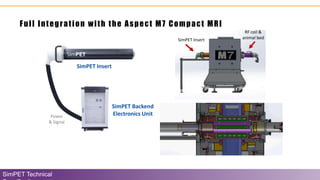
Full Integration with the Aspect M7 Compact MRI
SimPET Technical
SimPET Backend
Electronics Unit
SimPET Insert
Power
& Signal
Price: $699,000
SimPET Insert
RF coil &
animal bed
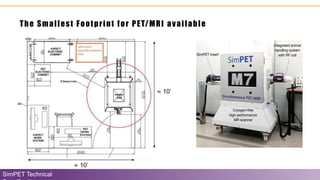
The Smallest Footprint for PET/MRI available
SimPET Technical
≈ 10’
≈ 10’
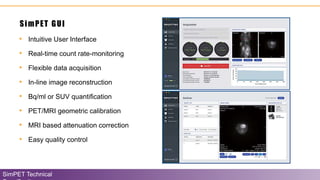
• Intuitive User Interface
• Real-time count rate-monitoring
• Flexible data acquisition
• In-line image reconstruction
• Bq/ml or SUV quantification
• PET/MRI geometric calibration
• MRI based attenuation correction
• Easy quality control
SimPET GUI
SimPET Technical
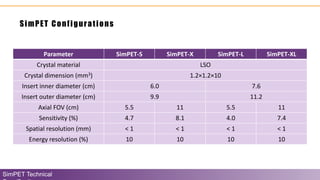
SimPET Configurations
SimPET Technical
Parameter SimPET-S SimPET-X SimPET-L SimPET-XL
Crystal material LSO
Crystal dimension (mm3) 1.2×1.2×10
Insert inner diameter (cm) 6.0 7.6
Insert outer diameter (cm) 9.9 11.2
Axial FOV (cm) 5.5 11 5.5 11
Sensitivity (%) 4.7 8.1 4.0 7.4
Spatial resolution (mm) < 1 < 1 < 1 < 1
Energy resolution (%) 10 10 10 10
Audience Poll
SimPET Performance Capabilities
SimPET Performance
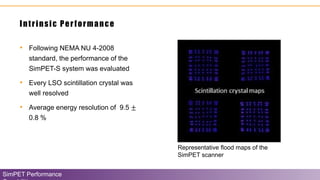
Intrinsic Performance
SimPET Performance
• Following NEMA NU 4-2008
standard, the performance of the
SimPET-S system was evaluated
• Every LSO scintillation crystal was
well resolved
• Average energy resolution of 9.5 ±
0.8 %
Representative flood maps of the
SimPET scanner
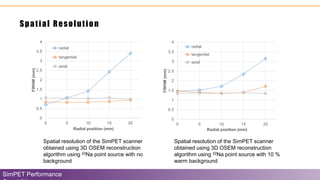
Spatial Resolution
SimPET Performance
0
0.5
1
1.5
2
2.5
3
3.5
4
0 5 10 15 20
FWHM(mm)
Radial position (mm)
radial
tangential
axial
0
0.5
1
1.5
2
2.5
3
3.5
4
0 5 10 15 20
FWHM(mm)
Radial position (mm)
radial
tangential
axial
Spatial resolution of the SimPET scanner
obtained using 3D OSEM reconstruction
algorithm using 22Na point source with no
background
Spatial resolution of the SimPET scanner
obtained using 3D OSEM reconstruction
algorithm using 22Na point source with 10 %
warm background
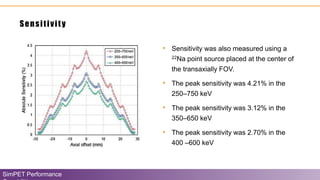
Sensitivity
SimPET Performance
• Sensitivity was also measured using a
22Na point source placed at the center of
the transaxially FOV.
• The peak sensitivity was 4.21% in the
250–750 keV
• The peak sensitivity was 3.12% in the
350–650 keV
• The peak sensitivity was 2.70% in the
400 –600 keV
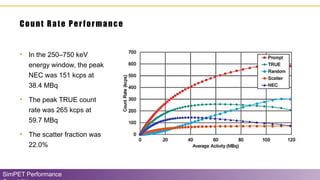
Count Rate Performance
SimPET Performance
• In the 250–750 keV
energy window, the peak
NEC was 151 kcps at
38.4 MBq
• The peak TRUE count
rate was 265 kcps at
59.7 MBq
• The scatter fraction was
22.0%
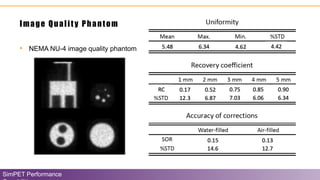
Image Quality Phantom
SimPET Performance
• NEMA NU-4 image quality phantom 5.48 6.34 4.62 4.42
0.17 0.52 0.75 0.85 0.90
0.15 0.13
RC
12.3 6.87 7.03 6.06 6.34
14.6 12.7
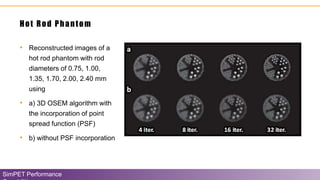
Hot Rod Phantom
SimPET Performance
• Reconstructed images of a
hot rod phantom with rod
diameters of 0.75, 1.00,
1.35, 1.70, 2.00, 2.40 mm
using
• a) 3D OSEM algorithm with
the incorporation of point
spread function (PSF)
• b) without PSF incorporation
SimPET and the Aspect M7
MRI
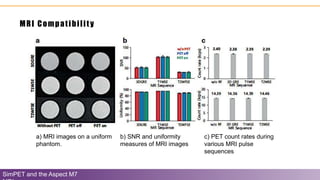
MRI Compatibility
SimPET and the Aspect M7
a) MRI images on a uniform
phantom.
b) SNR and uniformity
measures of MRI images
c) PET count rates during
various MRI pulse
sequences
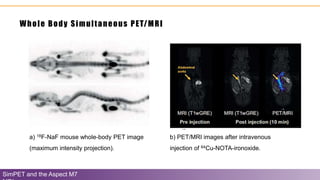
Whole Body Simultaneous PET/MRI
SimPET and the Aspect M7
b) PET/MRI images after intravenous
injection of 64Cu-NOTA-ironoxide.
a) 18F-NaF mouse whole-body PET image
(maximum intensity projection).
SimPET in Action
Audience Poll
Oncologic PET/MRI with SUV (standard uptake value)
quantification
SimPET in Action
• [ 18F]FDG PET and T2
FSE MRI scans
conducted to
investigate the effects
of tumor associated
macrophages on
tumor hypoxia and
aerobic glycolysis
(Cancer Research,
2019)
High spatial-resolution PET/MR imaging in the mouse arthritis
model
SimPET in Action
• Simultaneously
acquired and matched
[18F]FDG PET (300
µCi, 60-min uptake)
and 3D GRE MR
images in arthritis
model mouse
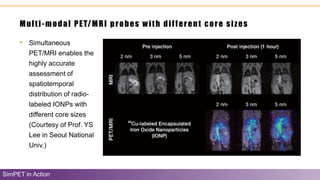
Multi-modal PET/MRI probes with different core sizes
SimPET in Action
• Simultaneous
PET/MRI enables the
highly accurate
assessment of
spatiotemporal
distribution of radio-
labeled IONPs with
different core sizes
(Courtesy of Prof. YS
Lee in Seoul National
Univ.)
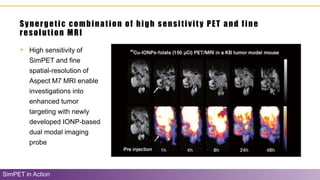
Synergetic combination of high sensitivity PET and fine
resolution MRI
SimPET in Action
• High sensitivity of
SimPET and fine
spatial-resolution of
Aspect M7 MRI enable
investigations into
enhanced tumor
targeting with newly
developed IONP-based
dual modal imaging
probe
Establishment of a [18F]-FDG-PET/MRI Imaging Protocol for
Gastric Cancer PDX as a Preclinical Research Tool
SimPET in Action
Bae, S. W., Berlth, F., Jeong, K. Y., Suh, Y. S., Kong, S. H., Lee, H. J., Kim, W. H., Chung, J. K., & Yang, H. K.
(2020). Establishment of a [18F]-FDG-PET/MRI Imaging Protocol for Gastric Cancer PDX as a Preclinical
Research Tool. Journal of gastric cancer, 20(1), 60–71.
SUMMARY
• Positron Emission Tomography
• Brightonix and the SimPET System
• SimPET Technical Capabilities
• SimPET and Aspect M7 MRI
• Applications
To ask a question, click the Q&A Button,
type your question and click send. Any
questions that are not addressed during
the live webinar will be answered
following the event.
Please indicate whom you want to
address your question.
Thank you for participating!
Q&A
SESSION:
Patrick McCunn, PhD
Postdoctoral Research
Fellow in Neurosciences
and Mental Health
Hospital for Sick Children

SimPET a Preclinical PET Insert for Simultaneous PET/MR Imaging

  • 1.
    SimPET State-of-the-Art Pre-Clinical PET/CTSystems Patrick McCunn, PhD Postdoctoral Research Fellow in Neurosciences and Mental Health Hospital for Sick Children
  • 2.
  • 3.
    Outline • Positron EmissionTomography • Brightonix and the SimPET System • SimPET Technical Specifications • SimPET Performance Capabilities • SimPET and Aspect M7 MRI • SimPET in Action
  • 4.
  • 5.
    From: Minimization ofparallax error in positron emission tomography using depth of interaction capable detectors: methods and apparatus I Mohammadi et al 2019 Biomed. Phys. Eng. Express 5 062001 doi:10.1088/2057-1976/ab4a1b POSITRON EMISSION TOMOGRAPHY (PET) Positron Emission Tomography • Inject radiotracer • Detect coincidence photons (107– 108 events) • Define lines along which annihilation lies • Reconstruct radiotracer distribution • Analyze
  • 6.
    From: Small-animal positronemission tomography as a tool for neuropharmacology. Sophie Lancelot, Luc Zimmer. Trends in Pharmacological Sciences ; Volume 31, Issue 9, Pages 411-417 (September 2010); DOI: 10.1016/j.tips.2010.06.002 Isotope Half-Life 15O (oxygen) 2 min 13N (nitrogen) 10 min 11C (carbon) 20 min 18F (fluorine) 110 min POSITRON EMISSION TOMOGRAPHY (PET) Positron Emission Tomography
  • 7.
    MAIN APPLICATIONS OFPRE-CLINICAL PET • Oncology • Neuroimaging • Cardiology • Bone • Biodistribution • Simultaneous PET/MRI Positron Emission Tomography
  • 8.
    Brightonix and theSimPET System
  • 9.
    BRIGHTONIX • Brightonix Imagingis a global leader established with the goal to provide society with innovative biomedical imaging devices and solutions • Located in Seoul, Republic of Korea • Under partnership with Aspect Imaging, Inc. to offer the SimPET preclinical PET/MRI insert with M7 compact MRI Brightonix and the SimPET
  • 10.
    SimPET Brightonix and theSimPET • An advanced silicon photomultiplier (SiPM) based PET insert for simultaneous PET/MRI
  • 11.
    • PET Imagingprovides metabolic and functional imaging capabilities • Magnetic resonance imaging (MRI) provides exceptional soft-tissue contrast • Combining both modalities allows researchers to collect both structure and metabolic processes in-vivo Why a PET Insert? Brightonix and the SimPET
  • 12.
    • The world’sfirst complete and most cost- effective permanent magnet simultaneous PET/MRI solution for preclinical research • High image quality • Simultaneous or standalone operation • MRI based attenuation correction • Low maintenance (no cryogens) • Small footprint, low power consumption, and limited siting requirements Aspect M7 Compact Preclinical MRI with SimPET Insert Brightonix and the SimPET
  • 13.
    Brightonix and theSimPET https://www.scintica.com/potential-role-of-aspect-imagings-compact-1t-preclinical-scanner-in-imaging-research/
  • 14.
    Brightonix and theSimPET www.scintica.com
  • 15.
  • 16.
    PET Detectors SimPET Technical DetectorRing Detector Block • PET detectors consist of multiple detector blocks arrange in a detector ring
  • 17.
    • The standardphotodetector in clinical PET is the photomultiplier tube (PMT) PMT PET Detectors SimPET Technical • PMT’s are highly sensitive to magnetic fields
  • 18.
    • The SimPETinsert utilizes Silicon Photo Multiplier (SiPM) detectors • Insensitive to magnetic fields • Compact size • Single photon resolution • High photon detection efficiency • Superior time resolution SiPM Detector Properties SimPET Technical RF Coil PET Insert Carbon fiber shield
  • 19.
    • 64 SiliconPhoto Multiplier (SiPM) detectors • 16 detector modules • 4 detector blocks • Each detector block is composed of a 9 x 9 array of lutetium yttrium orthosilicate (LSO) crystals SiPM Detector Properties SimPET Technical
  • 20.
    Full Integration withthe Aspect M7 Compact MRI SimPET Technical SimPET Backend Electronics Unit SimPET Insert Power & Signal Price: $699,000 SimPET Insert RF coil & animal bed
  • 21.
    The Smallest Footprintfor PET/MRI available SimPET Technical ≈ 10’ ≈ 10’
  • 22.
    • Intuitive UserInterface • Real-time count rate-monitoring • Flexible data acquisition • In-line image reconstruction • Bq/ml or SUV quantification • PET/MRI geometric calibration • MRI based attenuation correction • Easy quality control SimPET GUI SimPET Technical
  • 23.
    SimPET Configurations SimPET Technical ParameterSimPET-S SimPET-X SimPET-L SimPET-XL Crystal material LSO Crystal dimension (mm3) 1.2×1.2×10 Insert inner diameter (cm) 6.0 7.6 Insert outer diameter (cm) 9.9 11.2 Axial FOV (cm) 5.5 11 5.5 11 Sensitivity (%) 4.7 8.1 4.0 7.4 Spatial resolution (mm) < 1 < 1 < 1 < 1 Energy resolution (%) 10 10 10 10
  • 24.
  • 25.
  • 26.
  • 27.
    Intrinsic Performance SimPET Performance •Following NEMA NU 4-2008 standard, the performance of the SimPET-S system was evaluated • Every LSO scintillation crystal was well resolved • Average energy resolution of 9.5 ± 0.8 % Representative flood maps of the SimPET scanner
  • 28.
    Spatial Resolution SimPET Performance 0 0.5 1 1.5 2 2.5 3 3.5 4 05 10 15 20 FWHM(mm) Radial position (mm) radial tangential axial 0 0.5 1 1.5 2 2.5 3 3.5 4 0 5 10 15 20 FWHM(mm) Radial position (mm) radial tangential axial Spatial resolution of the SimPET scanner obtained using 3D OSEM reconstruction algorithm using 22Na point source with no background Spatial resolution of the SimPET scanner obtained using 3D OSEM reconstruction algorithm using 22Na point source with 10 % warm background
  • 29.
    Sensitivity SimPET Performance • Sensitivitywas also measured using a 22Na point source placed at the center of the transaxially FOV. • The peak sensitivity was 4.21% in the 250–750 keV • The peak sensitivity was 3.12% in the 350–650 keV • The peak sensitivity was 2.70% in the 400 –600 keV
  • 30.
    Count Rate Performance SimPETPerformance • In the 250–750 keV energy window, the peak NEC was 151 kcps at 38.4 MBq • The peak TRUE count rate was 265 kcps at 59.7 MBq • The scatter fraction was 22.0%
  • 31.
    Image Quality Phantom SimPETPerformance • NEMA NU-4 image quality phantom 5.48 6.34 4.62 4.42 0.17 0.52 0.75 0.85 0.90 0.15 0.13 RC 12.3 6.87 7.03 6.06 6.34 14.6 12.7
  • 32.
    Hot Rod Phantom SimPETPerformance • Reconstructed images of a hot rod phantom with rod diameters of 0.75, 1.00, 1.35, 1.70, 2.00, 2.40 mm using • a) 3D OSEM algorithm with the incorporation of point spread function (PSF) • b) without PSF incorporation
  • 33.
    SimPET and theAspect M7 MRI
  • 34.
    MRI Compatibility SimPET andthe Aspect M7 a) MRI images on a uniform phantom. b) SNR and uniformity measures of MRI images c) PET count rates during various MRI pulse sequences
  • 35.
    Whole Body SimultaneousPET/MRI SimPET and the Aspect M7 b) PET/MRI images after intravenous injection of 64Cu-NOTA-ironoxide. a) 18F-NaF mouse whole-body PET image (maximum intensity projection).
  • 36.
  • 37.
  • 38.
    Oncologic PET/MRI withSUV (standard uptake value) quantification SimPET in Action • [ 18F]FDG PET and T2 FSE MRI scans conducted to investigate the effects of tumor associated macrophages on tumor hypoxia and aerobic glycolysis (Cancer Research, 2019)
  • 39.
    High spatial-resolution PET/MRimaging in the mouse arthritis model SimPET in Action • Simultaneously acquired and matched [18F]FDG PET (300 µCi, 60-min uptake) and 3D GRE MR images in arthritis model mouse
  • 40.
    Multi-modal PET/MRI probeswith different core sizes SimPET in Action • Simultaneous PET/MRI enables the highly accurate assessment of spatiotemporal distribution of radio- labeled IONPs with different core sizes (Courtesy of Prof. YS Lee in Seoul National Univ.)
  • 41.
    Synergetic combination ofhigh sensitivity PET and fine resolution MRI SimPET in Action • High sensitivity of SimPET and fine spatial-resolution of Aspect M7 MRI enable investigations into enhanced tumor targeting with newly developed IONP-based dual modal imaging probe
  • 42.
    Establishment of a[18F]-FDG-PET/MRI Imaging Protocol for Gastric Cancer PDX as a Preclinical Research Tool SimPET in Action Bae, S. W., Berlth, F., Jeong, K. Y., Suh, Y. S., Kong, S. H., Lee, H. J., Kim, W. H., Chung, J. K., & Yang, H. K. (2020). Establishment of a [18F]-FDG-PET/MRI Imaging Protocol for Gastric Cancer PDX as a Preclinical Research Tool. Journal of gastric cancer, 20(1), 60–71.
  • 43.
    SUMMARY • Positron EmissionTomography • Brightonix and the SimPET System • SimPET Technical Capabilities • SimPET and Aspect M7 MRI • Applications
  • 44.
    To ask aquestion, click the Q&A Button, type your question and click send. Any questions that are not addressed during the live webinar will be answered following the event. Please indicate whom you want to address your question. Thank you for participating! Q&A SESSION: Patrick McCunn, PhD Postdoctoral Research Fellow in Neurosciences and Mental Health Hospital for Sick Children