INTENSIVE SHEEP PRODUCTION
CONFINEMENT  DRY LOT  ZERO GRAZING
SUSAN SCHOENIAN
Sheep & Goat Specialist
University of Maryland Extension
sschoen@umd.edu - sheep and goat.com
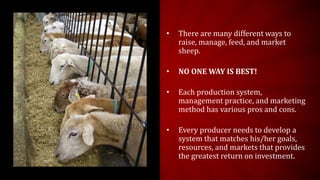
• There are many different ways to
raise, manage, feed, and market
sheep.
• NO ONE WAY IS BEST!
• Each production system,
management practice, and marketing
method has various pros and cons.
• Every producer needs to develop a
system that matches his/her goals,
resources, and markets that provides
the greatest return on investment.
CHARACTERISTICS OF
INTENSIVE SHEEP PRODUCTION
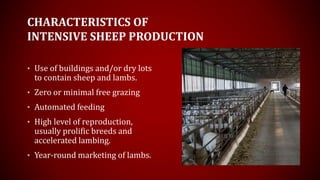
• Use of buildings and/or dry lots
to contain sheep and lambs.
• Zero or minimal free grazing
• Automated feeding
• High level of reproduction,
usually prolific breeds and
accelerated lambing.
• Year-round marketing of lambs.
WHY RAISE SHEEP INTENSIVELY?
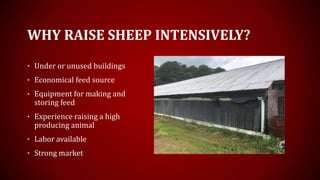
• Under or unused buildings
• Economical feed source
• Equipment for making and
storing feed
• Experience raising a high
producing animal
• Labor available
• Strong market
INTENSIVE SHEEP PRODUCTION
ADVANTAGES (PROS)
• Greater control over production
• No worm problems
(coccidia still a risk)
• No predators or cost of predator
control (fences or guardians)
• Minimal weather risk
• Better nutrition: you control what
animals eat
• Greater potential returns
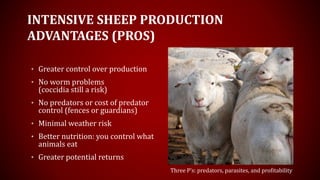
Three P’s: predators, parasites, and profitability
INTENSIVE SHEEP PRODUCTION
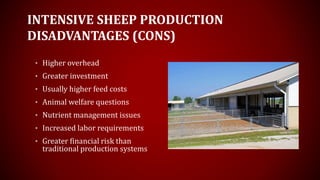
DISADVANTAGES (CONS)
• Higher overhead
• Greater investment
• Usually higher feed costs
• Animal welfare questions
• Nutrient management issues
• Increased labor requirements
• Greater financial risk than
traditional production systems
CONSIDERATIONS FOR INTENSIVE SHEEP
PRODUCTION
• Housing
• Feeding
• Management
• Breeding / genetics
• Nutrient management
• Animal welfare
• Labor
• Technology
• Marketing
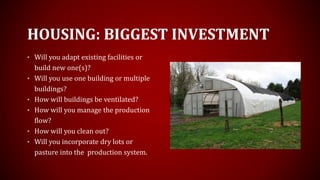
HOUSING: BIGGEST INVESTMENT
• Will you adapt existing facilities or
build new one(s)?
• Will you use one building or multiple
buildings?
• How will buildings be ventilated?
• How will you manage the production
flow?
• How will you clean out?
• Will you incorporate dry lots or
pasture into the production system.
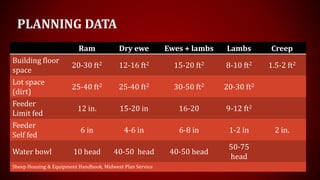
PLANNING DATA
Ram Dry ewe Ewes + lambs Lambs Creep
Building floor
space
20-30 ft2 12-16 ft2 15-20 ft2 8-10 ft2 1.5-2 ft2
Lot space
(dirt)
25-40 ft2 25-40 ft2 30-50 ft2 20-30 ft2
Feeder
Limit fed
12 in. 15-20 in 16-20 9-12 ft2
Feeder
Self fed
6 in 4-6 in 6-8 in 1-2 in 2 in.
Water bowl 10 head 40-50 head 40-50 head
50-75
head
Sheep Housing & Equipment Handbook, Midwest Plan Service
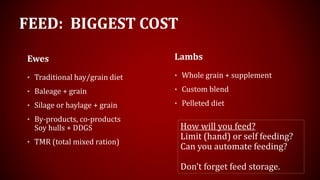
FEED: BIGGEST COST
Ewes
• Traditional hay/grain diet
• Baleage + grain
• Silage or haylage + grain
• By-products, co-products
Soy hulls + DDGS
• TMR (total mixed ration)
Lambs
• Whole grain + supplement
• Custom blend
• Pelleted diet
How will you feed?
Limit (hand) or self feeding?
Can you automate feeding?
Don’t forget feed storage.
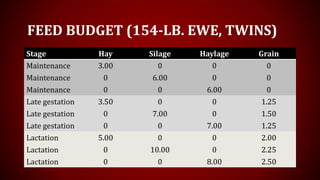
FEED BUDGET (154-LB. EWE, TWINS)
Stage Hay Silage Haylage Grain
Maintenance 3.00 0 0 0
Maintenance 0 6.00 0 0
Maintenance 0 0 6.00 0
Late gestation 3.50 0 0 1.25
Late gestation 0 7.00 0 1.50
Late gestation 0 0 7.00 1.25
Lactation 5.00 0 0 2.00
Lactation 0 10.00 0 2.25
Lactation 0 0 8.00 2.50
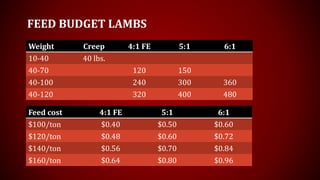
FEED BUDGET LAMBS
Weight Creep 4:1 FE 5:1 6:1
10-40 40 lbs.
40-70 120 150
40-100 240 300 360
40-120 320 400 480
Feed cost 4:1 FE 5:1 6:1
$100/ton $0.40 $0.50 $0.60
$120/ton $0.48 $0.60 $0.72
$140/ton $0.56 $0.70 $0.84
$160/ton $0.64 $0.80 $0.96
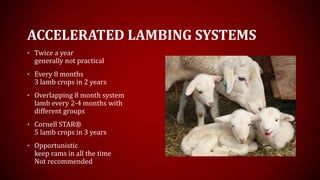
ACCELERATED LAMBING SYSTEMS
• Twice a year
generally not practical
• Every 8 months
3 lamb crops in 2 years
• Overlapping 8 month system
lamb every 2-4 months with
different groups
• Cornell STAR®
5 lamb crops in 3 years
• Opportunistic
keep rams in all the time
Not recommended
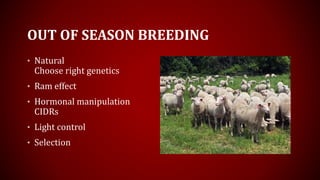
OUT OF SEASON BREEDING
• Natural
Choose right genetics
• Ram effect
• Hormonal manipulation
CIDRs
• Light control
• Selection
BREEDING STOCK FOR INTENSIVE
PRODUCTION
Ewes (and rams that sire
replacement females)
• Healthy
Free from foot rot, CL, OPP, etc.
• Structurally sound
• Reproductively sound
• Moderate size and muscling
• Reproductive efficiency
Early puberty, prolific, good
mothering, good milking ability,
breed out-of-season
Terminal sires
• Healthy
• Structurally sound
• Reproductively sound
• Frame size appropriate for market
• Good early growth
• Good muscling (carcass)
• Good lamb survival
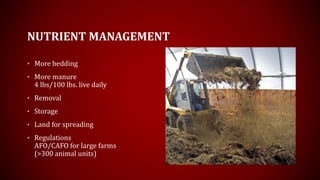
NUTRIENT MANAGEMENT
• More bedding
• More manure
4 lbs/100 lbs. live daily
• Removal
• Storage
• Land for spreading
• Regulations
AFO/CAFO for large farms
(>300 animal units)
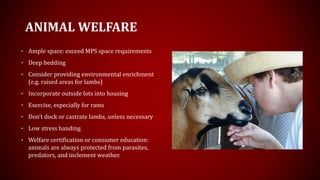
ANIMAL WELFARE
• Ample space: exceed MPS space requirements
• Deep bedding
• Consider providing environmental enrichment
(e.g. raised areas for lambs)
• Incorporate outside lots into housing
• Exercise, especially for rams
• Don’t dock or castrate lambs, unless necessary
• Low stress handing
• Welfare certification or consumer education:
animals are always protected from parasites,
predators, and inclement weather.
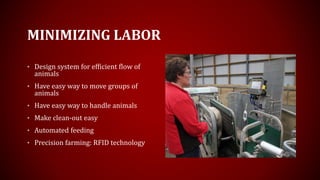
MINIMIZING LABOR
• Design system for efficient flow of
animals
• Have easy way to move groups of
animals
• Have easy way to handle animals
• Make clean-out easy
• Automated feeding
• Precision farming: RFID technology
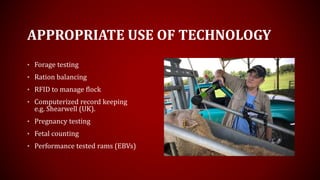
APPROPRIATE USE OF TECHNOLOGY
• Forage testing
• Ration balancing
• RFID to manage flock
• Computerized record keeping
e.g. Shearwell (UK).
• Pregnancy testing
• Fetal counting
• Performance tested rams (EBVs)
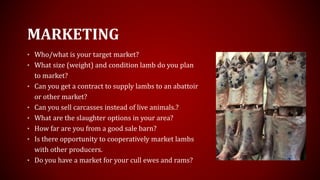
MARKETING
• Who/what is your target market?
• What size (weight) and condition lamb do you plan
to market?
• Can you get a contract to supply lambs to an abattoir
or other market?
• Can you sell carcasses instead of live animals.?
• What are the slaughter options in your area?
• How far are you from a good sale barn?
• Is there opportunity to cooperatively market lambs
with other producers.
• Do you have a market for your cull ewes and rams?
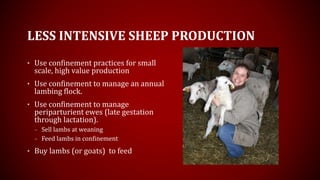
LESS INTENSIVE SHEEP PRODUCTION
• Use confinement practices for small
scale, high value production
• Use confinement to manage an annual
lambing flock.
• Use confinement to manage
periparturient ewes (late gestation
through lactation).
– Sell lambs at weaning
– Feed lambs in confinement
• Buy lambs (or goats) to feed
THANK YOU
SUSAN SCHOENIAN
Sheep & Goat Specialist
University of Maryland Extension
sschoen@umd.edu
www.sheepandgoat.com
www.sheep101.info
www.wormx.info

Raising sheep intensively

  • 1.
    INTENSIVE SHEEP PRODUCTION CONFINEMENT DRY LOT  ZERO GRAZING SUSAN SCHOENIAN Sheep & Goat Specialist University of Maryland Extension sschoen@umd.edu - sheep and goat.com
  • 2.
    • There aremany different ways to raise, manage, feed, and market sheep. • NO ONE WAY IS BEST! • Each production system, management practice, and marketing method has various pros and cons. • Every producer needs to develop a system that matches his/her goals, resources, and markets that provides the greatest return on investment.
  • 3.
    CHARACTERISTICS OF INTENSIVE SHEEPPRODUCTION • Use of buildings and/or dry lots to contain sheep and lambs. • Zero or minimal free grazing • Automated feeding • High level of reproduction, usually prolific breeds and accelerated lambing. • Year-round marketing of lambs.
  • 4.
    WHY RAISE SHEEPINTENSIVELY? • Under or unused buildings • Economical feed source • Equipment for making and storing feed • Experience raising a high producing animal • Labor available • Strong market
  • 5.
    INTENSIVE SHEEP PRODUCTION ADVANTAGES(PROS) • Greater control over production • No worm problems (coccidia still a risk) • No predators or cost of predator control (fences or guardians) • Minimal weather risk • Better nutrition: you control what animals eat • Greater potential returns Three P’s: predators, parasites, and profitability
  • 6.
    INTENSIVE SHEEP PRODUCTION DISADVANTAGES(CONS) • Higher overhead • Greater investment • Usually higher feed costs • Animal welfare questions • Nutrient management issues • Increased labor requirements • Greater financial risk than traditional production systems
  • 7.
    CONSIDERATIONS FOR INTENSIVESHEEP PRODUCTION • Housing • Feeding • Management • Breeding / genetics • Nutrient management • Animal welfare • Labor • Technology • Marketing
  • 8.
    HOUSING: BIGGEST INVESTMENT •Will you adapt existing facilities or build new one(s)? • Will you use one building or multiple buildings? • How will buildings be ventilated? • How will you manage the production flow? • How will you clean out? • Will you incorporate dry lots or pasture into the production system.
  • 9.
    PLANNING DATA Ram Dryewe Ewes + lambs Lambs Creep Building floor space 20-30 ft2 12-16 ft2 15-20 ft2 8-10 ft2 1.5-2 ft2 Lot space (dirt) 25-40 ft2 25-40 ft2 30-50 ft2 20-30 ft2 Feeder Limit fed 12 in. 15-20 in 16-20 9-12 ft2 Feeder Self fed 6 in 4-6 in 6-8 in 1-2 in 2 in. Water bowl 10 head 40-50 head 40-50 head 50-75 head Sheep Housing & Equipment Handbook, Midwest Plan Service
  • 10.
    FEED: BIGGEST COST Ewes •Traditional hay/grain diet • Baleage + grain • Silage or haylage + grain • By-products, co-products Soy hulls + DDGS • TMR (total mixed ration) Lambs • Whole grain + supplement • Custom blend • Pelleted diet How will you feed? Limit (hand) or self feeding? Can you automate feeding? Don’t forget feed storage.
  • 11.
    FEED BUDGET (154-LB.EWE, TWINS) Stage Hay Silage Haylage Grain Maintenance 3.00 0 0 0 Maintenance 0 6.00 0 0 Maintenance 0 0 6.00 0 Late gestation 3.50 0 0 1.25 Late gestation 0 7.00 0 1.50 Late gestation 0 0 7.00 1.25 Lactation 5.00 0 0 2.00 Lactation 0 10.00 0 2.25 Lactation 0 0 8.00 2.50
  • 12.
    FEED BUDGET LAMBS WeightCreep 4:1 FE 5:1 6:1 10-40 40 lbs. 40-70 120 150 40-100 240 300 360 40-120 320 400 480 Feed cost 4:1 FE 5:1 6:1 $100/ton $0.40 $0.50 $0.60 $120/ton $0.48 $0.60 $0.72 $140/ton $0.56 $0.70 $0.84 $160/ton $0.64 $0.80 $0.96
  • 13.
    ACCELERATED LAMBING SYSTEMS •Twice a year generally not practical • Every 8 months 3 lamb crops in 2 years • Overlapping 8 month system lamb every 2-4 months with different groups • Cornell STAR® 5 lamb crops in 3 years • Opportunistic keep rams in all the time Not recommended
  • 14.
    OUT OF SEASONBREEDING • Natural Choose right genetics • Ram effect • Hormonal manipulation CIDRs • Light control • Selection
  • 15.
    BREEDING STOCK FORINTENSIVE PRODUCTION Ewes (and rams that sire replacement females) • Healthy Free from foot rot, CL, OPP, etc. • Structurally sound • Reproductively sound • Moderate size and muscling • Reproductive efficiency Early puberty, prolific, good mothering, good milking ability, breed out-of-season Terminal sires • Healthy • Structurally sound • Reproductively sound • Frame size appropriate for market • Good early growth • Good muscling (carcass) • Good lamb survival
  • 16.
    NUTRIENT MANAGEMENT • Morebedding • More manure 4 lbs/100 lbs. live daily • Removal • Storage • Land for spreading • Regulations AFO/CAFO for large farms (>300 animal units)
  • 17.
    ANIMAL WELFARE • Amplespace: exceed MPS space requirements • Deep bedding • Consider providing environmental enrichment (e.g. raised areas for lambs) • Incorporate outside lots into housing • Exercise, especially for rams • Don’t dock or castrate lambs, unless necessary • Low stress handing • Welfare certification or consumer education: animals are always protected from parasites, predators, and inclement weather.
  • 18.
    MINIMIZING LABOR • Designsystem for efficient flow of animals • Have easy way to move groups of animals • Have easy way to handle animals • Make clean-out easy • Automated feeding • Precision farming: RFID technology
  • 19.
    APPROPRIATE USE OFTECHNOLOGY • Forage testing • Ration balancing • RFID to manage flock • Computerized record keeping e.g. Shearwell (UK). • Pregnancy testing • Fetal counting • Performance tested rams (EBVs)
  • 20.
    MARKETING • Who/what isyour target market? • What size (weight) and condition lamb do you plan to market? • Can you get a contract to supply lambs to an abattoir or other market? • Can you sell carcasses instead of live animals.? • What are the slaughter options in your area? • How far are you from a good sale barn? • Is there opportunity to cooperatively market lambs with other producers. • Do you have a market for your cull ewes and rams?
  • 21.
    LESS INTENSIVE SHEEPPRODUCTION • Use confinement practices for small scale, high value production • Use confinement to manage an annual lambing flock. • Use confinement to manage periparturient ewes (late gestation through lactation). – Sell lambs at weaning – Feed lambs in confinement • Buy lambs (or goats) to feed
  • 22.
    THANK YOU SUSAN SCHOENIAN Sheep& Goat Specialist University of Maryland Extension sschoen@umd.edu www.sheepandgoat.com www.sheep101.info www.wormx.info