Singapore’s Population PolicyChanging Times, Changing Needs
Reasons for  ageing populationPost-war baby boom
Declining birth rate
Longer lifespansReasons for decline in population:Success of govt policies
Social factors
Economic factorsImpact of ageing population:Strain on working population
Reduction in competitiveness
Increased demand for healthcare     & social servicesSmaller security forcesImpact of decline in population:Unattractive to MNCs
Defence
Ageing populationOptimal population growth rateRapid population growth(1950s-1960s)Declining birth rate(from 1980s)Promote population growth
Control population growth1950s- 1960s: Post-war “Baby-Boom”
1950s- 1960s: Post-war “Baby-Boom”Peace and stabilityMore children = more security in old ageGrew by more than ½ million from 1950-1960
UnemploymentInsufficient healthcareservicesShortage of housingInsufficient education
Source A – An observation by a family planning pioneer about women who visited family planning clinics in the 1950s.There was a Chinese woman who had had 19 pregnancies before she found her way to a family planning clinic in 1955 but she was not a record holder; there were others who out-produced her! Volunteers manning the clinics learnt from patients that all too often, babies had to be given away. In every case, poverty was given as the reason.The overwhelming majority of the patients came from families whose monthly income were not more than $200. Particularly worrisome was the finding that the lower the income, the greater the number of children born. The women’s common reply, “I don’t know what to do!” Study Source A.What does Source A tell you about the population problem that Singapore faced in the 1950s?
Reasons for  ageing populationPost-war baby boom
Declining birth rate
Longer lifespansReasons for decline in population:Success of govt policies
Social factors
Economic factorsImpact of ageing population:Strain on working population
Reduction in competitiveness
Increased demand for healthcare     & social servicesSmaller security forcesImpact of decline in population:Unattractive to MNCs
Defence
Ageing populationGovernment strategy: Reduce & ControlImplementation of five-year plans
Legalizing use of contraceptives & sterilization
Legalizing abortion
Financial disincentivesFive-year plans- Campaign to “Stop at Two”1st plan: need for smaller families
2nd plan: stop at two policy
3rd plan : maintain at 2.1A Family Planning Clinic
Source B & C - Posters from the Family Planning Information ServiceSource CStudy Sources B & C.What are the similarities and differences in the two sources?
Other measures:Legalize use of contraceptives and sterilization
Prevent unwanted pregnancies
Legalize abortion
Get rid of unwanted pregnanciesOther measures:Financial disincentivesLoss of income, higher taxes, higher bills  financial burden
Result of the Population Policy in the 1950s – 60sNumber of births fell between 1966 – 1981Reached replacement level of 2.1 babies born per woman in 1975Policy was effective & successful
Declining birth rate from 1980s
Reasons for  ageing populationPost-war baby boom
Declining birth rate
Longer lifespansReasons for decline in birth rate:Success of govt policies
Social factors
Economic factorsImpact of ageing population:Strain on working population
Reduction in competitiveness
Increased demand for healthcare     & social servicesSmaller security forcesImpact of decline in birth rateUnattractive to MNCs
Defence
Ageing population
Success of government policies Social factorsEconomic factorsDeclining birth rate from 1980s
“Time for a cultural shift”“Having children not top priority: Survey”“Number of Single Singaporeans on the rise”“Late (great) expectations”Economic & Social Factors:
Success of government policies Social factorsEconomic factorsDeclining birth rate from 1980s
Social Factors:Singles; Babies at later age, No babiesChange in attitude towards marriage & children
Prefer to remain single, marry later or have children at a later age
For example, more women are highly educated & enter the workforce & women felt that their careers are more importantEconomic factors:Higher costs of living/educationPeople realized that having more children is additional burden due to the high cost of living & increasing standard of living
Education/Housing is increasingly more costly
Problems of  Slow Population Growth
Reasons for  ageing populationPost-war baby boom
Declining birth rate
Longer lifespansReasons for decline in birth rate:Success of govt policies
Social factors
Economic factorsImpact of ageing population:Strain on working population
Reduction in competitiveness
Increased demand for healthcare     & social servicesSmaller security forcesImpact of decline in birth rateUnattractive to MNCs
Defence
Ageing populationProblem 1: Unattractive to Multinational CompaniesSmaller talent pool
Fewer people in the workforce
Lower productivity
Smaller consumer market  less attractive to businessesHow does this affect Singapore?
Problem 1: Unattractive to Multinational CompaniesSmaller talent pool
Fewer people in the workforce
Lower productivity
Smaller consumer market  less attractive to businessesLess investments  slower economic growth
Problem 2: Ageing population
Population Changes in Singapore 1990 - 2050
Problem 2: Ageing populationFewer younger people, disproportionately larger number of older people
Greater need for healthcare & social services
More resources needed to take care of increasing no. of senior citizensProblem 2: Ageing population
Problem 2: Ageing populationGreater stress on working populationHow does it affect Singapore’s development?
Problem 2: Ageing populationGreater stress on working populationHeavier taxes on working populationMore resources spent on taking care of agedLess resources for development of nation
Problem 3: DefenceFewer people to recruit for NS
Weaken defence forceStruggles of making babies; Need for immigration
Reasons for  ageing populationPost-war baby boom
Declining birth rate
Longer lifespansReasons for decline in birth rate:Success of govt policies
Social factors
Economic factorsImpact of ageing population:Strain on working population
Reduction in competitiveness
Increased demand for healthcare     & social servicesSmaller security forcesImpact of decline in birth rateUnattractive to MNCs
Defence
Ageing populationGovernment strategy: Promote Population GrowthThe Graduate Mothers Scheme
Three or More if You can Afford It
Pro-family measures
Attracting foreign talent1) The Graduate Mothers SchemeTRENDMarrying later
Bearing fewer children1) The Graduate Mothers SchemePM Lee: female graduates should have more children  new generation will be more educated1) The Graduate Mothers SchemeIntroduced in 1984
Encourage marriage and children amongst graduatesThis is unfair to Singaporean mothers like me, who do not have university qualifications! As long as we are all Singaporeans, we should be treated equally. Why deny me of incentives when I can bring up my child as well? I need the financial incentives more than graduate mothers who are better off in many ways!
Source EIn his 1983 National Day Rally speech, Prime Minister Lee Kuan Yew lamented that declining birth rates and large number of graduate women remaining single or not marrying their intellectual equal could see Singapore's talent pool shrink. The PAP government then proceeded to launch the "Graduate Mother Scheme" to entice graduate women with incentives to get married. These were said to have caused a big dip in PAP's support for this GE and its share of votes plunged by more than 10% to below 70%, the biggest fall and the lowest for PAP since the 1963 GE.Study Source E.What does Source E tell the impact of the Graduate Mothers Scheme on the PAP?
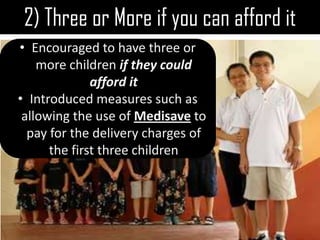
2) Three or More if you can afford itLaunched in 1987
Aimed at bringing population growth back to 2.1 children/ woman2) Three or More if you can afford itEncouraged to have three or more children if they could afford it
Introduced measures such as allowing the use of Medisave to pay for the delivery charges of the first three childrenStudy the source.Why was this poster printed?
1.881.481.24

Singapore’s population policy