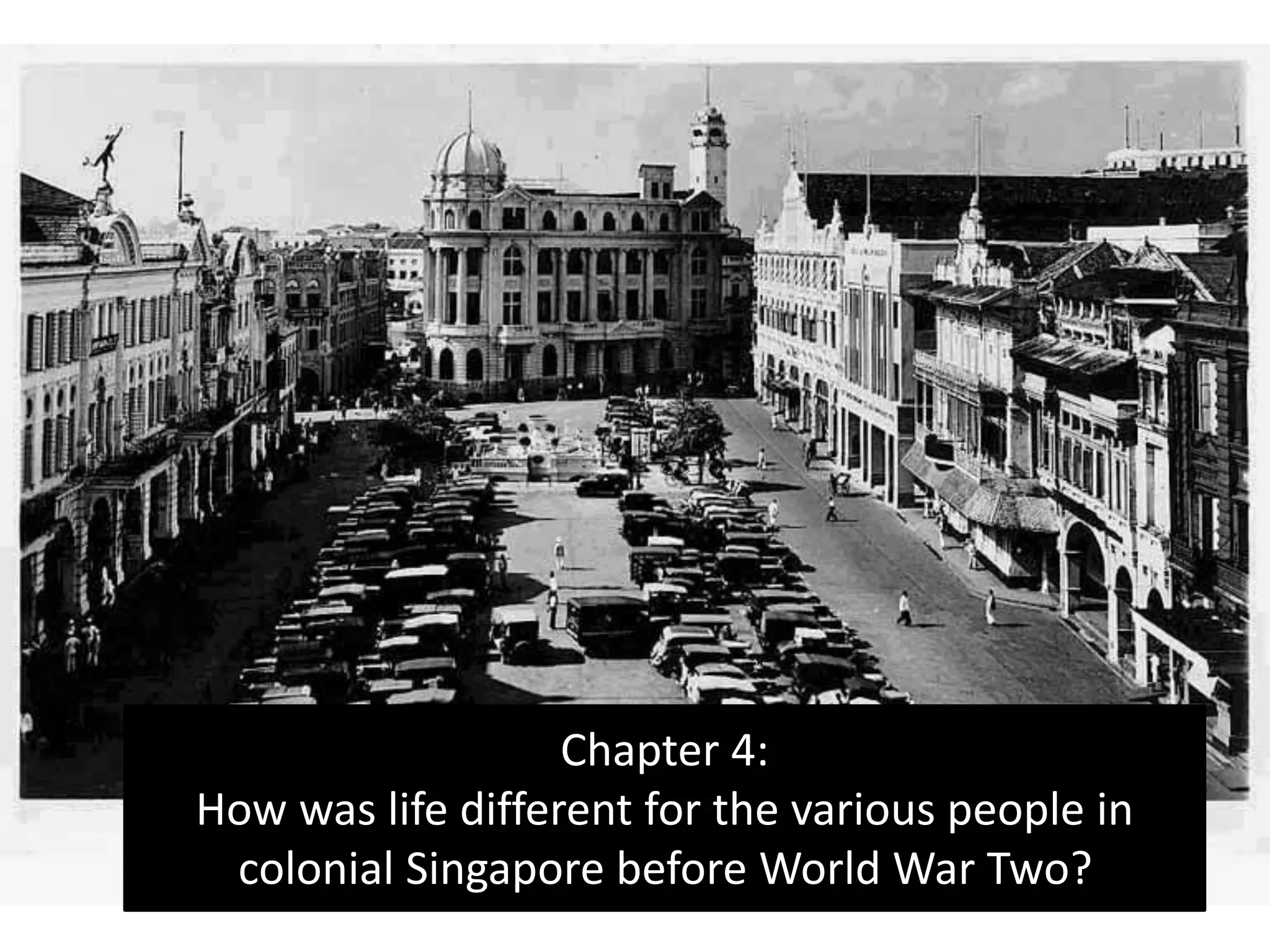
Chapter 4:
How was life different for the various people in
colonial Singapore before World War Two?
Singapore-
Crossroads of the East (1938)
• http://www.youtube.com/watch?v=FvvhY6Dtf
Zs
Topics and Skills focus:
• Topics:
 Raffles Town Plan
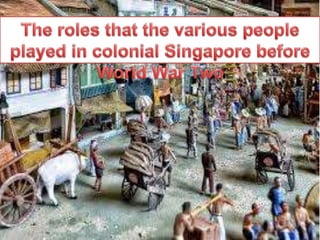
 The roles that the various people played in colonial Singapore
before World War Two
 Lives of the various people in colonial Singapore before World
War Two
• Skills
 Intended Outcome
 Compare and Contrast
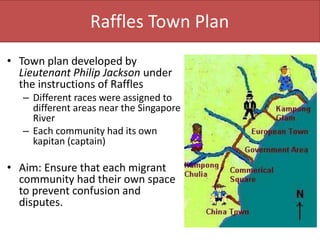
Raffles Town Plan
• Town plan developed by
Lieutenant Philip Jackson under
the instructions of Raffles
– Different races were assigned to
different areas near the Singapore
River
– Each community had its own
kapitan (captain)
• Aim: Ensure that each migrant
community had their own space
to prevent confusion and
disputes.
An Overview: Footprints
• http://www.channelnewsasia.com/tv/tvshows
/footprints
Why was this book written?
Singapore is certainly the most convenient city I ever saw … It is like a
big desk, full of drawers and pigeon holes, where everything has its
place, and can always be found in it. Around the Esplanade you find
the European hotels; around commercial square are shipping offices,
warehouses and shops owned by European merchants; and along Boat
Quay are all the ship chandlers. Nearby, you will find large Chinese
medicine shops, cloth shops, tin shops, and shops kept by blacksmiths,
tailors and carpenters. There are also people selling fruit, vegetables,
grain, and so on … Because of the many different trades, one can do
more business in less time in Singapore than any other town in the
world.
Adapted from Two Years in the Jungle, a book widely found in the
British colonies, by William Temple Hornaday
Skill Practice: Intended Outcome
The Chinese
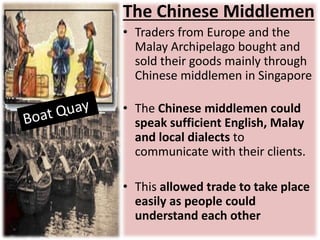
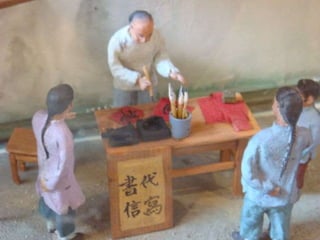
The Chinese Middlemen
• Traders from Europe and the
Malay Archipelago bought and
sold their goods mainly through
Chinese middlemen in Singapore
• The Chinese middlemen could
speak sufficient English, Malay
and local dialects to
communicate with their clients.
• This allowed trade to take place
easily as people could
understand each other
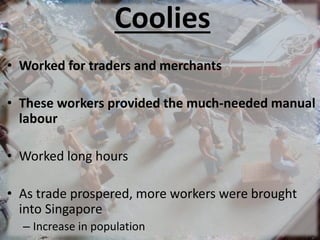
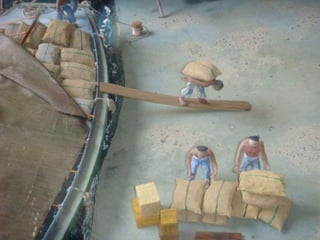
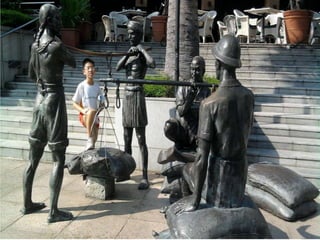
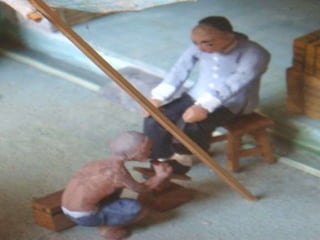
Coolies
• Worked for traders and merchants
• These workers provided the much-needed manual
labour
• Worked long hours
• As trade prospered, more workers were brought
into Singapore
– Increase in population
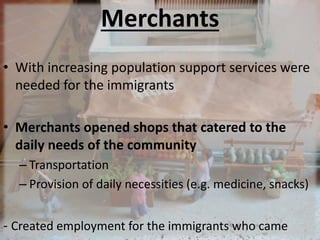
Merchants
• With increasing population support services were
needed for the immigrants
• Merchants opened shops that catered to the
daily needs of the community
– Transportation
– Provision of daily necessities (e.g. medicine, snacks)
- Created employment for the immigrants who came
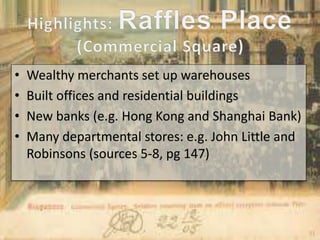
• Wealthy merchants set up warehouses
• Built offices and residential buildings
• New banks (e.g. Hong Kong and Shanghai Bank)
• Many departmental stores: e.g. John Little and
Robinsons (sources 5-8, pg 147)
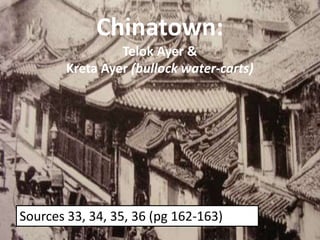
Chinatown:
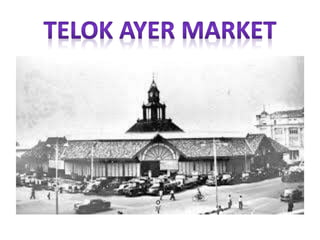
Telok Ayer &
Kreta Ayer (bullock water-carts)
Sources 33, 34, 35, 36 (pg 162-163)
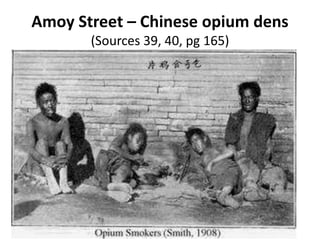
Amoy Street – Chinese opium dens
(Sources 39, 40, pg 165)
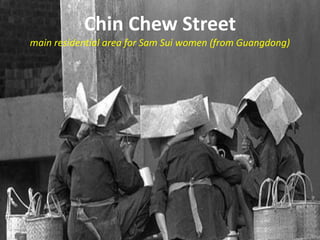
Chin Chew Street
main residential area for Sam Sui women (from Guangdong)
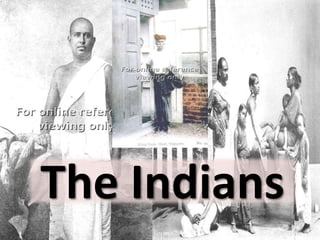
The Indians
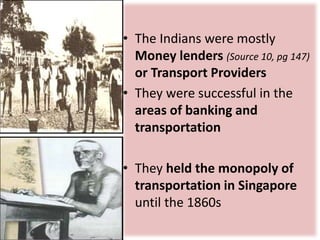
• The Indians were mostly
Money lenders (Source 10, pg 147)
or Transport Providers
• They were successful in the
areas of banking and
transportation
• They held the monopoly of
transportation in Singapore
until the 1860s
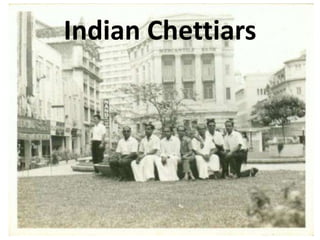
Indian Chettiars
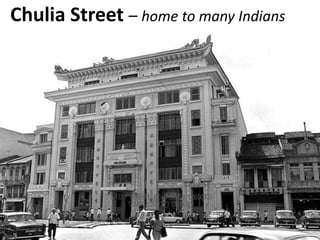
Chulia Street – home to many Indians
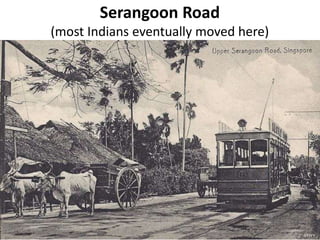
Serangoon Road
(most Indians eventually moved here)
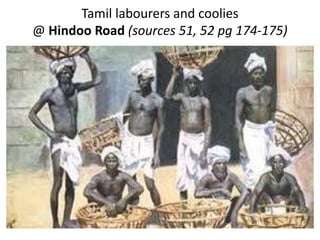
Tamil labourers and coolies
@ Hindoo Road (sources 51, 52 pg 174-175)
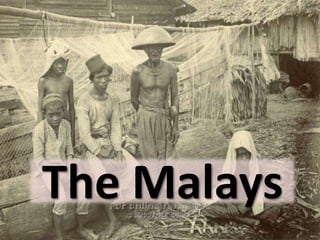
The Malays
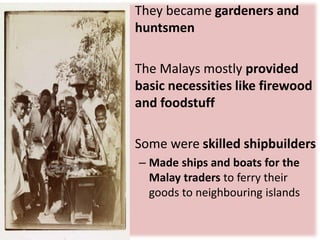
• They became gardeners and
huntsmen
• The Malays mostly provided
basic necessities like firewood
and foodstuff
• Some were skilled shipbuilders
– Made ships and boats for the
Malay traders to ferry their
goods to neighbouring islands
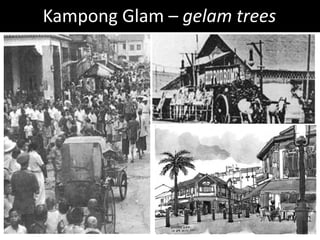
Kampong Glam – gelam trees
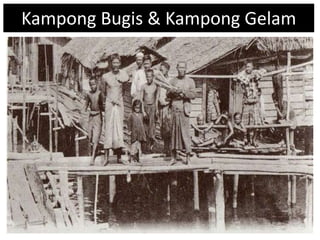
Kampong Bugis & Kampong Gelam
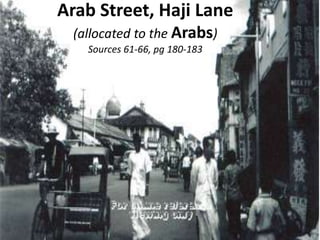
Arab Street, Haji Lane
(allocated to the Arabs)
Sources 61-66, pg 180-183
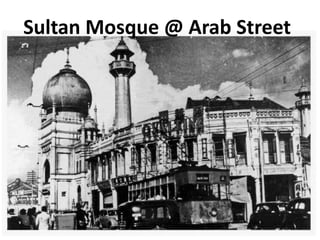
Sultan Mosque @ Arab Street
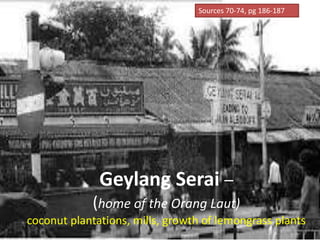
Geylang Serai –
(home of the Orang Laut)
coconut plantations, mills, growth of lemongrass plants
Sources 70-74, pg 186-187
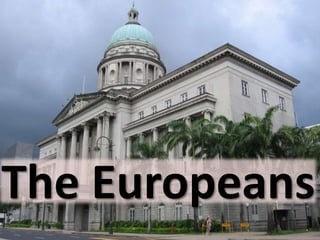
The Europeans
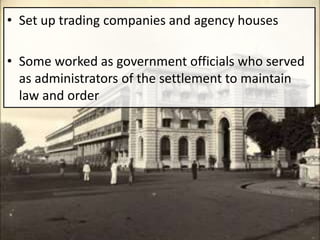
• Set up trading companies and agency houses
• Some worked as government officials who served
as administrators of the settlement to maintain
law and order
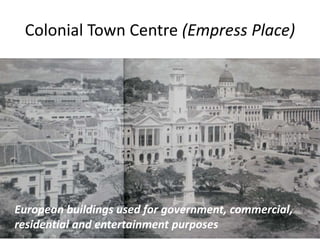
Colonial Town Centre (Empress Place)
European buildings used for government, commercial,
residential and entertainment purposes
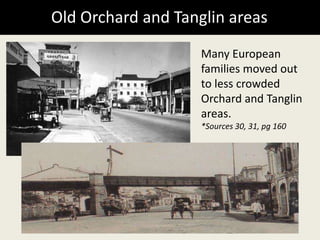
Old Orchard and Tanglin areas
Many European
families moved out
to less crowded
Orchard and Tanglin
areas.
*Sources 30, 31, pg 160
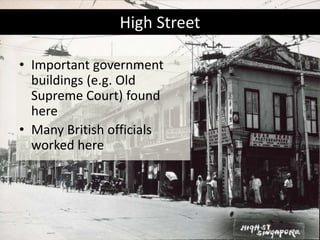
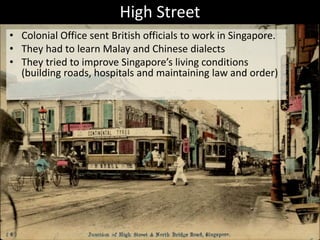
High Street
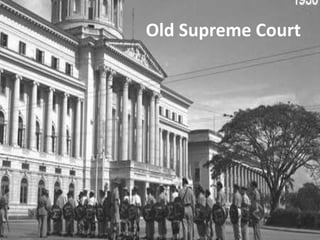
• Important government
buildings (e.g. Old
Supreme Court) found
here
• Many British officials
worked here
High Street
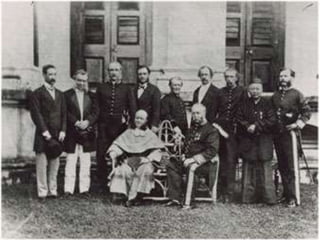
• Colonial Office sent British officials to work in Singapore.
• They had to learn Malay and Chinese dialects
• They tried to improve Singapore’s living conditions
(building roads, hospitals and maintaining law and order)
Old Supreme Court
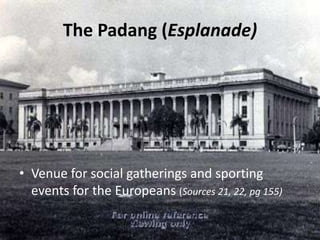
The Padang (Esplanade)
• Venue for social gatherings and sporting
events for the Europeans (Sources 21, 22, pg 155)
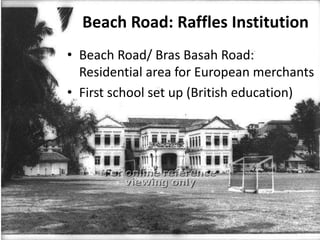
Beach Road: Raffles Institution
• Beach Road/ Bras Basah Road:
Residential area for European merchants
• First school set up (British education)
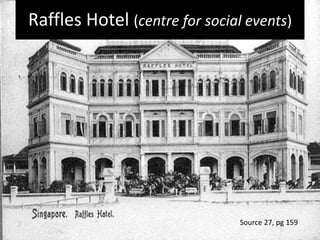
Raffles Hotel (centre for social events)
Source 27, pg 159
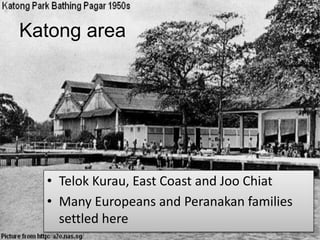
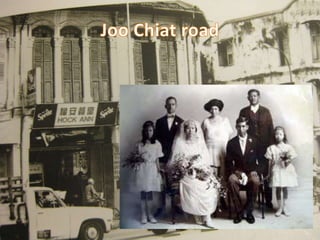
Katong area
• Telok Kurau, East Coast and Joo Chiat
• Many Europeans and Peranakan families
settled here
Why did Li Chung Chu report this?
Along Kreta Ayer, brothels are as many and as close together
as the teeth of a comb. It is said that the licensed prostitutes
registered at the Chinese Protectorate number 3,000 and
several hundred. Apart from these, there are countless
unlicensed prostitutes and actress. They are all Cantonese
who were wither sold at a young age and sent to Nanyang, or
were born and brought up in Singapore … Year after year, little
girls from Hong King are shipped to Singapore and sold to the
brothels in rapid succession.
Adapted from an account by Li Chung Chu from Shanghai, who
visited Singapore in 1887 and reported the incident to his
village
Skill Practice: Intended Outcome
In what ways are Sources A and B
similar?
Source A
On my first day of arrival in Singapore as a child, I felt
like I was a fish out of water. Everything was new to
me. I couldn’t understand people who talked to me
because they sounded different. The people living
here also spoke a mixture of Malay words with their
own languages. I could not understand sentences
such as ‘Lu suka ki pasar bo?’
The people here were so different. Among the
Chinese, there were people from different provinces
who spoke different dialects that were completely
different from mine, such as the Hainanese. Then
there were also so many other races, speaking
languages I had never heard, and wearing different
clothes.
Adapted from an account by Low Cheung Gin, whose
family was forced by the bandit attacks to leave his
village in China in 1925. He came to Singapore at the
age of 10. He had never left his village before coming
to Singapore.
Source B
It was very difficult to get a job in the early 1930s,
unless you had a lot of experience and
recommendations from friends. I got a job eventually
only because one of my friends recommended me to
the Singapore Traction Company. Otherwise I
couldn’t get one because everywhere you went, you
would see a ‘NO VACANCY’ signboard. I was quite
disappointed, you know. My uncle told me, ‘If you
come to Singapore, you can easily get a job, you
know.’ But when I came here I would not find any
jobs.
Adapted from an account by Palanivelu Natesan,
who came from India.
Skill Practice: Compare and Contrast
In what ways are Sources B and D
similar?
Source C
There were many sports clubs for the people of
Singapore to join, but they were all separated
according to race.
The Chinese had their Chinese Swimming Club;
The Ceylonese the Ceylon Sports Club; the
Indians the Indian Association; the Malays the
Kota Raja Club, and so on. The Eurasians formed
the Singapore Recreation Club (SRC) in 1883, and
it was located at the Padang.
At the other end of the Padang was the Singapore
Cricket Club, which was meant only for the
Europeans. One has to be of a pure white race to
be a member. While members of all other
denominational clubs were allowed to bring
guests of any race to their respective clubs, only
Europeans were allowed entry as guests at the
Singapore Cricket Club.
Adapted from an account by F.A.C. ‘Jock’ Oehlers,
a Singapore Eurasian born in 1921
Source D
The policy of racial division applied in those days. The
European teachers had their common room. They were
just about one-third of the staff or less.
Two-thirds or three-quarters consisted of Asians. Our
common room was half the size of the common room of
the Europeans. They were forbidden to come to our
common room …
Well, this policy applied strictly between the whites and
the non-whites …
I remember a European teacher somewhere in the year
1933 or 34, who probably didn’t believe in that sort of
attitude of the white man. He used to frequent our
common room and he was very happy. He was called up
by the principal and was told to stop coming there. He
disobeyed and he came and told us that he had been
called up and told not to come. But he was coming there
and was waiting to see what would happen. Within a few
days he was transferred away, up north, somewhere in
Kedah.
Adapted from an account by Velauthar Ambiavagar, a
Ceylonese (Sri Lankan) Tamil describing the situation in
Raffles Institution when he was teaching there in the
1930s.
Skill Practice: Compare and Contrast
In what ways are Sources E and F
different?
Source E
When we wanted some recreation, we would go to
Katong Park, where a military band would play music
and people would go there to listen to the music. It
was just behind the Chinese Swimming Club and
there was also a playground there.
We also had a couple of bicycle shops in the Joo
Chiat and East Coast area were we could hire bicycles
for one or two hours for a couple of cents. We would
ride the bicycles in Karikal Road [Still Road], Joo Chiat
and East Coast Road. At the end of Still Road there
was a big field and there were games like football,
kite-flying, marbles, and tops. Kite-flying was very
famous in the Karikal area because everyone went to
that open field to fly their kites, as there were strong
breezes from the sea. There was a lot of kite-fighting
at that time, where you try to cut the line of your
friend’s kite, or competitions to see who could fly
their kites highest.
Adapted from an account by Aloysius Leo de
Conceicao, an Eurasian
Source F
The Malay people would go to see the bangsawan
[traditional Malay opera]. There was no other
entertainment for the Malays so it was popular
among them. There used to be a bangsawan
opposite Haji Lane. People would travel on a
bullock cart from Tanjong Pagar just to see the
bangsawan and there will be about 10 to 12
people on the bullock cart each time. The
Javanese had their own wayang kulit [shadow
puppets] and wayang wayong [theatrical
performance] but these were normally staged
behind the back lane in the open and on certain
occasions such as marriages or birthdays.
Adapted from an account by Mohamed Sidek,
describing the entertainment by the Malays
Skill Practice: Compare and Contrast
In what ways are Sources G and H
different?
Source G
Houses here did not have any electricity or gas at
all. People also rarely burnt or cooked using
kerosene oil, because it was expensive for us.
People used wood instead, because it was the
cheapest. People would also sew their own
clothes using their own [sewing] machine,
instead of giving them to the tailor. And when the
children grew up, they also learnt to sew their
own clothes.
Adapted from an account by Chanan Bal Singh, a
Sikh who came from India in late 1939
Source H
The chettiars were a very influential community
then, because there were very few banks and
banks would not lean money unless they were
fully satisfied that the borrower was a well-
established company. Where would small traders
go? So they used to go to the chettiars to borrow
money to trade. Of course, the rate of interest
was very high, usually above 30 percent … The
maximum rate of interest was fixed at 36 percent.
Chettiars took the risks in lending money and
sometimes they lost money. But the overall
interest rate was sufficient to cover their losses.
Adapted from an account by Rajabali Jumabhoy,
a prominent Indian businessman whose first
company was set up on 9 Market Street
Skill Practice: Compare and Contrast
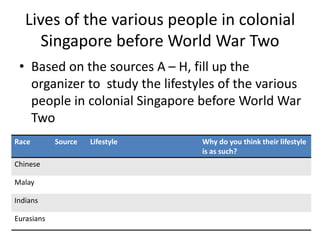
Lives of the various people in colonial
Singapore before World War Two
• Based on the sources A – H, fill up the
organizer to study the lifestyles of the various
people in colonial Singapore before World War
Two
Race Source Lifestyle Why do you think their lifestyle
is as such?
Chinese
Malay
Indians
Eurasians

Chapter 4 immigrants

  • 1.
    Chapter 4: How waslife different for the various people in colonial Singapore before World War Two?
  • 2.
    Singapore- Crossroads of theEast (1938) • http://www.youtube.com/watch?v=FvvhY6Dtf Zs
  • 3.
    Topics and Skillsfocus: • Topics:  Raffles Town Plan  The roles that the various people played in colonial Singapore before World War Two  Lives of the various people in colonial Singapore before World War Two • Skills  Intended Outcome  Compare and Contrast
  • 4.
    Raffles Town Plan •Town plan developed by Lieutenant Philip Jackson under the instructions of Raffles – Different races were assigned to different areas near the Singapore River – Each community had its own kapitan (captain) • Aim: Ensure that each migrant community had their own space to prevent confusion and disputes.
  • 5.
    An Overview: Footprints •http://www.channelnewsasia.com/tv/tvshows /footprints
  • 6.
    Why was thisbook written? Singapore is certainly the most convenient city I ever saw … It is like a big desk, full of drawers and pigeon holes, where everything has its place, and can always be found in it. Around the Esplanade you find the European hotels; around commercial square are shipping offices, warehouses and shops owned by European merchants; and along Boat Quay are all the ship chandlers. Nearby, you will find large Chinese medicine shops, cloth shops, tin shops, and shops kept by blacksmiths, tailors and carpenters. There are also people selling fruit, vegetables, grain, and so on … Because of the many different trades, one can do more business in less time in Singapore than any other town in the world. Adapted from Two Years in the Jungle, a book widely found in the British colonies, by William Temple Hornaday
  • 7.
  • 9.
  • 10.
    The Chinese Middlemen •Traders from Europe and the Malay Archipelago bought and sold their goods mainly through Chinese middlemen in Singapore • The Chinese middlemen could speak sufficient English, Malay and local dialects to communicate with their clients. • This allowed trade to take place easily as people could understand each other
  • 11.
    Coolies • Worked fortraders and merchants • These workers provided the much-needed manual labour • Worked long hours • As trade prospered, more workers were brought into Singapore – Increase in population
  • 14.
    Merchants • With increasingpopulation support services were needed for the immigrants • Merchants opened shops that catered to the daily needs of the community – Transportation – Provision of daily necessities (e.g. medicine, snacks) - Created employment for the immigrants who came
  • 17.
    • Wealthy merchantsset up warehouses • Built offices and residential buildings • New banks (e.g. Hong Kong and Shanghai Bank) • Many departmental stores: e.g. John Little and Robinsons (sources 5-8, pg 147)
  • 18.
    Chinatown: Telok Ayer & KretaAyer (bullock water-carts) Sources 33, 34, 35, 36 (pg 162-163)
  • 19.
    Amoy Street –Chinese opium dens (Sources 39, 40, pg 165)
  • 20.
    Chin Chew Street mainresidential area for Sam Sui women (from Guangdong)
  • 21.
  • 22.
    • The Indianswere mostly Money lenders (Source 10, pg 147) or Transport Providers • They were successful in the areas of banking and transportation • They held the monopoly of transportation in Singapore until the 1860s
  • 24.
  • 26.
    Chulia Street –home to many Indians
  • 27.
    Serangoon Road (most Indianseventually moved here)
  • 28.
    Tamil labourers andcoolies @ Hindoo Road (sources 51, 52 pg 174-175)
  • 29.
  • 30.
    • They becamegardeners and huntsmen • The Malays mostly provided basic necessities like firewood and foodstuff • Some were skilled shipbuilders – Made ships and boats for the Malay traders to ferry their goods to neighbouring islands
  • 31.
    Kampong Glam –gelam trees
  • 32.
    Kampong Bugis &Kampong Gelam
  • 33.
    Arab Street, HajiLane (allocated to the Arabs) Sources 61-66, pg 180-183
  • 34.
    Sultan Mosque @Arab Street
  • 35.
    Geylang Serai – (homeof the Orang Laut) coconut plantations, mills, growth of lemongrass plants Sources 70-74, pg 186-187
  • 36.
  • 37.
    • Set uptrading companies and agency houses • Some worked as government officials who served as administrators of the settlement to maintain law and order
  • 38.
    Colonial Town Centre(Empress Place) European buildings used for government, commercial, residential and entertainment purposes
  • 39.
    Old Orchard andTanglin areas Many European families moved out to less crowded Orchard and Tanglin areas. *Sources 30, 31, pg 160
  • 40.
    High Street • Importantgovernment buildings (e.g. Old Supreme Court) found here • Many British officials worked here
  • 41.
    High Street • ColonialOffice sent British officials to work in Singapore. • They had to learn Malay and Chinese dialects • They tried to improve Singapore’s living conditions (building roads, hospitals and maintaining law and order)
  • 43.
  • 44.
    The Padang (Esplanade) •Venue for social gatherings and sporting events for the Europeans (Sources 21, 22, pg 155)
  • 45.
    Beach Road: RafflesInstitution • Beach Road/ Bras Basah Road: Residential area for European merchants • First school set up (British education)
  • 46.
    Raffles Hotel (centrefor social events) Source 27, pg 159
  • 48.
    Katong area • TelokKurau, East Coast and Joo Chiat • Many Europeans and Peranakan families settled here
  • 50.
    Why did LiChung Chu report this? Along Kreta Ayer, brothels are as many and as close together as the teeth of a comb. It is said that the licensed prostitutes registered at the Chinese Protectorate number 3,000 and several hundred. Apart from these, there are countless unlicensed prostitutes and actress. They are all Cantonese who were wither sold at a young age and sent to Nanyang, or were born and brought up in Singapore … Year after year, little girls from Hong King are shipped to Singapore and sold to the brothels in rapid succession. Adapted from an account by Li Chung Chu from Shanghai, who visited Singapore in 1887 and reported the incident to his village
  • 51.
  • 52.
    In what waysare Sources A and B similar? Source A On my first day of arrival in Singapore as a child, I felt like I was a fish out of water. Everything was new to me. I couldn’t understand people who talked to me because they sounded different. The people living here also spoke a mixture of Malay words with their own languages. I could not understand sentences such as ‘Lu suka ki pasar bo?’ The people here were so different. Among the Chinese, there were people from different provinces who spoke different dialects that were completely different from mine, such as the Hainanese. Then there were also so many other races, speaking languages I had never heard, and wearing different clothes. Adapted from an account by Low Cheung Gin, whose family was forced by the bandit attacks to leave his village in China in 1925. He came to Singapore at the age of 10. He had never left his village before coming to Singapore. Source B It was very difficult to get a job in the early 1930s, unless you had a lot of experience and recommendations from friends. I got a job eventually only because one of my friends recommended me to the Singapore Traction Company. Otherwise I couldn’t get one because everywhere you went, you would see a ‘NO VACANCY’ signboard. I was quite disappointed, you know. My uncle told me, ‘If you come to Singapore, you can easily get a job, you know.’ But when I came here I would not find any jobs. Adapted from an account by Palanivelu Natesan, who came from India.
  • 53.
  • 54.
    In what waysare Sources B and D similar? Source C There were many sports clubs for the people of Singapore to join, but they were all separated according to race. The Chinese had their Chinese Swimming Club; The Ceylonese the Ceylon Sports Club; the Indians the Indian Association; the Malays the Kota Raja Club, and so on. The Eurasians formed the Singapore Recreation Club (SRC) in 1883, and it was located at the Padang. At the other end of the Padang was the Singapore Cricket Club, which was meant only for the Europeans. One has to be of a pure white race to be a member. While members of all other denominational clubs were allowed to bring guests of any race to their respective clubs, only Europeans were allowed entry as guests at the Singapore Cricket Club. Adapted from an account by F.A.C. ‘Jock’ Oehlers, a Singapore Eurasian born in 1921 Source D The policy of racial division applied in those days. The European teachers had their common room. They were just about one-third of the staff or less. Two-thirds or three-quarters consisted of Asians. Our common room was half the size of the common room of the Europeans. They were forbidden to come to our common room … Well, this policy applied strictly between the whites and the non-whites … I remember a European teacher somewhere in the year 1933 or 34, who probably didn’t believe in that sort of attitude of the white man. He used to frequent our common room and he was very happy. He was called up by the principal and was told to stop coming there. He disobeyed and he came and told us that he had been called up and told not to come. But he was coming there and was waiting to see what would happen. Within a few days he was transferred away, up north, somewhere in Kedah. Adapted from an account by Velauthar Ambiavagar, a Ceylonese (Sri Lankan) Tamil describing the situation in Raffles Institution when he was teaching there in the 1930s.
  • 55.
  • 56.
    In what waysare Sources E and F different? Source E When we wanted some recreation, we would go to Katong Park, where a military band would play music and people would go there to listen to the music. It was just behind the Chinese Swimming Club and there was also a playground there. We also had a couple of bicycle shops in the Joo Chiat and East Coast area were we could hire bicycles for one or two hours for a couple of cents. We would ride the bicycles in Karikal Road [Still Road], Joo Chiat and East Coast Road. At the end of Still Road there was a big field and there were games like football, kite-flying, marbles, and tops. Kite-flying was very famous in the Karikal area because everyone went to that open field to fly their kites, as there were strong breezes from the sea. There was a lot of kite-fighting at that time, where you try to cut the line of your friend’s kite, or competitions to see who could fly their kites highest. Adapted from an account by Aloysius Leo de Conceicao, an Eurasian Source F The Malay people would go to see the bangsawan [traditional Malay opera]. There was no other entertainment for the Malays so it was popular among them. There used to be a bangsawan opposite Haji Lane. People would travel on a bullock cart from Tanjong Pagar just to see the bangsawan and there will be about 10 to 12 people on the bullock cart each time. The Javanese had their own wayang kulit [shadow puppets] and wayang wayong [theatrical performance] but these were normally staged behind the back lane in the open and on certain occasions such as marriages or birthdays. Adapted from an account by Mohamed Sidek, describing the entertainment by the Malays
  • 57.
  • 58.
    In what waysare Sources G and H different? Source G Houses here did not have any electricity or gas at all. People also rarely burnt or cooked using kerosene oil, because it was expensive for us. People used wood instead, because it was the cheapest. People would also sew their own clothes using their own [sewing] machine, instead of giving them to the tailor. And when the children grew up, they also learnt to sew their own clothes. Adapted from an account by Chanan Bal Singh, a Sikh who came from India in late 1939 Source H The chettiars were a very influential community then, because there were very few banks and banks would not lean money unless they were fully satisfied that the borrower was a well- established company. Where would small traders go? So they used to go to the chettiars to borrow money to trade. Of course, the rate of interest was very high, usually above 30 percent … The maximum rate of interest was fixed at 36 percent. Chettiars took the risks in lending money and sometimes they lost money. But the overall interest rate was sufficient to cover their losses. Adapted from an account by Rajabali Jumabhoy, a prominent Indian businessman whose first company was set up on 9 Market Street
  • 59.
  • 60.
    Lives of thevarious people in colonial Singapore before World War Two • Based on the sources A – H, fill up the organizer to study the lifestyles of the various people in colonial Singapore before World War Two Race Source Lifestyle Why do you think their lifestyle is as such? Chinese Malay Indians Eurasians