One Child Policy
China[LEDC]
Hannah Emm=)
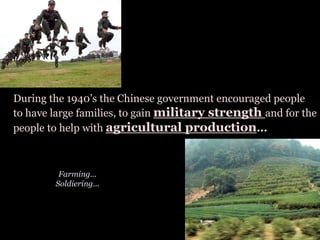
During the 1940’s the Chinese government encouraged people
to have large families, to gain military strength and for the
people to help with agricultural production...
Farming...
Soldiering...
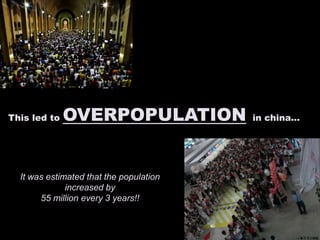
This led to OVERPOPULATION in china...
It was estimated that the population
increased by
55 million every 3 years!!
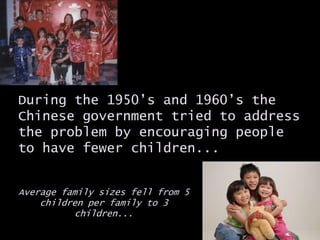
During the 1950’s and 1960’s the
Chinese government tried to address
the problem by encouraging people
to have fewer children...
Average family sizes fell from 5
children per family to 3
children...
However, this still
wasn’t enough as
the population was
still growing at a
rapid rate. China
introduced the: ONE
CHILD POLICY
In 1979.
The marriageable age was also changed to tackle
overpopulation... 22 for men and 20 for women!
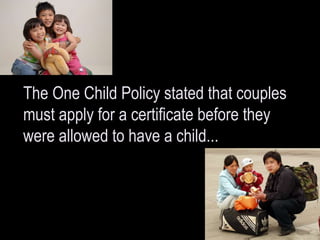
The One Child Policy stated that couples
must apply for a certificate before they
were allowed to have a child...
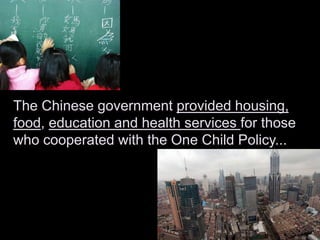
The Chinese government provided housing,
food, education and health services for those
who cooperated with the One Child Policy...
Many people did not cooperate with the
One Child Policy and found themselves
receiving no help from the state, and
often having to pay large fines...
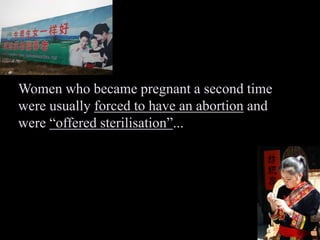
Women who became pregnant a second time
were usually forced to have an abortion and
were “offered sterilisation”...
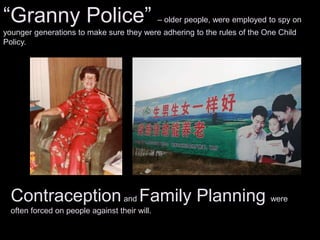
“Granny Police” – older people, were employed to spy on
younger generations to make sure they were adhering to the rules of the One Child
Policy.
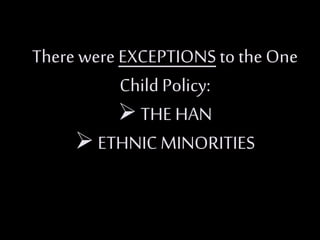
Contraceptionand Family Planning were
often forced on people against their will.
There were EXCEPTIONS to theOne
Child Policy:
 THE HAN
 ETHNICMINORITIES
The HAN
The Han are allowed a second
child if the first is MENTALLY
or PHYSICALLY handicapped.
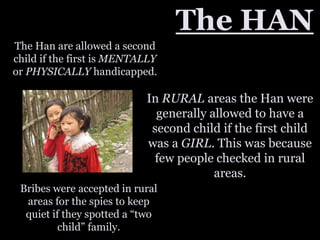
In RURAL areas the Han were
generally allowed to have a
second child if the first child
was a GIRL. This was because
few people checked in rural
areas.
Bribes were accepted in rural
areas for the spies to keep
quiet if they spotted a “two
child” family.
Ethnic Minorities
Ethnic minorities were
allowed two children in
rural areas, and
sometimes up to four if
no-one was checking.
The government didn't want ethnic minorities to die out
and in rural areas they needed them to work on farms...
If a parent was an only
child they could have
more than one child but
were subject to birth
spacing [3 or 4 years]
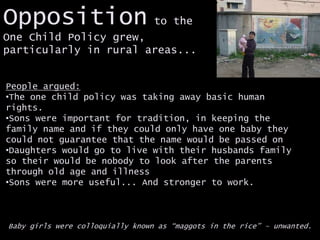
Opposition to the
One Child Policy grew,
particularly in rural areas...
People argued:
•The one child policy was taking away basic human
rights.
•Sons were important for tradition, in keeping the
family name and if they could only have one baby they
could not guarantee that the name would be passed on
•Daughters would go to live with their husbands family
so their would be nobody to look after the parents
through old age and illness
•Sons were more useful... And stronger to work.
Baby girls were colloquially known as “maggots in the rice” – unwanted.
The One Child Policy has had a number of
different EFFECTS, including:
•Sex selective abortion – people aborting the baby if it
was not the sex they wanted, usually aborting girls after
not getting the boy.
•A sharp increase in the number of
orphans, particularly girls.
• High divorce rate involving women whose
child turns out to be a girl, as the men want
to try with another woman for a boy [it has
been reported that mean beat women until
they agree to a divorce].
• “Little emperor syndrome” – boys are treated very
well, girls are badly treated – abandoned, unloved etc.
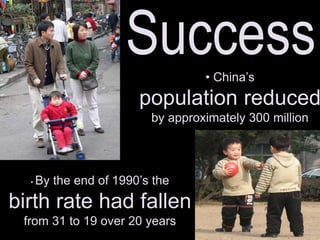
Success?
• China’s
population reduced
by approximately 300 million
• By the end of 1990’s the
birth rate had fallen
from 31 to 19 over 20 years
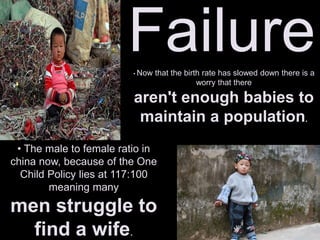
Failure
• The male to female ratio in
china now, because of the One
Child Policy lies at 117:100
meaning many
men struggle to
find a wife.
• Now that the birth rate has slowed down there is a
worry that there
aren't enough babies to
maintain a population.
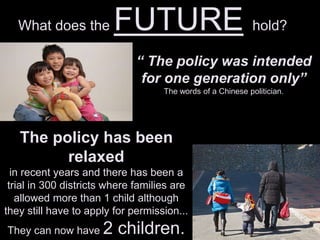
What does the FUTURE hold?
“ The policy was intended
for one generation only”
The words of a Chinese politician.
The policy has been
relaxed
in recent years and there has been a
trial in 300 districts where families are
allowed more than 1 child although
they still have to apply for permission...
They can now have 2 children.
One Child Policy
China[LEDC]

China One child-policy

  • 1.
  • 2.
    During the 1940’sthe Chinese government encouraged people to have large families, to gain military strength and for the people to help with agricultural production... Farming... Soldiering...
  • 3.
    This led toOVERPOPULATION in china... It was estimated that the population increased by 55 million every 3 years!!
  • 4.
    During the 1950’sand 1960’s the Chinese government tried to address the problem by encouraging people to have fewer children... Average family sizes fell from 5 children per family to 3 children...
  • 5.
    However, this still wasn’tenough as the population was still growing at a rapid rate. China introduced the: ONE CHILD POLICY In 1979. The marriageable age was also changed to tackle overpopulation... 22 for men and 20 for women!
  • 6.
    The One ChildPolicy stated that couples must apply for a certificate before they were allowed to have a child...
  • 7.
    The Chinese governmentprovided housing, food, education and health services for those who cooperated with the One Child Policy...
  • 8.
    Many people didnot cooperate with the One Child Policy and found themselves receiving no help from the state, and often having to pay large fines...
  • 9.
    Women who becamepregnant a second time were usually forced to have an abortion and were “offered sterilisation”...
  • 10.
    “Granny Police” –older people, were employed to spy on younger generations to make sure they were adhering to the rules of the One Child Policy. Contraceptionand Family Planning were often forced on people against their will.
  • 11.
    There were EXCEPTIONSto theOne Child Policy:  THE HAN  ETHNICMINORITIES
  • 12.
    The HAN The Hanare allowed a second child if the first is MENTALLY or PHYSICALLY handicapped. In RURAL areas the Han were generally allowed to have a second child if the first child was a GIRL. This was because few people checked in rural areas. Bribes were accepted in rural areas for the spies to keep quiet if they spotted a “two child” family.
  • 13.
    Ethnic Minorities Ethnic minoritieswere allowed two children in rural areas, and sometimes up to four if no-one was checking. The government didn't want ethnic minorities to die out and in rural areas they needed them to work on farms... If a parent was an only child they could have more than one child but were subject to birth spacing [3 or 4 years]
  • 14.
    Opposition to the OneChild Policy grew, particularly in rural areas... People argued: •The one child policy was taking away basic human rights. •Sons were important for tradition, in keeping the family name and if they could only have one baby they could not guarantee that the name would be passed on •Daughters would go to live with their husbands family so their would be nobody to look after the parents through old age and illness •Sons were more useful... And stronger to work. Baby girls were colloquially known as “maggots in the rice” – unwanted.
  • 15.
    The One ChildPolicy has had a number of different EFFECTS, including: •Sex selective abortion – people aborting the baby if it was not the sex they wanted, usually aborting girls after not getting the boy. •A sharp increase in the number of orphans, particularly girls. • High divorce rate involving women whose child turns out to be a girl, as the men want to try with another woman for a boy [it has been reported that mean beat women until they agree to a divorce]. • “Little emperor syndrome” – boys are treated very well, girls are badly treated – abandoned, unloved etc.
  • 16.
    Success? • China’s population reduced byapproximately 300 million • By the end of 1990’s the birth rate had fallen from 31 to 19 over 20 years
  • 17.
    Failure • The maleto female ratio in china now, because of the One Child Policy lies at 117:100 meaning many men struggle to find a wife. • Now that the birth rate has slowed down there is a worry that there aren't enough babies to maintain a population.
  • 18.
    What does theFUTURE hold? “ The policy was intended for one generation only” The words of a Chinese politician. The policy has been relaxed in recent years and there has been a trial in 300 districts where families are allowed more than 1 child although they still have to apply for permission... They can now have 2 children.
  • 19.