






Salivary
Acini
By
Second year StudentS
Section (4) Group (c)
Under supervision of
dr/azza el-Hadidi
dr/Sanaa el-SHerbeni
dr/GHalia MaHfouz
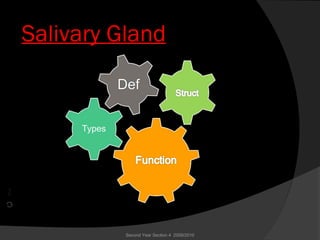
Salivary Gland
Second Year Section 4 2009/2010
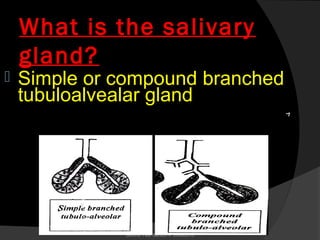
What is the salivary
gland?
 Simple or compound branched
tubuloalvealar gland
Second Year Section 4 2009/2010
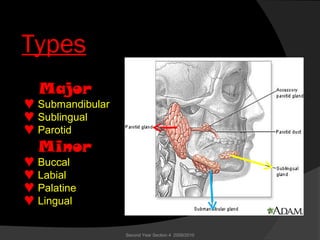
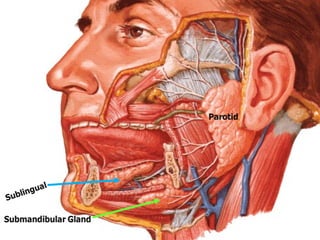
Types
Major
♥ Submandibular
♥ Sublingual
♥ Parotid
Minor
♥ Buccal
♥ Labial
♥ Palatine
♥ Lingual
Second Year Section 4 2009/2010
Function
 Secretion of saliva
Second Year Section 4 2009/2010
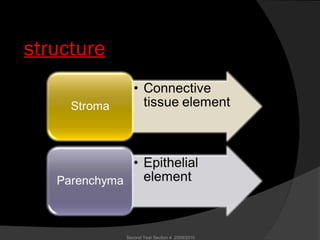
structure
Second Year Section 4 2009/2010
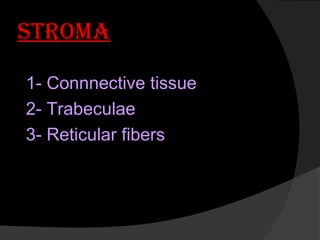
StroMa
1- Connnective tissue
2- Trabeculae
3- Reticular fibers
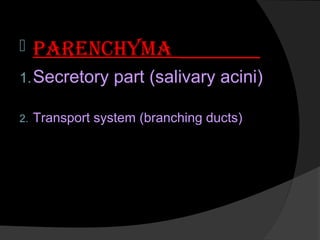
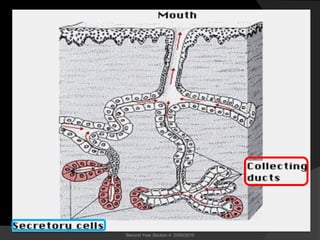
 parencHyMa
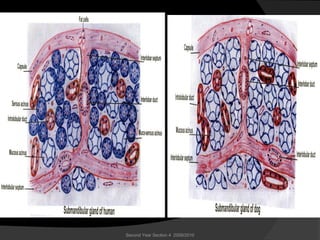
1.Secretory part (salivary acini)
2. Transport system (branching ducts)
Second Year Section 4 2009/2010
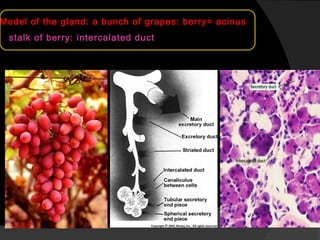
Model of the gland: a bunch of grapes: berry= acinusModel of the gland: a bunch of grapes: berry= acinus
stalk of berry: intercalated ductstalk of berry: intercalated duct
Salivary Acini
Second Year Section 4 2009/2010
What is the salivary
acini?
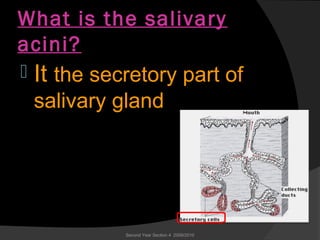
 It the secretory part of
salivary gland
Second Year Section 4 2009/2010
Structure
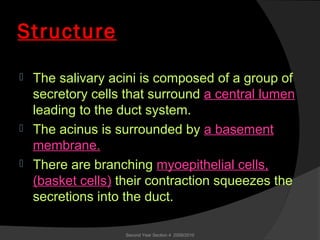
 The salivary acini is composed of a group of
secretory cells that surround a central lumen
leading to the duct system.
 The acinus is surrounded by a basement
membrane.
 There are branching myoepithelial cells,
(basket cells) their contraction squeezes the
secretions into the duct.
Second Year Section 4 2009/2010
Classification
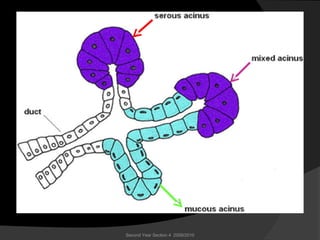
 According to the nature of
secretion
 There are 3 types:
 Mucous
 Serous
 mucoserous
Second Year Section 4 2009/2010
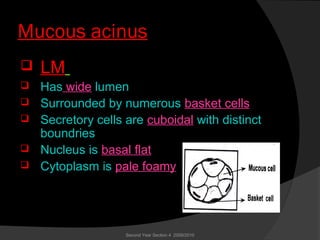
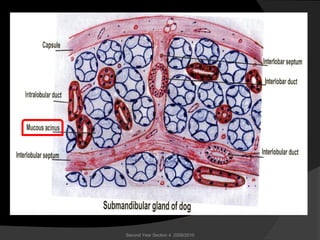
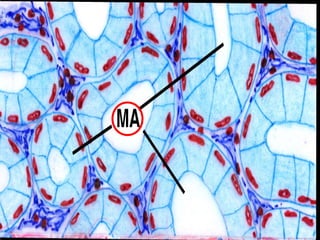
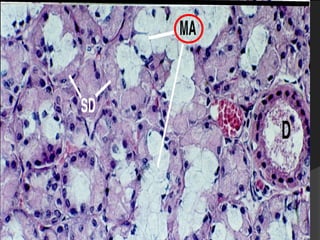
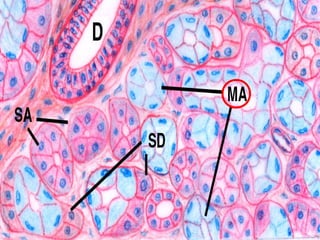
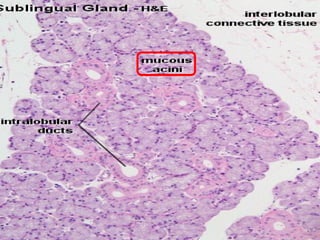
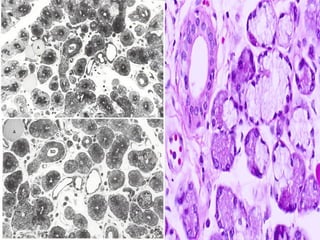
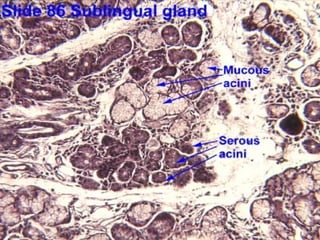
Mucous acinus
 LM
 Has wide lumen
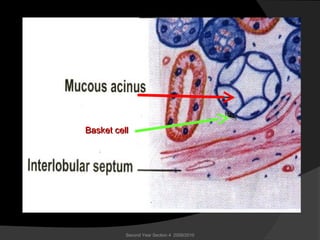
 Surrounded by numerous basket cells
 Secretory cells are cuboidal with distinct
boundries
 Nucleus is basal flat
 Cytoplasm is pale foamy
Second Year Section 4 2009/2010
Basket cellBasket cell
Second Year Section 4 2009/2010
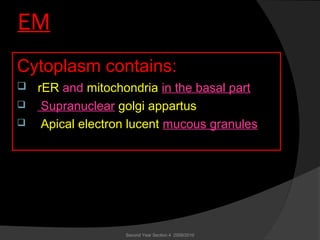
EM
Cytoplasm contains:
 rER and mitochondria in the basal part
 Supranuclear golgi appartus
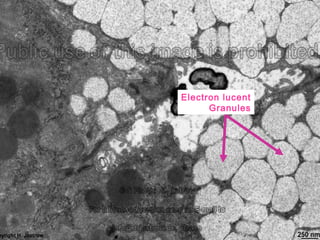
 Apical electron lucent mucous granules
Second Year Section 4 2009/2010
Electron lucent
Granules
Second Year Section 4 2009/2010
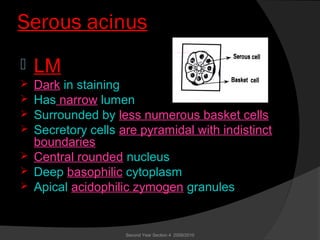
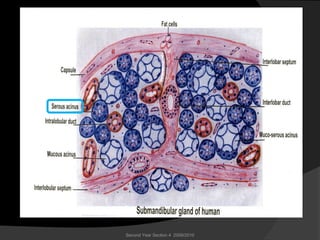
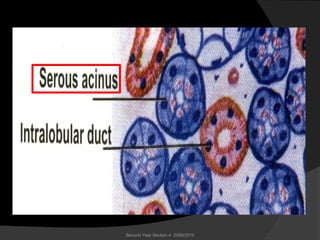
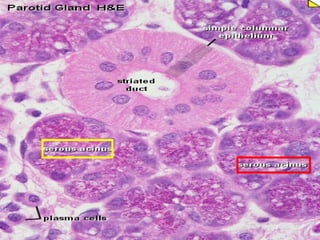
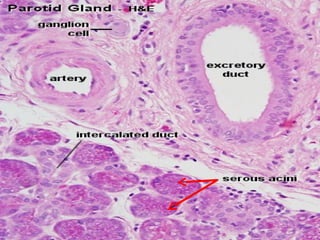
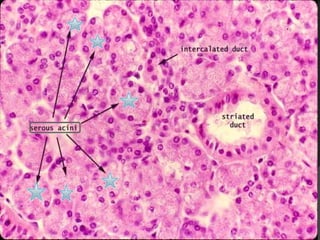
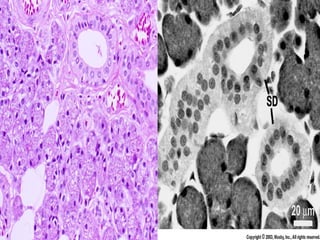
Serous acinus
 LM
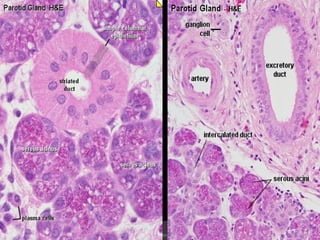
 Dark in staining
 Has narrow lumen
 Surrounded by less numerous basket cells
 Secretory cells are pyramidal with indistinct
boundaries
 Central rounded nucleus
 Deep basophilic cytoplasm
 Apical acidophilic zymogen granules
Second Year Section 4 2009/2010
EM
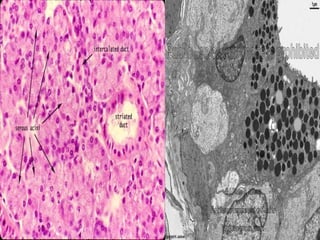
Cytoplasm contains:
 Numerous rER and mitochondria in the
around nucleus
 Supranuclear golgi appartus
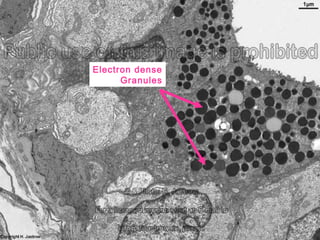
 Apical electron dense secretory granules
Second Year Section 4 2009/2010
Electron dense
Granules
Why Crying??
Histology is Easy!!
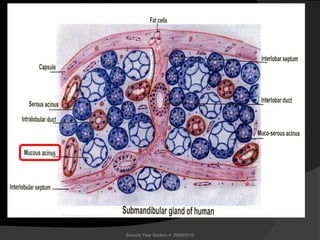
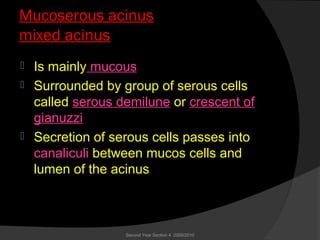
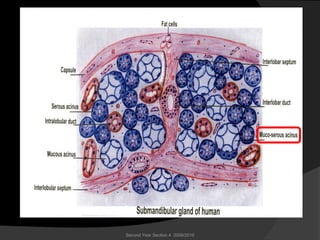
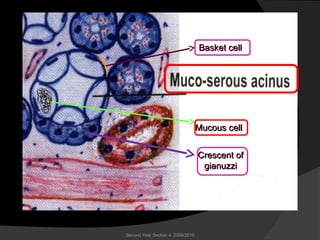
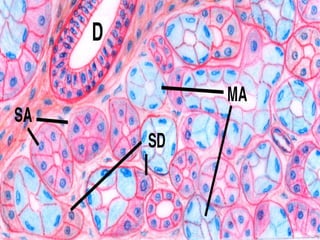
Mucoserous acinus
mixed acinus
 Is mainly mucous
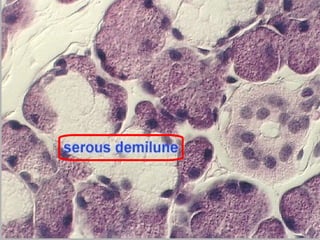
 Surrounded by group of serous cells
called serous demilune or crescent of
gianuzzi
 Secretion of serous cells passes into
canaliculi between mucos cells and
lumen of the acinus
Second Year Section 4 2009/2010
Mucous cellMucous cell
Crescent ofCrescent of
gianuzzigianuzzi
Basket cellBasket cell
Second Year Section 4 2009/2010
Important mCQ
QuestIon
? ? ?
?
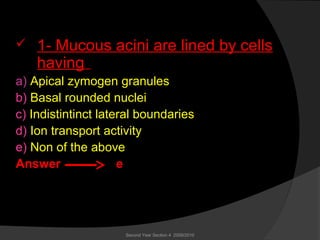
 1- Mucous acini are lined by cells
having
a) Apical zymogen granules
b) Basal rounded nuclei
c) Indistintinct lateral boundaries
d) Ion transport activity
e) Non of the above
Answer e
Second Year Section 4 2009/2010
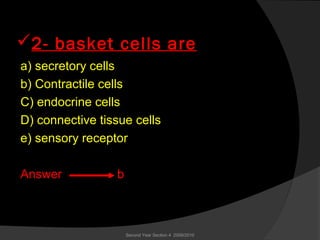
2- basket cells are
a) secretory cells
b) Contractile cells
C) endocrine cells
D) connective tissue cells
e) sensory receptor
Answer b
Second Year Section 4 2009/2010
3- serous acini are
a) dark in staining
b) surrounded by basket cells
c) lined by pyramidal cells with apical
zymogen granules
d) all of the above
e) non of the above
Answer d
Second Year Section 4 2009/2010
See you in
See you in
anotheranother
presentation
presentation
Second Year Section 4 2009/2010

Salivary acini