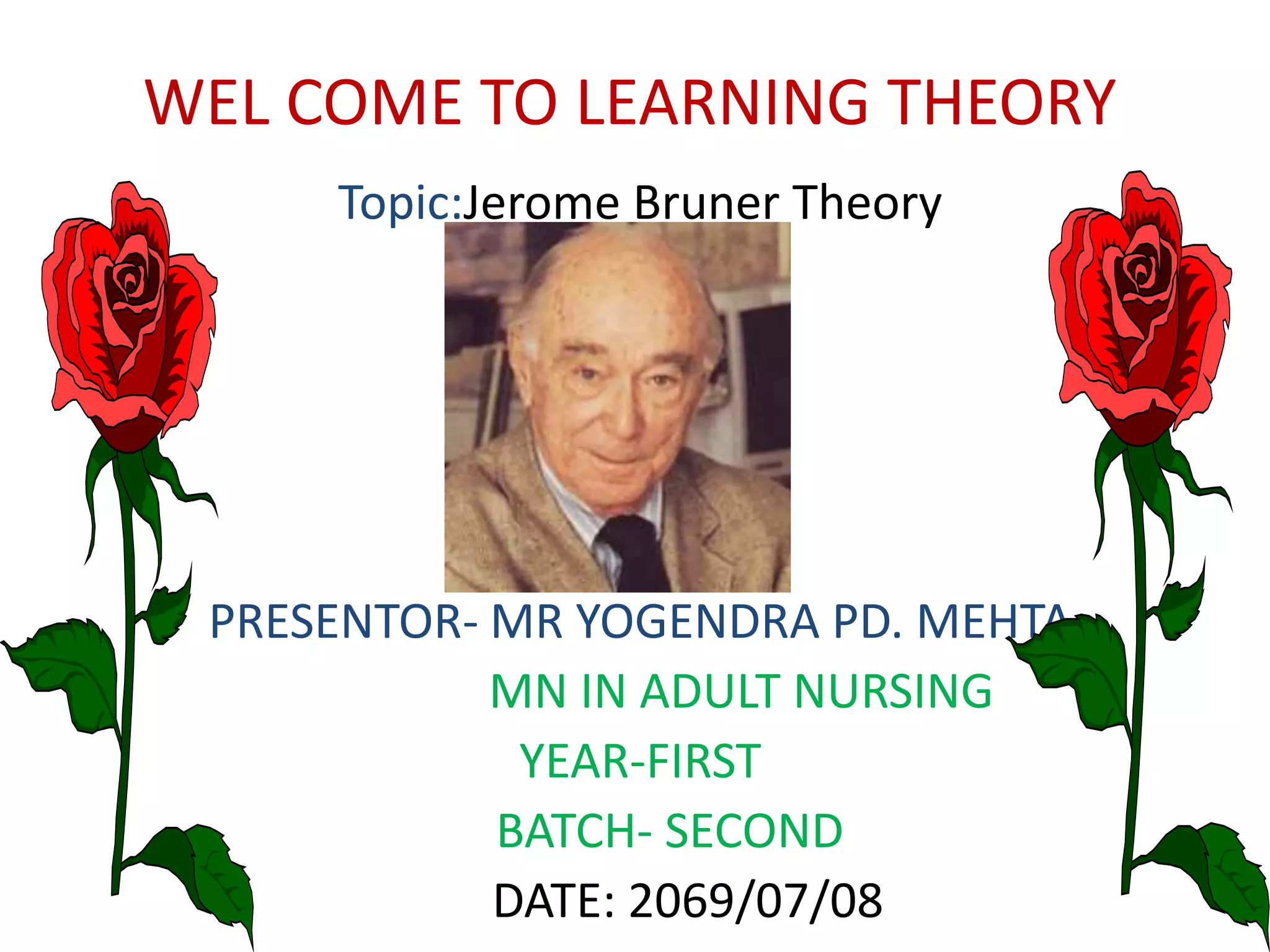
WEL COME TO LEARNING THEORY
     Topic:Jerome Bruner Theory


 PRESENTOR- MR YOGENDRA PD. MEHTA
            MN IN ADULT NURSING
             YEAR-FIRST
            BATCH- SECOND
            DATE: 2069/07/08
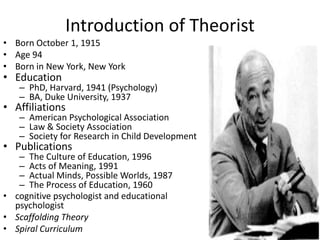
Introduction of Theorist
• Born October 1, 1915
• Age 94
• Born in New York, New York
• Education
   – PhD, Harvard, 1941 (Psychology)
   – BA, Duke University, 1937
• Affiliations
   – American Psychological Association
   – Law & Society Association
   – Society for Research in Child Development
• Publications
   – The Culture of Education, 1996
   – Acts of Meaning, 1991
   – Actual Minds, Possible Worlds, 1987
   – The Process of Education, 1960
• cognitive psychologist and educational
  psychologist
• Scaffolding Theory
• Spiral Curriculum
Principles of J. Bruner Theory

1. Instruction must be concerned with the experiences and contexts
   that make the student willing and able to learn (readiness).

2. Instruction must be structured so that it can be easily grasped by the
    student (spiral organization).

3. Instruction should be designed to facilitate extrapolation and or fill in
    the gaps (going beyond the information given).
J. Bruner Theory
• Bruner's theoretical framework is based on the theme that learning is
  an active process and learners construct new ideas or concepts
  based upon existing knowledge.

• Facets of the process include selection and transformation of
  information, decision making, generating hypotheses, and making
  meaning from information and experiences.

• Cognitive structure (i.e., schema, mental models) provides meaning
  and organization to experiences and allows the individual to "go
  beyond the information given".
Contd………
• Bruner believed that intuitive and analytical thinking should both be
  encouraged and rewarded.

• He believed the intuitive skills were under-emphasized and he
  reflected on the ability of experts in every field to make spontaneous
  bound.

• He investigated motivation for learning. He felt that ideally, interest in
  the subject matter is the best stimulus for learning. Bruner did not
  like external competitive goals such as grades or class ranking.
Conclusion of Theory
• A major theme in the theoretical framework of Bruner is that learning
  is an active process in which learners construct new ideas or concepts
  based upon their current/past knowledge.

• As far as instruction is concerned, the instructor should try and
  encourage students to discover principles by themselves and they
  should engage in an active dialog (i.e., socratic learning).

• Curriculum should be organized in a spiral manner so that the
  student continually builds upon what they have already learned.
Features of J. Bruner's theory of
                   Instruction
1. Tendency towards learning

2. The ways in which a body of knowledge can be structured so that it
   can be most readily grasped by the learner,

3. The most effective sequences in which to present material.

4.   The nature and pacing of rewards and punishments.
Cognitive Development
Like Piaget, Bruner believed in stages of instruction based on
   development.

• Enactive (birth to age 3)

• Iconic (age 3 to 8)

• Symbolic (from age 8)

Each mode is dominant at different phases of development but all are
  present and accessible always.
Enactive


The first stage he termed
"Enactive", when a person learns
about the world through actions
on physical objects and the
outcomes of these actions.


                                   .
Iconic


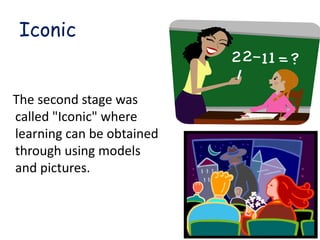
The second stage was
called "Iconic" where
learning can be obtained
through using models
and pictures.
Symbolic
• "Symbolic" in which the
  learner develops the capacity
  to think in abstract terms.

• Based on this three-stage
  notion, Bruner recommended
  using a combination of
  concrete, pictorial then
  symbolic activities will lead to
  more effective learning.
Classroom Applications
• Provide study materials, activities and tools.

• Examples of all three to help children learn about dinosaurs

   – Construct a model of a dinosaur (enactive)

   – Watch a film about dinosaurs (iconic)

   – Consult reference texts and discuss findings (symbolic)


                                               .
Technology in Classroom
• Manipulatives for enactive stage.

• Safari Montage and other video footage for iconic mode.

• Simulations to discover/develop their own approach for symbolic
  mode

• Educators equip students with basic skills to access information to
  increase their knowledge and desire to learn.
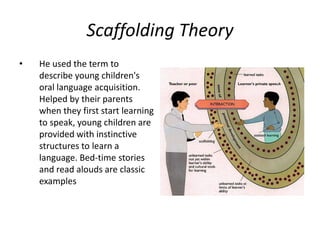
Scaffolding Theory
•   He used the term to
    describe young children's
    oral language acquisition.
    Helped by their parents
    when they first start learning
    to speak, young children are
    provided with instinctive
    structures to learn a
    language. Bed-time stories
    and read alouds are classic
    examples
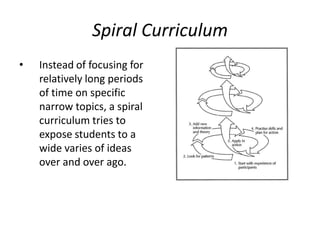
Spiral Curriculum
•   Instead of focusing for
    relatively long periods
    of time on specific
    narrow topics, a spiral
    curriculum tries to
    expose students to a
    wide varies of ideas
    over and over ago.
Characteristics of constructivism theory

1. Constructivist learning environments provide multiple
   representations of reality.

2. Multiple representations avoid oversimplification and represent the
   complexity of the real world.

3. Constructivist learning environments emphasize authentic tasks in a
   meaningful context rather than abstract instruction out of context.
Contd…….

5. Constructivist learning environments provide learning
   environments such as real-world settings or case-based learning
   instead of predetermined sequences of instruction.

6. Constructivist learning environments encourage thoughtful
   reflection on experience.

7. Constructivist learning environments support "collaborative
   construction of knowledge through social negotiation, not
   competition among learners for recognition."
Refferences
• Bruner, Jerome. Retrieved June 3, 2008. NYU Department of Psychology
  Web site: http://www.psych.nyu.edu.

• Flores, Nicole. Jerome Bruner’s educational theory. Retrieved June 3, 2008.
  New Foundation Web site: http://www.newfoundations.com.

• Hollyman, David. Retrieved June 3, 2008. Jerome Bruner a web overview.
  http://au.geocities.com.
• http://www.learningandteaching.info/learning/behaviour.htm#ixzz1c
  K1zDCYm
• http://www.learning-theories.com/behaviorism.html
• http://nicefun.net/learning-theory-of-gestalt-
  vt2659.html#ixzz2ClBwhC00
• http://www.a2zpsychology.com/a2z%20guide/gestalt_theory.htm
                                                 .
Jerome bruner learning theory

Jerome bruner learning theory

  • 1.
    WEL COME TOLEARNING THEORY Topic:Jerome Bruner Theory PRESENTOR- MR YOGENDRA PD. MEHTA MN IN ADULT NURSING YEAR-FIRST BATCH- SECOND DATE: 2069/07/08
  • 2.
    Introduction of Theorist •Born October 1, 1915 • Age 94 • Born in New York, New York • Education – PhD, Harvard, 1941 (Psychology) – BA, Duke University, 1937 • Affiliations – American Psychological Association – Law & Society Association – Society for Research in Child Development • Publications – The Culture of Education, 1996 – Acts of Meaning, 1991 – Actual Minds, Possible Worlds, 1987 – The Process of Education, 1960 • cognitive psychologist and educational psychologist • Scaffolding Theory • Spiral Curriculum
  • 3.
    Principles of J.Bruner Theory 1. Instruction must be concerned with the experiences and contexts that make the student willing and able to learn (readiness). 2. Instruction must be structured so that it can be easily grasped by the student (spiral organization). 3. Instruction should be designed to facilitate extrapolation and or fill in the gaps (going beyond the information given).
  • 4.
    J. Bruner Theory •Bruner's theoretical framework is based on the theme that learning is an active process and learners construct new ideas or concepts based upon existing knowledge. • Facets of the process include selection and transformation of information, decision making, generating hypotheses, and making meaning from information and experiences. • Cognitive structure (i.e., schema, mental models) provides meaning and organization to experiences and allows the individual to "go beyond the information given".
  • 5.
    Contd……… • Bruner believedthat intuitive and analytical thinking should both be encouraged and rewarded. • He believed the intuitive skills were under-emphasized and he reflected on the ability of experts in every field to make spontaneous bound. • He investigated motivation for learning. He felt that ideally, interest in the subject matter is the best stimulus for learning. Bruner did not like external competitive goals such as grades or class ranking.
  • 6.
    Conclusion of Theory •A major theme in the theoretical framework of Bruner is that learning is an active process in which learners construct new ideas or concepts based upon their current/past knowledge. • As far as instruction is concerned, the instructor should try and encourage students to discover principles by themselves and they should engage in an active dialog (i.e., socratic learning). • Curriculum should be organized in a spiral manner so that the student continually builds upon what they have already learned.
  • 7.
    Features of J.Bruner's theory of Instruction 1. Tendency towards learning 2. The ways in which a body of knowledge can be structured so that it can be most readily grasped by the learner, 3. The most effective sequences in which to present material. 4. The nature and pacing of rewards and punishments.
  • 8.
    Cognitive Development Like Piaget,Bruner believed in stages of instruction based on development. • Enactive (birth to age 3) • Iconic (age 3 to 8) • Symbolic (from age 8) Each mode is dominant at different phases of development but all are present and accessible always.
  • 9.
    Enactive The first stagehe termed "Enactive", when a person learns about the world through actions on physical objects and the outcomes of these actions. .
  • 10.
    Iconic The second stagewas called "Iconic" where learning can be obtained through using models and pictures.
  • 11.
    Symbolic • "Symbolic" inwhich the learner develops the capacity to think in abstract terms. • Based on this three-stage notion, Bruner recommended using a combination of concrete, pictorial then symbolic activities will lead to more effective learning.
  • 12.
    Classroom Applications • Providestudy materials, activities and tools. • Examples of all three to help children learn about dinosaurs – Construct a model of a dinosaur (enactive) – Watch a film about dinosaurs (iconic) – Consult reference texts and discuss findings (symbolic) .
  • 13.
    Technology in Classroom •Manipulatives for enactive stage. • Safari Montage and other video footage for iconic mode. • Simulations to discover/develop their own approach for symbolic mode • Educators equip students with basic skills to access information to increase their knowledge and desire to learn.
  • 14.
    Scaffolding Theory • He used the term to describe young children's oral language acquisition. Helped by their parents when they first start learning to speak, young children are provided with instinctive structures to learn a language. Bed-time stories and read alouds are classic examples
  • 15.
    Spiral Curriculum • Instead of focusing for relatively long periods of time on specific narrow topics, a spiral curriculum tries to expose students to a wide varies of ideas over and over ago.
  • 16.
    Characteristics of constructivismtheory 1. Constructivist learning environments provide multiple representations of reality. 2. Multiple representations avoid oversimplification and represent the complexity of the real world. 3. Constructivist learning environments emphasize authentic tasks in a meaningful context rather than abstract instruction out of context.
  • 17.
    Contd……. 5. Constructivist learningenvironments provide learning environments such as real-world settings or case-based learning instead of predetermined sequences of instruction. 6. Constructivist learning environments encourage thoughtful reflection on experience. 7. Constructivist learning environments support "collaborative construction of knowledge through social negotiation, not competition among learners for recognition."
  • 18.
    Refferences • Bruner, Jerome.Retrieved June 3, 2008. NYU Department of Psychology Web site: http://www.psych.nyu.edu. • Flores, Nicole. Jerome Bruner’s educational theory. Retrieved June 3, 2008. New Foundation Web site: http://www.newfoundations.com. • Hollyman, David. Retrieved June 3, 2008. Jerome Bruner a web overview. http://au.geocities.com. • http://www.learningandteaching.info/learning/behaviour.htm#ixzz1c K1zDCYm • http://www.learning-theories.com/behaviorism.html • http://nicefun.net/learning-theory-of-gestalt- vt2659.html#ixzz2ClBwhC00 • http://www.a2zpsychology.com/a2z%20guide/gestalt_theory.htm .