DEVELOPMENTAL STAGES
   JEROME BRUNER


         Practice II: Didactics of English as EFL
                               Byrne, Laureana
                           Scaricaciottoli, Sofia
                                           2012
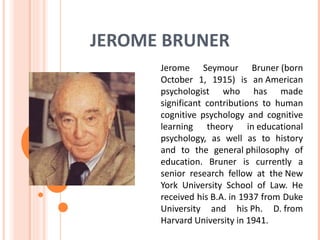
JEROME BRUNER
      Jerome Seymour Bruner (born
      October 1, 1915) is an American
      psychologist who has made
      significant contributions to human
      cognitive psychology and cognitive
      learning theory in educational
      psychology, as well as to history
      and to the general philosophy of
      education. Bruner is currently a
      senior research fellow at the New
      York University School of Law. He
      received his B.A. in 1937 from Duke
      University and his Ph. D. from
      Harvard University in 1941.
BRUNER’S IDEAS ARE GREATLY INFLUENCED BY
PIAGET’S THEORY ABOUT DEVELOPMENTAL STAGES.
LANGUAGE IS THE MOST IMPORTANT TOOL FOR
COGNITIVE GROWTH


Bruner’s ideas:
Scaffolding

Formats and routines

The spiral curriculum

Important influences in education and language
teaching.
SCAFFOLDING
A  cognitive support that an adult or a more able
peer can give to a child so that he/she should
develop and grow. E.g.: being a model or simplifying
tasks.
Good scaffolding is tuned to the needs of the child
and adjusted as the child becomes more
competent.
Scaffolding has been transferred to the classroom
and teacher-pupil talk.
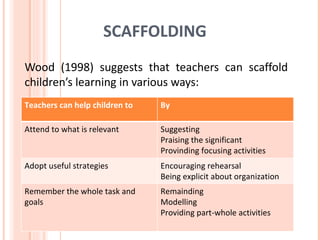
SCAFFOLDING
Wood (1998) suggests that teachers can scaffold
children’s learning in various ways:
Teachers can help children to   By

Attend to what is relevant      Suggesting
                                Praising the significant
                                Provinding focusing activities
Adopt useful strategies         Encouraging rehearsal
                                Being explicit about organization
Remember the whole task and     Remainding
goals                           Modelling
                                Providing part-whole activities
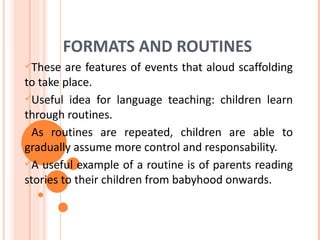
FORMATS AND ROUTINES
These   are features of events that aloud scaffolding
to take place.
Useful idea for language teaching: children learn
through routines.
As routines are repeated, children are able to
gradually assume more control and responsability.
A useful example of a routine is of parents reading
stories to their children from babyhood onwards.
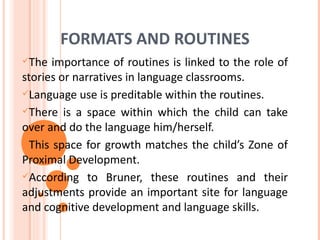
FORMATS AND ROUTINES
The  importance of routines is linked to the role of
stories or narratives in language classrooms.
Language use is preditable within the routines.

There is a space within which the child can take
over and do the language him/herself.
This space for growth matches the child’s Zone of
Proximal Development.
According to Bruner, these routines and their
adjustments provide an important site for language
and cognitive development and language skills.
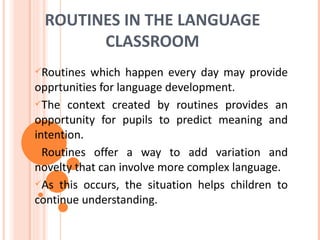
ROUTINES IN THE LANGUAGE
       CLASSROOM
Routines  which happen every day may provide
opprtunities for language development.
The context created by routines provides an
opportunity for pupils to predict meaning and
intention.
Routines offer a way to add variation and
novelty that can involve more complex language.
As this occurs, the situation helps children to
continue understanding.
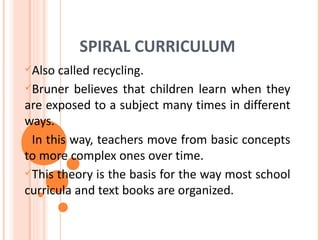
SPIRAL CURRICULUM
Also called recycling.
Bruner believes that children learn when they
are exposed to a subject many times in different
ways.
In this way, teachers move from basic concepts
to more complex ones over time.
This theory is the basis for the way most school
curricula and text books are organized.
REFERENCES
1.-http://en.wikipedia.org/wiki/Jerome_Bruner (last
retrieved 30/5/12)
2.- Understanding how children learn, Section B:
Children development. August, 2010. Harlow:
Pearson Education Limited, Longman
3.- Cameron, L. (2001). Teaching languages to
young learners. Cambridge: Cambridge University
Press.

Bruner 2012

  • 1.
    DEVELOPMENTAL STAGES JEROME BRUNER Practice II: Didactics of English as EFL Byrne, Laureana Scaricaciottoli, Sofia 2012
  • 2.
    JEROME BRUNER Jerome Seymour Bruner (born October 1, 1915) is an American psychologist who has made significant contributions to human cognitive psychology and cognitive learning theory in educational psychology, as well as to history and to the general philosophy of education. Bruner is currently a senior research fellow at the New York University School of Law. He received his B.A. in 1937 from Duke University and his Ph. D. from Harvard University in 1941.
  • 3.
    BRUNER’S IDEAS AREGREATLY INFLUENCED BY PIAGET’S THEORY ABOUT DEVELOPMENTAL STAGES. LANGUAGE IS THE MOST IMPORTANT TOOL FOR COGNITIVE GROWTH Bruner’s ideas: Scaffolding Formats and routines The spiral curriculum Important influences in education and language teaching.
  • 4.
    SCAFFOLDING A cognitivesupport that an adult or a more able peer can give to a child so that he/she should develop and grow. E.g.: being a model or simplifying tasks. Good scaffolding is tuned to the needs of the child and adjusted as the child becomes more competent. Scaffolding has been transferred to the classroom and teacher-pupil talk.
  • 5.
    SCAFFOLDING Wood (1998) suggeststhat teachers can scaffold children’s learning in various ways: Teachers can help children to By Attend to what is relevant Suggesting Praising the significant Provinding focusing activities Adopt useful strategies Encouraging rehearsal Being explicit about organization Remember the whole task and Remainding goals Modelling Providing part-whole activities
  • 6.
    FORMATS AND ROUTINES These are features of events that aloud scaffolding to take place. Useful idea for language teaching: children learn through routines. As routines are repeated, children are able to gradually assume more control and responsability. A useful example of a routine is of parents reading stories to their children from babyhood onwards.
  • 7.
    FORMATS AND ROUTINES The importance of routines is linked to the role of stories or narratives in language classrooms. Language use is preditable within the routines. There is a space within which the child can take over and do the language him/herself. This space for growth matches the child’s Zone of Proximal Development. According to Bruner, these routines and their adjustments provide an important site for language and cognitive development and language skills.
  • 8.
    ROUTINES IN THELANGUAGE CLASSROOM Routines which happen every day may provide opprtunities for language development. The context created by routines provides an opportunity for pupils to predict meaning and intention. Routines offer a way to add variation and novelty that can involve more complex language. As this occurs, the situation helps children to continue understanding.
  • 9.
    SPIRAL CURRICULUM Also calledrecycling. Bruner believes that children learn when they are exposed to a subject many times in different ways. In this way, teachers move from basic concepts to more complex ones over time. This theory is the basis for the way most school curricula and text books are organized.
  • 10.
    REFERENCES 1.-http://en.wikipedia.org/wiki/Jerome_Bruner (last retrieved 30/5/12) 2.-Understanding how children learn, Section B: Children development. August, 2010. Harlow: Pearson Education Limited, Longman 3.- Cameron, L. (2001). Teaching languages to young learners. Cambridge: Cambridge University Press.