CHROMATIN REMODELING
Maryam Amini
Winter 2012
Contents:
1. Chromatin Remodeling
2. Chromatin Remodeling Complexes
3. Mechanisms of Chromatin Remodeling
4. Disorders of Chromatin Remodeling
5. Chromatin Immunoprecipitation Sequencing
 ATP-dependent chromatin remodeling, or simply chromatin
remodeling, refers to dynamic changes in the structure of chromatin
that occur during the life of a cell.
Introduction
A summary of the events of gene expression
Structural
backbone or
A molecular spool for
DNA
Gene Expression
Replication,
DNA repair
Recombination
Histones
Chromatin Remodeling Complexes Alter the
Positions and Compositions of Nucleosomes
 A key role of some transcriptional activators is to orchestrate
changes in chromatin structure from the closed to the open
conformation by altering Nucleosomes.
 One way to change chromatin structure is through ATP dependent
chromatin remodeling.
 All remodeling complexes have a catalytic ATPase subunit that is
similar to other motor proteins, called DNA translocases , that
move along the DNA.
Chromatin
Remodeling
Complexes
SWI/SNF
family
ISWI
family
Mi-2/Chd
family
INO80
family
A summary of the different classes of nucleosome remodeling
ATPases and reactions they catalyze.
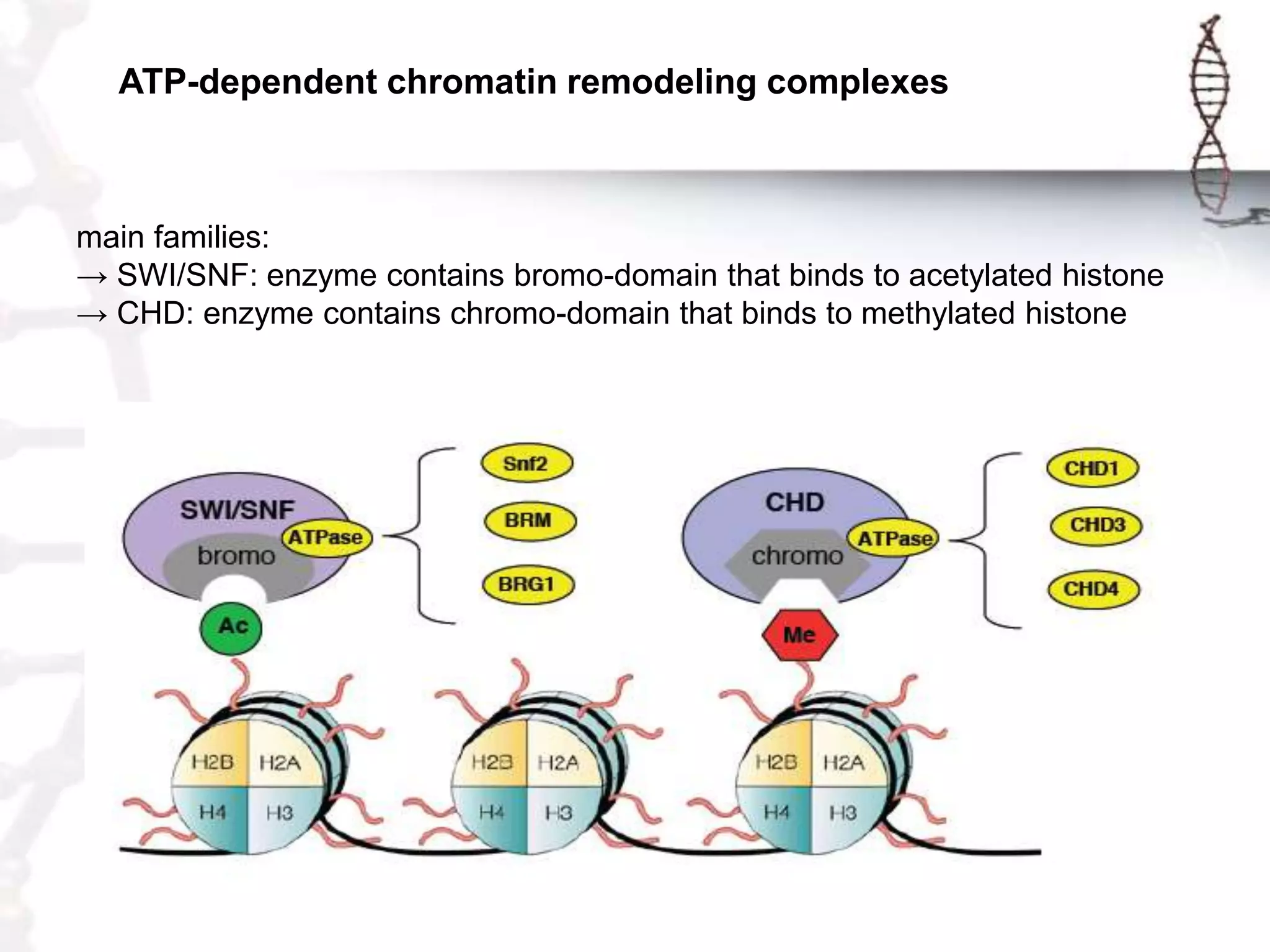
main families:
→ SWI/SNF: enzyme contains bromo-domain that binds to acetylated histone
→ CHD: enzyme contains chromo-domain that binds to methylated histone
ATP-dependent chromatin remodeling complexes
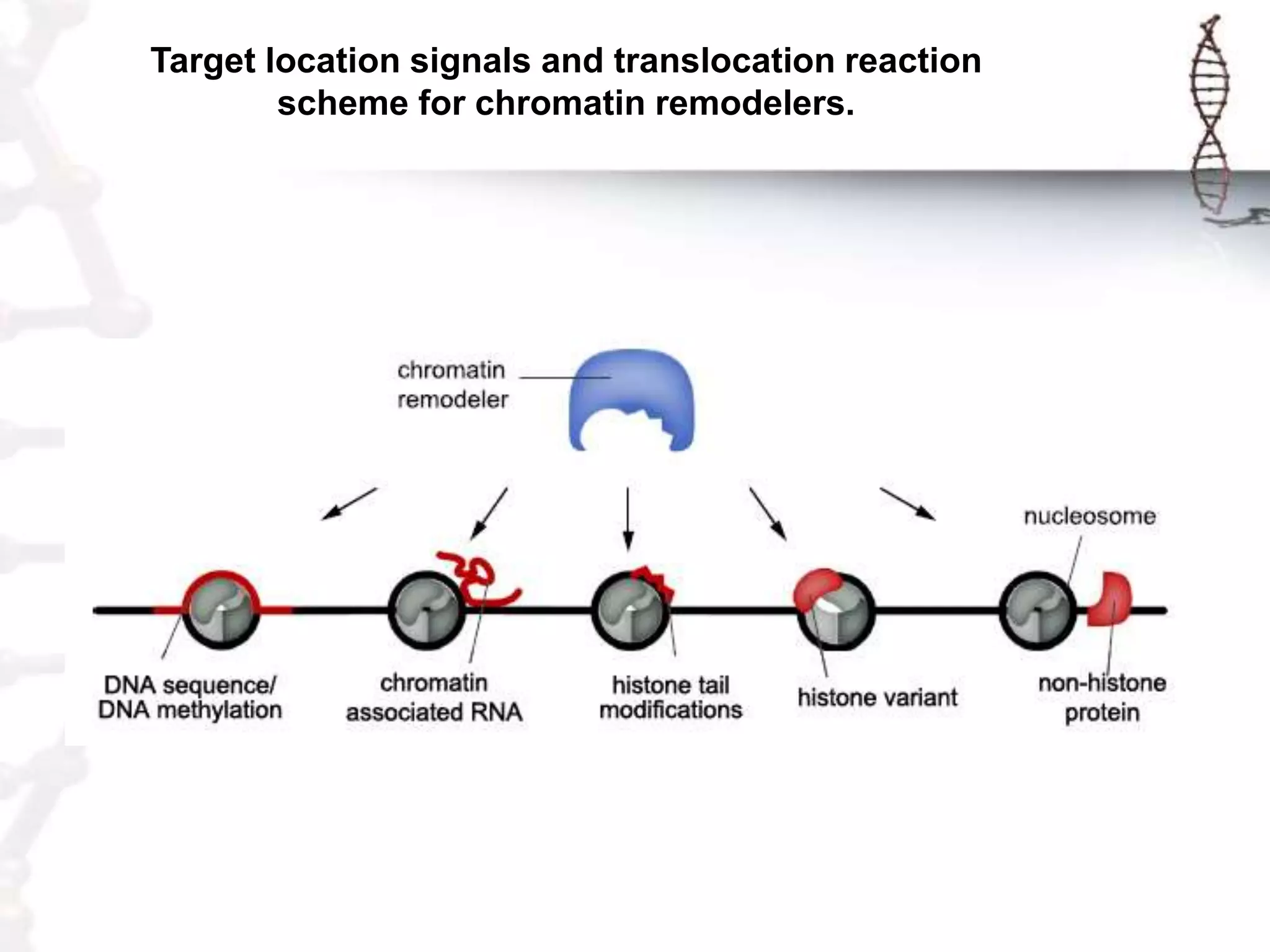
Target location signals and translocation reaction
scheme for chromatin remodelers.
One
•Nucleosome Sliding
Two
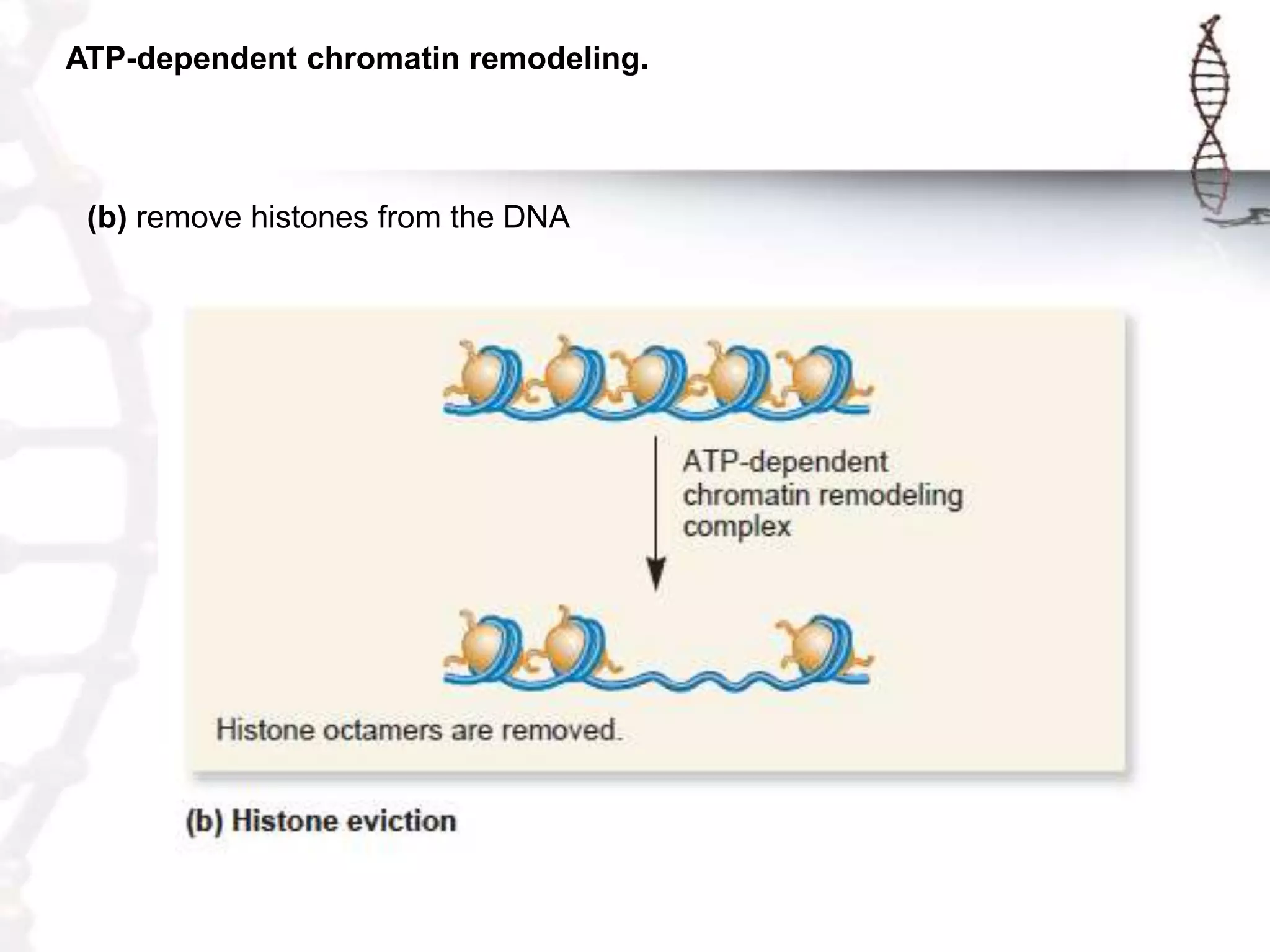
•eject histone octamers
Three
•Remove H2A-H2B dimers
Four
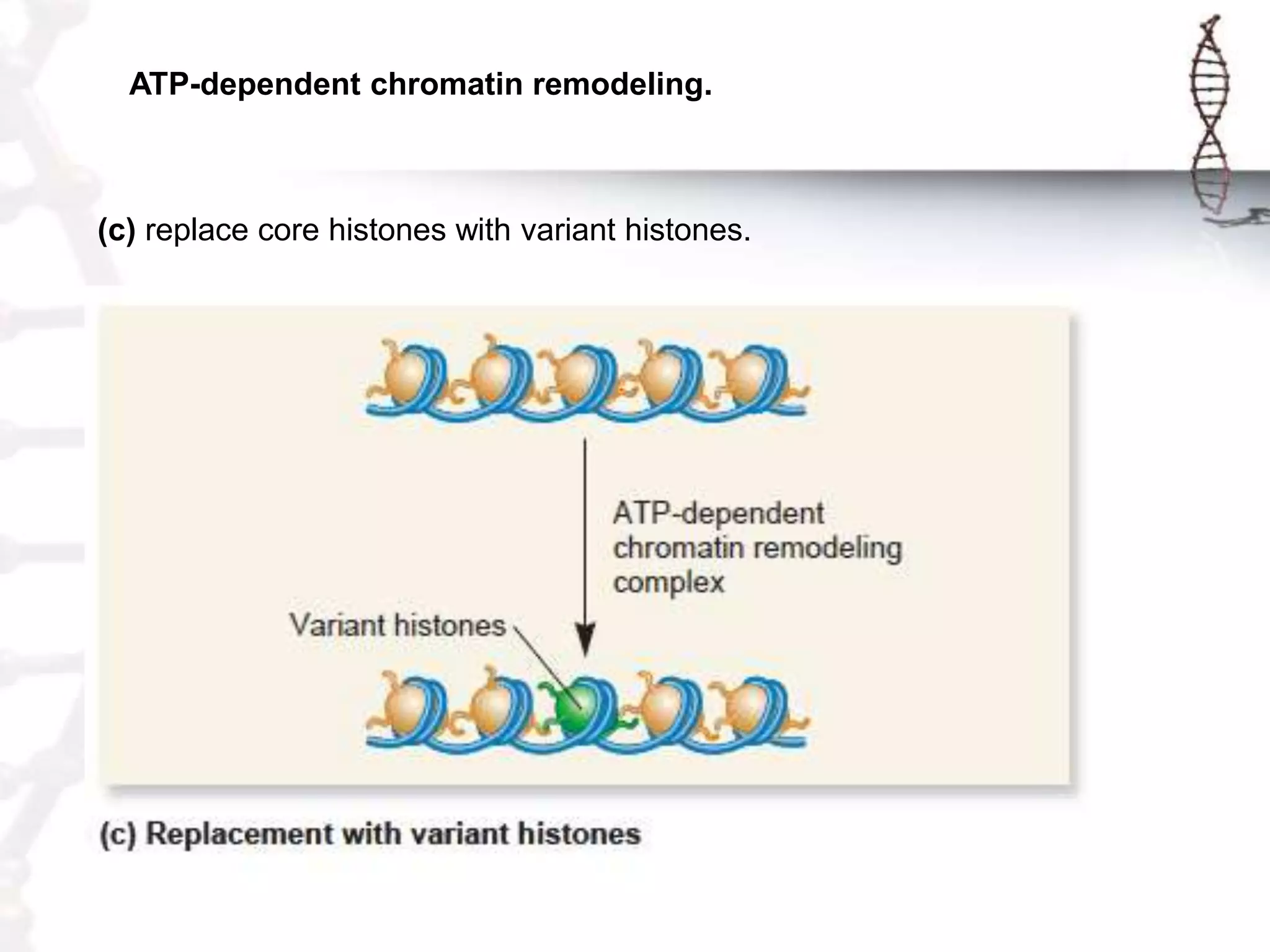
•replace dimers
Mechanisms of Chromatin Remodeling
Start
SWI/SNF
ATPase
4 ATP
hydrolysis
displaces
the
nucleosom
rebind
forms a larger
DNA bulge
DNA
rewrapped
end
1. Nucleosome Sliding
ATP-dependent chromatin remodeling.
(a) change the locations of nucleosomes
Nucleosome Conformational Change
 Sliding provides an efficient way to allow access to DNA which
was once contained within a nucleosome.
 The SWI/SNF complex create accessible DNA by
generating stable DNA loops within the context of the
nucleosome.
 The average loop size on nucleosomal templates
approximately 100 bp.
2. Nucleosome ejection
All members of the SWI/SNF family and only a subset of ISWI
remodelers are able to eject histone dimers.
1. DNA loops Remove dimers or the entire octamer
2. Tendency of the octamer to dissociate into H2A–H2B dimers
and the (H3–H4)2 tetramer
3. Large loops may allow for other DNA molecules to invade the
open histone-DNA contacts
4. DNA translocation release of the neighboring histone
dimer or octamer
ATP-dependent chromatin remodeling.
(b) remove histones from the DNA
Proposed Mechanism of SWI/SNF Nucleosome Eviction
Histone Exchange
 The SWR1 complex catalyzes the exchange of nucleosomal H2A for
the H2AZ variant.
relaxation of DNA
 Release of H2AZ-H2B
from the SWR1 complex
reassembly of a histone octamer containing
one of each H2AZ–H2B and H2A–H2B
ATP-dependent chromatin remodeling.
(c) replace core histones with variant histones.
Role of histone tails
 Histone tails have been found to be required for the
nucleosome remodeling activity of some remodeler complexes
and not for others.
 Modification of histone tails can affect remodeler complex
recruitment and stability.
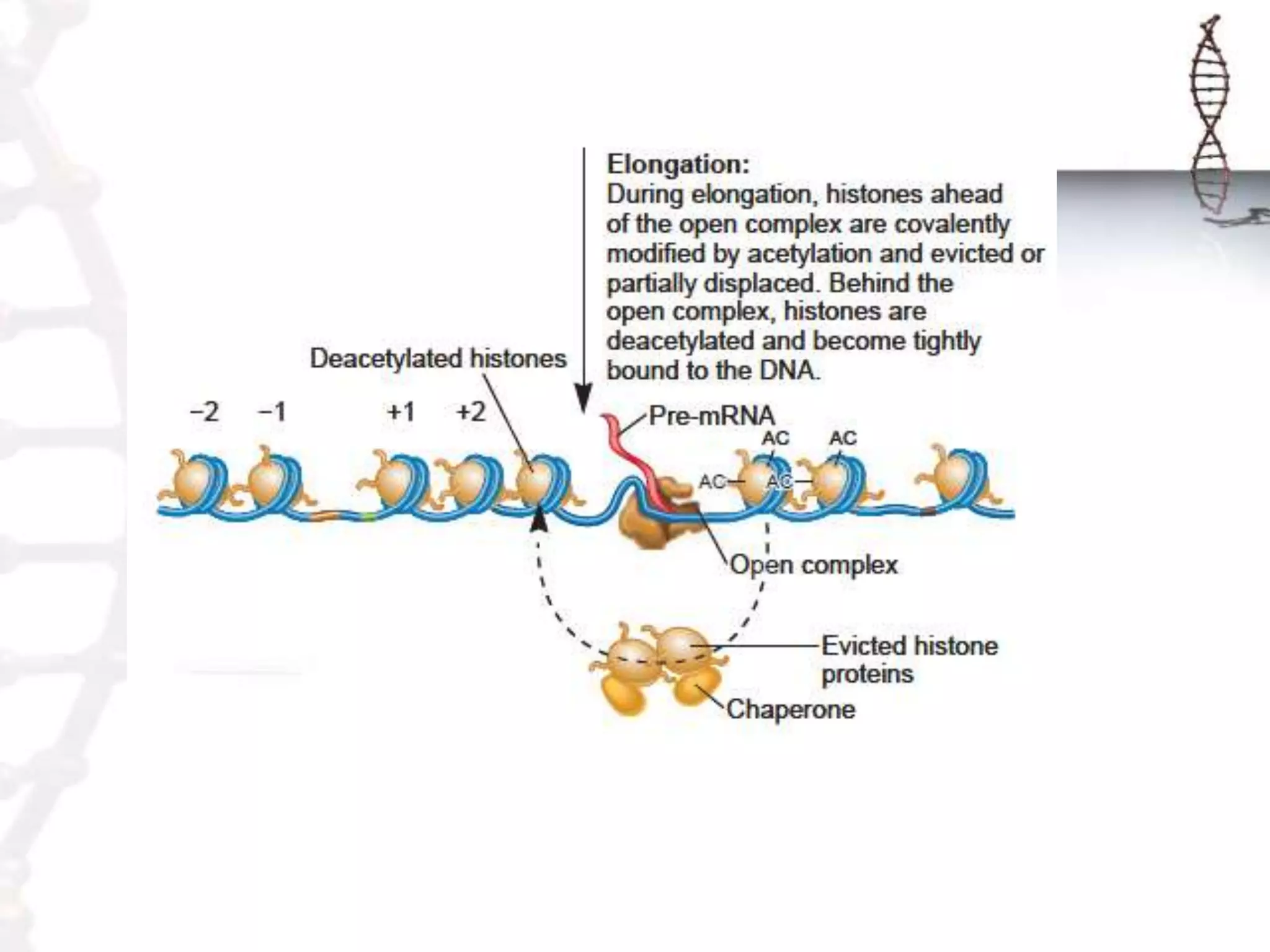
 Histone acetylation stabilizes SWI/SNF interaction with
nucleosomes.
Histone modifications and their effects on nucleosome structure
Acetylated histones allow
transcription to begin.
Once acetyl groups are
added to particular amino
acids in the tails of certain
histones, the TATA box
becomes accessible to
transcription factors.
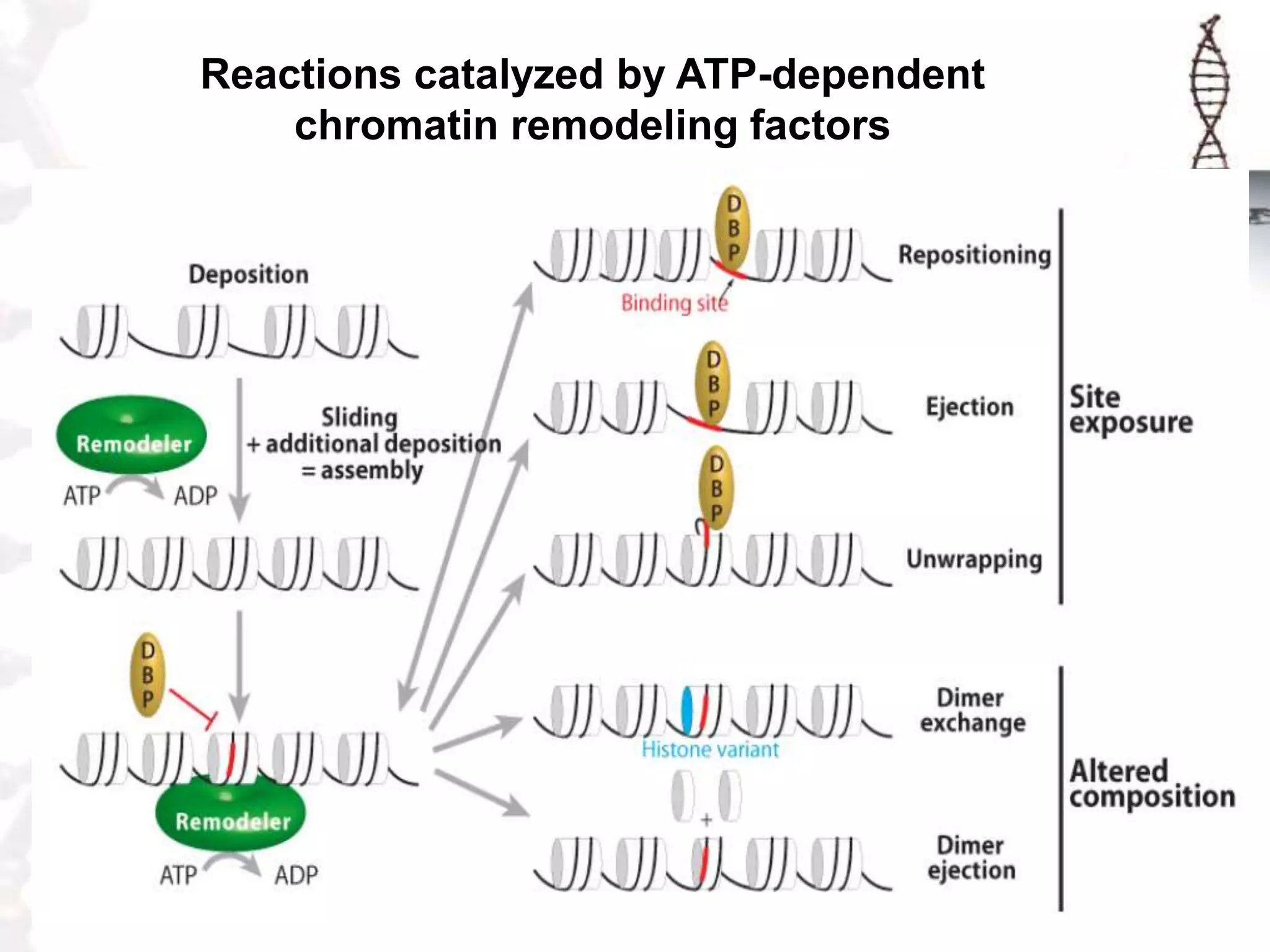
Reactions catalyzed by ATP-dependent
chromatin remodeling factors
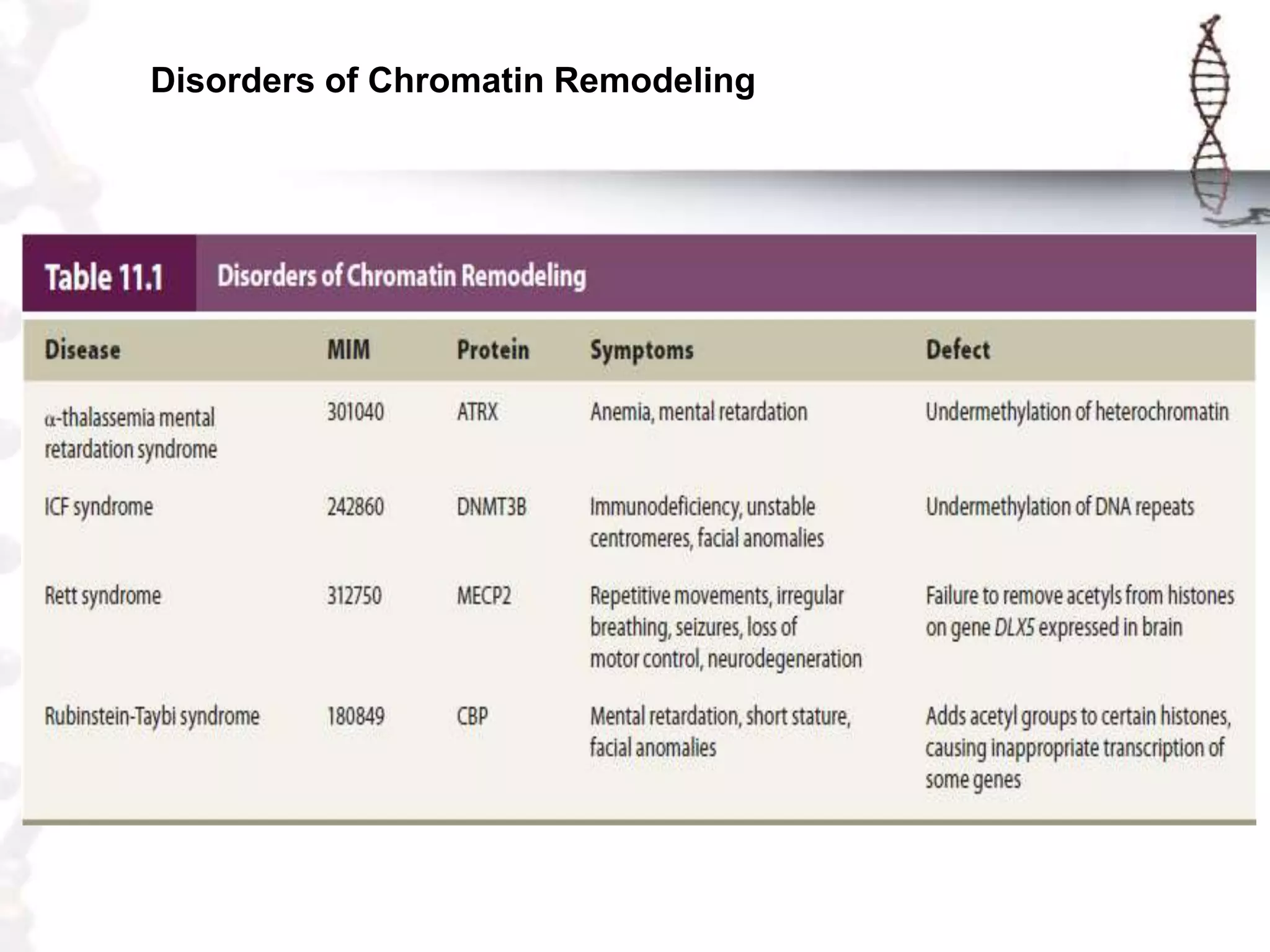
Disorders of Chromatin Remodeling
Chromatin Evaluation
Techniques
DNase footprinting
assay
enzymatic assaysModel systems
Nucleosomal arrays
Electromobility gel
shift assay (EMSA)
Chromatin
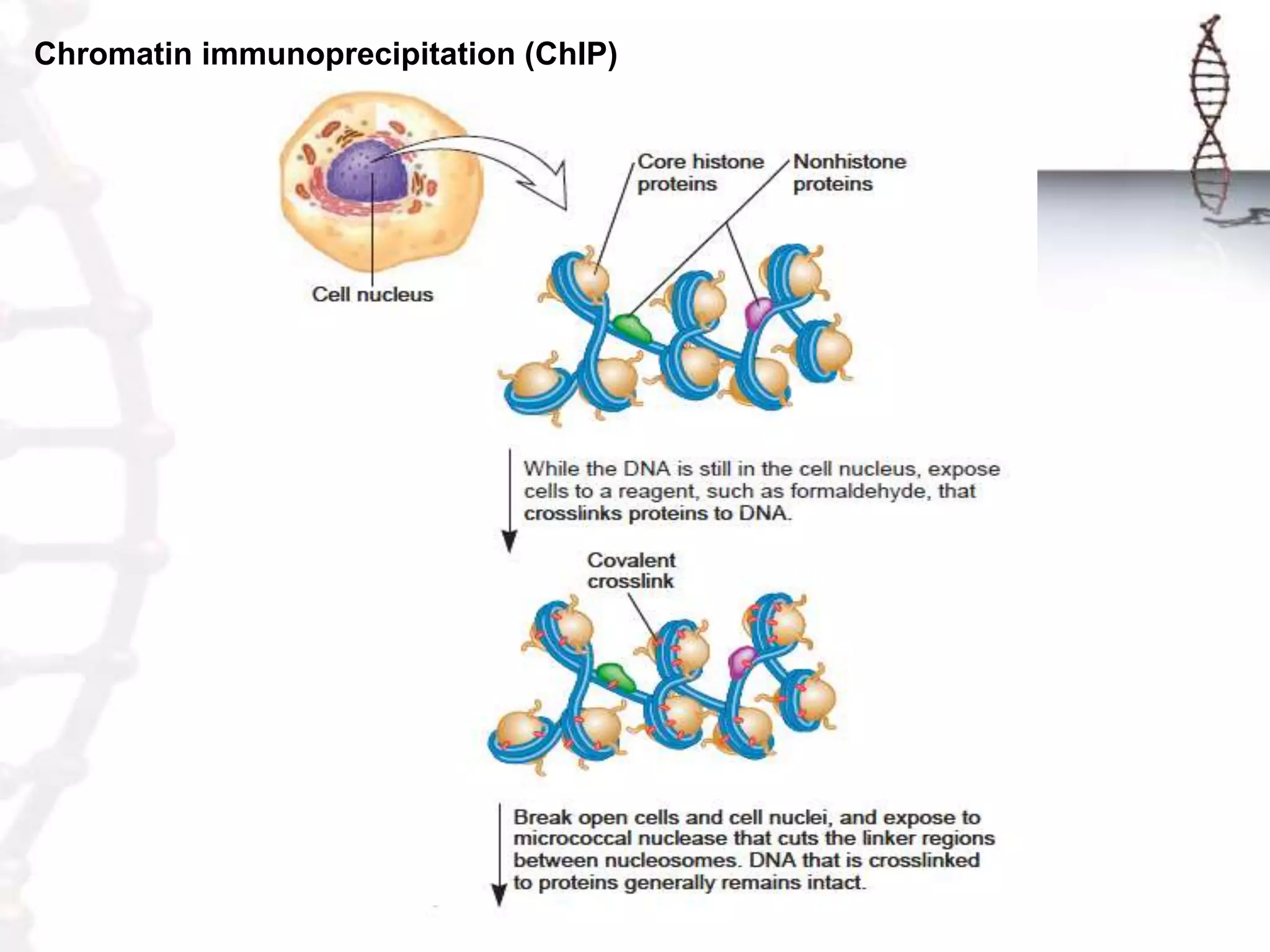
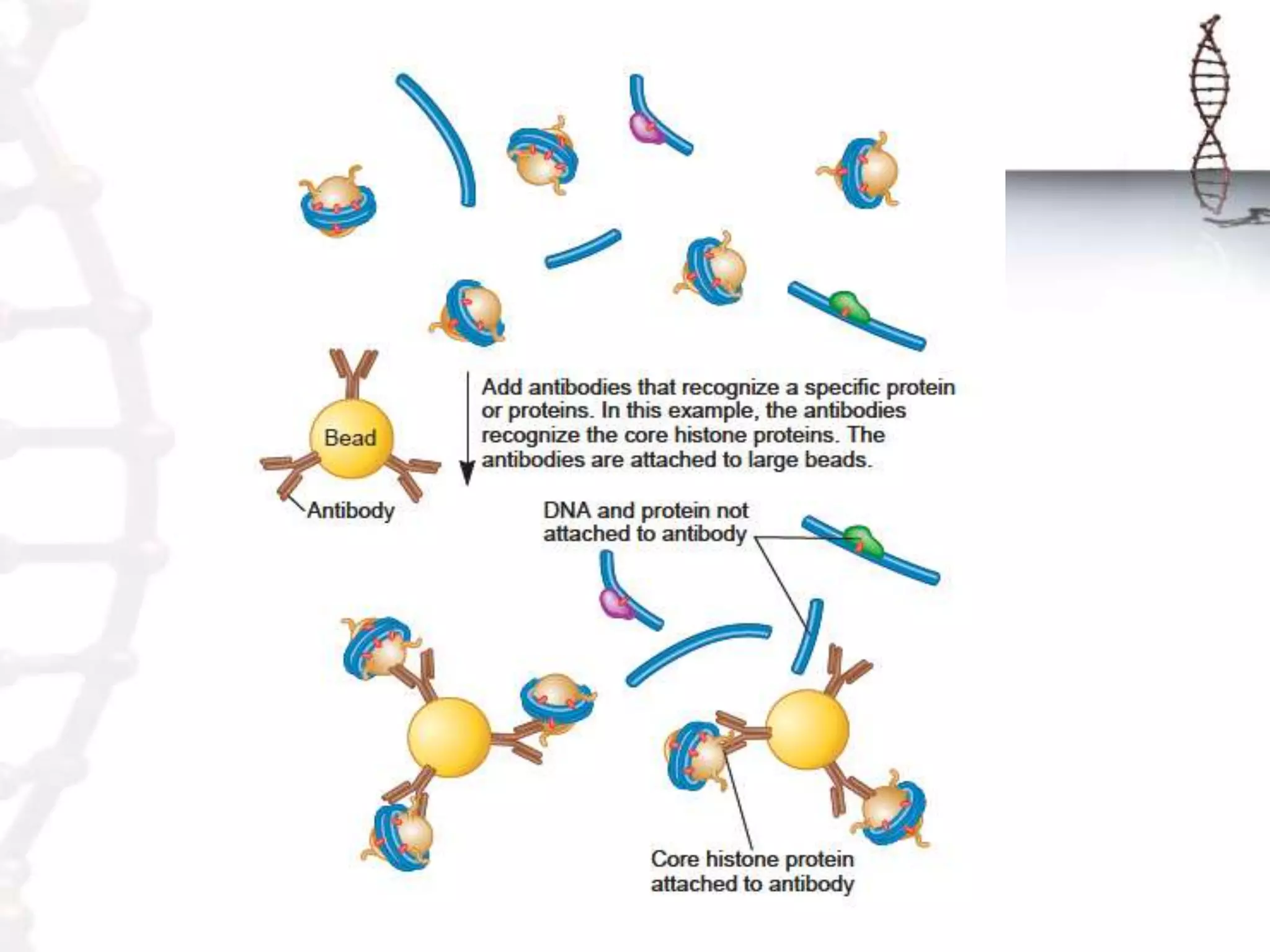
Immunoprecipitation
(ChIP)
Chromatin immunoprecipitation (ChIP)
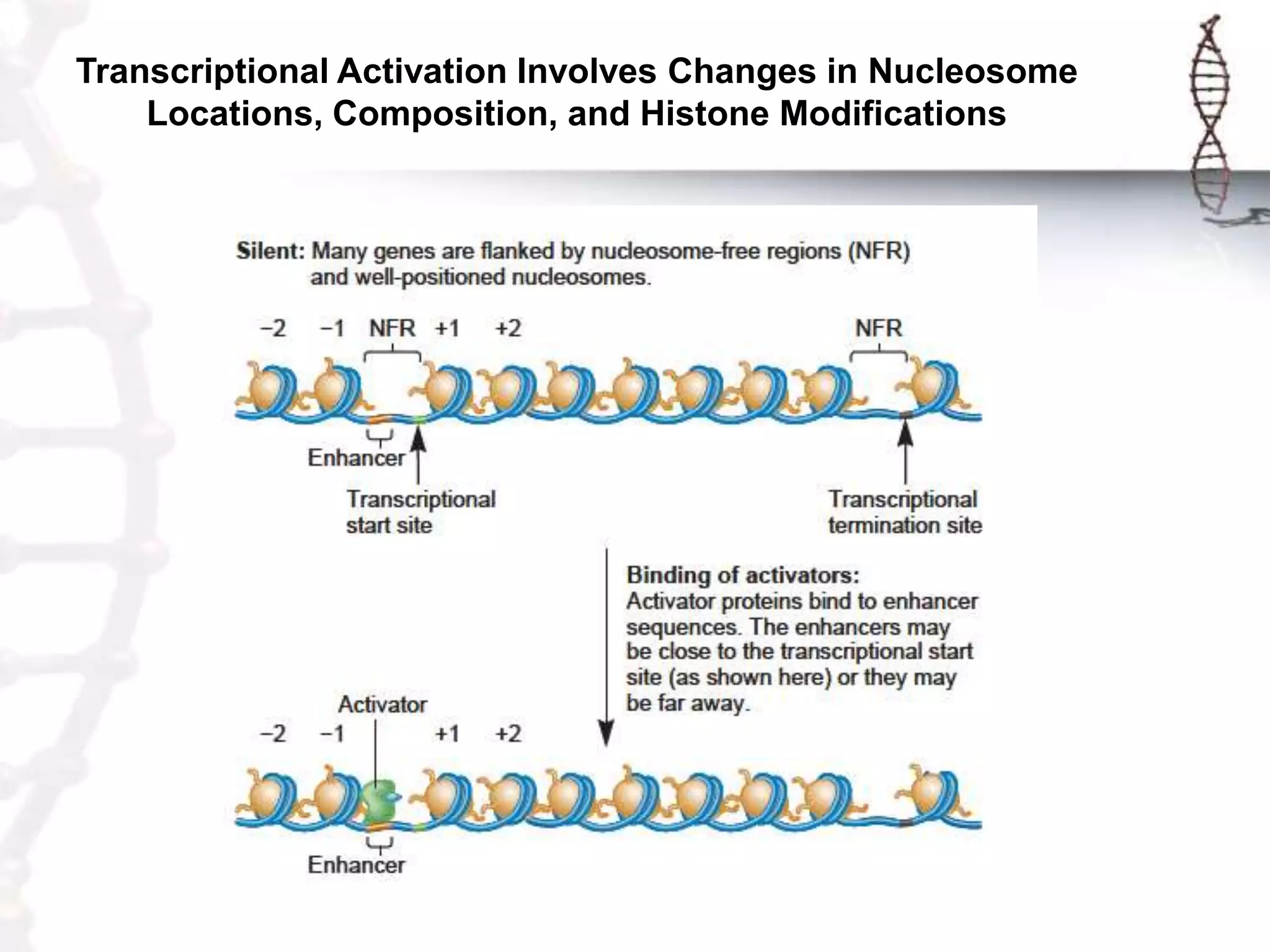
Eukaryotic Genes Are Flanked by Nucleosome-Free Regions and
Well-Positioned Nucleosomes
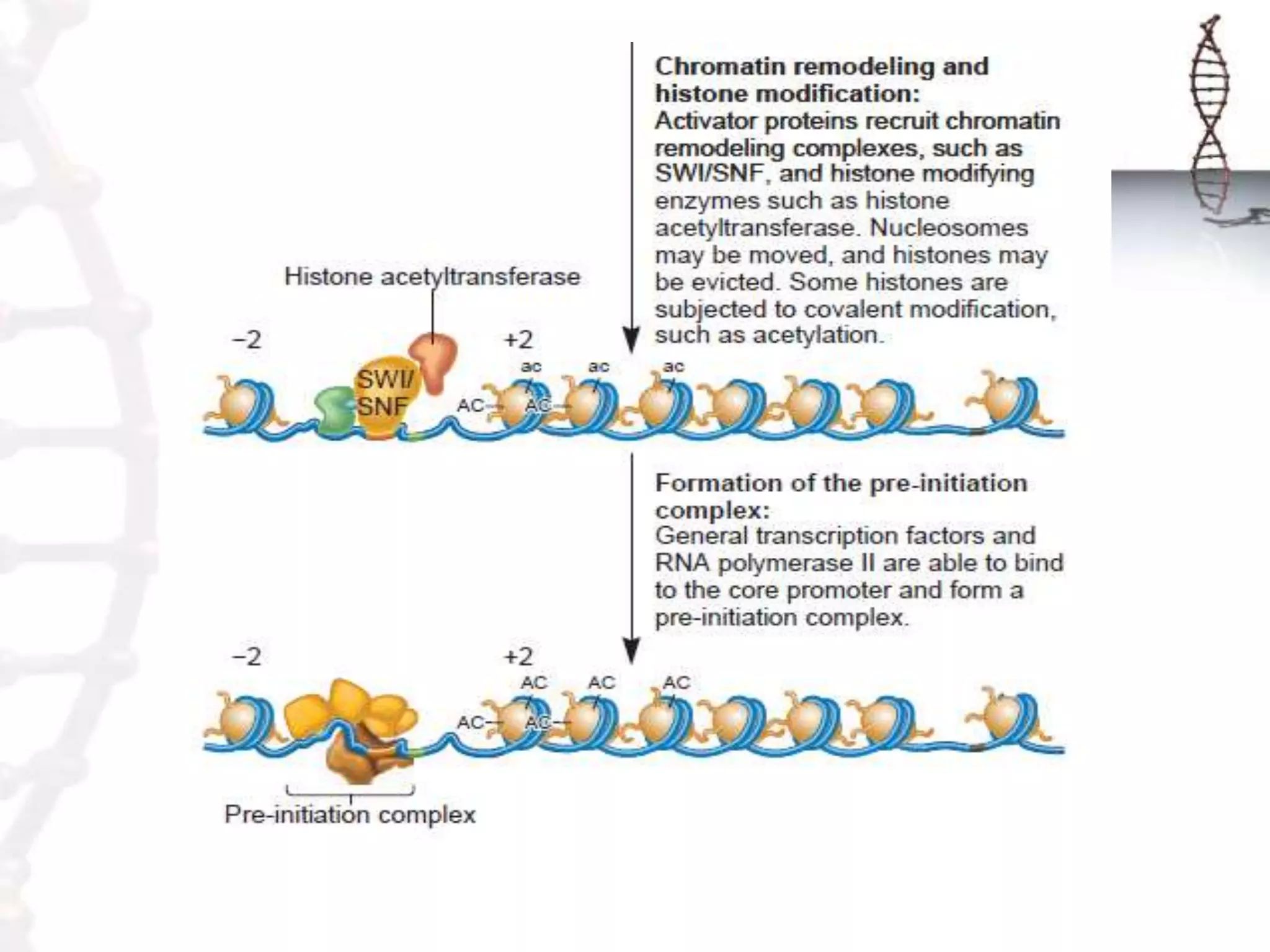
Transcriptional Activation Involves Changes in Nucleosome
Locations, Composition, and Histone Modifications
Chromatin remodeling

Chromatin remodeling