Overview of Alternating
Treatments
Alternating Treatments Design
• Compares the effects of two or more
treatments on the same behavior.
• Answers the question “Is one treatment more
effective than another?”
• The purpose is to determine which condition
is more effective in changing one behavior.
• Basic concept: When two or more treatments
are alternated rapidly in time, you can
evaluate the relative effects of the treatments.
Alternating Treatments Design
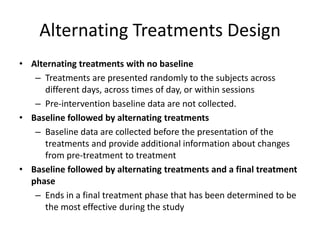
• Alternating treatments with no baseline
– Treatments are presented randomly to the subjects across
different days, across times of day, or within sessions
– Pre-intervention baseline data are not collected.
• Baseline followed by alternating treatments
– Baseline data are collected before the presentation of the
treatments and provide additional information about changes
from pre-treatment to treatment
• Baseline followed by alternating treatments and a final treatment
phase
– Ends in a final treatment phase that has been determined to be
the most effective during the study
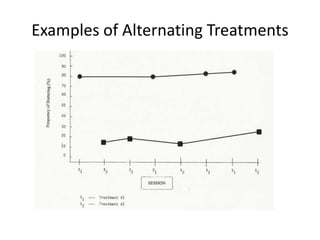
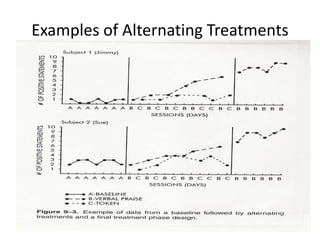
Examples of Alternating Treatments
Alternating Treatments Design
• Use when:
– You want to determine the relative effectiveness
of more than one treatment on a given behavior
– Baseline data are either unavailable or might be
unstable
– Treatments are sufficiently different from each
other
– Participants can discriminate the treatment
conditions
Alternating Treatments Design
• Disadvantages
– No controls for extraneous variables are present.
You cannot make statements about absolute
effects of treatment, only relative ones
– Not an appropriate design for behavior that is
learned in stages.
– Should not be used when treatments need to be
administered continuously to be effective

Alternating treatments design

  • 1.
  • 2.
    Alternating Treatments Design •Compares the effects of two or more treatments on the same behavior. • Answers the question “Is one treatment more effective than another?” • The purpose is to determine which condition is more effective in changing one behavior. • Basic concept: When two or more treatments are alternated rapidly in time, you can evaluate the relative effects of the treatments.
  • 3.
    Alternating Treatments Design •Alternating treatments with no baseline – Treatments are presented randomly to the subjects across different days, across times of day, or within sessions – Pre-intervention baseline data are not collected. • Baseline followed by alternating treatments – Baseline data are collected before the presentation of the treatments and provide additional information about changes from pre-treatment to treatment • Baseline followed by alternating treatments and a final treatment phase – Ends in a final treatment phase that has been determined to be the most effective during the study
  • 4.
  • 5.
  • 6.
    Alternating Treatments Design •Use when: – You want to determine the relative effectiveness of more than one treatment on a given behavior – Baseline data are either unavailable or might be unstable – Treatments are sufficiently different from each other – Participants can discriminate the treatment conditions
  • 7.
    Alternating Treatments Design •Disadvantages – No controls for extraneous variables are present. You cannot make statements about absolute effects of treatment, only relative ones – Not an appropriate design for behavior that is learned in stages. – Should not be used when treatments need to be administered continuously to be effective