Rodney Gabel, Ph.D., CCC-SLP, BRS-FD
 A new fad that jumped up out of nowhere
 Only a research issue
 Something to be afraid of
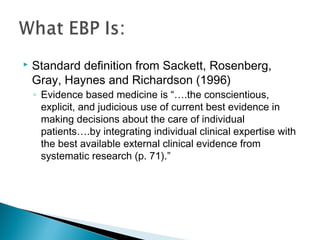
 Standard definition from Sackett, Rosenberg,
Gray, Haynes and Richardson (1996)
◦ Evidence based medicine is “….the conscientious,
explicit, and judicious use of current best evidence in
making decisions about the care of individual
patients….by integrating individual clinical expertise with
the best available external clinical evidence from
systematic research (p. 71).”
 The definition was updated by the same authors in
2000 to include patient values:
◦ ….the integration of best available research evidence,
expertise, and patient values.
◦ A combination of internal evidence to a specific treatment
(clinician expertise and client values) and external (best
available research evidence).
 Approaches that are well researched
◦ With the population specifically
◦ Used with other populations
◦ What is good or useful research?
 Theory driven
◦ What is the theory underlying the approach?
◦ Some approaches that are well researched are not
theory driven
 Maybe a combination of both
◦ Careful, thoughtful consideration of best evidence
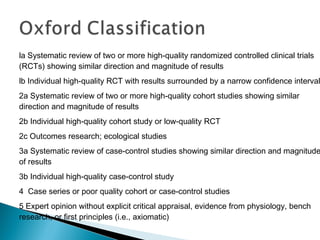
la Systematic review of two or more high-quality randomized controlled clinical trials
(RCTs) showing similar direction and magnitude of results
lb Individual high-quality RCT with results surrounded by a narrow confidence interval
2a Systematic review of two or more high-quality cohort studies showing similar
direction and magnitude of results
2b Individual high-quality cohort study or low-quality RCT
2c Outcomes research; ecological studies
3a Systematic review of case-control studies showing similar direction and magnitude
of results
3b Individual high-quality case-control study
4 Case series or poor quality cohort or case-control studies
5 Expert opinion without explicit critical appraisal, evidence from physiology, bench
research, or first principles (i.e., axiomatic)
 Thinking about level encourages all or none
thinking
◦ Should not discount lower levels of evidence, if this is the
best available at the time.
◦ Should look at lower levels as a call to action or with
some suspicion, but still useful if clinician expertise or
client values dictate the use. More on that in a minute.
◦ Research should not get a bad rap either, we need to
find the best available evidence.
 Treatment Efficacy
◦ Large group or single subject study
◦ Careful selection of participants (ideal)
◦ Precise control of treatment variables/environment
◦ Use of a well trained clinician
◦ High in internal validity, may lack external validity
 Treatment effectiveness
◦ Can be single case studies, large or small groups
◦ Measure the effectiveness of therapy as it actually
occurs, under typical clinical conditions.
◦ Lacks control, but allows for naturalistic measurement of
the benefits of treatment as it actually occurs.
 As an ethical clinician, prepared to work using
E3
BP you should have:
◦ Healthy uncertainty whether a clinical action is optimal
for a client. Honest doubt.
◦ Professional integrity-comprising honesty,
respectfulness, awareness of biases, and openness to
the need to change one’s mind.
 A clinician may state: I do what works, because I
know it works
 Certainly, clinical expertise can be very good
evidence, even the highest level, if this expertise
is based on thoughtful consideration of theory and
evidence
 Less is known or studied about client values in treatment, but
we know that they need to be a part of the decision
 Little research has explored this
◦ Yaruss et all reported that clients reported many benefits of therapy
beyond speech changes
◦ One study by Cream et al (2003) found that a group of clients reported not
wanting to use fluency techniques
◦ May not like doing certain techniques
◦ Maintaining changes in fluency is quite hard
◦ Bring a lot of experience to the table, but also might be misinformed or
have had bad experiences
◦ Venkatagiri (2009)
 Fluency or freedom??
Rodney Gabel, Ph.D., CCC-SLP, BRS-FD
 Beneficence
◦ Approaches we choose should have maximum benefit for our
clients and their families.
 Nonmalificence
◦ Minimize harm. I would go farther and suggest “do no harm.”
 Autonomy
◦ Clients are individuals, not numbers or disorders. We need to
value their need for self-determination.
◦ We must respect their rights to make choices about what
happens to them.
 Justice
◦ We should strive for fairness in all we do. Be advocates for our
clients and families. Never discriminate.
 We should have doubt about what we are doing,
and search for answers instead.
 Avoid subjective bias.
◦ We need to be skeptical about expert opinion and
testimonials
 We can find resources that help us explore the
right answers.
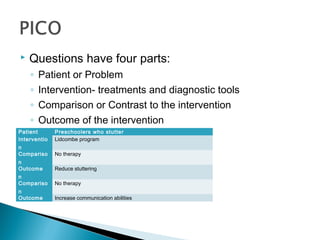
 Questions have four parts:
◦ Patient or Problem
◦ Intervention- treatments and diagnostic tools
◦ Comparison or Contrast to the intervention
◦ Outcome of the intervention
Patient Elderly patients with Aphasia
Interventio
n
Constraint Induced Intensive therapy
Compariso
n
No therapy
Outcome Increase communication abilities
Patient Preschoolers who stutter
Interventio
n
Lidcombe program
Compariso
n
No therapy
Outcome Reduce stuttering

Introduction to evidence based practice slp6030

  • 1.
    Rodney Gabel, Ph.D.,CCC-SLP, BRS-FD
  • 2.
     A newfad that jumped up out of nowhere  Only a research issue  Something to be afraid of
  • 3.
     Standard definitionfrom Sackett, Rosenberg, Gray, Haynes and Richardson (1996) ◦ Evidence based medicine is “….the conscientious, explicit, and judicious use of current best evidence in making decisions about the care of individual patients….by integrating individual clinical expertise with the best available external clinical evidence from systematic research (p. 71).”
  • 4.
     The definitionwas updated by the same authors in 2000 to include patient values: ◦ ….the integration of best available research evidence, expertise, and patient values. ◦ A combination of internal evidence to a specific treatment (clinician expertise and client values) and external (best available research evidence).
  • 6.
     Approaches thatare well researched ◦ With the population specifically ◦ Used with other populations ◦ What is good or useful research?  Theory driven ◦ What is the theory underlying the approach? ◦ Some approaches that are well researched are not theory driven  Maybe a combination of both ◦ Careful, thoughtful consideration of best evidence
  • 7.
    la Systematic reviewof two or more high-quality randomized controlled clinical trials (RCTs) showing similar direction and magnitude of results lb Individual high-quality RCT with results surrounded by a narrow confidence interval 2a Systematic review of two or more high-quality cohort studies showing similar direction and magnitude of results 2b Individual high-quality cohort study or low-quality RCT 2c Outcomes research; ecological studies 3a Systematic review of case-control studies showing similar direction and magnitude of results 3b Individual high-quality case-control study 4 Case series or poor quality cohort or case-control studies 5 Expert opinion without explicit critical appraisal, evidence from physiology, bench research, or first principles (i.e., axiomatic)
  • 8.
     Thinking aboutlevel encourages all or none thinking ◦ Should not discount lower levels of evidence, if this is the best available at the time. ◦ Should look at lower levels as a call to action or with some suspicion, but still useful if clinician expertise or client values dictate the use. More on that in a minute. ◦ Research should not get a bad rap either, we need to find the best available evidence.
  • 9.
     Treatment Efficacy ◦Large group or single subject study ◦ Careful selection of participants (ideal) ◦ Precise control of treatment variables/environment ◦ Use of a well trained clinician ◦ High in internal validity, may lack external validity  Treatment effectiveness ◦ Can be single case studies, large or small groups ◦ Measure the effectiveness of therapy as it actually occurs, under typical clinical conditions. ◦ Lacks control, but allows for naturalistic measurement of the benefits of treatment as it actually occurs.
  • 10.
     As anethical clinician, prepared to work using E3 BP you should have: ◦ Healthy uncertainty whether a clinical action is optimal for a client. Honest doubt. ◦ Professional integrity-comprising honesty, respectfulness, awareness of biases, and openness to the need to change one’s mind.
  • 11.
     A clinicianmay state: I do what works, because I know it works  Certainly, clinical expertise can be very good evidence, even the highest level, if this expertise is based on thoughtful consideration of theory and evidence
  • 12.
     Less isknown or studied about client values in treatment, but we know that they need to be a part of the decision  Little research has explored this ◦ Yaruss et all reported that clients reported many benefits of therapy beyond speech changes ◦ One study by Cream et al (2003) found that a group of clients reported not wanting to use fluency techniques ◦ May not like doing certain techniques ◦ Maintaining changes in fluency is quite hard ◦ Bring a lot of experience to the table, but also might be misinformed or have had bad experiences ◦ Venkatagiri (2009)  Fluency or freedom??
  • 13.
    Rodney Gabel, Ph.D.,CCC-SLP, BRS-FD
  • 14.
     Beneficence ◦ Approacheswe choose should have maximum benefit for our clients and their families.  Nonmalificence ◦ Minimize harm. I would go farther and suggest “do no harm.”  Autonomy ◦ Clients are individuals, not numbers or disorders. We need to value their need for self-determination. ◦ We must respect their rights to make choices about what happens to them.  Justice ◦ We should strive for fairness in all we do. Be advocates for our clients and families. Never discriminate.
  • 15.
     We shouldhave doubt about what we are doing, and search for answers instead.  Avoid subjective bias. ◦ We need to be skeptical about expert opinion and testimonials  We can find resources that help us explore the right answers.
  • 16.
     Questions havefour parts: ◦ Patient or Problem ◦ Intervention- treatments and diagnostic tools ◦ Comparison or Contrast to the intervention ◦ Outcome of the intervention Patient Elderly patients with Aphasia Interventio n Constraint Induced Intensive therapy Compariso n No therapy Outcome Increase communication abilities Patient Preschoolers who stutter Interventio n Lidcombe program Compariso n No therapy Outcome Reduce stuttering

Editor's Notes

  • #3 A new fad that jumped up out of nowhere Clinicians and professionals from a variety of disciplines have been utilizing evidence to guide therapy for long, long, long time. Certainly, the past 15-20 years has seen a stark increase in the discussion of the need to support what it is we do and why we do it. Driven by third party billing and professional organizations. Only a research issue I will discuss a model that suggests there are multiple forms of evidence that might be used, because we need to look at the use of best available evidence. Something to be afraid of It is a good thing to carefully consider what it is we do and why we do it, and there are many tools to assist in searching for evidence for what we do.
  • #4 Sackett and many colleagues are the most often cited authors related to evidence based practice and medicine. A standard definition of EBP comes from Sackett and collleages, who defined EBP as the conscientious, explicit, and judicious use of current best evidence in making decisions about the care of individual patients….by integrating individual clinical expertise with the best available external clinical evidence from systematic research.” From this early definition, you can see that both research and clinical expertise is a part of evidence. More on clinical expertise later.
  • #5 The definition was updated by the same authors in 2000 to include patient values: … .the integration of best available research evidence, expertise, and patient values. A combination of internal evidence to a specific treatment (clinician expertise and client values) and external (best available research evidence).
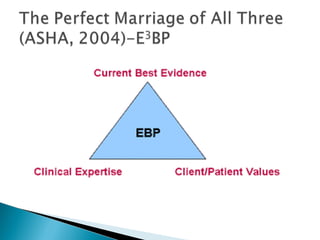
  • #6 Here we have a representation of the three facets of EBP, often described as the EBP triangle. You can see here that EBP is not just based on research evidence. Clinical expertise and client values count for quite a lot! A story I often tell is of an elderly man I was treating in the nursing home. His diet was for regular solids and thin liquids, and I was working with him on cognition. I saw him over lunch one day, and as he was eating, he coughed and coughed on his steak. I could also hear the most awful gurgling sound in his lungs when he drank. Clearly, his diet needed to be evaluated and altered—both the research evidence and my clinical expertise told me so. But when I contacted his family, who had health care power of attorney, they were adamant that his diet not be changed, because he had always enjoyed eating and drinking so much, and didn’t have long to live. Nothing I said would change their mind. Clearly, the client’s families values trumped the other two points of the triangle in this case.
  • #7 Approaches that are well researched With the population specifically Used with other populations What is good or useful research? Theory driven What is the theory underlying the approach? Some approaches that are well researched are not theory driven Maybe a combination of both Careful, thoughtful consideration of best evidence
  • #8 Here we have the Oxford classification, which is a way of designating evidence into categories according to which evidence should carry the most weight. You can see that the highest level of evidence comes from those studies that are most highly controlled, such as randomized control studies, often conducted as clinical trials. The best evidence also comes from a systematic review of more than one highly controlled study. Remember, one study by itself does not constitute a fact—we need more evidence than just one study. You can see as we progress down the list, the types of studies become less highly controlled. Case studies with a control person is better than a case study in which there was no control subject, for example. Keep in mind that level 5, expert opinion, provides the least evidence and should be taken with a grain of salt.
  • #9 But overall, we don’t want to get too caught up in designing a perfect Level 1 study, because in reality, some research questions don’t lend themselves to highly controlled, randomized clinical trials. A question such as “How do the spouses of people with dementia cope with their partner’s disorder?” is still a very good research question, but it can’t and shouldn’t be answered in the same way we would ask if the ‘Spaced Retrieval” technique for memory loss is an effective strategy for recall with patients who have dementia. So don’t discount lower levels of evidence outright. Be aware of the research question and the methods that could best provide an answer to it.
  • #10 One thing that always trips students up is the concept of efficacy versus effectiveness in research studies. Treatment efficacy involves highly controlled research under the best possible conditions, such as a laboratory. The clinician is highly trained and usually has some expertise in the treatment. The subjects are specifically selected based on their characteristics. When we see that a treatment has good efficacy, we know that under ideal conditions, for the typical client, the treatment should work. When we want to know more about how treatments should work in the “real” world, we may conduct a treatment effectiveness study. This type of study lacks the high levels of control that is necessary for treatment efficacy studies, but may be more realistic for clinicians who are out in the field and may have clients who are not typical or do not work in ideal settings.
  • #11 If you want to be an ethical clinician who uses EBP, the most helpful things that you can do is to have a healthy uncertainty whether a clinical action is optimal for a client. We don’t want to be so optimistic about a treatment that it blinds us to whether it is actually working or not. We always want to demonstrate professional integrity-comprising honesty, respectfulness, awareness of biases, and openness to the need to change one’s mind.
  • #12 Let’s talk more now about clinician expertise. Sometimes we say that we do what works, because we’ve seen our clients progress when we use a certain therapy approach. This is not the best evidence for sure, especially if the clinician is clearly doing something that has little theoretical or research support. Clinical expertise, though, shouldn’t always be disregarded. Experience matters, especially when certain approaches have a good theoretical basis but cannot necessarily be researched through traditional methods. Some stuttering techniques that relate to attitudes and emotions are like this. If this is the case, we always want to incorporate a more eclectic approach to therapy using different levels of evidence
  • #13 Client values are so important, yet we don’t have a ton of information about how we have factored client values into the clinical decision making process. We know that we must calibrate best available evidence, clinical expertise to our client’s needs and values. Researchers in fluency have studied this, probably because there is a debate about what the best approach to stuttering treatment is. Do you teach people to be as fluent as possible, or do you teach them not to hide their stuttering and to manage their stuttering as it happens, freeing them up from emotional worry? SLPs who work with fluency clients will have to take their clients’ values and preferences into account when they design treatment plans.
  • #14 Let’s talk now about ethics and our role in EBP.
  • #15 There are four ethical principles that we should apply whenever we make clinical decisions about and with our clients. These are beneficence, nonmalificence, autonomy, and justice. Beneficence Approaches we choose should have maximum benefit for our clients and their families. Nonmalificence Minimize harm. I would go farther and suggest “do no harm.” Autonomy Clients are individuals, not numbers or disorders. We need to value their need for self-determination. We must respect their rights to make choices about what happens to them. Justice We should strive for fairness in all we do. Be advocates for our clients and families. Never discriminate.
  • #16 As we wrap things up, we want to make sure that we are thinking evidence in the right way. We need evidence because humans tend to look for evidence that supports what we already believe. We should do the opposite and search for answers in an open-minded way. We also want to avoid subjective bias. That is, expert opinions and testimonials that may prejudice us toward thinking in a certain way, but may not have evidence to support these opinions. We also need to be able to find resources that help us explore the right answers.
  • #17 One way to find answers is to have a good question in mind. This is where the PICO approach comes in handy. In this four-part approach to writing questions, we must clearly identify P: the patient or problem; I: treatments and diagnostic tools; C: comparision or contrast to the intervention, and O: outcome of the intervention. For example, we might write a question such as: Does use of the Lidcombe program for preschoolers who stutter reduce stuttering as compared to preschoolers who do not receive fluency therapy? Another question might be: Do elderly patients with aphasia who undergo constraint induced intensive therapy as compared to no therapy perceive an increase in their communication abilities? The PICO format is the cornerstone of good question writing, and is something you will be able to practice in this unit.