THE M. S. UNIVERSITY OF BARODA 
POLYTECHNIC 
SUBJECT: 
RANDOM ACCESS MEMORY 
CREATED BY: 
Ruchi M. Maurya 
Roll no. 03 
S.Y.D. 2nd IT
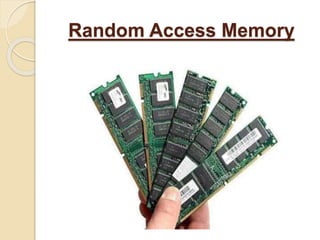
Random Access Memory
Index: 
 Introduction 
 History 
 Technologies 
 Block Diagram 
 Position & Structure 
 Types of Ram 
 Difference 
 Capacity to store 
 Manufacturing companies 
 Advantage & Disadvantage
Introduction: 
 Random access memory (RAM) is the best 
known form of computer memory. 
RAM is considered as volatile memory, which 
means that the stored information is lost when 
there is no power. 
RAM is made up of small memory chips that 
form a memory module. 
Whenever you open a program, it gets loaded 
from the hard drive into the RAM. 
This is because reading data from the RAM is 
much faster than reading data from the hard 
drive
History: 
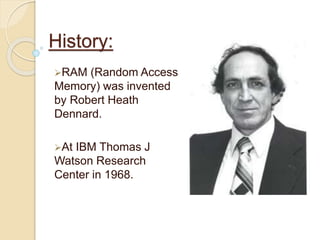
RAM (Random Access 
Memory) was invented 
by Robert Heath 
Dennard. 
At IBM Thomas J 
Watson Research 
Center in 1968.
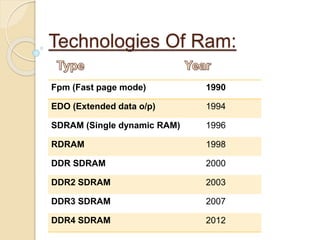
Technologies Of Ram: 
Fpm (Fast page mode) 1990 
EDO (Extended data o/p) 1994 
SDRAM (Single dynamic RAM) 1996 
RDRAM 1998 
DDR SDRAM 2000 
DDR2 SDRAM 2003 
DDR3 SDRAM 2007 
DDR4 SDRAM 2012
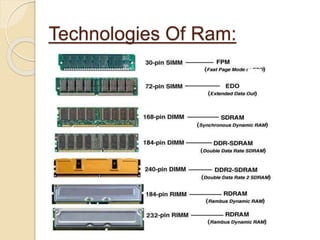
Technologies Of Ram:
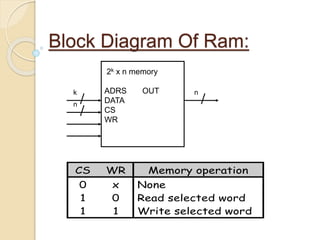
Block Diagram Of Ram: 
2k x n memory 
ADRS OUT 
DATA 
CS 
WR 
k 
n 
n 
CS WR Memory operation 
0 x None 
1 0 Read selected word 
1 1 Write selected word
Block Diagram Of Ram: 
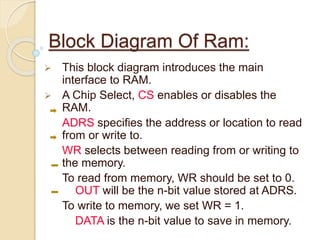
 This block diagram introduces the main 
interface to RAM. 
 A Chip Select, CS enables or disables the 
RAM. 
ADRS specifies the address or location to read 
from or write to. 
WR selects between reading from or writing to 
the memory. 
To read from memory, WR should be set to 0. 
OUT will be the n-bit value stored at ADRS. 
To write to memory, we set WR = 1. 
DATA is the n-bit value to save in memory.
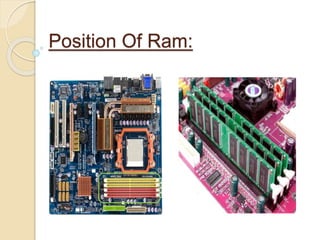
Position Of Ram:
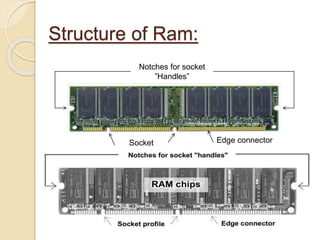
Structure of Ram: 
Notches for socket 
”Handles” 
Socket 
profile 
Edge connector
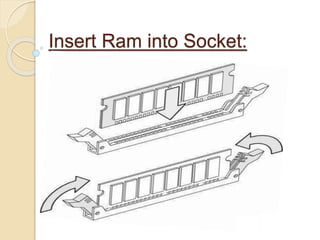
Insert Ram into Socket:
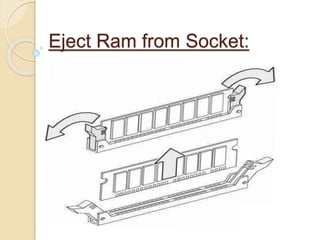
Eject Ram from Socket:
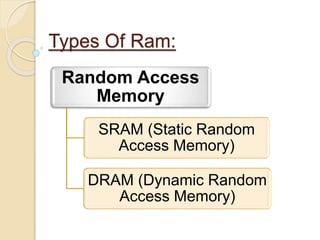
Types Of Ram: 
Random Access 
Memory 
SRAM (Static Random 
Access Memory) 
DRAM (Dynamic Random 
Access Memory)
Types Of Ram: 
 SRAM (Static Random Access Memory) 
 SRAM holds data in a static form, as long as 
the memory has power. 
 Each bit is stored on four transistor that forms 
two cross coupled inverters. 
 DRAM (Dynamic Random Access Memory) 
 DRAM is called dynamic because it must 
constantly be refreshed and lose the data in 
very short time. 
 DRAM stores each bit of data in a separate 
capacitor within a integrated circuit.
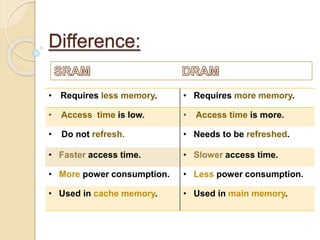
Difference: 
• Requires less memory. • Requires more memory. 
• Access time is low. • Access time is more. 
• Do not refresh. • Needs to be refreshed. 
• Faster access time. • Slower access time. 
• More power consumption. • Less power consumption. 
• Used in cache memory. • Used in main memory.
Capacity Of Ram: 
 From Beginning: 
256 MB 
512 MB 
1024 MB (1 GB) 
2048 MB (2 GB) 
4096 MB (4 GB) 
8192 MB (8 GB) 
• NOTE: Here every time the size of Ram 
increased by multiplying twice.
Manufacturing companies: 
ASUS 
Buffalo Technology 
Century 
CEON 
CHAINTECH 
ELIXIR 
HP 
IBM
Advantage: 
Programs will load much faster. 
Power Efficient, that uses much less 
power than disk drives. 
Disadvantage: 
Volatile: a power outage will cause 
irrecoverable data loss. 
Space-limited: cost per bit is high.
THANK YOU

Random access memory

  • 1.
    THE M. S.UNIVERSITY OF BARODA POLYTECHNIC SUBJECT: RANDOM ACCESS MEMORY CREATED BY: Ruchi M. Maurya Roll no. 03 S.Y.D. 2nd IT
  • 2.
  • 3.
    Index:  Introduction  History  Technologies  Block Diagram  Position & Structure  Types of Ram  Difference  Capacity to store  Manufacturing companies  Advantage & Disadvantage
  • 4.
    Introduction:  Randomaccess memory (RAM) is the best known form of computer memory. RAM is considered as volatile memory, which means that the stored information is lost when there is no power. RAM is made up of small memory chips that form a memory module. Whenever you open a program, it gets loaded from the hard drive into the RAM. This is because reading data from the RAM is much faster than reading data from the hard drive
  • 5.
    History: RAM (RandomAccess Memory) was invented by Robert Heath Dennard. At IBM Thomas J Watson Research Center in 1968.
  • 6.
    Technologies Of Ram: Fpm (Fast page mode) 1990 EDO (Extended data o/p) 1994 SDRAM (Single dynamic RAM) 1996 RDRAM 1998 DDR SDRAM 2000 DDR2 SDRAM 2003 DDR3 SDRAM 2007 DDR4 SDRAM 2012
  • 7.
  • 8.
    Block Diagram OfRam: 2k x n memory ADRS OUT DATA CS WR k n n CS WR Memory operation 0 x None 1 0 Read selected word 1 1 Write selected word
  • 9.
    Block Diagram OfRam:  This block diagram introduces the main interface to RAM.  A Chip Select, CS enables or disables the RAM. ADRS specifies the address or location to read from or write to. WR selects between reading from or writing to the memory. To read from memory, WR should be set to 0. OUT will be the n-bit value stored at ADRS. To write to memory, we set WR = 1. DATA is the n-bit value to save in memory.
  • 10.
  • 11.
    Structure of Ram: Notches for socket ”Handles” Socket profile Edge connector
  • 12.
  • 13.
  • 14.
    Types Of Ram: Random Access Memory SRAM (Static Random Access Memory) DRAM (Dynamic Random Access Memory)
  • 15.
    Types Of Ram:  SRAM (Static Random Access Memory)  SRAM holds data in a static form, as long as the memory has power.  Each bit is stored on four transistor that forms two cross coupled inverters.  DRAM (Dynamic Random Access Memory)  DRAM is called dynamic because it must constantly be refreshed and lose the data in very short time.  DRAM stores each bit of data in a separate capacitor within a integrated circuit.
  • 16.
    Difference: • Requiresless memory. • Requires more memory. • Access time is low. • Access time is more. • Do not refresh. • Needs to be refreshed. • Faster access time. • Slower access time. • More power consumption. • Less power consumption. • Used in cache memory. • Used in main memory.
  • 17.
    Capacity Of Ram:  From Beginning: 256 MB 512 MB 1024 MB (1 GB) 2048 MB (2 GB) 4096 MB (4 GB) 8192 MB (8 GB) • NOTE: Here every time the size of Ram increased by multiplying twice.
  • 18.
    Manufacturing companies: ASUS Buffalo Technology Century CEON CHAINTECH ELIXIR HP IBM
  • 19.
    Advantage: Programs willload much faster. Power Efficient, that uses much less power than disk drives. Disadvantage: Volatile: a power outage will cause irrecoverable data loss. Space-limited: cost per bit is high.
  • 20.