GENOME GENOME ORGANIZATION ACQUISITION OF NEW GENES ORIGIN OF INTRONS Ms.ruchi yadav lecturer amity institute of biotechnology amity university lucknow(up)
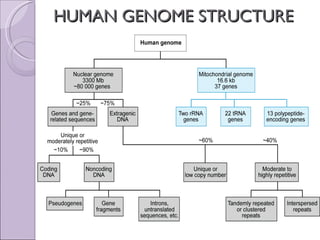
HUMAN GENOME STRUCTURE
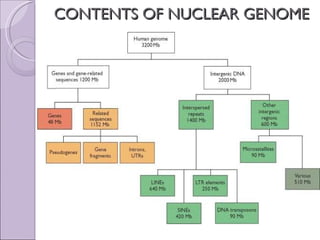
CONTENTS OF NUCLEAR GENOME
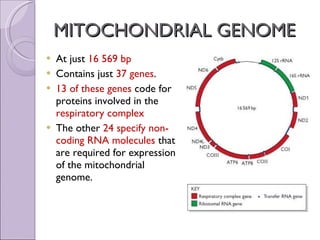
MITOCHONDRIAL GENOME At just  16 569 bp Contains just  37 genes . 13 of these genes  code for proteins involved in the  respiratory complex The other  24 specify non-coding RNA molecules  that are required for expression of the mitochondrial genome.
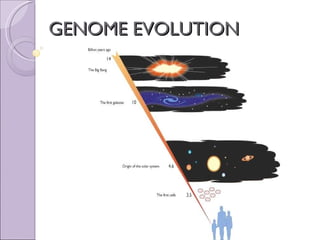
GENOME EVOLUTION
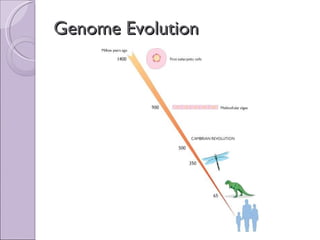
Genome Evolution
Acquisition of New Genes There are two ways in which new genes could be acquired by a genome:  By duplicating  some or all of the existing genes in the genome . By acquiring genes from other species
I. Acquisition of new genes by gene duplication By duplication of the  entire genome; By duplication of a  single chromosome or part of a chromosome; By duplication of a  single gene or group of genes.
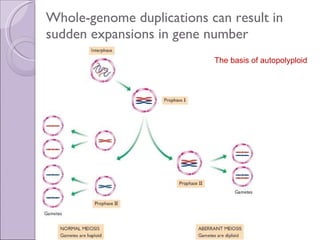
Whole-genome duplications can result in sudden expansions in gene number The basis of autopolyploid
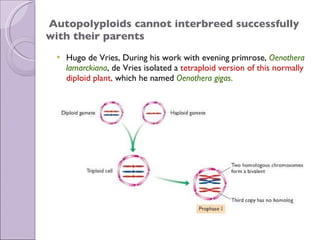
  Autopolyploids cannot interbreed successfully with their parents   Hugo de Vries, During his work with evening primrose,  Oenothera lamarckiana , de Vries isolated a  tetraploid version of this normally diploid plant,  which he named  Oenothera gigas .
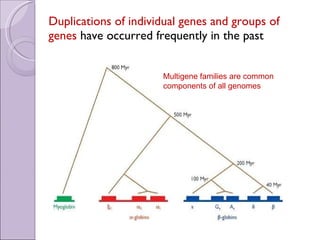
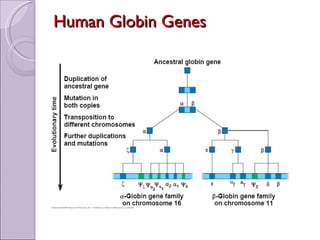
Duplications of individual genes and groups of genes  have occurred frequently in the past Multigene families are common components of all genomes
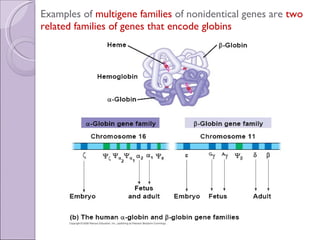
Examples of  multigene families  of nonidentical genes are  two related families of genes that encode globins
Human Globin Genes
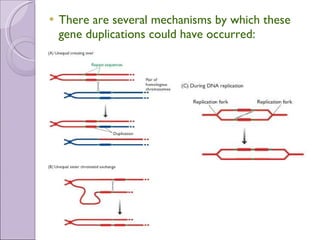
There are several mechanisms by which these gene duplications could have occurred:
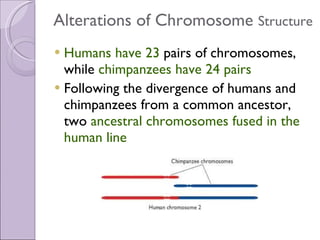
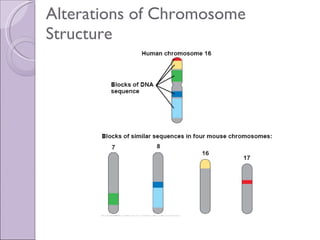
Alterations of Chromosome  Structure Humans have 23  pairs of chromosomes, while  chimpanzees have 24 pairs Following the divergence of humans and chimpanzees from a common ancestor, two  ancestral chromosomes fused in the human line
Alterations of Chromosome Structure
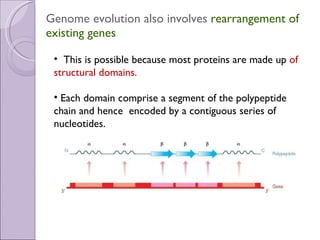
Genome evolution also involves  rearrangement of existing genes This is possible because most proteins are made up  of structural domains. Each domain comprise a segment of the polypeptide chain and hence  encoded by a contiguous series of nucleotides.
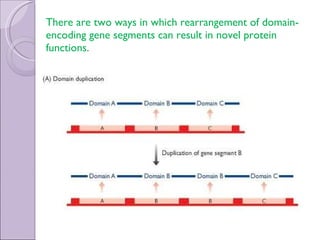
There are two ways in which rearrangement of domain-encoding gene segments can result in novel protein functions .
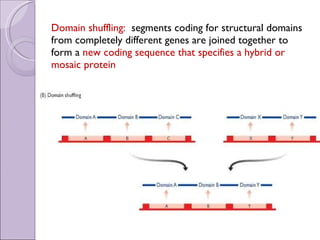
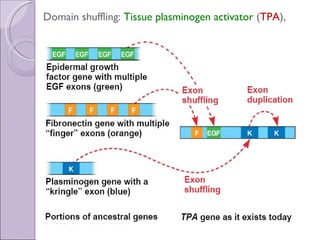
Domain shuffling:  segments coding for structural domains from completely different genes are joined together to form a  new coding sequence that specifies a hybrid or mosaic protein
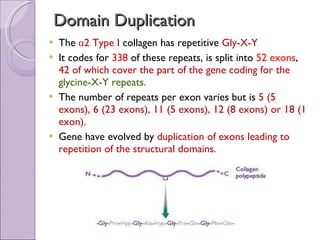
Domain Duplication The  α2 Type I  collagen has repetitive  Gly-X-Y  It codes for  338  of these repeats, is split into  52 exons ,  42 of which cover the part of the gene coding for the  glycine-X-Y repeats. The number of repeats per exon varies but is  5 (5 exons), 6 (23 exons), 11 (5 exons), 12 (8 exons) or 18 (1 exon).  Gene have evolved by  duplication of exons leading to repetition of the structural domains.
Domain shuffling:  Tissue plasminogen activator  ( TPA ),
Evolution of Genes with Novel Functions For example the  lysozyme gene  was  duplicated  and evolved into  the α lactalbumin gene  in mammals Lysozyme  is an enzyme that helps  protect  animals against  bacterial infection α-lactalbumin  is a nonenzymatic protein that plays a  role in milk production   in mammals
II. Acquisition of new genes from other species Comparisons  of bacterial and archaeal genome  sequences suggest that  lateral gene transfer  has been a major event in the evolution of prokaryotic genomes Conjugation  , for example, enables plasmids to move between  bacteria  and frequently results in the acquisition of new gene functions by the recipients A second process for DNA transfer between  prokaryotes ,  transformation  , is more likely to have had an influence on genome evolution.
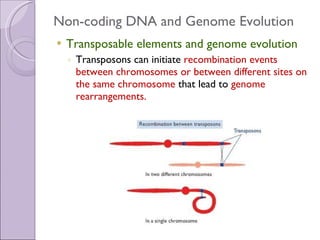
Non-coding DNA and Genome Evolution Transposable elements and genome evolution Transposons can initiate  recombination events between chromosomes or between different sites on the same chromosome  that lead to  genome rearrangements.
Origins of introns Self-splicing introns  evolved in the RNA world and have survived ever since without undergoing a great deal of change  Origins of  GU-AG introns: ‘ Introns early’  states that introns are  very ancient  and are gradually being lost from eukaryotic genomes. ‘ Introns late’  states that introns  evolved relatively recently  and are gradually accumulating in eukaryotic genomes.
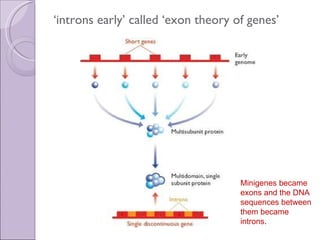
‘ introns early’ called ‘exon theory of genes’  Minigenes became exons and the DNA sequences between them became introns .
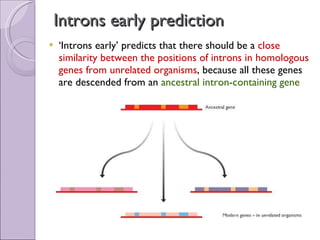
Introns early prediction ‘ Introns early’ predicts that there should be a  close similarity between the positions of introns in homologous genes   from unrelated organisms , because all these genes are descended from an  ancestral intron-containing gene
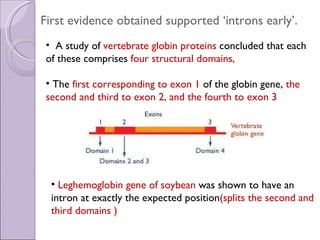
First evidence obtained supported ‘introns early’. A study of  vertebrate globin proteins  concluded that each of these comprises  four structural domains,  The  first corresponding to exon 1  of the globin gene,  the second and third to exon 2, and the fourth to exon 3 Leghemoglobin   gene of soybean  was shown to have an intron at exactly the expected position (splits the second and third domains )
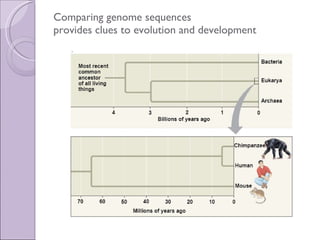
Comparing genome sequences provides clues to evolution and development

Genome origin

  • 1.
    GENOME GENOME ORGANIZATIONACQUISITION OF NEW GENES ORIGIN OF INTRONS Ms.ruchi yadav lecturer amity institute of biotechnology amity university lucknow(up)
  • 2.
  • 3.
  • 4.
    MITOCHONDRIAL GENOME Atjust 16 569 bp Contains just 37 genes . 13 of these genes code for proteins involved in the respiratory complex The other 24 specify non-coding RNA molecules that are required for expression of the mitochondrial genome.
  • 5.
  • 6.
  • 7.
    Acquisition of NewGenes There are two ways in which new genes could be acquired by a genome: By duplicating some or all of the existing genes in the genome . By acquiring genes from other species
  • 8.
    I. Acquisition ofnew genes by gene duplication By duplication of the entire genome; By duplication of a single chromosome or part of a chromosome; By duplication of a single gene or group of genes.
  • 9.
    Whole-genome duplications canresult in sudden expansions in gene number The basis of autopolyploid
  • 10.
      Autopolyploids cannotinterbreed successfully with their parents Hugo de Vries, During his work with evening primrose, Oenothera lamarckiana , de Vries isolated a tetraploid version of this normally diploid plant, which he named Oenothera gigas .
  • 11.
    Duplications of individualgenes and groups of genes have occurred frequently in the past Multigene families are common components of all genomes
  • 12.
    Examples of multigene families of nonidentical genes are two related families of genes that encode globins
  • 13.
  • 14.
    There are severalmechanisms by which these gene duplications could have occurred:
  • 15.
    Alterations of Chromosome Structure Humans have 23 pairs of chromosomes, while chimpanzees have 24 pairs Following the divergence of humans and chimpanzees from a common ancestor, two ancestral chromosomes fused in the human line
  • 16.
  • 17.
    Genome evolution alsoinvolves rearrangement of existing genes This is possible because most proteins are made up of structural domains. Each domain comprise a segment of the polypeptide chain and hence encoded by a contiguous series of nucleotides.
  • 18.
    There are twoways in which rearrangement of domain-encoding gene segments can result in novel protein functions .
  • 19.
    Domain shuffling: segments coding for structural domains from completely different genes are joined together to form a new coding sequence that specifies a hybrid or mosaic protein
  • 20.
    Domain Duplication The α2 Type I collagen has repetitive Gly-X-Y It codes for 338 of these repeats, is split into 52 exons , 42 of which cover the part of the gene coding for the glycine-X-Y repeats. The number of repeats per exon varies but is 5 (5 exons), 6 (23 exons), 11 (5 exons), 12 (8 exons) or 18 (1 exon). Gene have evolved by duplication of exons leading to repetition of the structural domains.
  • 21.
    Domain shuffling: Tissue plasminogen activator ( TPA ),
  • 22.
    Evolution of Geneswith Novel Functions For example the lysozyme gene was duplicated and evolved into the α lactalbumin gene in mammals Lysozyme is an enzyme that helps protect animals against bacterial infection α-lactalbumin is a nonenzymatic protein that plays a role in milk production in mammals
  • 23.
    II. Acquisition ofnew genes from other species Comparisons of bacterial and archaeal genome sequences suggest that lateral gene transfer has been a major event in the evolution of prokaryotic genomes Conjugation , for example, enables plasmids to move between bacteria and frequently results in the acquisition of new gene functions by the recipients A second process for DNA transfer between prokaryotes , transformation , is more likely to have had an influence on genome evolution.
  • 24.
    Non-coding DNA andGenome Evolution Transposable elements and genome evolution Transposons can initiate recombination events between chromosomes or between different sites on the same chromosome that lead to genome rearrangements.
  • 25.
    Origins of intronsSelf-splicing introns evolved in the RNA world and have survived ever since without undergoing a great deal of change Origins of GU-AG introns: ‘ Introns early’ states that introns are very ancient and are gradually being lost from eukaryotic genomes. ‘ Introns late’ states that introns evolved relatively recently and are gradually accumulating in eukaryotic genomes.
  • 26.
    ‘ introns early’called ‘exon theory of genes’ Minigenes became exons and the DNA sequences between them became introns .
  • 27.
    Introns early prediction‘ Introns early’ predicts that there should be a close similarity between the positions of introns in homologous genes from unrelated organisms , because all these genes are descended from an ancestral intron-containing gene
  • 28.
    First evidence obtainedsupported ‘introns early’. A study of vertebrate globin proteins concluded that each of these comprises four structural domains, The first corresponding to exon 1 of the globin gene, the second and third to exon 2, and the fourth to exon 3 Leghemoglobin gene of soybean was shown to have an intron at exactly the expected position (splits the second and third domains )
  • 29.
    Comparing genome sequencesprovides clues to evolution and development