CURRICULUM
CONTEXTUALIZATION
Objectives
1. Identify the initiatives of DepEd and its Legal
Bases in relation to contextualization.
2. Explain the process of contextualization
3. Cite the importance of curriculum
contextualization
4 Discuss the “Policy Guidelines on Classroom
Assessment”
DEPARTMENT OF EDUCATION - REGIONAL OFFICE NO. III
LET US THINK
1. What do you know about curriculum
contextualization?
2. What is localization?
3. What is indigenization?
DEPARTMENT OF EDUCATION - REGIONAL OFFICE NO. III
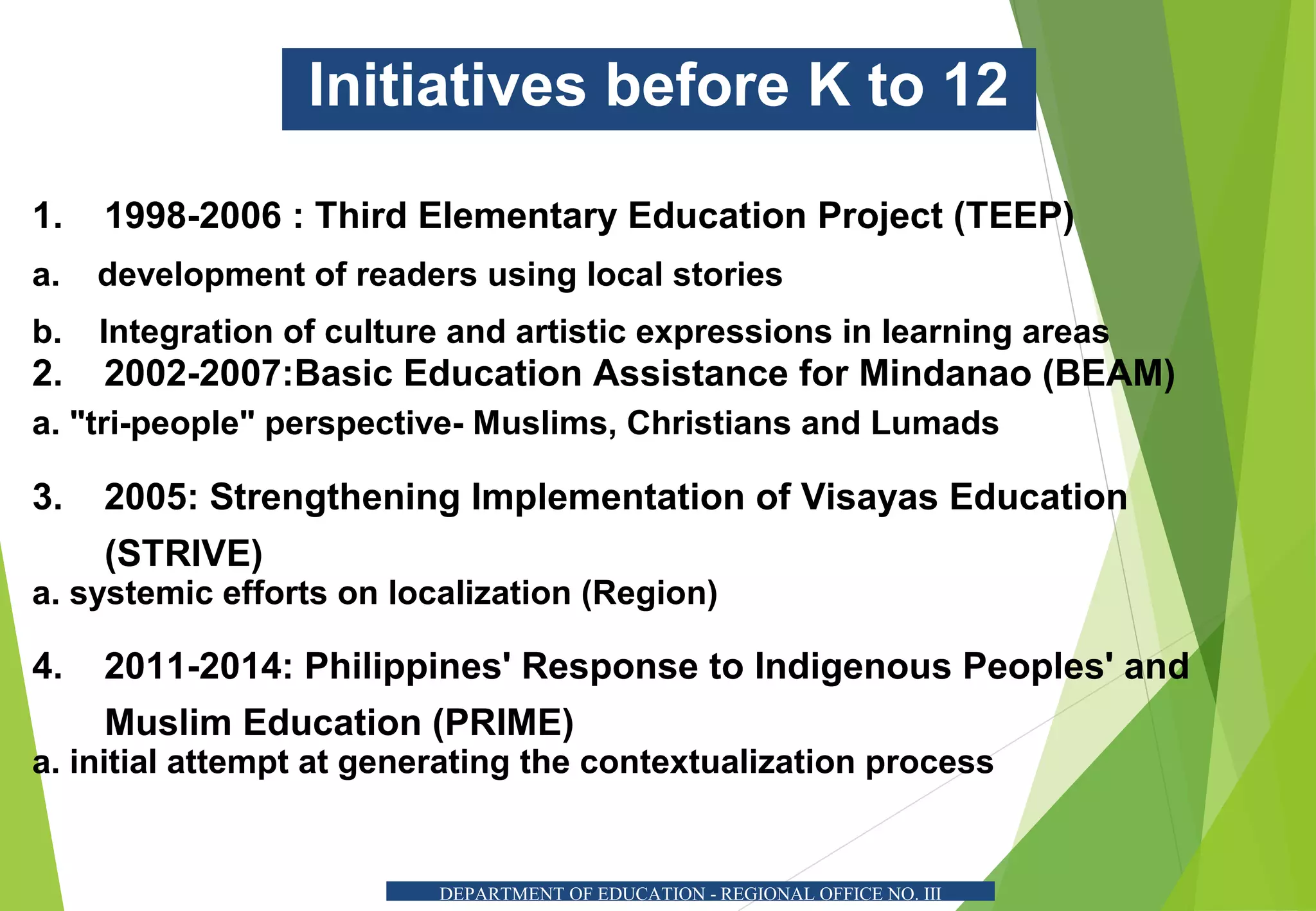
Initiatives before K to 12
1. 1998-2006 : Third Elementary Education Project (TEEP)
a. development of readers using local stories
b. Integration of culture and artistic expressions in learning areas
2. 2002-2007:Basic Education Assistance for Mindanao (BEAM)
a. "tri-people" perspective- Muslims, Christians and Lumads
3. 2005: Strengthening Implementation of Visayas Education
(STRIVE)
a. systemic efforts on localization (Region)
4. 2011-2014: Philippines' Response to Indigenous Peoples' and
Muslim Education (PRIME)
a. initial attempt at generating the contextualization process
DEPARTMENT OF EDUCATION - REGIONAL OFFICE NO. III
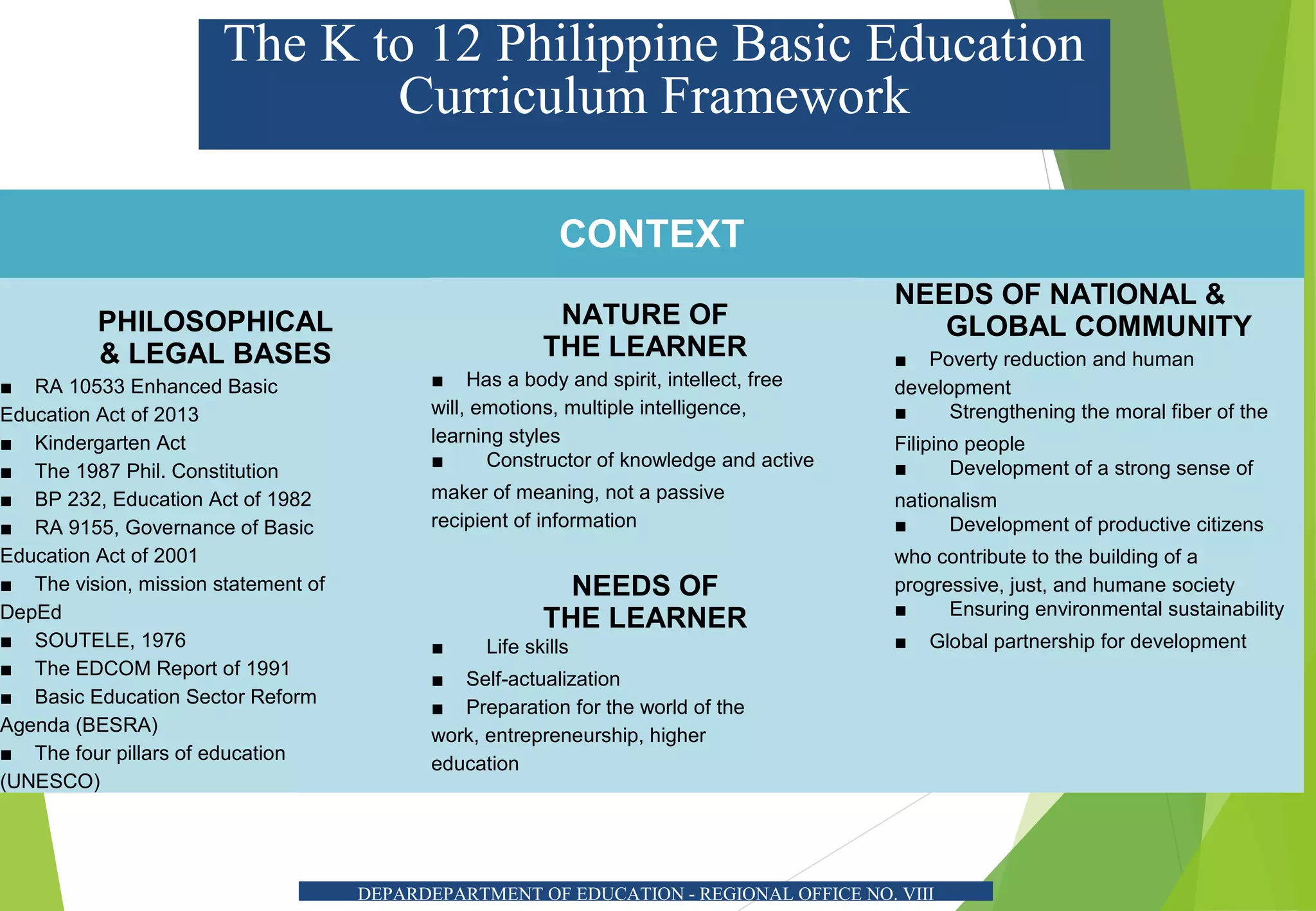
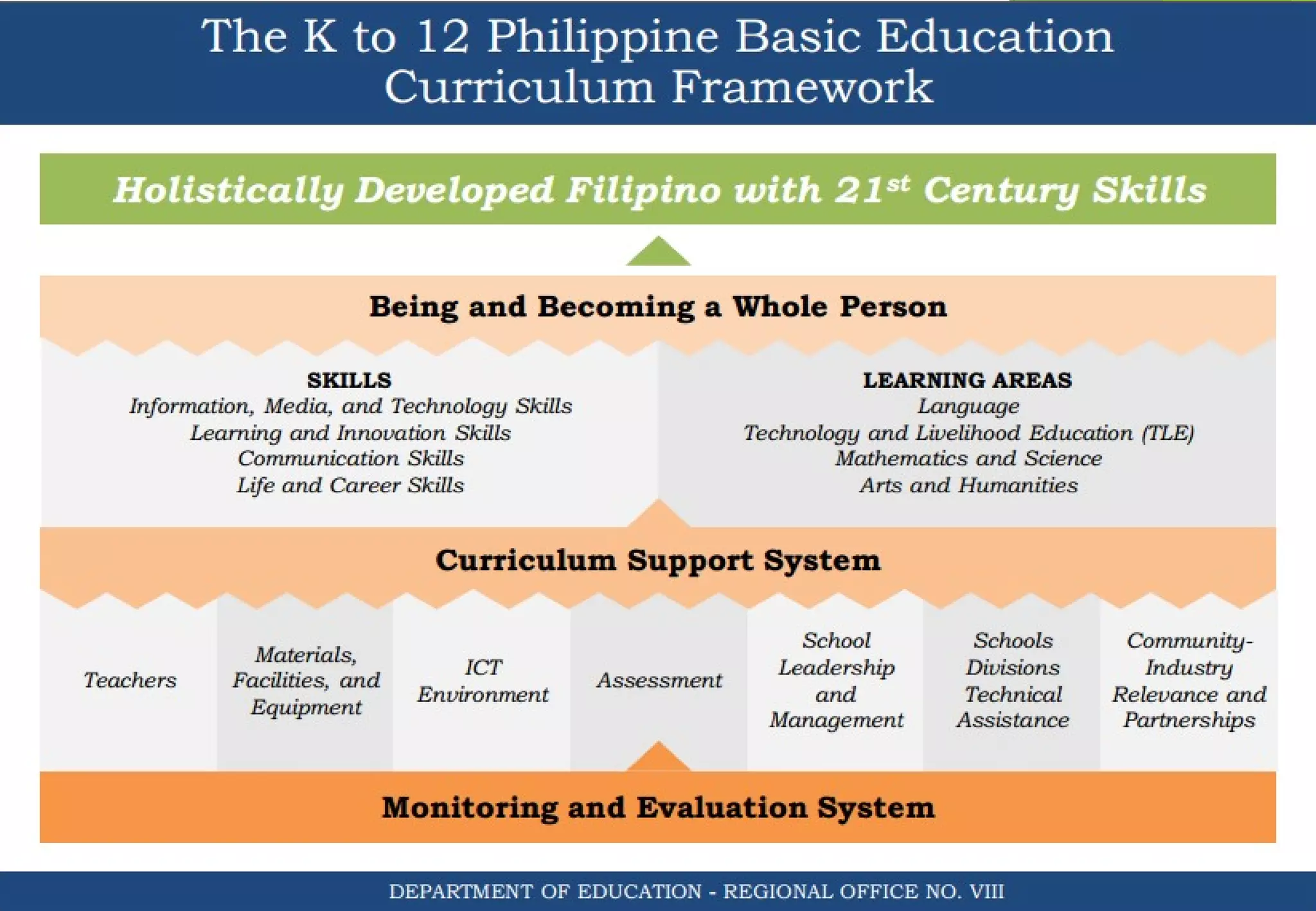
The K to 12 Philippine Basic Education
Curriculum Framework
CONTEXT
PHILOSOPHICAL
& LEGAL BASES
■ RA 10533 Enhanced Basic
Education Act of 2013
■ Kindergarten Act
■ The 1987 Phil. Constitution
■ BP 232, Education Act of 1982
■ RA 9155, Governance of Basic
Education Act of 2001
■ The vision, mission statement of
DepEd
■ SOUTELE, 1976
■ The EDCOM Report of 1991
■ Basic Education Sector Reform
Agenda (BESRA)
■ The four pillars of education
(UNESCO)
NATURE OF
THE LEARNER
■ Has a body and spirit, intellect, free
will, emotions, multiple intelligence,
learning styles
■ Constructor of knowledge and active
maker of meaning, not a passive
recipient of information
NEEDS OF NATIONAL &
GLOBAL COMMUNITY
■ Poverty reduction and human
development
■ Strengthening the moral fiber of the
Filipino people
■ Development of a strong sense of
nationalism
■ Development of productive citizens
who contribute to the building of a
progressive, just, and humane society
■ Ensuring environmental sustainability
■ Global partnership for development
NEEDS OF
THE LEARNER
■ Life skills
■ Self-actualization
■ Preparation for the world of the
work, entrepreneurship, higher
education
DEPARDEPARTMENT OF EDUCATION - REGIONAL OFFICE NO. VIII
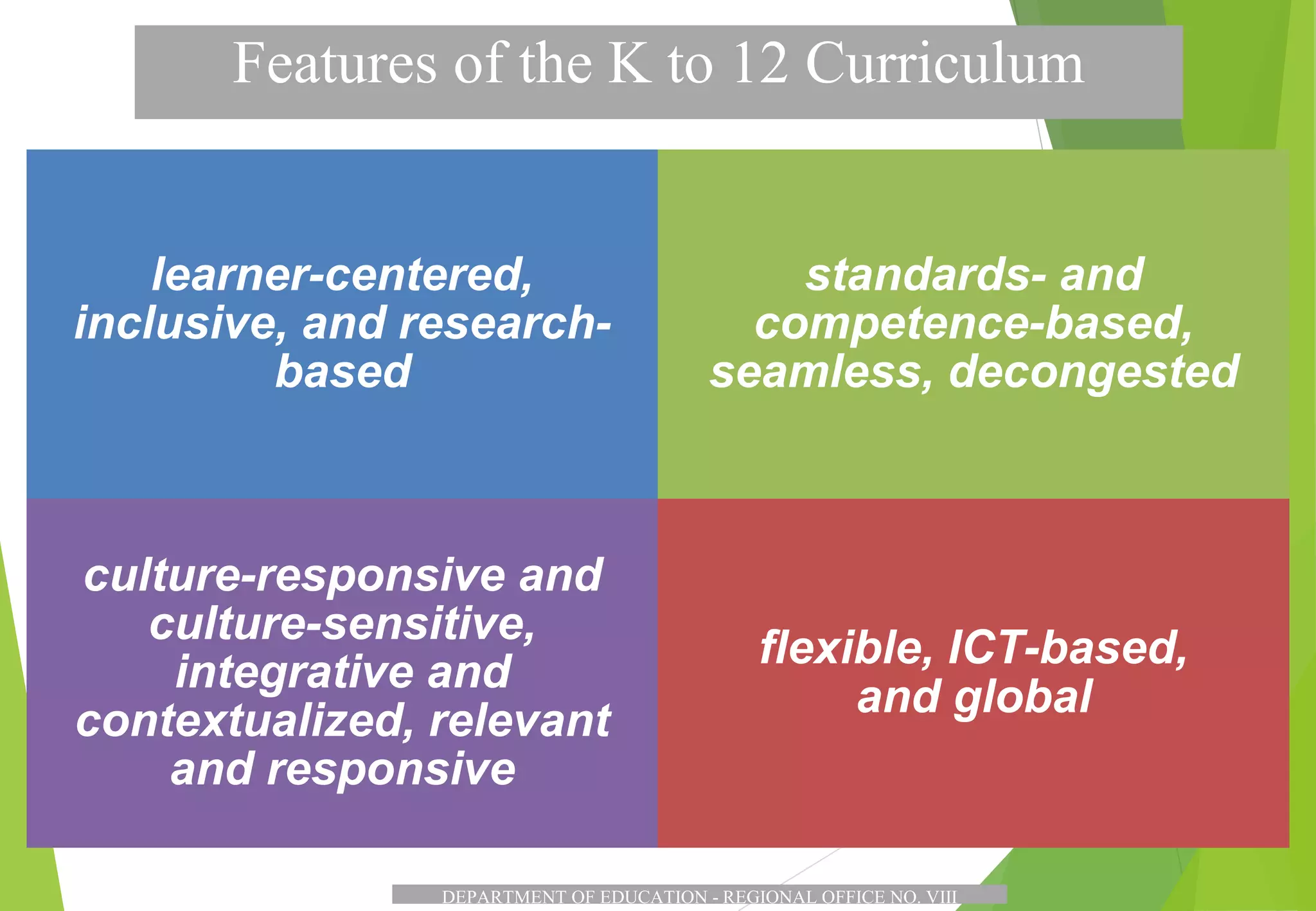
Features of the K to 12 Curriculum
learner-centered,
inclusive, and research-
based
standards- and
competence-based,
seamless, decongested
culture-responsive and
culture-sensitive,
integrative and
contextualized, relevant
and responsive
flexible, ICT-based,
and global
DEPARTMENT OF EDUCATION - REGIONAL OFFICE NO. VIII
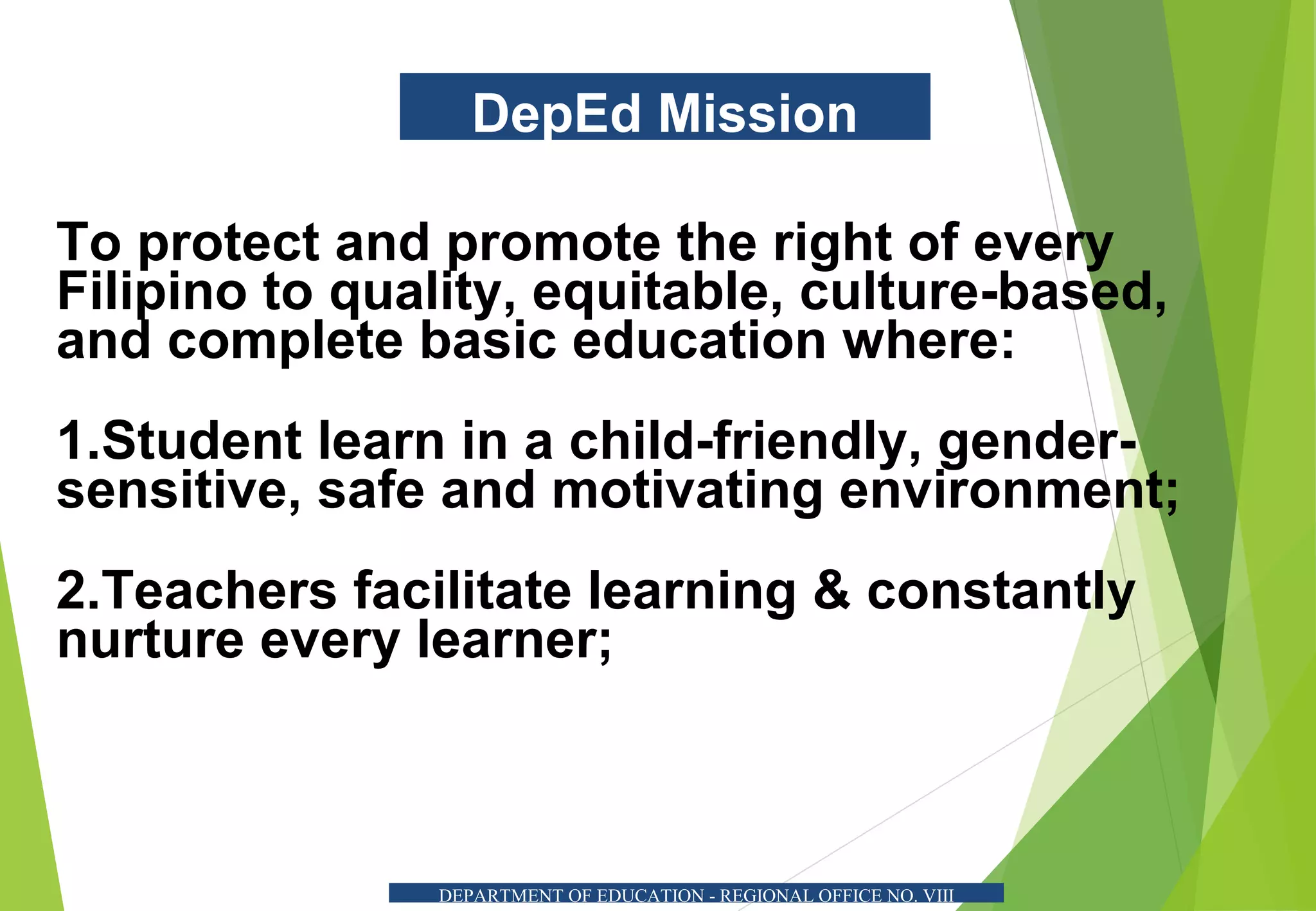
DepEd Mission
To protect and promote the right of every
Filipino to quality, equitable, culture-based,
and complete basic education where:
1.Student learn in a child-friendly, gender-
sensitive, safe and motivating environment;
2.Teachers facilitate learning & constantly
nurture every learner;
DEPARTMENT OF EDUCATION - REGIONAL OFFICE NO. VIII
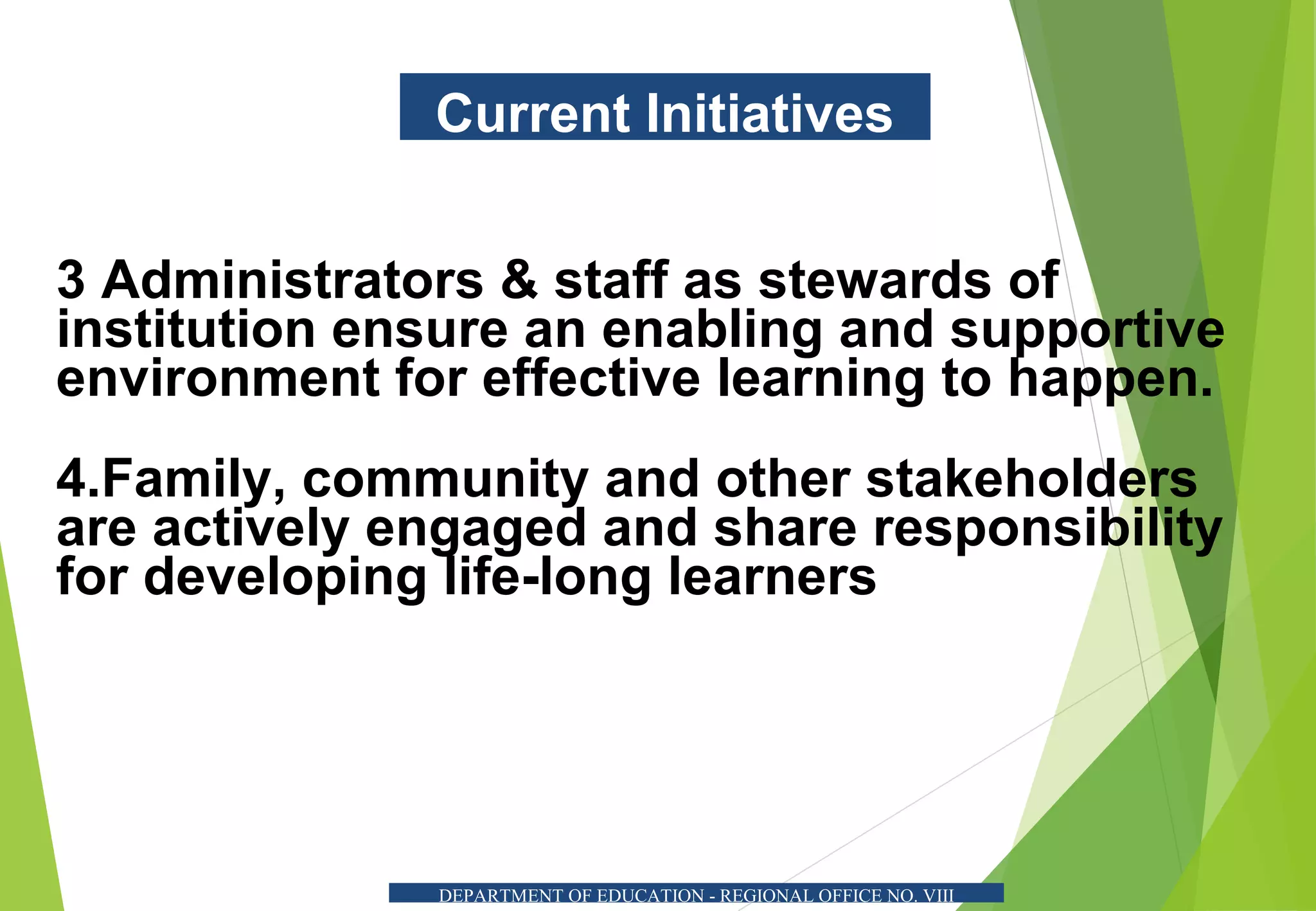
Current Initiatives
3 Administrators & staff as stewards of
institution ensure an enabling and supportive
environment for effective learning to happen.
4.Family, community and other stakeholders
are actively engaged and share responsibility
for developing life-long learners
DEPARTMENT OF EDUCATION - REGIONAL OFFICE NO. VIII
Current Initiatives
What we have now:
Contextualizing Education at Various Levels
1. K to 12 Framework
a. MTB
b. SHS
2. Programs (IPEd, Muslim Ed, SPED, Special
Interest Programs, ALS)
3. Learning Areas (e.g. AP -regional profiles, Art and
Music- cultural artistic expressions by regions)
DEPARTMENT OF EDUCATION - REGIONAL OFFICE NO. VIII
CONTEXTUALIZATION
The K to 12 curriculum framework highlights the
fundamental importance of context in shaping
the curriculum, and consequently, the teaching-
learning process
Enhanced Basic Education Act of 2013 (RA 10533), Sec. 5
The DepEd shall adhere to the following standards and
principles in
developing the enhanced basic education curriculum:
(d)... contextualized and global
DEPARTMENT OF EDUCATION - REGIONAL OFFICE NO. VIII
CONTEXTUALIZATION
Flexibility of the K to 12 curriculum allows for
curriculum enhancement in relation to the diverse
background of learners
Enhanced Basic Education Act of 2013 (RA 10533), Sec. 5
The DepEd shall adhere to the following standards and principles in
developing the enhanced basic education curriculum:
h)... flexible enough to enable and allow schools to
localize, indigenize and enhance the same based on
their respective educational and social contexts. The
production and development of locally produced
teaching materials shall be encouraged and approval of
these materials shall devolve to the regional and
division education units.
DEPARTMENT OF EDUCATION - REGIONAL OFFICE NO. VIII
Key Concepts
CONTEXTUALIZATION
LOCALIZATION
INDIGENIZATION
DEPARTMENT OF EDUCATION - REGIONAL OFFICE NO. VIII
Key Concepts
Contextualization refers to the educational process of
relating the curriculum to a particular setting, situation or
area of application to make the competencies relevant,
meaningful, and useful to all learners.
The degree of contextualization may be described and
distinguished into the following:
1. Localization
2. Indigenization
DEPARTMENT OF EDUCATION - REGIONAL OFFICE NO. VIII
Key Concepts
The degree of contextualization may be
described and distinguished into the
following:
1. Localization refers to the process of
relating learning content specified in the
curriculum to local information and materials
in the learners'
community.
DEPARTMENT OF EDUCATION - REGIONAL OFFICE NO. VIII
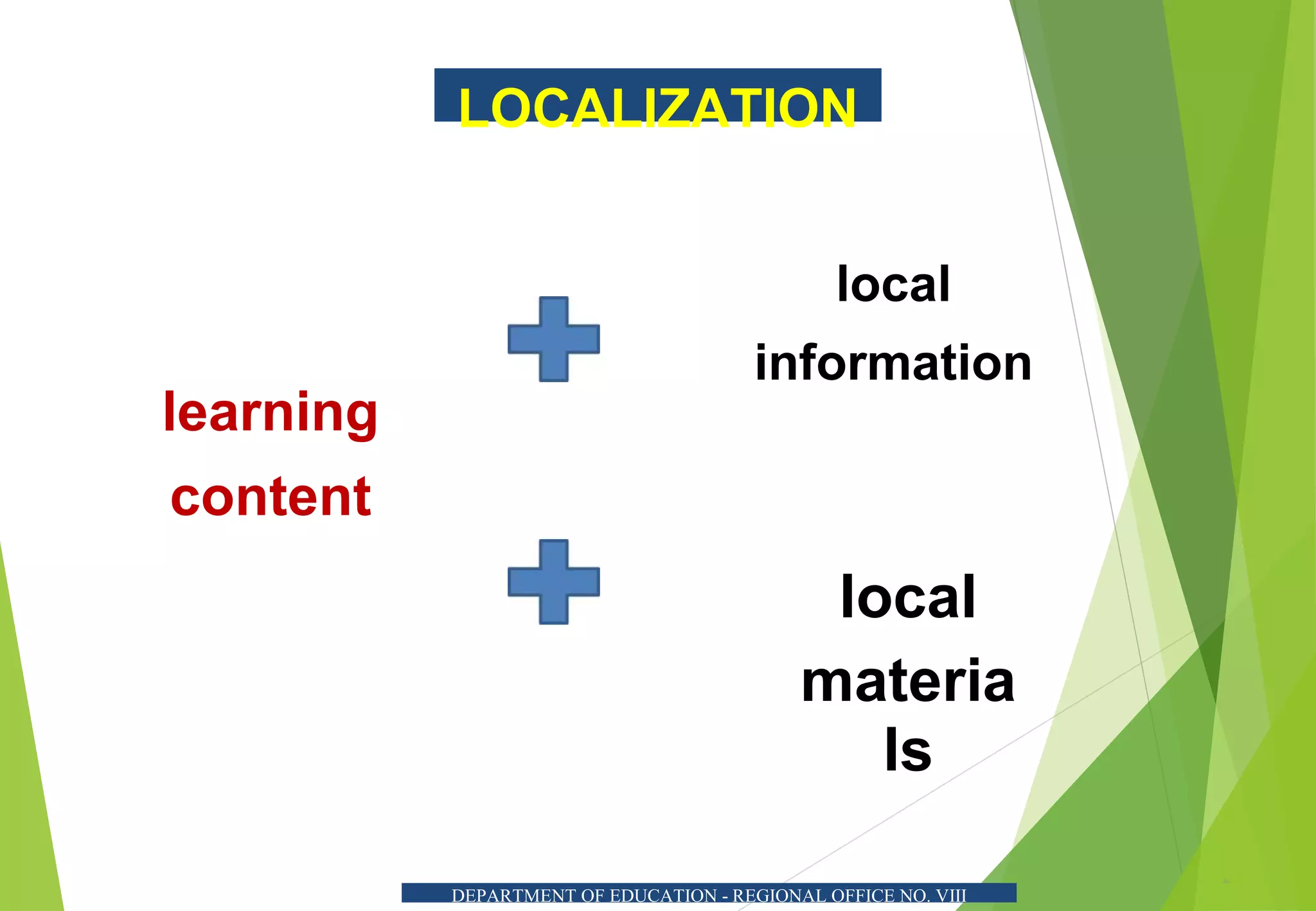
LOCALIZATION
learning
content
local
information
local
materia
ls
11;
DEPARTMENT OF EDUCATION - REGIONAL OFFICE NO. VIII
Examples of Localization
1. Examples used in lessons start with those in the locality
2. Names, situations, setting needed to give context to
test questions or problem-solving exercises are those
of the immediate community
3. Local materials are used as often as possible in making
instructional materials
4. Local stories are used in the language learning areas
5. Translating a story written in another language to the
language of one's learners for use in MTB-MLE
DEPARTMENT OF EDUCATION - REGIONAL OFFICE NO. VIII
Key Concepts
The degree of contextualization may be described and distinguished into the
following:
1. Localization refers to the process of relating learning content specified in
the curriculum to local information and materials in the learners'
community.
2. Indigenization refers to the process of enhancing curriculum
competencies, education resources, and teaching-learning processes in
relation to the bio-geographical, historical, and socio-cultural context of
the learners' community. Indigenization may also involve the
enhancement of the curriculum framework, curriculum design, and
learning standards of subject areas, guided by the standards and
principles adhered to by the national curriculum.
DEPARTMENT OF EDUCATION - REGIONAL OFFICE NO. VIII
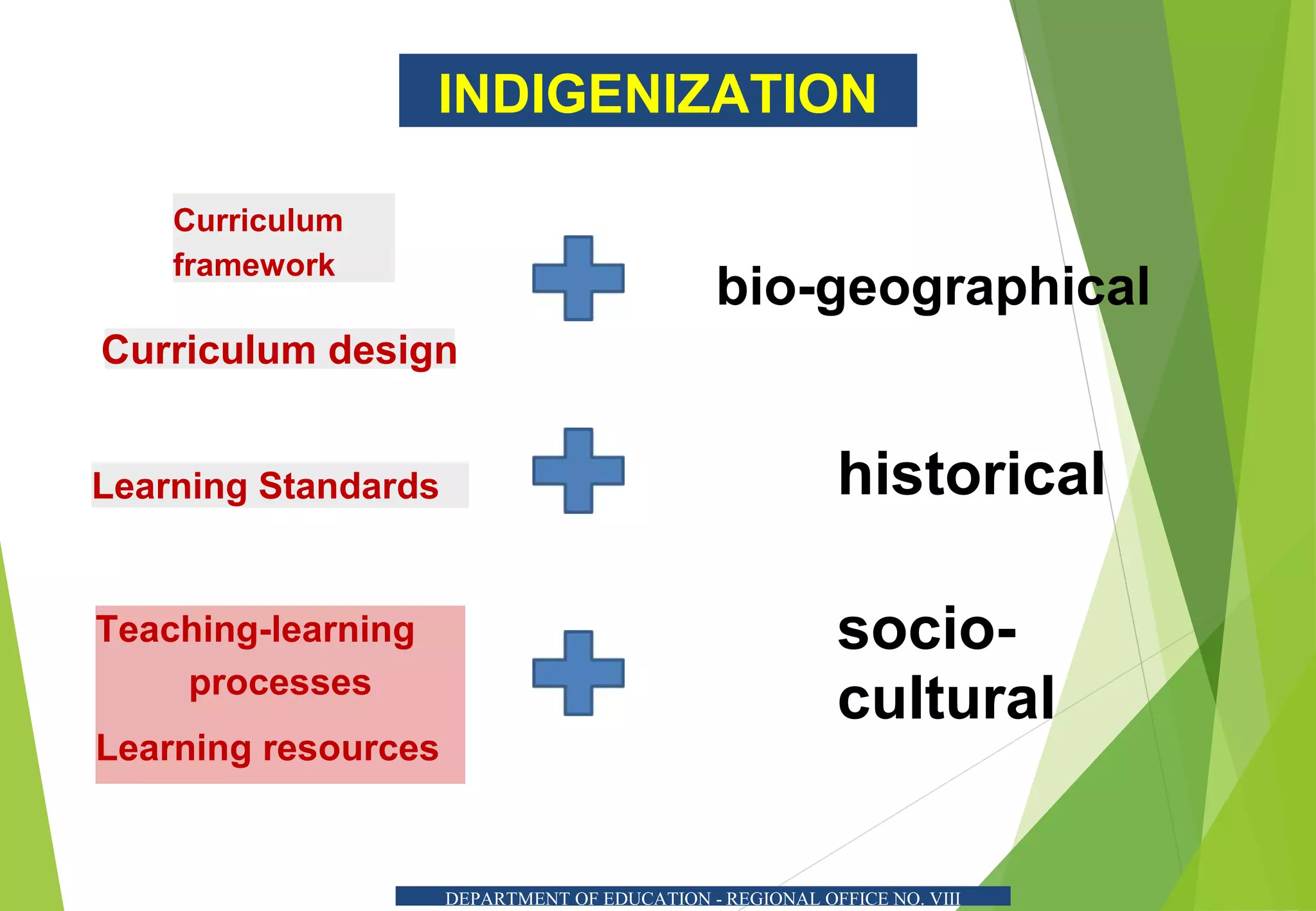
INDIGENIZATION
Curriculum
framework
Curriculum design
bio-geographical
Learning Standards
Teaching-learning
processes
Learning resources
historical
socio-
cultural
DEPARTMENT OF EDUCATION - REGIONAL OFFICE NO. VIII
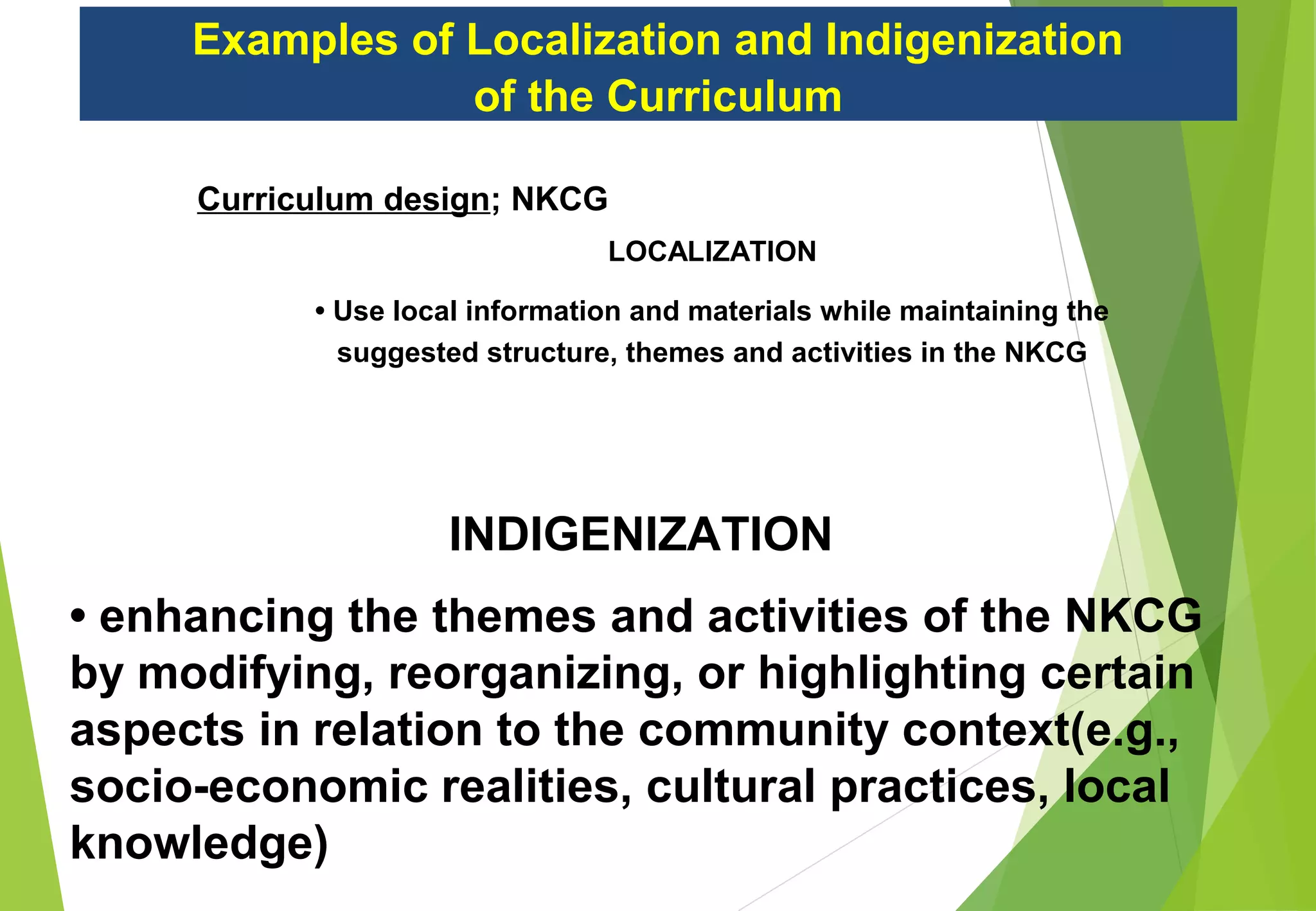
Examples of Localization and Indigenization
of the Curriculum
Curriculum design; NKCG
LOCALIZATION
• Use local information and materials while maintaining the
suggested structure, themes and activities in the NKCG
INDIGENIZATION
• enhancing the themes and activities of the NKCG
by modifying, reorganizing, or highlighting certain
aspects in relation to the community context(e.g.,
socio-economic realities, cultural practices, local
knowledge)
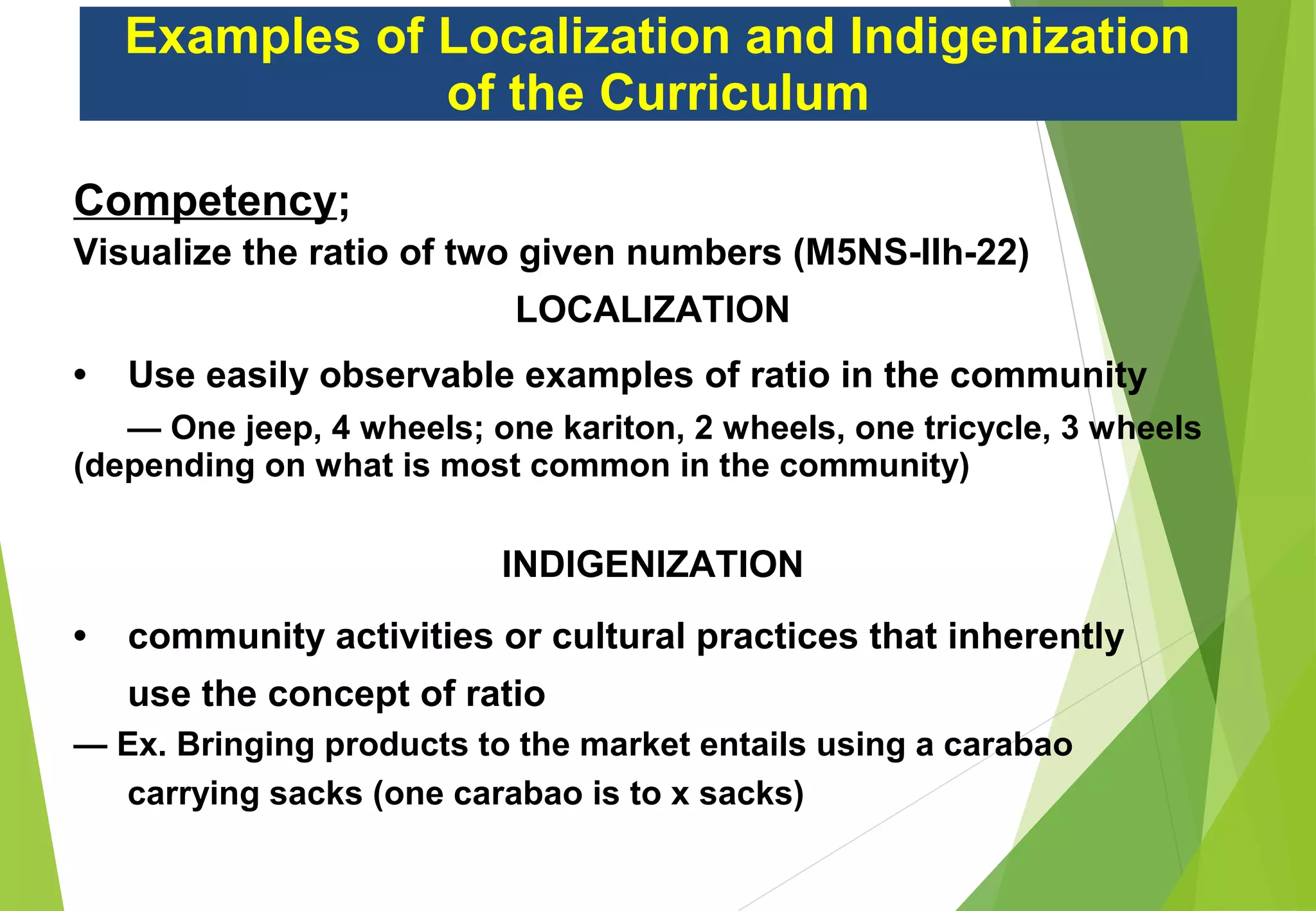
Examples of Localization and Indigenization
of the Curriculum
Competency;
Visualize the ratio of two given numbers (M5NS-IIh-22)
LOCALIZATION
• Use easily observable examples of ratio in the community
— One jeep, 4 wheels; one kariton, 2 wheels, one tricycle, 3 wheels
(depending on what is most common in the community)
INDIGENIZATION
• community activities or cultural practices that inherently
use the concept of ratio
— Ex. Bringing products to the market entails using a carabao
carrying sacks (one carabao is to x sacks)
Examples of Localization and Indigenization of the
Curriculum
Competency;
Identify star patterns that can be seen at particular times of the
year (S5FE-IVi-j-1)
LOCALIZATION
• use the community's name for prominent stars, if they have,
while retaining the use of the Greek constellations and its
background in discussing star patterns
INDIGENIZATION
• Discuss the community's own calendar of star patterns and its
background before discussing the Greek constellations
DEPARTMENT OF EDUCATION - REGIONAL OFFICE NO. VIII
BANGHAY ARALIN SA EDUKASYON SA
PAGPAPAKATAO 3
(Unang Markahan)
National Competence:
Naipapakita ang natatanging kakayahan.
Hal. Talentong ibinigay ng Diyos.
(EsP3PKP- Ia – 13) pg.166
Community Competence:
Nakasasayaw ng Igal-Igal.
Banghay Aralin sa Edukasyon Sa
Pagpapakatao 3
(Second Quarter)
National competence: Nakapagpapakita nang
may kasiyahan sa pakikiisa sa mga gawaing
pambata. (ESP3P-II h-i-17 page 168)
Community competence: Napaghihiwalay
ang mga malalaki at maliit na isda.
DEPARTMENT OF EDUCATION - REGIONAL OFFICE NO. VIII
Major curriculum thrust of
K to 12: CONTEXTUALIZATION
• Localization and indigenization are
degrees or levels of doing
contextualization
• When we localize, we do not
necessarily indigenize
• When we indigenize, we localize
DEPARTMENT OF EDUCATION - REGIONAL OFFICE NO. VIII
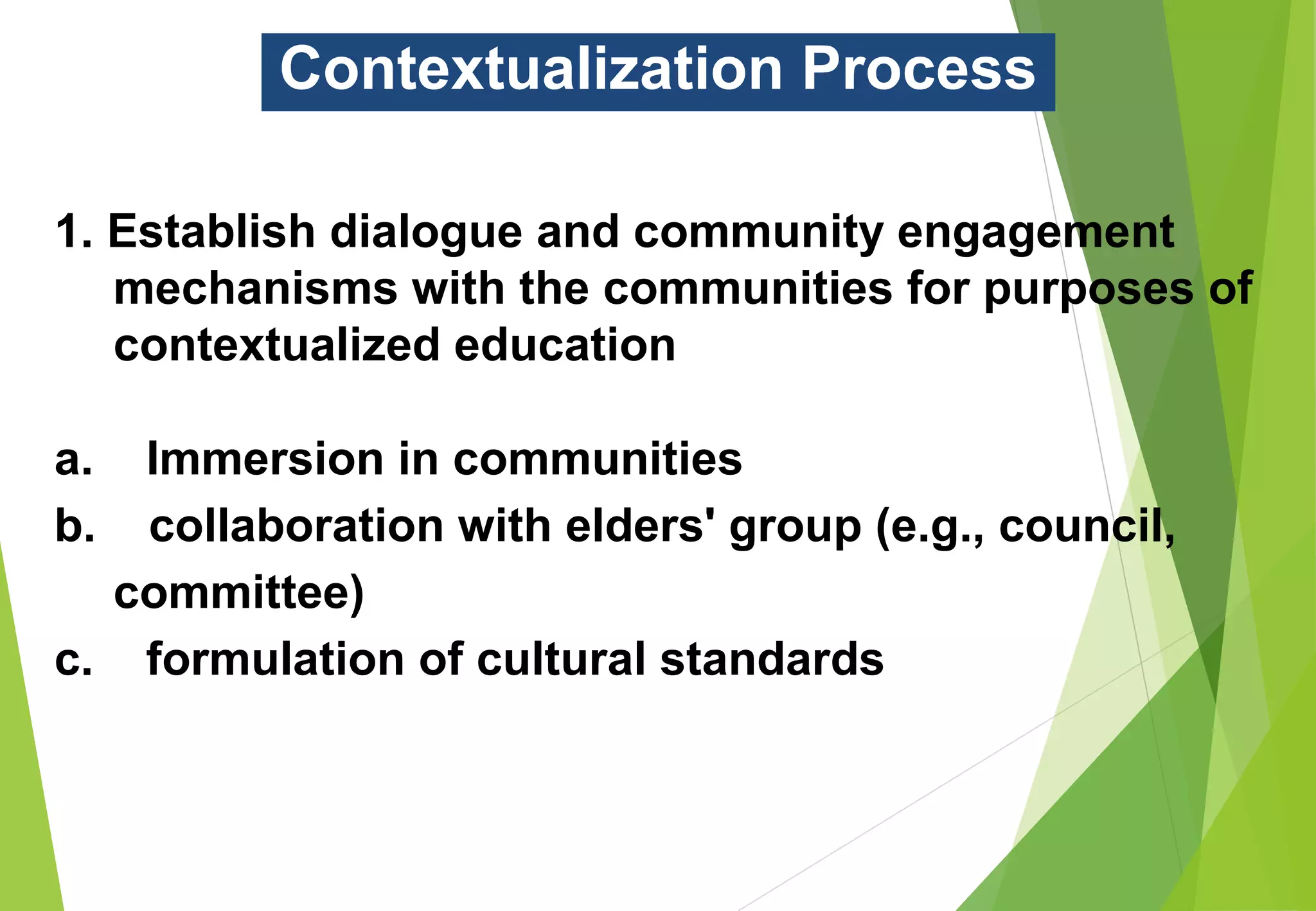
Contextualization Process
1. Establish dialogue and community engagement
mechanisms with the communities for purposes of
contextualized education
a. Immersion in communities
b. collaboration with elders' group (e.g., council,
committee)
c. formulation of cultural standards
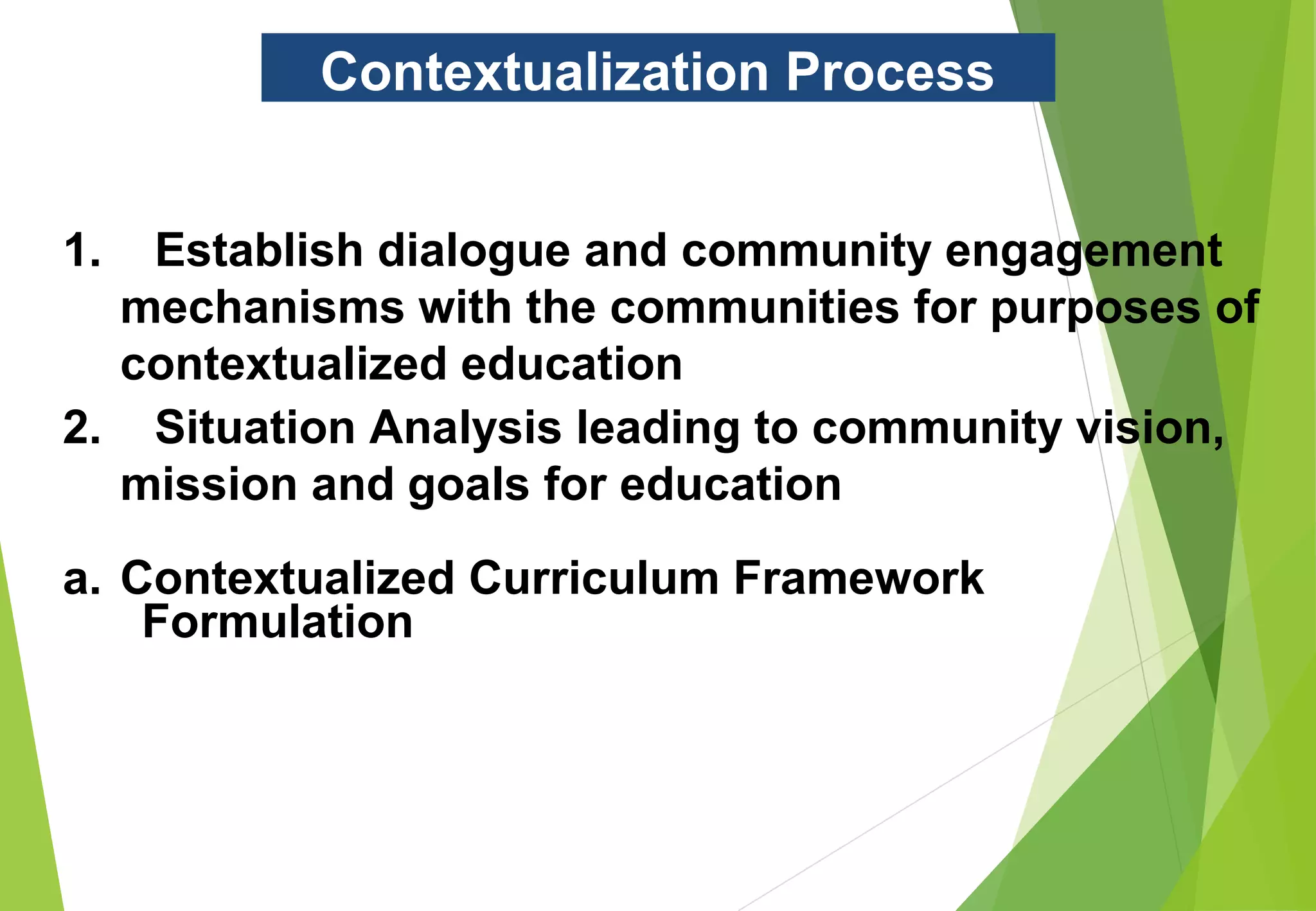
Contextualization Process
1. Establish dialogue and community engagement
mechanisms with the communities for purposes of
contextualized education
2. Situation Analysis leading to community vision,
mission and goals for education
a. Contextualized Curriculum Framework
Formulation
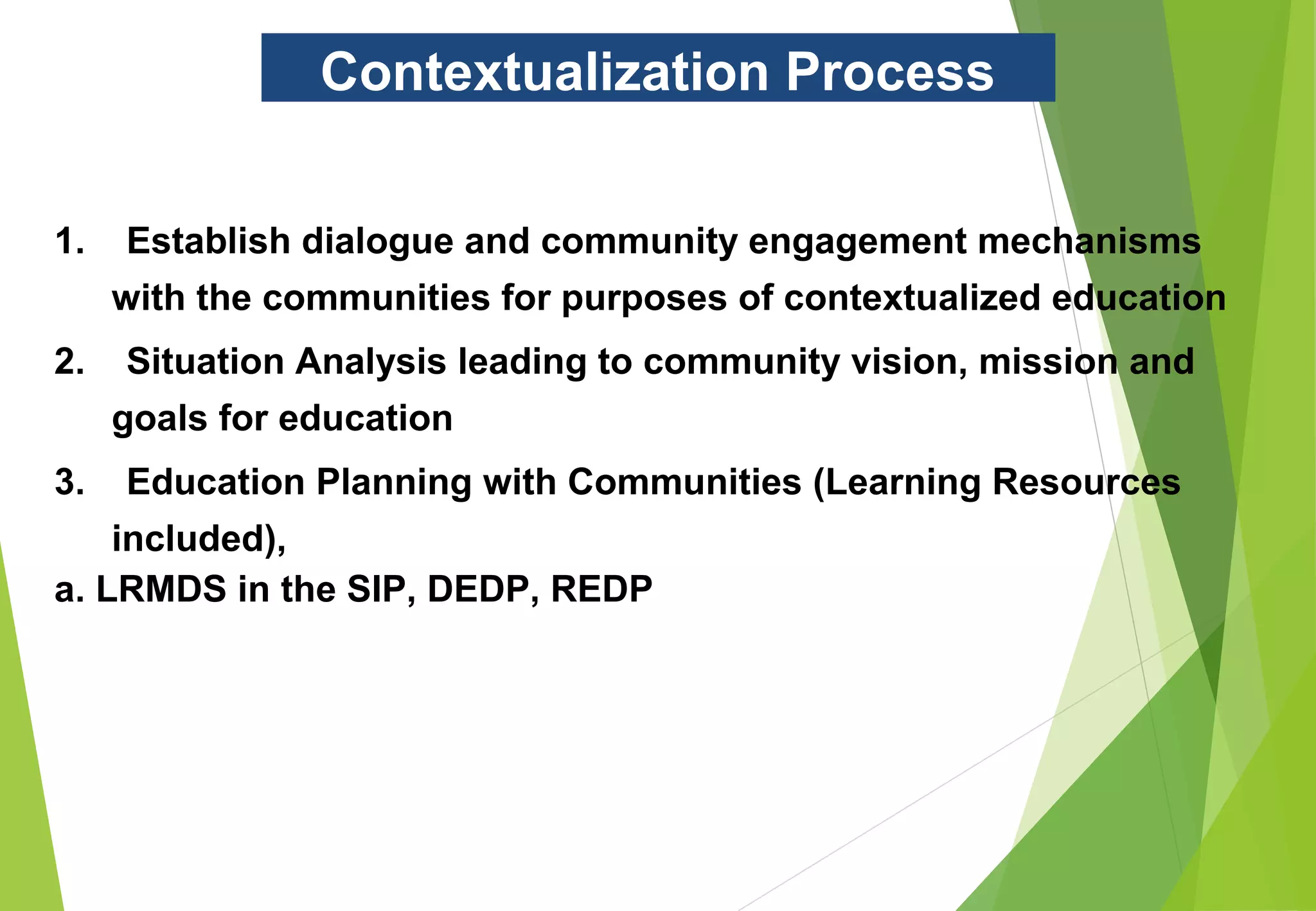
Contextualization Process
1. Establish dialogue and community engagement mechanisms
with the communities for purposes of contextualized education
2. Situation Analysis leading to community vision, mission and
goals for education
3. Education Planning with Communities (Learning Resources
included),
a. LRMDS in the SIP, DEDP, REDP
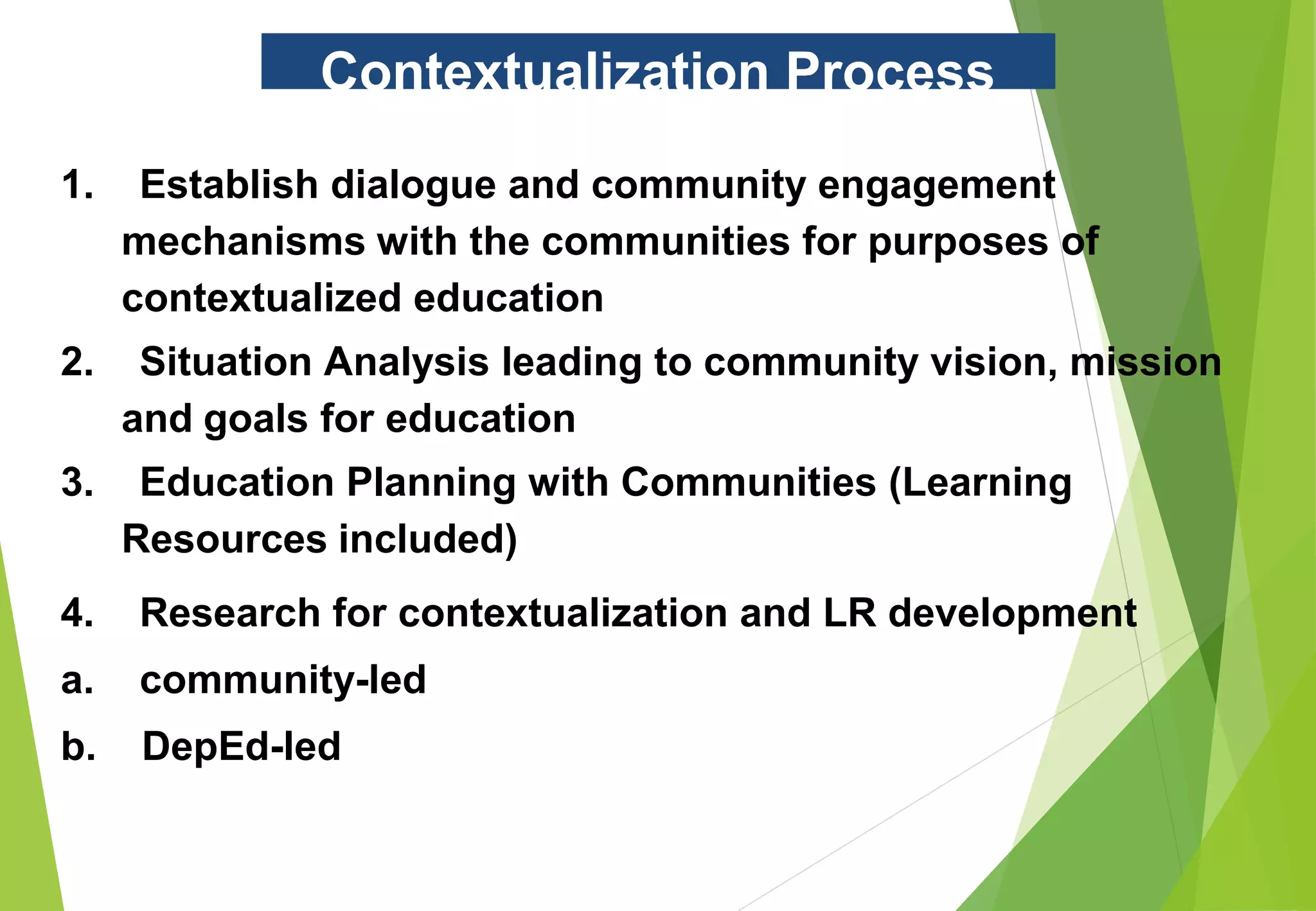
Contextualization Process
1. Establish dialogue and community engagement
mechanisms with the communities for purposes of
contextualized education
2. Situation Analysis leading to community vision, mission
and goals for education
3. Education Planning with Communities (Learning
Resources included)
4. Research for contextualization and LR development
a. community-led
b. DepEd-led
Contextualization Process
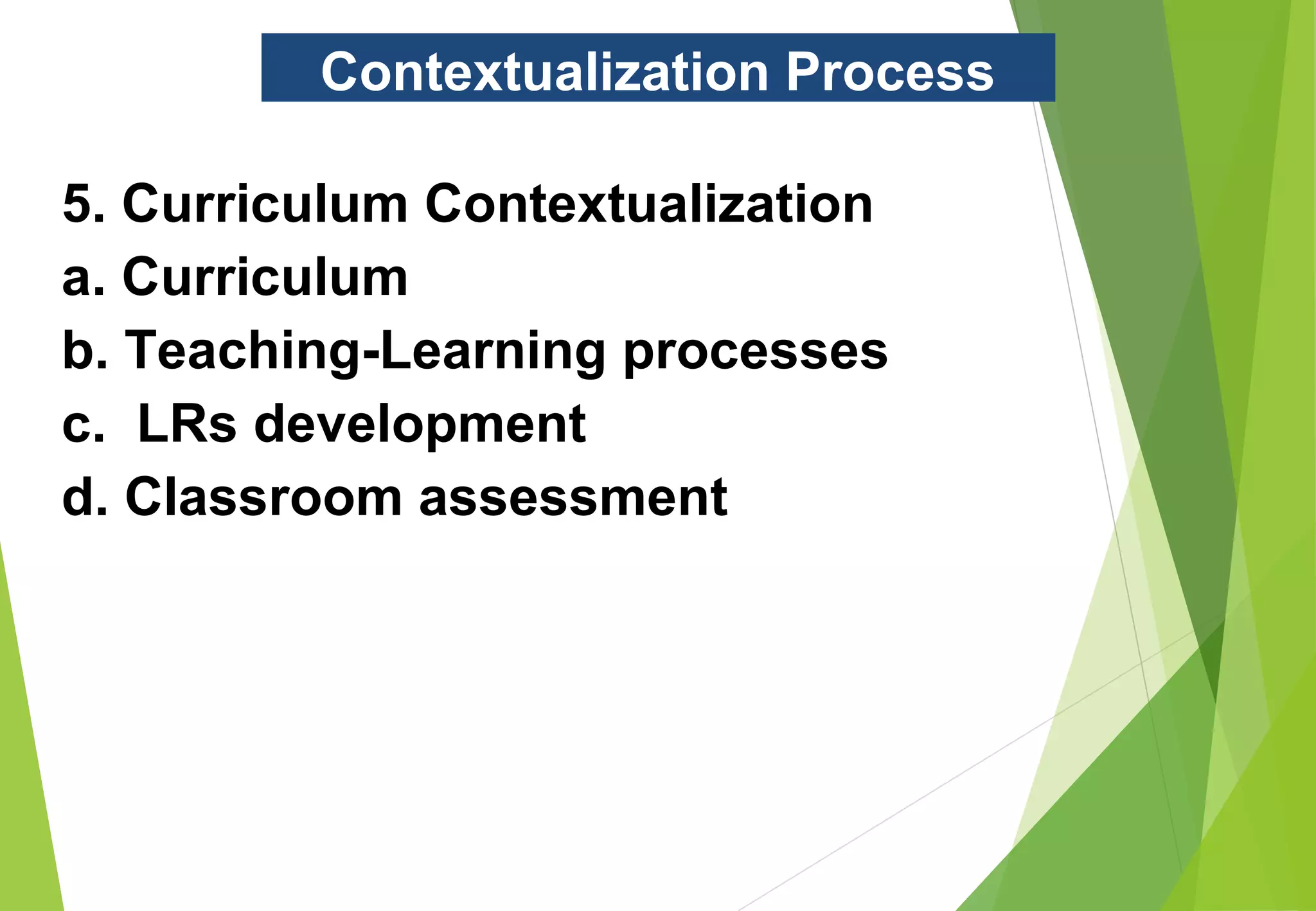
5. Curriculum Contextualization
a. Curriculum
b. Teaching-Learning processes
c. LRs development
d. Classroom assessment
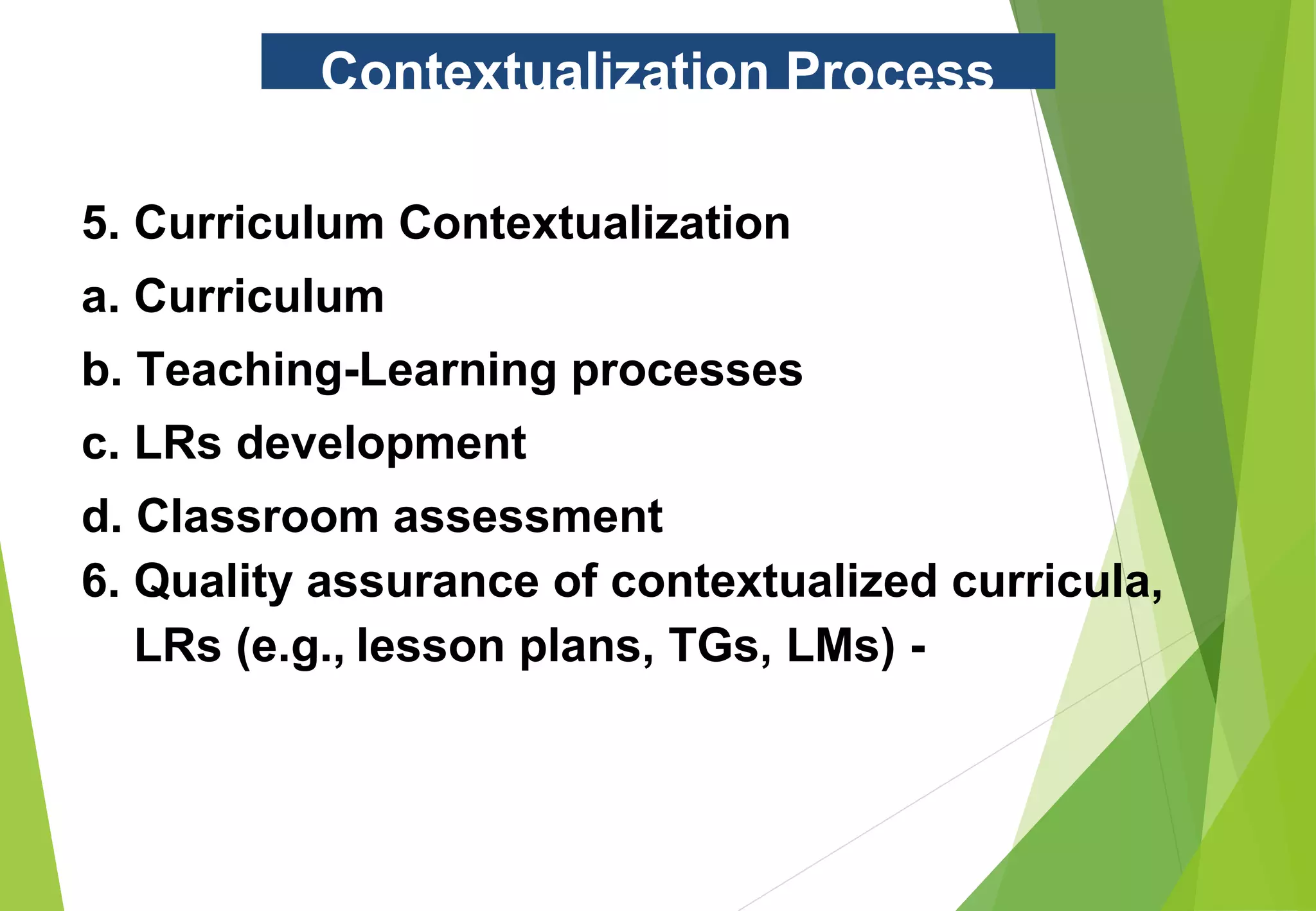
Contextualization Process
5. Curriculum Contextualization
a. Curriculum
b. Teaching-Learning processes
c. LRs development
d. Classroom assessment
6. Quality assurance of contextualized curricula,
LRs (e.g., lesson plans, TGs, LMs) -
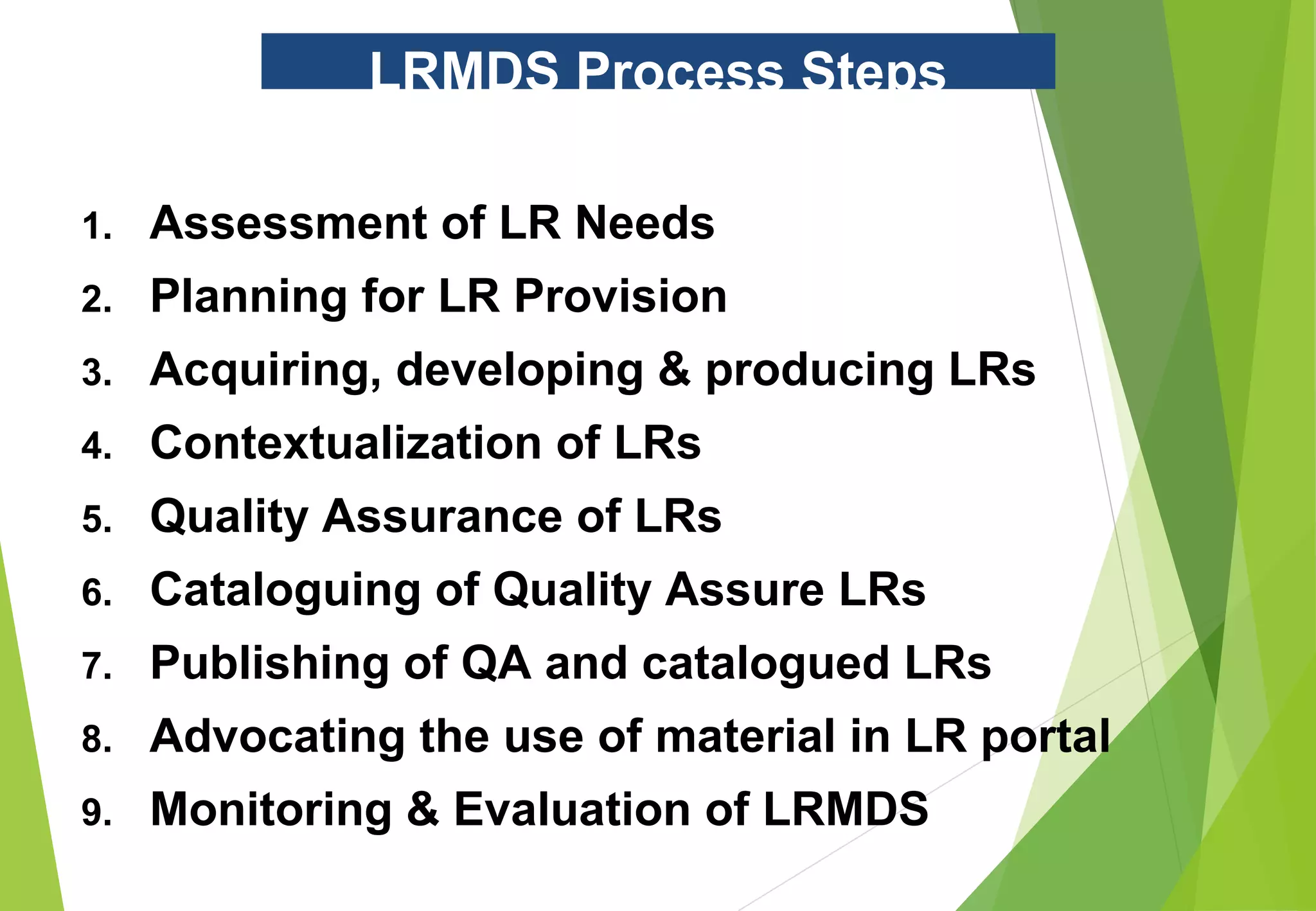
LRMDS Process Steps
1. Assessment of LR Needs
2. Planning for LR Provision
3. Acquiring, developing & producing LRs
4. Contextualization of LRs
5. Quality Assurance of LRs
6. Cataloguing of Quality Assure LRs
7. Publishing of QA and catalogued LRs
8. Advocating the use of material in LR portal
9. Monitoring & Evaluation of LRMDS
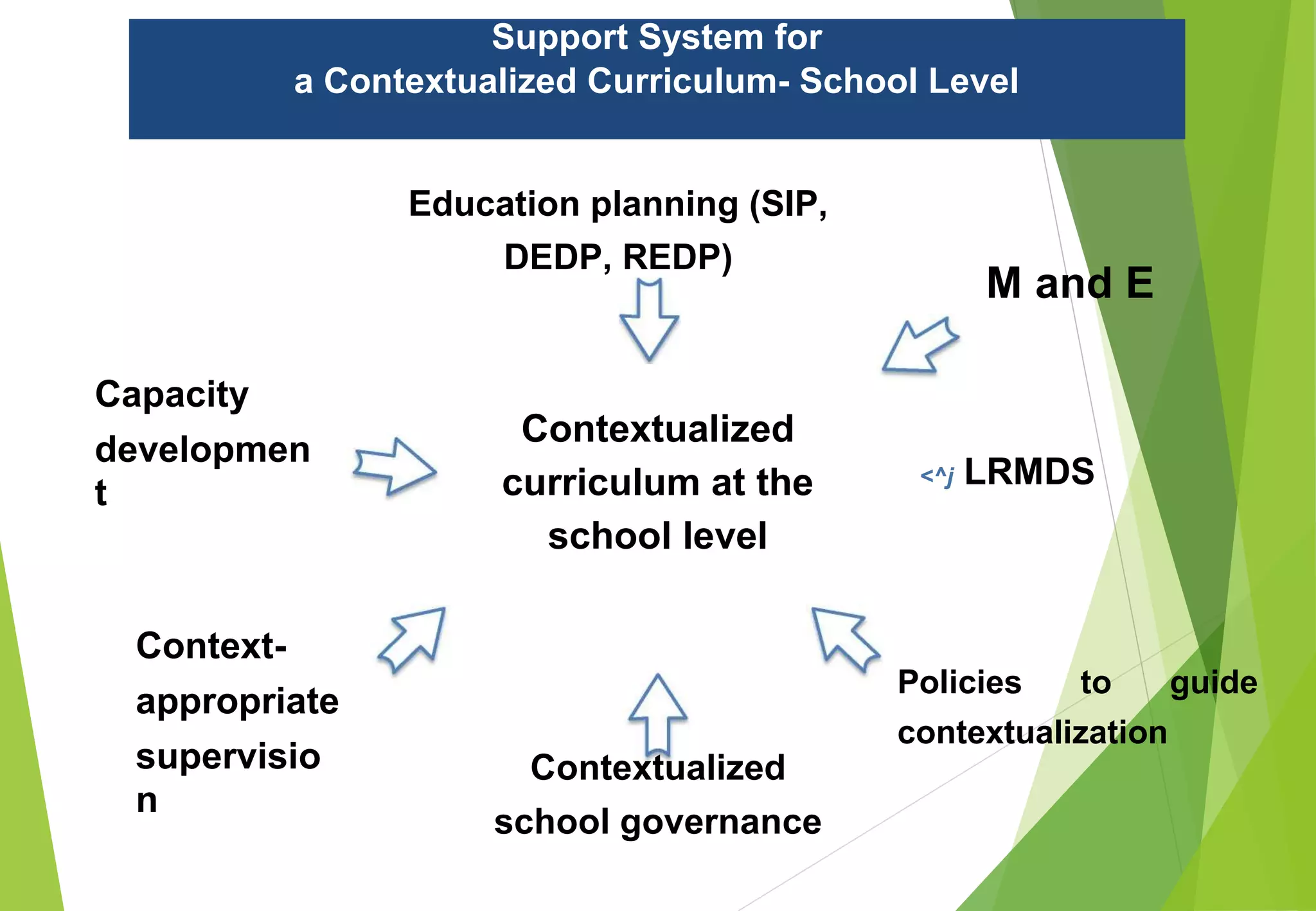
Support System for
a Contextualized Curriculum- School Level
Capacity
developmen
t
Education planning (SIP,
DEDP, REDP)
M and E
Contextualized
curriculum at the
school level
<^j LRMDS
Context-
appropriate
supervisio
n
Policies to guide
contextualization
Contextualized
school governance
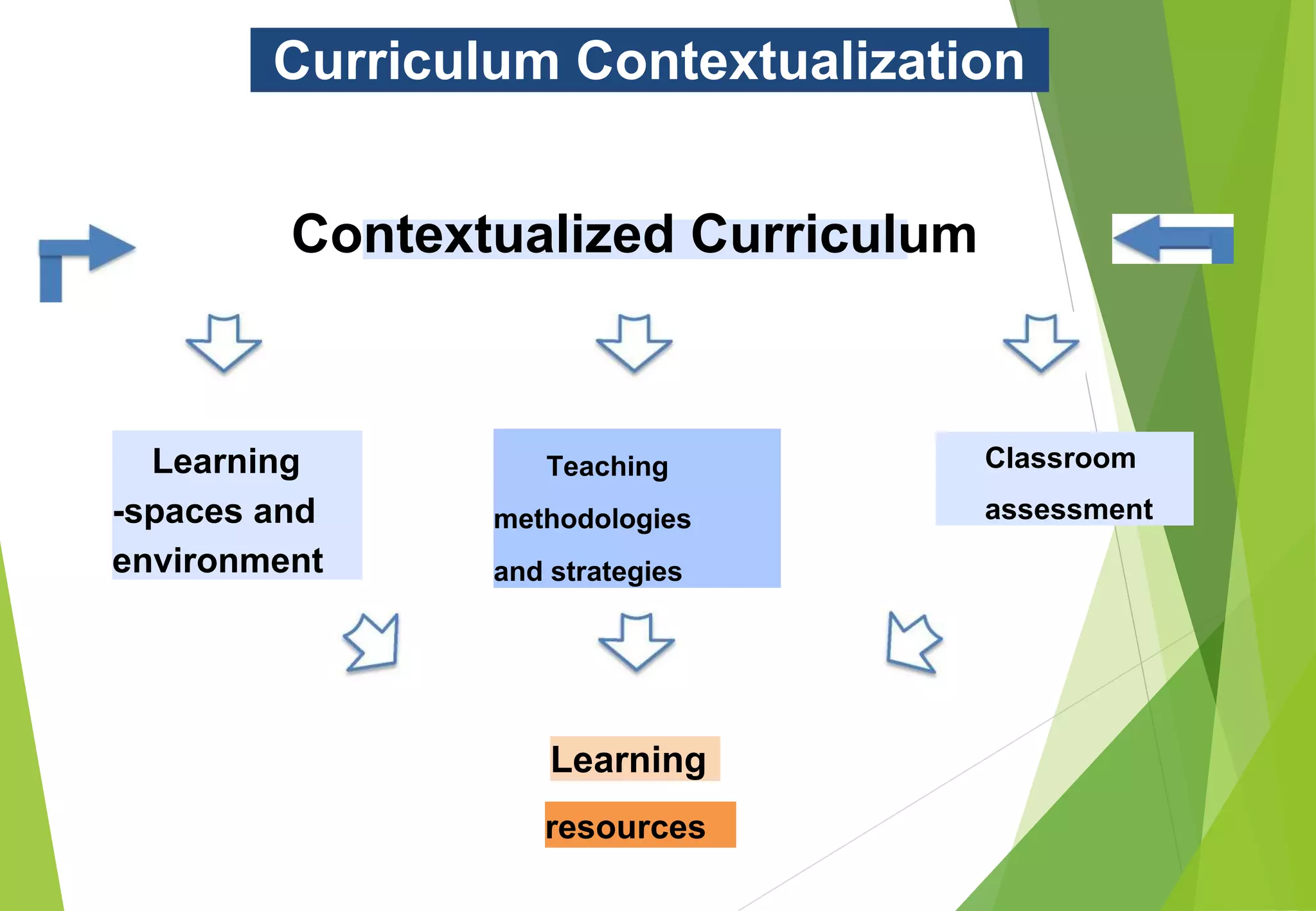
Curriculum Contextualization
Contextualized Curriculum
Learning
-spaces and
environment
Teaching
methodologies
and strategies
Classroom
assessment
Learning
resources
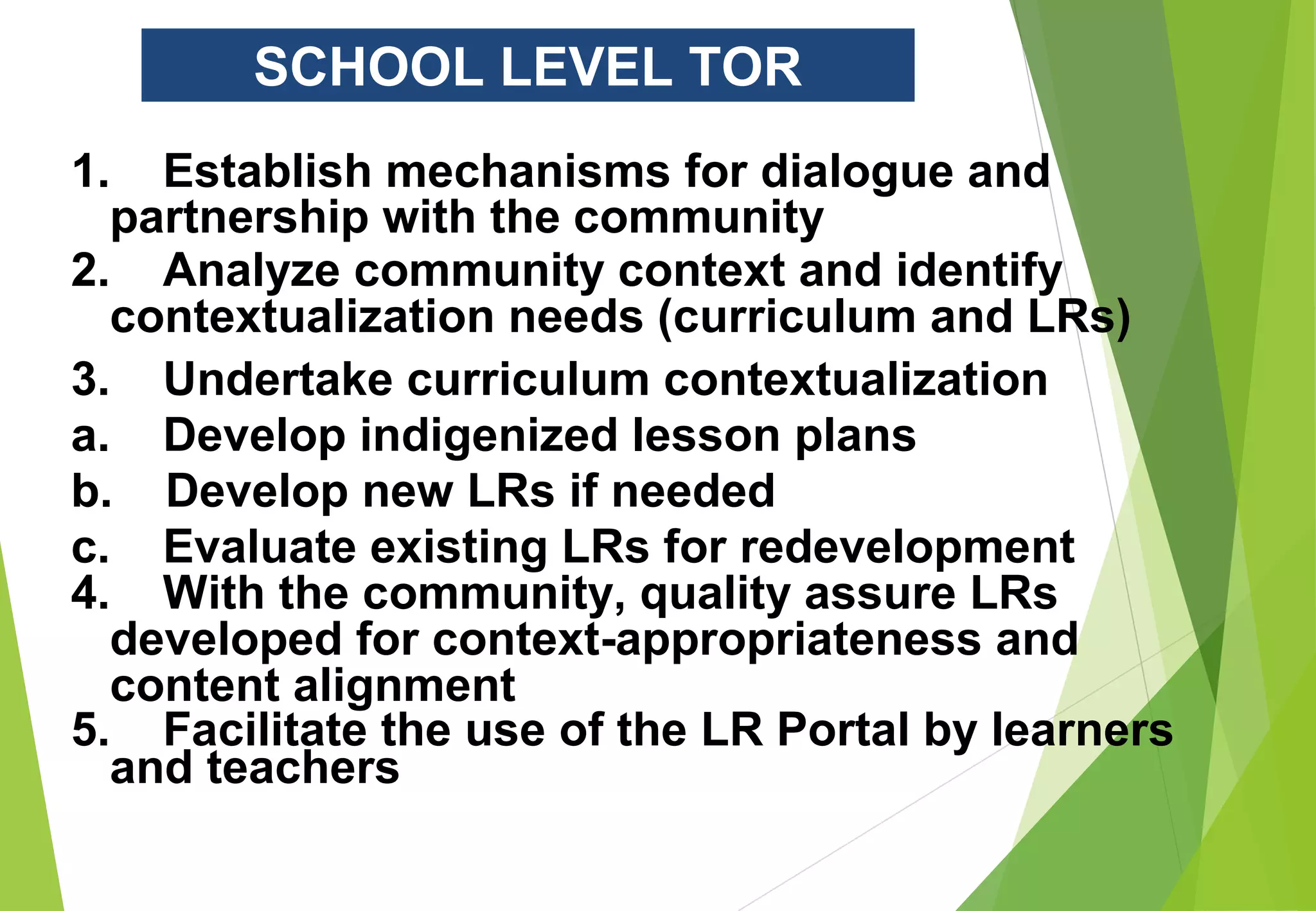
SCHOOL LEVEL TOR
1. Establish mechanisms for dialogue and
partnership with the community
2. Analyze community context and identify
contextualization needs (curriculum and LRs)
3. Undertake curriculum contextualization
a. Develop indigenized lesson plans
b. Develop new LRs if needed
c. Evaluate existing LRs for redevelopment
4. With the community, quality assure LRs
developed for context-appropriateness and
content alignment
5. Facilitate the use of the LR Portal by learners
and teachers
Division level TOR
1. Provide technical assistance to schools in establishing mechanisms
for dialogue and partnership with the community
2. Provide technical assistance to schools for situation analysis leading
to directions for curriculum contextualization
3. Provide technical assistance to schools for curriculum
contextualization and LR development
4. Conduct division mapping of possible themes for contextualization
5. Quality assure contextualized curricula and monitor its
implementation
6. Quality assure submitted LRs from the schools
7. Evaluate LRs from donors for redevelopment
8. Monitoring and Evaluation of the implementation of contextualized
curricula
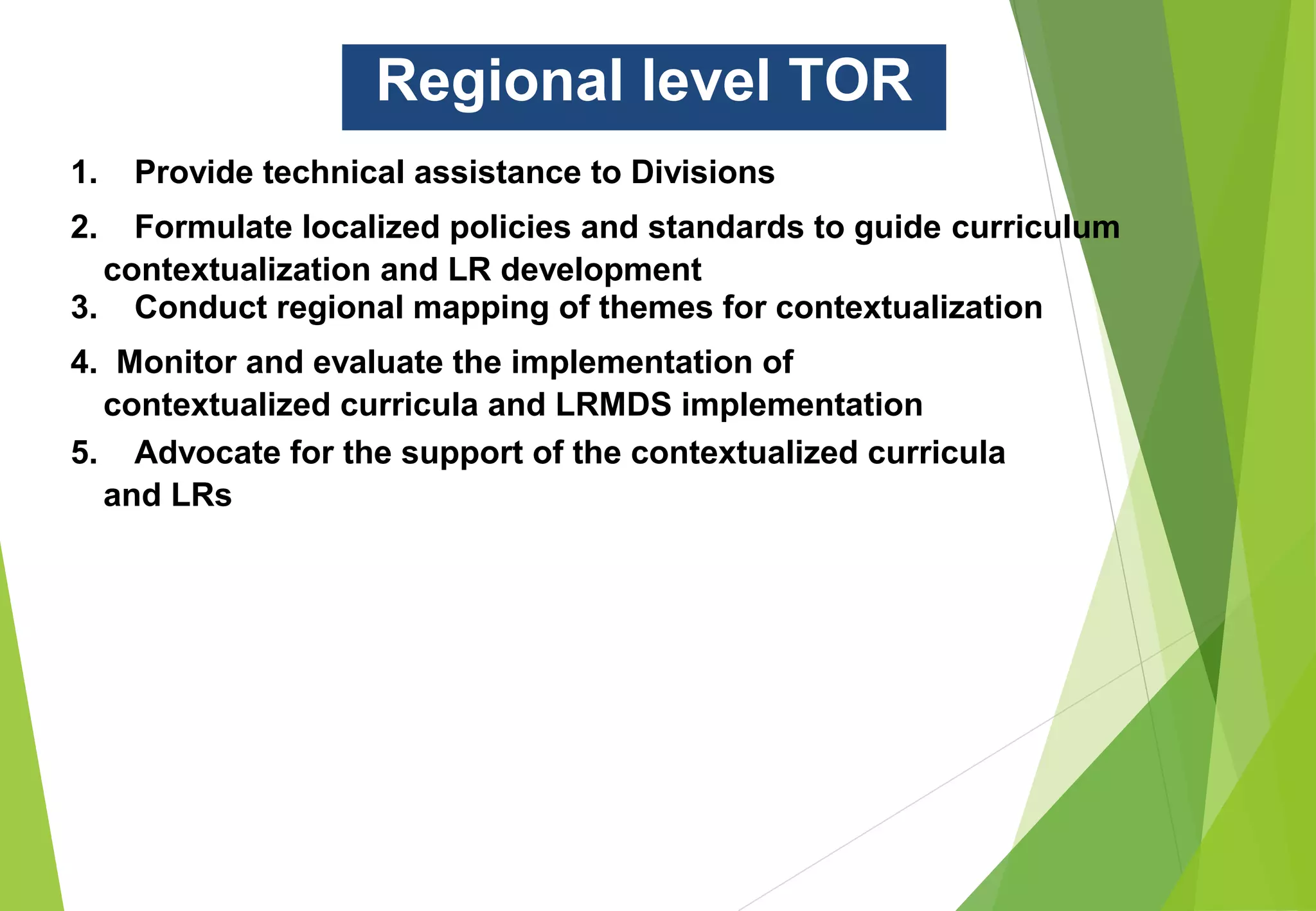
Regional level TOR
1. Provide technical assistance to Divisions
2. Formulate localized policies and standards to guide curriculum
contextualization and LR development
3. Conduct regional mapping of themes for contextualization
4. Monitor and evaluate the implementation of
contextualized curricula and LRMDS implementation
5. Advocate for the support of the contextualized curricula
and LRs
CO level TOR
1. Formulate national policies and standards (including
indicators) to guide curriculum contextualization and LR
development
2. Provide technical assistance to regions
3. Monitoring and Evaluation of implementation
CLASSROOM ASSESSMENT
(DepEd Order No. 8, s. 2015)
POLICY GUIDELINES ON CLASSROOM
ASSESSMENT FOR THE K TO 12 BASIC
EDUCATION PROGRAM
Classroom Assessment is an integral part of curriculum
implementation. It allows the teachers to track and measure
learner’s progress and to adjust instruction accordingly.
Classroom Assessment is an ongoing progress of
identifying, gathering, organizing, and interpreting
quantitative and qualitative information about what learners
know and can do.
Two Types of Classroom Assessment
a. Formative Assessment
 Assessment for Learning
 Assessment as Learning
b. Summative Assessment
 Assessment of Learning
WHAT IS ASSESSED IN THE CLASSROOM?
a. Content Standards – identify and set the essential
knowledge and understanding that should be learned.
b. Performance Standard – describe the abilities and
skills that learners are expected to demonstrate in
relation to the content standards and integration of 21st
century skills.
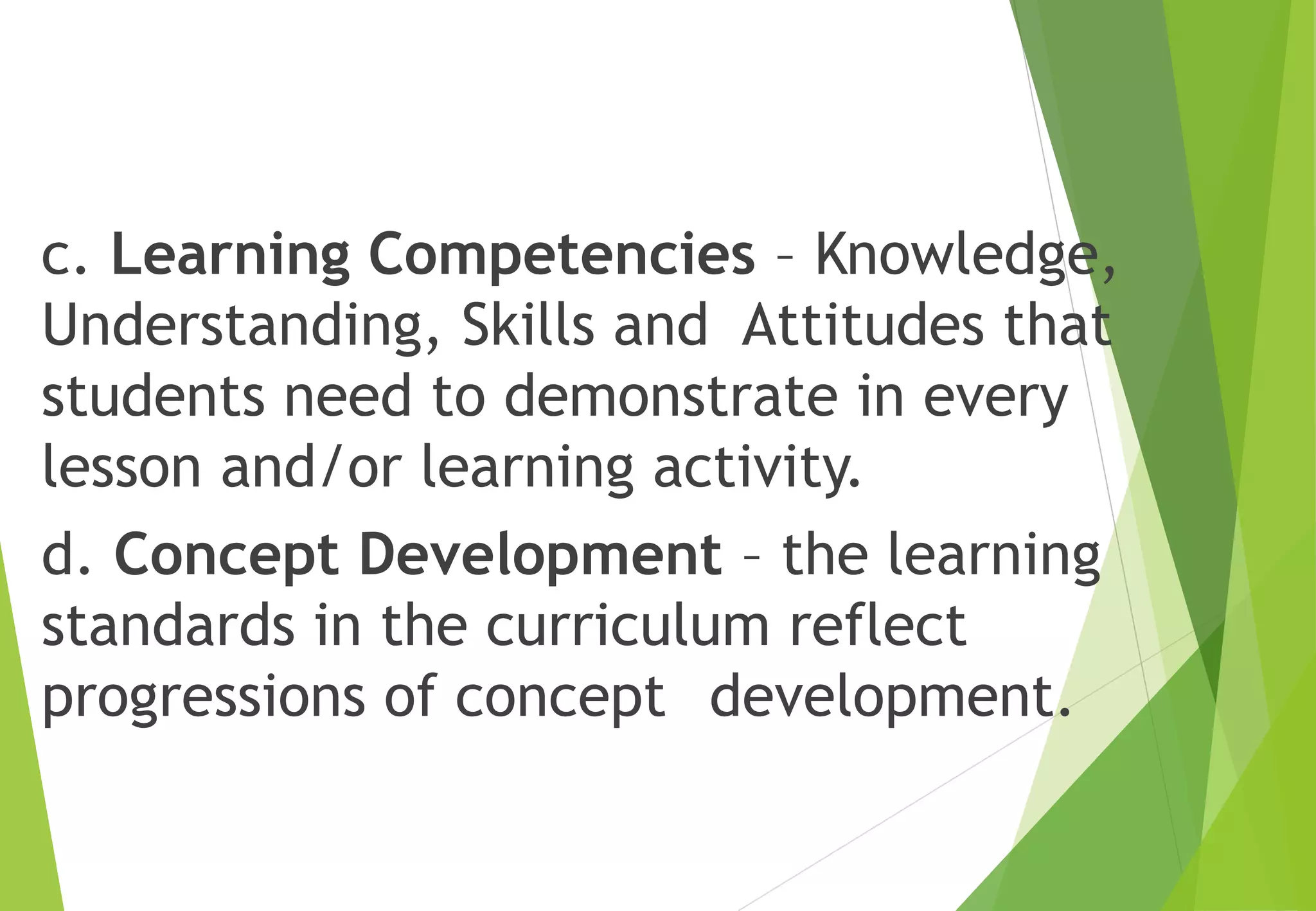
c. Learning Competencies – Knowledge,
Understanding, Skills and Attitudes that
students need to demonstrate in every
lesson and/or learning activity.
d. Concept Development – the learning
standards in the curriculum reflect
progressions of concept development.
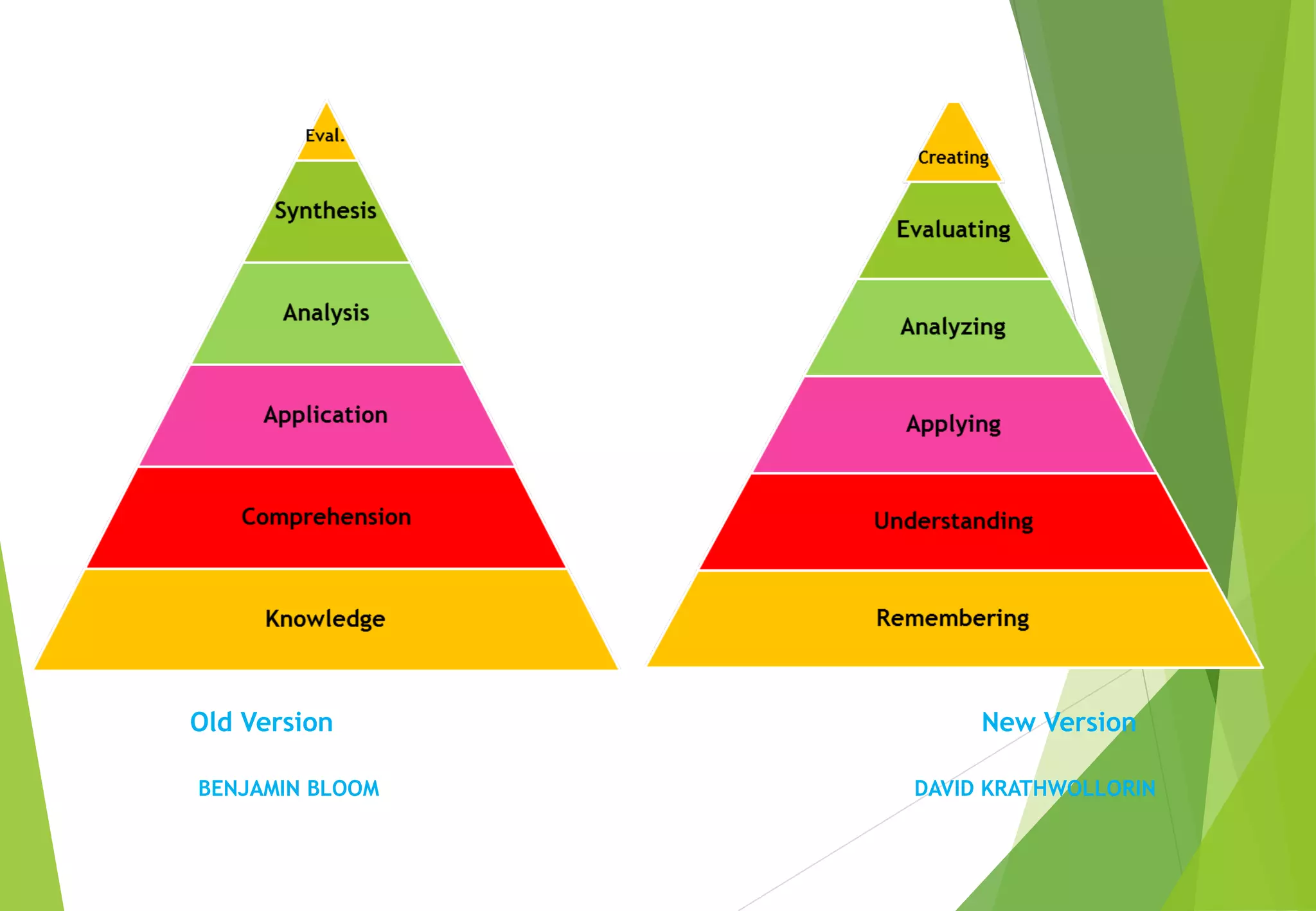
Old Version New Version
BENJAMIN BLOOM DAVID KRATHWOLLORIN
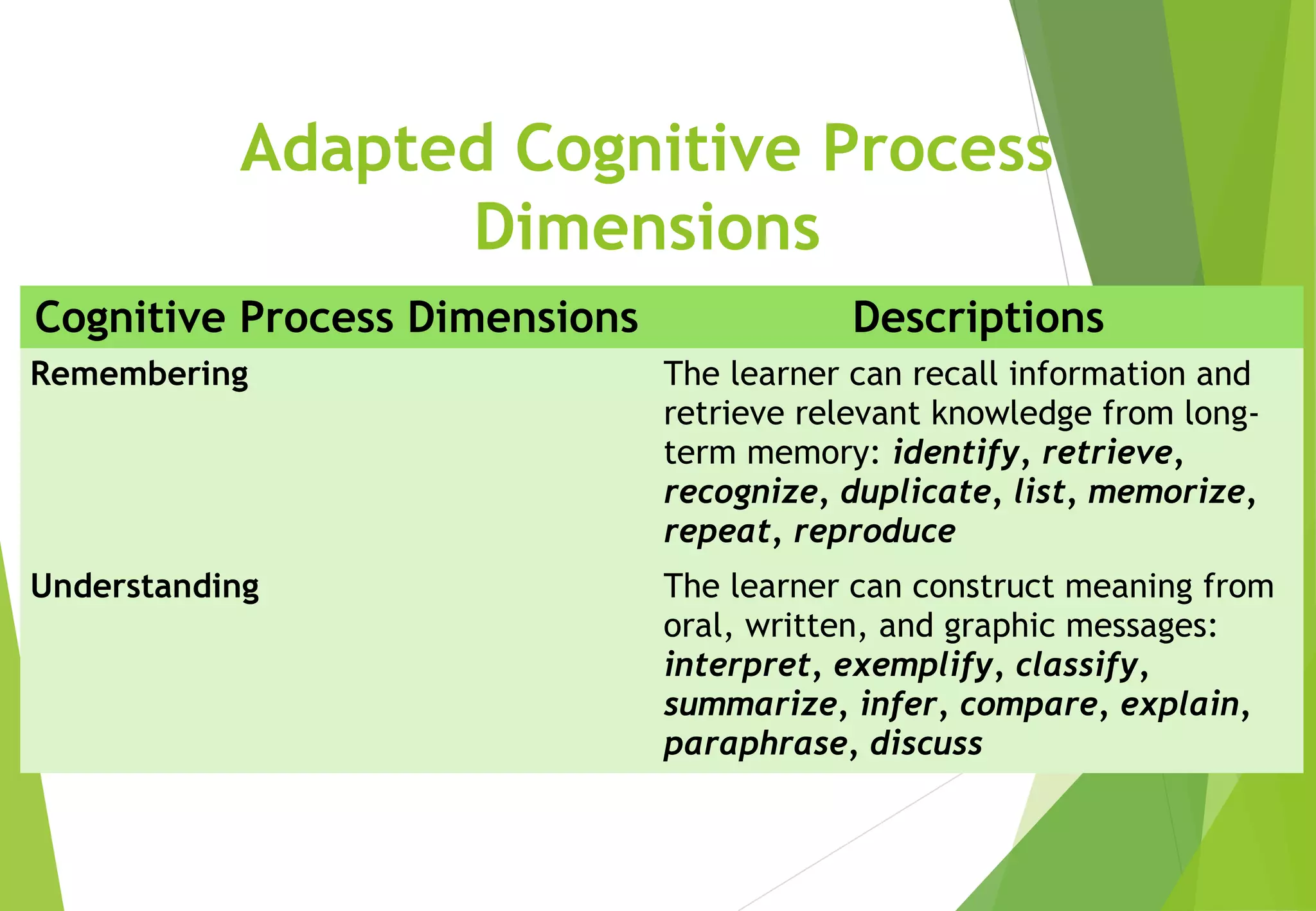
Adapted Cognitive Process
Dimensions
Cognitive Process Dimensions Descriptions
Remembering The learner can recall information and
retrieve relevant knowledge from long-
term memory: identify, retrieve,
recognize, duplicate, list, memorize,
repeat, reproduce
Understanding The learner can construct meaning from
oral, written, and graphic messages:
interpret, exemplify, classify,
summarize, infer, compare, explain,
paraphrase, discuss
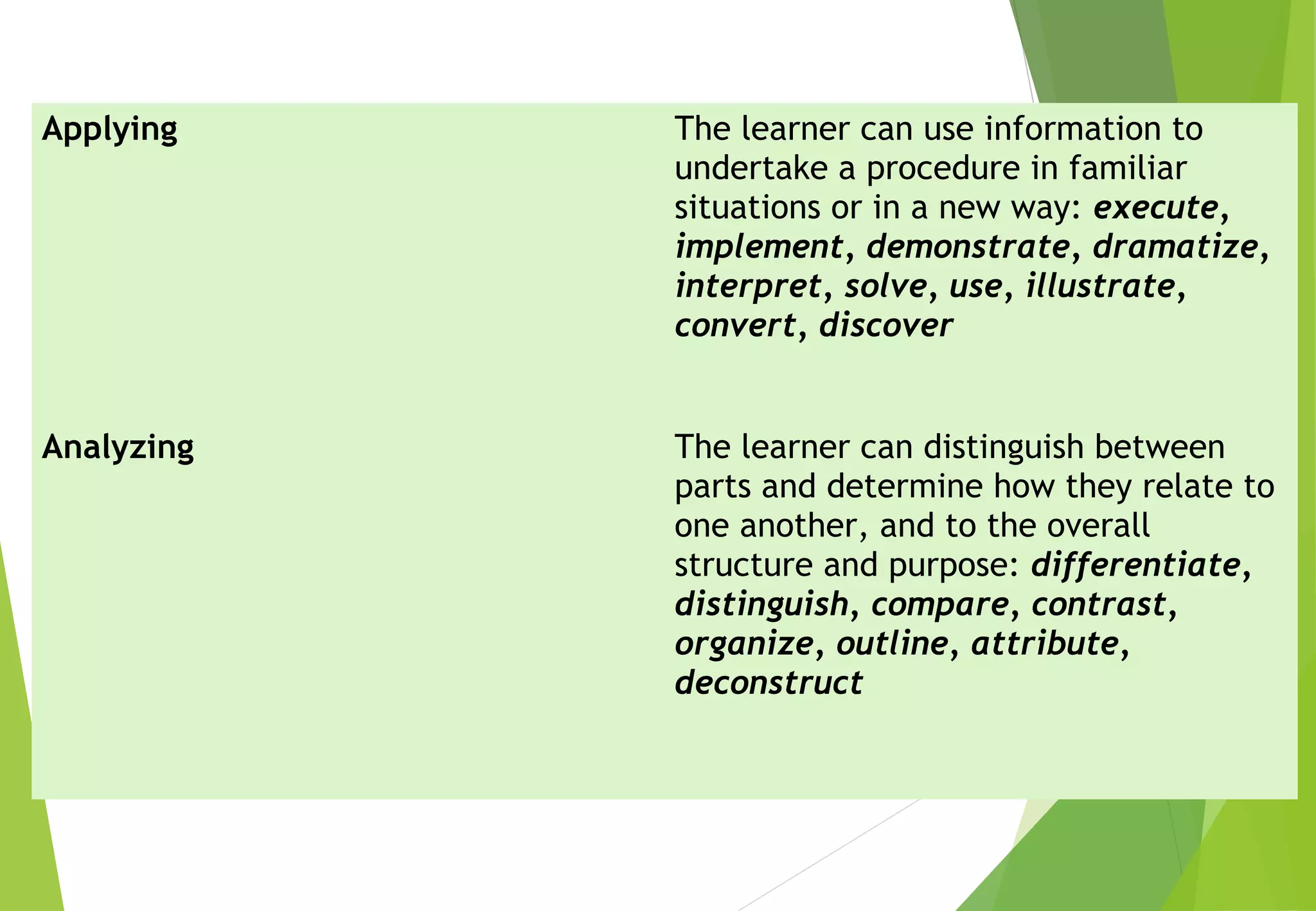
Applying The learner can use information to
undertake a procedure in familiar
situations or in a new way: execute,
implement, demonstrate, dramatize,
interpret, solve, use, illustrate,
convert, discover
Analyzing The learner can distinguish between
parts and determine how they relate to
one another, and to the overall
structure and purpose: differentiate,
distinguish, compare, contrast,
organize, outline, attribute,
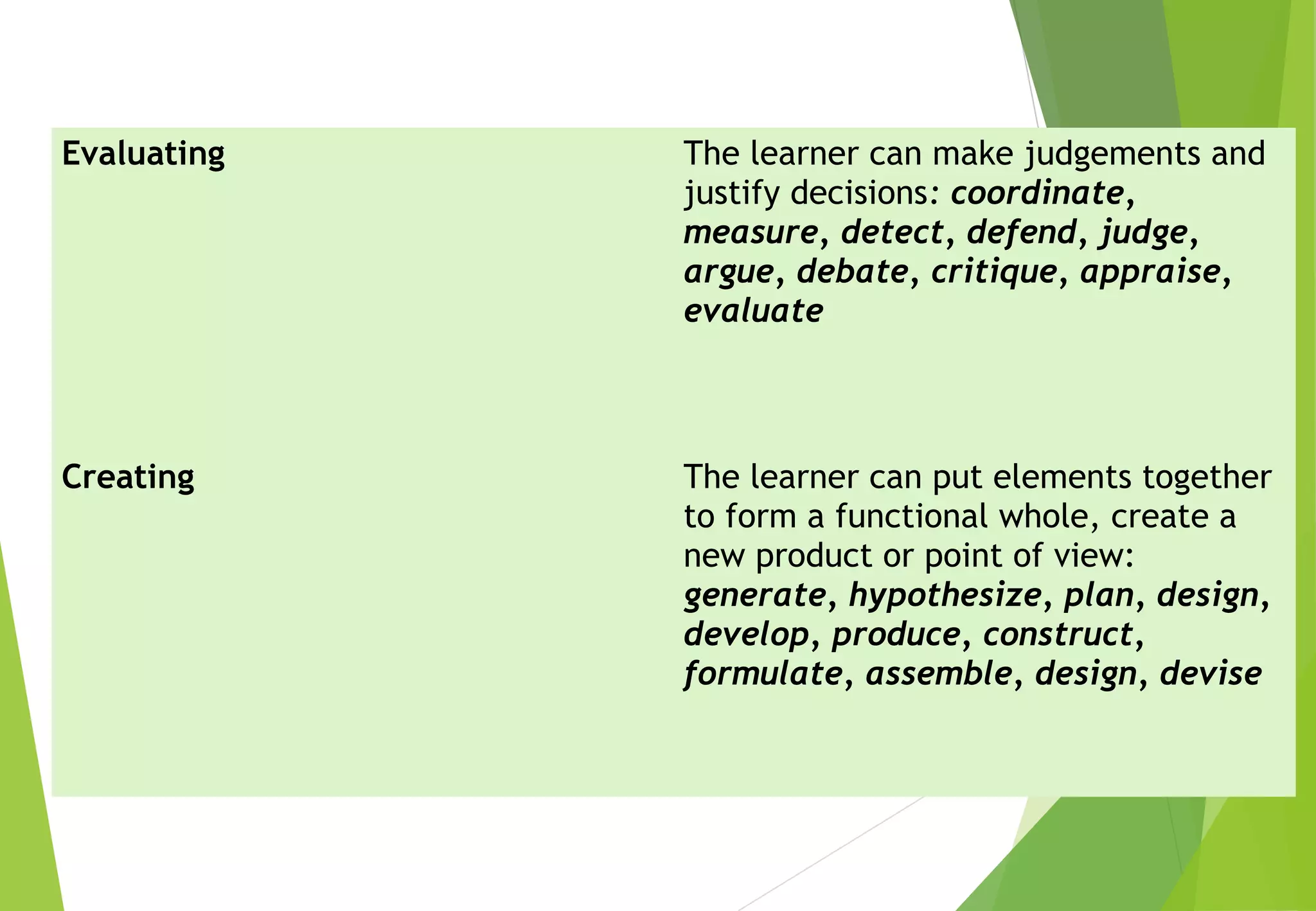
deconstruct
Evaluating The learner can make judgements and
justify decisions: coordinate,
measure, detect, defend, judge,
argue, debate, critique, appraise,
evaluate
Creating The learner can put elements together
to form a functional whole, create a
new product or point of view:
generate, hypothesize, plan, design,
develop, produce, construct,
formulate, assemble, design, devise
To align the assessment process
with the K to 12 curriculum, the
adapted Cognitive Process Dimensions
may be used as guide not only in
lesson development but also in the
formulation of assessment tasks and
activities.
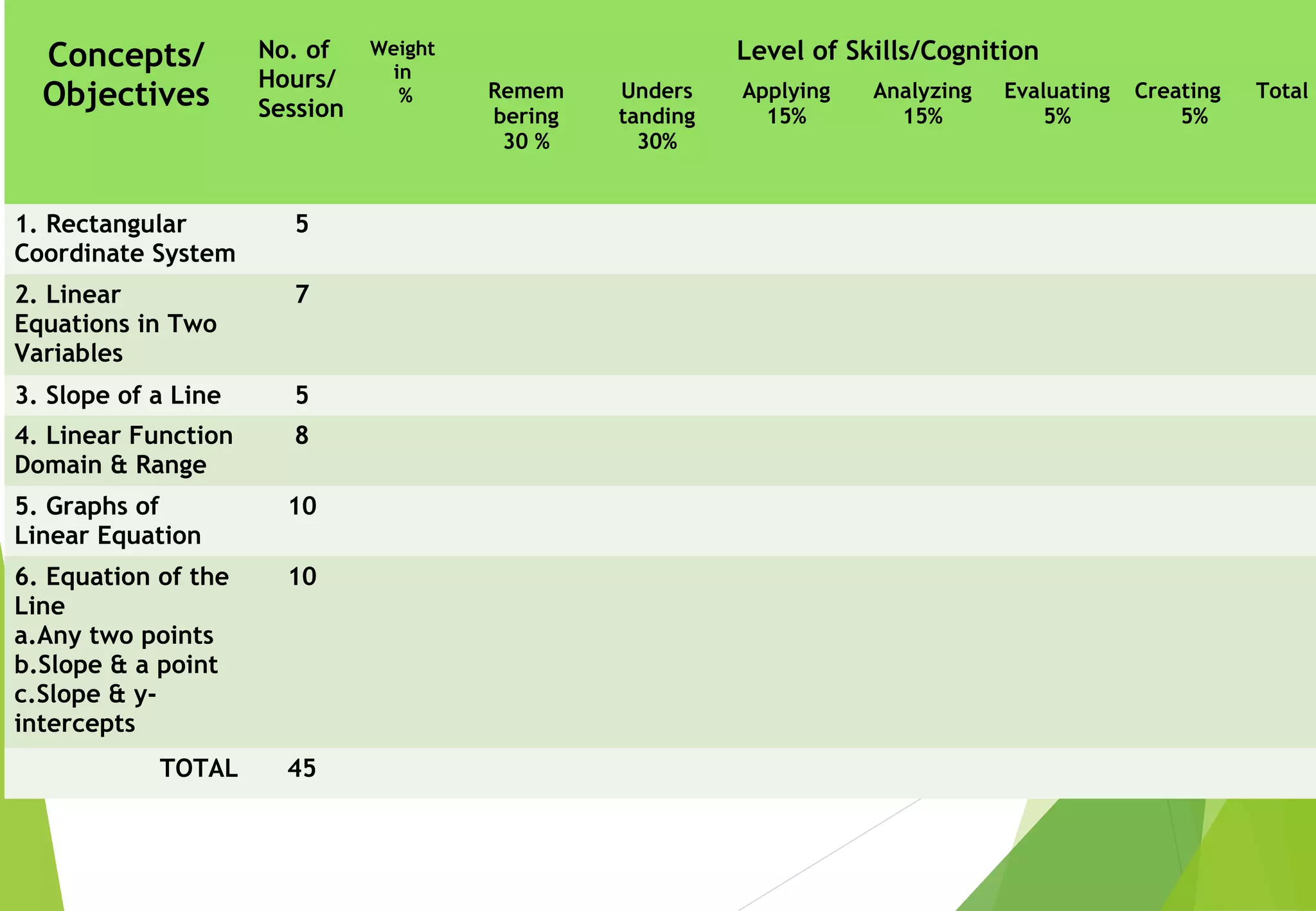
TABLE OF
SPECIFICATION
What is a Table of Specifications?
The Table of Specifications is a blueprint
for the preparation of an exam. It serves as the
“map” or guide to assigning the appropriate
number of items to topics included in the course
or subject.
A Table of Specifications is a
two-way chart which describes the
topics to be covered by a test and
the number of items or points
which will be associated with each
topic.
A Table of Specifications provides the teacher
with evidence that a test has content validity,
that it covers what should be covered.
A Table of Specifications helps to ensure that
there is a match between what is taught and
what is tested.
Concepts/
Objectives
No. of
Hours/
Session
Weight
in
%
Level of Skills/Cognition
Remem
bering
30 %
Unders
tanding
30%
Applying
15%
Analyzing
15%
Evaluating
5%
Creating
5%
Total
1. Rectangular
Coordinate System
5
2. Linear
Equations in Two
Variables
7
3. Slope of a Line 5
4. Linear Function
Domain & Range
8
5. Graphs of
Linear Equation
10
6. Equation of the
Line
a.Any two points
b.Slope & a point
c.Slope & y-
intercepts
10
TOTAL 45
DEPARTMENT OF EDUCATION - REGIONAL OFFICE NO. VIII
The best curricula is contextualized by those
implementing it.
It is now up to us to ensure that this
enhanced curriculum truly transforms our
schools and communities.
With the best of our abilities, let us do what
we can for the Filipino learner.
- Undersecretary Dina S. Ocampo
DEPARTMENT OF EDUCATION - REGIONAL OFFICE NO. VIII
Thank you!

Contextualization presentation

  • 1.
  • 2.
    Objectives 1. Identify theinitiatives of DepEd and its Legal Bases in relation to contextualization. 2. Explain the process of contextualization 3. Cite the importance of curriculum contextualization 4 Discuss the “Policy Guidelines on Classroom Assessment” DEPARTMENT OF EDUCATION - REGIONAL OFFICE NO. III
  • 3.
    LET US THINK 1.What do you know about curriculum contextualization? 2. What is localization? 3. What is indigenization? DEPARTMENT OF EDUCATION - REGIONAL OFFICE NO. III
  • 4.
    Initiatives before Kto 12 1. 1998-2006 : Third Elementary Education Project (TEEP) a. development of readers using local stories b. Integration of culture and artistic expressions in learning areas 2. 2002-2007:Basic Education Assistance for Mindanao (BEAM) a. "tri-people" perspective- Muslims, Christians and Lumads 3. 2005: Strengthening Implementation of Visayas Education (STRIVE) a. systemic efforts on localization (Region) 4. 2011-2014: Philippines' Response to Indigenous Peoples' and Muslim Education (PRIME) a. initial attempt at generating the contextualization process DEPARTMENT OF EDUCATION - REGIONAL OFFICE NO. III
  • 5.
    The K to12 Philippine Basic Education Curriculum Framework CONTEXT PHILOSOPHICAL & LEGAL BASES ■ RA 10533 Enhanced Basic Education Act of 2013 ■ Kindergarten Act ■ The 1987 Phil. Constitution ■ BP 232, Education Act of 1982 ■ RA 9155, Governance of Basic Education Act of 2001 ■ The vision, mission statement of DepEd ■ SOUTELE, 1976 ■ The EDCOM Report of 1991 ■ Basic Education Sector Reform Agenda (BESRA) ■ The four pillars of education (UNESCO) NATURE OF THE LEARNER ■ Has a body and spirit, intellect, free will, emotions, multiple intelligence, learning styles ■ Constructor of knowledge and active maker of meaning, not a passive recipient of information NEEDS OF NATIONAL & GLOBAL COMMUNITY ■ Poverty reduction and human development ■ Strengthening the moral fiber of the Filipino people ■ Development of a strong sense of nationalism ■ Development of productive citizens who contribute to the building of a progressive, just, and humane society ■ Ensuring environmental sustainability ■ Global partnership for development NEEDS OF THE LEARNER ■ Life skills ■ Self-actualization ■ Preparation for the world of the work, entrepreneurship, higher education DEPARDEPARTMENT OF EDUCATION - REGIONAL OFFICE NO. VIII
  • 7.
    Features of theK to 12 Curriculum learner-centered, inclusive, and research- based standards- and competence-based, seamless, decongested culture-responsive and culture-sensitive, integrative and contextualized, relevant and responsive flexible, ICT-based, and global DEPARTMENT OF EDUCATION - REGIONAL OFFICE NO. VIII
  • 8.
    DepEd Mission To protectand promote the right of every Filipino to quality, equitable, culture-based, and complete basic education where: 1.Student learn in a child-friendly, gender- sensitive, safe and motivating environment; 2.Teachers facilitate learning & constantly nurture every learner; DEPARTMENT OF EDUCATION - REGIONAL OFFICE NO. VIII
  • 9.
    Current Initiatives 3 Administrators& staff as stewards of institution ensure an enabling and supportive environment for effective learning to happen. 4.Family, community and other stakeholders are actively engaged and share responsibility for developing life-long learners DEPARTMENT OF EDUCATION - REGIONAL OFFICE NO. VIII
  • 10.
    Current Initiatives What wehave now: Contextualizing Education at Various Levels 1. K to 12 Framework a. MTB b. SHS 2. Programs (IPEd, Muslim Ed, SPED, Special Interest Programs, ALS) 3. Learning Areas (e.g. AP -regional profiles, Art and Music- cultural artistic expressions by regions) DEPARTMENT OF EDUCATION - REGIONAL OFFICE NO. VIII
  • 11.
    CONTEXTUALIZATION The K to12 curriculum framework highlights the fundamental importance of context in shaping the curriculum, and consequently, the teaching- learning process Enhanced Basic Education Act of 2013 (RA 10533), Sec. 5 The DepEd shall adhere to the following standards and principles in developing the enhanced basic education curriculum: (d)... contextualized and global DEPARTMENT OF EDUCATION - REGIONAL OFFICE NO. VIII
  • 12.
    CONTEXTUALIZATION Flexibility of theK to 12 curriculum allows for curriculum enhancement in relation to the diverse background of learners Enhanced Basic Education Act of 2013 (RA 10533), Sec. 5 The DepEd shall adhere to the following standards and principles in developing the enhanced basic education curriculum: h)... flexible enough to enable and allow schools to localize, indigenize and enhance the same based on their respective educational and social contexts. The production and development of locally produced teaching materials shall be encouraged and approval of these materials shall devolve to the regional and division education units. DEPARTMENT OF EDUCATION - REGIONAL OFFICE NO. VIII
  • 13.
  • 14.
    Key Concepts Contextualization refersto the educational process of relating the curriculum to a particular setting, situation or area of application to make the competencies relevant, meaningful, and useful to all learners. The degree of contextualization may be described and distinguished into the following: 1. Localization 2. Indigenization DEPARTMENT OF EDUCATION - REGIONAL OFFICE NO. VIII
  • 15.
    Key Concepts The degreeof contextualization may be described and distinguished into the following: 1. Localization refers to the process of relating learning content specified in the curriculum to local information and materials in the learners' community. DEPARTMENT OF EDUCATION - REGIONAL OFFICE NO. VIII
  • 16.
  • 17.
    Examples of Localization 1.Examples used in lessons start with those in the locality 2. Names, situations, setting needed to give context to test questions or problem-solving exercises are those of the immediate community 3. Local materials are used as often as possible in making instructional materials 4. Local stories are used in the language learning areas 5. Translating a story written in another language to the language of one's learners for use in MTB-MLE DEPARTMENT OF EDUCATION - REGIONAL OFFICE NO. VIII
  • 18.
    Key Concepts The degreeof contextualization may be described and distinguished into the following: 1. Localization refers to the process of relating learning content specified in the curriculum to local information and materials in the learners' community. 2. Indigenization refers to the process of enhancing curriculum competencies, education resources, and teaching-learning processes in relation to the bio-geographical, historical, and socio-cultural context of the learners' community. Indigenization may also involve the enhancement of the curriculum framework, curriculum design, and learning standards of subject areas, guided by the standards and principles adhered to by the national curriculum. DEPARTMENT OF EDUCATION - REGIONAL OFFICE NO. VIII
  • 19.
    INDIGENIZATION Curriculum framework Curriculum design bio-geographical Learning Standards Teaching-learning processes Learningresources historical socio- cultural DEPARTMENT OF EDUCATION - REGIONAL OFFICE NO. VIII
  • 20.
    Examples of Localizationand Indigenization of the Curriculum Curriculum design; NKCG LOCALIZATION • Use local information and materials while maintaining the suggested structure, themes and activities in the NKCG INDIGENIZATION • enhancing the themes and activities of the NKCG by modifying, reorganizing, or highlighting certain aspects in relation to the community context(e.g., socio-economic realities, cultural practices, local knowledge)
  • 21.
    Examples of Localizationand Indigenization of the Curriculum Competency; Visualize the ratio of two given numbers (M5NS-IIh-22) LOCALIZATION • Use easily observable examples of ratio in the community — One jeep, 4 wheels; one kariton, 2 wheels, one tricycle, 3 wheels (depending on what is most common in the community) INDIGENIZATION • community activities or cultural practices that inherently use the concept of ratio — Ex. Bringing products to the market entails using a carabao carrying sacks (one carabao is to x sacks)
  • 22.
    Examples of Localizationand Indigenization of the Curriculum Competency; Identify star patterns that can be seen at particular times of the year (S5FE-IVi-j-1) LOCALIZATION • use the community's name for prominent stars, if they have, while retaining the use of the Greek constellations and its background in discussing star patterns INDIGENIZATION • Discuss the community's own calendar of star patterns and its background before discussing the Greek constellations
  • 23.
    DEPARTMENT OF EDUCATION- REGIONAL OFFICE NO. VIII BANGHAY ARALIN SA EDUKASYON SA PAGPAPAKATAO 3 (Unang Markahan) National Competence: Naipapakita ang natatanging kakayahan. Hal. Talentong ibinigay ng Diyos. (EsP3PKP- Ia – 13) pg.166 Community Competence: Nakasasayaw ng Igal-Igal.
  • 24.
    Banghay Aralin saEdukasyon Sa Pagpapakatao 3 (Second Quarter) National competence: Nakapagpapakita nang may kasiyahan sa pakikiisa sa mga gawaing pambata. (ESP3P-II h-i-17 page 168) Community competence: Napaghihiwalay ang mga malalaki at maliit na isda. DEPARTMENT OF EDUCATION - REGIONAL OFFICE NO. VIII
  • 25.
    Major curriculum thrustof K to 12: CONTEXTUALIZATION • Localization and indigenization are degrees or levels of doing contextualization • When we localize, we do not necessarily indigenize • When we indigenize, we localize DEPARTMENT OF EDUCATION - REGIONAL OFFICE NO. VIII
  • 26.
    Contextualization Process 1. Establishdialogue and community engagement mechanisms with the communities for purposes of contextualized education a. Immersion in communities b. collaboration with elders' group (e.g., council, committee) c. formulation of cultural standards
  • 27.
    Contextualization Process 1. Establishdialogue and community engagement mechanisms with the communities for purposes of contextualized education 2. Situation Analysis leading to community vision, mission and goals for education a. Contextualized Curriculum Framework Formulation
  • 28.
    Contextualization Process 1. Establishdialogue and community engagement mechanisms with the communities for purposes of contextualized education 2. Situation Analysis leading to community vision, mission and goals for education 3. Education Planning with Communities (Learning Resources included), a. LRMDS in the SIP, DEDP, REDP
  • 29.
    Contextualization Process 1. Establishdialogue and community engagement mechanisms with the communities for purposes of contextualized education 2. Situation Analysis leading to community vision, mission and goals for education 3. Education Planning with Communities (Learning Resources included) 4. Research for contextualization and LR development a. community-led b. DepEd-led
  • 30.
    Contextualization Process 5. CurriculumContextualization a. Curriculum b. Teaching-Learning processes c. LRs development d. Classroom assessment
  • 31.
    Contextualization Process 5. CurriculumContextualization a. Curriculum b. Teaching-Learning processes c. LRs development d. Classroom assessment 6. Quality assurance of contextualized curricula, LRs (e.g., lesson plans, TGs, LMs) -
  • 32.
    LRMDS Process Steps 1.Assessment of LR Needs 2. Planning for LR Provision 3. Acquiring, developing & producing LRs 4. Contextualization of LRs 5. Quality Assurance of LRs 6. Cataloguing of Quality Assure LRs 7. Publishing of QA and catalogued LRs 8. Advocating the use of material in LR portal 9. Monitoring & Evaluation of LRMDS
  • 33.
    Support System for aContextualized Curriculum- School Level Capacity developmen t Education planning (SIP, DEDP, REDP) M and E Contextualized curriculum at the school level <^j LRMDS Context- appropriate supervisio n Policies to guide contextualization Contextualized school governance
  • 34.
    Curriculum Contextualization Contextualized Curriculum Learning -spacesand environment Teaching methodologies and strategies Classroom assessment Learning resources
  • 35.
    SCHOOL LEVEL TOR 1.Establish mechanisms for dialogue and partnership with the community 2. Analyze community context and identify contextualization needs (curriculum and LRs) 3. Undertake curriculum contextualization a. Develop indigenized lesson plans b. Develop new LRs if needed c. Evaluate existing LRs for redevelopment 4. With the community, quality assure LRs developed for context-appropriateness and content alignment 5. Facilitate the use of the LR Portal by learners and teachers
  • 36.
    Division level TOR 1.Provide technical assistance to schools in establishing mechanisms for dialogue and partnership with the community 2. Provide technical assistance to schools for situation analysis leading to directions for curriculum contextualization 3. Provide technical assistance to schools for curriculum contextualization and LR development 4. Conduct division mapping of possible themes for contextualization 5. Quality assure contextualized curricula and monitor its implementation 6. Quality assure submitted LRs from the schools 7. Evaluate LRs from donors for redevelopment 8. Monitoring and Evaluation of the implementation of contextualized curricula
  • 37.
    Regional level TOR 1.Provide technical assistance to Divisions 2. Formulate localized policies and standards to guide curriculum contextualization and LR development 3. Conduct regional mapping of themes for contextualization 4. Monitor and evaluate the implementation of contextualized curricula and LRMDS implementation 5. Advocate for the support of the contextualized curricula and LRs
  • 38.
    CO level TOR 1.Formulate national policies and standards (including indicators) to guide curriculum contextualization and LR development 2. Provide technical assistance to regions 3. Monitoring and Evaluation of implementation
  • 39.
    CLASSROOM ASSESSMENT (DepEd OrderNo. 8, s. 2015) POLICY GUIDELINES ON CLASSROOM ASSESSMENT FOR THE K TO 12 BASIC EDUCATION PROGRAM
  • 40.
    Classroom Assessment isan integral part of curriculum implementation. It allows the teachers to track and measure learner’s progress and to adjust instruction accordingly. Classroom Assessment is an ongoing progress of identifying, gathering, organizing, and interpreting quantitative and qualitative information about what learners know and can do.
  • 41.
    Two Types ofClassroom Assessment a. Formative Assessment  Assessment for Learning  Assessment as Learning b. Summative Assessment  Assessment of Learning
  • 42.
    WHAT IS ASSESSEDIN THE CLASSROOM? a. Content Standards – identify and set the essential knowledge and understanding that should be learned. b. Performance Standard – describe the abilities and skills that learners are expected to demonstrate in relation to the content standards and integration of 21st century skills.
  • 43.
    c. Learning Competencies– Knowledge, Understanding, Skills and Attitudes that students need to demonstrate in every lesson and/or learning activity. d. Concept Development – the learning standards in the curriculum reflect progressions of concept development.
  • 44.
    Old Version NewVersion BENJAMIN BLOOM DAVID KRATHWOLLORIN
  • 45.
    Adapted Cognitive Process Dimensions CognitiveProcess Dimensions Descriptions Remembering The learner can recall information and retrieve relevant knowledge from long- term memory: identify, retrieve, recognize, duplicate, list, memorize, repeat, reproduce Understanding The learner can construct meaning from oral, written, and graphic messages: interpret, exemplify, classify, summarize, infer, compare, explain, paraphrase, discuss
  • 46.
    Applying The learnercan use information to undertake a procedure in familiar situations or in a new way: execute, implement, demonstrate, dramatize, interpret, solve, use, illustrate, convert, discover Analyzing The learner can distinguish between parts and determine how they relate to one another, and to the overall structure and purpose: differentiate, distinguish, compare, contrast, organize, outline, attribute, deconstruct
  • 47.
    Evaluating The learnercan make judgements and justify decisions: coordinate, measure, detect, defend, judge, argue, debate, critique, appraise, evaluate Creating The learner can put elements together to form a functional whole, create a new product or point of view: generate, hypothesize, plan, design, develop, produce, construct, formulate, assemble, design, devise
  • 48.
    To align theassessment process with the K to 12 curriculum, the adapted Cognitive Process Dimensions may be used as guide not only in lesson development but also in the formulation of assessment tasks and activities.
  • 49.
  • 50.
    What is aTable of Specifications? The Table of Specifications is a blueprint for the preparation of an exam. It serves as the “map” or guide to assigning the appropriate number of items to topics included in the course or subject.
  • 51.
    A Table ofSpecifications is a two-way chart which describes the topics to be covered by a test and the number of items or points which will be associated with each topic.
  • 52.
    A Table ofSpecifications provides the teacher with evidence that a test has content validity, that it covers what should be covered. A Table of Specifications helps to ensure that there is a match between what is taught and what is tested.
  • 53.
    Concepts/ Objectives No. of Hours/ Session Weight in % Level ofSkills/Cognition Remem bering 30 % Unders tanding 30% Applying 15% Analyzing 15% Evaluating 5% Creating 5% Total 1. Rectangular Coordinate System 5 2. Linear Equations in Two Variables 7 3. Slope of a Line 5 4. Linear Function Domain & Range 8 5. Graphs of Linear Equation 10 6. Equation of the Line a.Any two points b.Slope & a point c.Slope & y- intercepts 10 TOTAL 45
  • 54.
    DEPARTMENT OF EDUCATION- REGIONAL OFFICE NO. VIII The best curricula is contextualized by those implementing it. It is now up to us to ensure that this enhanced curriculum truly transforms our schools and communities. With the best of our abilities, let us do what we can for the Filipino learner. - Undersecretary Dina S. Ocampo
  • 55.
    DEPARTMENT OF EDUCATION- REGIONAL OFFICE NO. VIII Thank you!

Editor's Notes

  • #6 SOUTELE- Survey Outcomes for Elementary
  • #7 Focus on materials, Assessment, and School Leadership &amp; management
  • #8 Focus on culture-responsive and culture sesitive
  • #13 Curr. guide is non-negotiable-
  • #19 Content standard and performance standard