Types ofWriting
 In college you will encounter many different types of
writing.
 Sometimes you may be asked to write from a personal
standpoint whereas other times you may be required to
write more analytically.
 Many college instructors require you to read a text and
then summarize it and respond to it.
 Today we will cover the summary response assignment,
which is made up of two parts: summary and response.
Important Note
 For my course, I call this assignment a “Summary
Response” paper.
 You might have learned it with different names like
Reaction Piece, Summary and Reflection Piece, Reading
Response, etc.
 Instead of being attached to the specific name of the
assignment, understand the gist of it:
 It is a summary of what you have read
 Followed by a response (your opinion) to what you have read
The Summary Paragraph
 What is a summary paragraph?
 A summary (whether it is a sentence or an entire
paragraph) is a rewritten, shortened version of a piece of
text in which you use your own words.
 It’s important to summarize effectively, for 2 reasons:
1. It shows strong reading comprehension skills.
2. It helps you to incorporate outside sources when doing any
kind of research paper.
 For this assignment, it will be ONE paragraph.
Rules for the Summary Paragraph
1. Begin with a FATt statement as your topic sentence,
2. Follow with the main ideas to support,
3. Reduce the length of the original text, (avoid specific details)
4. Change the original wording into your own words without
changing the idea,
5. Be objective:
a. Do not evaluate the content or give an opinion in any way,
b. Do not add ideas, (even if you have an abundance of related info!)
c. Do not include personal information, (that is, don’t use I )
6. Use quotations only infrequently,
7. Use some author tags (“statesYork” or “according toYork”).
Example of a Summary Paragraph
Wrap Up Part I: Summary
Paragraph
 As you can see in the examples, the summary has the
following:
 It begins with a FATt statement
 Has about 5-7 sentences of supporting points
 Does not use quotes but is written in the writer’s own words
 Does NOT have any personal opinion (it is objective!)
 Uses author tags
 Concludes the summary by getting back to the FATt
Writing a Response Paragraph
 What is a response paragraph?
 A response, in general, is your reaction to the summary; it requires
 Taking a stance,
 Using “I” or first person, and
 Critically thinking about the text.
 The reaction is up to the writer, and will vary from student to student, but it should
clearly show where you stand in relation to the reading.
 Finally, the best responses zero in on one specific aspect of the text:
 agree or disagree with a specific quote,
 extend on an argument,
 provide personal example to relate to an argument, etc.
 Remember: it is only one paragraph, so you shouldn’t be trying to make multiple
points. Just like in an essay, you should keep it to one point per paragraph.
Using the TSIS Templates
 Where to start? A good place is to first go back to your
annotations. It is there where you might find a note to
yourself, something where you were dubious, perturbed,
in accordance, disgusted, in awe, confused, etc.
 Then review the templates in Chapter 4, or for quick
reference, pages 297-299.
 For example:
 “I disagree with X’s view that _____________ because…
 “I agree that _______because my experience ________
 Although I agree with X up to a point, I cannot accept his overall
conclusion that _____________.
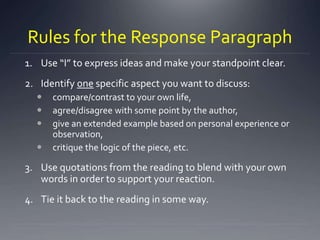
Rules for the Response Paragraph
1. Use “I” to express ideas and make your standpoint clear.
2. Identify one specific aspect you want to discuss:
 compare/contrast to your own life,
 agree/disagree with some point by the author,
 give an extended example based on personal experience or
observation,
 critique the logic of the piece, etc.
3. Use quotations from the reading to blend with your own
words in order to support your reaction.
4. Tie it back to the reading in some way.
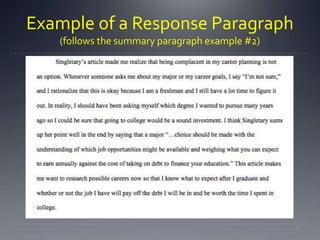
Example of a Response Paragraph
(follows the summary paragraph example #2)
Wrap Up Part II: Response
Paragraph
 As you can see in the example, the writer does the
following:
 Provides her stance (uses I and is subjective)
 Focuses on one aspect of the text (doesn’t rant or talk about
all kinds of things!)
 Uses a quote to strengthen her response
 Concludes the paragraph by getting back to the topic
sentence
TheWorks Cited Page
 Because you will be referring to another author’s ideas
that are not your own and possibly quoting these ideas,
you will need to include a “Works Cited” at the bottom of
your page or on the next page of your Summary Response.
 AWorksCited is a compilation of citations—a citation
provides the information about the secondary source to
which you are referring to in your own writing.The citation
includes the text’s full title, the author, publisher, date of
publication, etc.
 A full list of directions and examples is available in your
Little Seagull Handbook.
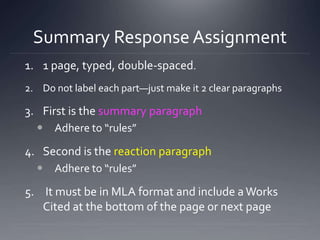
Summary Response Assignment
1. 1 page, typed, double-spaced.
2. Do not label each part—just make it 2 clear paragraphs
3. First is the summary paragraph
 Adhere to “rules”
4. Second is the reaction paragraph
 Adhere to “rules”
5. It must be in MLA format and include a Works
Cited at the bottom of the page or next page

The Summary Response Assignment

  • 2.
    Types ofWriting  Incollege you will encounter many different types of writing.  Sometimes you may be asked to write from a personal standpoint whereas other times you may be required to write more analytically.  Many college instructors require you to read a text and then summarize it and respond to it.  Today we will cover the summary response assignment, which is made up of two parts: summary and response.
  • 3.
    Important Note  Formy course, I call this assignment a “Summary Response” paper.  You might have learned it with different names like Reaction Piece, Summary and Reflection Piece, Reading Response, etc.  Instead of being attached to the specific name of the assignment, understand the gist of it:  It is a summary of what you have read  Followed by a response (your opinion) to what you have read
  • 4.
    The Summary Paragraph What is a summary paragraph?  A summary (whether it is a sentence or an entire paragraph) is a rewritten, shortened version of a piece of text in which you use your own words.  It’s important to summarize effectively, for 2 reasons: 1. It shows strong reading comprehension skills. 2. It helps you to incorporate outside sources when doing any kind of research paper.  For this assignment, it will be ONE paragraph.
  • 5.
    Rules for theSummary Paragraph 1. Begin with a FATt statement as your topic sentence, 2. Follow with the main ideas to support, 3. Reduce the length of the original text, (avoid specific details) 4. Change the original wording into your own words without changing the idea, 5. Be objective: a. Do not evaluate the content or give an opinion in any way, b. Do not add ideas, (even if you have an abundance of related info!) c. Do not include personal information, (that is, don’t use I ) 6. Use quotations only infrequently, 7. Use some author tags (“statesYork” or “according toYork”).
  • 6.
    Example of aSummary Paragraph
  • 7.
    Example of aSummary Paragraph
  • 8.
    Wrap Up PartI: Summary Paragraph  As you can see in the examples, the summary has the following:  It begins with a FATt statement  Has about 5-7 sentences of supporting points  Does not use quotes but is written in the writer’s own words  Does NOT have any personal opinion (it is objective!)  Uses author tags  Concludes the summary by getting back to the FATt
  • 9.
    Writing a ResponseParagraph  What is a response paragraph?  A response, in general, is your reaction to the summary; it requires  Taking a stance,  Using “I” or first person, and  Critically thinking about the text.  The reaction is up to the writer, and will vary from student to student, but it should clearly show where you stand in relation to the reading.  Finally, the best responses zero in on one specific aspect of the text:  agree or disagree with a specific quote,  extend on an argument,  provide personal example to relate to an argument, etc.  Remember: it is only one paragraph, so you shouldn’t be trying to make multiple points. Just like in an essay, you should keep it to one point per paragraph.
  • 10.
    Using the TSISTemplates  Where to start? A good place is to first go back to your annotations. It is there where you might find a note to yourself, something where you were dubious, perturbed, in accordance, disgusted, in awe, confused, etc.  Then review the templates in Chapter 4, or for quick reference, pages 297-299.  For example:  “I disagree with X’s view that _____________ because…  “I agree that _______because my experience ________  Although I agree with X up to a point, I cannot accept his overall conclusion that _____________.
  • 11.
    Rules for theResponse Paragraph 1. Use “I” to express ideas and make your standpoint clear. 2. Identify one specific aspect you want to discuss:  compare/contrast to your own life,  agree/disagree with some point by the author,  give an extended example based on personal experience or observation,  critique the logic of the piece, etc. 3. Use quotations from the reading to blend with your own words in order to support your reaction. 4. Tie it back to the reading in some way.
  • 12.
    Example of aResponse Paragraph (follows the summary paragraph example #2)
  • 13.
    Wrap Up PartII: Response Paragraph  As you can see in the example, the writer does the following:  Provides her stance (uses I and is subjective)  Focuses on one aspect of the text (doesn’t rant or talk about all kinds of things!)  Uses a quote to strengthen her response  Concludes the paragraph by getting back to the topic sentence
  • 14.
    TheWorks Cited Page Because you will be referring to another author’s ideas that are not your own and possibly quoting these ideas, you will need to include a “Works Cited” at the bottom of your page or on the next page of your Summary Response.  AWorksCited is a compilation of citations—a citation provides the information about the secondary source to which you are referring to in your own writing.The citation includes the text’s full title, the author, publisher, date of publication, etc.  A full list of directions and examples is available in your Little Seagull Handbook.
  • 15.
    Summary Response Assignment 1.1 page, typed, double-spaced. 2. Do not label each part—just make it 2 clear paragraphs 3. First is the summary paragraph  Adhere to “rules” 4. Second is the reaction paragraph  Adhere to “rules” 5. It must be in MLA format and include a Works Cited at the bottom of the page or next page