The Introductory Paragraph
One of the most important
paragraphs in your essay!
What is the purpose of the
introductory paragraph?
 Get the reader’s attention
 Set tone for the rest of the essay
 Make a contract with the reader - what will be
covered in this piece?
The Parts of the Introductory
Paragraph
 The Hook - Designed to grab attention
immediately and give some indication about
the essay’s topic
 The Transition or Lead In - Moves the reader
from the hook to the driving force of the
essay….
 The Thesis - Makes the contract with the
reader about what will be discussed without a
blatant announcement.
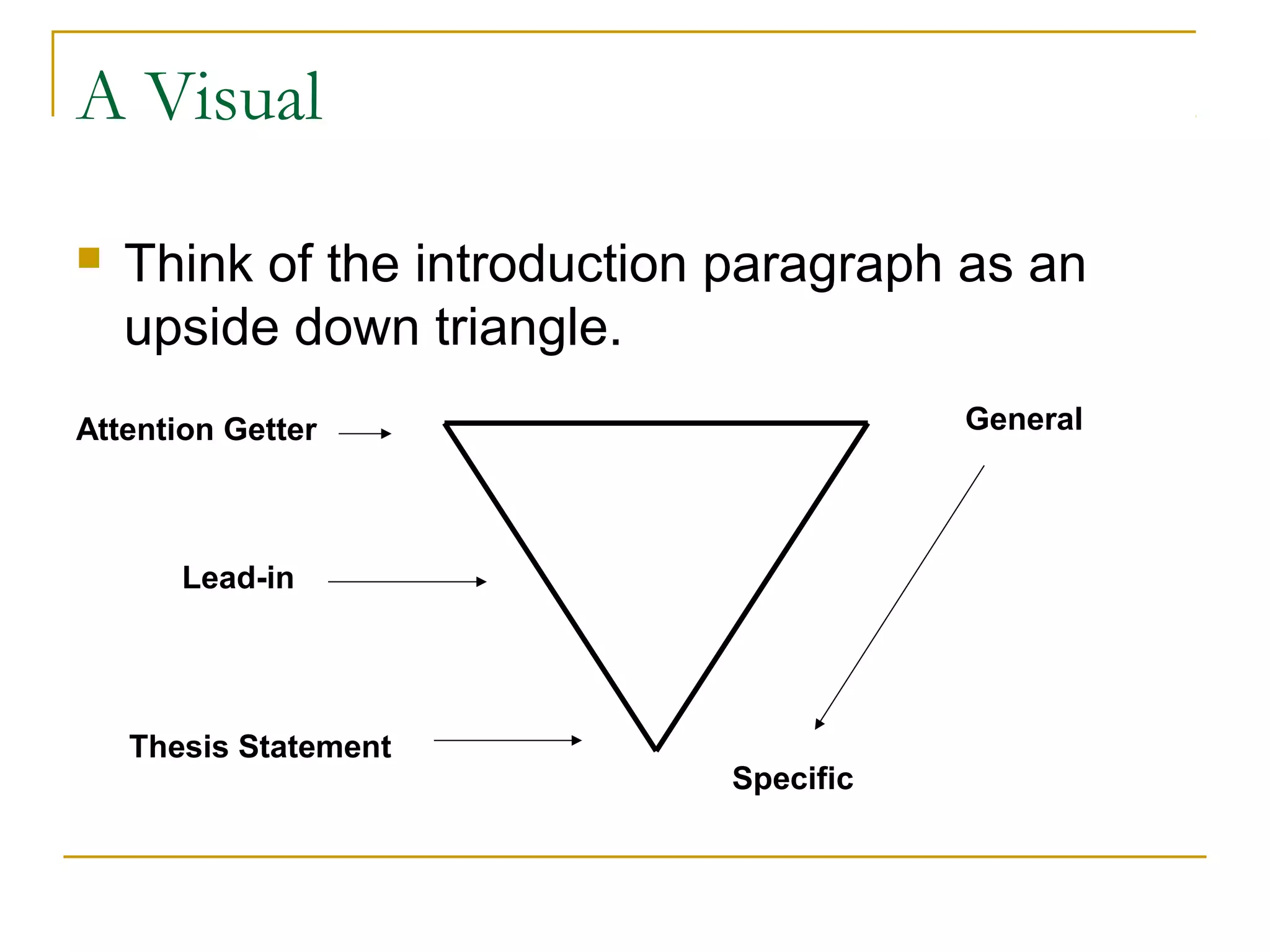
A Visual
 Think of the introduction paragraph as an
upside down triangle.
General
Specific
Attention Getter
Lead-in
Thesis Statement
Attention Getter / Hook
 The very first
sentence(s) that gets
the reader’s attention
and makes them want
to read more
 VERY general
introduction of the
topic
 Some options:
 Shocking statistic
 Startling story
 Quotation
 Setting the scene
 Description
 NO QUESTIONS
The Lead-in
 The sentences between the attention-getter
and thesis statement
 Helps narrow the topic from general to
specific
 Acts as a transition between attention-getter
and thesis statement
The Thesis Statement
 The most important sentence in the paper
 Last sentence of introduction paragraph
 Tells exactly what the paper will be about
 Sometimes, it will present the order of the
supporting material that will be in the paper
If you are handwriting an essay for a test or
other situation, make sure you still write the
thesis statement first. On a separate piece
of paper, write the thesis statement. Then
read over the thesis and generate a hook
that will grab the reader’s attention. Finally,
transition to the thesis and recopy the thesis
statement as the last sentence in the
paragraph.
Types of Hooks
1. Personal examples
2. Quotations
3. Facts or statistics
4. Rhetorical questions
5. Current events
6. Contrast to the thesis statement
Personal Examples
 Provides strong, dramatic incidents to use.
Honesty in expressing thoughts and feelings
will ring true with the reader. While you can
make up the personal experience, be careful
that it sounds credible.
 Personal observation - different from a
personal example, an observation is
something you saw happening.
On Friday, February 19, 2011, life changed
for an eighteen-year-old young man. He became
very ill from a bacterial infection. His body could
not fight the infection. Why? After a week of tests
and examinations by several specialists, the
diagnosis was made. He had leukemia, a cancer of
the bone marrow. I am that young man. When a
person finds out that he has cancer, just as I did,
his whole world changes. A cancer patient is
affected physically, psychologically, and socially
by the impact of cancer.
Example 1
One morning a young mother had her seven-
month old son in his stroller under the peach tree near
the family pool. She walked to the kitchen to get a
knife so she could peel the peach for him. Ten seconds
later, she found him facedown with the stroller at the
bottom of the pool. She immediately pulled him out
and administered CPR to her son. If she had been gone
any longer, he might have been one of the statistics
that plague our country every year. These child
drownings could be greatly reduced if parents never
left their children unattended around water, if pools
were properly fenced, and if other safety devices were
installed in or by the pool.
Example 2
Using Quotations
 Content of quote should be:
 Dramatic
 Emotionally appealing
 Surprising
 Humorous
 Quote does not have to be from a famous
person
 Must be relevant to thesis statement
Example 1
 “The mind is its own place, and in itself can make a
heaven of hell, a hell of heaven” (255). This thought
by John Milton was recorded over four hundred
years ago, but it is still timely for us today. He seems
to be saying that we are the ones to control our
lives. We can be miserable when things are going
well, just as we can be happy when things are going
wrong. With this thought in mind, we can control the
way we face life through our attitude, our
determination, and our ability.
Example 2
 “I am stupid. I am never going back to school.” These are
the words spoken by a learning disabled child when he
was in first grade. He cried as he slowly walked to his
bedroom, shredding his schoolwork into small pieces. This
was the first of many times when he and his parents would
feel frustrated because there was nothing that they could
do. Parents of children with learning disabilities have often
felt unprepared to help their children with their handicaps
and frustrated with attempts to seek the proper placement
of them in the public-school system. The experience of
school can be overwhelming for children who have trouble
learning. The learning disabled student in the public
educational system must deal with academic, social, and
emotional problems.
Using Facts or Statistics
 Must be startling or unusual
 Must be from a credible source
 Use journal as a place to
record both quotes and facts or
statistics that might work for an
introduction
“Just the facts,
please.”
Example 1
 In the desert regions of Arizona, solar homes
date back to the pre-Columbian Indians.
These people carefully designed their homes
in the recesses of south-facing cliffs to
receive the warmth of the winter sun. In the
summer, shade was provided by overhanging
cliffs. Today, solar homes are becoming
popular across the country. These solar
homes, as then, must be carefully designed
to use the sun efficiently in the orientation,
the exterior, and the interior.
Example 2
 According to an article in Family Safety & First Aid,
published by Berkley Books, “… every 45 seconds a
fire breaks out in an American home – 700,000
residences aflame each year. And 16 times a day
somebody dies in one of these burning homes” (45).
These statistics are frightening and should not be
taken lightly. The best way to deal with the
possibility of loss from fire is to plan ahead before it
happens. Otherwise, it is too late. In order not to
become one of these statistics, Americans need to
equip their homes with safety devices, set and
adhere to safety rules, and practice a family escape
plan in order to protect their families.
Using Current Events
 Must be recent
 Must be important
 Should be made public
by newspapers,
television, or radio
Example
 This morning’s news reported that a young girl, age 5,
was abducted from her classroom. As a frantic search
ensued, people across the Philadelphia area were
shocked to find that the kidnapper walked right into the
child’s classroom and demanded that the young
kindergartner leave with the woman. The child managed
to escape and was found, but she had been attacked by
her captors. Obviously, safety procedures broke down
and this poor child paid the price. In order to assure the
safety of all children, schools across the country must
review safety procedures, tighten safety protocols where
necessary, and assure all staff members are properly
trained.
Using Contrast to the Thesis Statement
 In direct contrast to the
thesis statement
 It’s fun to prove an
expert wrong
Example
 Since the middle 1940s, the female Cannabis sativa
plant, commonly known as marijuana, has been
classified by the United States government as a
Schedule I drug. This classification recognizes
marijuana as a dangerous narcotic, similar in
potency to heroin and possessing no redeeming
medicinal qualities. Research in the last few years,
however, has brought many new discoveries in
medicine relating to the possible uses of marijuana
to treat many different illnesses. Marijuana has been
found to be effective in treating glaucoma, cancer,
and phantom limb pain suffered by paraplegics and
amputees.
The Conclusion Paragraph
 The last paragraph in an essay that neatly
wraps up the paper
 Contains 3 main parts
 Restate the thesis
 Lead-out
 Clincher
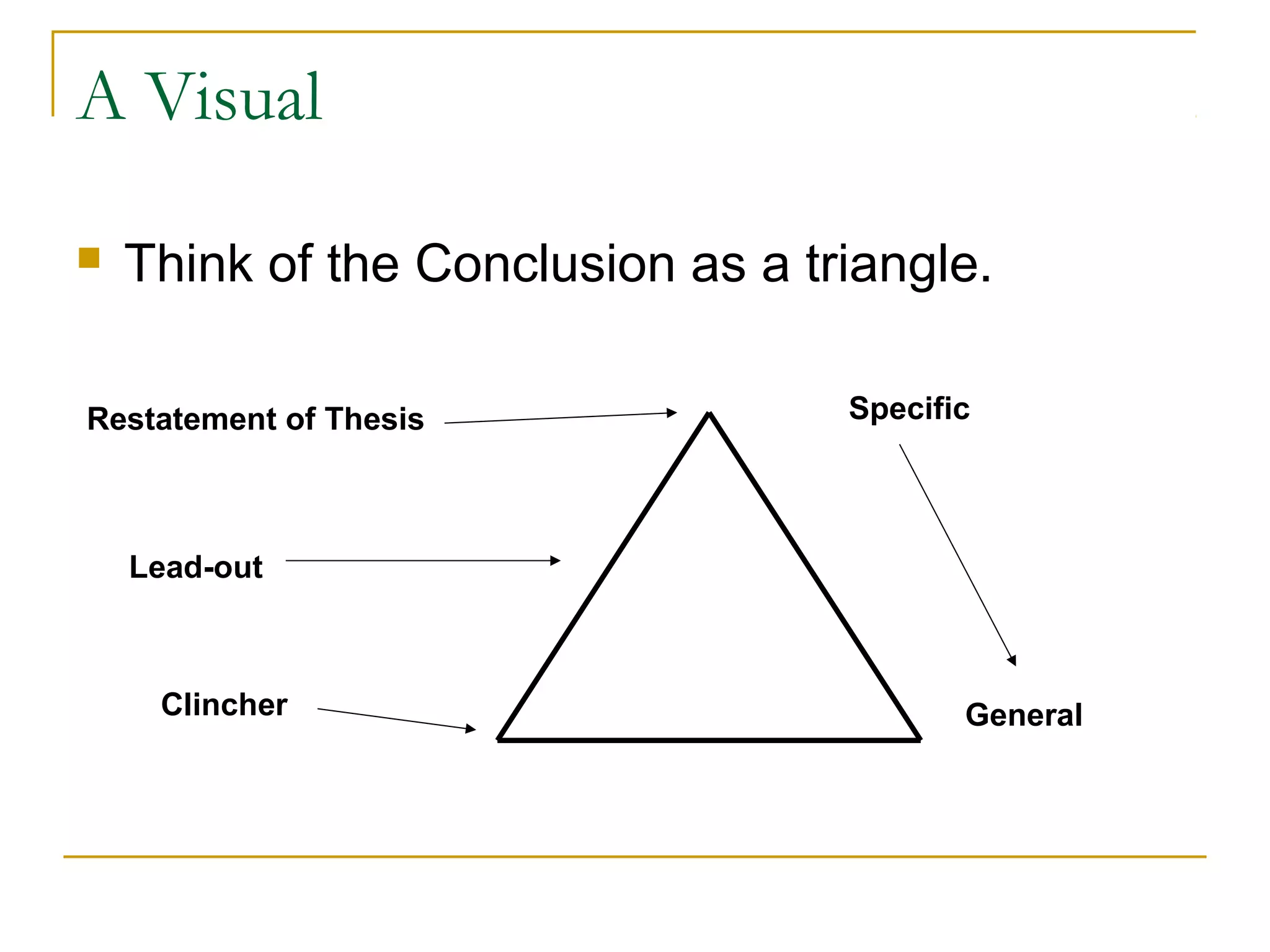
A Visual
 Think of the Conclusion as a triangle.
General
SpecificRestatement of Thesis
Lead-out
Clincher
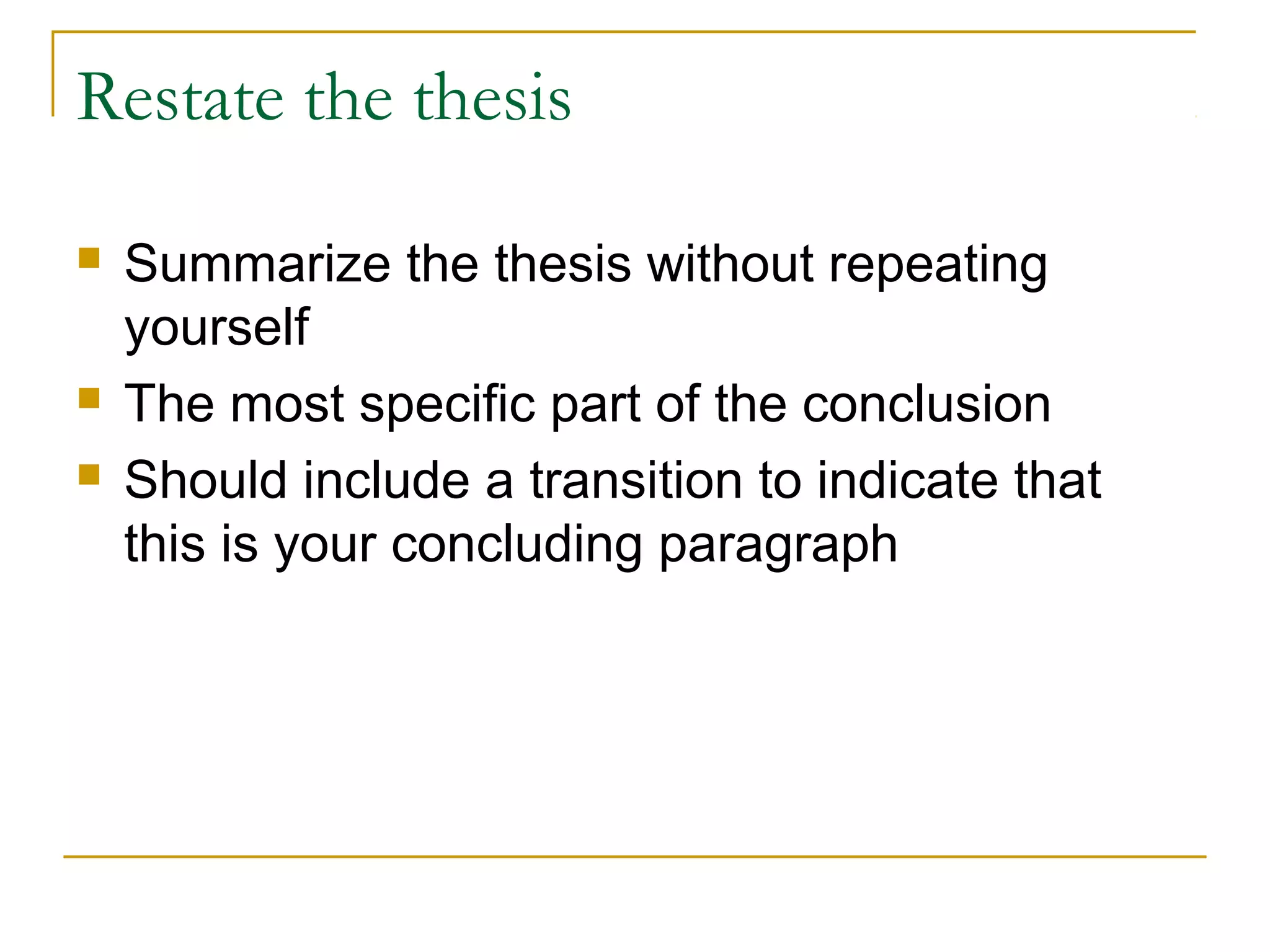
Restate the thesis
 Summarize the thesis without repeating
yourself
 The most specific part of the conclusion
 Should include a transition to indicate that
this is your concluding paragraph
The Lead-out
 Just like the lead-in only backwards
 Makes the topic larger to become more
general and less specific
 Smoothes out the conclusion paragraph
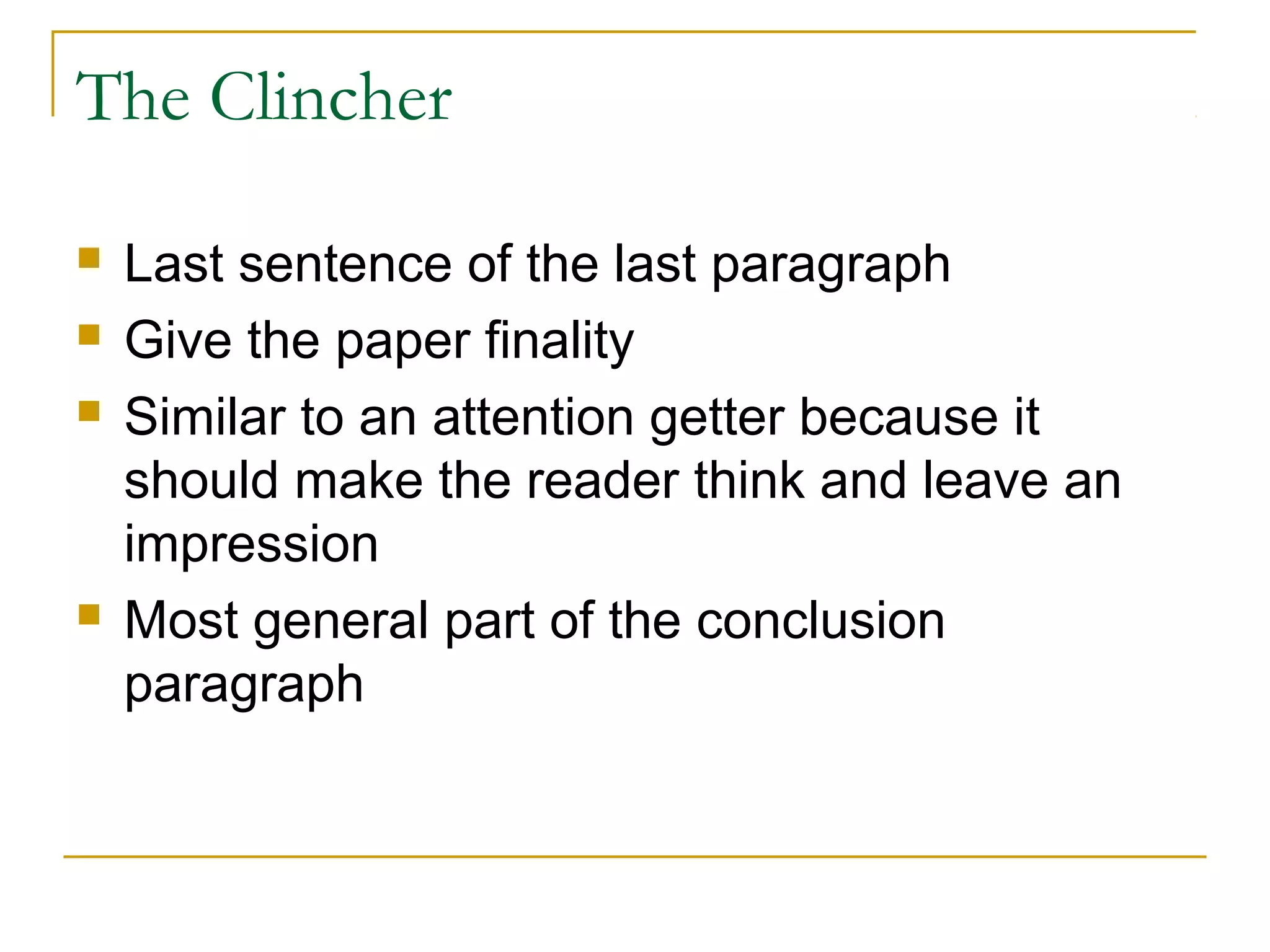
The Clincher
 Last sentence of the last paragraph
 Give the paper finality
 Similar to an attention getter because it
should make the reader think and leave an
impression
 Most general part of the conclusion
paragraph
Restate Thesis
 Try to restate your thesis in different words
and/or deeper thinking.
 Thesis: The most memorable moment in my
life was the 1987 Minnesota Twins World
Series win.
 Restate: The Twins victory that day sealed
their world title and made my day.
Types of Final Ideas
1. A statement about the significance of the
essay's subject (Why was it important for the
reader to know what you just finished
explaining?)
2. A call to action
 Ex: The fate of Chinese dissidents is still
unknown. Action must be taken to spare them
from torture and death.
Final Ideas
3. A warning based on the essay's thesis
 Example: If efforts to reduce and recycle are
not soon put into effect, we will be polluting
our own nest beyond habitation.
4. A quotation or story that sums up the essay's
point, may be taken from your text or your
personal experience, etc.
Final Ideas
5. An image or description that lends a feeling
of finality to the essay.
6. A question (based on the essay's point that
makes the reader think further about its
implications. BUT the question must be
carefully worded so that the reader does not
wonder WHAT to think.)
7. Refer back to your introduction.
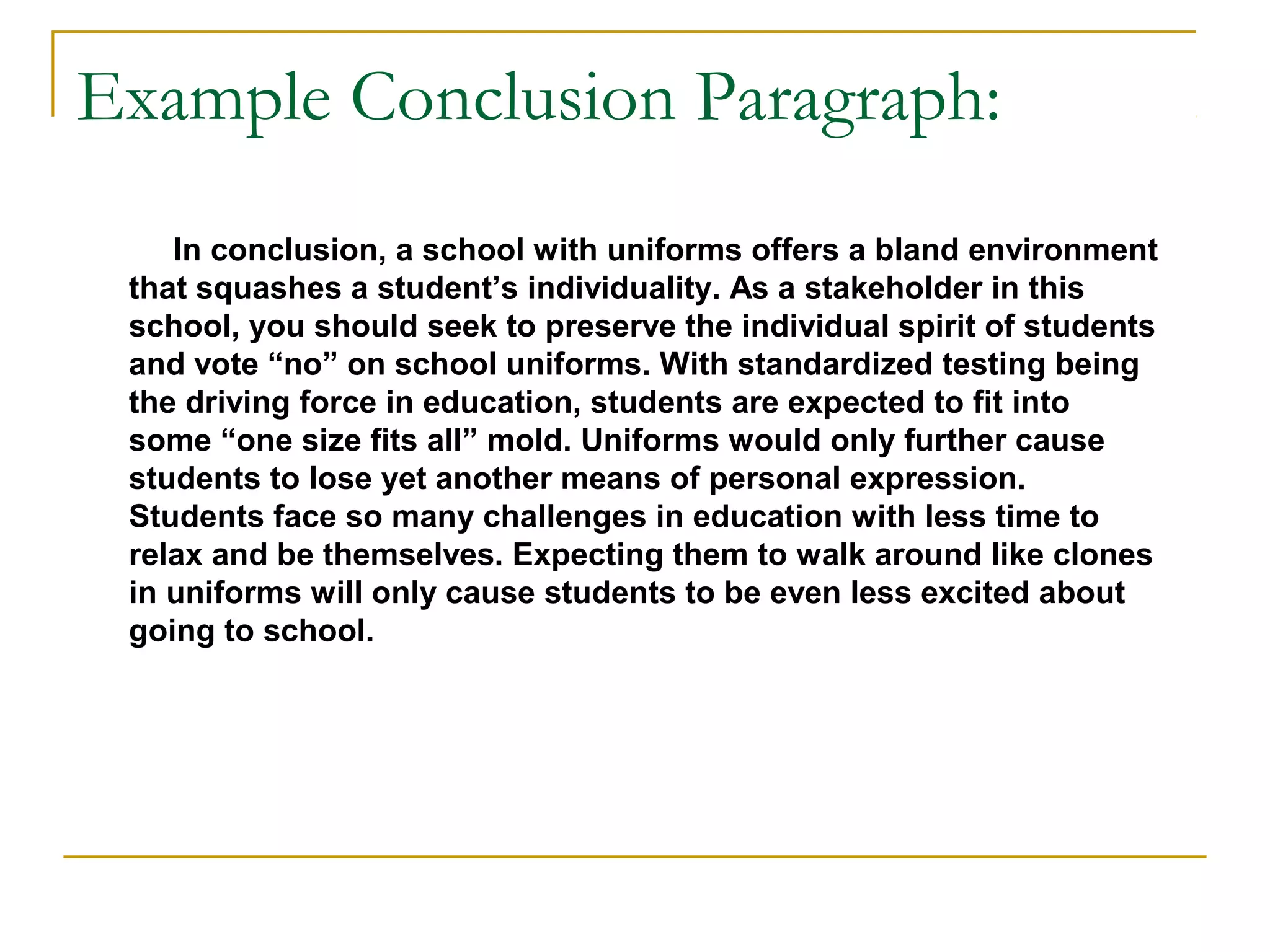
Example Conclusion Paragraph:
In conclusion, a school with uniforms offers a bland environment
that squashes a student’s individuality. As a stakeholder in this
school, you should seek to preserve the individual spirit of students
and vote “no” on school uniforms. With standardized testing being
the driving force in education, students are expected to fit into
some “one size fits all” mold. Uniforms would only further cause
students to lose yet another means of personal expression.
Students face so many challenges in education with less time to
relax and be themselves. Expecting them to walk around like clones
in uniforms will only cause students to be even less excited about
going to school.
Introduction Paragraph
 After eight hours of a long, stressful, day at work, the anticipation about
going to the college library to study is over. As soon as I arrive at the library,
it is packed. I am shocked to find no computers available, no desks to study
on, and chaos of students around. As I look around desperate for a
computer, a male student notices me in distress. He then gets up and asks
me if I want to use his computer since he was leaving. Gratefully I thank him
as I sit down and adjust to begin to do my studies. There is not much desk
space due to the belonging of students everywhere: no books, no work, no
studying around. I only see people’s belongings: jackets, sweaters, hats,
purses, and other unexplainable material. The chaos of the library comes
from personal use of the computers online. Groups clutter around to gossip,
and some clutter just to watch useless nonsense. College libraries should
only be limited to education and educational use
Conclusion Paragraph
 Isn’t it obvious that college libraries should be limited to
only education and educational use? As a student of
Hartnell College, I value the proper use of the college
library as it was meant to be: for educational success in
life. Simple signs posting the rules followed up by
librarians periodically monitoring the computer area is all
it would take to fix this problem
LOGICAL RELATIONSHIP TRANSITIONAL EXPRESSION
Similarity also, in the same way, just as … so too, likewise,
similarly
Exception/Contrast but, however, in spite of, on the one hand … on the
other hand, nevertheless, nonetheless,
notwithstanding, in contrast, on the contrary, still, yet
Sequence/Order first, second, third, … next, then, finally
Time after, afterward, at last, before, currently, during,
earlier, immediately, later, meanwhile, now, recently,
simultaneously, subsequently, then
Example for example, for instance, namely, specifically, to
illustrate
Emphasis even, indeed, in fact, of course, truly
Place/Position above, adjacent, below, beyond, here, in front, in back,
nearby, there
Cause and Effect accordingly, consequently, hence, so, therefore, thus
Additional Support or Evidence additionally, again, also, and, as well, besides, equally
important, further, furthermore, in addition, moreover,
then
Conclusion/Summary finally, in a word, in brief, briefly, in conclusion, in the
end, in the final analysis, on the whole, thus, to
conclude, to summarize, in sum, to sum up, in
summary

Introductory paragraph - Essay

  • 1.
    The Introductory Paragraph Oneof the most important paragraphs in your essay!
  • 2.
    What is thepurpose of the introductory paragraph?  Get the reader’s attention  Set tone for the rest of the essay  Make a contract with the reader - what will be covered in this piece?
  • 3.
    The Parts ofthe Introductory Paragraph  The Hook - Designed to grab attention immediately and give some indication about the essay’s topic  The Transition or Lead In - Moves the reader from the hook to the driving force of the essay….  The Thesis - Makes the contract with the reader about what will be discussed without a blatant announcement.
  • 4.
    A Visual  Thinkof the introduction paragraph as an upside down triangle. General Specific Attention Getter Lead-in Thesis Statement
  • 5.
    Attention Getter /Hook  The very first sentence(s) that gets the reader’s attention and makes them want to read more  VERY general introduction of the topic  Some options:  Shocking statistic  Startling story  Quotation  Setting the scene  Description  NO QUESTIONS
  • 6.
    The Lead-in  Thesentences between the attention-getter and thesis statement  Helps narrow the topic from general to specific  Acts as a transition between attention-getter and thesis statement
  • 7.
    The Thesis Statement The most important sentence in the paper  Last sentence of introduction paragraph  Tells exactly what the paper will be about  Sometimes, it will present the order of the supporting material that will be in the paper
  • 8.
    If you arehandwriting an essay for a test or other situation, make sure you still write the thesis statement first. On a separate piece of paper, write the thesis statement. Then read over the thesis and generate a hook that will grab the reader’s attention. Finally, transition to the thesis and recopy the thesis statement as the last sentence in the paragraph.
  • 9.
    Types of Hooks 1.Personal examples 2. Quotations 3. Facts or statistics 4. Rhetorical questions 5. Current events 6. Contrast to the thesis statement
  • 10.
    Personal Examples  Providesstrong, dramatic incidents to use. Honesty in expressing thoughts and feelings will ring true with the reader. While you can make up the personal experience, be careful that it sounds credible.  Personal observation - different from a personal example, an observation is something you saw happening.
  • 11.
    On Friday, February19, 2011, life changed for an eighteen-year-old young man. He became very ill from a bacterial infection. His body could not fight the infection. Why? After a week of tests and examinations by several specialists, the diagnosis was made. He had leukemia, a cancer of the bone marrow. I am that young man. When a person finds out that he has cancer, just as I did, his whole world changes. A cancer patient is affected physically, psychologically, and socially by the impact of cancer. Example 1
  • 12.
    One morning ayoung mother had her seven- month old son in his stroller under the peach tree near the family pool. She walked to the kitchen to get a knife so she could peel the peach for him. Ten seconds later, she found him facedown with the stroller at the bottom of the pool. She immediately pulled him out and administered CPR to her son. If she had been gone any longer, he might have been one of the statistics that plague our country every year. These child drownings could be greatly reduced if parents never left their children unattended around water, if pools were properly fenced, and if other safety devices were installed in or by the pool. Example 2
  • 13.
    Using Quotations  Contentof quote should be:  Dramatic  Emotionally appealing  Surprising  Humorous  Quote does not have to be from a famous person  Must be relevant to thesis statement
  • 14.
    Example 1  “Themind is its own place, and in itself can make a heaven of hell, a hell of heaven” (255). This thought by John Milton was recorded over four hundred years ago, but it is still timely for us today. He seems to be saying that we are the ones to control our lives. We can be miserable when things are going well, just as we can be happy when things are going wrong. With this thought in mind, we can control the way we face life through our attitude, our determination, and our ability.
  • 15.
    Example 2  “Iam stupid. I am never going back to school.” These are the words spoken by a learning disabled child when he was in first grade. He cried as he slowly walked to his bedroom, shredding his schoolwork into small pieces. This was the first of many times when he and his parents would feel frustrated because there was nothing that they could do. Parents of children with learning disabilities have often felt unprepared to help their children with their handicaps and frustrated with attempts to seek the proper placement of them in the public-school system. The experience of school can be overwhelming for children who have trouble learning. The learning disabled student in the public educational system must deal with academic, social, and emotional problems.
  • 16.
    Using Facts orStatistics  Must be startling or unusual  Must be from a credible source  Use journal as a place to record both quotes and facts or statistics that might work for an introduction “Just the facts, please.”
  • 17.
    Example 1  Inthe desert regions of Arizona, solar homes date back to the pre-Columbian Indians. These people carefully designed their homes in the recesses of south-facing cliffs to receive the warmth of the winter sun. In the summer, shade was provided by overhanging cliffs. Today, solar homes are becoming popular across the country. These solar homes, as then, must be carefully designed to use the sun efficiently in the orientation, the exterior, and the interior.
  • 18.
    Example 2  Accordingto an article in Family Safety & First Aid, published by Berkley Books, “… every 45 seconds a fire breaks out in an American home – 700,000 residences aflame each year. And 16 times a day somebody dies in one of these burning homes” (45). These statistics are frightening and should not be taken lightly. The best way to deal with the possibility of loss from fire is to plan ahead before it happens. Otherwise, it is too late. In order not to become one of these statistics, Americans need to equip their homes with safety devices, set and adhere to safety rules, and practice a family escape plan in order to protect their families.
  • 19.
    Using Current Events Must be recent  Must be important  Should be made public by newspapers, television, or radio
  • 20.
    Example  This morning’snews reported that a young girl, age 5, was abducted from her classroom. As a frantic search ensued, people across the Philadelphia area were shocked to find that the kidnapper walked right into the child’s classroom and demanded that the young kindergartner leave with the woman. The child managed to escape and was found, but she had been attacked by her captors. Obviously, safety procedures broke down and this poor child paid the price. In order to assure the safety of all children, schools across the country must review safety procedures, tighten safety protocols where necessary, and assure all staff members are properly trained.
  • 21.
    Using Contrast tothe Thesis Statement  In direct contrast to the thesis statement  It’s fun to prove an expert wrong
  • 22.
    Example  Since themiddle 1940s, the female Cannabis sativa plant, commonly known as marijuana, has been classified by the United States government as a Schedule I drug. This classification recognizes marijuana as a dangerous narcotic, similar in potency to heroin and possessing no redeeming medicinal qualities. Research in the last few years, however, has brought many new discoveries in medicine relating to the possible uses of marijuana to treat many different illnesses. Marijuana has been found to be effective in treating glaucoma, cancer, and phantom limb pain suffered by paraplegics and amputees.
  • 23.
    The Conclusion Paragraph The last paragraph in an essay that neatly wraps up the paper  Contains 3 main parts  Restate the thesis  Lead-out  Clincher
  • 24.
    A Visual  Thinkof the Conclusion as a triangle. General SpecificRestatement of Thesis Lead-out Clincher
  • 25.
    Restate the thesis Summarize the thesis without repeating yourself  The most specific part of the conclusion  Should include a transition to indicate that this is your concluding paragraph
  • 26.
    The Lead-out  Justlike the lead-in only backwards  Makes the topic larger to become more general and less specific  Smoothes out the conclusion paragraph
  • 27.
    The Clincher  Lastsentence of the last paragraph  Give the paper finality  Similar to an attention getter because it should make the reader think and leave an impression  Most general part of the conclusion paragraph
  • 28.
    Restate Thesis  Tryto restate your thesis in different words and/or deeper thinking.  Thesis: The most memorable moment in my life was the 1987 Minnesota Twins World Series win.  Restate: The Twins victory that day sealed their world title and made my day.
  • 29.
    Types of FinalIdeas 1. A statement about the significance of the essay's subject (Why was it important for the reader to know what you just finished explaining?) 2. A call to action  Ex: The fate of Chinese dissidents is still unknown. Action must be taken to spare them from torture and death.
  • 30.
    Final Ideas 3. Awarning based on the essay's thesis  Example: If efforts to reduce and recycle are not soon put into effect, we will be polluting our own nest beyond habitation. 4. A quotation or story that sums up the essay's point, may be taken from your text or your personal experience, etc.
  • 31.
    Final Ideas 5. Animage or description that lends a feeling of finality to the essay. 6. A question (based on the essay's point that makes the reader think further about its implications. BUT the question must be carefully worded so that the reader does not wonder WHAT to think.) 7. Refer back to your introduction.
  • 32.
    Example Conclusion Paragraph: Inconclusion, a school with uniforms offers a bland environment that squashes a student’s individuality. As a stakeholder in this school, you should seek to preserve the individual spirit of students and vote “no” on school uniforms. With standardized testing being the driving force in education, students are expected to fit into some “one size fits all” mold. Uniforms would only further cause students to lose yet another means of personal expression. Students face so many challenges in education with less time to relax and be themselves. Expecting them to walk around like clones in uniforms will only cause students to be even less excited about going to school.
  • 33.
    Introduction Paragraph  Aftereight hours of a long, stressful, day at work, the anticipation about going to the college library to study is over. As soon as I arrive at the library, it is packed. I am shocked to find no computers available, no desks to study on, and chaos of students around. As I look around desperate for a computer, a male student notices me in distress. He then gets up and asks me if I want to use his computer since he was leaving. Gratefully I thank him as I sit down and adjust to begin to do my studies. There is not much desk space due to the belonging of students everywhere: no books, no work, no studying around. I only see people’s belongings: jackets, sweaters, hats, purses, and other unexplainable material. The chaos of the library comes from personal use of the computers online. Groups clutter around to gossip, and some clutter just to watch useless nonsense. College libraries should only be limited to education and educational use
  • 34.
    Conclusion Paragraph  Isn’tit obvious that college libraries should be limited to only education and educational use? As a student of Hartnell College, I value the proper use of the college library as it was meant to be: for educational success in life. Simple signs posting the rules followed up by librarians periodically monitoring the computer area is all it would take to fix this problem
  • 35.
    LOGICAL RELATIONSHIP TRANSITIONALEXPRESSION Similarity also, in the same way, just as … so too, likewise, similarly Exception/Contrast but, however, in spite of, on the one hand … on the other hand, nevertheless, nonetheless, notwithstanding, in contrast, on the contrary, still, yet Sequence/Order first, second, third, … next, then, finally Time after, afterward, at last, before, currently, during, earlier, immediately, later, meanwhile, now, recently, simultaneously, subsequently, then Example for example, for instance, namely, specifically, to illustrate Emphasis even, indeed, in fact, of course, truly Place/Position above, adjacent, below, beyond, here, in front, in back, nearby, there Cause and Effect accordingly, consequently, hence, so, therefore, thus Additional Support or Evidence additionally, again, also, and, as well, besides, equally important, further, furthermore, in addition, moreover, then Conclusion/Summary finally, in a word, in brief, briefly, in conclusion, in the end, in the final analysis, on the whole, thus, to conclude, to summarize, in sum, to sum up, in summary