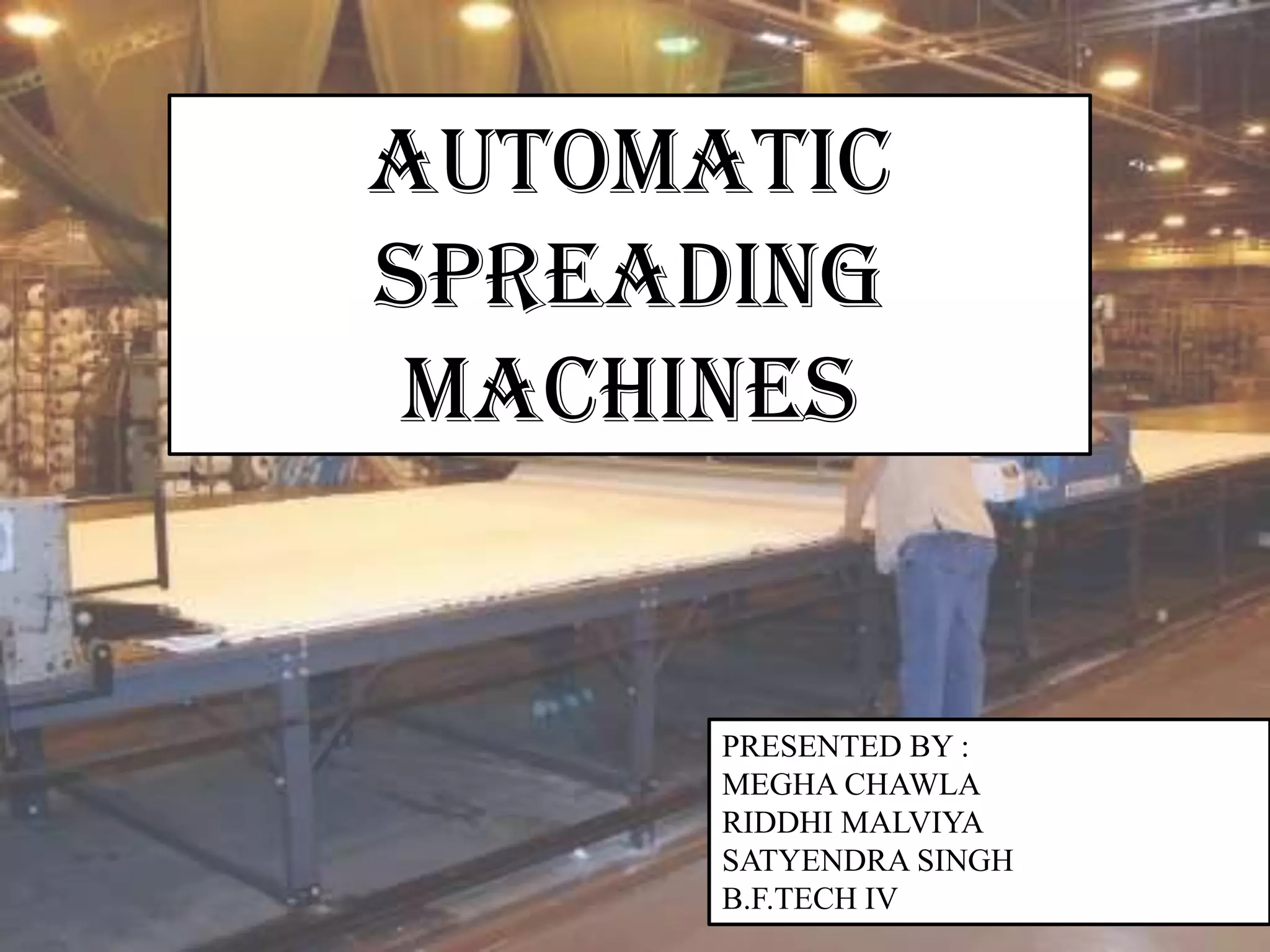
AUTOMATIC
SPREADING
MACHINES
PRESENTED BY :
MEGHA CHAWLA
RIDDHI MALVIYA
SATYENDRA SINGH
B.F.TECH IV
S
Superimpose layers of fabric
Smooth, tension-free
Accurate, efficient cutting
PURPOSE OF SPREADING
• Flat ,smooth surface
Spreading surfaces
• Manual
• Automatic
Spreading machines
• Control fabric during
spreading
Fabric control
devices during
spreading
SPREADING EQUIPMENTS :
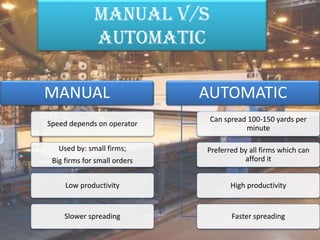
MANUAL
Speed depends on operator
Used by: small firms;
Big firms for small orders
Low productivity
Slower spreading
AUTOMATIC
Can spread 100-150 yards per
minute
Preferred by all firms which can
afford it
High productivity
Faster spreading
MANUAL V/S
AUTOMATIC
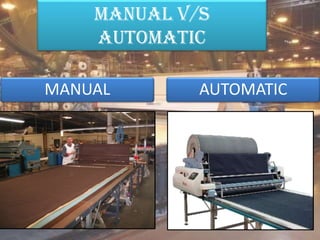
MANUAL AUTOMATIC
MANUAL V/S
AUTOMATIC
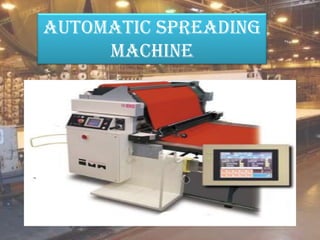
AUTOMATIC SPREADING
MACHINE
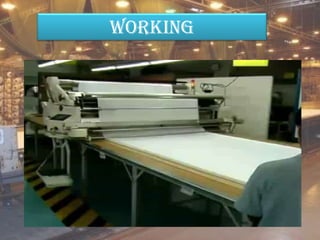
WORKING
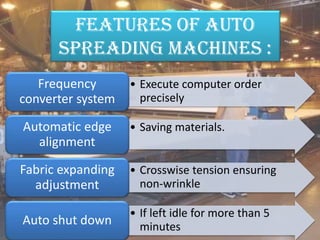
• Execute computer order
precisely
Frequency
converter system
• Saving materials.Automatic edge
alignment
• Crosswise tension ensuring
non-wrinkle
Fabric expanding
adjustment
• If left idle for more than 5
minutesAuto shut down
FEATURES OF AUTO
SPREADING MACHINES :
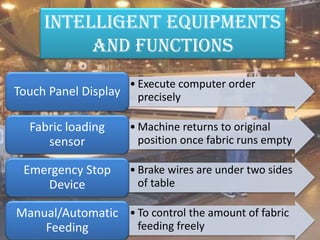
• Execute computer order
preciselyTouch Panel Display
• Machine returns to original
position once fabric runs empty
Fabric loading
sensor
• Brake wires are under two sides
of table
Emergency Stop
Device
• To control the amount of fabric
feeding freely
Manual/Automatic
Feeding
INTELLIGENT EQUIPMENTS
AND FUNCTIONS
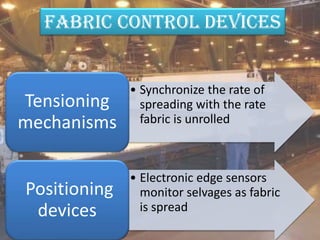
• Synchronize the rate of
spreading with the rate
fabric is unrolled
Tensioning
mechanisms
• Electronic edge sensors
monitor selvages as fabric
is spread
Positioning
devices
FABRIC CONTROL DEVICES
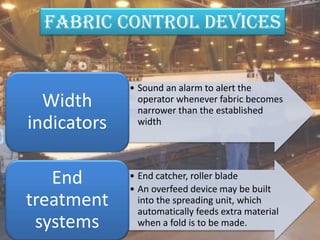
• Sound an alarm to alert the
operator whenever fabric becomes
narrower than the established
width
Width
indicators
• End catcher, roller blade
• An overfeed device may be built
into the spreading unit, which
automatically feeds extra material
when a fold is to be made.
End
treatment
systems
FABRIC CONTROL DEVICES
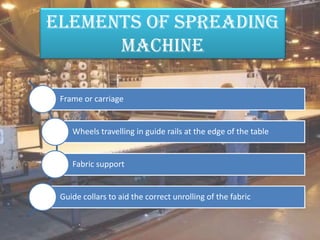
Elements of spreading
machine
Frame or carriage
Wheels travelling in guide rails at the edge of the table
Fabric support
Guide collars to aid the correct unrolling of the fabric
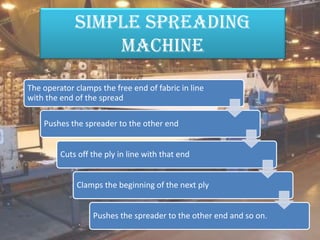
Simple spreading
machine
The operator clamps the free end of fabric in line
with the end of the spread
Pushes the spreader to the other end
Cuts off the ply in line with that end
Clamps the beginning of the next ply
Pushes the spreader to the other end and so on.
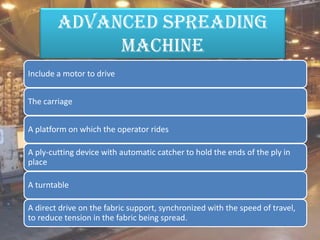
advanced spreading
machine
Include a motor to drive
The carriage
A platform on which the operator rides
A ply-cutting device with automatic catcher to hold the ends of the ply in
place
A turntable
A direct drive on the fabric support, synchronized with the speed of travel,
to reduce tension in the fabric being spread.
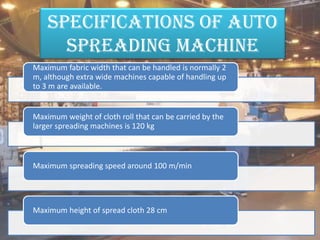
Specifications of auto
spreading machine
Maximum fabric width that can be handled is normally 2
m, although extra wide machines capable of handling up
to 3 m are available.
Maximum weight of cloth roll that can be carried by the
larger spreading machines is 120 kg
Maximum spreading speed around 100 m/min
Maximum height of spread cloth 28 cm
Dead heading
When a spreading machine dispenses
fabric when travelling in one direction
but returns to the first end without
spreading to begin the next ply, the
return pass is known as ‘dead heading’.
Microprocessor
control
Enabled the development of more automatic functions
A spreader can be preset to a selected number of plies,
emitting an audible signal when it has reached the selected
number or has come to the end of a piece of fabric.
Automatic turntabling gives automatic spreading even for
corduroys which are normally spread face to face
It repeats the process until it achieves the required number of
plies.
This method can be used in conjunction with the automatic
sensing of previously marked flaws and damages.
As the flaw moves past the sensor, the spreader will halt, the
ply cutter will cut across the ply, the spreader will reverse
direction and move back to the nearest splice mark on the
marker plan, and then it will continue its run to the end of the
ply.
Automatic TURNTABLE
• May use either catchers or a cut-off knife
mechanism, and is self powered.
• Requires the spreader to manually rotate the
fabric turntable rack when spreading F/F,
N/O/W and F/O/W, N/U/D modes of spreading.
Semi-
automatic
• Capable of rotating the fabric as well
Fully
automatic
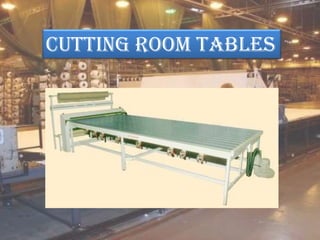
Cutting Room Tables
Pin Table
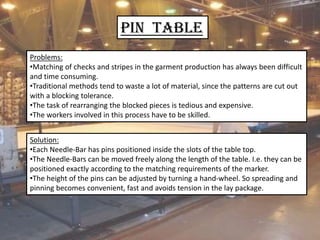
Problems:
•Matching of checks and stripes in the garment production has always been difficult
and time consuming.
•Traditional methods tend to waste a lot of material, since the patterns are cut out
with a blocking tolerance.
•The task of rearranging the blocked pieces is tedious and expensive.
•The workers involved in this process have to be skilled.
Solution:
•Each Needle-Bar has pins positioned inside the slots of the table top.
•The Needle-Bars can be moved freely along the length of the table. I.e. they can be
positioned exactly according to the matching requirements of the marker.
•The height of the pins can be adjusted by turning a hand-wheel. So spreading and
pinning becomes convenient, fast and avoids tension in the lay package.
Pin Table
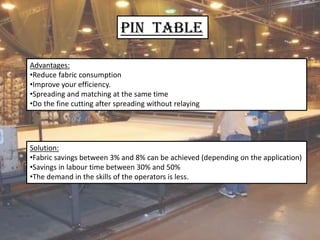
Advantages:
•Reduce fabric consumption
•Improve your efficiency.
•Spreading and matching at the same time
•Do the fine cutting after spreading without relaying
Solution:
•Fabric savings between 3% and 8% can be achieved (depending on the application)
•Savings in labour time between 30% and 50%
•The demand in the skills of the operators is less.
VACUUM Table
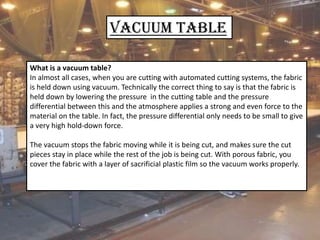
What is a vacuum table?
In almost all cases, when you are cutting with automated cutting systems, the fabric
is held down using vacuum. Technically the correct thing to say is that the fabric is
held down by lowering the pressure in the cutting table and the pressure
differential between this and the atmosphere applies a strong and even force to the
material on the table. In fact, the pressure differential only needs to be small to give
a very high hold-down force.
The vacuum stops the fabric moving while it is being cut, and makes sure the cut
pieces stay in place while the rest of the job is being cut. With porous fabric, you
cover the fabric with a layer of sacrificial plastic film so the vacuum works properly.
VACUUM Table
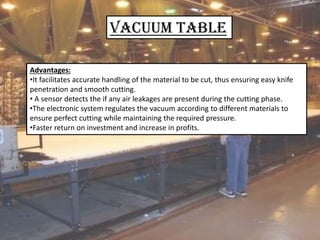
Advantages:
•It facilitates accurate handling of the material to be cut, thus ensuring easy knife
penetration and smooth cutting.
• A sensor detects the if any air leakages are present during the cutting phase.
•The electronic system regulates the vacuum according to different materials to
ensure perfect cutting while maintaining the required pressure.
•Faster return on investment and increase in profits.
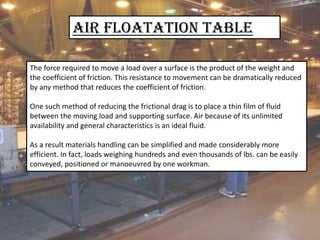
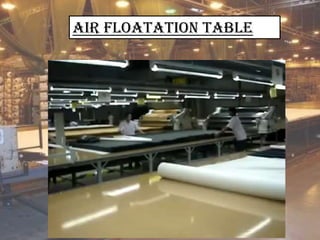
Air floatation Table
The force required to move a load over a surface is the product of the weight and
the coefficient of friction. This resistance to movement can be dramatically reduced
by any method that reduces the coefficient of friction.
One such method of reducing the frictional drag is to place a thin film of fluid
between the moving load and supporting surface. Air because of its unlimited
availability and general characteristics is an ideal fluid.
As a result materials handling can be simplified and made considerably more
efficient. In fact, loads weighing hundreds and even thousands of lbs. can be easily
conveyed, positioned or manoeuvred by one workman.
Air floatation Table
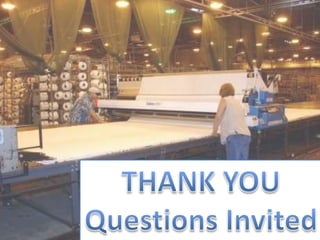
Automatic Spreading Machine (fabric spreading)

Automatic Spreading Machine (fabric spreading)

  • 1.
    AUTOMATIC SPREADING MACHINES PRESENTED BY : MEGHACHAWLA RIDDHI MALVIYA SATYENDRA SINGH B.F.TECH IV
  • 2.
  • 3.
    Superimpose layers offabric Smooth, tension-free Accurate, efficient cutting PURPOSE OF SPREADING
  • 4.
    • Flat ,smoothsurface Spreading surfaces • Manual • Automatic Spreading machines • Control fabric during spreading Fabric control devices during spreading SPREADING EQUIPMENTS :
  • 5.
    MANUAL Speed depends onoperator Used by: small firms; Big firms for small orders Low productivity Slower spreading AUTOMATIC Can spread 100-150 yards per minute Preferred by all firms which can afford it High productivity Faster spreading MANUAL V/S AUTOMATIC
  • 6.
  • 7.
  • 8.
  • 9.
    • Execute computerorder precisely Frequency converter system • Saving materials.Automatic edge alignment • Crosswise tension ensuring non-wrinkle Fabric expanding adjustment • If left idle for more than 5 minutesAuto shut down FEATURES OF AUTO SPREADING MACHINES :
  • 10.
    • Execute computerorder preciselyTouch Panel Display • Machine returns to original position once fabric runs empty Fabric loading sensor • Brake wires are under two sides of table Emergency Stop Device • To control the amount of fabric feeding freely Manual/Automatic Feeding INTELLIGENT EQUIPMENTS AND FUNCTIONS
  • 11.
    • Synchronize therate of spreading with the rate fabric is unrolled Tensioning mechanisms • Electronic edge sensors monitor selvages as fabric is spread Positioning devices FABRIC CONTROL DEVICES
  • 12.
    • Sound analarm to alert the operator whenever fabric becomes narrower than the established width Width indicators • End catcher, roller blade • An overfeed device may be built into the spreading unit, which automatically feeds extra material when a fold is to be made. End treatment systems FABRIC CONTROL DEVICES
  • 13.
    Elements of spreading machine Frameor carriage Wheels travelling in guide rails at the edge of the table Fabric support Guide collars to aid the correct unrolling of the fabric
  • 14.
    Simple spreading machine The operatorclamps the free end of fabric in line with the end of the spread Pushes the spreader to the other end Cuts off the ply in line with that end Clamps the beginning of the next ply Pushes the spreader to the other end and so on.
  • 15.
    advanced spreading machine Include amotor to drive The carriage A platform on which the operator rides A ply-cutting device with automatic catcher to hold the ends of the ply in place A turntable A direct drive on the fabric support, synchronized with the speed of travel, to reduce tension in the fabric being spread.
  • 16.
    Specifications of auto spreadingmachine Maximum fabric width that can be handled is normally 2 m, although extra wide machines capable of handling up to 3 m are available. Maximum weight of cloth roll that can be carried by the larger spreading machines is 120 kg Maximum spreading speed around 100 m/min Maximum height of spread cloth 28 cm
  • 17.
    Dead heading When aspreading machine dispenses fabric when travelling in one direction but returns to the first end without spreading to begin the next ply, the return pass is known as ‘dead heading’.
  • 18.
    Microprocessor control Enabled the developmentof more automatic functions A spreader can be preset to a selected number of plies, emitting an audible signal when it has reached the selected number or has come to the end of a piece of fabric. Automatic turntabling gives automatic spreading even for corduroys which are normally spread face to face
  • 19.
    It repeats theprocess until it achieves the required number of plies. This method can be used in conjunction with the automatic sensing of previously marked flaws and damages. As the flaw moves past the sensor, the spreader will halt, the ply cutter will cut across the ply, the spreader will reverse direction and move back to the nearest splice mark on the marker plan, and then it will continue its run to the end of the ply.
  • 20.
    Automatic TURNTABLE • Mayuse either catchers or a cut-off knife mechanism, and is self powered. • Requires the spreader to manually rotate the fabric turntable rack when spreading F/F, N/O/W and F/O/W, N/U/D modes of spreading. Semi- automatic • Capable of rotating the fabric as well Fully automatic
  • 21.
  • 22.
    Pin Table Problems: •Matching ofchecks and stripes in the garment production has always been difficult and time consuming. •Traditional methods tend to waste a lot of material, since the patterns are cut out with a blocking tolerance. •The task of rearranging the blocked pieces is tedious and expensive. •The workers involved in this process have to be skilled. Solution: •Each Needle-Bar has pins positioned inside the slots of the table top. •The Needle-Bars can be moved freely along the length of the table. I.e. they can be positioned exactly according to the matching requirements of the marker. •The height of the pins can be adjusted by turning a hand-wheel. So spreading and pinning becomes convenient, fast and avoids tension in the lay package.
  • 23.
    Pin Table Advantages: •Reduce fabricconsumption •Improve your efficiency. •Spreading and matching at the same time •Do the fine cutting after spreading without relaying Solution: •Fabric savings between 3% and 8% can be achieved (depending on the application) •Savings in labour time between 30% and 50% •The demand in the skills of the operators is less.
  • 24.
    VACUUM Table What isa vacuum table? In almost all cases, when you are cutting with automated cutting systems, the fabric is held down using vacuum. Technically the correct thing to say is that the fabric is held down by lowering the pressure in the cutting table and the pressure differential between this and the atmosphere applies a strong and even force to the material on the table. In fact, the pressure differential only needs to be small to give a very high hold-down force. The vacuum stops the fabric moving while it is being cut, and makes sure the cut pieces stay in place while the rest of the job is being cut. With porous fabric, you cover the fabric with a layer of sacrificial plastic film so the vacuum works properly.
  • 25.
    VACUUM Table Advantages: •It facilitatesaccurate handling of the material to be cut, thus ensuring easy knife penetration and smooth cutting. • A sensor detects the if any air leakages are present during the cutting phase. •The electronic system regulates the vacuum according to different materials to ensure perfect cutting while maintaining the required pressure. •Faster return on investment and increase in profits.
  • 26.
    Air floatation Table Theforce required to move a load over a surface is the product of the weight and the coefficient of friction. This resistance to movement can be dramatically reduced by any method that reduces the coefficient of friction. One such method of reducing the frictional drag is to place a thin film of fluid between the moving load and supporting surface. Air because of its unlimited availability and general characteristics is an ideal fluid. As a result materials handling can be simplified and made considerably more efficient. In fact, loads weighing hundreds and even thousands of lbs. can be easily conveyed, positioned or manoeuvred by one workman.
  • 27.