Cerebellum-1
All the information, including the images and pics collected
from different sources is strictly for teaching purposes only.
Learning objectives
1. Explain the location, parts, external features, anatomical lobes and blood
supply of cerebellum
2. Name the functional/morphological subdivisions of cerebellum and explain
their connections and functions
3. Define “cerebellar peduncle”
4. List the fibers present in the cerebellar peduncles
5. Name the deep cerebellar nuclei and their connections
6. Explain the mossy and climbing fibres
7. Explain the applied anatomy of cerebellum
8. Show the external features and dentate nuclei of the cerebellum
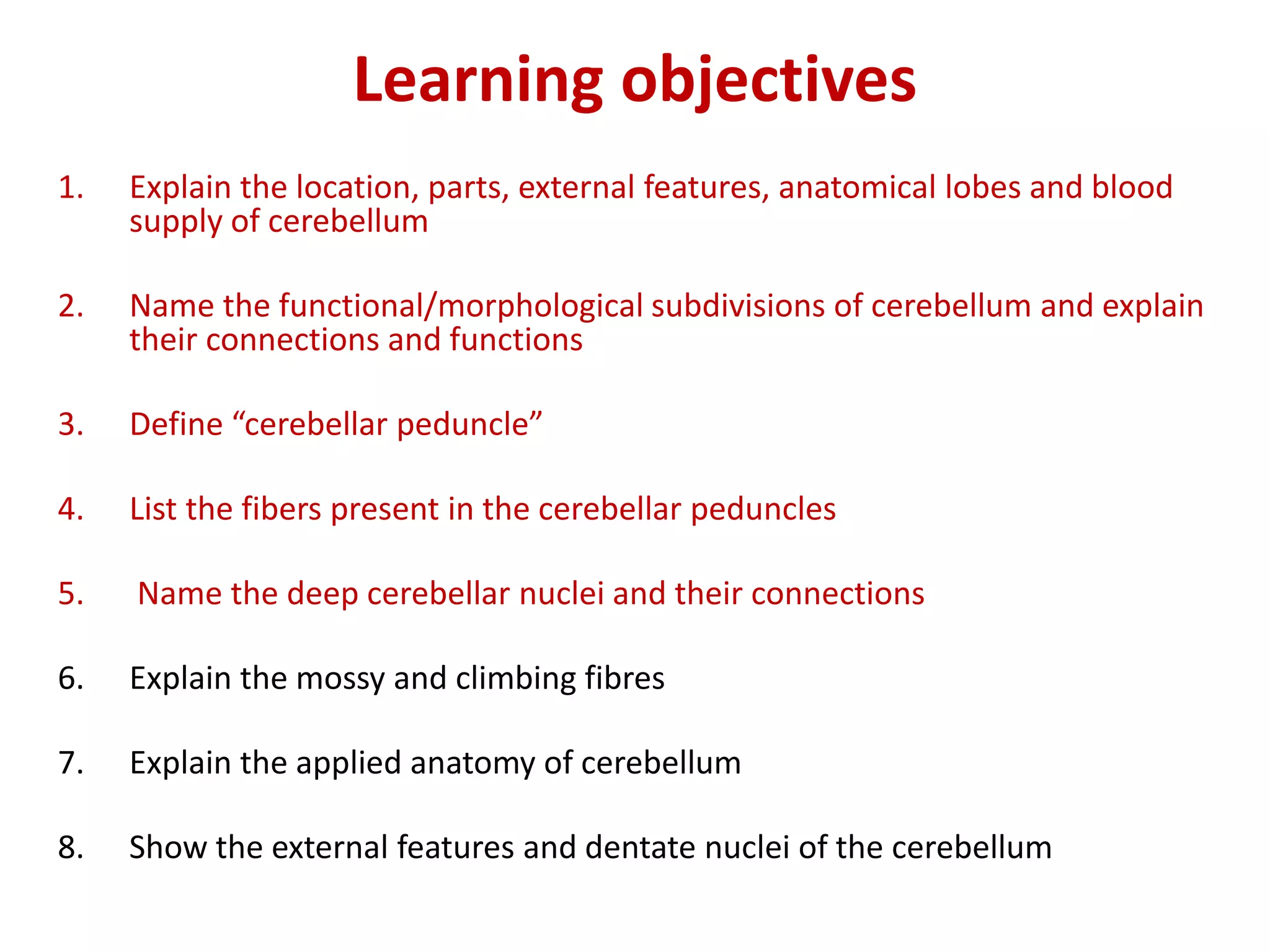
• It is the largest part of hind
brain(rhombencephalon)
• Cavity of 4th ventricle(its roof)
separates cerebellum from
pons and medulla
• It lies in the posterior cranial
fossa ,behind pons and upper
half of medulla
• Cerebellum is separated
superiorly from occipital
lobes of cerebrum by
tentorium cerebelli.
Cerebellum
Sagittal section of the brain
• 150 grams in weight.
• The proportion between
cerebellum & cerebrum in
the adult is 1:10
• Surface has numerous
laminae(folia) separated by
sulci or fissures.
• Unlike the cerebral
hemispheres, which work
entirely on a contralateral
basis, the cerebellar
hemispheres work
ipsilaterally(control the
same side of the body)
• The cerebellum consists of a cortex, (surface layer of gray matter)
contained in transverse folds or folia and a central core of white
matter.
• Four(4) pairs of deeply placed cerebellar nuclei are embedded
in the central cerebellar white matter.
• Three(3) pairs of cerebellar peduncles, composed of myelinated
axons, connect the cerebellum with the brain stem.
• Afferent fibers end in the three-layered cerebellar cortex. The
Purkinje cells of the cortexhave axons that end in the cerebellar
nuclei which are the source of efferent output.
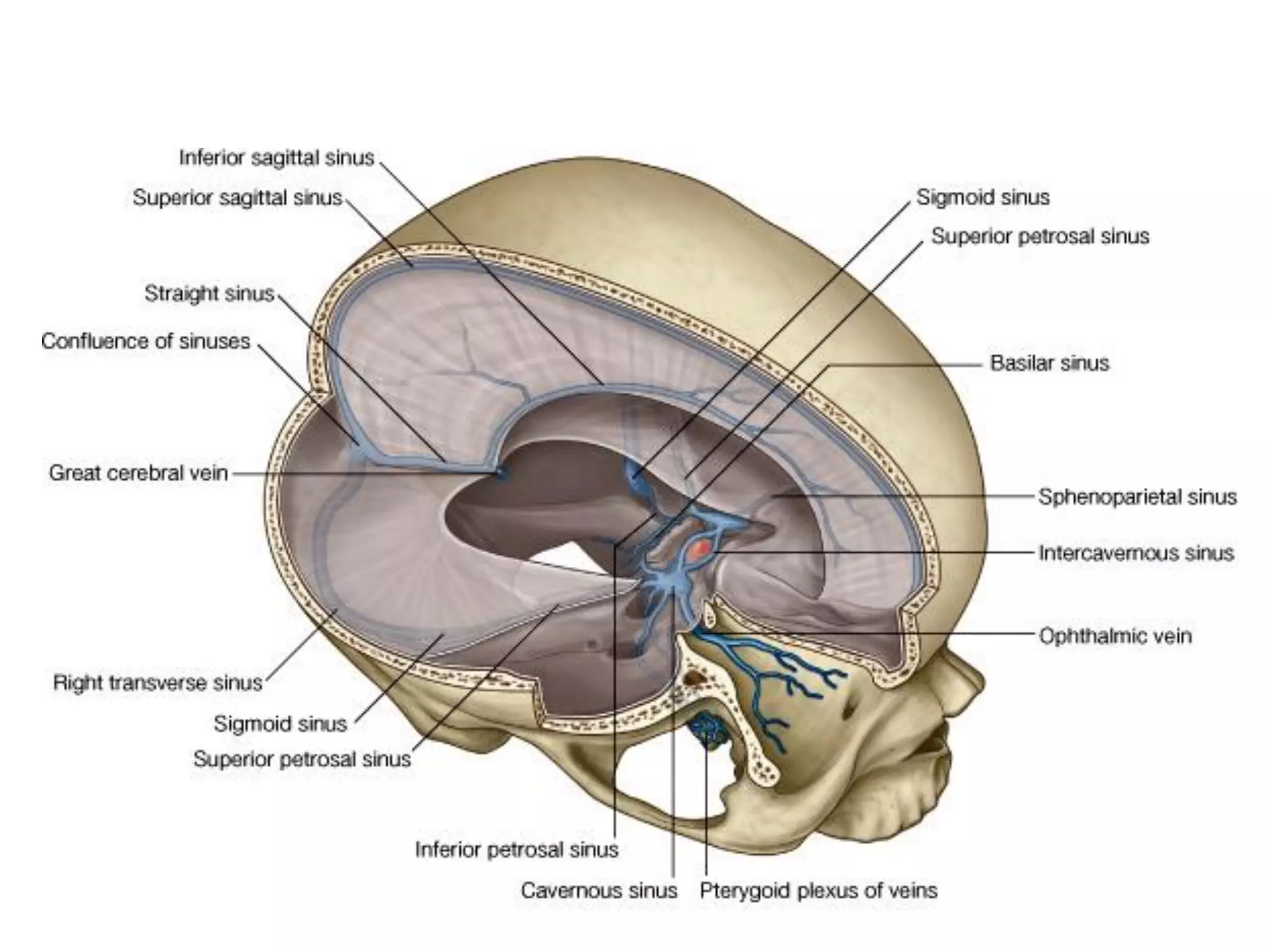
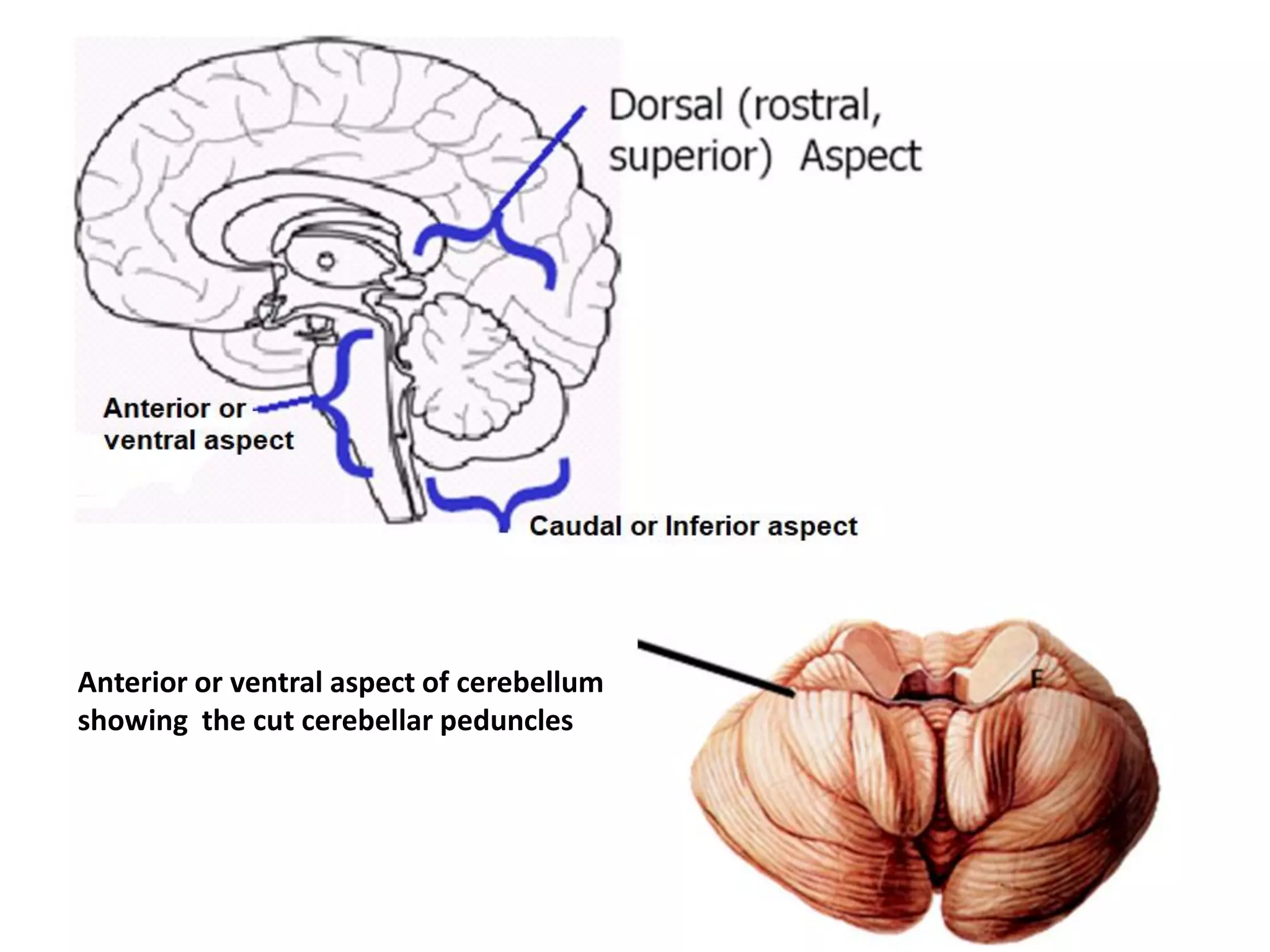
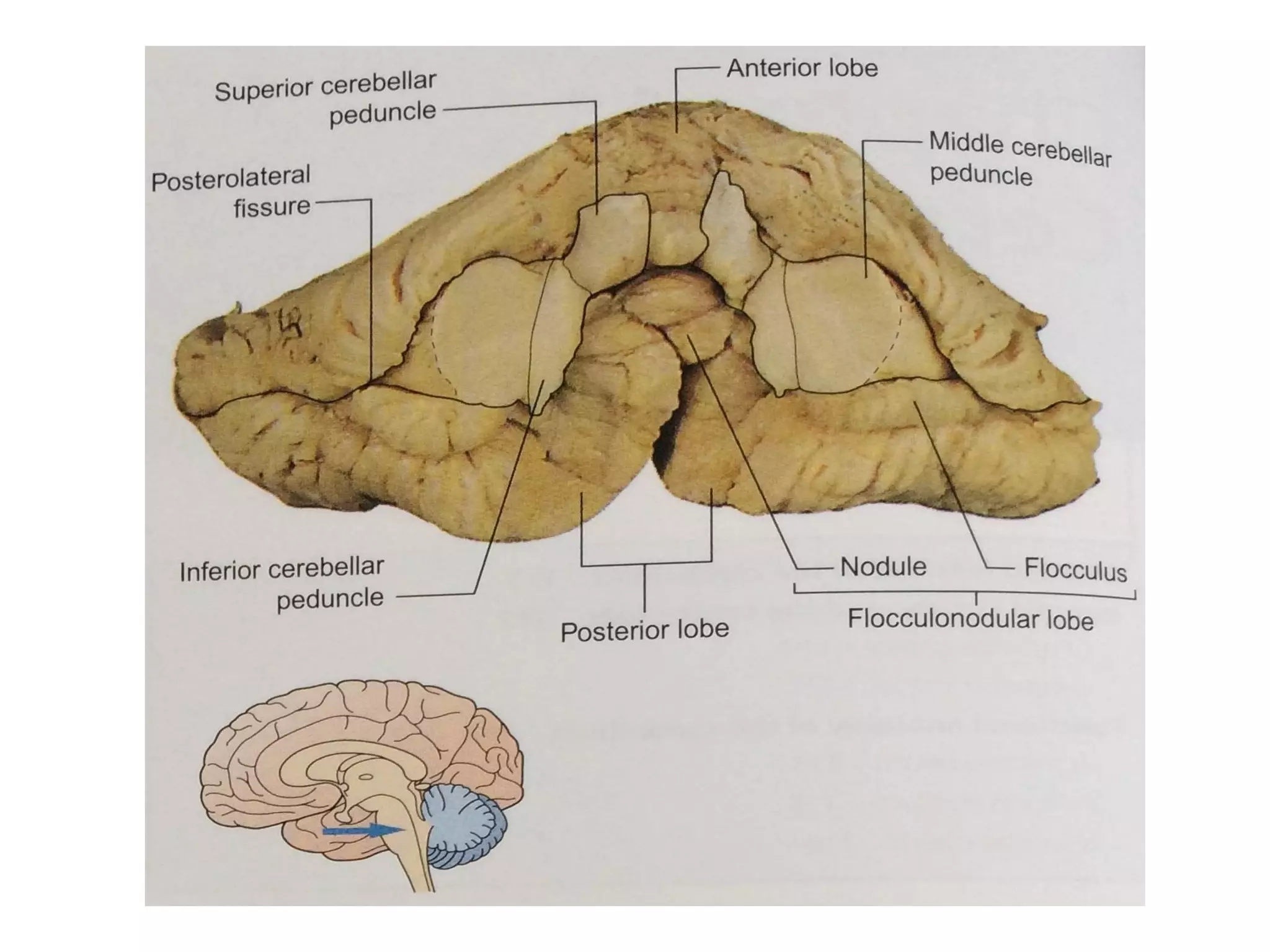
Anterior or ventral aspect of cerebellum
showing the cut cerebellar peduncles
Cerebellum- anterior view; after dissection of the
cerebellar peduncles
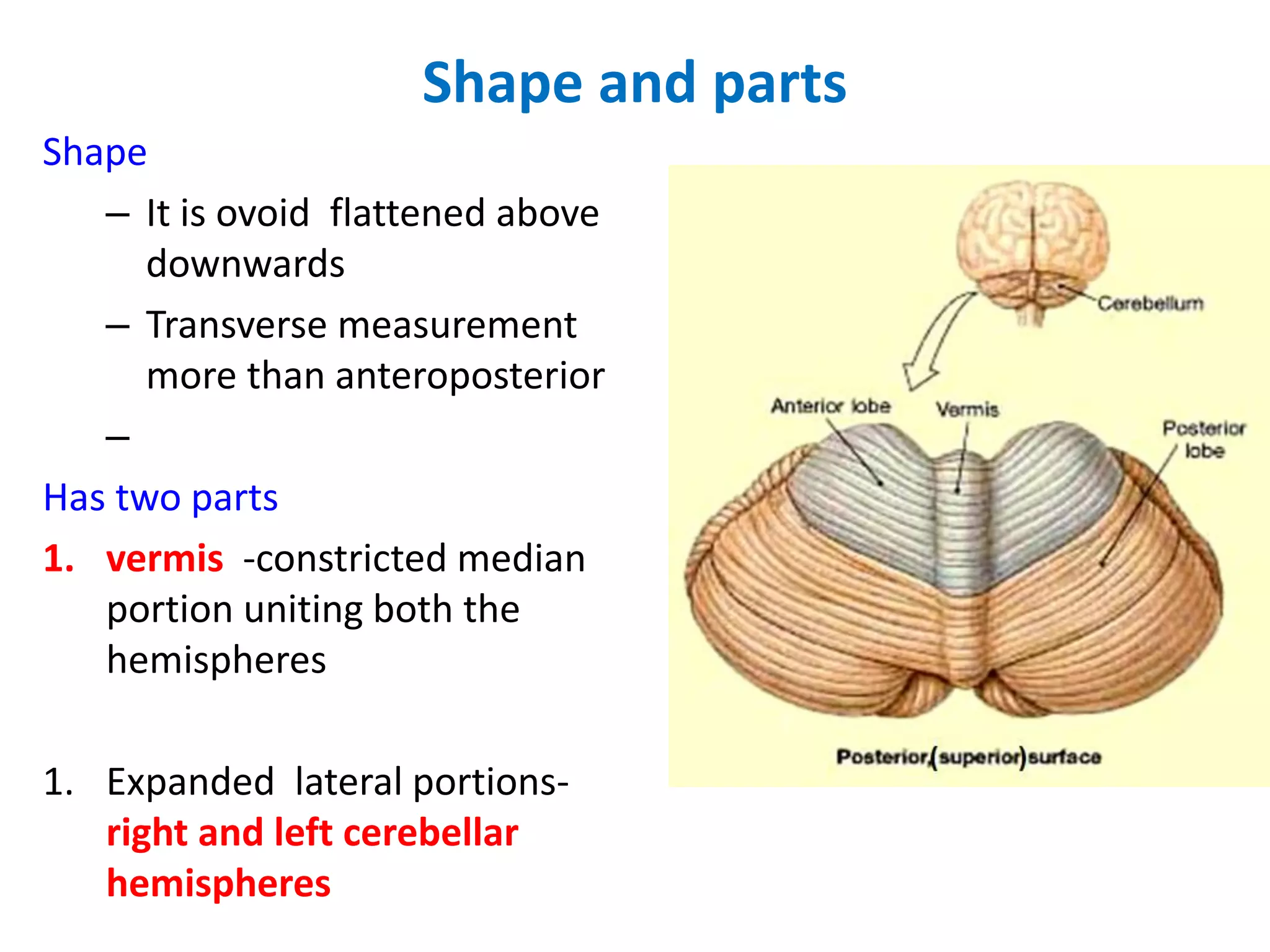
Shape and parts
Shape
– It is ovoid flattened above
downwards
– Transverse measurement
more than anteroposterior
–
Has two parts
1. vermis -constricted median
portion uniting both the
hemispheres
1. Expanded lateral portions-
right and left cerebellar
hemispheres
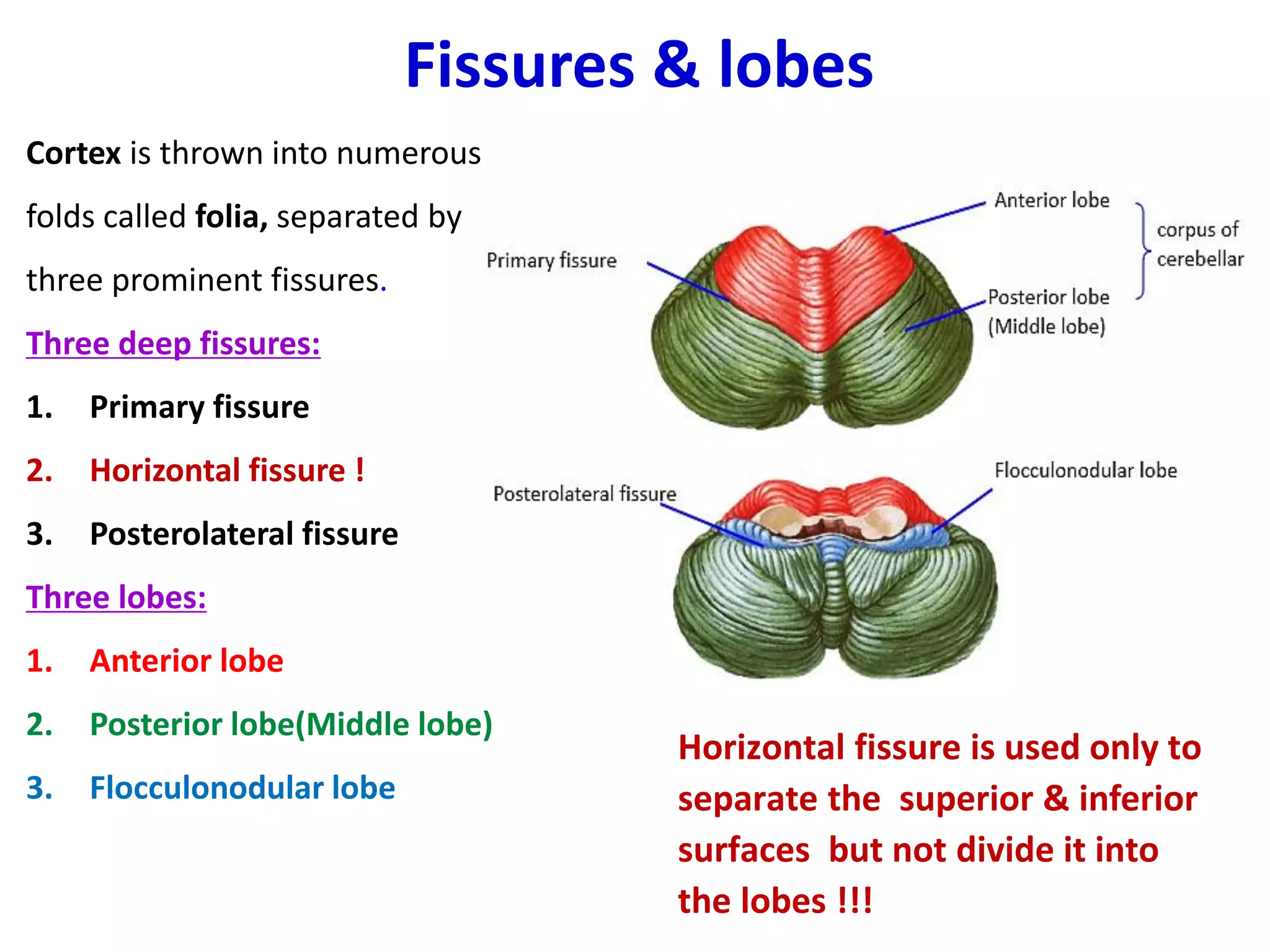
Fissures & lobes
Cortex is thrown into numerous
folds called folia, separated by
three prominent fissures.
Three deep fissures:
1. Primary fissure
2. Horizontal fissure !
3. Posterolateral fissure
Three lobes:
1. Anterior lobe
2. Posterior lobe(Middle lobe)
3. Flocculonodular lobe
F
Horizontal fissure is used only to
separate the superior & inferior
surfaces but not divide it into
the lobes !!!
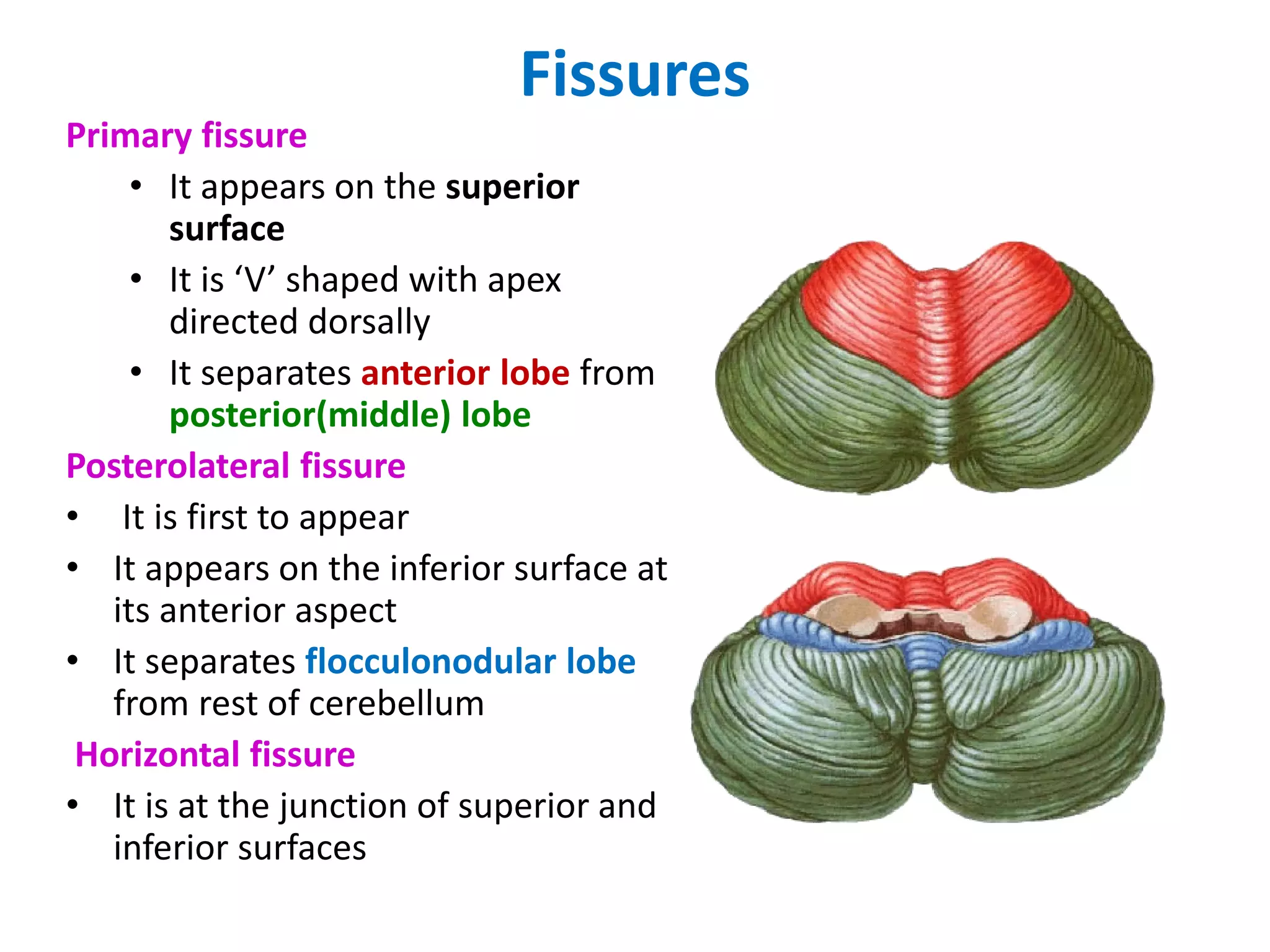
Fissures
Primary fissure
• It appears on the superior
surface
• It is ‘V’ shaped with apex
directed dorsally
• It separates anterior lobe from
posterior(middle) lobe
Posterolateral fissure
• It is first to appear
• It appears on the inferior surface at
its anterior aspect
• It separates flocculonodular lobe
from rest of cerebellum
Horizontal fissure
• It is at the junction of superior and
inferior surfaces
Surfaces of Cerebellum
The superior & inferior surfaces
separated by Horizontal fissure.
• Superior surface –
– elevated part in the midline
forms the superior vermis
– It is continuous laterally with
cerebellar hemispheres
• Inferior surface -
– In the midline it is deeply
grooved called vallecula
separating the hemispheres
– Inferior vermis lies in this
vallecula
Inferior surface of vermis
consists of following 4 parts
from behind forwards
(posterior to anterior):
6. Tuber
7. Pyramid
8. Uvula
9. nodule
Superior surface of vermis divided
into 5 parts by fissures, from before
backwards
1. Lingula
2. Central lobule
3. Culmen (resemblance to the
upper ridge of a bird's bill/beak)
4. Declive( a
slope or a slanting surface)
5. Folium
Vermis Hemisphere
1. Lingula Ala of the lingula
2. Central lobule Ala of the central lobule
3. Culmen ( Anterior) quadrangular lobule
1.Subdivisions of anterior lobe
Vermis Hemisphere
4. Declive Simple lobule(=posterior quadrangular lobule
5. Folium Superior semilunar lobule
Horizontal fissure
6. Tuber Inferior semilunar lobule
7. Pyramid Biventral lobule
8. Uvula Tonsil
2.Subdivisions of posterior(middle) lobe
3. flocculonodular lobe
“Unrolled” cerebellum, placing
the vermis in one plane
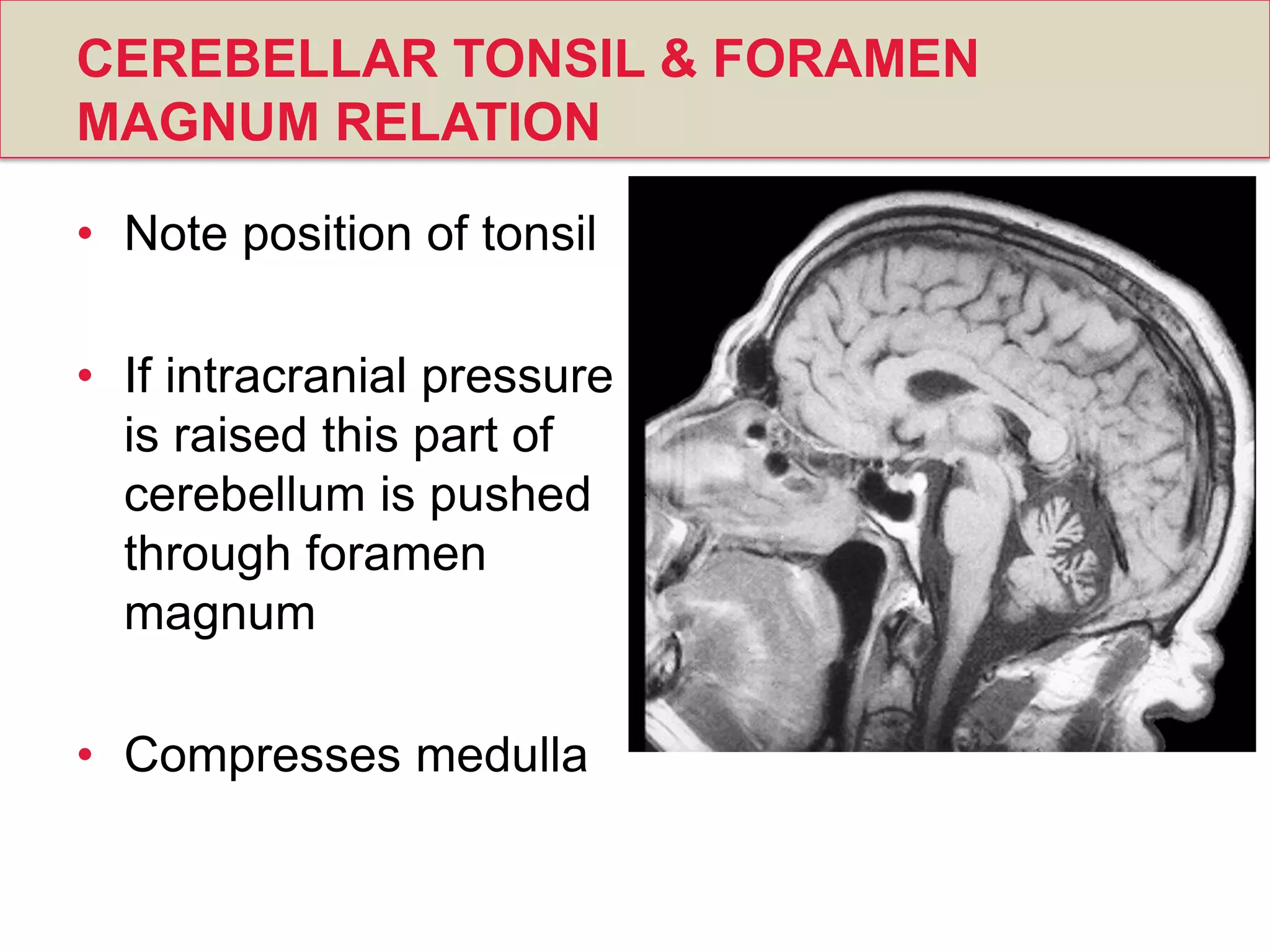
CEREBELLAR TONSIL & FORAMEN
MAGNUM RELATION
• Note position of tonsil
• If intracranial pressure
is raised this part of
cerebellum is pushed
through foramen
magnum
• Compresses medulla
Arbor vitae
• Deep inside folia there is
white matter called arbor
vitae (Latin for "Tree of
Life"), so called for its
branched, tree-like
appearance.
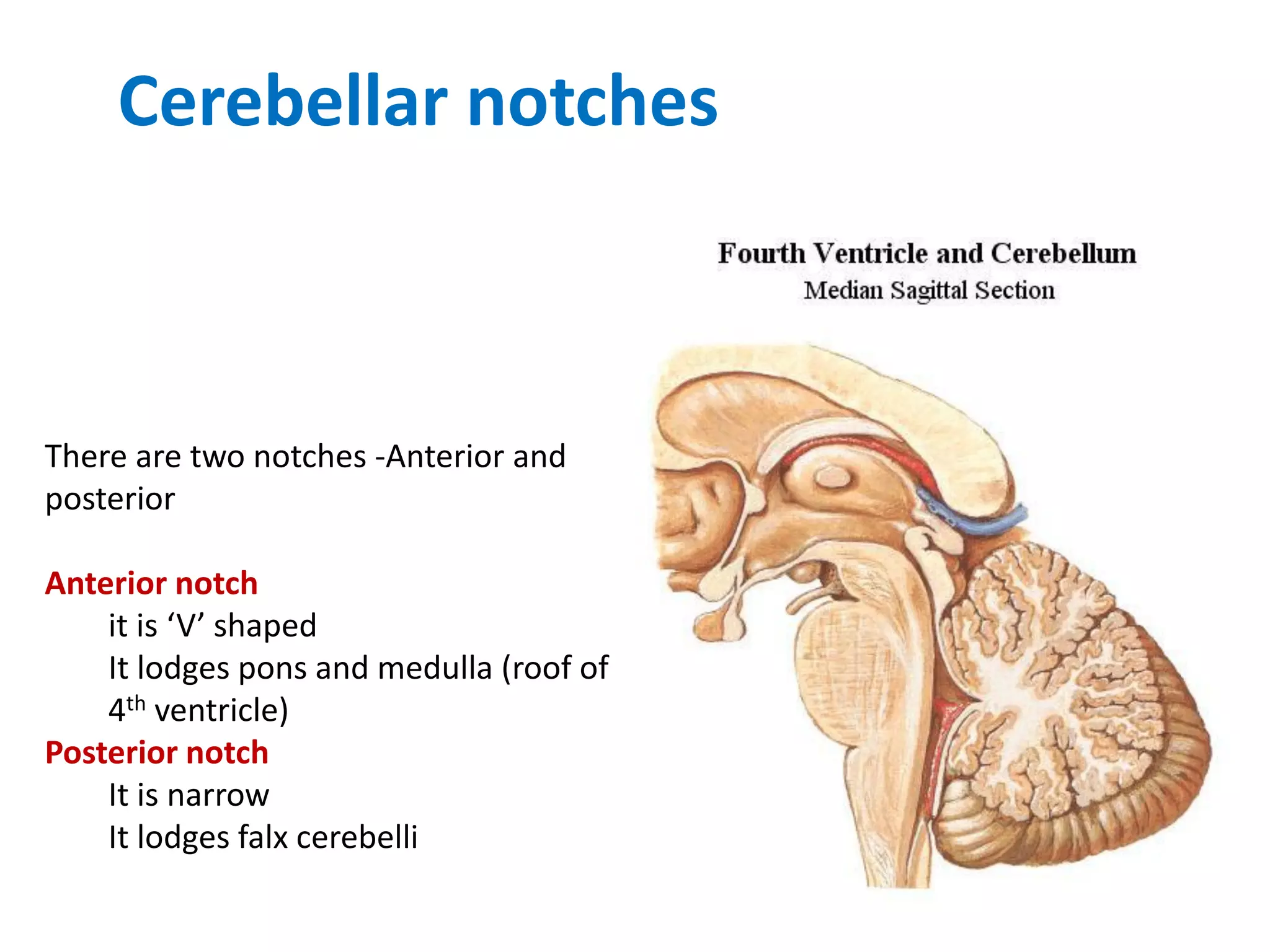
There are two notches -Anterior and
posterior
Anterior notch
it is ‘V’ shaped
It lodges pons and medulla (roof of
4th ventricle)
Posterior notch
It is narrow
It lodges falx cerebelli
Cerebellar notches
Arterial supply of cerebellum
Superior surface by:
• Superior cerebellar
artery(SCA)- branch of basilar
artery.
Inferior surface by:
1. Anterior inferior cerebellar
artery-AICA- a branch
of basilar artery and
2. Posterior inferior cerebellar
artery-PICA-a branch of
vertebral artery
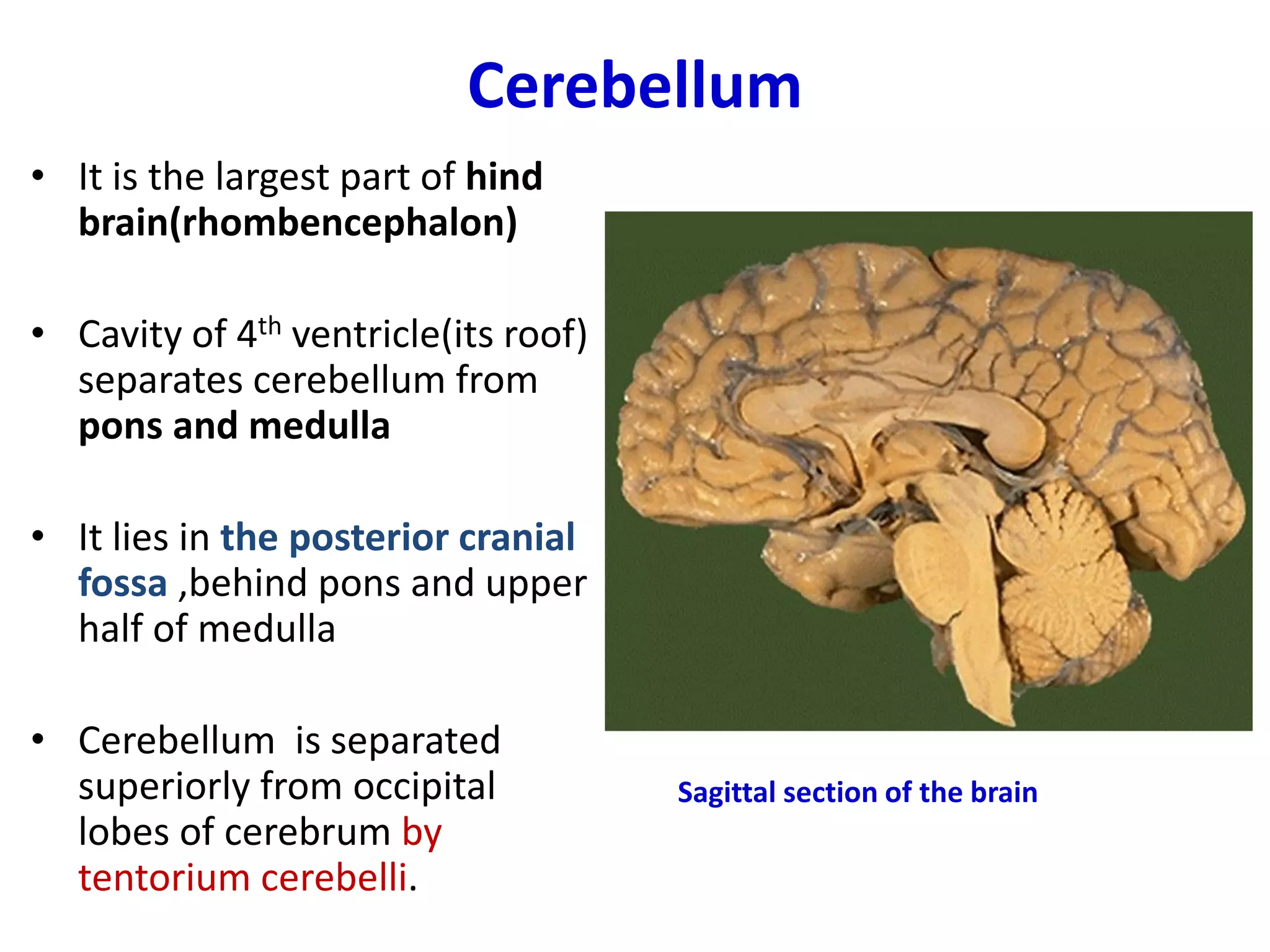
Venous drainage of cerebellum :
• Veins drain into neighbouring
venous sinuses.
Three(3) functional subdivisions of
cerebellum
1. Vestibulocerebellum
(Archicerebellum)-
Flocculonodular lobe
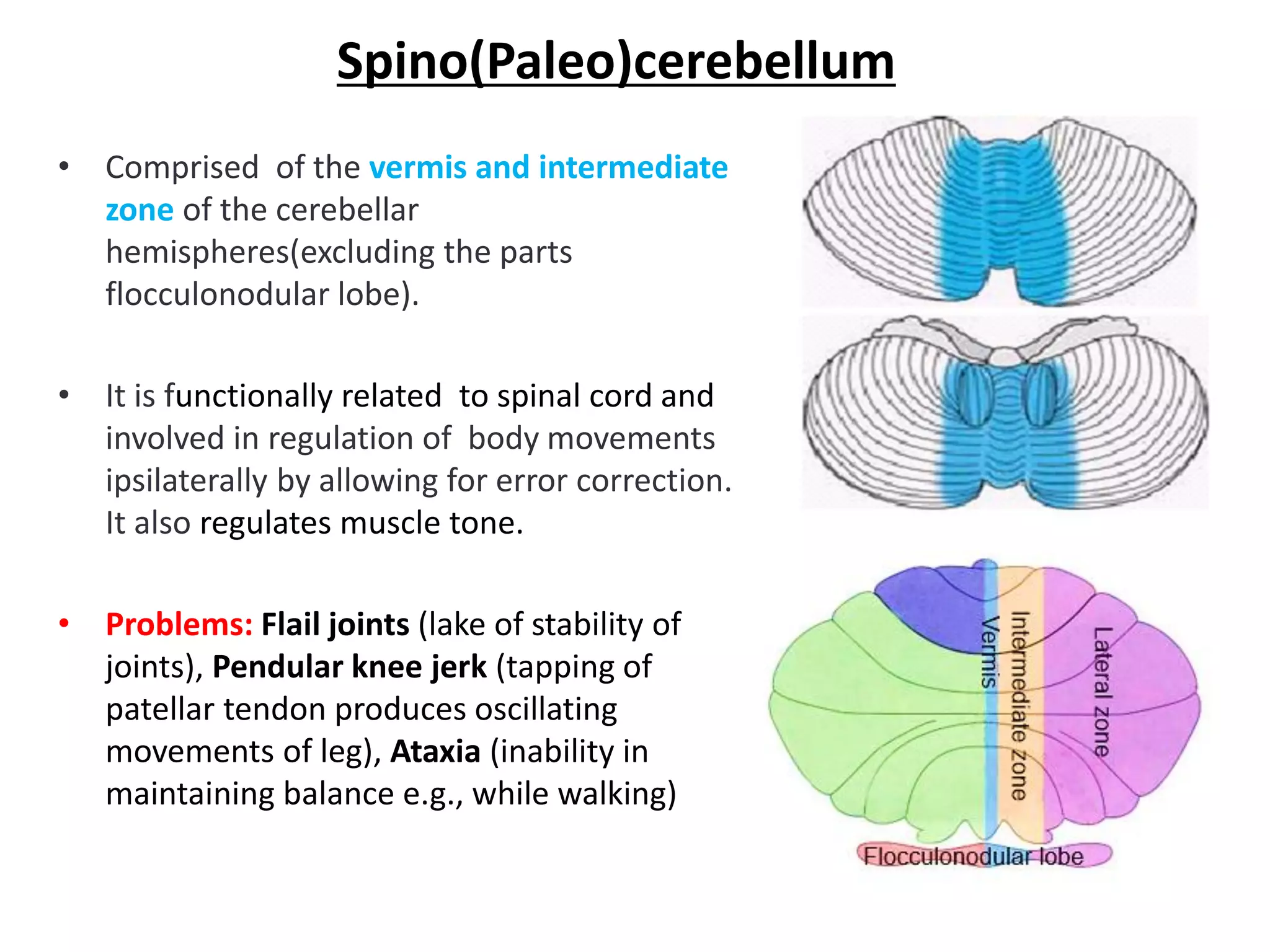
2. Spinocerebellum
( Paleocerebellum)-
Vermis and
intermediate zone
3. Cerebrocerebellum
(Neocerebellum)-
Lateral zone
Vestibulocerebellum(Archicerebellum)
• Phylogenetically the oldest part.
• It consists of the flocculus and the
nodulus (flocculonodular lobe).
• Responsible for the control of
balance and eye movements
mainly fixation on a target i.e.,
Vestibular in function
• Problems: Trunk ataxia ( unsteady
while standing), staggering gait,
posture problems & Nystagmus
Connections of the Vestibulo(archi)cerebellum
Afferents (reach the cortex of vesitibulocerebellum)
1. Vestibulocerebellar fibres - from vestibular nuclei
( secondary fibres) and also directly from vestibular nerve(primary fibres)
Efferents:
1. Cerebello- vestibular fibres-
a. sends outputs back from the cortex of the ipsilateral flocculo -nodular lobe
and fastigial nuclei to → vestibular nuclei → vestibulospinal tract → motor
neurons of anterior horn of SC.
b. and to the medial longitudinal fasciculus → motor nuclei of cranial nerves
innervating extraocular muscles
2.cerebello-reticular fibres- to pontine and medullary reticular formation and
reticulospinal tract → motor neurons of anterior horn
Spino(Paleo)cerebellum
• Comprised of the vermis and intermediate
zone of the cerebellar
hemispheres(excluding the parts
flocculonodular lobe).
• It is functionally related to spinal cord and
involved in regulation of body movements
ipsilaterally by allowing for error correction.
It also regulates muscle tone.
• Problems: Flail joints (lake of stability of
joints), Pendular knee jerk (tapping of
patellar tendon produces oscillating
movements of leg), Ataxia (inability in
maintaining balance e.g., while walking)
Connections of the Spino(paleo)cerebellum
Afferents reaching the spinocerebellar cortex are:
1. Spinocerebellar tracts(ventral and dorsal) and
2. Cuneo -cerebellar tracts
and carry the somatic sensory (exteroceptive & proprioceptive)
information from ipsilateral side.
Efferents are given from the interposed nuclei to contralateral red
nucleus
1. Cerebello - rubral fibres → red nucleus → rubrospinal tract →motor
neurons of the anterior horn
These crossed connections explains why each cerebellar hemisphere regulates
coordination and muscle tone on the ipsilateral side of the body .
Cerebrocerebellum (Neocerebellum)
The largest subdivision, formed by the
lateral part/zone of the hemispheres.
It is involved in planning movements
and motor learning.
This area also regulates coordination
of muscle activation and is important
in visually guided movements.
Problems: Intention tremor, Dysmetria
, dysdiadochokinesia
Connections of the Cerebro(Neo)cerebellum
• It receives inputs from the cerebral cortex and pontine nuclei
and sends outputs to the thalamus and red nucleus.
• Afferents( inputs) : receive from the cerebral cortex via a relay
in the pontine nuclei(cortico- ponto-cerebellar pathway fibres)
• Efferents( outputs) : from neocerebellar cortex go first to the
dentate nucleus and then → as Dentato - rubro - thalamo -
cortical pathway → to the contralateral cerebral motor cortex →
corticobulbar & corticospinal tracts → motor neurons of cranial
nerve nuclei and anterior horn of the spinal cord.
“Deep” cerebellar nuclei
Situated ‘deep’ within the
white matter and receive
afferents from cerebellar
cortex.
1. dentate,
2. emboliform
3. globose, and the
4. fastigial nuclei.
These four nuclei are
the source of efferent
projections of the
cerebellum
Dentate nucleus
• It is largest ,
phylogenetically most
recent nucleus and
receives afferents from
ipsilateral
neocerebellar cortex.
• It is shaped like a
crumpled bag with
hilus facing medially
Dentate nucleus
• It receives afferents from the
ipsilateral cortex of the lateral
part of hemisphere
(neocerebellum) and also
collaterals from the mossy and
climbing fibers
• Efferents pass in the superior
cerebellar peduncle to
terminate mostly in the red
nucleus and thalamus as :
1. Dentatorubrospinal
patyhway
2. Dentatothalamocortical
pathway
• Globosus and emboliformis nuclei - are more recent which
receive afferents from paleo/spinocerebellar cortex.
• Nucleus fastigius - This is the oldest nucleus and lies close to the
midline which receives afferents from archi/vestibulocerebellar
cortex.
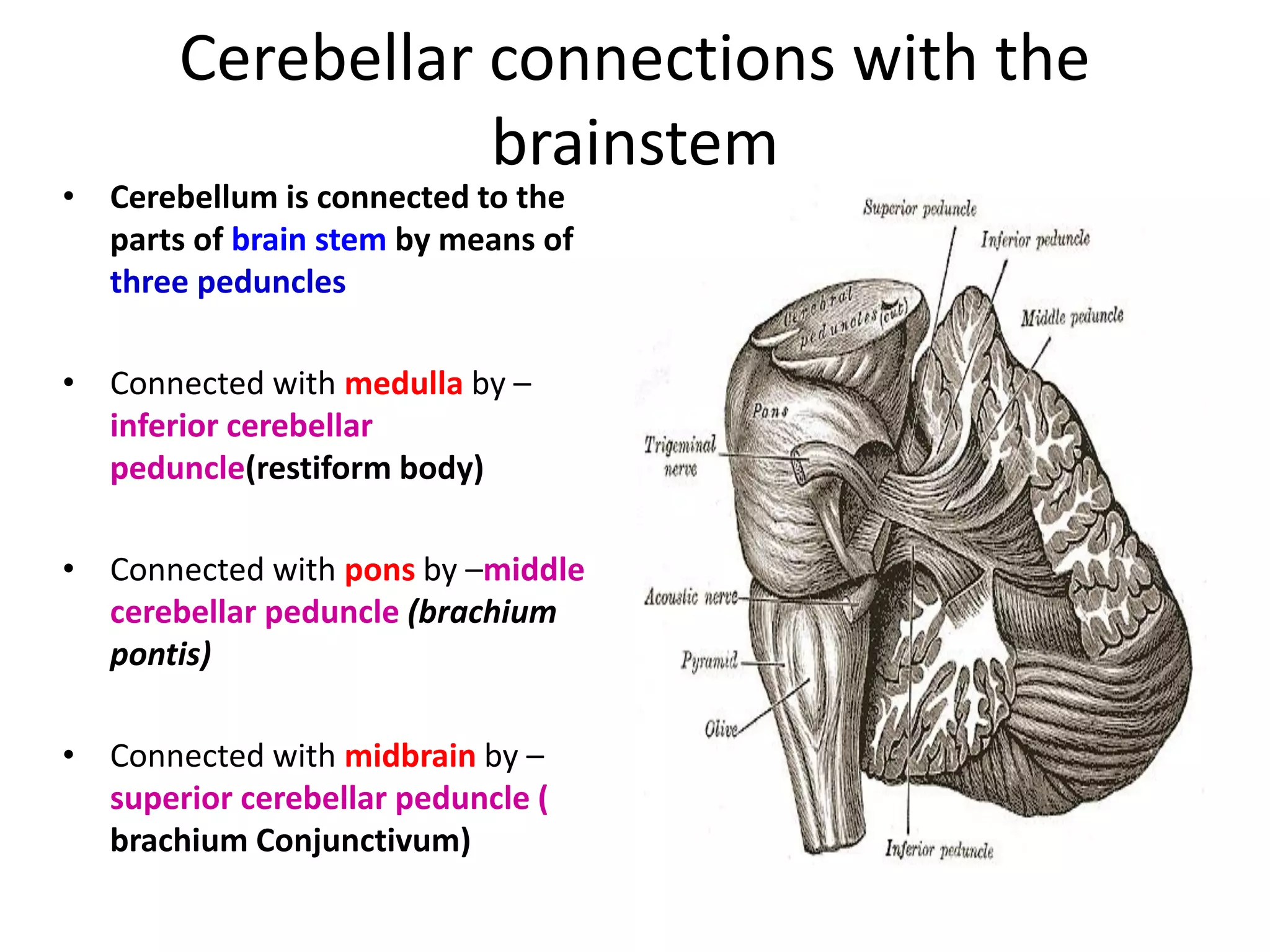
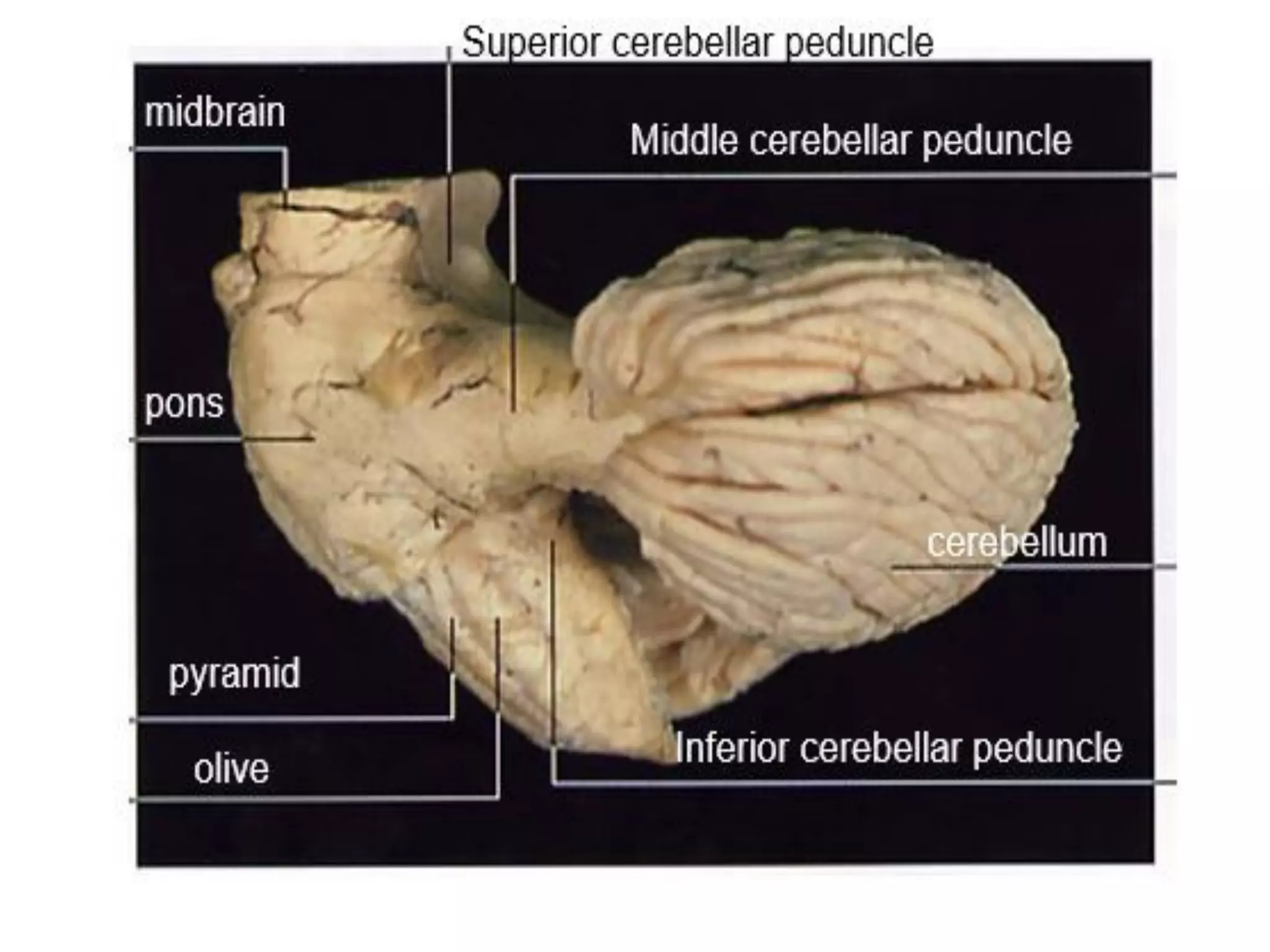
Cerebellar connections with the
brainstem
• Cerebellum is connected to the
parts of brain stem by means of
three peduncles
• Connected with medulla by –
inferior cerebellar
peduncle(restiform body)
• Connected with pons by –middle
cerebellar peduncle (brachium
pontis)
• Connected with midbrain by –
superior cerebellar peduncle (
brachium Conjunctivum)
Inferior Cerebellar peduncle(restiform body)
It consists of following afferent
(incoming)and efferent fibers
The afferent fibers (6 groups):
1. Posterior/dorsal spinocerebellar
tract
2. Posterior external arcuate
fibers(cuneo-cerebellar)
3. Anterior external arcuate fibers
4. Vestibulocerebellar ,
5. Olivocerebellar –arise from
contralateral inferior olivary
nucleus,
6. Reticulocerebellar
Efferent fibers :
1. Cerebello-vestibular
2. Cerebello-olivary
3. Cerebello-reticular
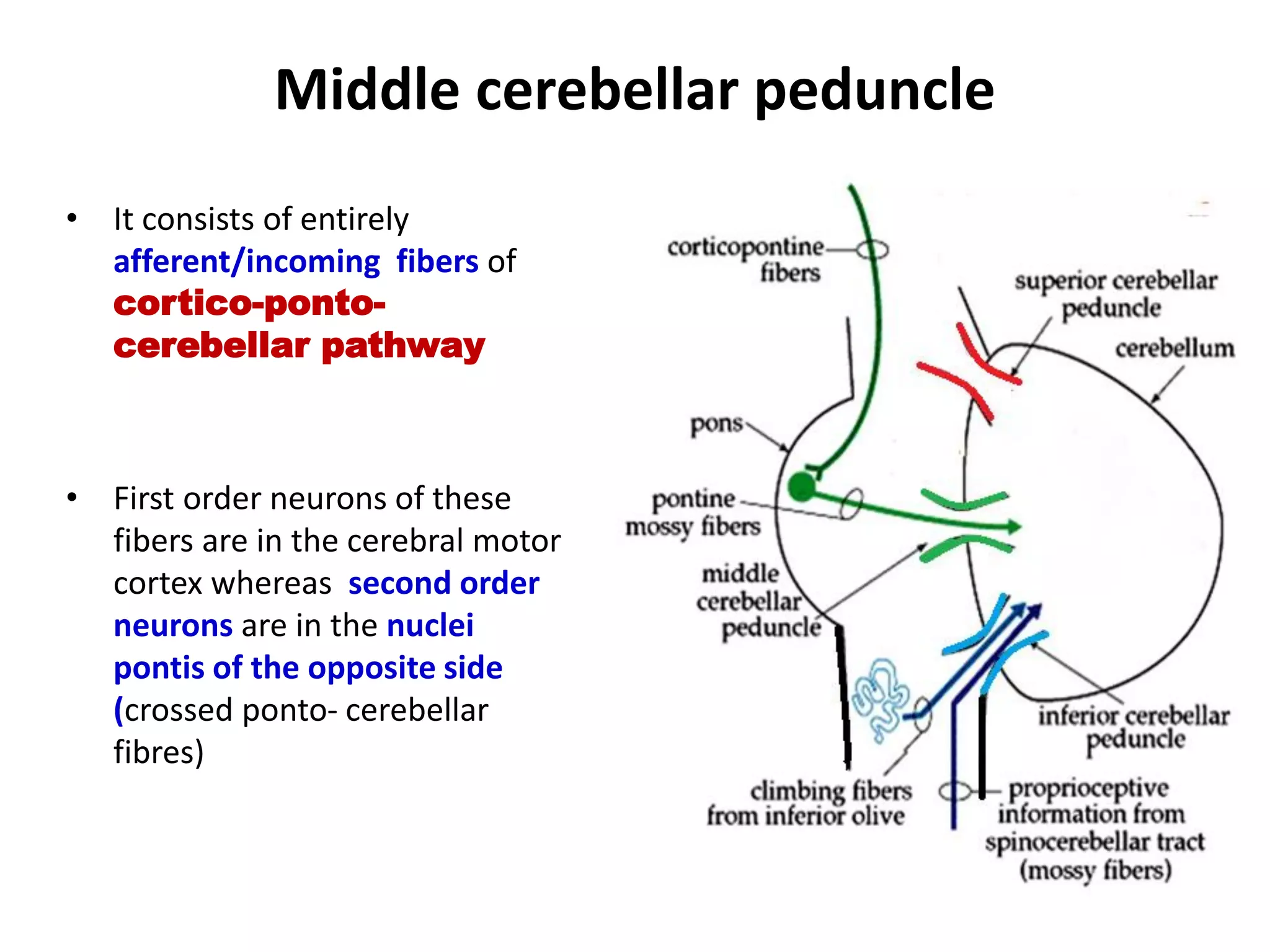
Middle cerebellar peduncle
• It consists of entirely
afferent/incoming fibers of
cortico-ponto-
cerebellar pathway
• First order neurons of these
fibers are in the cerebral motor
cortex whereas second order
neurons are in the nuclei
pontis of the opposite side
(crossed ponto- cerebellar
fibres)
Superior cerebellar peduncle
It consists of mainly efferent (outgoing)
fibers form the cerebellum.
Efferent(outgoing) fibers
– arise in the dentate nucleus
– pass to the opposite side of the
midbrain and divide into
ascending and descending fibres
• Ascending fibres pass to end in red
nucleus and thalamus
• Descending fibres join the olivary
nucleus and reticular formation
Afferent fibers
1. Anterior spinocerbellar tract
2. Rubrocerebellar
Cerebellum
• 3 parts - 2 hemispheres and median vermis.
• 3 anatomical lobes and 3 functional subdivisions
• 3 cerebellar peduncles -superior, middle &
inferior.
• 3 main functions - coordination of movements,
regulates muscle tone & maintains balance
(equilibrium).
• 3 layers of cortex– outer Molecular, middle
Purkinje and inner Granular.
• 4 “deep” cerebellar nuclei - dentate, globose,
emboliformis & fastigius.
Thank you

Anatomy of Cerebellum 1

  • 1.
    Cerebellum-1 All the information,including the images and pics collected from different sources is strictly for teaching purposes only.
  • 2.
    Learning objectives 1. Explainthe location, parts, external features, anatomical lobes and blood supply of cerebellum 2. Name the functional/morphological subdivisions of cerebellum and explain their connections and functions 3. Define “cerebellar peduncle” 4. List the fibers present in the cerebellar peduncles 5. Name the deep cerebellar nuclei and their connections 6. Explain the mossy and climbing fibres 7. Explain the applied anatomy of cerebellum 8. Show the external features and dentate nuclei of the cerebellum
  • 3.
    • It isthe largest part of hind brain(rhombencephalon) • Cavity of 4th ventricle(its roof) separates cerebellum from pons and medulla • It lies in the posterior cranial fossa ,behind pons and upper half of medulla • Cerebellum is separated superiorly from occipital lobes of cerebrum by tentorium cerebelli. Cerebellum Sagittal section of the brain
  • 5.
    • 150 gramsin weight. • The proportion between cerebellum & cerebrum in the adult is 1:10 • Surface has numerous laminae(folia) separated by sulci or fissures. • Unlike the cerebral hemispheres, which work entirely on a contralateral basis, the cerebellar hemispheres work ipsilaterally(control the same side of the body)
  • 6.
    • The cerebellumconsists of a cortex, (surface layer of gray matter) contained in transverse folds or folia and a central core of white matter. • Four(4) pairs of deeply placed cerebellar nuclei are embedded in the central cerebellar white matter. • Three(3) pairs of cerebellar peduncles, composed of myelinated axons, connect the cerebellum with the brain stem. • Afferent fibers end in the three-layered cerebellar cortex. The Purkinje cells of the cortexhave axons that end in the cerebellar nuclei which are the source of efferent output.
  • 7.
    Anterior or ventralaspect of cerebellum showing the cut cerebellar peduncles
  • 8.
    Cerebellum- anterior view;after dissection of the cerebellar peduncles
  • 10.
    Shape and parts Shape –It is ovoid flattened above downwards – Transverse measurement more than anteroposterior – Has two parts 1. vermis -constricted median portion uniting both the hemispheres 1. Expanded lateral portions- right and left cerebellar hemispheres
  • 11.
    Fissures & lobes Cortexis thrown into numerous folds called folia, separated by three prominent fissures. Three deep fissures: 1. Primary fissure 2. Horizontal fissure ! 3. Posterolateral fissure Three lobes: 1. Anterior lobe 2. Posterior lobe(Middle lobe) 3. Flocculonodular lobe F Horizontal fissure is used only to separate the superior & inferior surfaces but not divide it into the lobes !!!
  • 12.
    Fissures Primary fissure • Itappears on the superior surface • It is ‘V’ shaped with apex directed dorsally • It separates anterior lobe from posterior(middle) lobe Posterolateral fissure • It is first to appear • It appears on the inferior surface at its anterior aspect • It separates flocculonodular lobe from rest of cerebellum Horizontal fissure • It is at the junction of superior and inferior surfaces
  • 13.
    Surfaces of Cerebellum Thesuperior & inferior surfaces separated by Horizontal fissure. • Superior surface – – elevated part in the midline forms the superior vermis – It is continuous laterally with cerebellar hemispheres • Inferior surface - – In the midline it is deeply grooved called vallecula separating the hemispheres – Inferior vermis lies in this vallecula
  • 14.
    Inferior surface ofvermis consists of following 4 parts from behind forwards (posterior to anterior): 6. Tuber 7. Pyramid 8. Uvula 9. nodule Superior surface of vermis divided into 5 parts by fissures, from before backwards 1. Lingula 2. Central lobule 3. Culmen (resemblance to the upper ridge of a bird's bill/beak) 4. Declive( a slope or a slanting surface) 5. Folium
  • 16.
    Vermis Hemisphere 1. LingulaAla of the lingula 2. Central lobule Ala of the central lobule 3. Culmen ( Anterior) quadrangular lobule 1.Subdivisions of anterior lobe Vermis Hemisphere 4. Declive Simple lobule(=posterior quadrangular lobule 5. Folium Superior semilunar lobule Horizontal fissure 6. Tuber Inferior semilunar lobule 7. Pyramid Biventral lobule 8. Uvula Tonsil 2.Subdivisions of posterior(middle) lobe 3. flocculonodular lobe
  • 17.
  • 18.
    CEREBELLAR TONSIL &FORAMEN MAGNUM RELATION • Note position of tonsil • If intracranial pressure is raised this part of cerebellum is pushed through foramen magnum • Compresses medulla
  • 19.
    Arbor vitae • Deepinside folia there is white matter called arbor vitae (Latin for "Tree of Life"), so called for its branched, tree-like appearance.
  • 20.
    There are twonotches -Anterior and posterior Anterior notch it is ‘V’ shaped It lodges pons and medulla (roof of 4th ventricle) Posterior notch It is narrow It lodges falx cerebelli Cerebellar notches
  • 21.
    Arterial supply ofcerebellum Superior surface by: • Superior cerebellar artery(SCA)- branch of basilar artery. Inferior surface by: 1. Anterior inferior cerebellar artery-AICA- a branch of basilar artery and 2. Posterior inferior cerebellar artery-PICA-a branch of vertebral artery Venous drainage of cerebellum : • Veins drain into neighbouring venous sinuses.
  • 22.
    Three(3) functional subdivisionsof cerebellum 1. Vestibulocerebellum (Archicerebellum)- Flocculonodular lobe 2. Spinocerebellum ( Paleocerebellum)- Vermis and intermediate zone 3. Cerebrocerebellum (Neocerebellum)- Lateral zone
  • 23.
    Vestibulocerebellum(Archicerebellum) • Phylogenetically theoldest part. • It consists of the flocculus and the nodulus (flocculonodular lobe). • Responsible for the control of balance and eye movements mainly fixation on a target i.e., Vestibular in function • Problems: Trunk ataxia ( unsteady while standing), staggering gait, posture problems & Nystagmus
  • 24.
    Connections of theVestibulo(archi)cerebellum Afferents (reach the cortex of vesitibulocerebellum) 1. Vestibulocerebellar fibres - from vestibular nuclei ( secondary fibres) and also directly from vestibular nerve(primary fibres) Efferents: 1. Cerebello- vestibular fibres- a. sends outputs back from the cortex of the ipsilateral flocculo -nodular lobe and fastigial nuclei to → vestibular nuclei → vestibulospinal tract → motor neurons of anterior horn of SC. b. and to the medial longitudinal fasciculus → motor nuclei of cranial nerves innervating extraocular muscles 2.cerebello-reticular fibres- to pontine and medullary reticular formation and reticulospinal tract → motor neurons of anterior horn
  • 25.
    Spino(Paleo)cerebellum • Comprised ofthe vermis and intermediate zone of the cerebellar hemispheres(excluding the parts flocculonodular lobe). • It is functionally related to spinal cord and involved in regulation of body movements ipsilaterally by allowing for error correction. It also regulates muscle tone. • Problems: Flail joints (lake of stability of joints), Pendular knee jerk (tapping of patellar tendon produces oscillating movements of leg), Ataxia (inability in maintaining balance e.g., while walking)
  • 26.
    Connections of theSpino(paleo)cerebellum Afferents reaching the spinocerebellar cortex are: 1. Spinocerebellar tracts(ventral and dorsal) and 2. Cuneo -cerebellar tracts and carry the somatic sensory (exteroceptive & proprioceptive) information from ipsilateral side. Efferents are given from the interposed nuclei to contralateral red nucleus 1. Cerebello - rubral fibres → red nucleus → rubrospinal tract →motor neurons of the anterior horn These crossed connections explains why each cerebellar hemisphere regulates coordination and muscle tone on the ipsilateral side of the body .
  • 27.
    Cerebrocerebellum (Neocerebellum) The largestsubdivision, formed by the lateral part/zone of the hemispheres. It is involved in planning movements and motor learning. This area also regulates coordination of muscle activation and is important in visually guided movements. Problems: Intention tremor, Dysmetria , dysdiadochokinesia
  • 28.
    Connections of theCerebro(Neo)cerebellum • It receives inputs from the cerebral cortex and pontine nuclei and sends outputs to the thalamus and red nucleus. • Afferents( inputs) : receive from the cerebral cortex via a relay in the pontine nuclei(cortico- ponto-cerebellar pathway fibres) • Efferents( outputs) : from neocerebellar cortex go first to the dentate nucleus and then → as Dentato - rubro - thalamo - cortical pathway → to the contralateral cerebral motor cortex → corticobulbar & corticospinal tracts → motor neurons of cranial nerve nuclei and anterior horn of the spinal cord.
  • 30.
    “Deep” cerebellar nuclei Situated‘deep’ within the white matter and receive afferents from cerebellar cortex. 1. dentate, 2. emboliform 3. globose, and the 4. fastigial nuclei. These four nuclei are the source of efferent projections of the cerebellum
  • 31.
    Dentate nucleus • Itis largest , phylogenetically most recent nucleus and receives afferents from ipsilateral neocerebellar cortex. • It is shaped like a crumpled bag with hilus facing medially
  • 32.
    Dentate nucleus • Itreceives afferents from the ipsilateral cortex of the lateral part of hemisphere (neocerebellum) and also collaterals from the mossy and climbing fibers • Efferents pass in the superior cerebellar peduncle to terminate mostly in the red nucleus and thalamus as : 1. Dentatorubrospinal patyhway 2. Dentatothalamocortical pathway
  • 33.
    • Globosus andemboliformis nuclei - are more recent which receive afferents from paleo/spinocerebellar cortex. • Nucleus fastigius - This is the oldest nucleus and lies close to the midline which receives afferents from archi/vestibulocerebellar cortex.
  • 34.
    Cerebellar connections withthe brainstem • Cerebellum is connected to the parts of brain stem by means of three peduncles • Connected with medulla by – inferior cerebellar peduncle(restiform body) • Connected with pons by –middle cerebellar peduncle (brachium pontis) • Connected with midbrain by – superior cerebellar peduncle ( brachium Conjunctivum)
  • 36.
    Inferior Cerebellar peduncle(restiformbody) It consists of following afferent (incoming)and efferent fibers The afferent fibers (6 groups): 1. Posterior/dorsal spinocerebellar tract 2. Posterior external arcuate fibers(cuneo-cerebellar) 3. Anterior external arcuate fibers 4. Vestibulocerebellar , 5. Olivocerebellar –arise from contralateral inferior olivary nucleus, 6. Reticulocerebellar Efferent fibers : 1. Cerebello-vestibular 2. Cerebello-olivary 3. Cerebello-reticular
  • 37.
    Middle cerebellar peduncle •It consists of entirely afferent/incoming fibers of cortico-ponto- cerebellar pathway • First order neurons of these fibers are in the cerebral motor cortex whereas second order neurons are in the nuclei pontis of the opposite side (crossed ponto- cerebellar fibres)
  • 38.
    Superior cerebellar peduncle Itconsists of mainly efferent (outgoing) fibers form the cerebellum. Efferent(outgoing) fibers – arise in the dentate nucleus – pass to the opposite side of the midbrain and divide into ascending and descending fibres • Ascending fibres pass to end in red nucleus and thalamus • Descending fibres join the olivary nucleus and reticular formation Afferent fibers 1. Anterior spinocerbellar tract 2. Rubrocerebellar
  • 39.
    Cerebellum • 3 parts- 2 hemispheres and median vermis. • 3 anatomical lobes and 3 functional subdivisions • 3 cerebellar peduncles -superior, middle & inferior. • 3 main functions - coordination of movements, regulates muscle tone & maintains balance (equilibrium). • 3 layers of cortex– outer Molecular, middle Purkinje and inner Granular. • 4 “deep” cerebellar nuclei - dentate, globose, emboliformis & fastigius.
  • 40.