Rahim Gohar
Medical Physicist
Dr Ziauddin Hospital
1
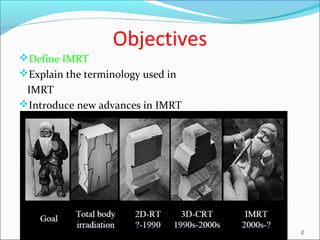
Objectives
Define IMRT
Explain the terminology used in
IMRT
Introduce new advances in IMRT
2
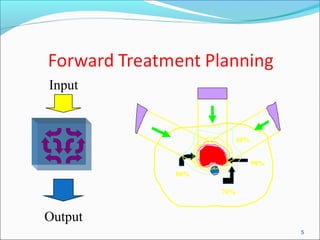
Forward Planning
3D Conformal Therapy (not IMRT) is forward based
planning.
Planner chooses number and position of beams,
shape, weighting and wedging, calculates the
resulting distribution, & adjusts the beam
parameters as needed
Dose to structures is NOT specified
3
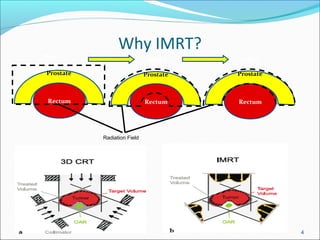
Why IMRT?
4
Radiation Field
Prostate
Rectum
Prostate
Rectum
Prostate
Rectum
Pre-
IMRT
IMRT IGRT
5
70%
80%
90%
40%
Input
Output
What is IMRT ?
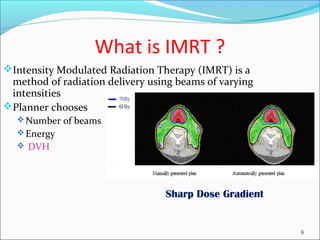
Intensity Modulated Radiation Therapy (IMRT) is a
method of radiation delivery using beams of varying
intensities
Planner chooses
Number of beams
Energy
 DVH
6
Sharp Dose Gradient
7
Intensity-Modulated Radiation Therapy
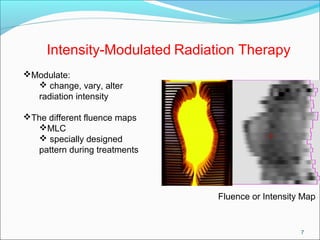
Modulate:
 change, vary, alter
radiation intensity
The different fluence maps
MLC
 specially designed
pattern during treatments
Fluence or Intensity Map
Work flow
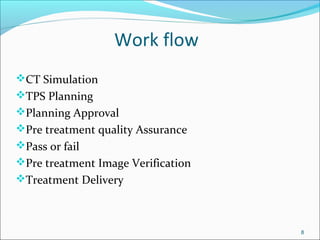
CT Simulation
TPS Planning
Planning Approval
Pre treatment quality Assurance
Pass or fail
Pre treatment Image Verification
Treatment Delivery
8
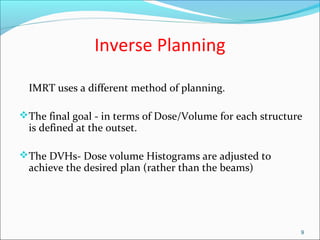
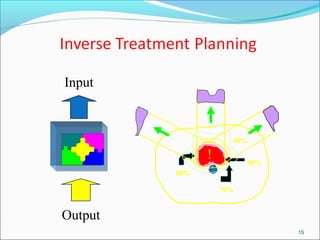
Inverse Planning
IMRT uses a different method of planning.
The final goal - in terms of Dose/Volume for each structure
is defined at the outset.
The DVHs- Dose volume Histograms are adjusted to
achieve the desired plan (rather than the beams)
9
9 beams
80
120
150
180
210
240
280
7 beams
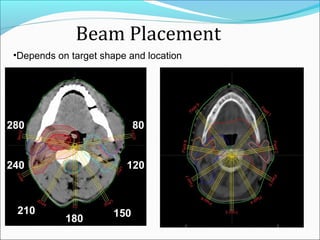
•Depends on target shape and location
Beam Placement
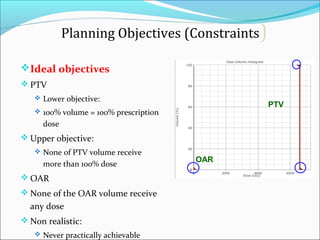
Ideal objectives
 PTV
 Lower objective:
 100% volume = 100% prescription
dose
 Upper objective:
 None of PTV volume receive
more than 100% dose
 OAR
 None of the OAR volume receive
any dose
 Non realistic:
 Never practically achievable
OAR
PTV
Planning Objectives (Constraints)
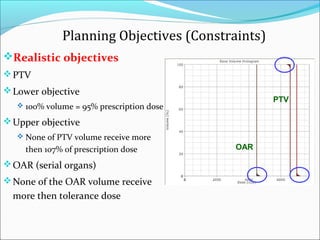
Realistic objectives
PTV
Lower objective
 100% volume = 95% prescription dose
Upper objective
 None of PTV volume receive more
then 107% of prescription dose
OAR (serial organs)
None of the OAR volume receive
more then tolerance dose
OAR
PTV
Planning Objectives (Constraints)
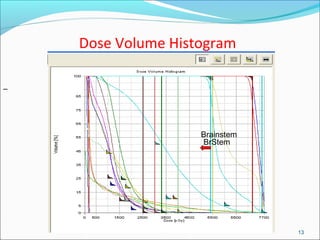
Dose Volume Histogram
13
Brainstem
BrStem
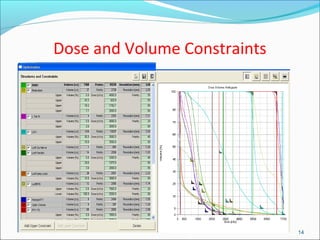
Dose and Volume Constraints
14
15
70%
80%
90%
40%
!
Input
Output
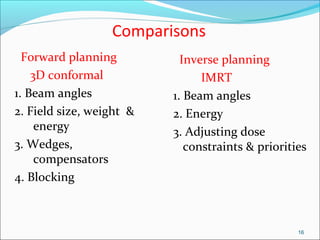
Comparisons
Forward planning
3D conformal
1. Beam angles
2. Field size, weight &
energy
3. Wedges,
compensators
4. Blocking
Inverse planning
IMRT
1. Beam angles
2. Energy
3. Adjusting dose
constraints & priorities
16
Optimization
Process where many different flounces are tried, in
order to find the best (optimum) one
17
18
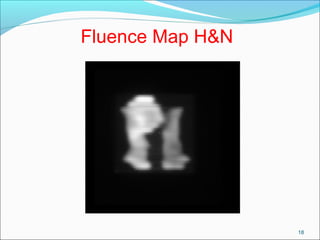
Fluence Map H&N
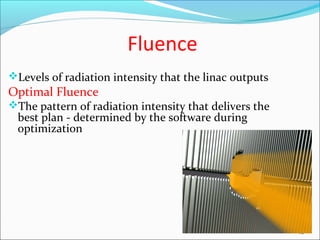
Fluence
Levels of radiation intensity that the linac outputs
Optimal Fluence
The pattern of radiation intensity that delivers the
best plan - determined by the software during
optimization
19
Actual fluence
 What the treatment unit is able to deliver –
considering physical parameters of the mlc (max.leaf
speed, leaf transmission etc.)
20
Optimization constraints
Define desired plan in terms of the Dose/Volume
each structure can receive
 Assign a priority to each point
21
Priorities
The priority is specified for each dose constraint
points
It defines the importance of that point relative to all
other points for all structures
22
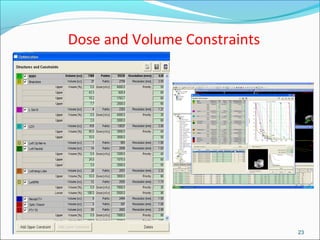
Dose and Volume Constraints
23
Iterations
The beam intensities are adjusted many times during
optimization, and many ‘plans’ calculated
Each adjustment is 1 iteration
24
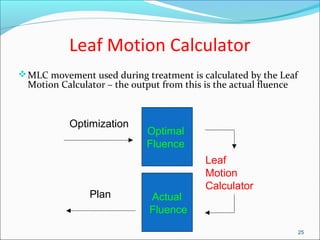
Leaf Motion Calculator
MLC movement used during treatment is calculated by the Leaf
Motion Calculator – the output from this is the actual fluence
25
Optimal
Fluence
Leaf
Motion
Calculator
Actual
Fluence
Optimization
Plan
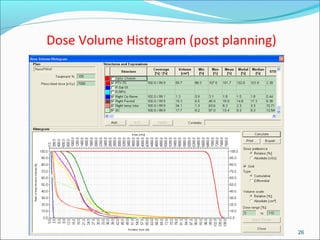
Dose Volume Histogram (post planning)
26
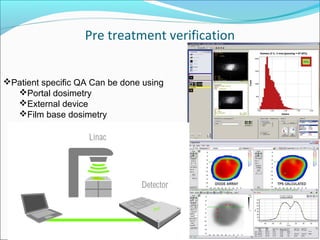
Pre treatment verification
27
Patient specific QA Can be done using
Portal dosimetry
External device
Film base dosimetry
Delivery
2 main ways of delivering the treatment;
1. Segmented Delivery
Also described as Step and Shoot -
the beam is OFF as the MLCs
move to their next position
28
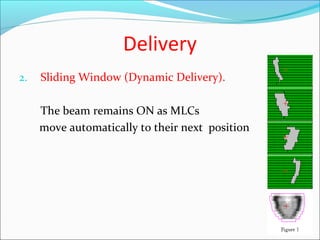
Delivery
2. Sliding Window (Dynamic Delivery).
The beam remains ON as MLCs
move automatically to their next position
29
Summary
 Forward planning
 IMRT
 Dose volume histogram
 Inverse planning
 Optimization
 Dose constraints
 Priorities
 Iterations
 Cost functions and penalties
 Fluence – actual and optimal
 Leaf motion calculator
 Segmented delivery
 Step and shoot
30
Takehomemessage
I
M
R
T
is
a
ll
a
b
o
u
t
V
o
lu
m
e
s
31
Questions?
Comments?

introduction to Intensity modulated radiation therapy

Editor's Notes

  • #3 Today I am going to talk about defining IMRT, explaining the terminology used in IMRT and new advances in IMRT. However the focus of my of my presentation is going to the terminology that is used in IMRT planning.
  • #4 Before we get into IMRT terminology I want to explain what we do when planning 3d conformal radiation therapy. In 3d conformal planning for eg a ct based 3 fld rectum plan the beam parameters are inputted & manipulated to get a desired dose distribution.it is by manipulating the beam parameters for example wedges ,we get a dose distribution.
  • #5 Beautiful B.C
  • #6 This slide demonstrates what happens when a 3 fld pelvis is planned. beam parameters such as the wedges angles, etc are inputted into the comp system and the resultant output that is dose distribution is obtained.
  • #7 In IMRT the beam is modulated by using different MLC patterns that the planning system produces after going through hundreds of calculations . These modulations correlate directly to the dose that is permitted to the determined volume of each structure specified by the planner...therefore if the planner says cord 50% of the cord can get 2500cGy for eg the system will try its best to achieve that. Of course the huge advantage of IMRT is the sparing of critical structures and as there are many structures that need sparing ,the planner must decide how to best give that information to the system to get the optimal plan.
  • #8 Radiation pattern for a beam ,showing the intensity pattern formed by the MLCs
  • #10 Dose Volume Histogram or DVH is defined as graph where each structure in the plan, can be viewed for the volume and dose that it is receiving. In IMRT by changing the DVH of particular structure the beam intensities are manipulated and the desired plan is acheived
  • #11 Beam angle optimizn not used as the more modulated beams used, the less imp is their direction of incidence No significant benefit, it’s a non-convex problem, trapped in local minima
  • #14 The dose volume histogram is used in two steps in IMRT planning. 1 is when we interactively adjust the doses and priorities of structures during optimization as the graph shows, and the other is when we have the final plan where we are able check exactly the volume and dose a particular structure is receiving. Brainstem
  • #15 The table on the left specifies the volume & dose to be received by each structure . On the right the software tries to match these criteria as set by the planer.
  • #16 So just as when you want to go form vanc to Coquitlam you tell the comp that Coquitlam is the end product and it finds the most efficient route to get you there, in Inverse planning you tell the planning system what doses you will accept to all the different structures, and it tells you the best and most efficient way to get those. So just as when you want to go form vanc to Coquitlam you tell the comp that Coquitlam is the end product and it finds the most efficient route to get you there, in Inverse planning you tell the planning system what doses you will accept to all the different structures, and it tells you the best and most efficient way to get there.. So just as when you want to go form vanc to Coquitlam you tell the comp that Coquitlam is the end product and it finds the most efficient route to get you there, in Inverse planning you tell the planning system what doses you will accept to all the different structures, and it tells you the best and most efficient way to get there.. So just as when you want to go form vanc to Coquitlam you tell the comp that Coquitlam is the end product and it finds the most efficient route to get you there, in Inverse planning you tell the planning system what doses you will accept to all the different structures, and it tells you the best and most efficient way to get those..
  • #17 So while with forward planning the beam is modulated by wedges etc , with IMRT it is modulated by adjusting the dose constraints and priorities.
  • #18 So hundreds of different mlc patterns and beam weights are tried by the computer to get to the specified dose goals that are set to the different structures by the planner.
  • #19 This slide shows a fluence map in IMRT
  • #20 Fluence is radiation intensity pattern & is calculated as the number of photons per given area .Optimal Fluence is what the planning system would like to deliver in a perfect world.
  • #22 These are set to tell the planning system how important it is to cover the PTVs and the spare the critical structures also known as Organs At Risk OARs.
  • #23 The priority is used as a weighting factor in the optimization process.For example the sparing of the Optic Chiasm could be more important than the spinal cord and therefore the Optic chiasm would have a higher priority. Only ptvs have upper & lower priorities. Upper for max dose & lower for minimum dose-all critical structures have upper only to limit dose. The highest priority is most often set on the PTVs as it is essential that these are covered with the appropriate dose
  • #24 The table on the left specifies the volume & dose to be received by each structure . On the right the software tries to match these criteria as set by the planer.
  • #25 Plans are run with hundreds of iterations , so that lots of different options are tried.
  • #26 This is what the Linac can actually deliver taking into account the MLC limitations ie leaf size, rounded edge, tongue & groove. etc.
  • #27 DVH to show exactly the dose received to the volume of each structure that was used in the planning process.
  • #29 For those working at the Vanc centre this method of delivery is used at the present time when treating nasopharynxs, tonsil etc with the mlc compensators.
  • #30 This is done under the control of the MLC computer
  • #31 So we have covered quite a lot of the terminology used in IMRT.