
GROUP IV
ELEMENTS
Krisnawati Hidayah
(06121010010)
Ina Ayu Nengtyas
(06121010013)
Pujiati (06121010018
Group IV elements:
C :Carbon
Si :Silicon
Ge :Germanium
Sn :Tin
Pb :Lead
SUMMARY OF GENERAL
CHARACTERISTICS
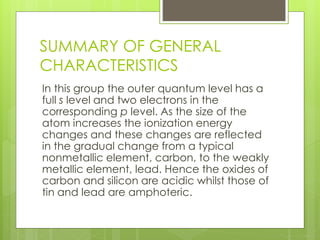
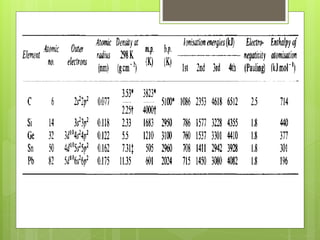
In this group the outer quantum level has a
full s level and two electrons in the
corresponding p level. As the size of the
atom increases the ionization energy
changes and these changes are reflected
in the gradual change from a typical
nonmetallic element, carbon, to the weakly
metallic element, lead. Hence the oxides of
carbon and silicon are acidic whilst those of
tin and lead are amphoteric.
CARBON
 Pure carbon occurs naturally in two
modifications, diamond and graphite. In
both these forms the carbon atoms are
linked by covalent bonds to give giant
molecules
Appearances of the Group IV elements at room
temperature and pressure: carbon (graphite)
SILICON
 After oxygen, silicon is the most abundant
element in the earth's crust. It occurs
extensively as the oxide, silica, in various
forms, for
example, flint, quartz, sand, and as silicates
in rocks and clays, but not as the free
element, silicon. Silicon is prepared by
reduction of silica, SiO2
Appearances of the Group IV elements at room
temperature and pressure: silicon
GERMANIUM
GERMANIUM
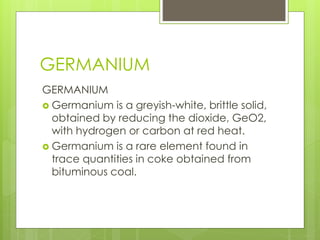
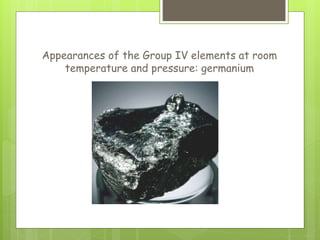
 Germanium is a greyish-white, brittle solid,
obtained by reducing the dioxide, GeO2,
with hydrogen or carbon at red heat.
 Germanium is a rare element found in
trace quantities in coke obtained from
bituminous coal.
Appearances of the Group IV elements at room
temperature and pressure: germanium
TIN
 The common ore of tin is tinstone or
cassiterite, SnO2, found in Cornwall and in
Germany and other countries.
 Tin is obtained from the tin dioxide, SnO2,
by reducing it with coal in a reverbatory
furnace:
SnO2 + 2C -> 2COf
Appearances of the Group IV elements at room
temperature and pressure: tin
Lead
 In the extraction of lead, the sulphide ore is first
roasted together with quartz in a current of air:
2PbS + 3O2 -> 2PbO + 2SO2
 Any lead(II) sulphate formed in this process is
converted to lead(II) silicate by reaction with the
quartz. The oxide produced is then mixed with
limestone and coke and heated in a blast
furnace.
The following reactions occur:
PbO + C -> Pb + CO
PbO + CO -> Pb + CO2
PbSiO3 + CaO + CO -> Pb + CaSiO3 + CO2
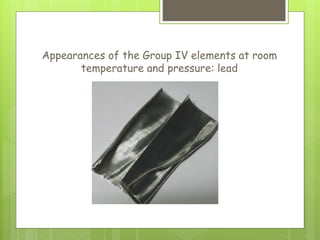
Appearances of the Group IV elements at room
temperature and pressure: lead
Kelompok 6 mohon undur diri
 ^_^ terimakasih atas
perhatiannya

Group iv elements

  • 1.
    GROUP IV ELEMENTS Krisnawati Hidayah (06121010010) InaAyu Nengtyas (06121010013) Pujiati (06121010018
  • 2.
    Group IV elements: C:Carbon Si :Silicon Ge :Germanium Sn :Tin Pb :Lead
  • 3.
    SUMMARY OF GENERAL CHARACTERISTICS Inthis group the outer quantum level has a full s level and two electrons in the corresponding p level. As the size of the atom increases the ionization energy changes and these changes are reflected in the gradual change from a typical nonmetallic element, carbon, to the weakly metallic element, lead. Hence the oxides of carbon and silicon are acidic whilst those of tin and lead are amphoteric.
  • 5.
    CARBON  Pure carbonoccurs naturally in two modifications, diamond and graphite. In both these forms the carbon atoms are linked by covalent bonds to give giant molecules
  • 6.
    Appearances of theGroup IV elements at room temperature and pressure: carbon (graphite)
  • 9.
    SILICON  After oxygen,silicon is the most abundant element in the earth's crust. It occurs extensively as the oxide, silica, in various forms, for example, flint, quartz, sand, and as silicates in rocks and clays, but not as the free element, silicon. Silicon is prepared by reduction of silica, SiO2
  • 10.
    Appearances of theGroup IV elements at room temperature and pressure: silicon
  • 13.
    GERMANIUM GERMANIUM  Germanium isa greyish-white, brittle solid, obtained by reducing the dioxide, GeO2, with hydrogen or carbon at red heat.  Germanium is a rare element found in trace quantities in coke obtained from bituminous coal.
  • 14.
    Appearances of theGroup IV elements at room temperature and pressure: germanium
  • 16.
    TIN  The commonore of tin is tinstone or cassiterite, SnO2, found in Cornwall and in Germany and other countries.  Tin is obtained from the tin dioxide, SnO2, by reducing it with coal in a reverbatory furnace: SnO2 + 2C -> 2COf
  • 17.
    Appearances of theGroup IV elements at room temperature and pressure: tin
  • 20.
    Lead  In theextraction of lead, the sulphide ore is first roasted together with quartz in a current of air: 2PbS + 3O2 -> 2PbO + 2SO2  Any lead(II) sulphate formed in this process is converted to lead(II) silicate by reaction with the quartz. The oxide produced is then mixed with limestone and coke and heated in a blast furnace. The following reactions occur: PbO + C -> Pb + CO PbO + CO -> Pb + CO2 PbSiO3 + CaO + CO -> Pb + CaSiO3 + CO2
  • 21.
    Appearances of theGroup IV elements at room temperature and pressure: lead
  • 25.
    Kelompok 6 mohonundur diri  ^_^ terimakasih atas perhatiannya