Adenoids
Dr. Priyanjal Gautam
PG-3rd Yr. (MS-ENT)
NIMS, Jaipur
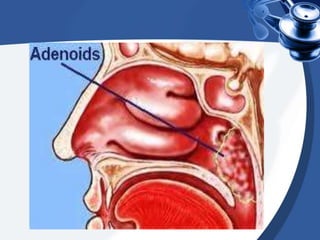
• Synonym: Nasopharyngeal tonsil
• Adenoids is the hypertrophied mass of
lymphoid tissue situated at the junction of
roof & post. wall of nasopharynx.
• The mass of lymphoid tissue is termed as
Adenoids only when it is hypertrophied.
• It usually undergoes atrophy by puberty (13-
14 yrs)
FEATURES :
• Pink, globular mass
• Vertical ridges on its surface
• No crypts
• Lined by ciliated columnar epithelium
• No capsule
BLOOD SUPPLY :
• Ascending palatine branch of facial
artery
• Ascending pharyngeal artery
• Pharyngeal branch of 3rd part of
maxillary artery
LYMPHATIC DRAINAGE :
• Upper deep jugular nodes
• Retropharyngeal nodes
• Parapharyngeal nodes
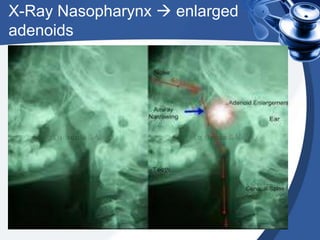
X-Ray Nasopharynx  enlarged
adenoids
ETIOLOGY :
• Hereditary
• Cold climate
• Specific infection like tuberculosis
• Physiological hypertrophy may be seen
between 3-10 yrs
SYMPTOMS :
LOCAL
• B/L nasal obstruction
• Snoring
• Mouth breathing
• Rhinolalia clausa
• Frequent rhinorrhoea
• Epistaxis
• Feeding problems in
children
• Conductive deafness due to
ET block
• Cervical lymphadenopathy
• Otitis media
• Adenoids facies
• Bronchitis
GENERAL
• Anorexia
• Lethargy
• Poor physical & mental
development
• Bed-wetting
• Pigeon chest
• Protuberent abdomen
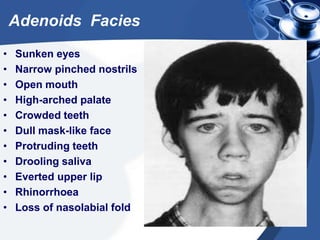
Adenoids Facies
• Sunken eyes
• Narrow pinched nostrils
• Open mouth
• High-arched palate
• Crowded teeth
• Dull mask-like face
• Protruding teeth
• Drooling saliva
• Everted upper lip
• Rhinorrhoea
• Loss of nasolabial fold
Aural manifestations in Adenoids
• Otalgia
• Secretory otitis media
• Acute otitis media
• Atelectasis of TM
• ET block
• Chonic otitis media
Diagnosis :
• H/O nasal obstruction, rhinorrhoea
• Pink globular mass with vertical ridges
on post. rhinoscopy
• B/L retracted ear drums
• X-ray nasopharynx Lat. View shows
soft tissue mass
Differential diagnosis:
• Thornwaldt’s cyst
• High arched palate
Complications:
• Adenoid facies
• Otitis media with effusion
• Recurrent acute otitis media
• Rhinolalia clausa
• Chronic sinusitis
• Sleep apnea syndrome
• Decreased mental/physical development
Treatment :
MEDICAL
• Adequate nutrition
• Antibiotics
• Anti inflammatory
analgesics
• Nasal decongestant
drops
SURGICAL
• Adenoidectomy
• Myringotomy with
grommet insertion
Adenoidectomy
Indications :
1. Adenoid hypertrophy causing snoring,
mouth breathing, sleep apnoea
syndrome or speech abnormalities, i.e.
(rhinolalia clausa).
2. Recurrent rhinosinusitis.
3. Chronic secretory otitis media
associated with adenoid hyperplasia.
4. Recurrent ear discharge in benign
CSOM associated with
adenoiditis/adenoid hyperplasia.
5. Dental malocclusion. Adenoidectomy
does not correct dental abnormalities
but will prevent its recurrence after
orthodontic treatment.
Contraindications :
1. Cleft palate
2. Haemorrhagic diathesis.
3. Acute URTI
Anaesthesia :
• Always general, with oral endotracheal
intubation.
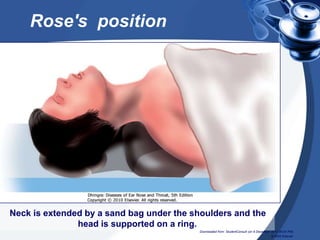
Neck is extended by a sand bag under the shoulders and the
head is supported on a ring.
Downloaded from: StudentConsult (on 6 December 2012 06:54 PM)
© 2005 Elsevier
Rose's position
Steps of Operation :
1. Boyle-Davis mouth-gag is inserted.
Before actual removal of adenoids,
nasopharynx should always be
examined by retracting the soft palate
with curved end of the tongue
depressor and by digital palpation, to
confirm the diagnosis, to assess the
size of adenoids mass and to push the
lateral adenoid masses towards the
midline.
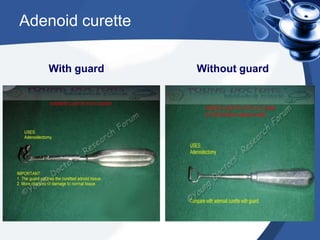
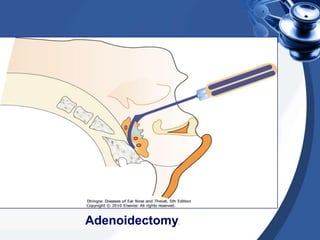
2. Proper size of "adenoid curette with
guard" is introduced into the
nasopharynx till its free edge touches
the posterior border of nasal septum
and is then pressed backwards to
engage the adenoids. At this level,
head should be slightly flexed to avoid
injury to the odontoid process.
Adenoid curette
With guard Without guard
3. With gentle sweeping movement, adenoids are
shaved off . Lateral masses are similarly removed
with smaller curettes; small tags of lymphoid tissue
left behind are removed with punch forceps.
4. Haemostasis is achieved by packing the area for
sometime. Persistent bleeders are electro-
coagulated under vision. If bleeding is still not
controlled, a postnasal pack is left for 24 hours.
Adenoidectomy.
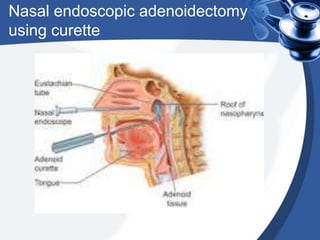
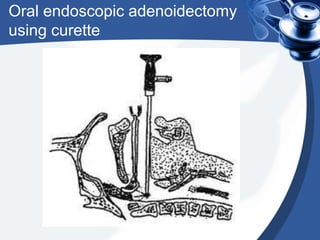
Endoscopic Adenoidectomy
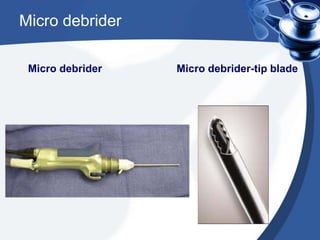
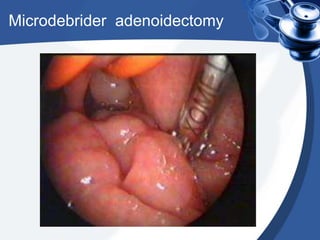
• These days adenoids can be removed
more precisely by using a debrider
under endoscopic control
Nasal endoscopic adenoidectomy
using curette
Oral endoscopic adenoidectomy
using curette
Micro debrider
Micro debrider Micro debrider-tip blade
Microdebrider adenoidectomy
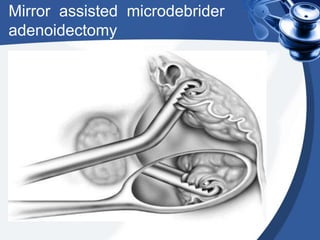
Mirror assisted microdebrider
adenoidectomy
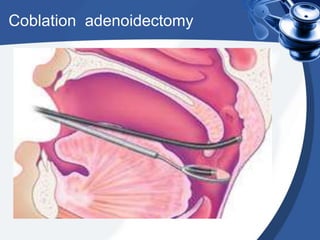
Coblation adenoidectomy
• It is also other wise known as cold
abalation. This technique utilises a field
of plasma, or ionised sodium
molecules, to ablate tissues. The heat
generated varies from 40 - 80 degrees
centigrade, much lower than that of
electro cautery. The major advantage of
this procedure is reduced bleeding and
reduced post operative pain.
Coblation adenoidectomy
Post-operative Care :
1. Immediate general care
(a) Keep the patient in coma position until
fully recovered from anaesthesia.
(b) Keep a watch on bleeding from the
nose and mouth.
(c) Keep check on vital signs, e.g. pulse,
respiration and blood pressure.
Post-operative Care cont..
2. Diet
When patient is fully recovered he/she is to
take liquids, e.g. cold milk or ice cream.
3. Nasal saline drops
Post-operative Care cont..
4. Analgesics : I/V or oral
5. Antibiotics : Orally or I/V for a week.
 Patient is usually sent home 24 hours after
operation unless there is some complication.
Patient can resume his normal duties within 2
weeks.
Complications :
1. Haemorrhage
2. Injury to eustachian tube opening
3. Injury to pharyngeal musculature and
vertebrae
4. Griesel syndrome. Patient complains of
neck pain and develops torticollis. Mostly it is
due to spasm of paraspinal muscles, but can
be due to atlanto-axial dislocation requiring
cervical collar and even traction.
5. Nasopharyngeal stenosis
6. Recurrence
Thank You…

Adenoids

  • 1.
    Adenoids Dr. Priyanjal Gautam PG-3rdYr. (MS-ENT) NIMS, Jaipur
  • 2.
    • Synonym: Nasopharyngealtonsil • Adenoids is the hypertrophied mass of lymphoid tissue situated at the junction of roof & post. wall of nasopharynx. • The mass of lymphoid tissue is termed as Adenoids only when it is hypertrophied. • It usually undergoes atrophy by puberty (13- 14 yrs)
  • 4.
    FEATURES : • Pink,globular mass • Vertical ridges on its surface • No crypts • Lined by ciliated columnar epithelium • No capsule
  • 5.
    BLOOD SUPPLY : •Ascending palatine branch of facial artery • Ascending pharyngeal artery • Pharyngeal branch of 3rd part of maxillary artery
  • 6.
    LYMPHATIC DRAINAGE : •Upper deep jugular nodes • Retropharyngeal nodes • Parapharyngeal nodes
  • 7.
    X-Ray Nasopharynx enlarged adenoids
  • 8.
    ETIOLOGY : • Hereditary •Cold climate • Specific infection like tuberculosis • Physiological hypertrophy may be seen between 3-10 yrs
  • 9.
    SYMPTOMS : LOCAL • B/Lnasal obstruction • Snoring • Mouth breathing • Rhinolalia clausa • Frequent rhinorrhoea • Epistaxis • Feeding problems in children • Conductive deafness due to ET block • Cervical lymphadenopathy • Otitis media • Adenoids facies • Bronchitis GENERAL • Anorexia • Lethargy • Poor physical & mental development • Bed-wetting • Pigeon chest • Protuberent abdomen
  • 10.
    Adenoids Facies • Sunkeneyes • Narrow pinched nostrils • Open mouth • High-arched palate • Crowded teeth • Dull mask-like face • Protruding teeth • Drooling saliva • Everted upper lip • Rhinorrhoea • Loss of nasolabial fold
  • 11.
    Aural manifestations inAdenoids • Otalgia • Secretory otitis media • Acute otitis media • Atelectasis of TM • ET block • Chonic otitis media
  • 12.
    Diagnosis : • H/Onasal obstruction, rhinorrhoea • Pink globular mass with vertical ridges on post. rhinoscopy • B/L retracted ear drums • X-ray nasopharynx Lat. View shows soft tissue mass
  • 13.
    Differential diagnosis: • Thornwaldt’scyst • High arched palate
  • 14.
    Complications: • Adenoid facies •Otitis media with effusion • Recurrent acute otitis media • Rhinolalia clausa • Chronic sinusitis • Sleep apnea syndrome • Decreased mental/physical development
  • 15.
    Treatment : MEDICAL • Adequatenutrition • Antibiotics • Anti inflammatory analgesics • Nasal decongestant drops SURGICAL • Adenoidectomy • Myringotomy with grommet insertion
  • 16.
  • 17.
    Indications : 1. Adenoidhypertrophy causing snoring, mouth breathing, sleep apnoea syndrome or speech abnormalities, i.e. (rhinolalia clausa). 2. Recurrent rhinosinusitis. 3. Chronic secretory otitis media associated with adenoid hyperplasia.
  • 18.
    4. Recurrent eardischarge in benign CSOM associated with adenoiditis/adenoid hyperplasia. 5. Dental malocclusion. Adenoidectomy does not correct dental abnormalities but will prevent its recurrence after orthodontic treatment.
  • 19.
    Contraindications : 1. Cleftpalate 2. Haemorrhagic diathesis. 3. Acute URTI
  • 20.
    Anaesthesia : • Alwaysgeneral, with oral endotracheal intubation.
  • 21.
    Neck is extendedby a sand bag under the shoulders and the head is supported on a ring. Downloaded from: StudentConsult (on 6 December 2012 06:54 PM) © 2005 Elsevier Rose's position
  • 22.
    Steps of Operation: 1. Boyle-Davis mouth-gag is inserted. Before actual removal of adenoids, nasopharynx should always be examined by retracting the soft palate with curved end of the tongue depressor and by digital palpation, to confirm the diagnosis, to assess the size of adenoids mass and to push the lateral adenoid masses towards the midline.
  • 23.
    2. Proper sizeof "adenoid curette with guard" is introduced into the nasopharynx till its free edge touches the posterior border of nasal septum and is then pressed backwards to engage the adenoids. At this level, head should be slightly flexed to avoid injury to the odontoid process.
  • 24.
  • 25.
    3. With gentlesweeping movement, adenoids are shaved off . Lateral masses are similarly removed with smaller curettes; small tags of lymphoid tissue left behind are removed with punch forceps. 4. Haemostasis is achieved by packing the area for sometime. Persistent bleeders are electro- coagulated under vision. If bleeding is still not controlled, a postnasal pack is left for 24 hours.
  • 26.
  • 27.
    Endoscopic Adenoidectomy • Thesedays adenoids can be removed more precisely by using a debrider under endoscopic control
  • 28.
  • 29.
  • 30.
    Micro debrider Micro debriderMicro debrider-tip blade
  • 31.
  • 32.
  • 33.
    Coblation adenoidectomy • Itis also other wise known as cold abalation. This technique utilises a field of plasma, or ionised sodium molecules, to ablate tissues. The heat generated varies from 40 - 80 degrees centigrade, much lower than that of electro cautery. The major advantage of this procedure is reduced bleeding and reduced post operative pain.
  • 34.
  • 35.
    Post-operative Care : 1.Immediate general care (a) Keep the patient in coma position until fully recovered from anaesthesia. (b) Keep a watch on bleeding from the nose and mouth. (c) Keep check on vital signs, e.g. pulse, respiration and blood pressure.
  • 36.
    Post-operative Care cont.. 2.Diet When patient is fully recovered he/she is to take liquids, e.g. cold milk or ice cream. 3. Nasal saline drops
  • 37.
    Post-operative Care cont.. 4.Analgesics : I/V or oral 5. Antibiotics : Orally or I/V for a week.  Patient is usually sent home 24 hours after operation unless there is some complication. Patient can resume his normal duties within 2 weeks.
  • 38.
    Complications : 1. Haemorrhage 2.Injury to eustachian tube opening 3. Injury to pharyngeal musculature and vertebrae 4. Griesel syndrome. Patient complains of neck pain and develops torticollis. Mostly it is due to spasm of paraspinal muscles, but can be due to atlanto-axial dislocation requiring cervical collar and even traction.
  • 39.
  • 40.