Secretors
Dr. Pratapsingh Rathod
What are Secretors?
Secretors are individuals who secrete their ABO antigenic charteristics (A,B,
and H Blood group substances) into the body fluids.
• 80% of people secrete these agglutinogens in the body fluids as water
soluble form.
• Non secretors are individuals who posses only lipodal form of this
agglutinogens.
• In Non Secretors blood group antigens are usually present over tissues
like RBC’s epithelium
Inheritance of Secretors:
• The ability to secrete soluble antigens is under control of a pair of
genes, Se and se.
• Se being dominant over se
• If the Se allele is inherited as Se Se or Se se, the person is called a
“secretor”
• If the Se allele is inherited as se se, the person is called a “non
secretors”
• The Se gene is responsible for the expression of the H antigen
on glycoprotein structures located in body secretions
• Secretors express soluble forms of the H antigen in secretions that
can then be converted to A or B antigens (by the transferases)
• The se allele is an amorph (nothing expressed)
• se se individuals do not convert antigen precursors to H antigen
and has neither soluble H antigen nor soluble A or B antigens in
body fluids.
Lewis System in Secretors:
Lewis blood group system is based on expression of glycoprotein
called Lewis(Le) antigens on surface of red blood cells or body fluids or
both.
-- Lewis ( a- b+) phenotypes are Secretors and Lewis (a+ b-)
are non-Secretors, where a and b allelic forms of Le gene.
Testing a known body fluid sample for ABO and Lewis groups
usually allows a conclusion with regards to ABO group and Secretor
status i.e., whether an individuals ABH blood group substances should
be found in evidential body fluids or not.
Body Fluids:
There are a many different types of body fluids that are secreted, they
can be broken down in two categories:
1. Excreted
- Sweat e.g., Assault,
- Breast milk
- Faeces ( often covered by mucous membrane)
- Bile
- Vomit
- Aqueous Humor
- Sebum (skin oil)
2. Secreted
- Cowper’s Fluid (Pre-ejaculatory Fluid)
- Semen
- Saliva
- Nasal secretions
- Female Ejaculate
- Urine
- Tears
Analysis of Body fluid:
• Body fluids are useful in helping forensic scientists and pathologists to
put together a detailed picture of how an individual died and likewise
may also present means of identifying the perpetrator.
• Varying fluids can be found contained within the human body and
about the body of an individual who has been the victim of a crime
• When dealing with a crime a scene that may have body fluids
secreted , all the personnel must be fully clothed in protective clothing to
avoid contamination of crime scene.
• Chemicals and ultraviolet light can be deployed to uncover the
existence of these body fluids in circumstances where they might be
overlooked or not visible to naked eye.
• These fluid if detected at a crime scene are swabbed, bagged and
collected in vials, which are air tight and at low risk of cross
contamination.
Tests:
Tests to identify body fluids:
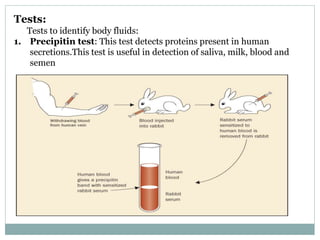
1. Precipitin test: This test detects proteins present in human
secretions.This test is useful in detection of saliva, milk, blood and
semen
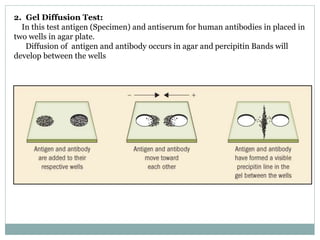
2. Gel Diffusion Test:
In this test antigen (Specimen) and antiserum for human antibodies in placed in
two wells in agar plate.
Diffusion of antigen and antibody occurs in agar and percipitin Bands will
develop between the wells
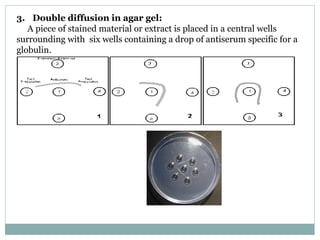
3. Double diffusion in agar gel:
A piece of stained material or extract is placed in a central wells
surrounding with six wells containing a drop of antiserum specific for a
globulin.
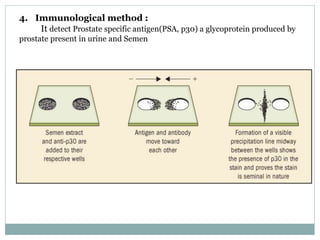
4. Immunological method :
It detect Prostate specific antigen(PSA, p30) a glycoprotein produced by
prostate present in urine and Semen
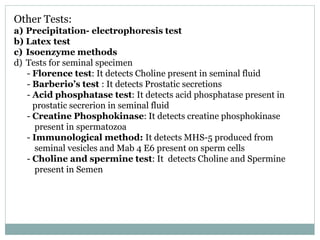
Other Tests:
a) Precipitation- electrophoresis test
b) Latex test
c) Isoenzyme methods
d) Tests for seminal specimen
- Florence test: It detects Choline present in seminal fluid
- Barberio’s test : It detects Prostatic secretions
- Acid phosphatase test: It detects acid phosphatase present in
prostatic secrerion in seminal fluid
- Creatine Phosphokinase: It detects creatine phosphokinase
present in spermatozoa
- Immunological method: It detects MHS-5 produced from
seminal vesicles and Mab 4 E6 present on sperm cells
- Choline and spermine test: It detects Choline and Spermine
present in Semen
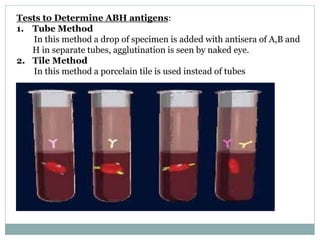
Tests to Determine ABH antigens:
1. Tube Method
In this method a drop of specimen is added with antisera of A,B and
H in separate tubes, agglutination is seen by naked eye.
2. Tile Method
In this method a porcelain tile is used instead of tubes
3. Absorption – Inhibition method
In this method samples and antisera are allowed to react with each
other for a longer period
4. Mixed Agglutination Test
In this test stained cloth is cut into 2-3mm pieces, fibers are separated and
added to tubes containing antisera of A, B, H types, Antisera will form clumps
over cloth fibers
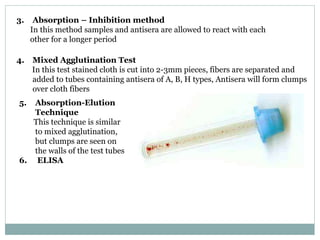
5. Absorption-Elution
Technique
This technique is similar
to mixed agglutination,
but clumps are seen on
the walls of the test tubes
6. ELISA
Medico-Legal Importance:
1. Identifying Blood groups in Disputed maternity or paternity as a
first order exclusion
2. Identification of victim or offender where only available specimen
is either saliva, urine or semen
3. Identification of mutilated remains where saliva or sweat sample
can be obtained
4. Sexual crime, samples like saliva of the offender can be obtained
5. In extortion or abduction cases, saliva samples can be obtained
from envelopes, face masks, nasal secretions, saliva from cigarette
butts
6. Alcohol intoxication with assault vomit samples of offender can be
helpful in identification
Secretors

Secretors

  • 1.
  • 2.
    What are Secretors? Secretorsare individuals who secrete their ABO antigenic charteristics (A,B, and H Blood group substances) into the body fluids. • 80% of people secrete these agglutinogens in the body fluids as water soluble form. • Non secretors are individuals who posses only lipodal form of this agglutinogens. • In Non Secretors blood group antigens are usually present over tissues like RBC’s epithelium
  • 3.
    Inheritance of Secretors: •The ability to secrete soluble antigens is under control of a pair of genes, Se and se. • Se being dominant over se • If the Se allele is inherited as Se Se or Se se, the person is called a “secretor” • If the Se allele is inherited as se se, the person is called a “non secretors” • The Se gene is responsible for the expression of the H antigen on glycoprotein structures located in body secretions • Secretors express soluble forms of the H antigen in secretions that can then be converted to A or B antigens (by the transferases) • The se allele is an amorph (nothing expressed) • se se individuals do not convert antigen precursors to H antigen and has neither soluble H antigen nor soluble A or B antigens in body fluids.
  • 4.
    Lewis System inSecretors: Lewis blood group system is based on expression of glycoprotein called Lewis(Le) antigens on surface of red blood cells or body fluids or both. -- Lewis ( a- b+) phenotypes are Secretors and Lewis (a+ b-) are non-Secretors, where a and b allelic forms of Le gene. Testing a known body fluid sample for ABO and Lewis groups usually allows a conclusion with regards to ABO group and Secretor status i.e., whether an individuals ABH blood group substances should be found in evidential body fluids or not.
  • 5.
    Body Fluids: There area many different types of body fluids that are secreted, they can be broken down in two categories: 1. Excreted - Sweat e.g., Assault, - Breast milk - Faeces ( often covered by mucous membrane) - Bile - Vomit - Aqueous Humor - Sebum (skin oil) 2. Secreted - Cowper’s Fluid (Pre-ejaculatory Fluid) - Semen - Saliva - Nasal secretions - Female Ejaculate - Urine - Tears
  • 6.
    Analysis of Bodyfluid: • Body fluids are useful in helping forensic scientists and pathologists to put together a detailed picture of how an individual died and likewise may also present means of identifying the perpetrator. • Varying fluids can be found contained within the human body and about the body of an individual who has been the victim of a crime • When dealing with a crime a scene that may have body fluids secreted , all the personnel must be fully clothed in protective clothing to avoid contamination of crime scene. • Chemicals and ultraviolet light can be deployed to uncover the existence of these body fluids in circumstances where they might be overlooked or not visible to naked eye. • These fluid if detected at a crime scene are swabbed, bagged and collected in vials, which are air tight and at low risk of cross contamination.
  • 7.
    Tests: Tests to identifybody fluids: 1. Precipitin test: This test detects proteins present in human secretions.This test is useful in detection of saliva, milk, blood and semen
  • 8.
    2. Gel DiffusionTest: In this test antigen (Specimen) and antiserum for human antibodies in placed in two wells in agar plate. Diffusion of antigen and antibody occurs in agar and percipitin Bands will develop between the wells
  • 9.
    3. Double diffusionin agar gel: A piece of stained material or extract is placed in a central wells surrounding with six wells containing a drop of antiserum specific for a globulin.
  • 10.
    4. Immunological method: It detect Prostate specific antigen(PSA, p30) a glycoprotein produced by prostate present in urine and Semen
  • 11.
    Other Tests: a) Precipitation-electrophoresis test b) Latex test c) Isoenzyme methods d) Tests for seminal specimen - Florence test: It detects Choline present in seminal fluid - Barberio’s test : It detects Prostatic secretions - Acid phosphatase test: It detects acid phosphatase present in prostatic secrerion in seminal fluid - Creatine Phosphokinase: It detects creatine phosphokinase present in spermatozoa - Immunological method: It detects MHS-5 produced from seminal vesicles and Mab 4 E6 present on sperm cells - Choline and spermine test: It detects Choline and Spermine present in Semen
  • 12.
    Tests to DetermineABH antigens: 1. Tube Method In this method a drop of specimen is added with antisera of A,B and H in separate tubes, agglutination is seen by naked eye. 2. Tile Method In this method a porcelain tile is used instead of tubes
  • 13.
    3. Absorption –Inhibition method In this method samples and antisera are allowed to react with each other for a longer period 4. Mixed Agglutination Test In this test stained cloth is cut into 2-3mm pieces, fibers are separated and added to tubes containing antisera of A, B, H types, Antisera will form clumps over cloth fibers 5. Absorption-Elution Technique This technique is similar to mixed agglutination, but clumps are seen on the walls of the test tubes 6. ELISA
  • 14.
    Medico-Legal Importance: 1. IdentifyingBlood groups in Disputed maternity or paternity as a first order exclusion 2. Identification of victim or offender where only available specimen is either saliva, urine or semen 3. Identification of mutilated remains where saliva or sweat sample can be obtained 4. Sexual crime, samples like saliva of the offender can be obtained 5. In extortion or abduction cases, saliva samples can be obtained from envelopes, face masks, nasal secretions, saliva from cigarette butts 6. Alcohol intoxication with assault vomit samples of offender can be helpful in identification