Classification of Plants
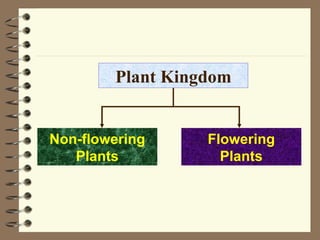
Plant Kingdom Flowering Plants Non-flowering Plants
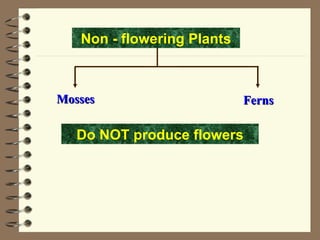
Ferns Mosses Non - flowering Plants Do NOT produce flowers
A plant can be divided into 3 parts
Examples of Mosses
Moss spores Spore-producing capsule
Characteristics of Mosses ●  No true roots,  No vascular tissues (no transport) ●  Simple stems & leaves ●  Have  rhizoids  for  anchorage ●  Spores  from capsules  (wind-dispersal) ●  Damp  terrestrial land ●  Simplest plants
Fern
Fern underground stem root A leaf (finely divided into small parts)
spore-producing organs
Characteristics of Ferns ●  roots, feathery leaves & underground stems ●  have  vascular tissues  (transport & support) ●  Damp  &  shady   places ●  Spore-producing organ   on the underside  of leaves (reproduction)
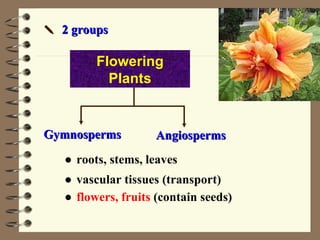
   2 groups Gymnosperms Angiosperms ●  roots, stems, leaves ●  vascular tissues (transport) ●  flowers, fruits  (contain seeds) Flowering Plants
Pine tree Gymnosperms
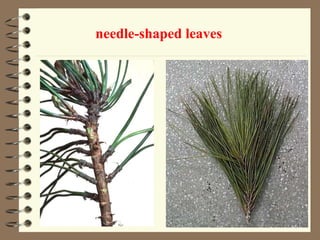
needle-shaped leaves
Male cones  (in clusters) Female cones  (scattered)
Characteristics of Gymnosperms ●  roots, woody stems ●  needle-shaped  leaves ●  tall evergreen trees ●  cones  with reproductive structures ●  dry places ●  vascular tissues  (transport) ●  naked seeds  in female cones.
Angiosperms ●  Highly developed ●  Flowering Plants ●  Seeds inside ovary 2 TYPES ●  MONOCOTYLEDONS ●  DICOTYLEDONS
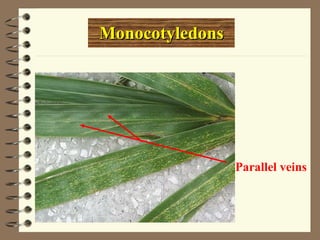
Monocotyledons Parallel veins
Characteristics of Monocotyledons ●  one seed-leaf ●   leaves have  parallel  veins ●  herbaceous plants ●  e.g. grass, maize
Dicotyledons Veins in network
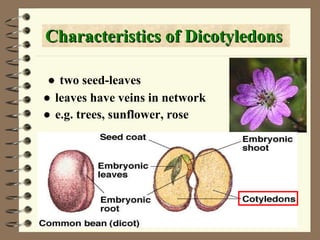
Characteristics of Dicotyledons ●  two seed-leaves ●  leaves have veins in network ●  e.g. trees, sunflower, rose
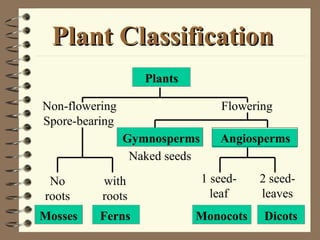
Plant Classification Non-flowering Plants Flowering Spore-bearing Naked seeds No roots with roots Mosses Ferns Gymnosperms 1 seed-leaf 2 seed-leaves Monocots Dicots Angiosperms

Classification of plants