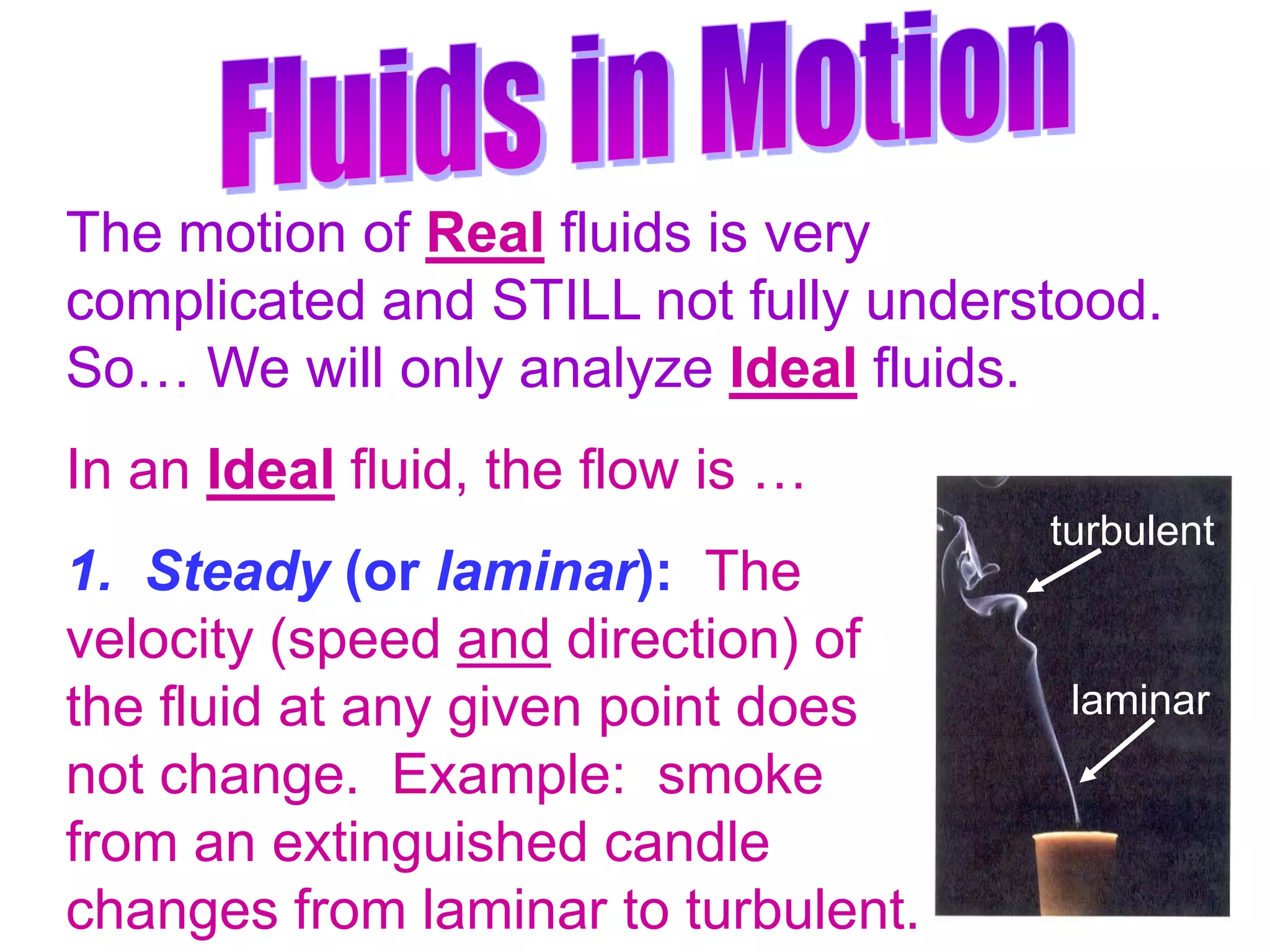
Fluids in MotionThe motion of Real fluids is very complicated and STILL not fully understood.  So… We will only analyze Ideal fluids.In an Ideal fluid, the flow is …1.  Steady (or laminar):  The                        velocity (speed and direction) of                              the fluid at any given point does                             not change.  Example:  smoke                                  from an extinguished candle                            changes from laminar to turbulent.  turbulentlaminar
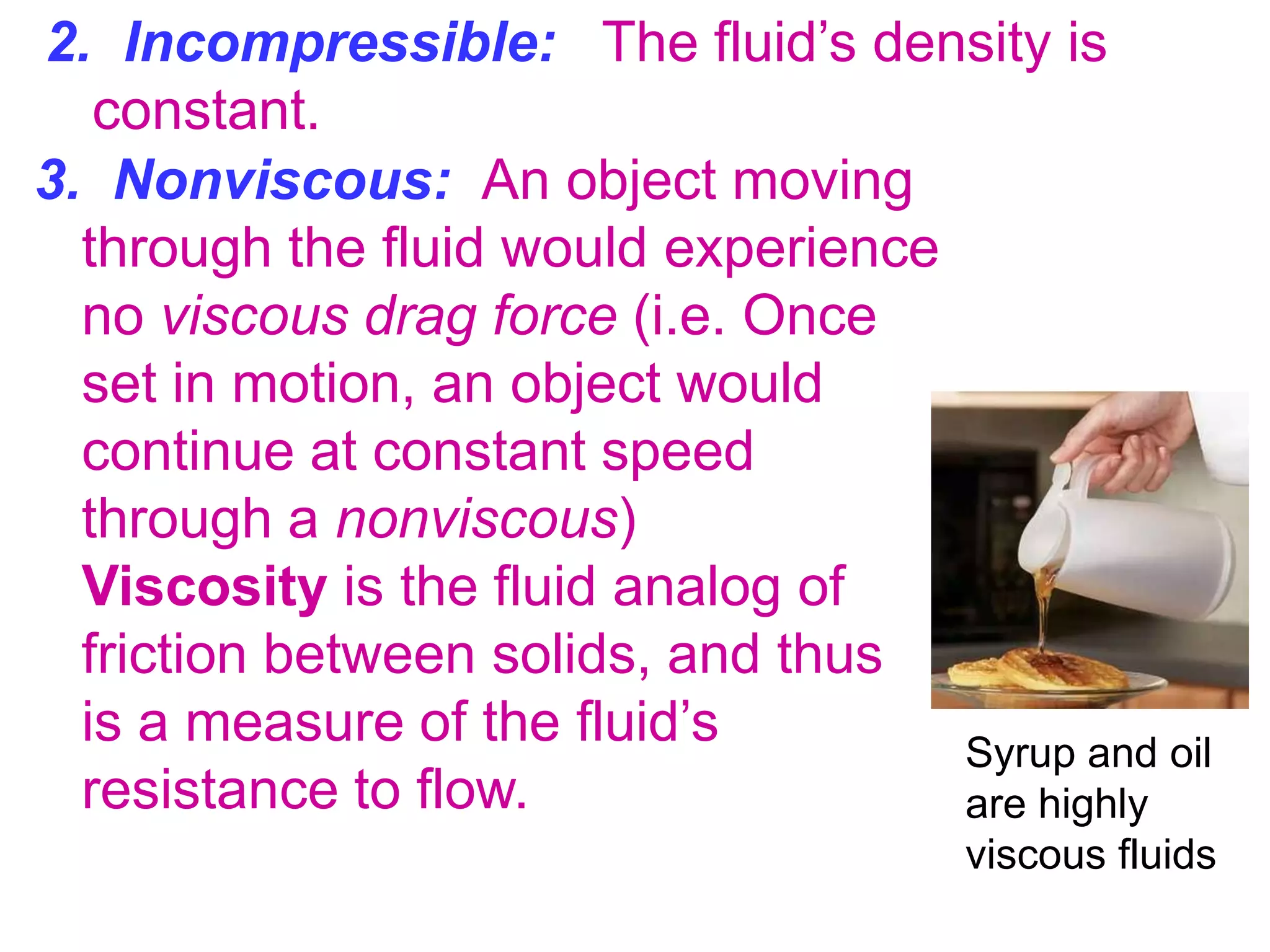
  Incompressible:   The fluid’s density is constant.3.  Nonviscous:  An object moving through the fluid would experience no viscous drag force (i.e. Once set in motion, an object would continue at constant speed through a nonviscous)    Viscosity is the fluid analog of friction between solids, and thus is a measure of the fluid’s resistance to flow.Syrup and oil are highly viscous fluids
The flow of a fluid can be made visible by adding a tracer, such as a dye to a liquid flow or smoke to a gas flow.  Each bit of tracer follows what is called a ___________.     streamlineLaminar flow in a liquid around an obstacleAirflow streamlines for a car in a wind-tunnel test.
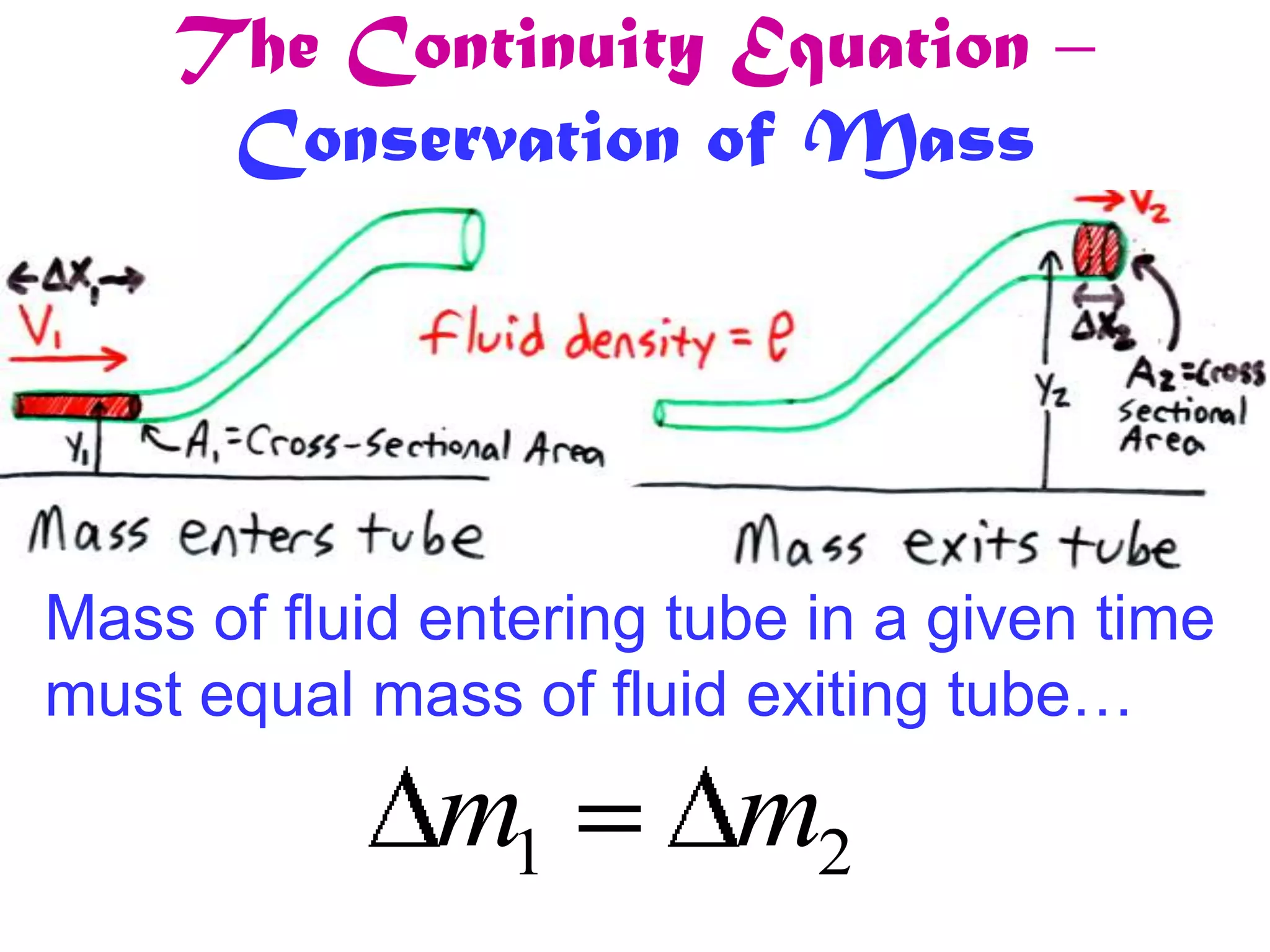
The Continuity Equation –Conservation of MassMass of fluid entering tube in a given time must equal mass of fluid exiting tube…
(V = Volume in this step)(Substitute Dx = …..?)(v = Velocity in this step)OR…
is often called the “Volume Flow Rate” equation because the term Av is equivalent to ___________, with SI units of
 As A↑, v __.Volume/time↓As velocity increases,  streamlines _________.get closerAn Application:
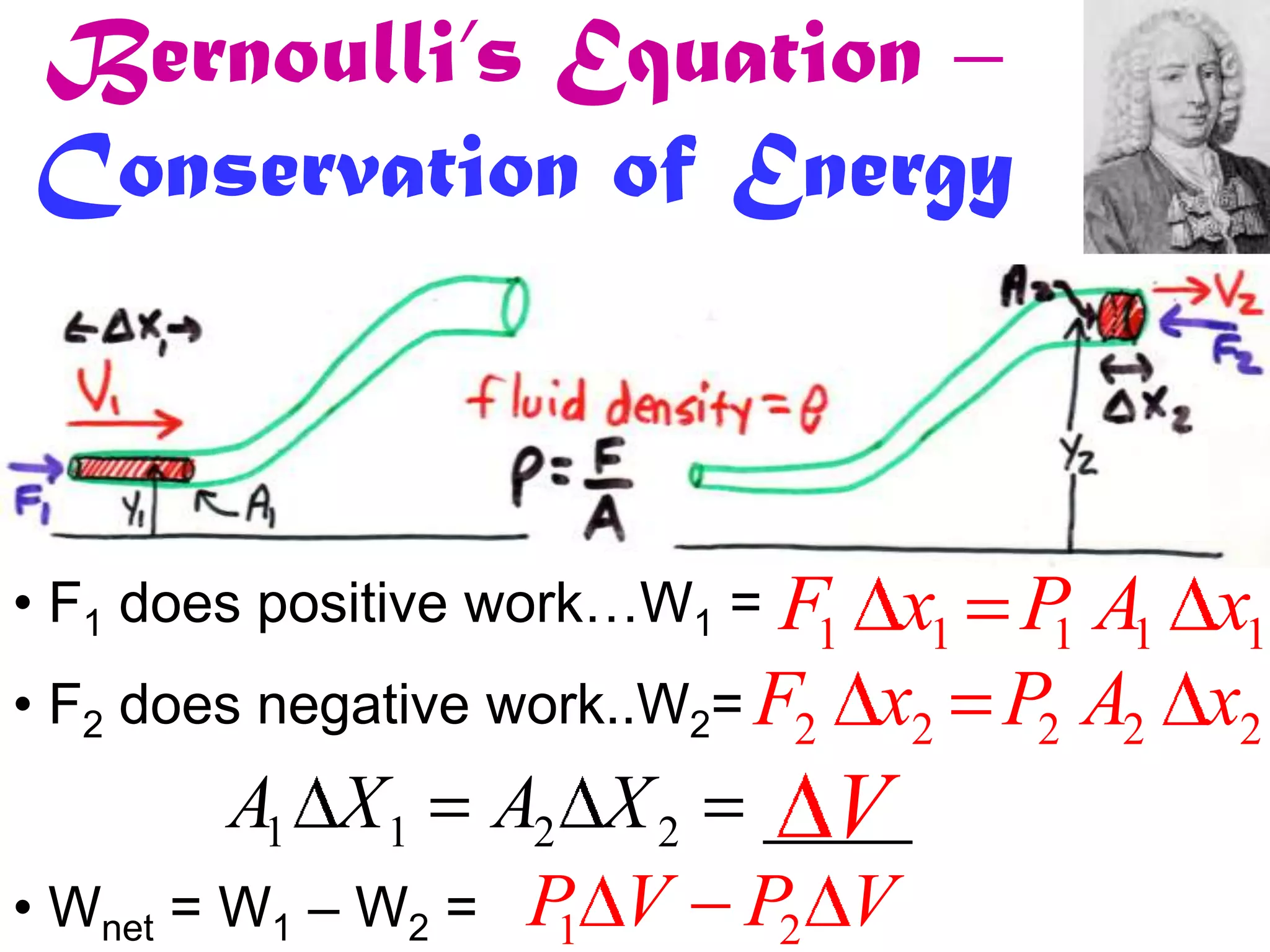
Bernoulli’s Equation –Conservation of Energy F1 does positive work…W1 =
 F2 does negative work..W2=
 Wnet = W1 – W2 = The net work on the fluid, then, must equal the __________________ of the fluid.		Wnet = change in energy
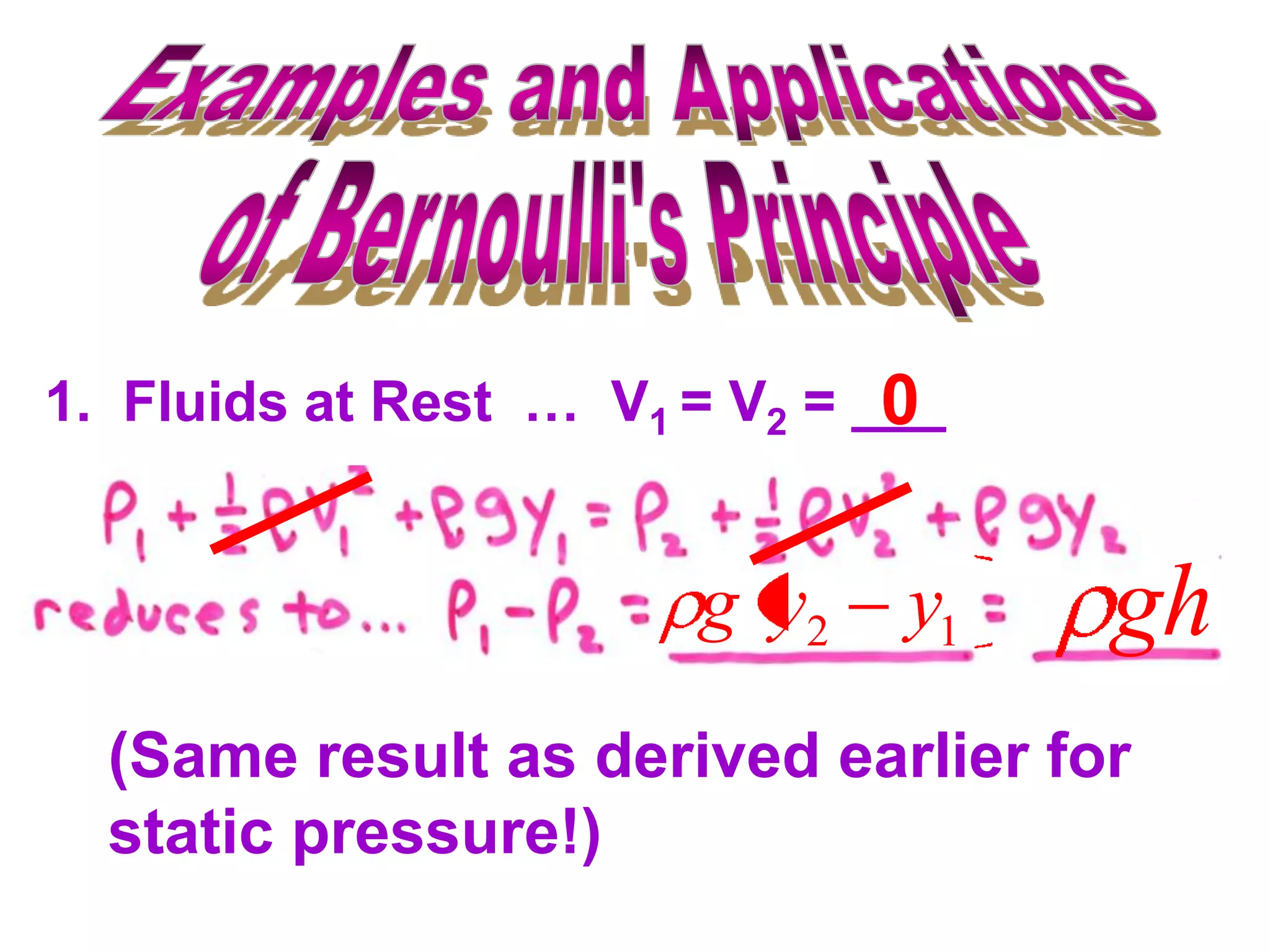
Examples and Applications of Bernoulli's Principle01.  Fluids at Rest  …  V1 = V2 = ___(Same result as derived earlier for static pressure!)
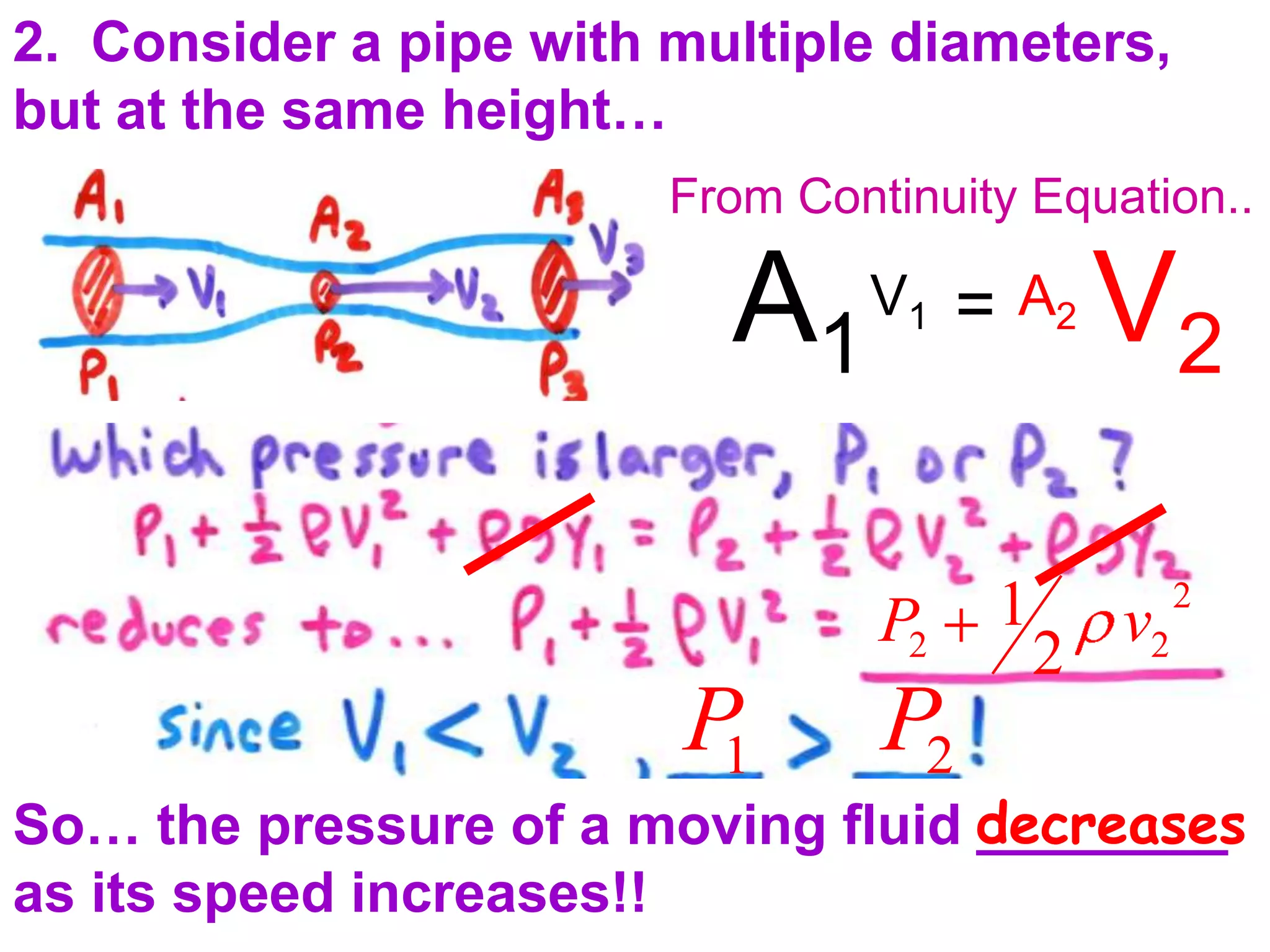
2.  Consider a pipe with multiple diameters, but at the same height…From Continuity Equation..A1V2V1=A2So… the pressure of a moving fluid ________ as its speed increases!!   decreases
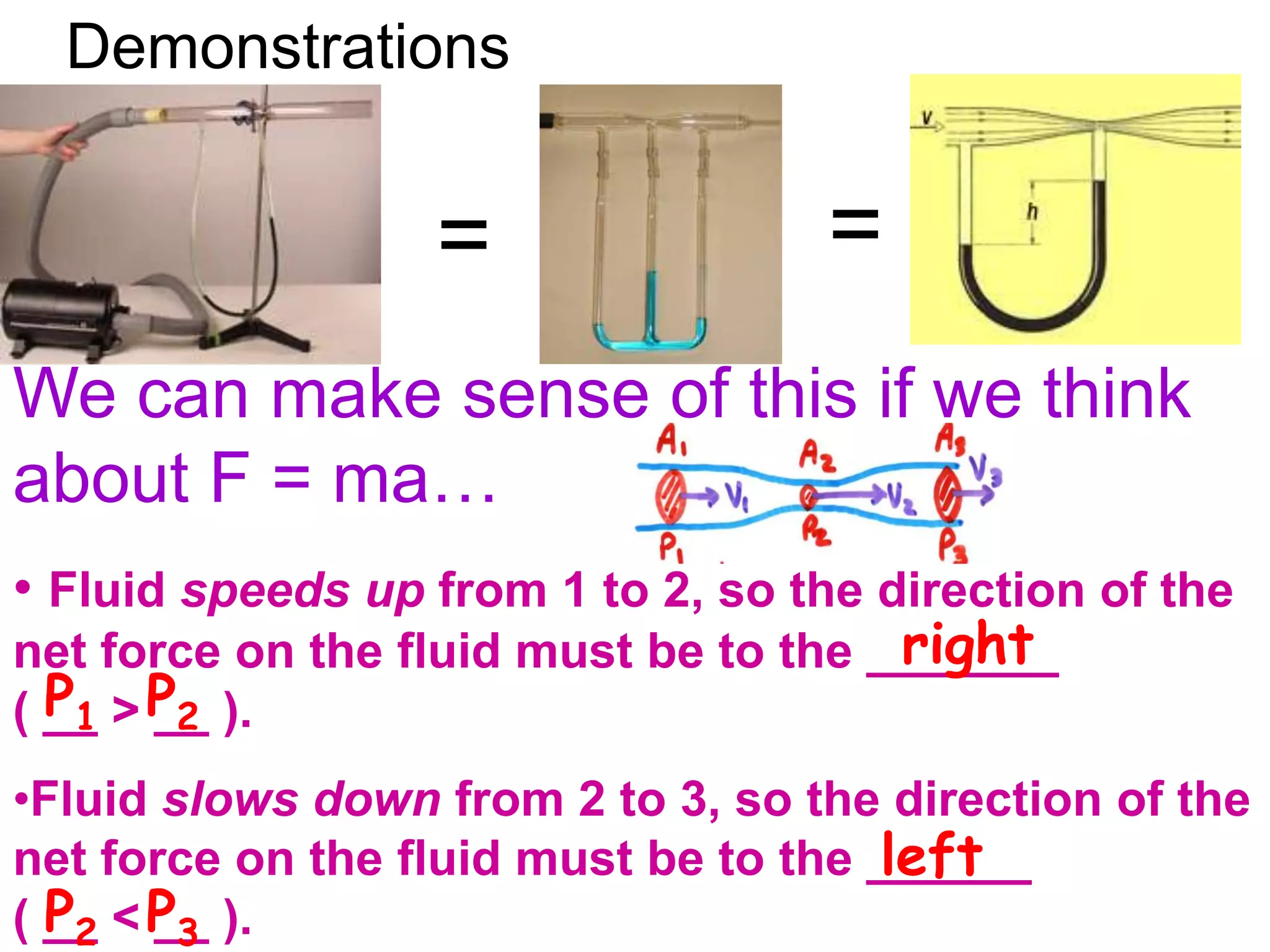
Demonstrations==We can make sense of this if we think about F = ma…Fluid speeds up from 1 to 2, so the direction of the net force on the fluid must be to the _______                       ( __ > __ ).
Fluid slows down from 2 to 3, so the direction of the net force on the fluid must be to the ______                     ( __ < __ ).rightP1  P2leftP2  P3
 A large tank has a small pipe near the bottom.  The speed at which a fluid will escape out the pipe can be calculated using Bernoulli’s Principle… Apply Bernoulli’s Equation between 1 and 2.Since 1 is at the surface & 2 is just as the fluid leaves the tank, P1 & P2 are both ___ absolute pressure or ___ gauge pressure (can use either in Bernoulli’s Equation, as long as you are consistent!)Pa0

Bernoulli’s equation

  • 1.
    Fluids in MotionThemotion of Real fluids is very complicated and STILL not fully understood. So… We will only analyze Ideal fluids.In an Ideal fluid, the flow is …1. Steady (or laminar): The velocity (speed and direction) of the fluid at any given point does not change. Example: smoke from an extinguished candle changes from laminar to turbulent. turbulentlaminar
  • 2.
    Incompressible: The fluid’s density is constant.3. Nonviscous: An object moving through the fluid would experience no viscous drag force (i.e. Once set in motion, an object would continue at constant speed through a nonviscous) Viscosity is the fluid analog of friction between solids, and thus is a measure of the fluid’s resistance to flow.Syrup and oil are highly viscous fluids
  • 3.
    The flow ofa fluid can be made visible by adding a tracer, such as a dye to a liquid flow or smoke to a gas flow. Each bit of tracer follows what is called a ___________. streamlineLaminar flow in a liquid around an obstacleAirflow streamlines for a car in a wind-tunnel test.
  • 4.
    The Continuity Equation–Conservation of MassMass of fluid entering tube in a given time must equal mass of fluid exiting tube…
  • 5.
    (V = Volumein this step)(Substitute Dx = …..?)(v = Velocity in this step)OR…
  • 6.
    is often calledthe “Volume Flow Rate” equation because the term Av is equivalent to ___________, with SI units of
  • 7.
    As A↑,v __.Volume/time↓As velocity increases, streamlines _________.get closerAn Application:
  • 8.
    Bernoulli’s Equation –Conservationof Energy F1 does positive work…W1 =
  • 9.
    F2 doesnegative work..W2=
  • 10.
    Wnet =W1 – W2 = The net work on the fluid, then, must equal the __________________ of the fluid. Wnet = change in energy
  • 11.
    Examples and Applicationsof Bernoulli's Principle01. Fluids at Rest … V1 = V2 = ___(Same result as derived earlier for static pressure!)
  • 12.
    2. Considera pipe with multiple diameters, but at the same height…From Continuity Equation..A1V2V1=A2So… the pressure of a moving fluid ________ as its speed increases!! decreases
  • 13.
    Demonstrations==We can makesense of this if we think about F = ma…Fluid speeds up from 1 to 2, so the direction of the net force on the fluid must be to the _______ ( __ > __ ).
  • 14.
    Fluid slows downfrom 2 to 3, so the direction of the net force on the fluid must be to the ______ ( __ < __ ).rightP1 P2leftP2 P3
  • 15.
    A largetank has a small pipe near the bottom. The speed at which a fluid will escape out the pipe can be calculated using Bernoulli’s Principle… Apply Bernoulli’s Equation between 1 and 2.Since 1 is at the surface & 2 is just as the fluid leaves the tank, P1 & P2 are both ___ absolute pressure or ___ gauge pressure (can use either in Bernoulli’s Equation, as long as you are consistent!)Pa0
  • 16.
    If the tankis large, V1≈ ___0y = 0Same result as for a body that _____________ from a height, h.free fallsChoosing a different 1 produces the same answer… choose point inside tank, a height, h, below the surface.If the outlet pipe were redirected vertically, how high would an ideal fluid rise above the outlet? ____!h
  • 17.
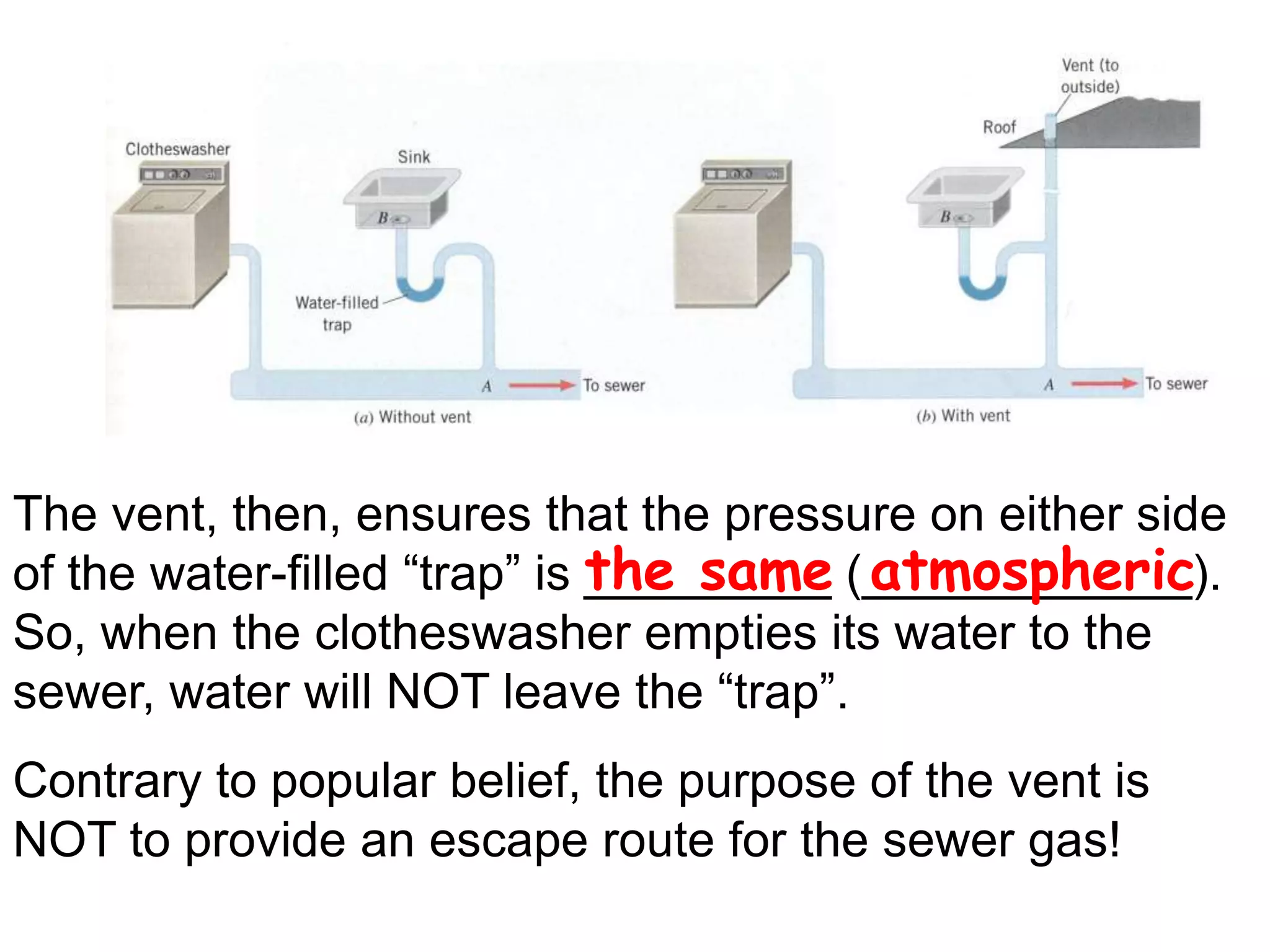
    5. HouseholdPlumbing…Whatis the purpose of the U-shaped pipe beneath a sink called a (“trap”) AND the vent pipe that extends through the roof?The purpose of the “trap” is to provide a barrier to prevent smelly sewer gases from entering the home. But what would happen, then, if there was no vent?....When water from the clotheswasher would rush through the pipe, the high velocity water would have a ________ pressure than atmospheric (Bernoulli). Since PB > PA, the water in the trap would be pushed out into the sewer line, allowing those nasty sewer gases to enter your lovely home!!lower
  • 18.
    The vent, then,ensures that the pressure on either side of the water-filled “trap” is _________ (____________). So, when the clotheswasher empties its water to the sewer, water will NOT leave the “trap”. Contrary to popular belief, the purpose of the vent is NOT to provide an escape route for the sewer gas! the sameatmospheric