2 A.C. Circuits
Bhavesh M Jesadia -EE Department Basic Electrical Engineering (3110005) 1
Single - Phase AC Circuits
2.1 Equation for generation of alternating induce EMF
 An AC generator uses the principle of Faraday’s electromagnetic induction law. It states that
when current carrying conductor cut the magnetic field then emf induced in the conductor.
 Inside this magnetic field a single rectangular loop of wire rotes around a fixed axis allowing
it to cut the magnetic flux at various angles as shown below figure 2.1.
N S
Axis of Rotation
Axis of Rotation
Magnetic Flux
Magnetic Pole
Wire
Loop(Conductor)
Wire
Loop(Conductor)
Figure 2.2.1 Generation of EMF
Where,
N =No. of turns of coil
A = Area of coil (m2)
ω=Angular velocity (radians/second)
m= Maximum flux (wb)
 When coil is along XX’ (perpendicular to the lines of flux), flux linking with coil= m. When
coil is along YY’ (parallel to the lines of flux), flux linking with the coil is zero. When coil is
making an angle  with respect to XX’ flux linking with coil,  = m cosωt [ = ωt].
SN
ωt
X
X’
m cosωt
m sinωt
YY’
Figure 2.2 Alternating Induced EMF
 According to Faraday’s law of electromagnetic induction,
Where,
2
  

 


  
m m
m m
2
m
2
E N
N no. of turns of the coil
B A
B Maximum flux density (wb/m )
A Area of the coil (m )
f

 
 
 
     
   
 
m
m
m
m
d
e N
dt
( cos t )
e Nd
dt
e N ( sin t )
e N sin t
e E sin t
2 A.C. Circuits
Bhavesh M Jesadia -EE Department Basic Electrical Engineering (3110005) 2
 Similarly, an alternating current can be express as
 mi I sin t Where, Im = Maximum values of current
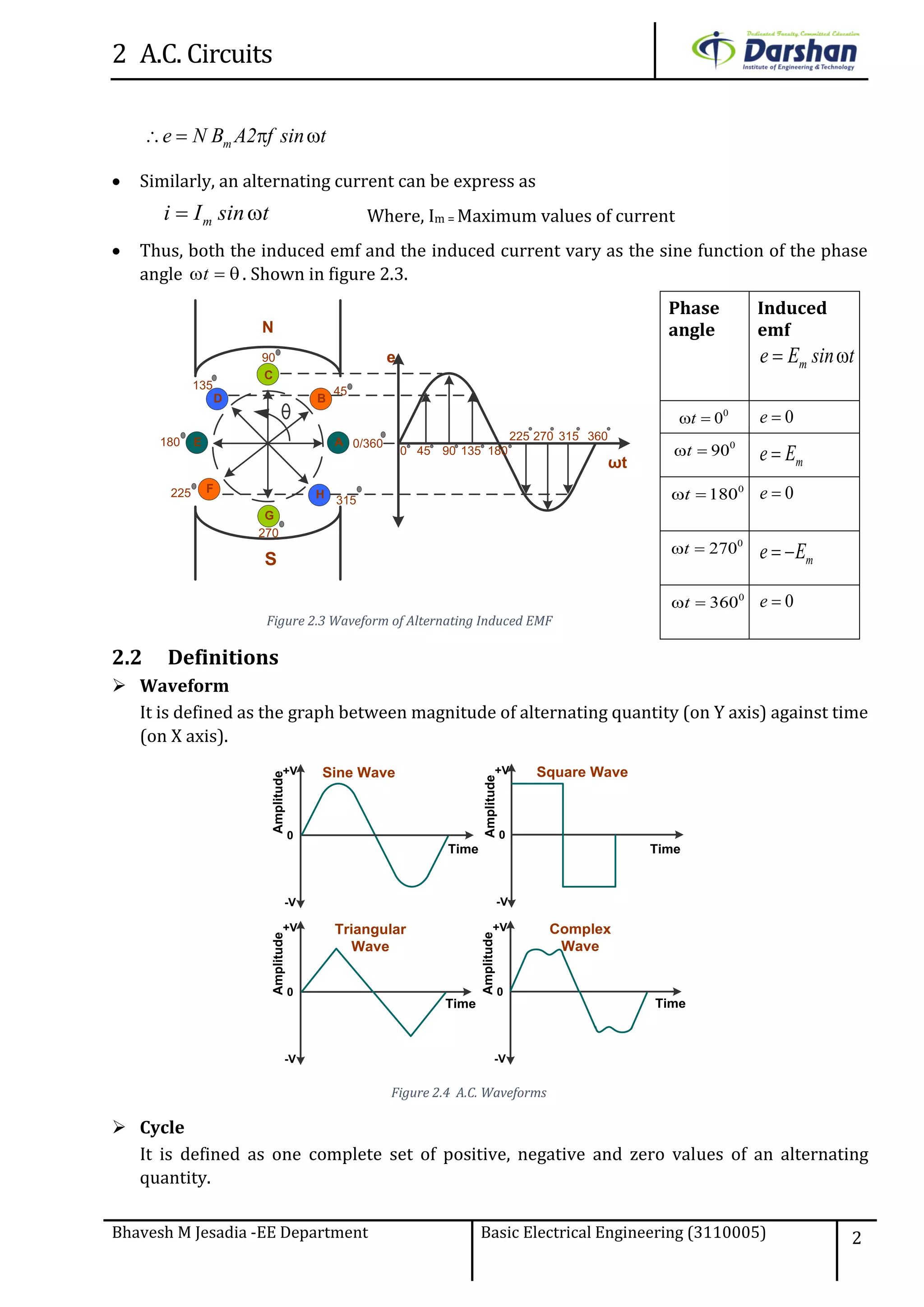
 Thus, both the induced emf and the induced current vary as the sine function of the phase
angle   t . Shown in figure 2.3.
A
B
C
D
E
F
G
H
0/360
45
90
135
180
225
270
315
0 45 90 135 180
225 270 315 360
S
N
e
ωt
Figure 2.3 Waveform of Alternating Induced EMF
Phase
angle
Induced
emf
 me E sin t
0
0 t 0e
0
90 t  me E
0
180 t 0e
0
270 t   me E
0
360 t 0e
2.2 Definitions
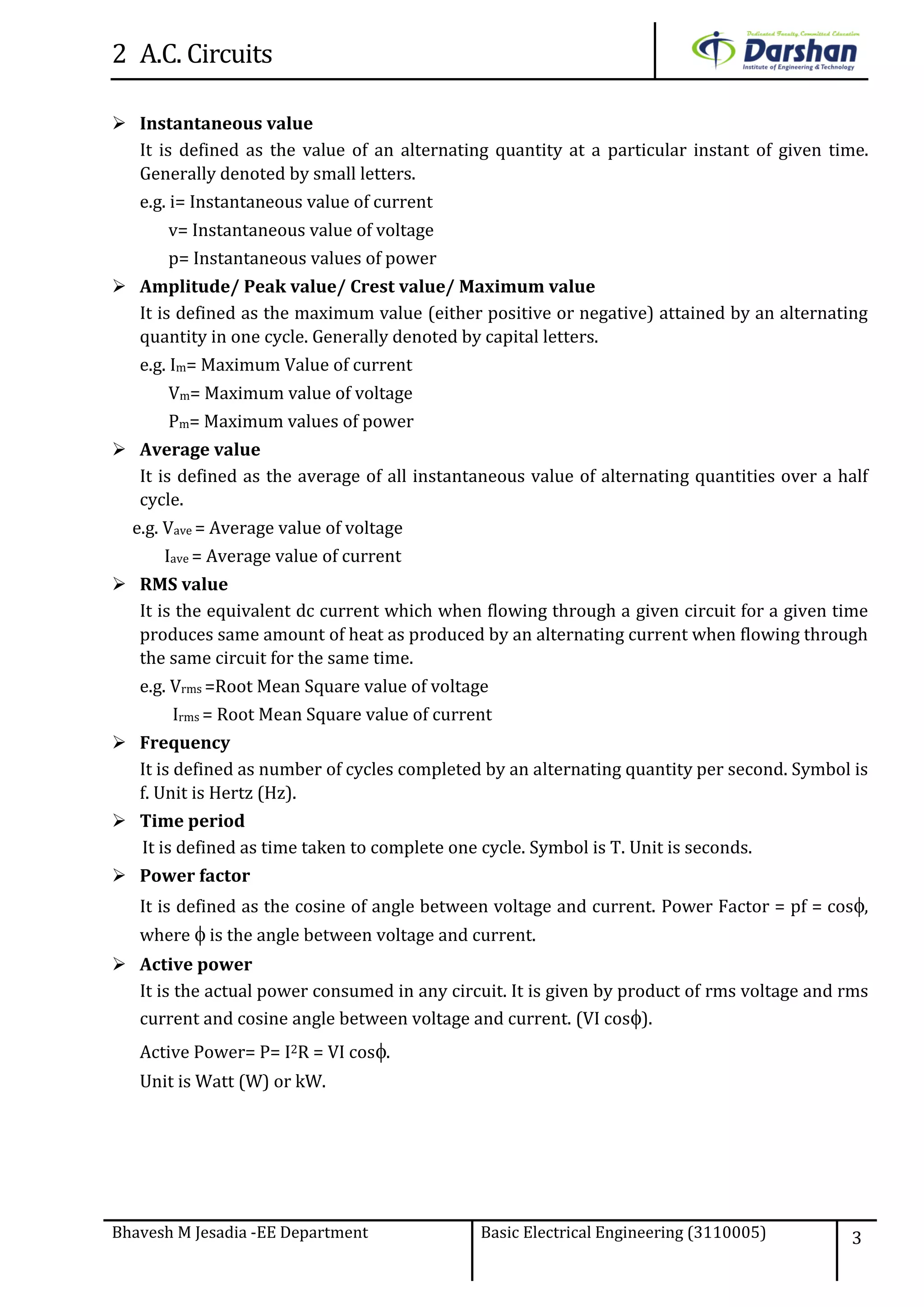
 Waveform
It is defined as the graph between magnitude of alternating quantity (on Y axis) against time
(on X axis).
Sine Wave
Amplitude
0
+V
-V
Time
Triangular
Wave
Amplitude
0
+V
-V
Time
Square Wave
Amplitude
0
+V
-V
Time
Complex
Wave
Amplitude
0
+V
-V
Time
Figure 2.4 A.C. Waveforms
 Cycle
It is defined as one complete set of positive, negative and zero values of an alternating
quantity.
me N B A2 f sin t   
2 A.C. Circuits
Bhavesh M Jesadia -EE Department Basic Electrical Engineering (3110005) 3
 Instantaneous value
It is defined as the value of an alternating quantity at a particular instant of given time.
Generally denoted by small letters.
e.g. i= Instantaneous value of current
v= Instantaneous value of voltage
p= Instantaneous values of power
 Amplitude/ Peak value/ Crest value/ Maximum value
It is defined as the maximum value (either positive or negative) attained by an alternating
quantity in one cycle. Generally denoted by capital letters.
e.g. Im= Maximum Value of current
Vm= Maximum value of voltage
Pm= Maximum values of power
 Average value
It is defined as the average of all instantaneous value of alternating quantities over a half
cycle.
e.g. Vave = Average value of voltage
Iave = Average value of current
 RMS value
It is the equivalent dc current which when flowing through a given circuit for a given time
produces same amount of heat as produced by an alternating current when flowing through
the same circuit for the same time.
e.g. Vrms =Root Mean Square value of voltage
Irms = Root Mean Square value of current
 Frequency
It is defined as number of cycles completed by an alternating quantity per second. Symbol is
f. Unit is Hertz (Hz).
 Time period
It is defined as time taken to complete one cycle. Symbol is T. Unit is seconds.
 Power factor
It is defined as the cosine of angle between voltage and current. Power Factor = pf = cos,
where  is the angle between voltage and current.
 Active power
It is the actual power consumed in any circuit. It is given by product of rms voltage and rms
current and cosine angle between voltage and current. (VI cos).
Active Power= P= I2R = VI cos.
Unit is Watt (W) or kW.
2 A.C. Circuits
Bhavesh M Jesadia -EE Department Basic Electrical Engineering (3110005) 4
 Reactive power
The power drawn by the circuit due to reactive component of current is called as reactive
power. It is given by product of rms voltage and rms current and sine angle between voltage
and current (VI sin).
Reactive Power = Q= I2X = VIsin.
Unit is VAR or kVAR.
 Apparent power
It is the product of rms value of voltage and rms value of current. It is total power supplied
to the circuit.
Apparent Power = S = VI.
Unit is VA or kVA.
 Peak factor/ Crest factor
It is defined as the ratio of peak value (crest value or maximum value) to rms value of an
alternating quantity.
Peak factor = Kp = 1.414 for sine wave.
 Form factor
It is defined as the ratio of rms value to average value of an alternating quantity. Denoted by
Kf. Form factor Kf = 1.11 for sine wave.
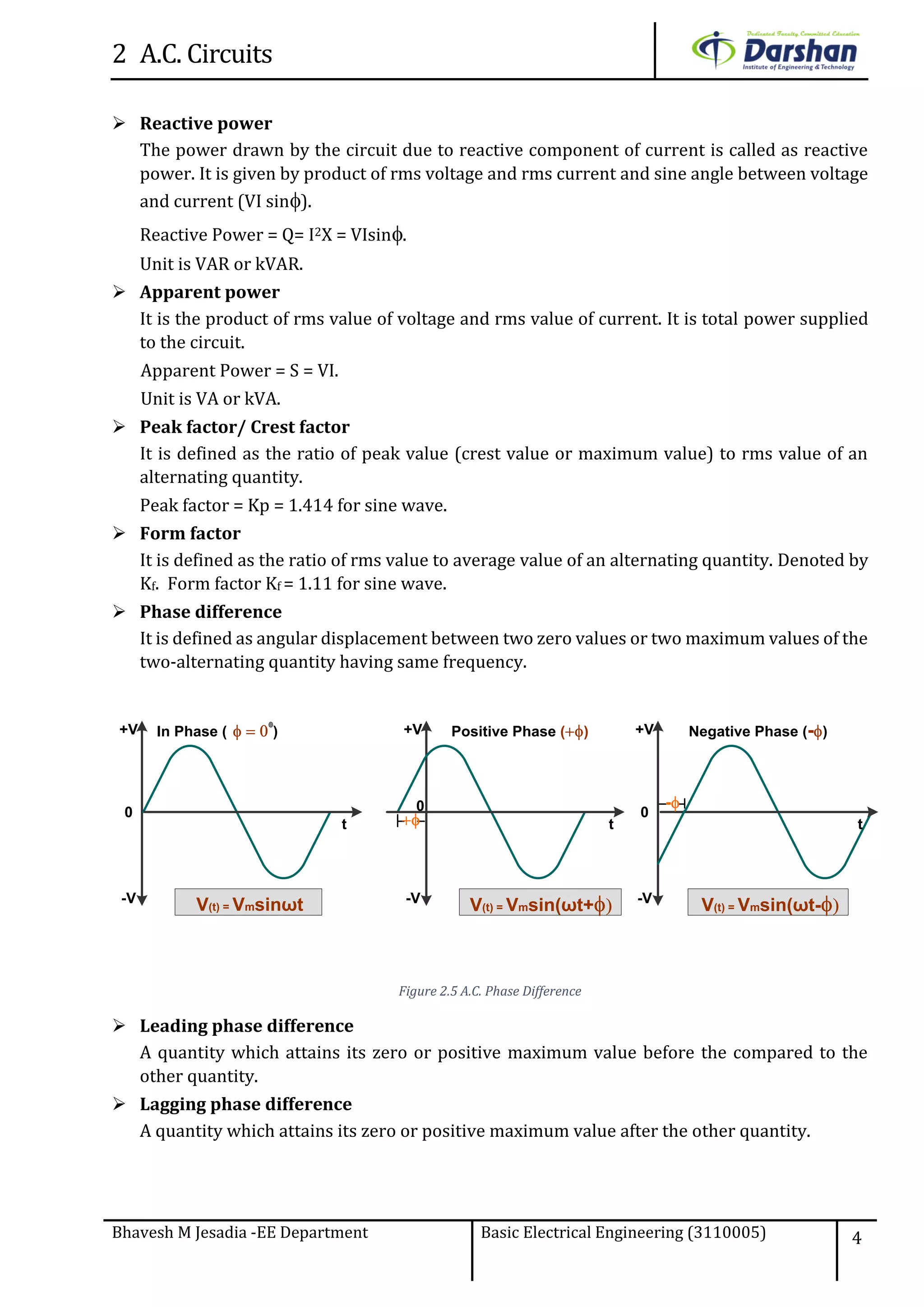
 Phase difference
It is defined as angular displacement between two zero values or two maximum values of the
two-alternating quantity having same frequency.
In Phase (  )
0
+V
-V
t
V(t) = Vmsinωt
Positive Phase ()
0
+V
-V
t
V(t) = Vmsin(ωt+

Negative Phase (-)
0
+V
-V
t
V(t) = Vmsin(ωt-
-
Figure 2.5 A.C. Phase Difference
 Leading phase difference
A quantity which attains its zero or positive maximum value before the compared to the
other quantity.
 Lagging phase difference
A quantity which attains its zero or positive maximum value after the other quantity.
2 A.C. Circuits
Bhavesh M Jesadia -EE Department Basic Electrical Engineering (3110005) 5
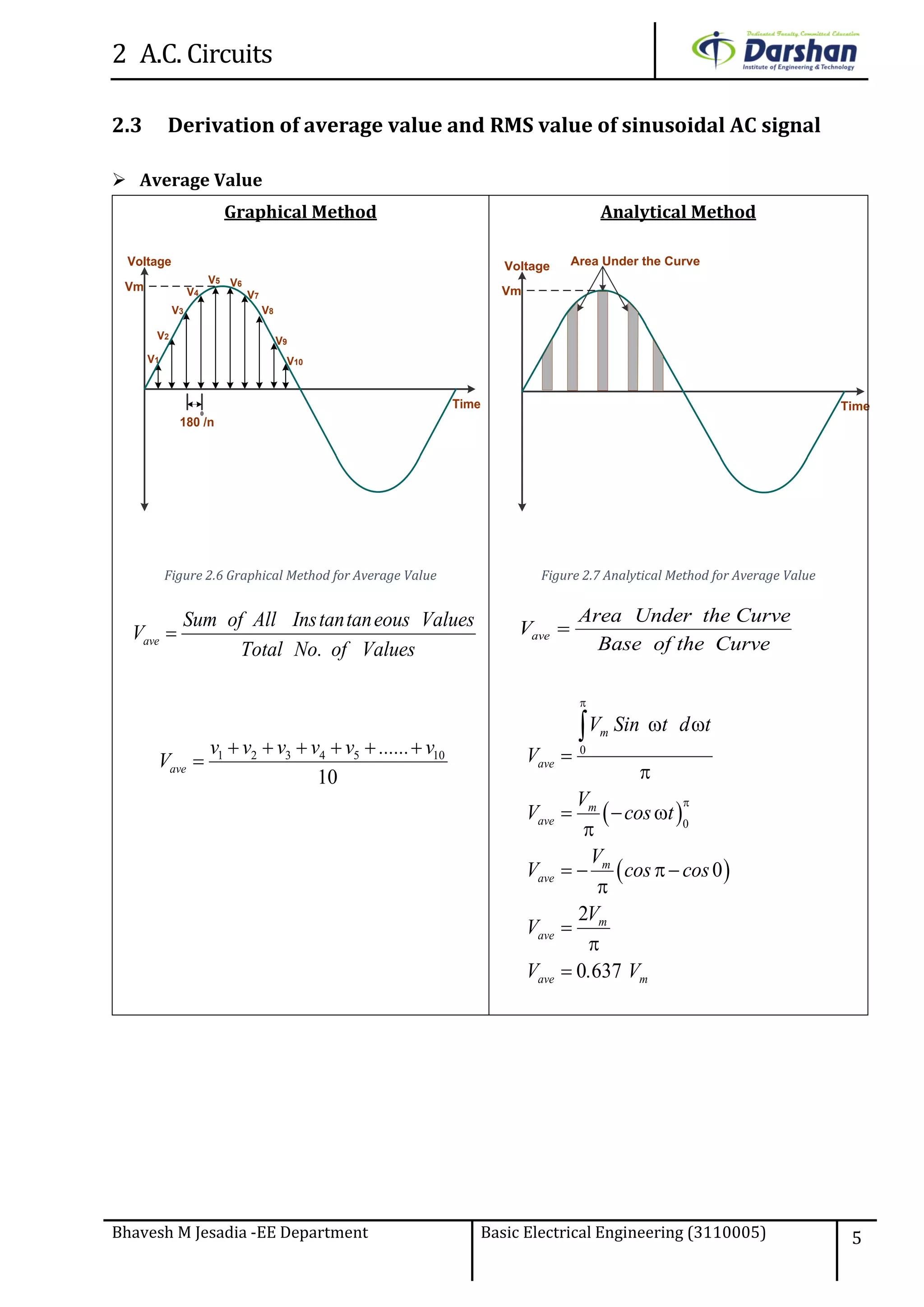
2.3 Derivation of average value and RMS value of sinusoidal AC signal
 Average Value
Graphical Method
V1
Voltage
Time
Vm
V2
V3
V4
V5 V6
V7
V8
V9
V10
180 /n
Figure 2.6 Graphical Method for Average Value
Analytical Method
Area Under the CurveVoltage
Time
Vm
Figure 2.7 Analytical Method for Average Value
 
 
0
0
0
2
0 637
m
ave
m
ave
m
ave
m
ave
ave m
V Sin t d t
V
V
V cos t
V
V cos cos
V
V
V . V


 


  

  





1 2 3 4 5 10
10
     
ave
v v v v v ...... v
V
ave
Area Under the Curve
V
Base of the Curve

ave
Sum of All Instantaneous Values
V
Total No. of Values

2 A.C. Circuits
Bhavesh M Jesadia -EE Department Basic Electrical Engineering (3110005) 6
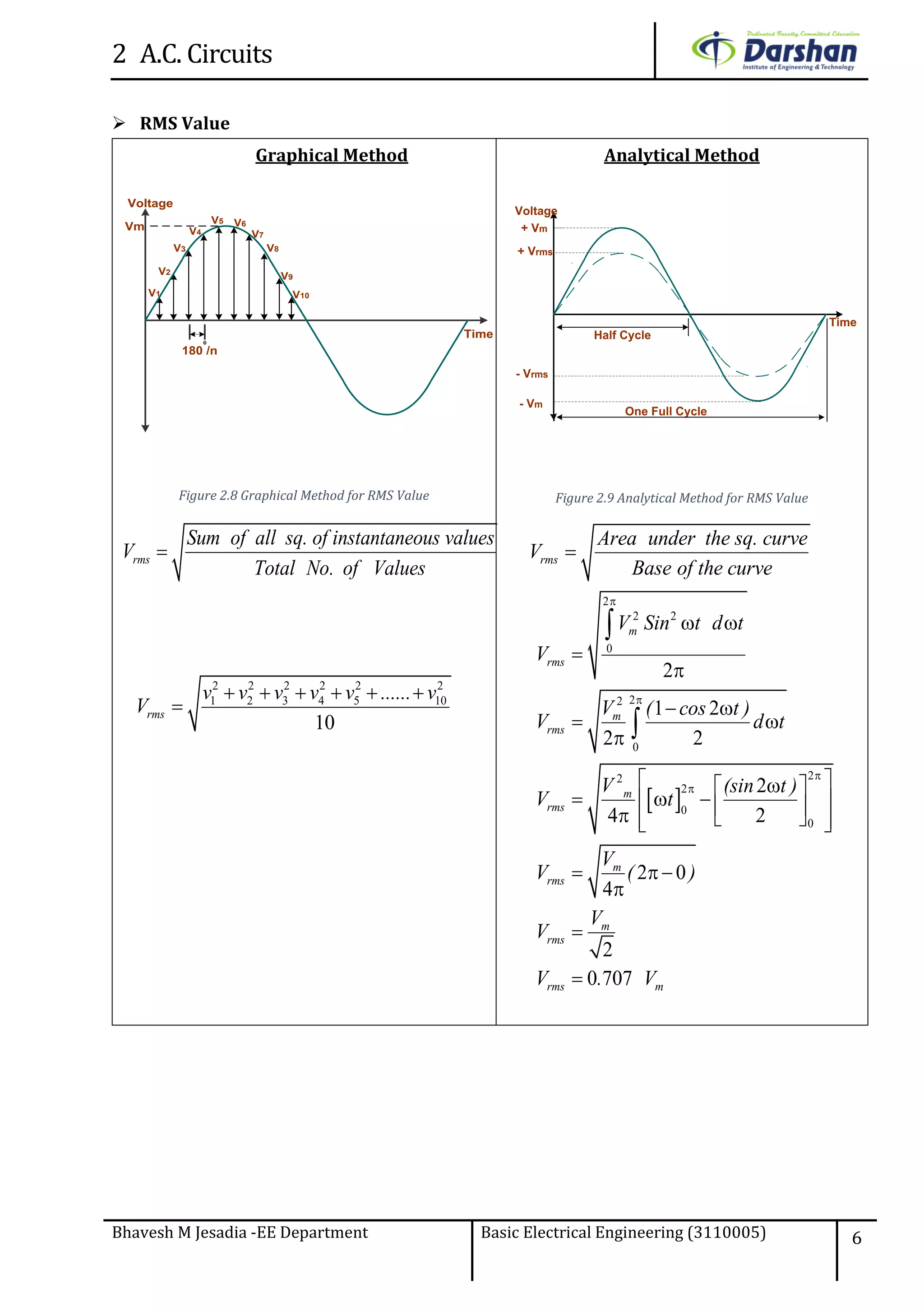
 RMS Value
Graphical Method
V1
Voltage
Time
Vm
V2
V3
V4
V5 V6
V7
V8
V9
V10
180 /n
Figure 2.8 Graphical Method for RMS Value
rms
Sum of all sq. of instantaneous values
V
Total No. of Values
Analytical Method
+ Vm
Time
+ Vrms
- Vrms
- Vm
Half Cycle
One Full Cycle
Voltage
Figure 2.9 Analytical Method for RMS Value
2 2 2 2 2 2
1 2 3 4 5 10
10
     
rms
v v v v v ...... v
V
rms
Area under the sq. curve
V
Base of the curve
 
2
2 2
0
22
0
22
2
0
0
2
1 2
2 2
2
4 2
2 0
4
2
0 707




 


 
 

  
        
 





m
rms
m
rms
m
rms
m
rms
m
rms
rms m
V Sin t d t
V
V ( cos t )
V d t
V (sin t )
V t
V
V ( )
V
V
V . V
2 A.C. Circuits
Bhavesh M Jesadia -EE Department Basic Electrical Engineering (3110005) 7
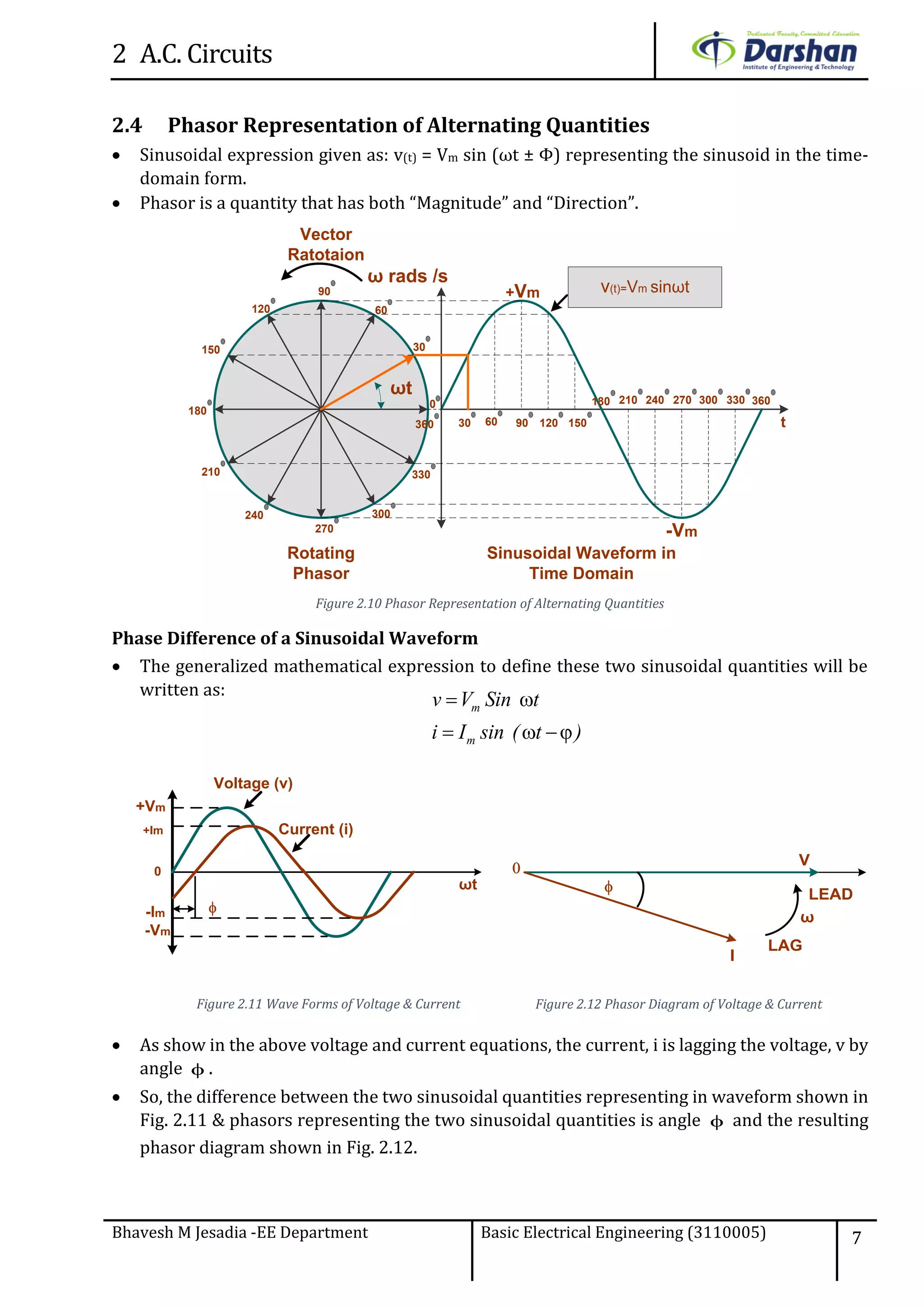
2.4 Phasor Representation of Alternating Quantities
 Sinusoidal expression given as: v(t) = Vm sin (ωt ± Φ) representing the sinusoid in the time-
domain form.
 Phasor is a quantity that has both “Magnitude” and “Direction”.
0
60
90
120
150
180
210
240
270
300
330
360
30
30 60 90 120 150
180 210 240 270 300 330 360
t
+Vm
ωt
Vector
Ratotaion
Rotating
Phasor
-Vm
Sinusoidal Waveform in
Time Domain
v(t)=Vm sinωt
ω rads /s
Figure 2.10 Phasor Representation of Alternating Quantities
Phase Difference of a Sinusoidal Waveform
 The generalized mathematical expression to define these two sinusoidal quantities will be
written as:
Voltage (v)
Current (i)
+Vm
+Im
-Vm
-Im
0
ωt

Figure 2.11 Wave Forms of Voltage & Current

V
II
LAG
LEAD
ω

Figure 2.12 Phasor Diagram of Voltage & Current
 As show in the above voltage and current equations, the current, i is lagging the voltage, v by
angle  .
 So, the difference between the two sinusoidal quantities representing in waveform shown in
Fig. 2.11 & phasors representing the two sinusoidal quantities is angle  and the resulting
phasor diagram shown in Fig. 2.12.
m
m
v V Sin t
i I sin ( t )
 
  
2 A.C. Circuits
Bhavesh M Jesadia -EE Department Basic Electrical Engineering (3110005) 8
2.5 Purely Resistive Circuit
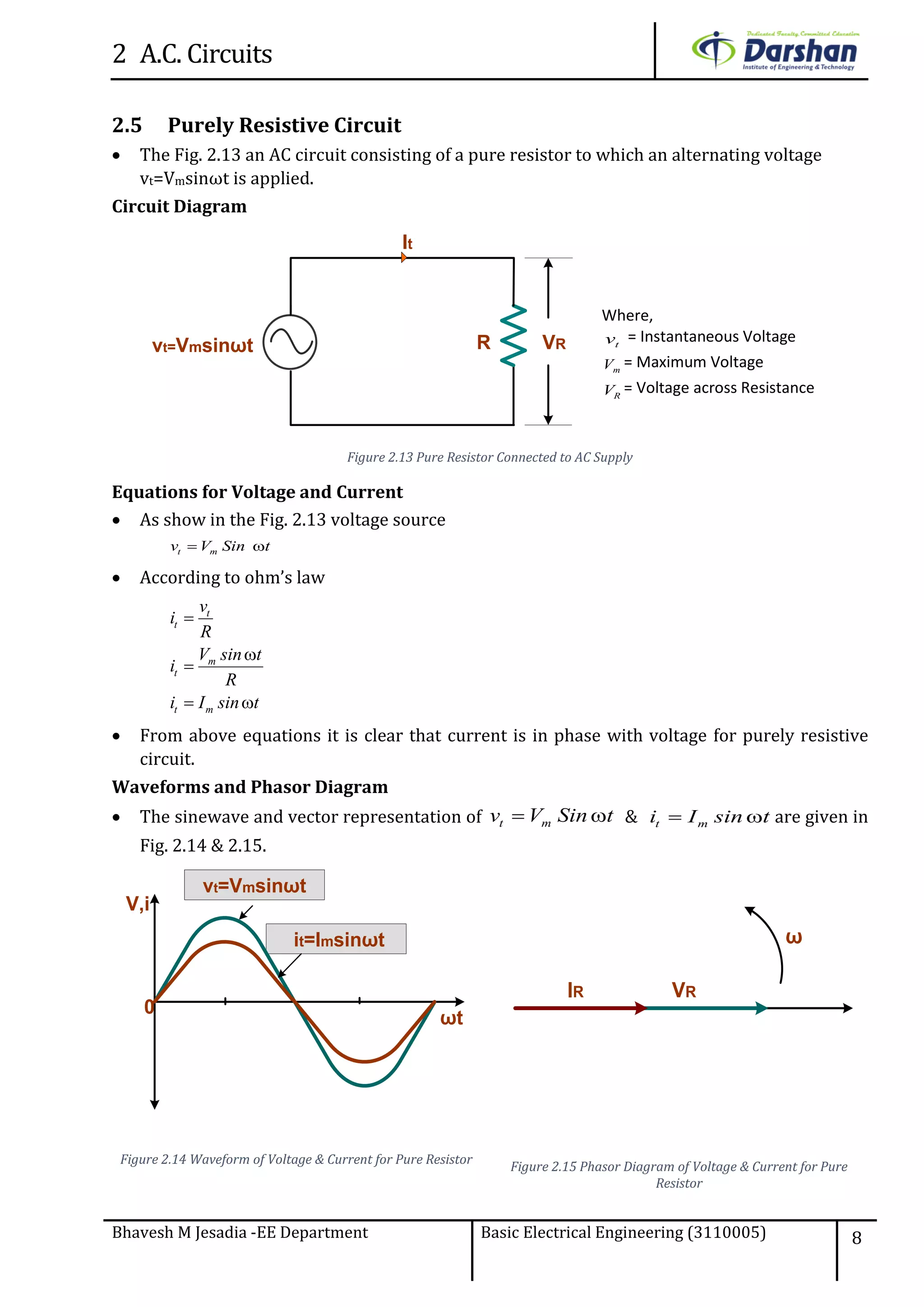
 The Fig. 2.13 an AC circuit consisting of a pure resistor to which an alternating voltage
vt=Vmsinωt is applied.
Circuit Diagram
VR
It
vt=Vmsinωt R
Where,
tv = Instantaneous Voltage
mV = Maximum Voltage
RV = Voltage across Resistance
Figure 2.13 Pure Resistor Connected to AC Supply
Equations for Voltage and Current
 As show in the Fig. 2.13 voltage source
t mv V Sin t 
 According to ohm’s law



 
t
t
m
t
t m
v
i
R
V sin t
i
R
i I sin t
 From above equations it is clear that current is in phase with voltage for purely resistive
circuit.
Waveforms and Phasor Diagram
 The sinewave and vector representation of  t mv V Sin t & t mi I sin t  are given in
Fig. 2.14 & 2.15.
0
ωt
V,i
vt=Vmsinωt
it=Imsinωt
Figure 2.14 Waveform of Voltage & Current for Pure Resistor
IR VR
ω
Figure 2.15 Phasor Diagram of Voltage & Current for Pure
Resistor
2 A.C. Circuits
Bhavesh M Jesadia -EE Department Basic Electrical Engineering (3110005) 9
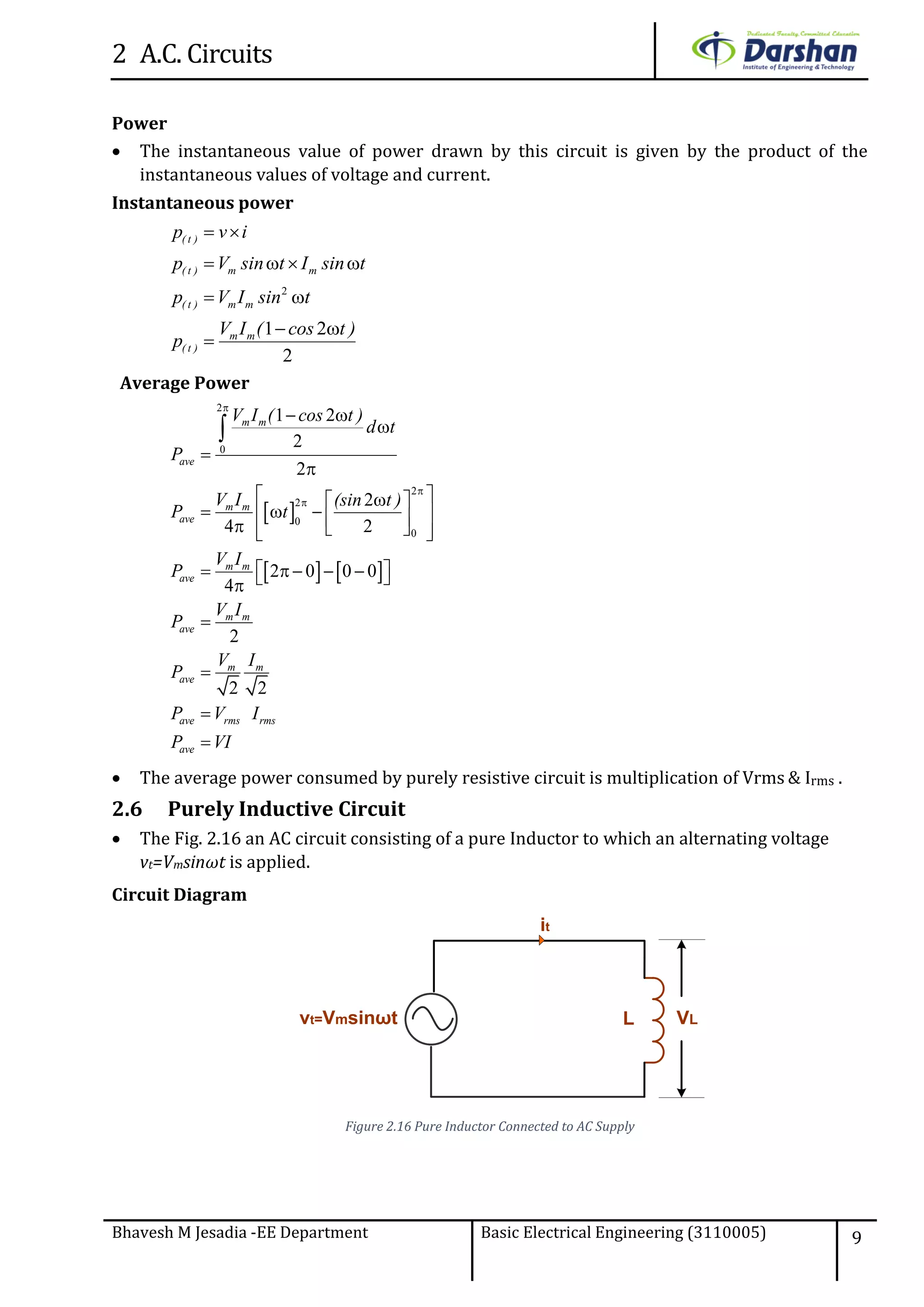
Power
 The instantaneous value of power drawn by this circuit is given by the product of the
instantaneous values of voltage and current.
Instantaneous power
2
1 2
2
 
   
 
 

( t )
( t ) m m
( t ) m m
m m
( t )
p v i
p V sin t I sin t
p V I sin t
V I ( cos t )
p
Average Power
 
   
2
0
2
2
0
0
1 2
2
2
2
4 2
2 0 0 0
4
2
2 2
m m
ave
m m
ave
m m
ave
m m
ave
m m
ave
ave rms rms
ave
V I ( cos t )
d t
P
V I (sin t )
P t
V I
P
V I
P
V I
P
P V I
P VI



 



  
        
      





 The average power consumed by purely resistive circuit is multiplication of Vrms & Irms .
2.6 Purely Inductive Circuit
 The Fig. 2.16 an AC circuit consisting of a pure Inductor to which an alternating voltage
vt=Vmsinωt is applied.
Circuit Diagram
VL
it
vt=Vmsinωt L
Figure 2.16 Pure Inductor Connected to AC Supply
2 A.C. Circuits
Bhavesh M Jesadia -EE Department Basic Electrical Engineering (3110005) 10
Equations for Voltage and Current
 As show in the Fig. 2.16 voltage source
t mv V Sin t 
 Due to self-inductance of the coil, there will be emf indued in it. This back emf will oppose
the instantaneous rise or fall of current through the coil, it is given by
b
di
e -L
dt

 As, circuit does not contain any resistance, there is no ohmic drop and hence applied voltage
is equal and opposite to back emf.

 
   
 

 


t b
t
t
m
m
v -e
di
v L
dt
di
v L
dt
di
V sin t L
dt
V sin t dt
di
L
 Integrate on both the sides,
mV
di sin t dt
L
  
  
  
 
m
t
V cos t
i
L
  

m
t
V
i cos t
L
 90
 
     
m
t m m
V
i I sin t I
L
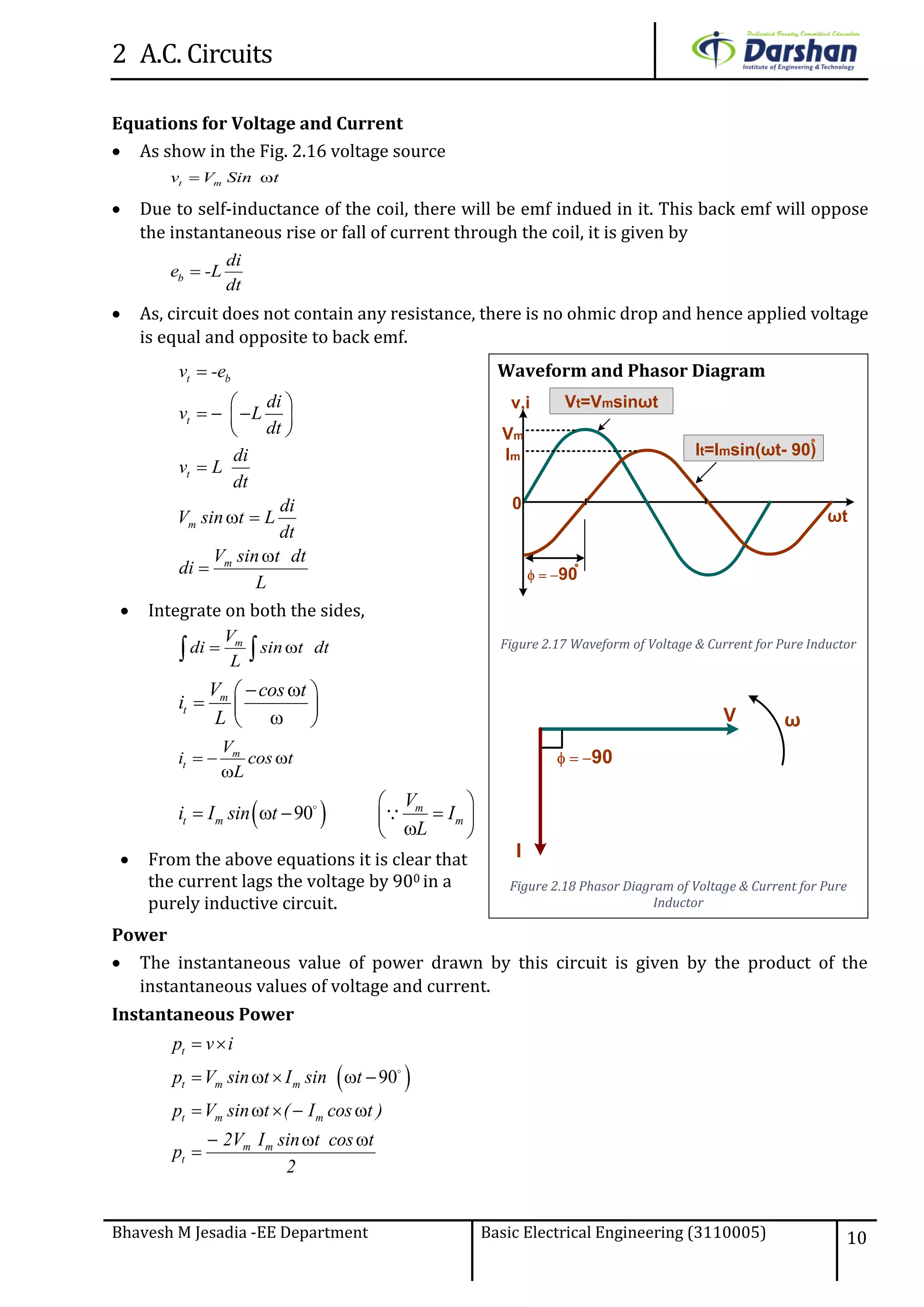
 From the above equations it is clear that
the current lags the voltage by 900 in a
purely inductive circuit.
Waveform and Phasor Diagram
0
ωt
v,i Vt=Vmsinωt
It=Imsin(ωt- 90)
90
Vm
Im
Figure 2.17 Waveform of Voltage & Current for Pure Inductor
V ω
I
90
Figure 2.18 Phasor Diagram of Voltage & Current for Pure
Inductor
Power
 The instantaneous value of power drawn by this circuit is given by the product of the
instantaneous values of voltage and current.
Instantaneous Power
 90
 
    
    
  

t
t m m
t m m
m m
t
p v i
p V sin t I sin t
p V sin t ( I cos t )
2V I sin t cos t
p
2
2 A.C. Circuits
Bhavesh M Jesadia -EE Department Basic Electrical Engineering (3110005) 11
2
2
  m m
t
V I
p sin t
Average Power
 
2
0
2
0
2
2
2
2
4 2
4 0
8
0


 
 

  
     
  


 m m
ave
m m
ave
m m
ave
ave
V I
sin t
P d t
V I cos t
P
V I
P cos cos
P
 The average power consumed by purely inductive circuit is zero.
2.7 Purely Capacitive Circuit
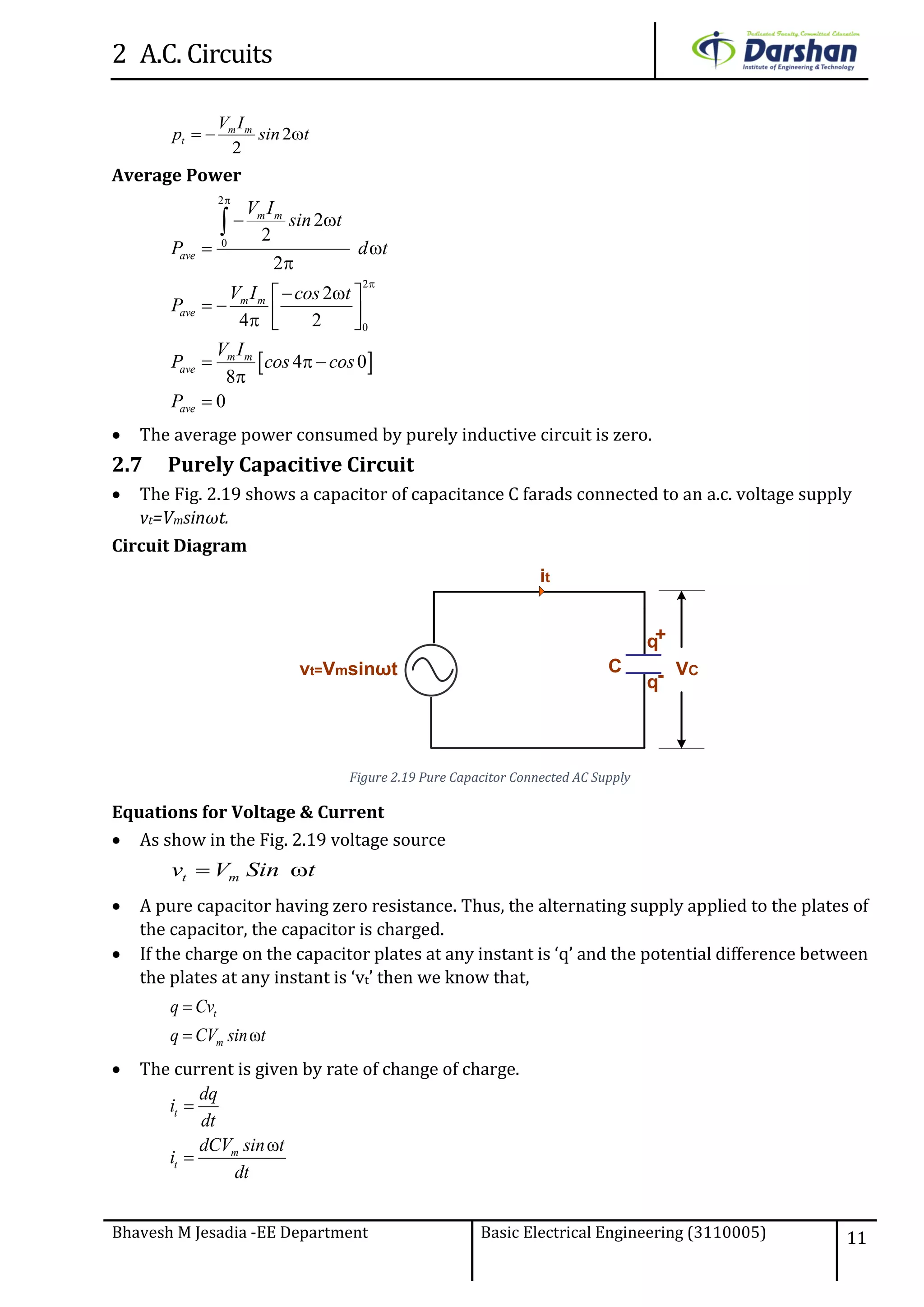
 The Fig. 2.19 shows a capacitor of capacitance C farads connected to an a.c. voltage supply
vt=Vmsinωt.
Circuit Diagram
VC
it
vt=Vmsinωt C
q
q
+
-
Figure 2.19 Pure Capacitor Connected AC Supply
Equations for Voltage & Current
 As show in the Fig. 2.19 voltage source
 t mv V Sin t
 A pure capacitor having zero resistance. Thus, the alternating supply applied to the plates of
the capacitor, the capacitor is charged.
 If the charge on the capacitor plates at any instant is ‘q’ and the potential difference between
the plates at any instant is ‘vt’ then we know that,

 
t
m
q Cv
q CV sin t
 The current is given by rate of change of charge.



t
m
t
dq
i
dt
dCV sin t
i
dt
2 A.C. Circuits
Bhavesh M Jesadia -EE Department Basic Electrical Engineering (3110005) 12
1
90
  
 

 
   
t m
m
t
m
t
c
o m
t m m
c
i CV sin t
V
i cos t
/ C
V
i cos t
X
V
i I sin( t ) ( I )
X
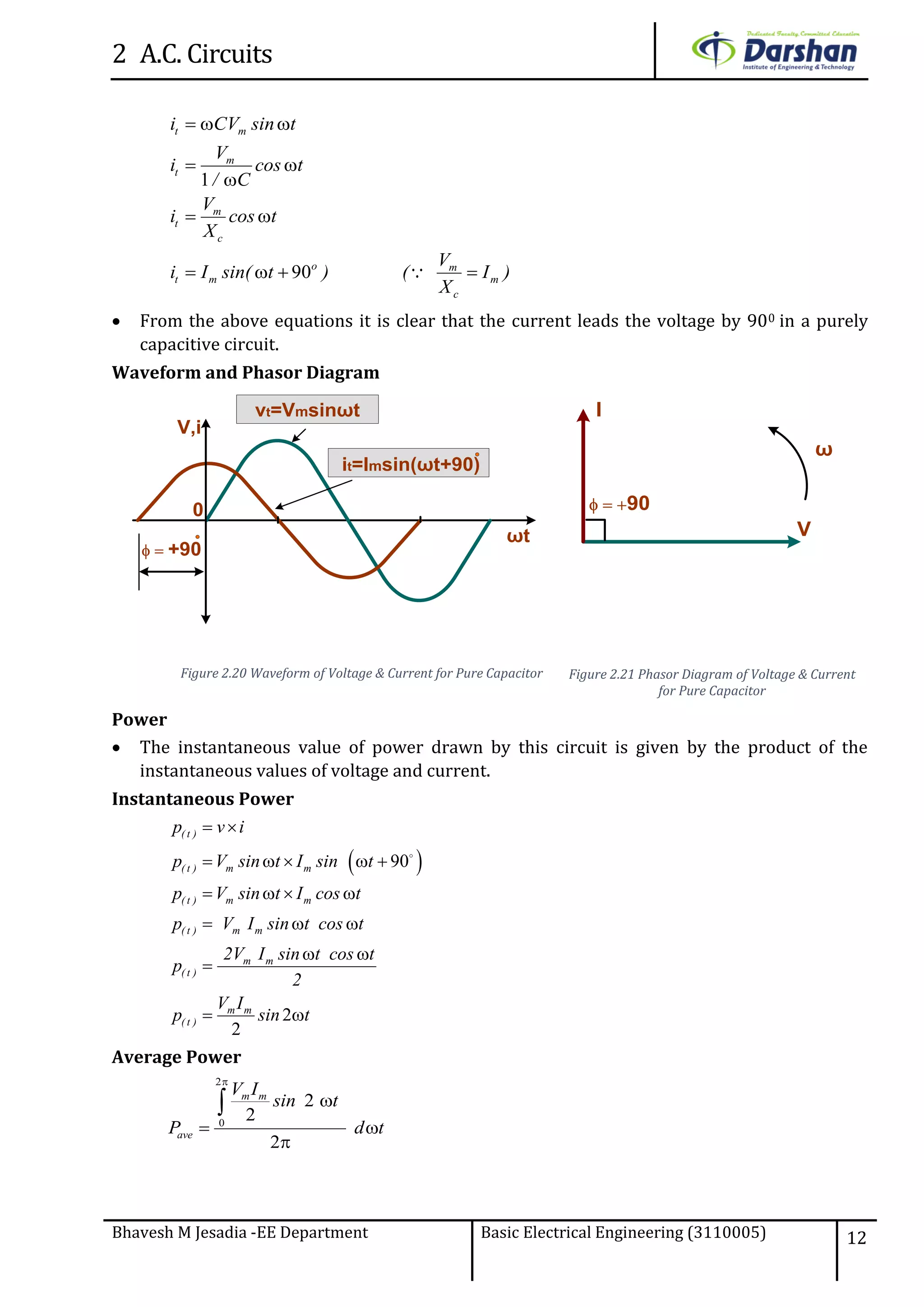
 From the above equations it is clear that the current leads the voltage by 900 in a purely
capacitive circuit.
Waveform and Phasor Diagram
0
ωt
V,i
vt=Vmsinωt
it=Imsin(ωt+90)
+90
Figure 2.20 Waveform of Voltage & Current for Pure Capacitor
V
ω
I
90
Figure 2.21 Phasor Diagram of Voltage & Current
for Pure Capacitor
Power
 The instantaneous value of power drawn by this circuit is given by the product of the
instantaneous values of voltage and current.
Instantaneous Power
 90
2
2
 
    
   
  
 

 
( t )
( t ) m m
( t ) m m
( t ) m m
m m
( t )
m m
( t )
p v i
p V sin t I sin t
p V sin t I cos t
p V I sin t cos t
2V I sin t cos t
p
2
V I
p sin t
Average Power
2
0
2
2
2


 

 m m
ave
V I
sin t
P d t
2 A.C. Circuits
Bhavesh M Jesadia -EE Department Basic Electrical Engineering (3110005) 13
 
2
04 2
4 0
8
0

  
    
   


m m
ave
m m
ave
ave
V I cos t
P
V I
P cos cos
P
 The average power consumed by purely capacitive circuit is zero.
2.8 Series Resistance-Inductance (R-L) Circuit
 Consider a circuit consisting of a resistor of resistance R ohms and a purely inductive coil of
inductance L henry in series as shown in the Figure 2.22.
vt=Vmsinωt
it
VLVR
R L
Figure 2.22 Circuit Diagram of Series R-L Circuit
 In the series circuit, the current it flowing through R and L will be the same.
 But the voltage across them will be different. The vector sum of voltage across resistor VR
and voltage across inductor VL will be equal to supply voltage vt.
Waveforms and Phasor Diagram
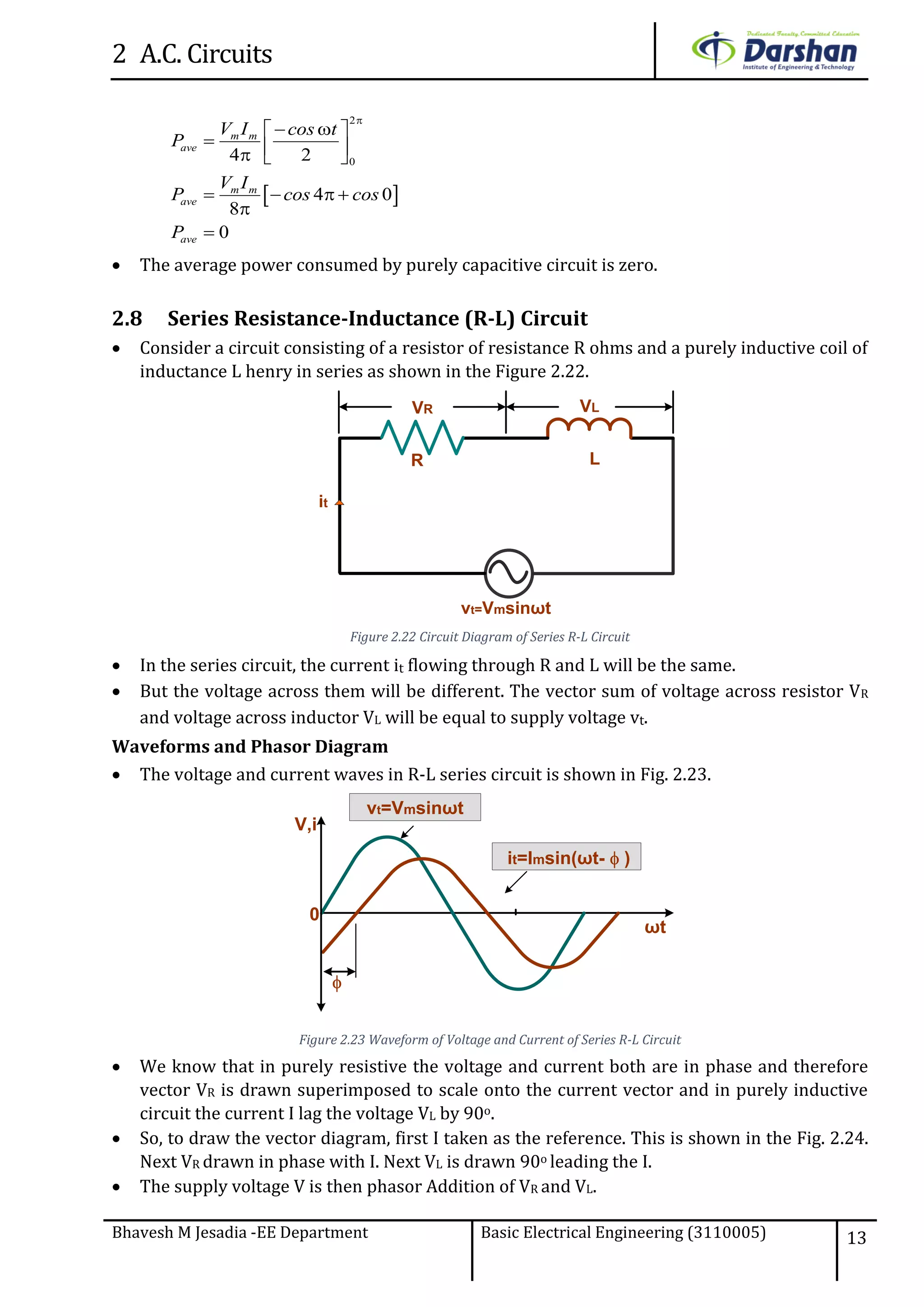
 The voltage and current waves in R-L series circuit is shown in Fig. 2.23.
0
ωt
V,i
vt=Vmsinωt
it=Imsin(ωt- )

Figure 2.23 Waveform of Voltage and Current of Series R-L Circuit
 We know that in purely resistive the voltage and current both are in phase and therefore
vector VR is drawn superimposed to scale onto the current vector and in purely inductive
circuit the current I lag the voltage VL by 90o.
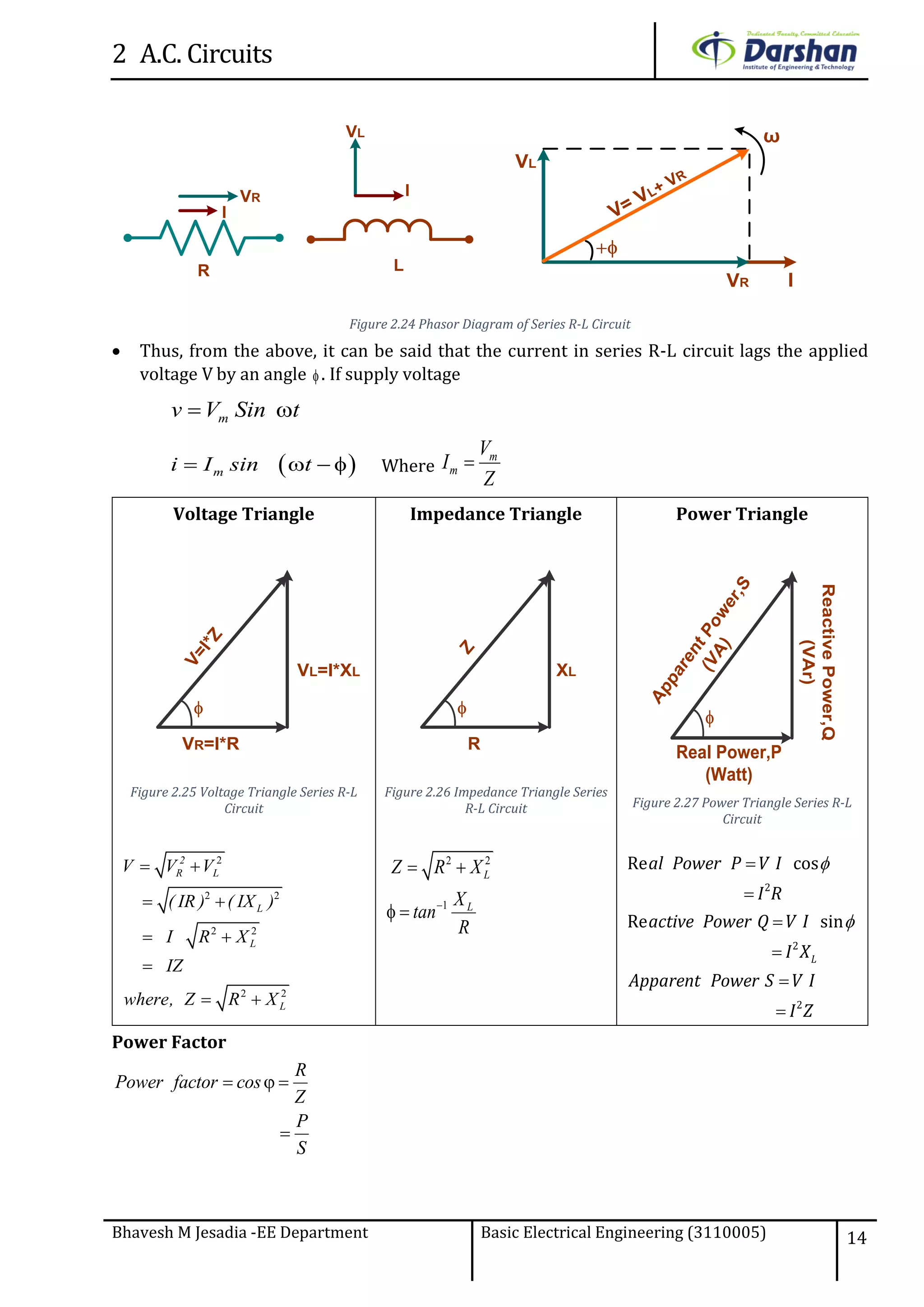
 So, to draw the vector diagram, first I taken as the reference. This is shown in the Fig. 2.24.
Next VR drawn in phase with I. Next VL is drawn 90o leading the I.
 The supply voltage V is then phasor Addition of VR and VL.
2 A.C. Circuits
Bhavesh M Jesadia -EE Department Basic Electrical Engineering (3110005) 14
R
VR
I
VL
I
L
VL
ω
IVR
V= VL+ VR

Figure 2.24 Phasor Diagram of Series R-L Circuit
 Thus, from the above, it can be said that the current in series R-L circuit lags the applied
voltage V by an angle  . If supply voltage
mv V Sin t 
    mi I sin t Where
m
m
V
I
Z

Voltage Triangle

VR=I*R
VL=I*XL
V=I*Z
Figure 2.25 Voltage Triangle Series R-L
Circuit
2
2 2
2 2
2 2
 
 
 

 
2
R L
L
L
L
V V V
( IR ) ( IX )
I R X
IZ
where, Z R X
Impedance Triangle

R
XL
Z
Figure 2.26 Impedance Triangle Series
R-L Circuit
2 2
1
 
 
L
L
Z R X
X
tan
R
Power Triangle

Real Power,P
(Watt)
ApparentPower,S
(VA)
ReactivePower,Q
(VAr)Figure 2.27 Power Triangle Series R-L
Circuit
2
2
2
Re cos
Re sin
L
al Power P V I
I R
active Power Q V I
I X
Apparent Power S V I
I Z








Power Factor
R
Power factor cos
Z
P
S
  

2 A.C. Circuits
Bhavesh M Jesadia -EE Department Basic Electrical Engineering (3110005) 15
Power
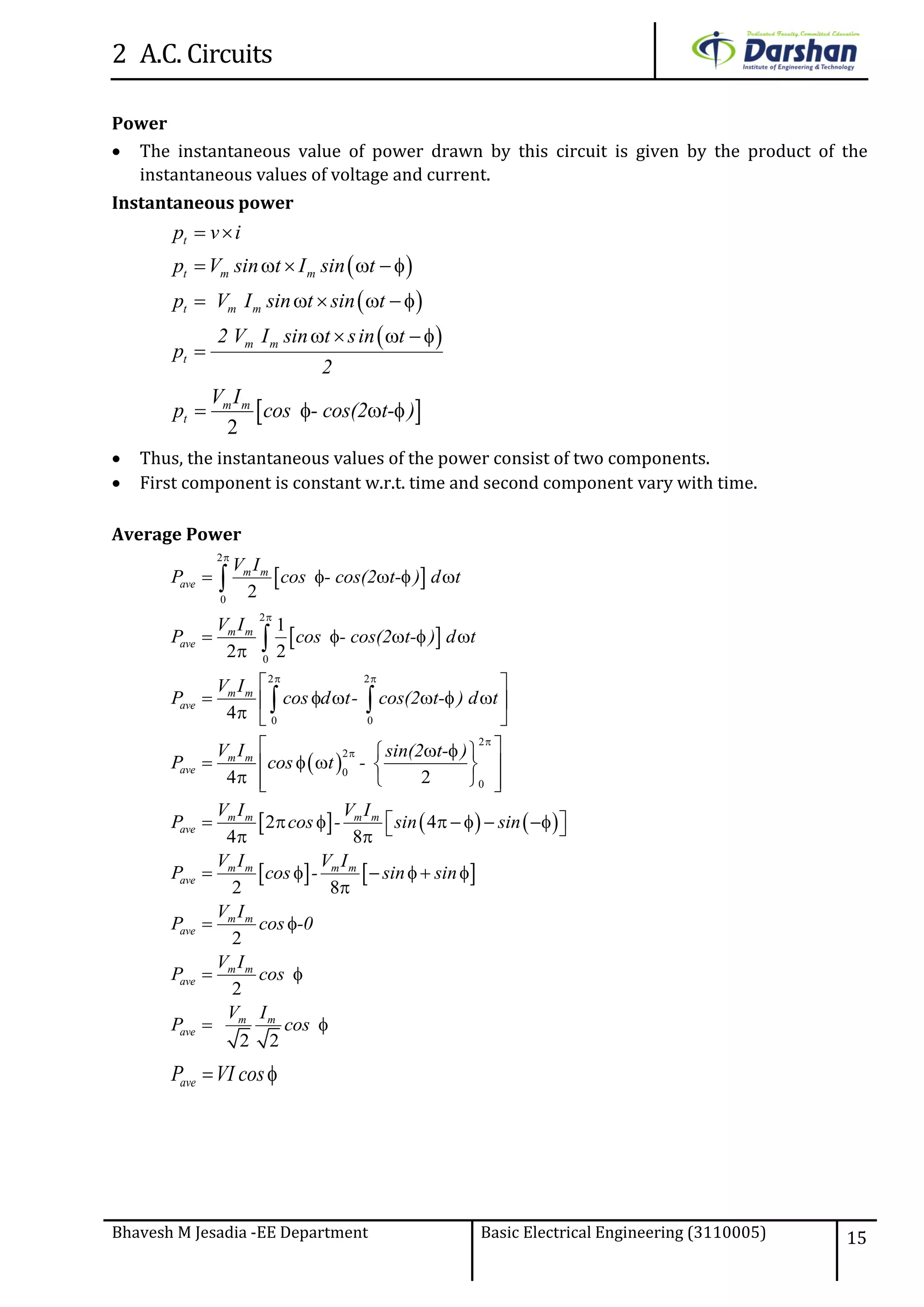
 The instantaneous value of power drawn by this circuit is given by the product of the
instantaneous values of voltage and current.
Instantaneous power
 
 
 
 
    
    
   

t
t m m
t m m
m m
t
p v i
p V sin t I sin t
p V I sin t sin t
2 V I sin t sin t
p
2
 
2
   m m
t
V I
p cos - cos(2 t- )
 Thus, the instantaneous values of the power consist of two components.
 First component is constant w.r.t. time and second component vary with time.
Average Power
 
 
 
 
2
0
2
0
2 2
0 0
2
2
0
0
2
1
2 2
4
4 2
2 4
4 8


 


    
    

 
      
  
   
    
    
   
 


 
m m
ave
m m
ave
m m
ave
m m
ave
m m m m
ave
V I
P cos - cos(2 t- ) d t
V I
P cos - cos(2 t- ) d t
V I
P cos d t- cos(2 t- ) d t
V I sin(2 t- )
P cos t -
V I V I
P cos - sin   
   
2 8
2
2
2 2
     
     

 
 
 
m m m m
ave
m m
ave
m m
ave
m m
ave
sin
V I V I
P cos - sin sin
V I
P cos -0
V I
P cos
V I
P cos
 aveP VI cos
2 A.C. Circuits
Bhavesh M Jesadia -EE Department Basic Electrical Engineering (3110005) 16
2.9 Series Resistance-Capacitance Circuit
 Consider a circuit consisting of a resistor of resistance R ohms and a purely capacitive of
capacitance farad in series as in the Fig. 2.28.
vt=Vmsinωt
it
VCVR
R C
Figure 2.28 Circuit Diagram of Series R-C Circuit
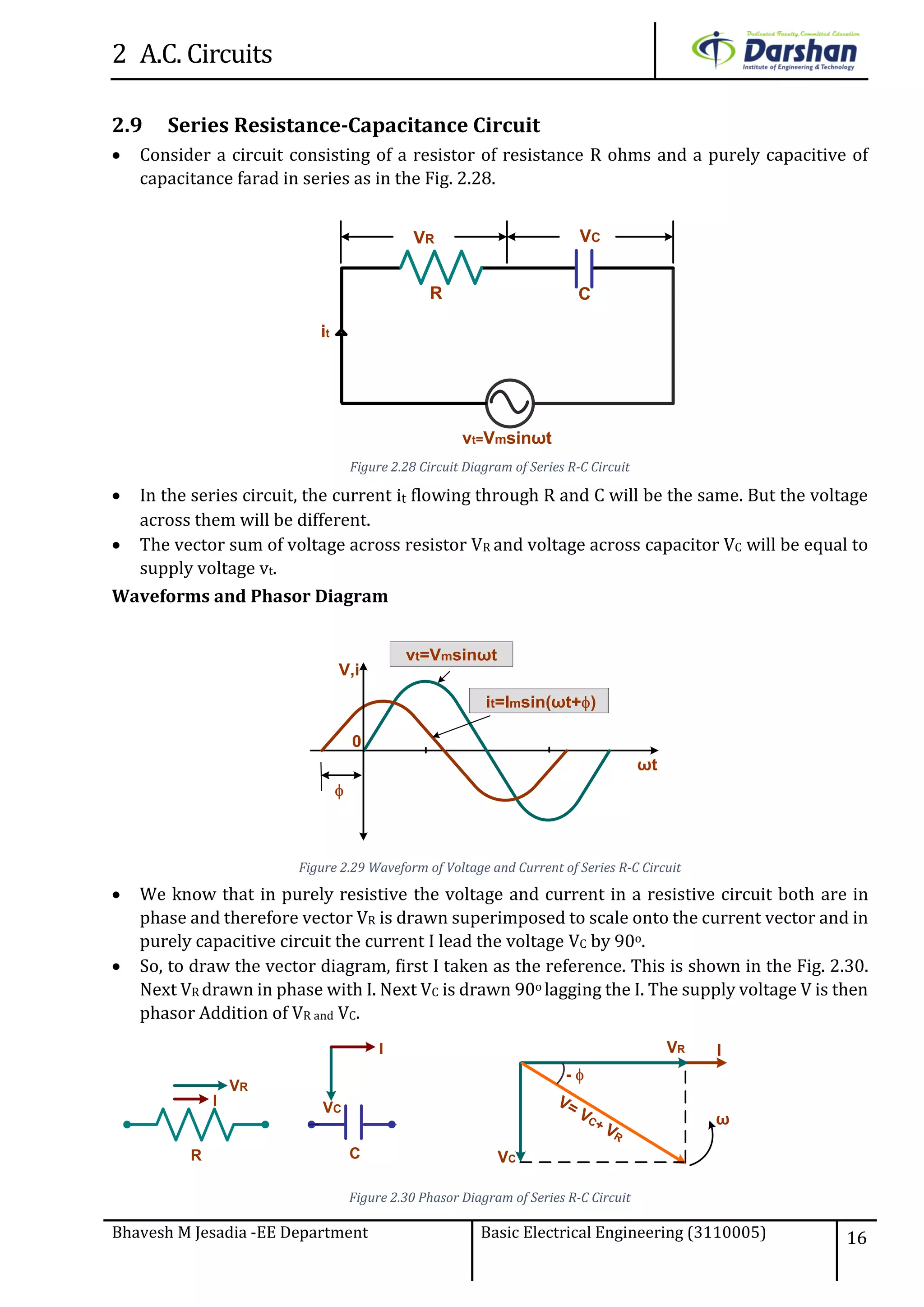
 In the series circuit, the current it flowing through R and C will be the same. But the voltage
across them will be different.
 The vector sum of voltage across resistor VR and voltage across capacitor VC will be equal to
supply voltage vt.
Waveforms and Phasor Diagram
0
ωt
V,i
vt=Vmsinωt
it=Imsin(ωt+)

Figure 2.29 Waveform of Voltage and Current of Series R-C Circuit
 We know that in purely resistive the voltage and current in a resistive circuit both are in
phase and therefore vector VR is drawn superimposed to scale onto the current vector and in
purely capacitive circuit the current I lead the voltage VC by 90o.
 So, to draw the vector diagram, first I taken as the reference. This is shown in the Fig. 2.30.
Next VR drawn in phase with I. Next VC is drawn 90o lagging the I. The supply voltage V is then
phasor Addition of VR and VC.
R
VR
I VC
I
C VC
ω
IVR
V= VC+ VR
- 
Figure 2.30 Phasor Diagram of Series R-C Circuit
2 A.C. Circuits
Bhavesh M Jesadia -EE Department Basic Electrical Engineering (3110005) 17
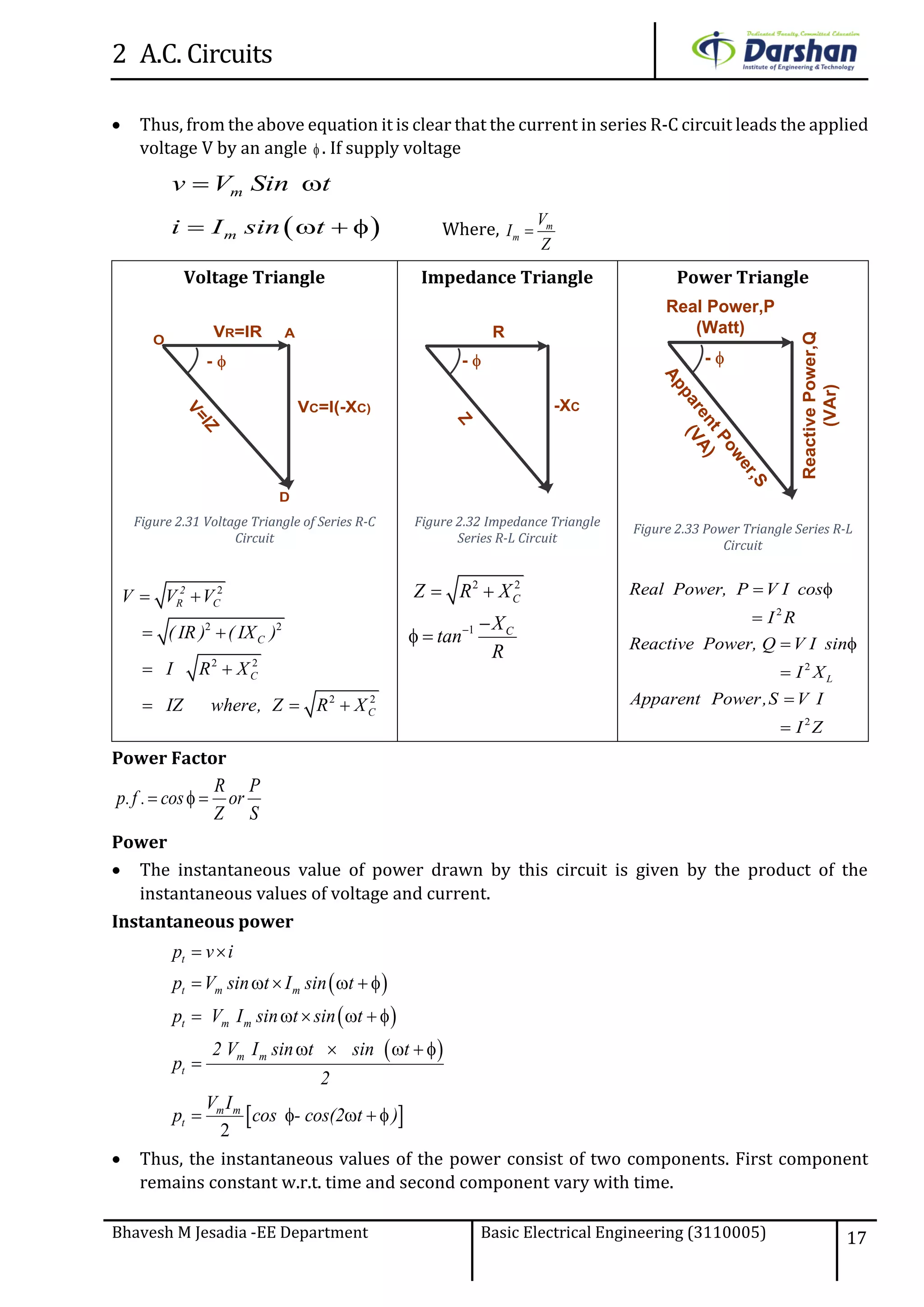
 Thus, from the above equation it is clear that the current in series R-C circuit leads the applied
voltage V by an angle  . If supply voltage
 mv V Sin t
    mi I sin t Where, m
m
V
I
Z

Voltage Triangle
O A
D
VR=IR
VC=I(-XC)
V=IZ
- 
Figure 2.31 Voltage Triangle of Series R-C
Circuit
2
2 2
2 2
2 2
 
 
 
  
2
R C
C
C
C
V V V
( IR ) ( IX )
I R X
IZ where, Z R X
Impedance Triangle
R
-XC
Z
- 
Figure 2.32 Impedance Triangle
Series R-L Circuit
2 2
1
 

 
C
C
Z R X
X
tan
R
Power Triangle
ApparentPower,S
(VA)
- 
ReactivePower,Q
(VAr)
Real Power,P
(Watt)
Figure 2.33 Power Triangle Series R-L
Circuit
2
2
2
 

 



L
Real Power, P V I cos
I R
Reactive Power, Q V I sin
I X
Apparent Power,S V I
I Z
Power Factor
  
R P
p.f . cos or
Z S
Power
 The instantaneous value of power drawn by this circuit is given by the product of the
instantaneous values of voltage and current.
Instantaneous power
 
 
 
 
2
 
     
     
    

    
t
t m m
t m m
m m
t
m m
t
p v i
p V sin t I sin t
p V I sin t sin t
2 V I sin t sin t
p
2
V I
p cos - cos(2 t )
 Thus, the instantaneous values of the power consist of two components. First component
remains constant w.r.t. time and second component vary with time.
2 A.C. Circuits
Bhavesh M Jesadia -EE Department Basic Electrical Engineering (3110005) 18
Average Power
 
 
 
 
2
0
2
0
2 2
0 0
2
2
0
0
2
1
2 2
4
4 2
2 0
4 8


 


    
    

 
      
  
   
    
    
     


 
m m
ave
m m
ave
m m
ave
m m
ave
m m m m
ave
V I
P cos - cos(2 t+ ) d t
V I
P cos - cos(2 t+ ) d t
V I
P cos d t- cos(2 t+ ) d t
V I sin(2 t+ )
P cos t -
V I V I
P cos -    
   
4
2 8
2
2 2
      
   

 
 
 
m m m m
ave
m m
ave
m m
ave
ave
sin sin
V I V I
P cos - sin sin
V I
P cos -0
V I
P cos
P VI cos
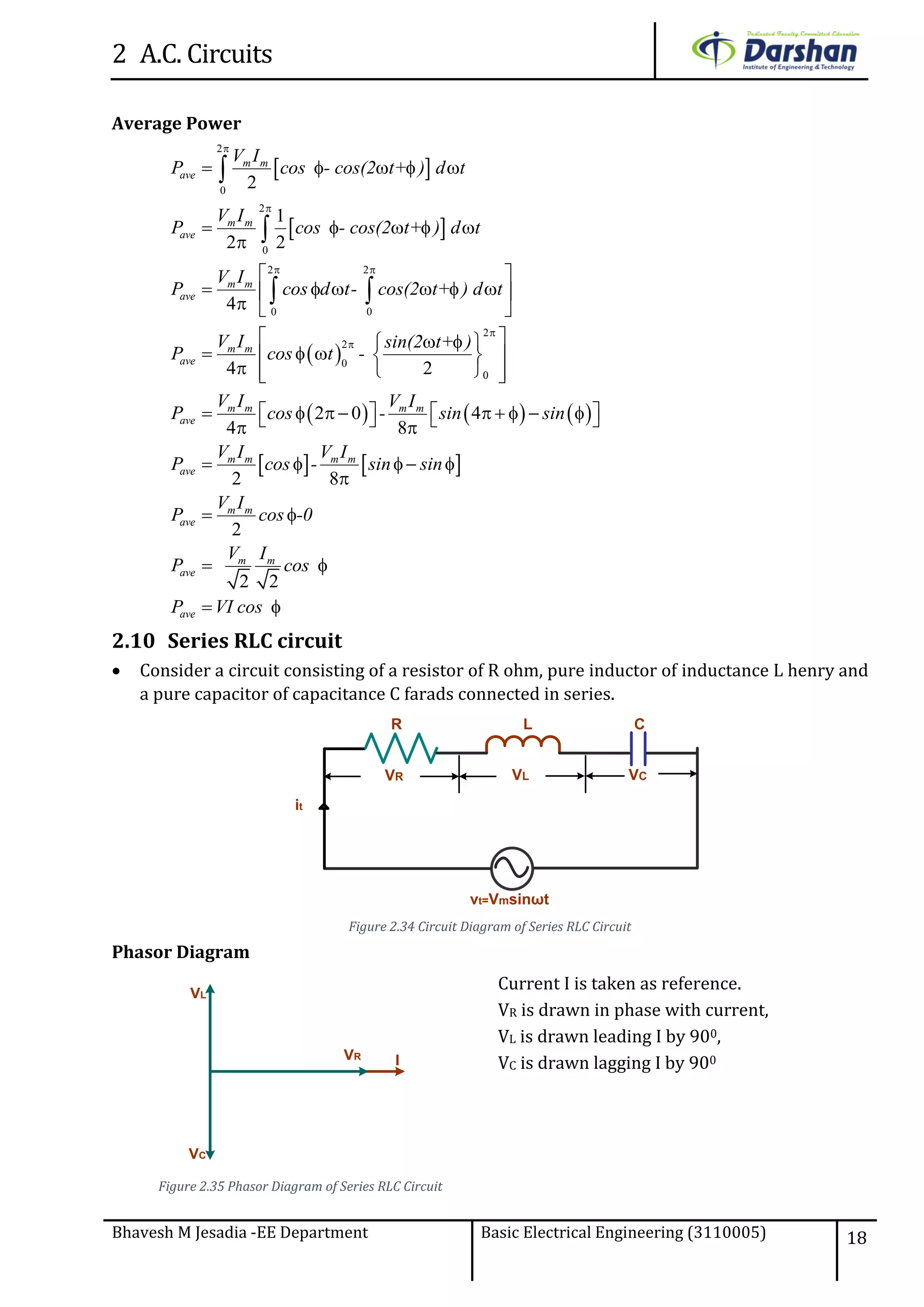
2.10 Series RLC circuit
 Consider a circuit consisting of a resistor of R ohm, pure inductor of inductance L henry and
a pure capacitor of capacitance C farads connected in series.
vt=Vmsinωt
it
VCVR
R C
VL
L
Figure 2.34 Circuit Diagram of Series RLC Circuit
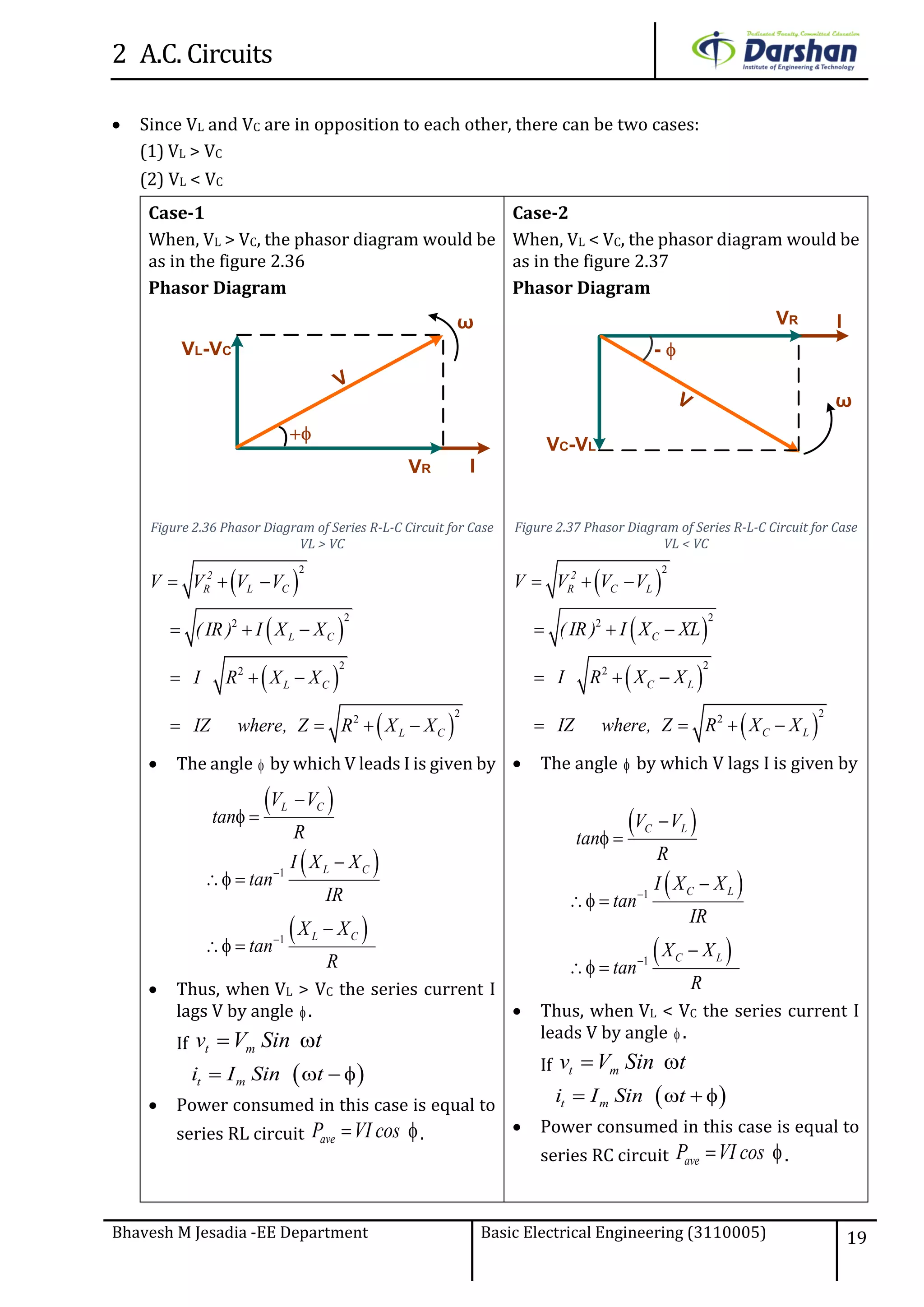
Phasor Diagram
IVR
VL
VC
Figure 2.35 Phasor Diagram of Series RLC Circuit
Current I is taken as reference.
VR is drawn in phase with current,
VL is drawn leading I by 900,
VC is drawn lagging I by 900
2 A.C. Circuits
Bhavesh M Jesadia -EE Department Basic Electrical Engineering (3110005) 19
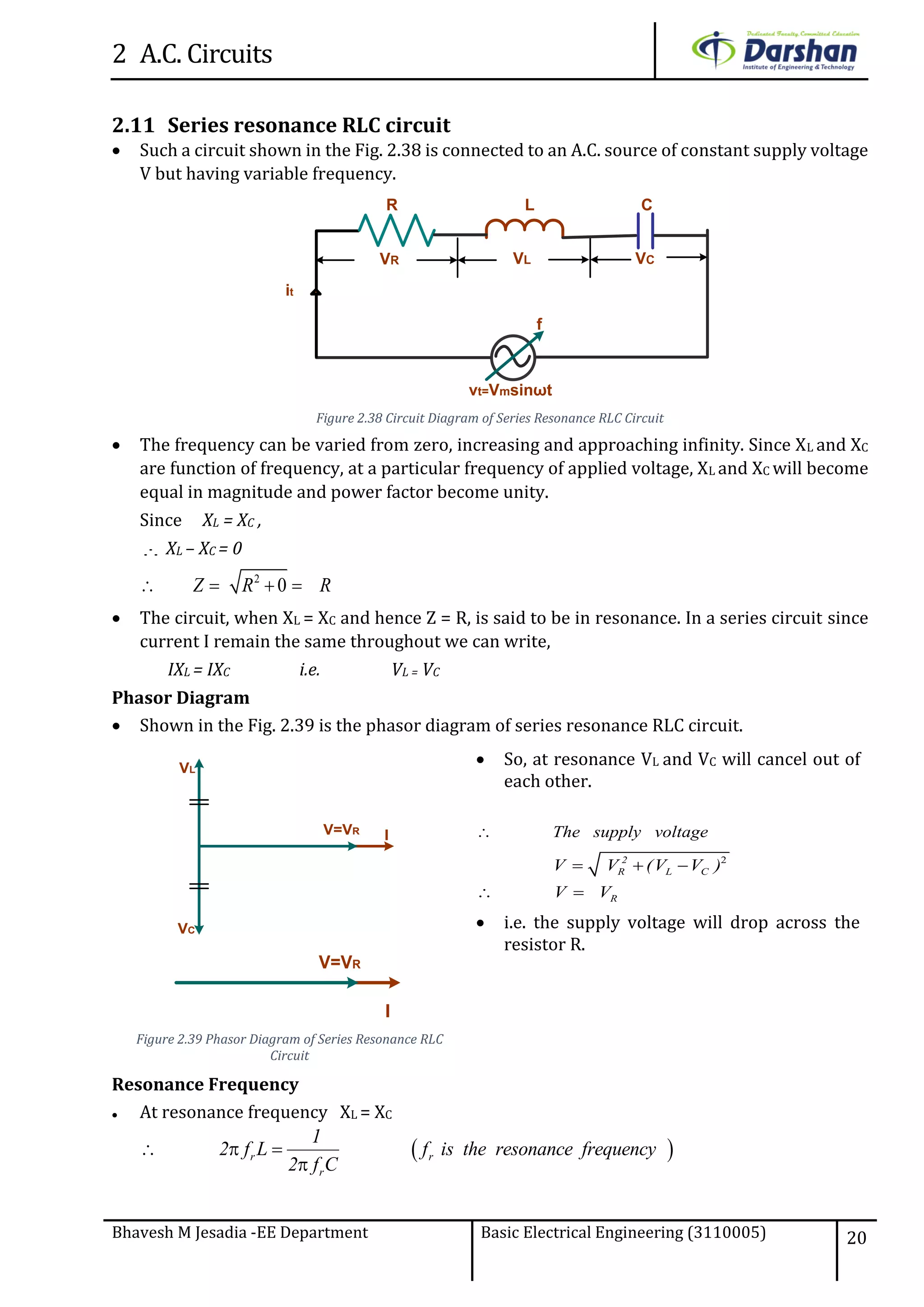
 Since VL and VC are in opposition to each other, there can be two cases:
(1) VL > VC
(2) VL < VC
Case-1
When, VL > VC, the phasor diagram would be
as in the figure 2.36
Phasor Diagram
ω
IVR
V

VL-VC
Figure 2.36 Phasor Diagram of Series R-L-C Circuit for Case
VL > VC
 
 
 
 
2
2
2
2
2
2
2
  
  
  
   
2
R L C
L C
L C
L C
V V V V
( IR ) I X X
I R X X
IZ where, Z R X X
 The angle  by which V leads I is given by
 
 
 
1
1



 

 

 
L C
L C
L C
V V
tan
R
I X X
tan
IR
X X
tan
R
 Thus, when VL > VC the series current I
lags V by angle  .
If  t mv V Sin t
    t mi I Sin t
 Power consumed in this case is equal to
series RL circuit  aveP VI cos .
Case-2
When, VL < VC, the phasor diagram would be
as in the figure 2.37
Phasor Diagram
VC-VL
ω
IVR
V
- 
Figure 2.37 Phasor Diagram of Series R-L-C Circuit for Case
VL < VC
 
 
 
 
2
2
2
2
2
2
2
  
  
  
   
2
R C L
C
C L
C L
V V V V
( IR ) I X XL
I R X X
IZ where, Z R X X
 The angle  by which V lags I is given by
 
 
 
1
1



 

 

 
C L
C L
C L
V V
tan
R
I X X
tan
IR
X X
tan
R
 Thus, when VL < VC the series current I
leads V by angle  .
If  t mv V Sin t
    t mi I Sin t
 Power consumed in this case is equal to
series RC circuit  aveP VI cos .
2 A.C. Circuits
Bhavesh M Jesadia -EE Department Basic Electrical Engineering (3110005) 20
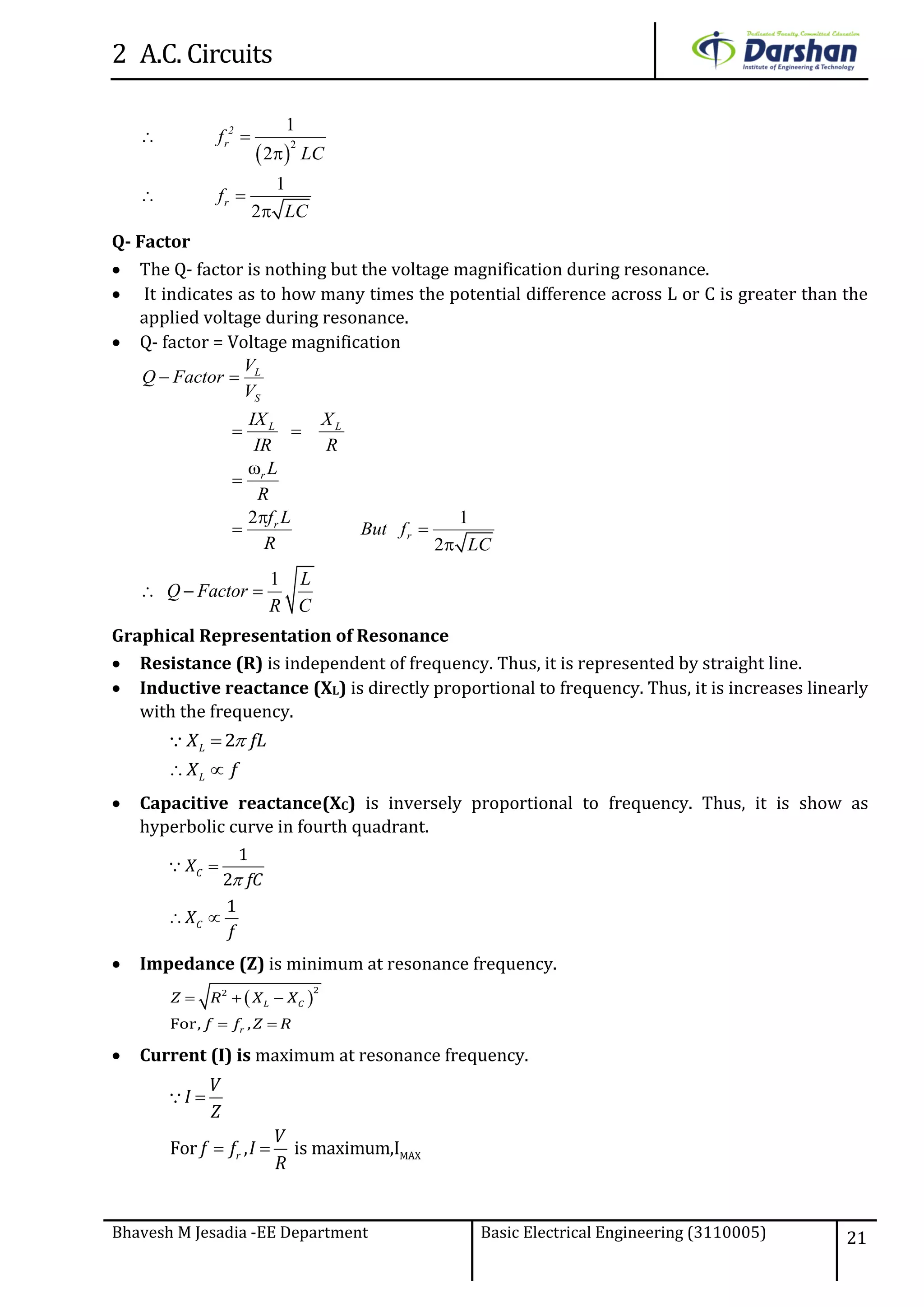
2.11 Series resonance RLC circuit
 Such a circuit shown in the Fig. 2.38 is connected to an A.C. source of constant supply voltage
V but having variable frequency.
vt=Vmsinωt
it
VCVR
R C
VL
L
f
Figure 2.38 Circuit Diagram of Series Resonance RLC Circuit
 The frequency can be varied from zero, increasing and approaching infinity. Since XL and XC
are function of frequency, at a particular frequency of applied voltage, XL and XC will become
equal in magnitude and power factor become unity.
Since XL = XC ,
 XL – XC = 0
2
0   Z R R
 The circuit, when XL = XC and hence Z = R, is said to be in resonance. In a series circuit since
current I remain the same throughout we can write,
IXL = IXC i.e. VL = VC
Phasor Diagram
 Shown in the Fig. 2.39 is the phasor diagram of series resonance RLC circuit.
IV=VR
VL
VC
I
V=VR
Figure 2.39 Phasor Diagram of Series Resonance RLC
Circuit
 So, at resonance VL and VC will cancel out of
each other.
The supply voltage
2
  
 
2
R L C
R
V V (V V )
V V
 i.e. the supply voltage will drop across the
resistor R.
Resonance Frequency
 At resonance frequency XL = XC
   

r r
r
1
2 f L f is the resonance frequency
2 f C
2 A.C. Circuits
Bhavesh M Jesadia -EE Department Basic Electrical Engineering (3110005) 21
 
2
1
2
1
2
 

 

2
r
r
f
LC
f
LC
Q- Factor
 The Q- factor is nothing but the voltage magnification during resonance.
 It indicates as to how many times the potential difference across L or C is greater than the
applied voltage during resonance.
 Q- factor = Voltage magnification
2 1
2
 
 



 

L
S
L L
r
r
r
V
Q Factor
V
IX X
IR R
L
R
f L
But f
R LC
1
  
L
Q Factor
R C
Graphical Representation of Resonance
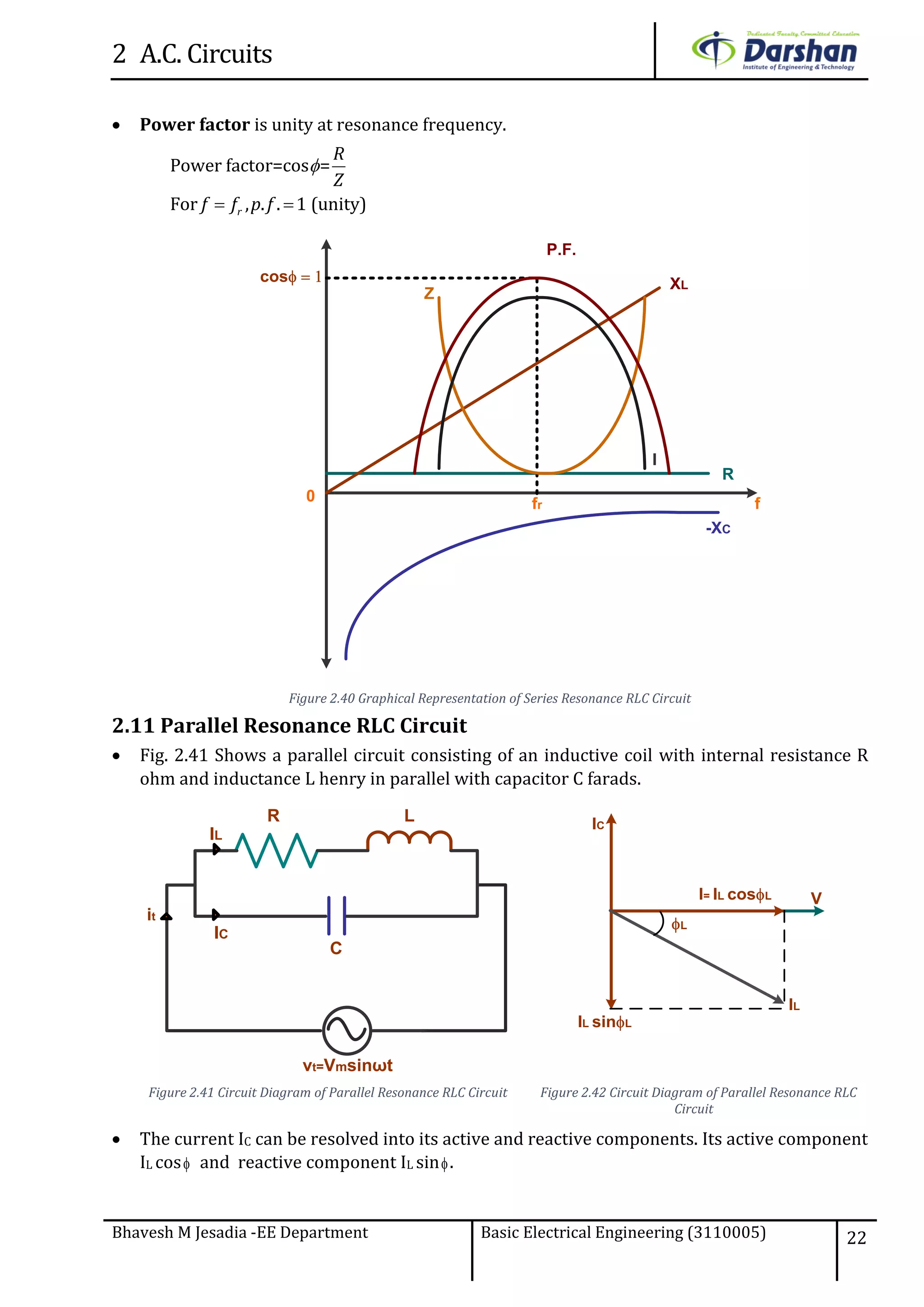
 Resistance (R) is independent of frequency. Thus, it is represented by straight line.
 Inductive reactance (XL) is directly proportional to frequency. Thus, it is increases linearly
with the frequency.

 
2L
L
X fL
X f

 Capacitive reactance(XC) is inversely proportional to frequency. Thus, it is show as
hyperbolic curve in fourth quadrant.

 
1
2
1
C
C
X
fC
X
f

 Impedance (Z) is minimum at resonance frequency.
 
22
For, ,
L C
r
Z R X X
f f Z R
  
 
 Current (I) is maximum at resonance frequency.

  MAXFor , is maximum,Ir
V
I
Z
V
f f I
R
2 A.C. Circuits
Bhavesh M Jesadia -EE Department Basic Electrical Engineering (3110005) 22
 Power factor is unity at resonance frequency.
Power factor=cos =
For , . . 1 (unity)r
R
Z
f f p f

 
-XC
XL
R
Z
I
P.F.
fr f
cos
0
Figure 2.40 Graphical Representation of Series Resonance RLC Circuit
2.11 Parallel Resonance RLC Circuit
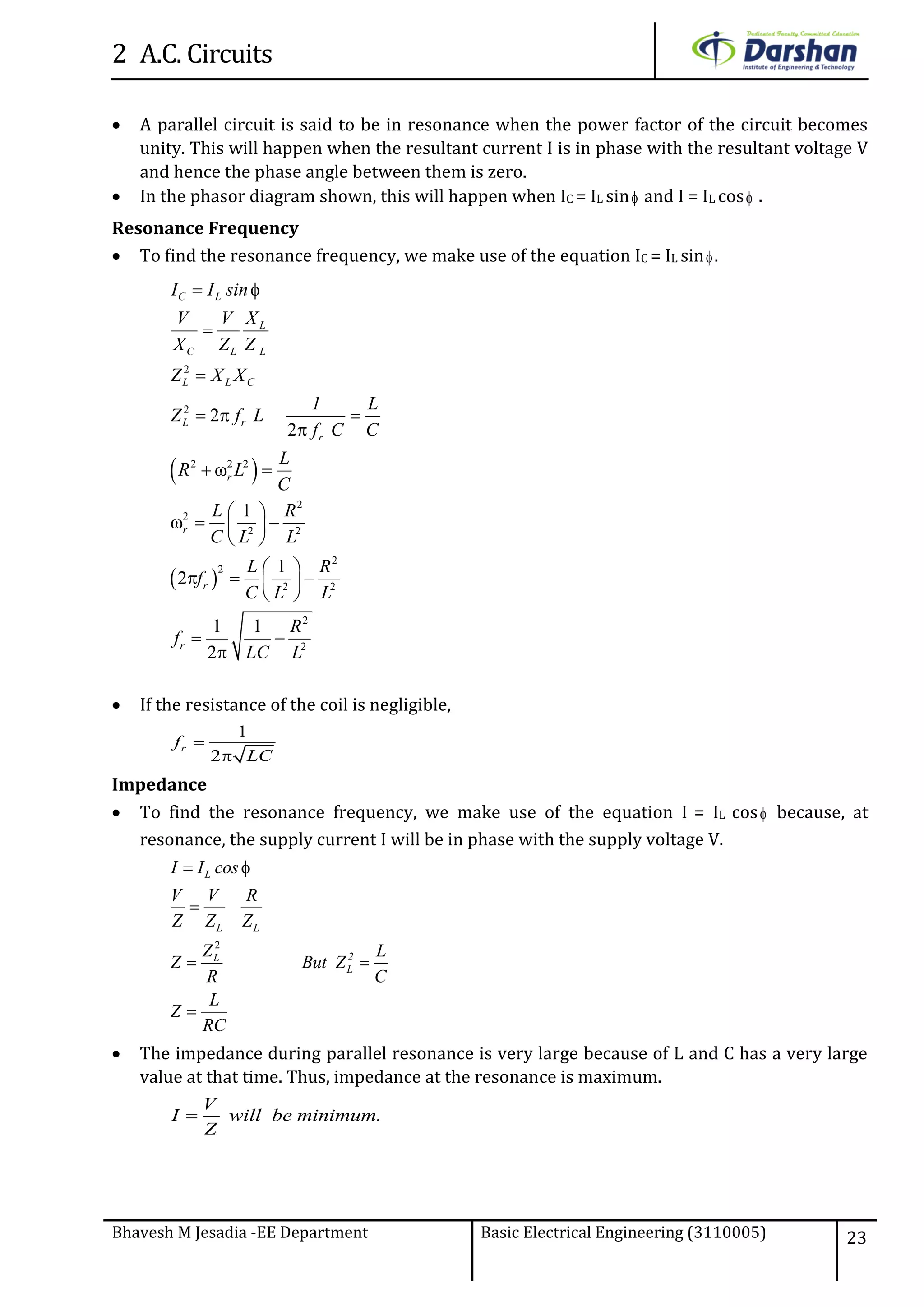
 Fig. 2.41 Shows a parallel circuit consisting of an inductive coil with internal resistance R
ohm and inductance L henry in parallel with capacitor C farads.
vt=Vmsinωt
it
R
C
L
IC
IL
Figure 2.41 Circuit Diagram of Parallel Resonance RLC Circuit
IL sinL
V
IC
L
I= IL cosL
IL
Figure 2.42 Circuit Diagram of Parallel Resonance RLC
Circuit
 The current IC can be resolved into its active and reactive components. Its active component
IL cos and reactive component IL sin.
2 A.C. Circuits
Bhavesh M Jesadia -EE Department Basic Electrical Engineering (3110005) 23
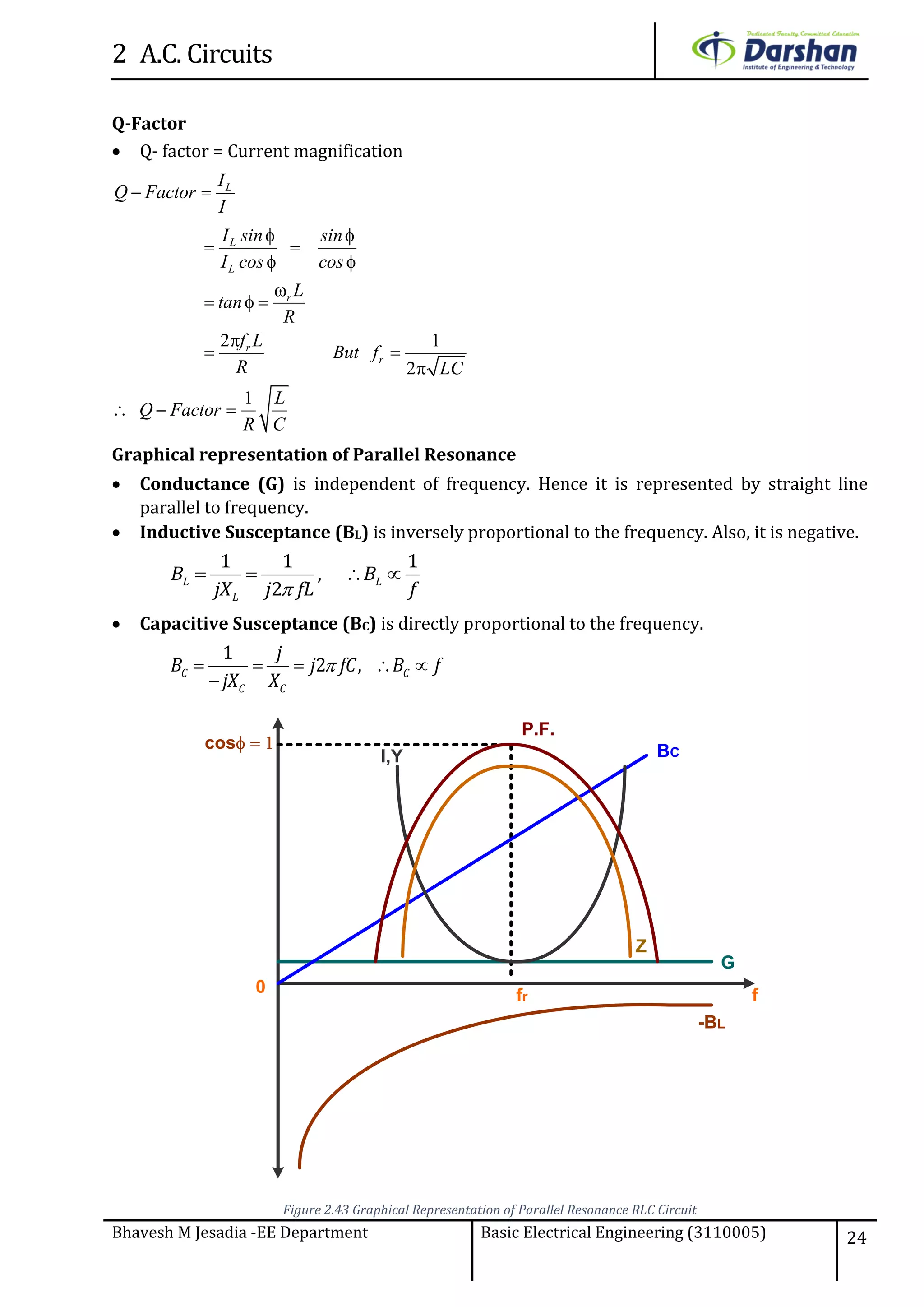
 A parallel circuit is said to be in resonance when the power factor of the circuit becomes
unity. This will happen when the resultant current I is in phase with the resultant voltage V
and hence the phase angle between them is zero.
 In the phasor diagram shown, this will happen when IC = IL sin and I = IL cos .
Resonance Frequency
 To find the resonance frequency, we make use of the equation IC = IL sin.
 If the resistance of the coil is negligible,
1
2
rf
LC


Impedance
 To find the resonance frequency, we make use of the equation I = IL cos because, at
resonance, the supply current I will be in phase with the supply voltage V.
2
 

 

L
L L
2L
L
I I cos
V V R
Z Z Z
Z L
Z But Z
R C
L
Z
RC
 The impedance during parallel resonance is very large because of L and C has a very large
value at that time. Thus, impedance at the resonance is maximum.
V
I will be minimum.
Z

 
 
2
2
2 2 2
2
2
2 2
2
2
2 2
2
2
2
2
1
1
2
1 1
2
 


  

  
 
   
 
 
   
 
 

C L
L
C L L
L L C
L r
r
r
r
r
r
I I sin
XV V
X Z Z
Z X X
1 L
Z f L
f C C
L
R L
C
L R
C L L
L R
f
C L L
R
f
LC L
2 A.C. Circuits
Bhavesh M Jesadia -EE Department Basic Electrical Engineering (3110005) 24
Q-Factor
 Q- factor = Current magnification
2 1
2
1
 
 
 
 

  

 

  
L
L
L
r
r
r
I
Q Factor
I
I sin sin
I cos cos
L
tan
R
f L
But f
R LC
L
Q Factor
R C
Graphical representation of Parallel Resonance
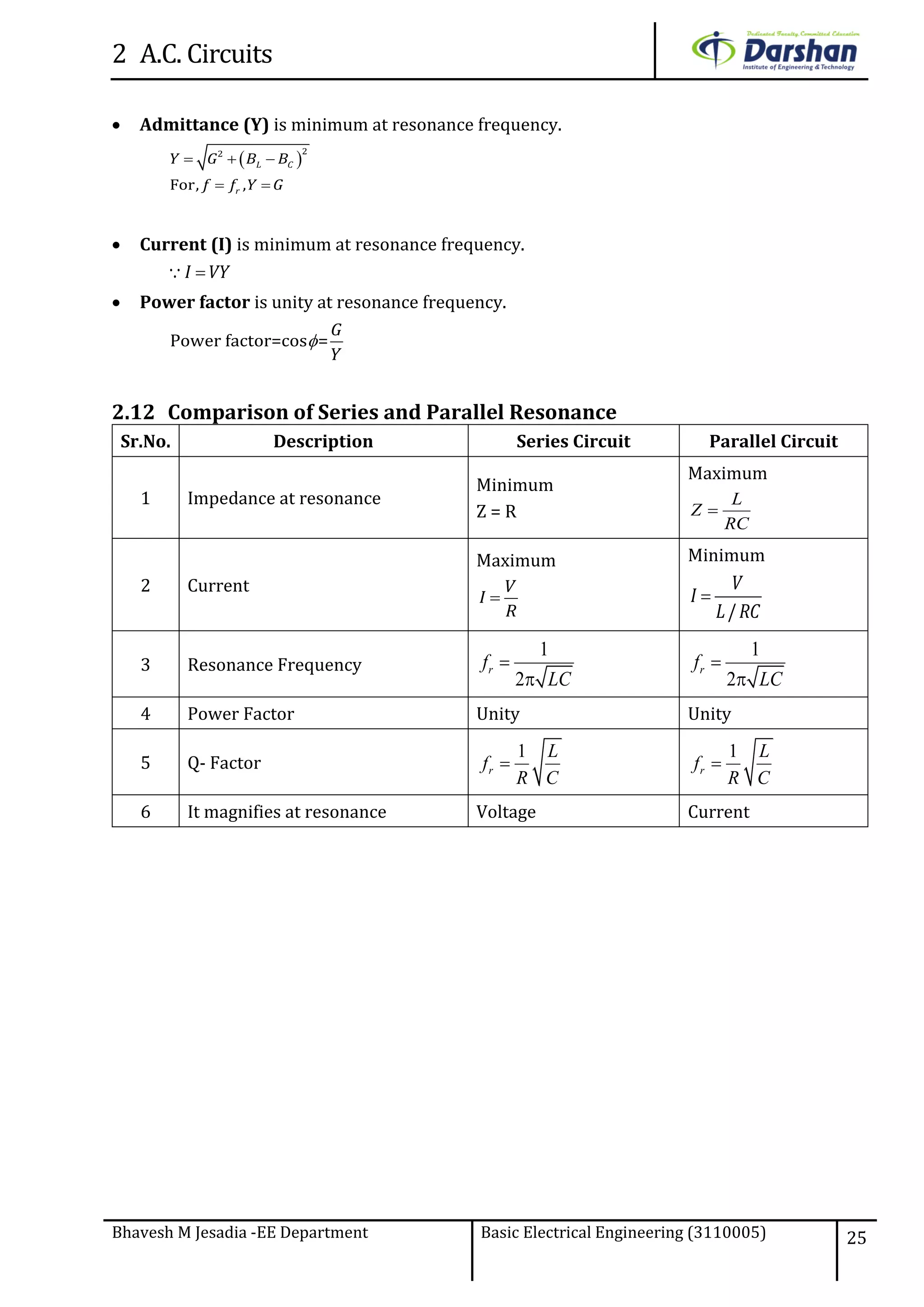
 Conductance (G) is independent of frequency. Hence it is represented by straight line
parallel to frequency.
 Inductive Susceptance (BL) is inversely proportional to the frequency. Also, it is negative.
1 1 1
,
2
L L
L
B B
jX j fL f
   
 Capacitive Susceptance (BC) is directly proportional to the frequency.
1
2 ,C C
C C
j
B j fC B f
jX X
    

-BL
BC
G
I,Y
Z
P.F.
fr f
cos
0
Figure 2.43 Graphical Representation of Parallel Resonance RLC Circuit
2 A.C. Circuits
Bhavesh M Jesadia -EE Department Basic Electrical Engineering (3110005) 25
 Admittance (Y) is minimum at resonance frequency.
 
22
For, ,
L C
r
Y G B B
f f Y G
  
 
 Current (I) is minimum at resonance frequency.
I VY
 Power factor is unity at resonance frequency.
Power factor=cos =
G
Y

2.12 Comparison of Series and Parallel Resonance
Sr.No. Description Series Circuit Parallel Circuit
1 Impedance at resonance
Minimum
Z = R
Maximum

L
Z
RC
2 Current
Maximum
V
I
R

Minimum
/
V
I
L RC

3 Resonance Frequency
1
2


rf
LC
1
2


rf
LC
4 Power Factor Unity Unity
5 Q- Factor
1
r
L
f
R C
1
r
L
f
R C
6 It magnifies at resonance Voltage Current
2 A.C. Circuits
Bhavesh M Jesadia -EE Department Basic Electrical Engineering (3110005) 26
Three - Phase AC Circuits
2.13 Comparison between single phase and three phase
Basis for
Comparison
Single Phase Three Phase
Definition The power supply through one
conductor.
The power supply through three
conductors.
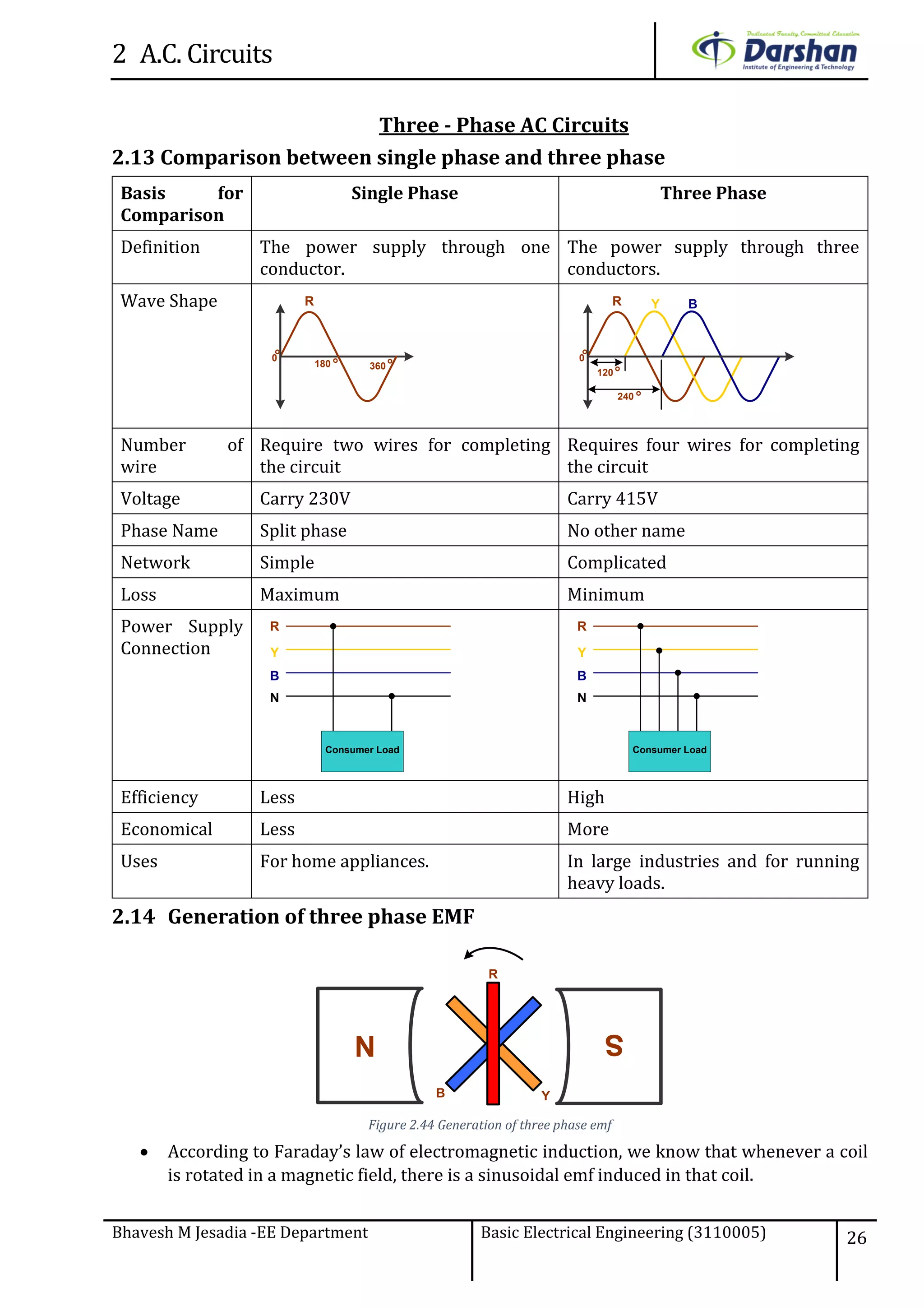
Wave Shape
0
360180
R
0
120
R
240
Y B
Number of
wire
Require two wires for completing
the circuit
Requires four wires for completing
the circuit
Voltage Carry 230V Carry 415V
Phase Name Split phase No other name
Network Simple Complicated
Loss Maximum Minimum
Power Supply
Connection
Consumer Load
R
Y
B
N
R
Y
B
N
Consumer Load
Efficiency Less High
Economical Less More
Uses For home appliances. In large industries and for running
heavy loads.
2.14 Generation of three phase EMF
N
S
R
YB
Figure 2.44 Generation of three phase emf
 According to Faraday’s law of electromagnetic induction, we know that whenever a coil
is rotated in a magnetic field, there is a sinusoidal emf induced in that coil.
2 A.C. Circuits
Bhavesh M Jesadia -EE Department Basic Electrical Engineering (3110005) 27
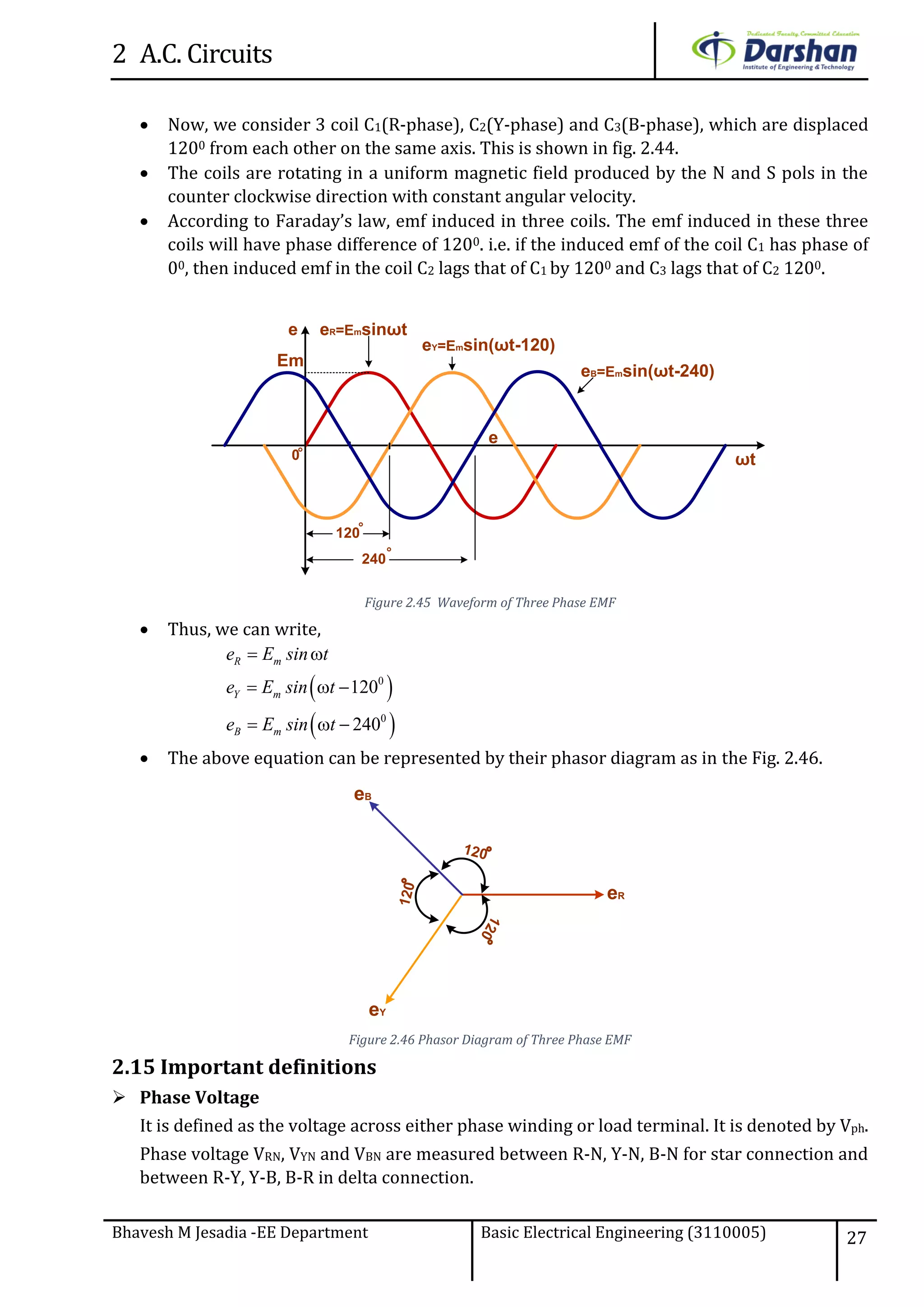
 Now, we consider 3 coil C1(R-phase), C2(Y-phase) and C3(B-phase), which are displaced
1200 from each other on the same axis. This is shown in fig. 2.44.
 The coils are rotating in a uniform magnetic field produced by the N and S pols in the
counter clockwise direction with constant angular velocity.
 According to Faraday’s law, emf induced in three coils. The emf induced in these three
coils will have phase difference of 1200. i.e. if the induced emf of the coil C1 has phase of
00, then induced emf in the coil C2 lags that of C1 by 1200 and C3 lags that of C2 1200.
0 ωt
120
240
e
e
Em
eR=Emsinωt
eY=Emsin(ωt-120)
eB=Emsin(ωt-240)
Figure 2.45 Waveform of Three Phase EMF
 Thus, we can write,
 
 
0
0
120
240
 
  
  
R m
Y m
B m
e E sin t
e E sin t
e E sin t
 The above equation can be represented by their phasor diagram as in the Fig. 2.46.
120
120
120
eR
eY
eB
Figure 2.46 Phasor Diagram of Three Phase EMF
2.15 Important definitions
 Phase Voltage
It is defined as the voltage across either phase winding or load terminal. It is denoted by Vph.
Phase voltage VRN, VYN and VBN are measured between R-N, Y-N, B-N for star connection and
between R-Y, Y-B, B-R in delta connection.
2 A.C. Circuits
Bhavesh M Jesadia -EE Department Basic Electrical Engineering (3110005) 28
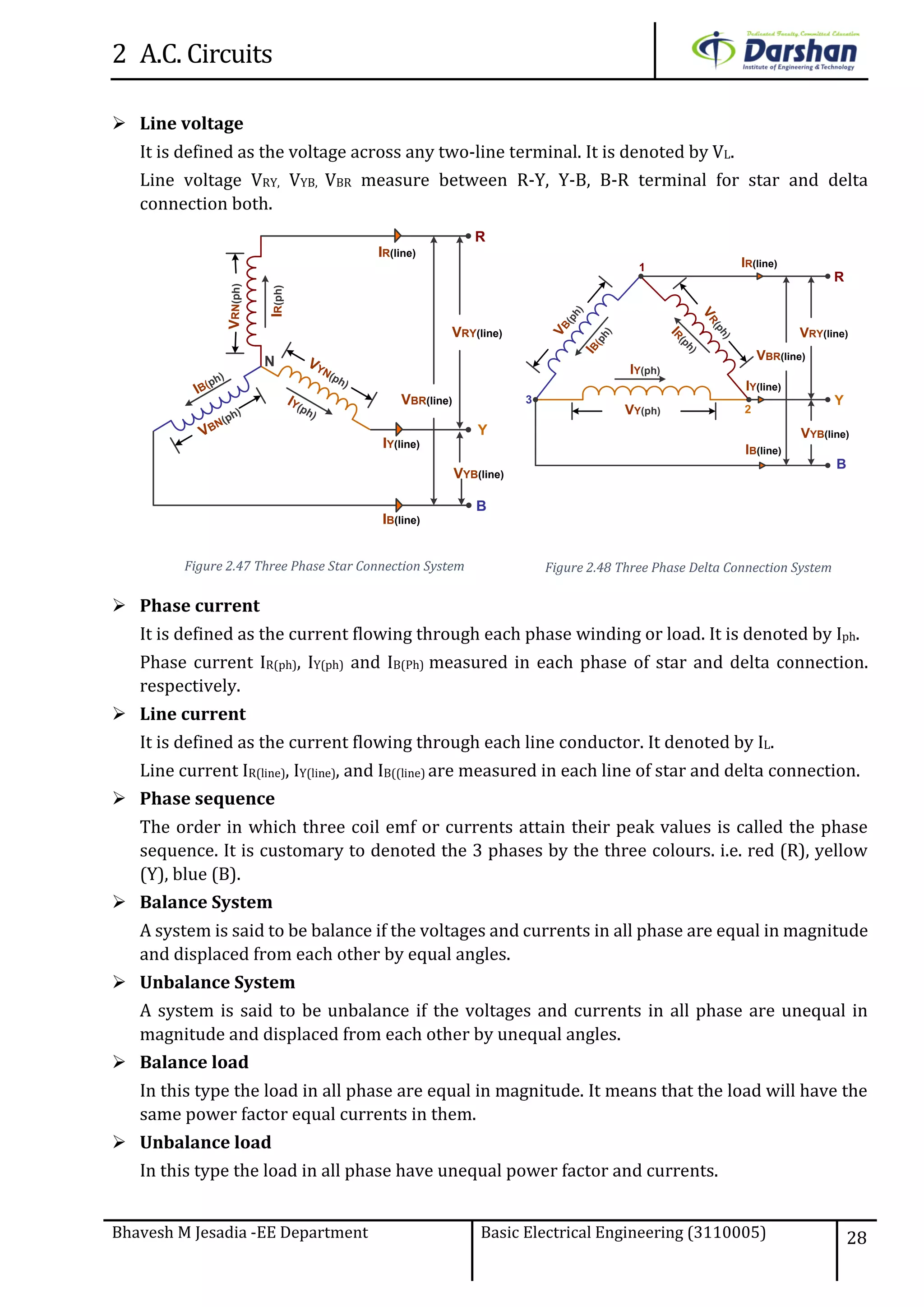
 Line voltage
It is defined as the voltage across any two-line terminal. It is denoted by VL.
Line voltage VRY, VYB, VBR measure between R-Y, Y-B, B-R terminal for star and delta
connection both.
R
Y
B
VRY(line)
VYB(line)
VBR(line)
IR(line)
IY(line)
IB(line)
VYN(ph)
VBN(ph)
VRN(ph)
IR(ph)
IY(ph)
IB(ph)
N
Figure 2.47 Three Phase Star Connection System
R
Y
B
VRY(line)
VYB(line)
VBR(line)
IR(line)
IY(line)
IB(line)
VY(ph)
VR(ph)
IR
(ph)
VB(ph)
IY(ph)
IB(ph)
2
3
1
Figure 2.48 Three Phase Delta Connection System
 Phase current
It is defined as the current flowing through each phase winding or load. It is denoted by Iph.
Phase current IR(ph), IY(ph) and IB(Ph) measured in each phase of star and delta connection.
respectively.
 Line current
It is defined as the current flowing through each line conductor. It denoted by IL.
Line current IR(line), IY(line), and IB((line) are measured in each line of star and delta connection.
 Phase sequence
The order in which three coil emf or currents attain their peak values is called the phase
sequence. It is customary to denoted the 3 phases by the three colours. i.e. red (R), yellow
(Y), blue (B).
 Balance System
A system is said to be balance if the voltages and currents in all phase are equal in magnitude
and displaced from each other by equal angles.
 Unbalance System
A system is said to be unbalance if the voltages and currents in all phase are unequal in
magnitude and displaced from each other by unequal angles.
 Balance load
In this type the load in all phase are equal in magnitude. It means that the load will have the
same power factor equal currents in them.
 Unbalance load
In this type the load in all phase have unequal power factor and currents.
2 A.C. Circuits
Bhavesh M Jesadia -EE Department Basic Electrical Engineering (3110005) 29
2.16 Relation between line and phase values for voltage and current in
case of balanced delta connection.
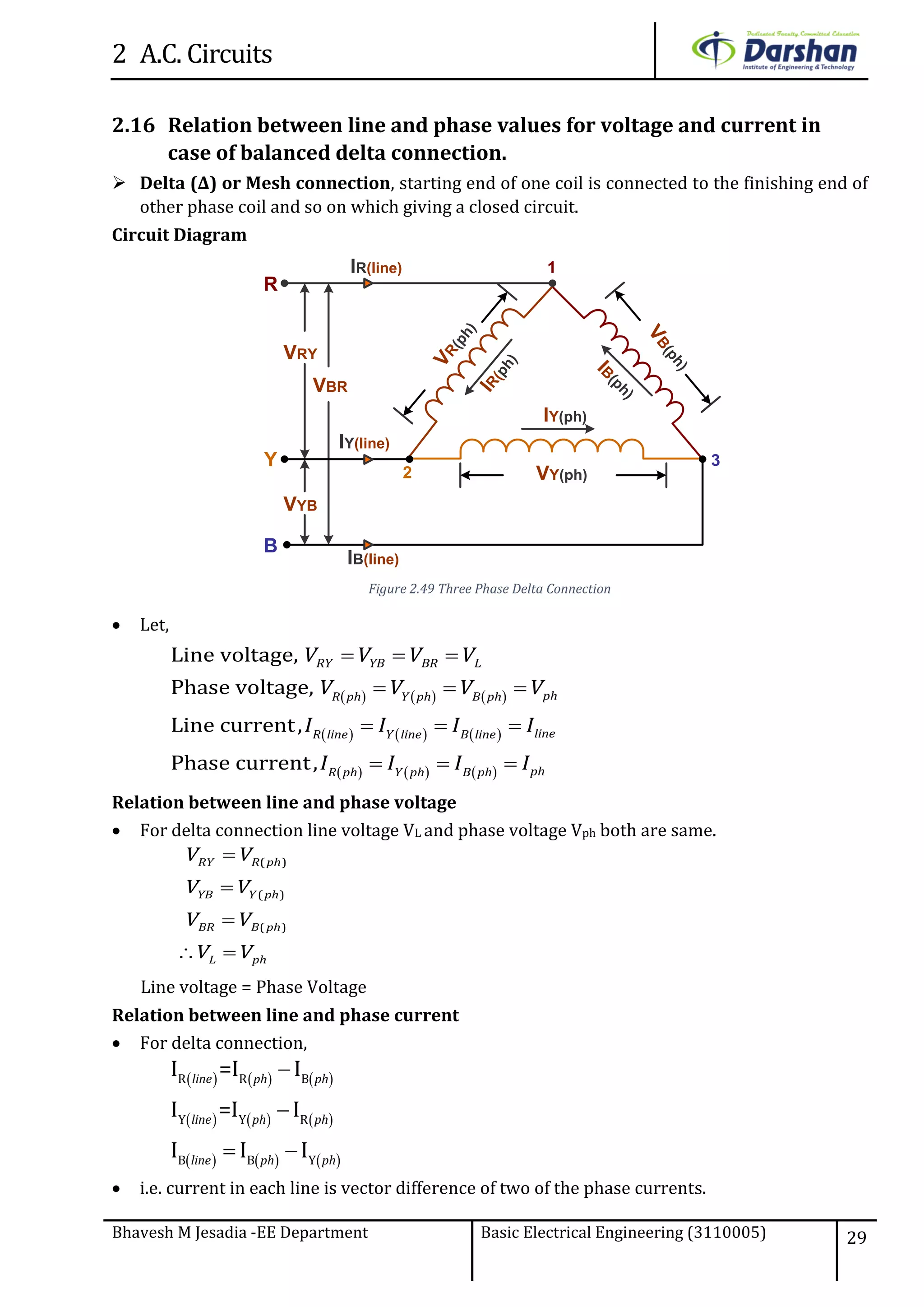
 Delta (Δ) or Mesh connection, starting end of one coil is connected to the finishing end of
other phase coil and so on which giving a closed circuit.
Circuit Diagram
R
Y
B
VRY
VYB
VBR
IR(line)
IY(line)
IB(line)
VY(ph)
VB(ph)
IB
(ph)
VR(ph)
IY(ph)
IR(ph)
2
3
1
Figure 2.49 Three Phase Delta Connection
 Let,
     
     
     
Line voltage,
Phase voltage,
Line current,
Phase current,
RY YB BR L
phR ph Y ph B ph
lineR line Y line B line
phR ph Y ph B ph
V V V V
V V V V
I I I I
I I I I
  
  
  
  
Relation between line and phase voltage
 For delta connection line voltage VL and phase voltage Vph both are same.
( )
( )
( )
RY R ph
YB Y ph
BR B ph
L ph
V V
V V
V V
V V



 
Line voltage = Phase Voltage
Relation between line and phase current
 For delta connection,
     
     
     
R R B
Y Y R
B B Y
I =I I
I =I I
I I I
line ph ph
line ph ph
line ph ph


 
 i.e. current in each line is vector difference of two of the phase currents.
2 A.C. Circuits
Bhavesh M Jesadia -EE Department Basic Electrical Engineering (3110005) 30
60
IR(ph)
IY(ph)
-IY(ph)
-IR(ph)
IB(ph)
-IB(ph)
6060
IR(line)IY(line)
IB(line)
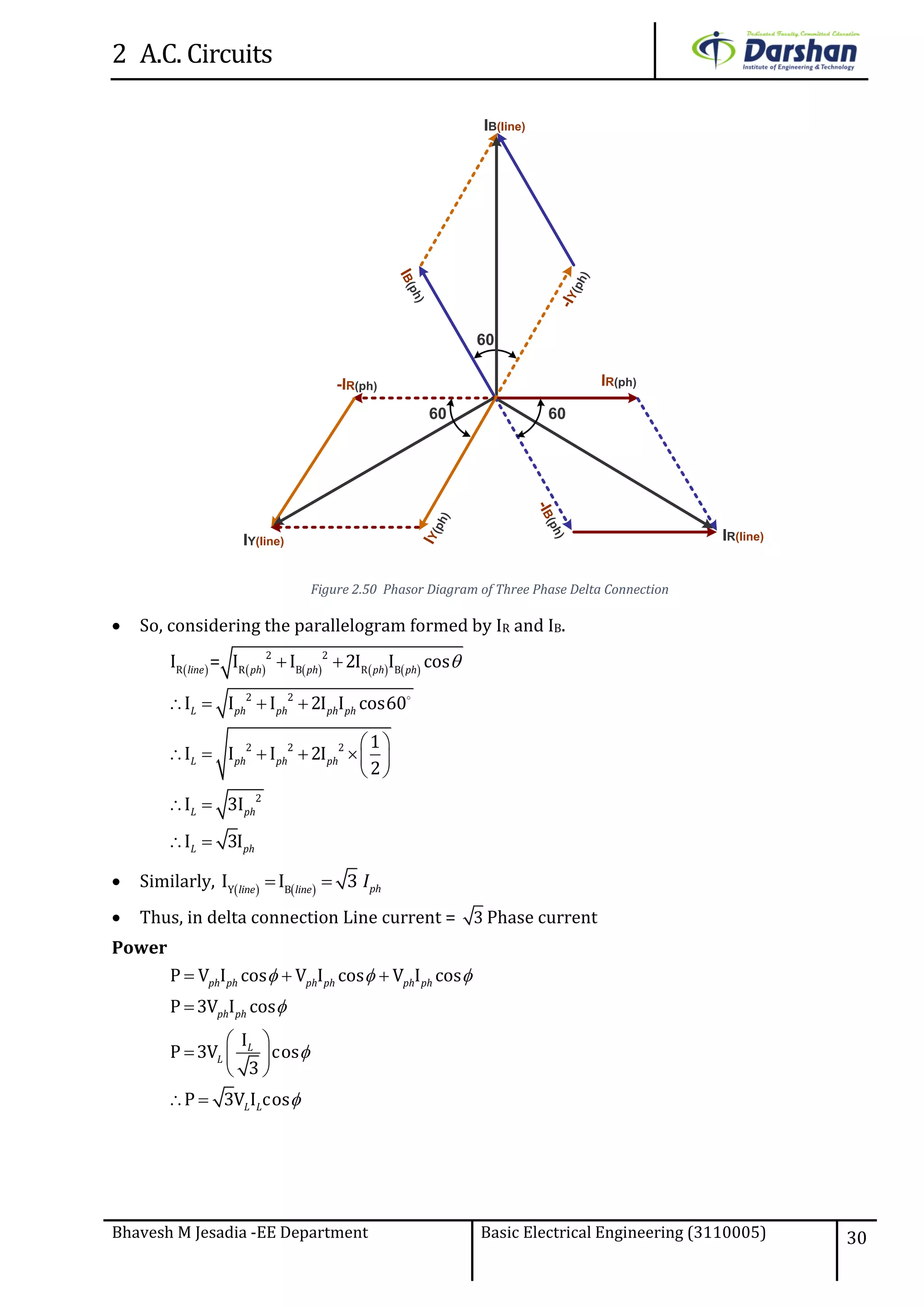
Figure 2.50 Phasor Diagram of Three Phase Delta Connection
 So, considering the parallelogram formed by IR and IB.
         
2 2
R R B R B
2 2
2 2 2
2
I = I I 2I I cos
I I I 2I I cos60
1
I I I 2I
2
I 3I
I 3I
line ph ph ph ph
L ph ph ph ph
L ph ph ph
L ph
L ph
 
   
 
     
 
 
 
 Similarly,    Y B
I I 3 phline line
I 
 Thus, in delta connection Line current = 3 Phase current
Power
P V I cos V I cos V I cos
P 3V I cos
I
P 3V cos
3
P 3V I cos
ph ph ph ph ph ph
ph ph
L
L
L L
  



  

 
  
 
 
2 A.C. Circuits
Bhavesh M Jesadia -EE Department Basic Electrical Engineering (3110005) 31
2.17 Relation between line and phase values for voltage and current in
case of balanced star connection.
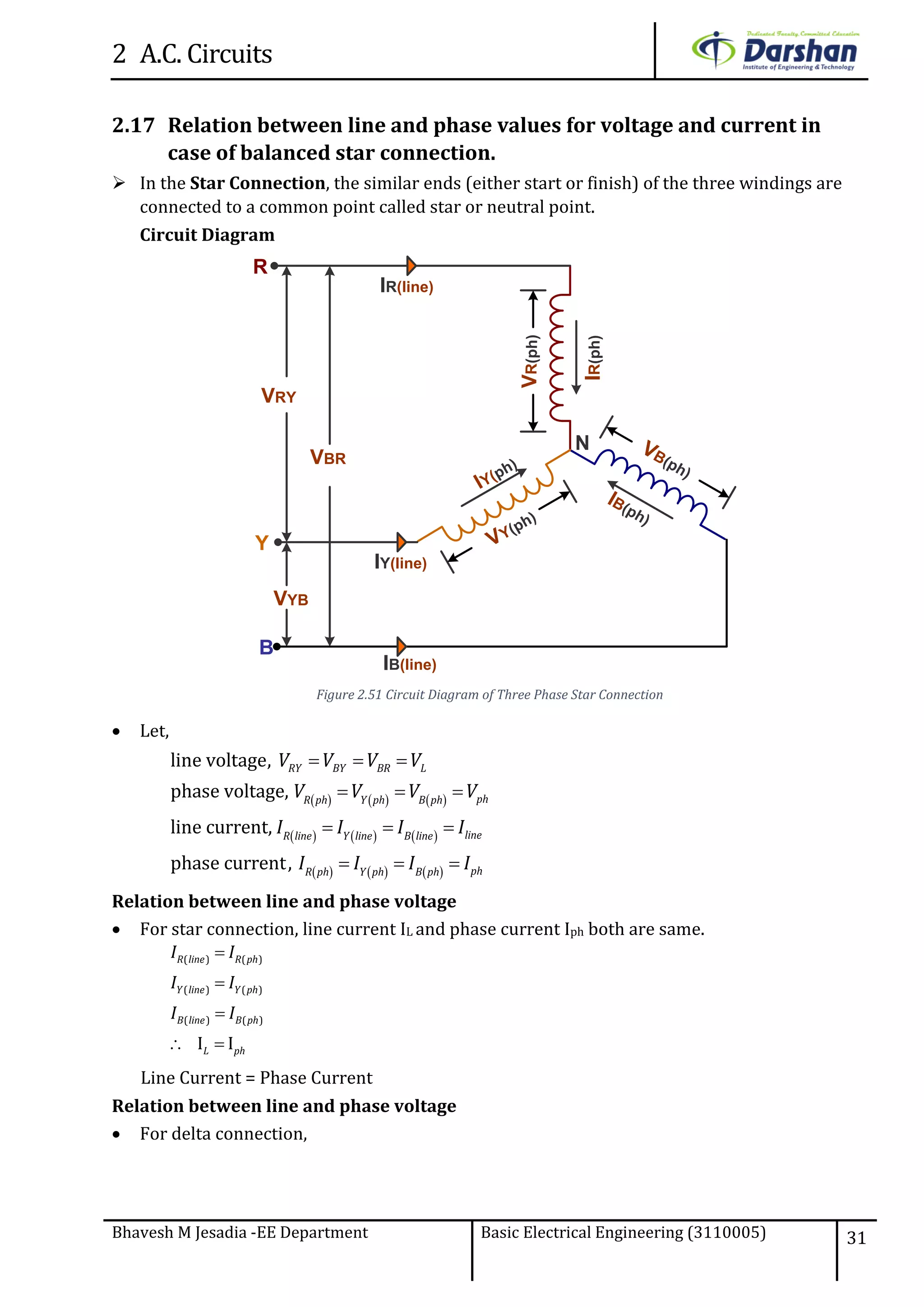
 In the Star Connection, the similar ends (either start or finish) of the three windings are
connected to a common point called star or neutral point.
Circuit Diagram
R
Y
B
VRY
VYB
VBR
IR(line)
IY(line)
VB(ph)
VY(ph)
VR(ph)
IR(ph)
IB(ph)
IY(ph)
N
IB(line)
Figure 2.51 Circuit Diagram of Three Phase Star Connection
 Let,
     
     
     
line voltage,
phase voltage,
line current,
phase current,
RY BY BR L
phR ph Y ph B ph
lineR line Y line B line
phR ph Y ph B ph
V V V V
V V V V
I I I I
I I I I
  
  
  
  
Relation between line and phase voltage
 For star connection, line current IL and phase current Iph both are same.
( ) ( )
( ) ( )
( ) ( )
I I
R line R ph
Y line Y ph
B line B ph
L ph
I I
I I
I I



 
Line Current = Phase Current
Relation between line and phase voltage
 For delta connection,
2 A.C. Circuits
Bhavesh M Jesadia -EE Department Basic Electrical Engineering (3110005) 32
   
   
   
R Y
YB Y B
BR B R
V =V V
V =V V
V =V V
RY ph ph
ph ph
ph ph



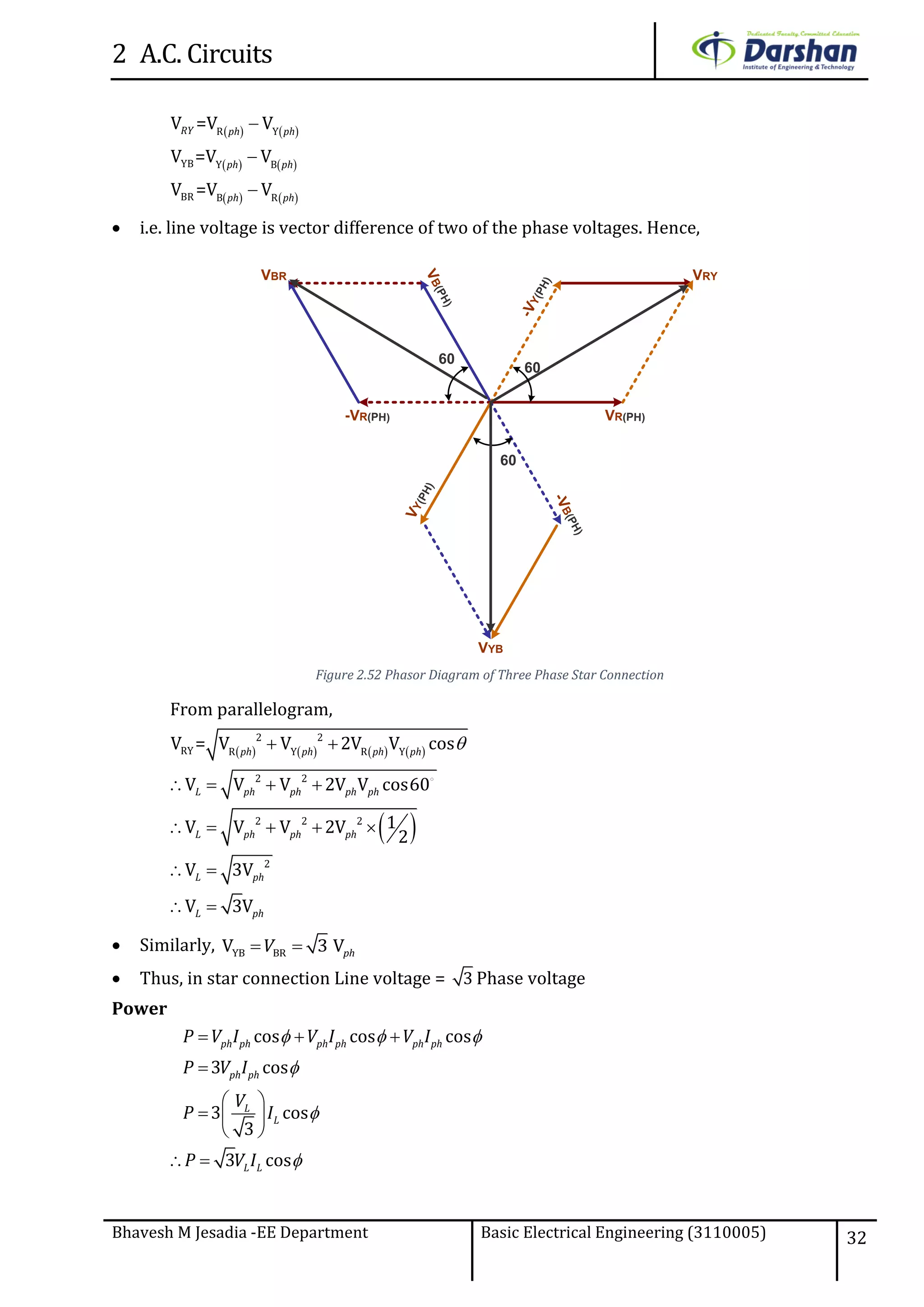
 i.e. line voltage is vector difference of two of the phase voltages. Hence,
60
VR(PH)
VY(PH)
-VY(PH)
-VR(PH) VB(PH)
-VB(PH)
60
60
VRY
VYB
VBR
Figure 2.52 Phasor Diagram of Three Phase Star Connection
       
 
2 2
RY R Y R Y
2 2
2 2 2
2
From parallelogram,
V = V V 2V V cos
V V V 2V V cos60
1V V V 2V
2
V 3V
V 3V
ph ph ph ph
L ph ph ph ph
L ph ph ph
L ph
L ph
 
   
    
 
 
 Similarly, YB BRV 3 VphV 
 Thus, in star connection Line voltage = 3 Phase voltage
Power
cos cos cos
3 cos
3 cos
3
3 cos
ph ph ph ph ph ph
ph ph
L
L
L L
P V I V I V I
P V I
V
P I
P V I
  



  

 
  
 
 
2 A.C. Circuits
Bhavesh M Jesadia -EE Department Basic Electrical Engineering (3110005) 33
2.18 Measurement of power in balanced 3-phase circuit by two-watt meter
method
 This is the method for 3-phase power measurement in which sum of reading of two
wattmeter gives total power of system.
Circuit Diagram
R
VRY
IR(line)
Y Z1
Z2
B
IB(lline)
IY(line)
VBY
M L
C V
M L
C V
Z3
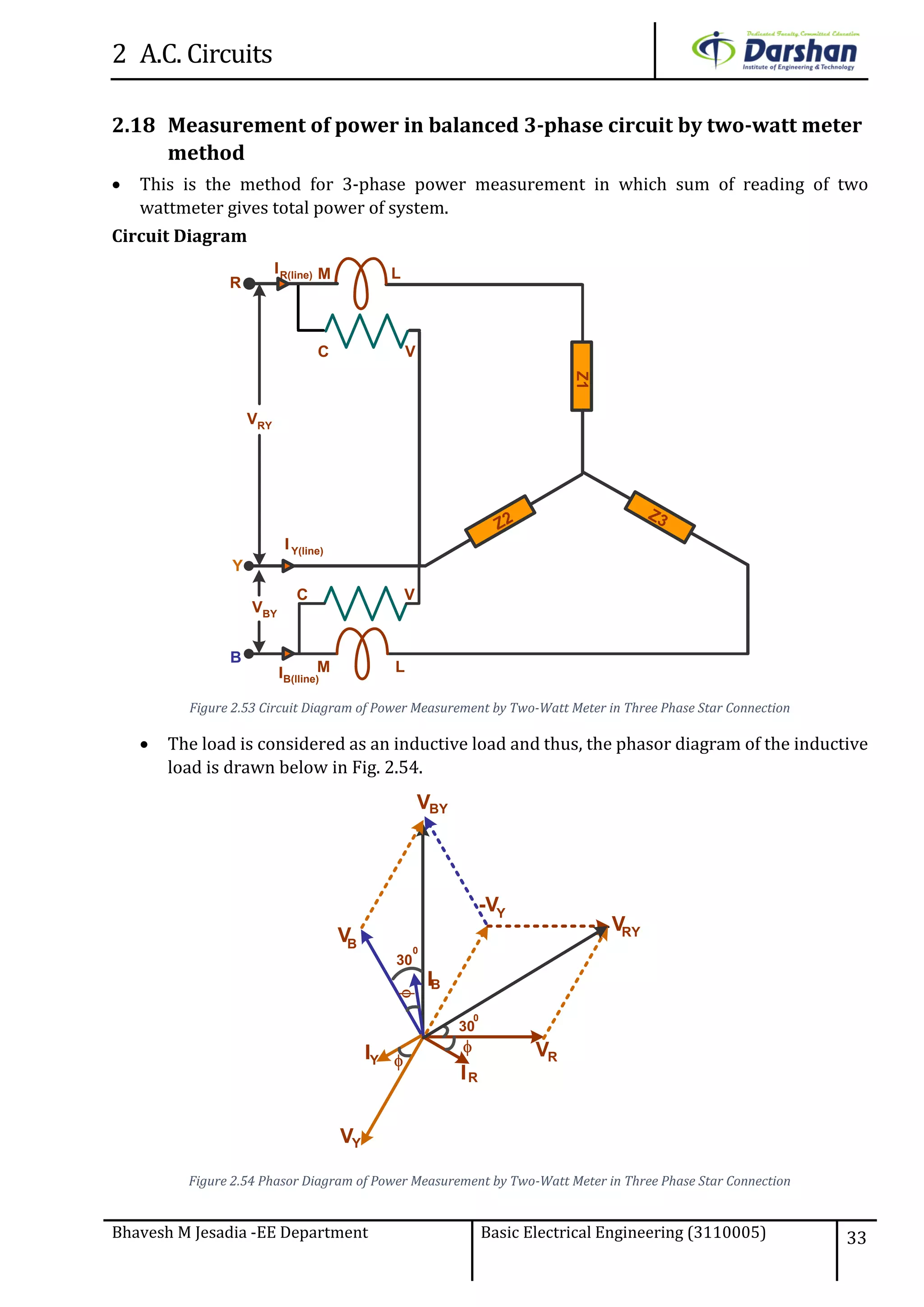
Figure 2.53 Circuit Diagram of Power Measurement by Two-Watt Meter in Three Phase Star Connection
 The load is considered as an inductive load and thus, the phasor diagram of the inductive
load is drawn below in Fig. 2.54.
VY
VR
VB
VRY
-VY
30
0
VBY
I
R
IY
I
B
30
0



Figure 2.54 Phasor Diagram of Power Measurement by Two-Watt Meter in Three Phase Star Connection
2 A.C. Circuits
Bhavesh M Jesadia -EE Department Basic Electrical Engineering (3110005) 34
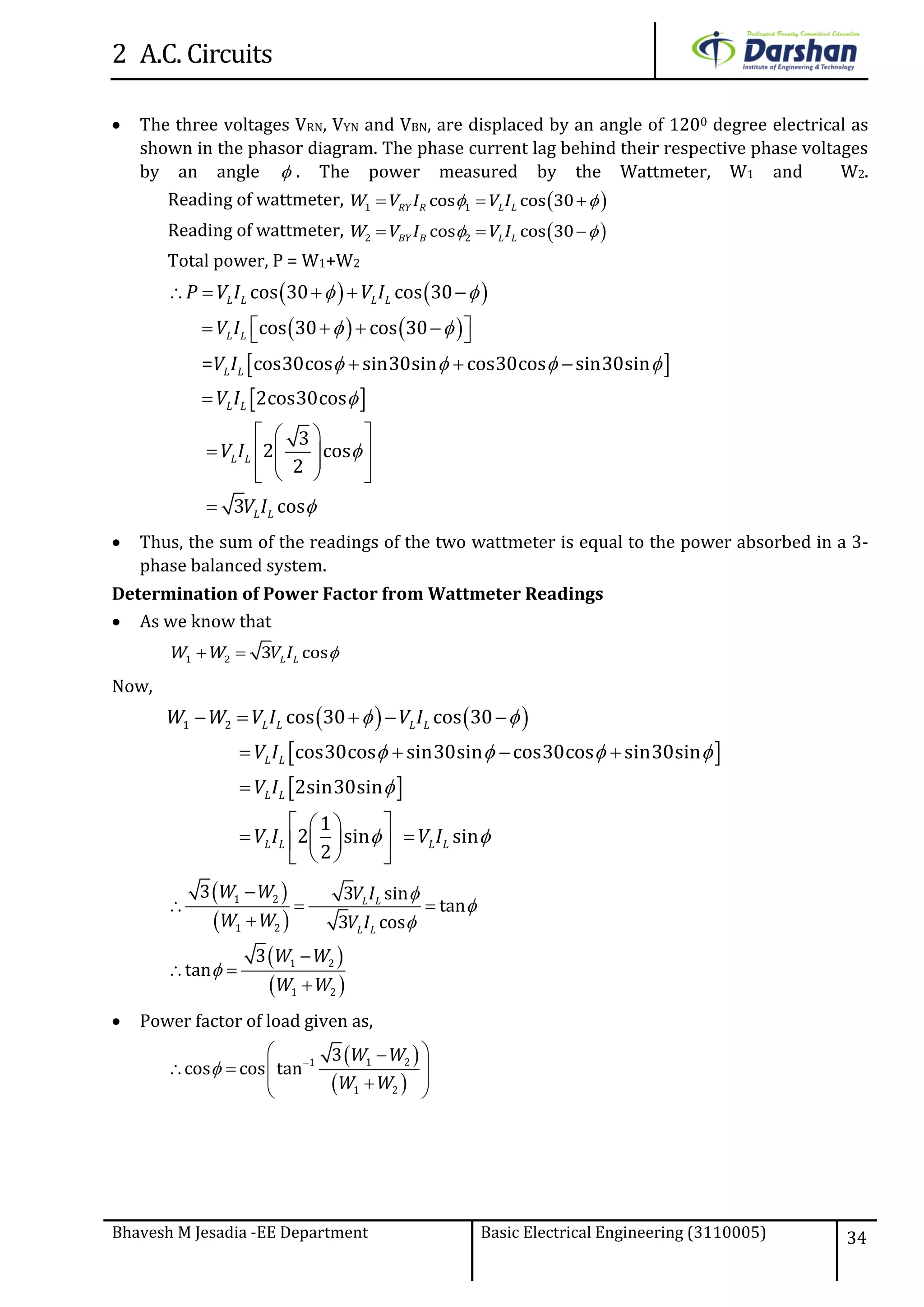
 The three voltages VRN, VYN and VBN, are displaced by an angle of 1200 degree electrical as
shown in the phasor diagram. The phase current lag behind their respective phase voltages
by an angle  . The power measured by the Wattmeter, W1 and W2.
Reading of wattmeter,  1 1cos cos 30RY R L LW V I V I   
Reading of wattmeter,  2 2cos cos 30BY B L LW V I V I   
Total power, P = W1+W2
   
   
 
 
cos 30 cos 30
cos 30 cos 30
= cos30cos sin30sin cos30cos sin30sin
2cos30cos
3
2 cos
2
3 cos
L L L L
L L
L L
L L
L L
L L
P V I V I
V I
V I
V I
V I
V I
 
 
   



    
     
  

  
    
   

 Thus, the sum of the readings of the two wattmeter is equal to the power absorbed in a 3-
phase balanced system.
Determination of Power Factor from Wattmeter Readings
 As we know that
1 2 3 cosL LW W V I  
Now,
   
 
 
1 2 cos 30 cos 30
cos30cos sin30sin cos30cos sin30sin
2sin30sin
1
2 sin sin
2
L L L L
L L
L L
L L L L
W W V I V I
V I
V I
V I V I
 
   

 
    
   

  
   
  
 
 
 
 
1 2
1 2
1 2
1 2
3 3 sin
tan
3 cos
3
tan
L L
L L
W W V I
W W V I
W W
W W





  


 

 Power factor of load given as,
 
 
1 21
1 2
3
cos cos tan
W W
W W
 
 
   
  
2 A.C. Circuits
Bhavesh M Jesadia -EE Department Basic Electrical Engineering (3110005) 35
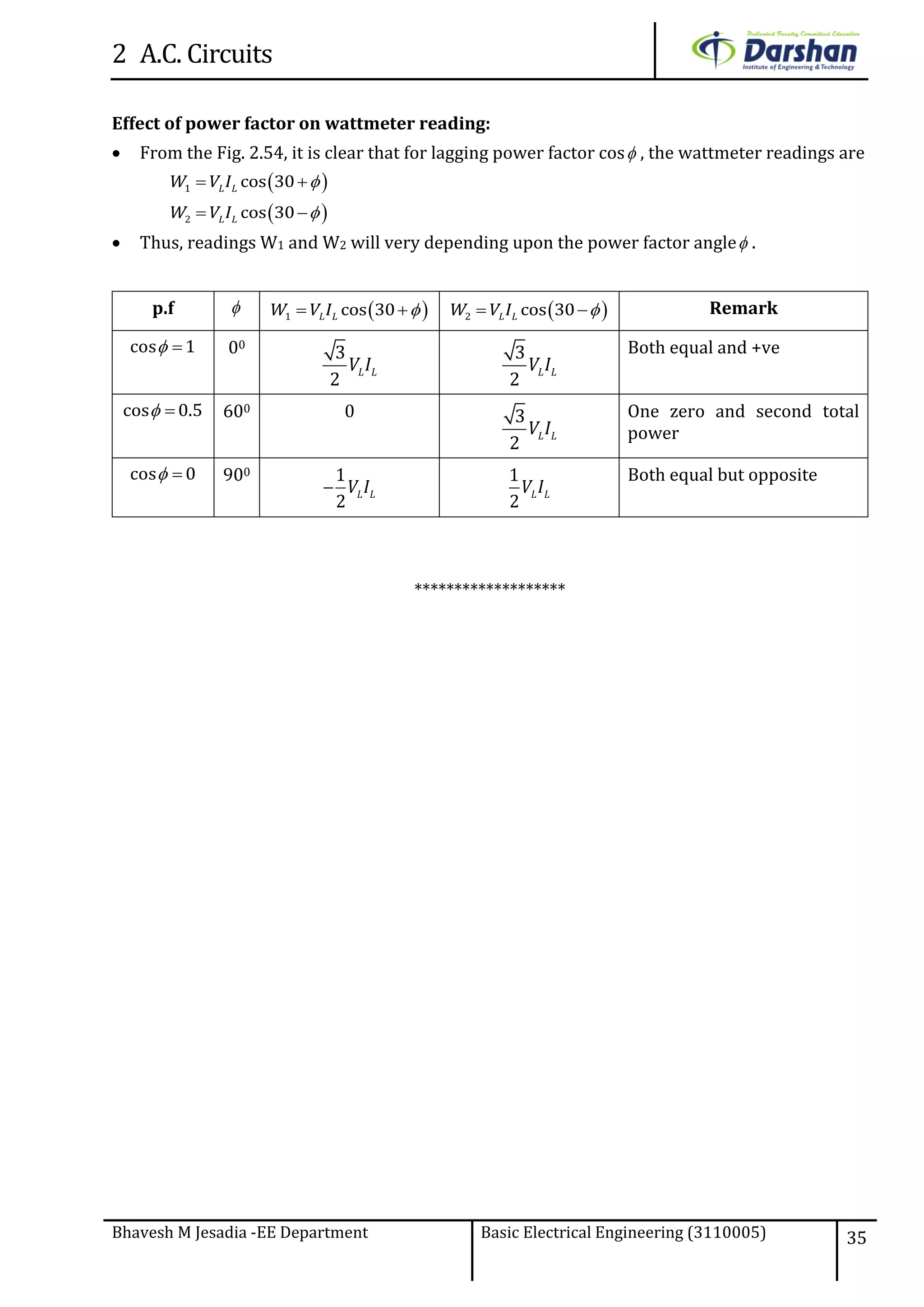
Effect of power factor on wattmeter reading:
 From the Fig. 2.54, it is clear that for lagging power factor cos , the wattmeter readings are
 1 cos 30L LW V I  
 2 cos 30L LW V I  
 Thus, readings W1 and W2 will very depending upon the power factor angle .
p.f   1 cos 30L LW V I    2 cos 30L LW V I   Remark
cos 1  00
3
2
L LV I
3
2
L LV I
Both equal and +ve
cos 0.5  600 0 3
2
L LV I
One zero and second total
power
cos 0  900 1
2
L LV I
1
2
L LV I
Both equal but opposite
*******************

Basic Electrical Engineering- AC Circuit

  • 1.
    2 A.C. Circuits BhaveshM Jesadia -EE Department Basic Electrical Engineering (3110005) 1 Single - Phase AC Circuits 2.1 Equation for generation of alternating induce EMF  An AC generator uses the principle of Faraday’s electromagnetic induction law. It states that when current carrying conductor cut the magnetic field then emf induced in the conductor.  Inside this magnetic field a single rectangular loop of wire rotes around a fixed axis allowing it to cut the magnetic flux at various angles as shown below figure 2.1. N S Axis of Rotation Axis of Rotation Magnetic Flux Magnetic Pole Wire Loop(Conductor) Wire Loop(Conductor) Figure 2.2.1 Generation of EMF Where, N =No. of turns of coil A = Area of coil (m2) ω=Angular velocity (radians/second) m= Maximum flux (wb)  When coil is along XX’ (perpendicular to the lines of flux), flux linking with coil= m. When coil is along YY’ (parallel to the lines of flux), flux linking with the coil is zero. When coil is making an angle  with respect to XX’ flux linking with coil,  = m cosωt [ = ωt]. SN ωt X X’ m cosωt m sinωt YY’ Figure 2.2 Alternating Induced EMF  According to Faraday’s law of electromagnetic induction, Where, 2            m m m m 2 m 2 E N N no. of turns of the coil B A B Maximum flux density (wb/m ) A Area of the coil (m ) f                    m m m m d e N dt ( cos t ) e Nd dt e N ( sin t ) e N sin t e E sin t
  • 2.
    2 A.C. Circuits BhaveshM Jesadia -EE Department Basic Electrical Engineering (3110005) 2  Similarly, an alternating current can be express as  mi I sin t Where, Im = Maximum values of current  Thus, both the induced emf and the induced current vary as the sine function of the phase angle   t . Shown in figure 2.3. A B C D E F G H 0/360 45 90 135 180 225 270 315 0 45 90 135 180 225 270 315 360 S N e ωt Figure 2.3 Waveform of Alternating Induced EMF Phase angle Induced emf  me E sin t 0 0 t 0e 0 90 t  me E 0 180 t 0e 0 270 t   me E 0 360 t 0e 2.2 Definitions  Waveform It is defined as the graph between magnitude of alternating quantity (on Y axis) against time (on X axis). Sine Wave Amplitude 0 +V -V Time Triangular Wave Amplitude 0 +V -V Time Square Wave Amplitude 0 +V -V Time Complex Wave Amplitude 0 +V -V Time Figure 2.4 A.C. Waveforms  Cycle It is defined as one complete set of positive, negative and zero values of an alternating quantity. me N B A2 f sin t   
  • 3.
    2 A.C. Circuits BhaveshM Jesadia -EE Department Basic Electrical Engineering (3110005) 3  Instantaneous value It is defined as the value of an alternating quantity at a particular instant of given time. Generally denoted by small letters. e.g. i= Instantaneous value of current v= Instantaneous value of voltage p= Instantaneous values of power  Amplitude/ Peak value/ Crest value/ Maximum value It is defined as the maximum value (either positive or negative) attained by an alternating quantity in one cycle. Generally denoted by capital letters. e.g. Im= Maximum Value of current Vm= Maximum value of voltage Pm= Maximum values of power  Average value It is defined as the average of all instantaneous value of alternating quantities over a half cycle. e.g. Vave = Average value of voltage Iave = Average value of current  RMS value It is the equivalent dc current which when flowing through a given circuit for a given time produces same amount of heat as produced by an alternating current when flowing through the same circuit for the same time. e.g. Vrms =Root Mean Square value of voltage Irms = Root Mean Square value of current  Frequency It is defined as number of cycles completed by an alternating quantity per second. Symbol is f. Unit is Hertz (Hz).  Time period It is defined as time taken to complete one cycle. Symbol is T. Unit is seconds.  Power factor It is defined as the cosine of angle between voltage and current. Power Factor = pf = cos, where  is the angle between voltage and current.  Active power It is the actual power consumed in any circuit. It is given by product of rms voltage and rms current and cosine angle between voltage and current. (VI cos). Active Power= P= I2R = VI cos. Unit is Watt (W) or kW.
  • 4.
    2 A.C. Circuits BhaveshM Jesadia -EE Department Basic Electrical Engineering (3110005) 4  Reactive power The power drawn by the circuit due to reactive component of current is called as reactive power. It is given by product of rms voltage and rms current and sine angle between voltage and current (VI sin). Reactive Power = Q= I2X = VIsin. Unit is VAR or kVAR.  Apparent power It is the product of rms value of voltage and rms value of current. It is total power supplied to the circuit. Apparent Power = S = VI. Unit is VA or kVA.  Peak factor/ Crest factor It is defined as the ratio of peak value (crest value or maximum value) to rms value of an alternating quantity. Peak factor = Kp = 1.414 for sine wave.  Form factor It is defined as the ratio of rms value to average value of an alternating quantity. Denoted by Kf. Form factor Kf = 1.11 for sine wave.  Phase difference It is defined as angular displacement between two zero values or two maximum values of the two-alternating quantity having same frequency. In Phase (  ) 0 +V -V t V(t) = Vmsinωt Positive Phase () 0 +V -V t V(t) = Vmsin(ωt+  Negative Phase (-) 0 +V -V t V(t) = Vmsin(ωt- - Figure 2.5 A.C. Phase Difference  Leading phase difference A quantity which attains its zero or positive maximum value before the compared to the other quantity.  Lagging phase difference A quantity which attains its zero or positive maximum value after the other quantity.
  • 5.
    2 A.C. Circuits BhaveshM Jesadia -EE Department Basic Electrical Engineering (3110005) 5 2.3 Derivation of average value and RMS value of sinusoidal AC signal  Average Value Graphical Method V1 Voltage Time Vm V2 V3 V4 V5 V6 V7 V8 V9 V10 180 /n Figure 2.6 Graphical Method for Average Value Analytical Method Area Under the CurveVoltage Time Vm Figure 2.7 Analytical Method for Average Value     0 0 0 2 0 637 m ave m ave m ave m ave ave m V Sin t d t V V V cos t V V cos cos V V V . V                   1 2 3 4 5 10 10       ave v v v v v ...... v V ave Area Under the Curve V Base of the Curve  ave Sum of All Instantaneous Values V Total No. of Values 
  • 6.
    2 A.C. Circuits BhaveshM Jesadia -EE Department Basic Electrical Engineering (3110005) 6  RMS Value Graphical Method V1 Voltage Time Vm V2 V3 V4 V5 V6 V7 V8 V9 V10 180 /n Figure 2.8 Graphical Method for RMS Value rms Sum of all sq. of instantaneous values V Total No. of Values Analytical Method + Vm Time + Vrms - Vrms - Vm Half Cycle One Full Cycle Voltage Figure 2.9 Analytical Method for RMS Value 2 2 2 2 2 2 1 2 3 4 5 10 10       rms v v v v v ...... v V rms Area under the sq. curve V Base of the curve   2 2 2 0 22 0 22 2 0 0 2 1 2 2 2 2 4 2 2 0 4 2 0 707                                 m rms m rms m rms m rms m rms rms m V Sin t d t V V ( cos t ) V d t V (sin t ) V t V V ( ) V V V . V
  • 7.
    2 A.C. Circuits BhaveshM Jesadia -EE Department Basic Electrical Engineering (3110005) 7 2.4 Phasor Representation of Alternating Quantities  Sinusoidal expression given as: v(t) = Vm sin (ωt ± Φ) representing the sinusoid in the time- domain form.  Phasor is a quantity that has both “Magnitude” and “Direction”. 0 60 90 120 150 180 210 240 270 300 330 360 30 30 60 90 120 150 180 210 240 270 300 330 360 t +Vm ωt Vector Ratotaion Rotating Phasor -Vm Sinusoidal Waveform in Time Domain v(t)=Vm sinωt ω rads /s Figure 2.10 Phasor Representation of Alternating Quantities Phase Difference of a Sinusoidal Waveform  The generalized mathematical expression to define these two sinusoidal quantities will be written as: Voltage (v) Current (i) +Vm +Im -Vm -Im 0 ωt  Figure 2.11 Wave Forms of Voltage & Current  V II LAG LEAD ω  Figure 2.12 Phasor Diagram of Voltage & Current  As show in the above voltage and current equations, the current, i is lagging the voltage, v by angle  .  So, the difference between the two sinusoidal quantities representing in waveform shown in Fig. 2.11 & phasors representing the two sinusoidal quantities is angle  and the resulting phasor diagram shown in Fig. 2.12. m m v V Sin t i I sin ( t )     
  • 8.
    2 A.C. Circuits BhaveshM Jesadia -EE Department Basic Electrical Engineering (3110005) 8 2.5 Purely Resistive Circuit  The Fig. 2.13 an AC circuit consisting of a pure resistor to which an alternating voltage vt=Vmsinωt is applied. Circuit Diagram VR It vt=Vmsinωt R Where, tv = Instantaneous Voltage mV = Maximum Voltage RV = Voltage across Resistance Figure 2.13 Pure Resistor Connected to AC Supply Equations for Voltage and Current  As show in the Fig. 2.13 voltage source t mv V Sin t   According to ohm’s law      t t m t t m v i R V sin t i R i I sin t  From above equations it is clear that current is in phase with voltage for purely resistive circuit. Waveforms and Phasor Diagram  The sinewave and vector representation of  t mv V Sin t & t mi I sin t  are given in Fig. 2.14 & 2.15. 0 ωt V,i vt=Vmsinωt it=Imsinωt Figure 2.14 Waveform of Voltage & Current for Pure Resistor IR VR ω Figure 2.15 Phasor Diagram of Voltage & Current for Pure Resistor
  • 9.
    2 A.C. Circuits BhaveshM Jesadia -EE Department Basic Electrical Engineering (3110005) 9 Power  The instantaneous value of power drawn by this circuit is given by the product of the instantaneous values of voltage and current. Instantaneous power 2 1 2 2            ( t ) ( t ) m m ( t ) m m m m ( t ) p v i p V sin t I sin t p V I sin t V I ( cos t ) p Average Power       2 0 2 2 0 0 1 2 2 2 2 4 2 2 0 0 0 4 2 2 2 m m ave m m ave m m ave m m ave m m ave ave rms rms ave V I ( cos t ) d t P V I (sin t ) P t V I P V I P V I P P V I P VI                                  The average power consumed by purely resistive circuit is multiplication of Vrms & Irms . 2.6 Purely Inductive Circuit  The Fig. 2.16 an AC circuit consisting of a pure Inductor to which an alternating voltage vt=Vmsinωt is applied. Circuit Diagram VL it vt=Vmsinωt L Figure 2.16 Pure Inductor Connected to AC Supply
  • 10.
    2 A.C. Circuits BhaveshM Jesadia -EE Department Basic Electrical Engineering (3110005) 10 Equations for Voltage and Current  As show in the Fig. 2.16 voltage source t mv V Sin t   Due to self-inductance of the coil, there will be emf indued in it. This back emf will oppose the instantaneous rise or fall of current through the coil, it is given by b di e -L dt   As, circuit does not contain any resistance, there is no ohmic drop and hence applied voltage is equal and opposite to back emf.               t b t t m m v -e di v L dt di v L dt di V sin t L dt V sin t dt di L  Integrate on both the sides, mV di sin t dt L            m t V cos t i L     m t V i cos t L  90         m t m m V i I sin t I L  From the above equations it is clear that the current lags the voltage by 900 in a purely inductive circuit. Waveform and Phasor Diagram 0 ωt v,i Vt=Vmsinωt It=Imsin(ωt- 90) 90 Vm Im Figure 2.17 Waveform of Voltage & Current for Pure Inductor V ω I 90 Figure 2.18 Phasor Diagram of Voltage & Current for Pure Inductor Power  The instantaneous value of power drawn by this circuit is given by the product of the instantaneous values of voltage and current. Instantaneous Power  90                 t t m m t m m m m t p v i p V sin t I sin t p V sin t ( I cos t ) 2V I sin t cos t p 2
  • 11.
    2 A.C. Circuits BhaveshM Jesadia -EE Department Basic Electrical Engineering (3110005) 11 2 2   m m t V I p sin t Average Power   2 0 2 0 2 2 2 2 4 2 4 0 8 0                       m m ave m m ave m m ave ave V I sin t P d t V I cos t P V I P cos cos P  The average power consumed by purely inductive circuit is zero. 2.7 Purely Capacitive Circuit  The Fig. 2.19 shows a capacitor of capacitance C farads connected to an a.c. voltage supply vt=Vmsinωt. Circuit Diagram VC it vt=Vmsinωt C q q + - Figure 2.19 Pure Capacitor Connected AC Supply Equations for Voltage & Current  As show in the Fig. 2.19 voltage source  t mv V Sin t  A pure capacitor having zero resistance. Thus, the alternating supply applied to the plates of the capacitor, the capacitor is charged.  If the charge on the capacitor plates at any instant is ‘q’ and the potential difference between the plates at any instant is ‘vt’ then we know that,    t m q Cv q CV sin t  The current is given by rate of change of charge.    t m t dq i dt dCV sin t i dt
  • 12.
    2 A.C. Circuits BhaveshM Jesadia -EE Department Basic Electrical Engineering (3110005) 12 1 90             t m m t m t c o m t m m c i CV sin t V i cos t / C V i cos t X V i I sin( t ) ( I ) X  From the above equations it is clear that the current leads the voltage by 900 in a purely capacitive circuit. Waveform and Phasor Diagram 0 ωt V,i vt=Vmsinωt it=Imsin(ωt+90) +90 Figure 2.20 Waveform of Voltage & Current for Pure Capacitor V ω I 90 Figure 2.21 Phasor Diagram of Voltage & Current for Pure Capacitor Power  The instantaneous value of power drawn by this circuit is given by the product of the instantaneous values of voltage and current. Instantaneous Power  90 2 2                    ( t ) ( t ) m m ( t ) m m ( t ) m m m m ( t ) m m ( t ) p v i p V sin t I sin t p V sin t I cos t p V I sin t cos t 2V I sin t cos t p 2 V I p sin t Average Power 2 0 2 2 2       m m ave V I sin t P d t
  • 13.
    2 A.C. Circuits BhaveshM Jesadia -EE Department Basic Electrical Engineering (3110005) 13   2 04 2 4 0 8 0                m m ave m m ave ave V I cos t P V I P cos cos P  The average power consumed by purely capacitive circuit is zero. 2.8 Series Resistance-Inductance (R-L) Circuit  Consider a circuit consisting of a resistor of resistance R ohms and a purely inductive coil of inductance L henry in series as shown in the Figure 2.22. vt=Vmsinωt it VLVR R L Figure 2.22 Circuit Diagram of Series R-L Circuit  In the series circuit, the current it flowing through R and L will be the same.  But the voltage across them will be different. The vector sum of voltage across resistor VR and voltage across inductor VL will be equal to supply voltage vt. Waveforms and Phasor Diagram  The voltage and current waves in R-L series circuit is shown in Fig. 2.23. 0 ωt V,i vt=Vmsinωt it=Imsin(ωt- )  Figure 2.23 Waveform of Voltage and Current of Series R-L Circuit  We know that in purely resistive the voltage and current both are in phase and therefore vector VR is drawn superimposed to scale onto the current vector and in purely inductive circuit the current I lag the voltage VL by 90o.  So, to draw the vector diagram, first I taken as the reference. This is shown in the Fig. 2.24. Next VR drawn in phase with I. Next VL is drawn 90o leading the I.  The supply voltage V is then phasor Addition of VR and VL.
  • 14.
    2 A.C. Circuits BhaveshM Jesadia -EE Department Basic Electrical Engineering (3110005) 14 R VR I VL I L VL ω IVR V= VL+ VR  Figure 2.24 Phasor Diagram of Series R-L Circuit  Thus, from the above, it can be said that the current in series R-L circuit lags the applied voltage V by an angle  . If supply voltage mv V Sin t      mi I sin t Where m m V I Z  Voltage Triangle  VR=I*R VL=I*XL V=I*Z Figure 2.25 Voltage Triangle Series R-L Circuit 2 2 2 2 2 2 2          2 R L L L L V V V ( IR ) ( IX ) I R X IZ where, Z R X Impedance Triangle  R XL Z Figure 2.26 Impedance Triangle Series R-L Circuit 2 2 1     L L Z R X X tan R Power Triangle  Real Power,P (Watt) ApparentPower,S (VA) ReactivePower,Q (VAr)Figure 2.27 Power Triangle Series R-L Circuit 2 2 2 Re cos Re sin L al Power P V I I R active Power Q V I I X Apparent Power S V I I Z         Power Factor R Power factor cos Z P S    
  • 15.
    2 A.C. Circuits BhaveshM Jesadia -EE Department Basic Electrical Engineering (3110005) 15 Power  The instantaneous value of power drawn by this circuit is given by the product of the instantaneous values of voltage and current. Instantaneous power                        t t m m t m m m m t p v i p V sin t I sin t p V I sin t sin t 2 V I sin t sin t p 2   2    m m t V I p cos - cos(2 t- )  Thus, the instantaneous values of the power consist of two components.  First component is constant w.r.t. time and second component vary with time. Average Power         2 0 2 0 2 2 0 0 2 2 0 0 2 1 2 2 4 4 2 2 4 4 8                                                      m m ave m m ave m m ave m m ave m m m m ave V I P cos - cos(2 t- ) d t V I P cos - cos(2 t- ) d t V I P cos d t- cos(2 t- ) d t V I sin(2 t- ) P cos t - V I V I P cos - sin        2 8 2 2 2 2                    m m m m ave m m ave m m ave m m ave sin V I V I P cos - sin sin V I P cos -0 V I P cos V I P cos  aveP VI cos
  • 16.
    2 A.C. Circuits BhaveshM Jesadia -EE Department Basic Electrical Engineering (3110005) 16 2.9 Series Resistance-Capacitance Circuit  Consider a circuit consisting of a resistor of resistance R ohms and a purely capacitive of capacitance farad in series as in the Fig. 2.28. vt=Vmsinωt it VCVR R C Figure 2.28 Circuit Diagram of Series R-C Circuit  In the series circuit, the current it flowing through R and C will be the same. But the voltage across them will be different.  The vector sum of voltage across resistor VR and voltage across capacitor VC will be equal to supply voltage vt. Waveforms and Phasor Diagram 0 ωt V,i vt=Vmsinωt it=Imsin(ωt+)  Figure 2.29 Waveform of Voltage and Current of Series R-C Circuit  We know that in purely resistive the voltage and current in a resistive circuit both are in phase and therefore vector VR is drawn superimposed to scale onto the current vector and in purely capacitive circuit the current I lead the voltage VC by 90o.  So, to draw the vector diagram, first I taken as the reference. This is shown in the Fig. 2.30. Next VR drawn in phase with I. Next VC is drawn 90o lagging the I. The supply voltage V is then phasor Addition of VR and VC. R VR I VC I C VC ω IVR V= VC+ VR -  Figure 2.30 Phasor Diagram of Series R-C Circuit
  • 17.
    2 A.C. Circuits BhaveshM Jesadia -EE Department Basic Electrical Engineering (3110005) 17  Thus, from the above equation it is clear that the current in series R-C circuit leads the applied voltage V by an angle  . If supply voltage  mv V Sin t     mi I sin t Where, m m V I Z  Voltage Triangle O A D VR=IR VC=I(-XC) V=IZ -  Figure 2.31 Voltage Triangle of Series R-C Circuit 2 2 2 2 2 2 2          2 R C C C C V V V ( IR ) ( IX ) I R X IZ where, Z R X Impedance Triangle R -XC Z -  Figure 2.32 Impedance Triangle Series R-L Circuit 2 2 1      C C Z R X X tan R Power Triangle ApparentPower,S (VA) -  ReactivePower,Q (VAr) Real Power,P (Watt) Figure 2.33 Power Triangle Series R-L Circuit 2 2 2         L Real Power, P V I cos I R Reactive Power, Q V I sin I X Apparent Power,S V I I Z Power Factor    R P p.f . cos or Z S Power  The instantaneous value of power drawn by this circuit is given by the product of the instantaneous values of voltage and current. Instantaneous power         2                          t t m m t m m m m t m m t p v i p V sin t I sin t p V I sin t sin t 2 V I sin t sin t p 2 V I p cos - cos(2 t )  Thus, the instantaneous values of the power consist of two components. First component remains constant w.r.t. time and second component vary with time.
  • 18.
    2 A.C. Circuits BhaveshM Jesadia -EE Department Basic Electrical Engineering (3110005) 18 Average Power         2 0 2 0 2 2 0 0 2 2 0 0 2 1 2 2 4 4 2 2 0 4 8                                                      m m ave m m ave m m ave m m ave m m m m ave V I P cos - cos(2 t+ ) d t V I P cos - cos(2 t+ ) d t V I P cos d t- cos(2 t+ ) d t V I sin(2 t+ ) P cos t - V I V I P cos -         4 2 8 2 2 2                   m m m m ave m m ave m m ave ave sin sin V I V I P cos - sin sin V I P cos -0 V I P cos P VI cos 2.10 Series RLC circuit  Consider a circuit consisting of a resistor of R ohm, pure inductor of inductance L henry and a pure capacitor of capacitance C farads connected in series. vt=Vmsinωt it VCVR R C VL L Figure 2.34 Circuit Diagram of Series RLC Circuit Phasor Diagram IVR VL VC Figure 2.35 Phasor Diagram of Series RLC Circuit Current I is taken as reference. VR is drawn in phase with current, VL is drawn leading I by 900, VC is drawn lagging I by 900
  • 19.
    2 A.C. Circuits BhaveshM Jesadia -EE Department Basic Electrical Engineering (3110005) 19  Since VL and VC are in opposition to each other, there can be two cases: (1) VL > VC (2) VL < VC Case-1 When, VL > VC, the phasor diagram would be as in the figure 2.36 Phasor Diagram ω IVR V  VL-VC Figure 2.36 Phasor Diagram of Series R-L-C Circuit for Case VL > VC         2 2 2 2 2 2 2              2 R L C L C L C L C V V V V ( IR ) I X X I R X X IZ where, Z R X X  The angle  by which V leads I is given by       1 1            L C L C L C V V tan R I X X tan IR X X tan R  Thus, when VL > VC the series current I lags V by angle  . If  t mv V Sin t     t mi I Sin t  Power consumed in this case is equal to series RL circuit  aveP VI cos . Case-2 When, VL < VC, the phasor diagram would be as in the figure 2.37 Phasor Diagram VC-VL ω IVR V -  Figure 2.37 Phasor Diagram of Series R-L-C Circuit for Case VL < VC         2 2 2 2 2 2 2              2 R C L C C L C L V V V V ( IR ) I X XL I R X X IZ where, Z R X X  The angle  by which V lags I is given by       1 1            C L C L C L V V tan R I X X tan IR X X tan R  Thus, when VL < VC the series current I leads V by angle  . If  t mv V Sin t     t mi I Sin t  Power consumed in this case is equal to series RC circuit  aveP VI cos .
  • 20.
    2 A.C. Circuits BhaveshM Jesadia -EE Department Basic Electrical Engineering (3110005) 20 2.11 Series resonance RLC circuit  Such a circuit shown in the Fig. 2.38 is connected to an A.C. source of constant supply voltage V but having variable frequency. vt=Vmsinωt it VCVR R C VL L f Figure 2.38 Circuit Diagram of Series Resonance RLC Circuit  The frequency can be varied from zero, increasing and approaching infinity. Since XL and XC are function of frequency, at a particular frequency of applied voltage, XL and XC will become equal in magnitude and power factor become unity. Since XL = XC ,  XL – XC = 0 2 0   Z R R  The circuit, when XL = XC and hence Z = R, is said to be in resonance. In a series circuit since current I remain the same throughout we can write, IXL = IXC i.e. VL = VC Phasor Diagram  Shown in the Fig. 2.39 is the phasor diagram of series resonance RLC circuit. IV=VR VL VC I V=VR Figure 2.39 Phasor Diagram of Series Resonance RLC Circuit  So, at resonance VL and VC will cancel out of each other. The supply voltage 2      2 R L C R V V (V V ) V V  i.e. the supply voltage will drop across the resistor R. Resonance Frequency  At resonance frequency XL = XC      r r r 1 2 f L f is the resonance frequency 2 f C
  • 21.
    2 A.C. Circuits BhaveshM Jesadia -EE Department Basic Electrical Engineering (3110005) 21   2 1 2 1 2       2 r r f LC f LC Q- Factor  The Q- factor is nothing but the voltage magnification during resonance.  It indicates as to how many times the potential difference across L or C is greater than the applied voltage during resonance.  Q- factor = Voltage magnification 2 1 2           L S L L r r r V Q Factor V IX X IR R L R f L But f R LC 1    L Q Factor R C Graphical Representation of Resonance  Resistance (R) is independent of frequency. Thus, it is represented by straight line.  Inductive reactance (XL) is directly proportional to frequency. Thus, it is increases linearly with the frequency.    2L L X fL X f   Capacitive reactance(XC) is inversely proportional to frequency. Thus, it is show as hyperbolic curve in fourth quadrant.    1 2 1 C C X fC X f   Impedance (Z) is minimum at resonance frequency.   22 For, , L C r Z R X X f f Z R       Current (I) is maximum at resonance frequency.    MAXFor , is maximum,Ir V I Z V f f I R
  • 22.
    2 A.C. Circuits BhaveshM Jesadia -EE Department Basic Electrical Engineering (3110005) 22  Power factor is unity at resonance frequency. Power factor=cos = For , . . 1 (unity)r R Z f f p f    -XC XL R Z I P.F. fr f cos 0 Figure 2.40 Graphical Representation of Series Resonance RLC Circuit 2.11 Parallel Resonance RLC Circuit  Fig. 2.41 Shows a parallel circuit consisting of an inductive coil with internal resistance R ohm and inductance L henry in parallel with capacitor C farads. vt=Vmsinωt it R C L IC IL Figure 2.41 Circuit Diagram of Parallel Resonance RLC Circuit IL sinL V IC L I= IL cosL IL Figure 2.42 Circuit Diagram of Parallel Resonance RLC Circuit  The current IC can be resolved into its active and reactive components. Its active component IL cos and reactive component IL sin.
  • 23.
    2 A.C. Circuits BhaveshM Jesadia -EE Department Basic Electrical Engineering (3110005) 23  A parallel circuit is said to be in resonance when the power factor of the circuit becomes unity. This will happen when the resultant current I is in phase with the resultant voltage V and hence the phase angle between them is zero.  In the phasor diagram shown, this will happen when IC = IL sin and I = IL cos . Resonance Frequency  To find the resonance frequency, we make use of the equation IC = IL sin.  If the resistance of the coil is negligible, 1 2 rf LC   Impedance  To find the resonance frequency, we make use of the equation I = IL cos because, at resonance, the supply current I will be in phase with the supply voltage V. 2       L L L 2L L I I cos V V R Z Z Z Z L Z But Z R C L Z RC  The impedance during parallel resonance is very large because of L and C has a very large value at that time. Thus, impedance at the resonance is maximum. V I will be minimum. Z      2 2 2 2 2 2 2 2 2 2 2 2 2 2 2 2 2 1 1 2 1 1 2                               C L L C L L L L C L r r r r r r I I sin XV V X Z Z Z X X 1 L Z f L f C C L R L C L R C L L L R f C L L R f LC L
  • 24.
    2 A.C. Circuits BhaveshM Jesadia -EE Department Basic Electrical Engineering (3110005) 24 Q-Factor  Q- factor = Current magnification 2 1 2 1                    L L L r r r I Q Factor I I sin sin I cos cos L tan R f L But f R LC L Q Factor R C Graphical representation of Parallel Resonance  Conductance (G) is independent of frequency. Hence it is represented by straight line parallel to frequency.  Inductive Susceptance (BL) is inversely proportional to the frequency. Also, it is negative. 1 1 1 , 2 L L L B B jX j fL f      Capacitive Susceptance (BC) is directly proportional to the frequency. 1 2 ,C C C C j B j fC B f jX X       -BL BC G I,Y Z P.F. fr f cos 0 Figure 2.43 Graphical Representation of Parallel Resonance RLC Circuit
  • 25.
    2 A.C. Circuits BhaveshM Jesadia -EE Department Basic Electrical Engineering (3110005) 25  Admittance (Y) is minimum at resonance frequency.   22 For, , L C r Y G B B f f Y G       Current (I) is minimum at resonance frequency. I VY  Power factor is unity at resonance frequency. Power factor=cos = G Y  2.12 Comparison of Series and Parallel Resonance Sr.No. Description Series Circuit Parallel Circuit 1 Impedance at resonance Minimum Z = R Maximum  L Z RC 2 Current Maximum V I R  Minimum / V I L RC  3 Resonance Frequency 1 2   rf LC 1 2   rf LC 4 Power Factor Unity Unity 5 Q- Factor 1 r L f R C 1 r L f R C 6 It magnifies at resonance Voltage Current
  • 26.
    2 A.C. Circuits BhaveshM Jesadia -EE Department Basic Electrical Engineering (3110005) 26 Three - Phase AC Circuits 2.13 Comparison between single phase and three phase Basis for Comparison Single Phase Three Phase Definition The power supply through one conductor. The power supply through three conductors. Wave Shape 0 360180 R 0 120 R 240 Y B Number of wire Require two wires for completing the circuit Requires four wires for completing the circuit Voltage Carry 230V Carry 415V Phase Name Split phase No other name Network Simple Complicated Loss Maximum Minimum Power Supply Connection Consumer Load R Y B N R Y B N Consumer Load Efficiency Less High Economical Less More Uses For home appliances. In large industries and for running heavy loads. 2.14 Generation of three phase EMF N S R YB Figure 2.44 Generation of three phase emf  According to Faraday’s law of electromagnetic induction, we know that whenever a coil is rotated in a magnetic field, there is a sinusoidal emf induced in that coil.
  • 27.
    2 A.C. Circuits BhaveshM Jesadia -EE Department Basic Electrical Engineering (3110005) 27  Now, we consider 3 coil C1(R-phase), C2(Y-phase) and C3(B-phase), which are displaced 1200 from each other on the same axis. This is shown in fig. 2.44.  The coils are rotating in a uniform magnetic field produced by the N and S pols in the counter clockwise direction with constant angular velocity.  According to Faraday’s law, emf induced in three coils. The emf induced in these three coils will have phase difference of 1200. i.e. if the induced emf of the coil C1 has phase of 00, then induced emf in the coil C2 lags that of C1 by 1200 and C3 lags that of C2 1200. 0 ωt 120 240 e e Em eR=Emsinωt eY=Emsin(ωt-120) eB=Emsin(ωt-240) Figure 2.45 Waveform of Three Phase EMF  Thus, we can write,     0 0 120 240         R m Y m B m e E sin t e E sin t e E sin t  The above equation can be represented by their phasor diagram as in the Fig. 2.46. 120 120 120 eR eY eB Figure 2.46 Phasor Diagram of Three Phase EMF 2.15 Important definitions  Phase Voltage It is defined as the voltage across either phase winding or load terminal. It is denoted by Vph. Phase voltage VRN, VYN and VBN are measured between R-N, Y-N, B-N for star connection and between R-Y, Y-B, B-R in delta connection.
  • 28.
    2 A.C. Circuits BhaveshM Jesadia -EE Department Basic Electrical Engineering (3110005) 28  Line voltage It is defined as the voltage across any two-line terminal. It is denoted by VL. Line voltage VRY, VYB, VBR measure between R-Y, Y-B, B-R terminal for star and delta connection both. R Y B VRY(line) VYB(line) VBR(line) IR(line) IY(line) IB(line) VYN(ph) VBN(ph) VRN(ph) IR(ph) IY(ph) IB(ph) N Figure 2.47 Three Phase Star Connection System R Y B VRY(line) VYB(line) VBR(line) IR(line) IY(line) IB(line) VY(ph) VR(ph) IR (ph) VB(ph) IY(ph) IB(ph) 2 3 1 Figure 2.48 Three Phase Delta Connection System  Phase current It is defined as the current flowing through each phase winding or load. It is denoted by Iph. Phase current IR(ph), IY(ph) and IB(Ph) measured in each phase of star and delta connection. respectively.  Line current It is defined as the current flowing through each line conductor. It denoted by IL. Line current IR(line), IY(line), and IB((line) are measured in each line of star and delta connection.  Phase sequence The order in which three coil emf or currents attain their peak values is called the phase sequence. It is customary to denoted the 3 phases by the three colours. i.e. red (R), yellow (Y), blue (B).  Balance System A system is said to be balance if the voltages and currents in all phase are equal in magnitude and displaced from each other by equal angles.  Unbalance System A system is said to be unbalance if the voltages and currents in all phase are unequal in magnitude and displaced from each other by unequal angles.  Balance load In this type the load in all phase are equal in magnitude. It means that the load will have the same power factor equal currents in them.  Unbalance load In this type the load in all phase have unequal power factor and currents.
  • 29.
    2 A.C. Circuits BhaveshM Jesadia -EE Department Basic Electrical Engineering (3110005) 29 2.16 Relation between line and phase values for voltage and current in case of balanced delta connection.  Delta (Δ) or Mesh connection, starting end of one coil is connected to the finishing end of other phase coil and so on which giving a closed circuit. Circuit Diagram R Y B VRY VYB VBR IR(line) IY(line) IB(line) VY(ph) VB(ph) IB (ph) VR(ph) IY(ph) IR(ph) 2 3 1 Figure 2.49 Three Phase Delta Connection  Let,                   Line voltage, Phase voltage, Line current, Phase current, RY YB BR L phR ph Y ph B ph lineR line Y line B line phR ph Y ph B ph V V V V V V V V I I I I I I I I             Relation between line and phase voltage  For delta connection line voltage VL and phase voltage Vph both are same. ( ) ( ) ( ) RY R ph YB Y ph BR B ph L ph V V V V V V V V      Line voltage = Phase Voltage Relation between line and phase current  For delta connection,                   R R B Y Y R B B Y I =I I I =I I I I I line ph ph line ph ph line ph ph      i.e. current in each line is vector difference of two of the phase currents.
  • 30.
    2 A.C. Circuits BhaveshM Jesadia -EE Department Basic Electrical Engineering (3110005) 30 60 IR(ph) IY(ph) -IY(ph) -IR(ph) IB(ph) -IB(ph) 6060 IR(line)IY(line) IB(line) Figure 2.50 Phasor Diagram of Three Phase Delta Connection  So, considering the parallelogram formed by IR and IB.           2 2 R R B R B 2 2 2 2 2 2 I = I I 2I I cos I I I 2I I cos60 1 I I I 2I 2 I 3I I 3I line ph ph ph ph L ph ph ph ph L ph ph ph L ph L ph                      Similarly,    Y B I I 3 phline line I   Thus, in delta connection Line current = 3 Phase current Power P V I cos V I cos V I cos P 3V I cos I P 3V cos 3 P 3V I cos ph ph ph ph ph ph ph ph L L L L                   
  • 31.
    2 A.C. Circuits BhaveshM Jesadia -EE Department Basic Electrical Engineering (3110005) 31 2.17 Relation between line and phase values for voltage and current in case of balanced star connection.  In the Star Connection, the similar ends (either start or finish) of the three windings are connected to a common point called star or neutral point. Circuit Diagram R Y B VRY VYB VBR IR(line) IY(line) VB(ph) VY(ph) VR(ph) IR(ph) IB(ph) IY(ph) N IB(line) Figure 2.51 Circuit Diagram of Three Phase Star Connection  Let,                   line voltage, phase voltage, line current, phase current, RY BY BR L phR ph Y ph B ph lineR line Y line B line phR ph Y ph B ph V V V V V V V V I I I I I I I I             Relation between line and phase voltage  For star connection, line current IL and phase current Iph both are same. ( ) ( ) ( ) ( ) ( ) ( ) I I R line R ph Y line Y ph B line B ph L ph I I I I I I      Line Current = Phase Current Relation between line and phase voltage  For delta connection,
  • 32.
    2 A.C. Circuits BhaveshM Jesadia -EE Department Basic Electrical Engineering (3110005) 32             R Y YB Y B BR B R V =V V V =V V V =V V RY ph ph ph ph ph ph     i.e. line voltage is vector difference of two of the phase voltages. Hence, 60 VR(PH) VY(PH) -VY(PH) -VR(PH) VB(PH) -VB(PH) 60 60 VRY VYB VBR Figure 2.52 Phasor Diagram of Three Phase Star Connection           2 2 RY R Y R Y 2 2 2 2 2 2 From parallelogram, V = V V 2V V cos V V V 2V V cos60 1V V V 2V 2 V 3V V 3V ph ph ph ph L ph ph ph ph L ph ph ph L ph L ph                 Similarly, YB BRV 3 VphV   Thus, in star connection Line voltage = 3 Phase voltage Power cos cos cos 3 cos 3 cos 3 3 cos ph ph ph ph ph ph ph ph L L L L P V I V I V I P V I V P I P V I                   
  • 33.
    2 A.C. Circuits BhaveshM Jesadia -EE Department Basic Electrical Engineering (3110005) 33 2.18 Measurement of power in balanced 3-phase circuit by two-watt meter method  This is the method for 3-phase power measurement in which sum of reading of two wattmeter gives total power of system. Circuit Diagram R VRY IR(line) Y Z1 Z2 B IB(lline) IY(line) VBY M L C V M L C V Z3 Figure 2.53 Circuit Diagram of Power Measurement by Two-Watt Meter in Three Phase Star Connection  The load is considered as an inductive load and thus, the phasor diagram of the inductive load is drawn below in Fig. 2.54. VY VR VB VRY -VY 30 0 VBY I R IY I B 30 0    Figure 2.54 Phasor Diagram of Power Measurement by Two-Watt Meter in Three Phase Star Connection
  • 34.
    2 A.C. Circuits BhaveshM Jesadia -EE Department Basic Electrical Engineering (3110005) 34  The three voltages VRN, VYN and VBN, are displaced by an angle of 1200 degree electrical as shown in the phasor diagram. The phase current lag behind their respective phase voltages by an angle  . The power measured by the Wattmeter, W1 and W2. Reading of wattmeter,  1 1cos cos 30RY R L LW V I V I    Reading of wattmeter,  2 2cos cos 30BY B L LW V I V I    Total power, P = W1+W2             cos 30 cos 30 cos 30 cos 30 = cos30cos sin30sin cos30cos sin30sin 2cos30cos 3 2 cos 2 3 cos L L L L L L L L L L L L L L P V I V I V I V I V I V I V I                                         Thus, the sum of the readings of the two wattmeter is equal to the power absorbed in a 3- phase balanced system. Determination of Power Factor from Wattmeter Readings  As we know that 1 2 3 cosL LW W V I   Now,         1 2 cos 30 cos 30 cos30cos sin30sin cos30cos sin30sin 2sin30sin 1 2 sin sin 2 L L L L L L L L L L L L W W V I V I V I V I V I V I                                      1 2 1 2 1 2 1 2 3 3 sin tan 3 cos 3 tan L L L L W W V I W W V I W W W W               Power factor of load given as,     1 21 1 2 3 cos cos tan W W W W           
  • 35.
    2 A.C. Circuits BhaveshM Jesadia -EE Department Basic Electrical Engineering (3110005) 35 Effect of power factor on wattmeter reading:  From the Fig. 2.54, it is clear that for lagging power factor cos , the wattmeter readings are  1 cos 30L LW V I    2 cos 30L LW V I    Thus, readings W1 and W2 will very depending upon the power factor angle . p.f   1 cos 30L LW V I    2 cos 30L LW V I   Remark cos 1  00 3 2 L LV I 3 2 L LV I Both equal and +ve cos 0.5  600 0 3 2 L LV I One zero and second total power cos 0  900 1 2 L LV I 1 2 L LV I Both equal but opposite *******************