Downloaded 314 times
![VIEWS ON EQUIVALENCEVIEWS ON EQUIVALENCE
translation studies: the contemporary theory of
“partial communication”: communication does not
transfer the total message the translating process
does not transfer the totality of what is in the original
“the ideal of total equivalence is a chimera. Languages
are different from each other; they are different in form
having distinct codes and rules regulating the
construction of grammatical stretches of language and
these forms have different meanings.[...]There is no
absolute synonymy between words in the same
language, so why should anyone be surprised to
discover a lack of synonymy between languages?”
(Bell, 1991:6)](https://image.slidesharecdn.com/textualequivalence-130506090422-phpapp01/85/Textual-equivalence-3-320.jpg)
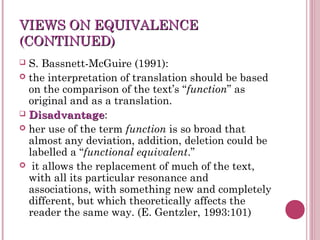
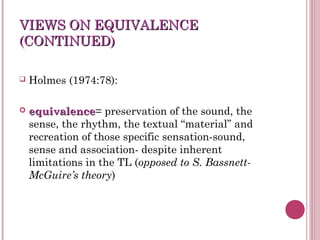
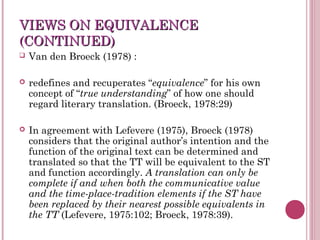
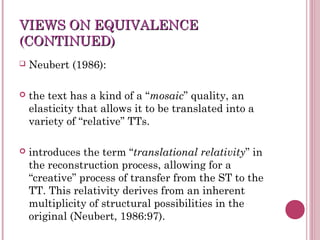
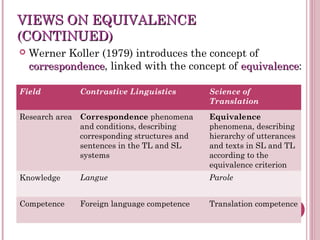
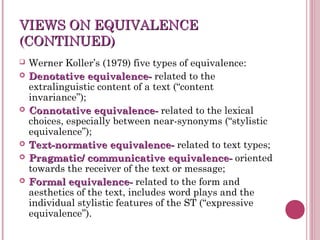
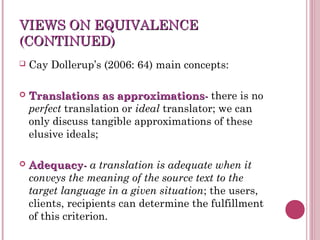
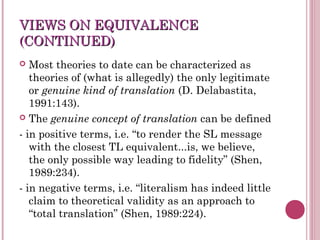

Views on equivalence in translation theory have evolved over time. Early views focused on achieving total equivalence between source and target texts, but it is now recognized that complete equivalence is impossible due to inherent differences between languages. More recent approaches view translation as establishing functional or dynamic equivalence, where the goal is to produce a similar effect on the target language reader as the original text had on its own readers. Theories also take into account the target language and culture in evaluating a translation. There is no single definition of equivalence, but most modern views see translations as approximations that aim to adequately convey the original meaning.


