Equivalence
and equivalent effect
LESSON 2
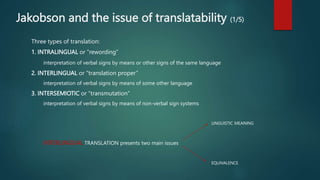
Jakobson and the issue of translatability (1/5)
Three types of translation:
1. INTRALINGUAL or “rewording”
interpretation of verbal signs by means or other signs of the same language
2. INTERLINGUAL or “translation proper”
interpretation of verbal signs by means of some other language
3. INTERSEMIOTIC or “transmutation”
interpretation of verbal signs by means of non-verbal sign systems
LINGUISTIC MEANING
INTERLINGUAL TRANSLATION presents two main issues
EQUIVALENCE
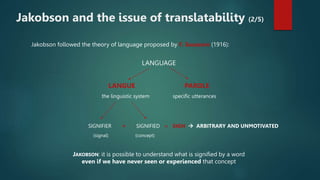
Jakobson followed the theory of language proposed by F. Saussure (1916):
LANGUAGE
LANGUE PAROLE
the linguistic system specific utterances
SIGNIFIER + SIGNIFIED = SIGN  ARBITRARY AND UNMOTIVATED
(signal) (concept)
JAKOBSON: it is possible to understand what is signified by a word
even if we have never seen or experienced that concept
Jakobson and the issue of translatability (2/5)
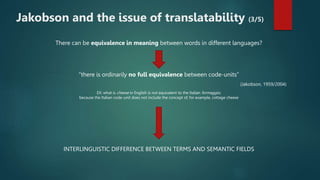
There can be equivalence in meaning between words in different languages?
“there is ordinarily no full equivalence between code-units”
(Jakobson, 1959/2004)
EX: what is cheese in English is not equivalent to the Italian formaggio,
because the Italian code-unit does not include the concept of, for example, cottage cheese
INTERLINGUISTIC DIFFERENCE BETWEEN TERMS AND SEMANTIC FIELDS
Jakobson and the issue of translatability (3/5)
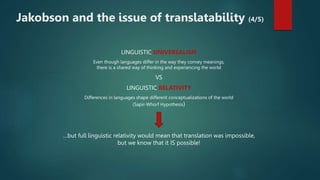
LINGUISTIC UNIVERSALISM
Even though languages differ in the way they convey meanings,
there is a shared way of thinking and experiencing the world
VS
LINGUISTIC RELATIVITY
Differences in languages shape different conceptualizations of the world
(Sapir-Whorf Hypothesis)
…but full linguistic relativity would mean that translation was impossible,
but we know that it IS possible!
Jakobson and the issue of translatability (4/5)
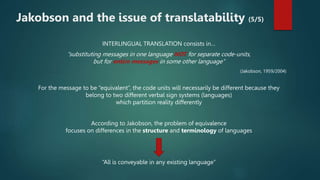
INTERLINGUAL TRANSLATION consists in…
“substituting messages in one language NOT for separate code-units,
but for entire messages in some other language”
(Jakobson, 1959/2004)
For the message to be “equivalent”, the code units will necessarily be different because they
belong to two different verbal sign systems (languages)
which partition reality differently
According to Jakobson, the problem of equivalence
focuses on differences in the structure and terminology of languages
“All is conveyable in any existing language”
Jakobson and the issue of translatability (5/5)
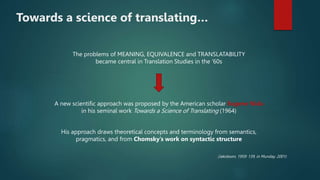
The problems of MEANING, EQUIVALENCE and TRANSLATABILITY
became central in Translation Studies in the ‘60s
A new scientific approach was proposed by the American scholar Eugene Nida
in his seminal work Towards a Science of Translating (1964)
His approach draws theoretical concepts and terminology from semantics,
pragmatics, and from Chomsky’s work on syntactic structure
(Jakobson, 1959: 139, in Munday, 2001)
Towards a science of translating…
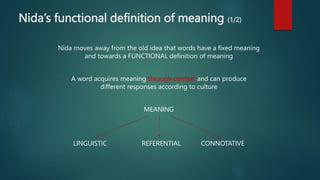
Nida’s functional definition of meaning (1/2)
Nida moves away from the old idea that words have a fixed meaning
and towards a FUNCTIONAL definition of meaning
A word acquires meaning through context and can produce
different responses according to culture
MEANING
LINGUISTIC REFERENTIAL CONNOTATIVE
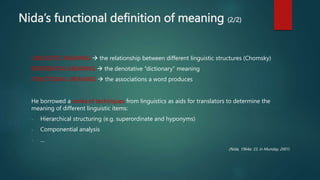
Nida’s functional definition of meaning (2/2)
LINGUISTIC MEANING  the relationship between different linguistic structures (Chomsky)
REFERENTIAL MEANING  the denotative “dictionary” meaning
FUNCTIONAL MEANING  the associations a word produces
He borrowed a series of techniques from linguistics as aids for translators to determine the
meaning of different linguistic items:
- Hierarchical structuring (e.g. superordinate and hyponyms)
- Componential analysis
- …
(Nida, 1964a: 33, in Munday, 2001)
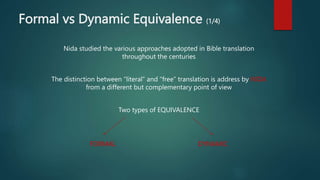
Formal vs Dynamic Equivalence (1/4)
Nida studied the various approaches adopted in Bible translation
throughout the centuries
The distinction between “literal” and “free” translation is address by NIDA
from a different but complementary point of view
Two types of EQUIVALENCE
FORMAL DYNAMIC
Formal vs Dynamic Equivalence (2/4)
FORMAL EQUIVALENCE:
“focuses attention on the message itself, in both form and content […] One is concerned that the
message in the receptor language should match as closely as possible the different elements in
the source language”
DYNAMIC EQUIVALENCE:
based on what he calls ‘the principle of equivalent effect’, where the “relationship between
receptor and message should be substantially the same as that which existed between the
original receptors and the message. […] The message “aims at a complete naturalness of
expression”
(Nida, 1964a: 159, in Munday, 2001)
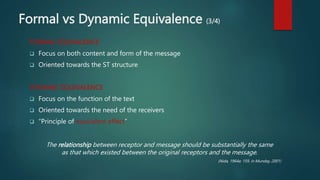
Formal vs Dynamic Equivalence (3/4)
FORMAL EQUIVALENCE
 Focus on both content and form of the message
 Oriented towards the ST structure
DYNAMIC EQUIVALENCE
 Focus on the function of the text
 Oriented towards the need of the receivers
 “Principle of equivalent effect”
The relationship between receptor and message should be substantially the same
as that which existed between the original receptors and the message.
(Nida, 1964a: 159, in Munday, 2001)
Formal vs Dynamic Equivalence (4/4)
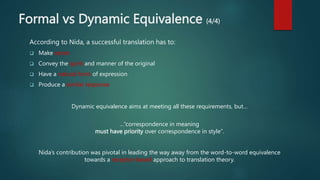
According to Nida, a successful translation has to:
 Make sense
 Convey the spirit and manner of the original
 Have a natural form of expression
 Produce a similar response
Dynamic equivalence aims at meeting all these requirements, but…
…“correspondence in meaning
must have priority over correspondence in style”.
Nida’s contribution was pivotal in leading the way away from the word-to-word equivalence
towards a receptor-based approach to translation theory.
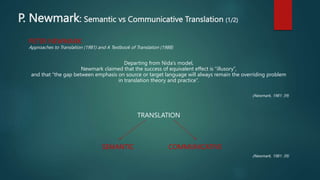
P. Newmark: Semantic vs Communicative Translation (1/2)
PETER NEWMARK
Approaches to Translation (1981) and A Textbook of Translation (1988)
Departing from Nida’s model,
Newmark claimed that the success of equivalent effect is “illusory”,
and that “the gap between emphasis on source or target language will always remain the overriding problem
in translation theory and practice”.
(Newmark, 1981: 39)
TRANSLATION
SEMANTIC COMMUNICATIVE
(Newmark, 1981: 39)
P. Newmark: Semantic vs Communicative Translation (2/2)
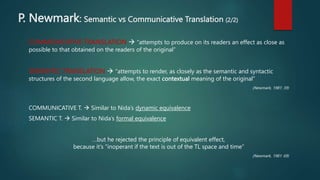
COMMUNICATIVE TRANSLATION  “attempts to produce on its readers an effect as close as
possible to that obtained on the readers of the original”
SEMANTIC TRANSLATION  “attempts to render, as closely as the semantic and syntactic
structures of the second language allow, the exact contextual meaning of the original”
(Newmark, 1981: 39)
COMMUNICATIVE T.  Similar to Nida’s dynamic equivalence
SEMANTIC T.  Similar to Nida’s formal equivalence
…but he rejected the principle of equivalent effect,
because it’s “inoperant if the text is out of the TL space and time”
(Newmark, 1981: 69)
Skopos Theory (1/5)
KATHARINA REISS & HANS J. VERMEER
Grundlegung einer allgemeine Translationstheorie (1984)
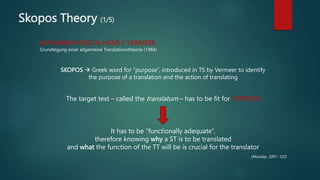
SKOPOS  Greek word for “purpose”, introduced in TS by Vermeer to identify
the purpose of a translation and the action of translating
The target text – called the translatum – has to be fit for PURPOSE
It has to be “functionally adequate”,
therefore knowing why a ST is to be translated
and what the function of the TT will be is crucial for the translator
(Munday, 2001: 122)
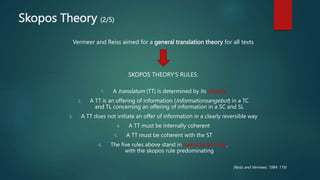
Skopos Theory (2/5)
Vermeer and Reiss aimed for a general translation theory for all texts
SKOPOS THEORY’S RULES:
1. A translatum (TT) is determined by its skopos
2. A TT is an offering of information (Informationsangebot) in a TC
and TL concerning an offering of information in a SC and SL
3. A TT does not initiate an offer of information in a clearly reversible way
4. A TT must be internally coherent
5. A TT must be coherent with the ST
6. The five rules above stand in hierarchical order,
with the skopos rule predominating
(Reiss and Vermeer, 1984: 119)
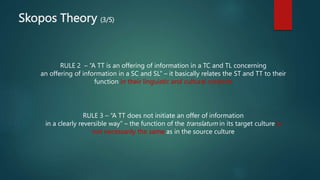
Skopos Theory (3/5)
RULE 2 – “A TT is an offering of information in a TC and TL concerning
an offering of information in a SC and SL” – it basically relates the ST and TT to their
function in their linguistic and cultural contexts
RULE 3 – “A TT does not initiate an offer of information
in a clearly reversible way” – the function of the translatum in its target culture is
not necessarily the same as in the source culture
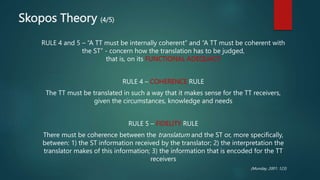
Skopos Theory (4/5)
RULE 4 and 5 – “A TT must be internally coherent” and “A TT must be coherent with
the ST” - concern how the translation has to be judged,
that is, on its FUNCTIONAL ADEQUACY
RULE 4 – COHERENCE RULE
The TT must be translated in such a way that it makes sense for the TT receivers,
given the circumstances, knowledge and needs
RULE 5 – FIDELITY RULE
There must be coherence between the translatum and the ST or, more specifically,
between: 1) the ST information received by the translator; 2) the interpretation the
translator makes of this information; 3) the information that is encoded for the TT
receivers
(Munday, 2001: 123)
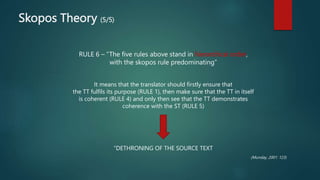
Skopos Theory (5/5)
RULE 6 – “The five rules above stand in hierarchical order,
with the skopos rule predominating”
It means that the translator should firstly ensure that
the TT fulfils its purpose (RULE 1), then make sure that the TT in itself
is coherent (RULE 4) and only then see that the TT demonstrates
coherence with the ST (RULE 5)
“DETHRONING OF THE SOURCE TEXT
(Munday, 2001: 123)
Summary
- We examined important questions of translating raised by linguists in the ‘50 and ’60.
- Jakobson discussed the key issues of “meaning” and “equivalence”,
which Nida further developed
- Nida claimed that a translation should aim for “equivalent effect”
- Nida suggested the dichotomy “formal” VS “dynamic” equivalence (moving away from the old
concepts of literal VS free translation) and focused on the receiver
- Newmark proposed his model of semantic vs communicative translation,
rejecting the principle of equivalent effect
References
BAKER, M. 1992. In Other Words – A coursebook on Translation. London and New York: Routledge.
JAKOBSON, R. 1959. “On linguistic aspects of translation”, in Lawrence Venuti (ed). 2004. The
Translation Studies Reader. London and New York: Routledge.
MUNDAY, J. 2001. Introducing Translation Studies. Theories and Applications. London and New
York: Routledge.
NEWMARK, P. 1981. Approaches to Translation. Oxford and New York: Pergamon.
NEWMARK, P. 1988. A Textbook of Translation. New York and London: Prentice Hall.
NIDA, E. 1964a. Towards a Science of Translating. Leiden: E. J. Brill.
NIDA, E. 1964a/2004. “Principles or Correspondence” in in Lawrence Venuti (ed). 2004. The Translation
Studies Reader. London and New York: Routledge.
REISS, K. and H. J. Vermeer. 1984. Grundlegung einer allgemeine Translationstheorie.
Tübingen: Niemeyer.
VERMEER, H. 1989. “Skopos and commission in translation action”, in Lawrence Venuti (ed).
2004. The Translation Studies Reader. London and New York: Routledge
THANKS FOR YOUR ATTENTION!
PROF.SSA LAURA LIUCCI
laura.liucci@uniroma2.it

Equivalent Effect in Javanese Translation.ppt

  • 1.
  • 2.
    Jakobson and theissue of translatability (1/5) Three types of translation: 1. INTRALINGUAL or “rewording” interpretation of verbal signs by means or other signs of the same language 2. INTERLINGUAL or “translation proper” interpretation of verbal signs by means of some other language 3. INTERSEMIOTIC or “transmutation” interpretation of verbal signs by means of non-verbal sign systems LINGUISTIC MEANING INTERLINGUAL TRANSLATION presents two main issues EQUIVALENCE
  • 3.
    Jakobson followed thetheory of language proposed by F. Saussure (1916): LANGUAGE LANGUE PAROLE the linguistic system specific utterances SIGNIFIER + SIGNIFIED = SIGN  ARBITRARY AND UNMOTIVATED (signal) (concept) JAKOBSON: it is possible to understand what is signified by a word even if we have never seen or experienced that concept Jakobson and the issue of translatability (2/5)
  • 4.
    There can beequivalence in meaning between words in different languages? “there is ordinarily no full equivalence between code-units” (Jakobson, 1959/2004) EX: what is cheese in English is not equivalent to the Italian formaggio, because the Italian code-unit does not include the concept of, for example, cottage cheese INTERLINGUISTIC DIFFERENCE BETWEEN TERMS AND SEMANTIC FIELDS Jakobson and the issue of translatability (3/5)
  • 5.
    LINGUISTIC UNIVERSALISM Even thoughlanguages differ in the way they convey meanings, there is a shared way of thinking and experiencing the world VS LINGUISTIC RELATIVITY Differences in languages shape different conceptualizations of the world (Sapir-Whorf Hypothesis) …but full linguistic relativity would mean that translation was impossible, but we know that it IS possible! Jakobson and the issue of translatability (4/5)
  • 6.
    INTERLINGUAL TRANSLATION consistsin… “substituting messages in one language NOT for separate code-units, but for entire messages in some other language” (Jakobson, 1959/2004) For the message to be “equivalent”, the code units will necessarily be different because they belong to two different verbal sign systems (languages) which partition reality differently According to Jakobson, the problem of equivalence focuses on differences in the structure and terminology of languages “All is conveyable in any existing language” Jakobson and the issue of translatability (5/5)
  • 7.
    The problems ofMEANING, EQUIVALENCE and TRANSLATABILITY became central in Translation Studies in the ‘60s A new scientific approach was proposed by the American scholar Eugene Nida in his seminal work Towards a Science of Translating (1964) His approach draws theoretical concepts and terminology from semantics, pragmatics, and from Chomsky’s work on syntactic structure (Jakobson, 1959: 139, in Munday, 2001) Towards a science of translating…
  • 8.
    Nida’s functional definitionof meaning (1/2) Nida moves away from the old idea that words have a fixed meaning and towards a FUNCTIONAL definition of meaning A word acquires meaning through context and can produce different responses according to culture MEANING LINGUISTIC REFERENTIAL CONNOTATIVE
  • 9.
    Nida’s functional definitionof meaning (2/2) LINGUISTIC MEANING  the relationship between different linguistic structures (Chomsky) REFERENTIAL MEANING  the denotative “dictionary” meaning FUNCTIONAL MEANING  the associations a word produces He borrowed a series of techniques from linguistics as aids for translators to determine the meaning of different linguistic items: - Hierarchical structuring (e.g. superordinate and hyponyms) - Componential analysis - … (Nida, 1964a: 33, in Munday, 2001)
  • 10.
    Formal vs DynamicEquivalence (1/4) Nida studied the various approaches adopted in Bible translation throughout the centuries The distinction between “literal” and “free” translation is address by NIDA from a different but complementary point of view Two types of EQUIVALENCE FORMAL DYNAMIC
  • 11.
    Formal vs DynamicEquivalence (2/4) FORMAL EQUIVALENCE: “focuses attention on the message itself, in both form and content […] One is concerned that the message in the receptor language should match as closely as possible the different elements in the source language” DYNAMIC EQUIVALENCE: based on what he calls ‘the principle of equivalent effect’, where the “relationship between receptor and message should be substantially the same as that which existed between the original receptors and the message. […] The message “aims at a complete naturalness of expression” (Nida, 1964a: 159, in Munday, 2001)
  • 12.
    Formal vs DynamicEquivalence (3/4) FORMAL EQUIVALENCE  Focus on both content and form of the message  Oriented towards the ST structure DYNAMIC EQUIVALENCE  Focus on the function of the text  Oriented towards the need of the receivers  “Principle of equivalent effect” The relationship between receptor and message should be substantially the same as that which existed between the original receptors and the message. (Nida, 1964a: 159, in Munday, 2001)
  • 13.
    Formal vs DynamicEquivalence (4/4) According to Nida, a successful translation has to:  Make sense  Convey the spirit and manner of the original  Have a natural form of expression  Produce a similar response Dynamic equivalence aims at meeting all these requirements, but… …“correspondence in meaning must have priority over correspondence in style”. Nida’s contribution was pivotal in leading the way away from the word-to-word equivalence towards a receptor-based approach to translation theory.
  • 14.
    P. Newmark: Semanticvs Communicative Translation (1/2) PETER NEWMARK Approaches to Translation (1981) and A Textbook of Translation (1988) Departing from Nida’s model, Newmark claimed that the success of equivalent effect is “illusory”, and that “the gap between emphasis on source or target language will always remain the overriding problem in translation theory and practice”. (Newmark, 1981: 39) TRANSLATION SEMANTIC COMMUNICATIVE (Newmark, 1981: 39)
  • 15.
    P. Newmark: Semanticvs Communicative Translation (2/2) COMMUNICATIVE TRANSLATION  “attempts to produce on its readers an effect as close as possible to that obtained on the readers of the original” SEMANTIC TRANSLATION  “attempts to render, as closely as the semantic and syntactic structures of the second language allow, the exact contextual meaning of the original” (Newmark, 1981: 39) COMMUNICATIVE T.  Similar to Nida’s dynamic equivalence SEMANTIC T.  Similar to Nida’s formal equivalence …but he rejected the principle of equivalent effect, because it’s “inoperant if the text is out of the TL space and time” (Newmark, 1981: 69)
  • 16.
    Skopos Theory (1/5) KATHARINAREISS & HANS J. VERMEER Grundlegung einer allgemeine Translationstheorie (1984) SKOPOS  Greek word for “purpose”, introduced in TS by Vermeer to identify the purpose of a translation and the action of translating The target text – called the translatum – has to be fit for PURPOSE It has to be “functionally adequate”, therefore knowing why a ST is to be translated and what the function of the TT will be is crucial for the translator (Munday, 2001: 122)
  • 17.
    Skopos Theory (2/5) Vermeerand Reiss aimed for a general translation theory for all texts SKOPOS THEORY’S RULES: 1. A translatum (TT) is determined by its skopos 2. A TT is an offering of information (Informationsangebot) in a TC and TL concerning an offering of information in a SC and SL 3. A TT does not initiate an offer of information in a clearly reversible way 4. A TT must be internally coherent 5. A TT must be coherent with the ST 6. The five rules above stand in hierarchical order, with the skopos rule predominating (Reiss and Vermeer, 1984: 119)
  • 18.
    Skopos Theory (3/5) RULE2 – “A TT is an offering of information in a TC and TL concerning an offering of information in a SC and SL” – it basically relates the ST and TT to their function in their linguistic and cultural contexts RULE 3 – “A TT does not initiate an offer of information in a clearly reversible way” – the function of the translatum in its target culture is not necessarily the same as in the source culture
  • 19.
    Skopos Theory (4/5) RULE4 and 5 – “A TT must be internally coherent” and “A TT must be coherent with the ST” - concern how the translation has to be judged, that is, on its FUNCTIONAL ADEQUACY RULE 4 – COHERENCE RULE The TT must be translated in such a way that it makes sense for the TT receivers, given the circumstances, knowledge and needs RULE 5 – FIDELITY RULE There must be coherence between the translatum and the ST or, more specifically, between: 1) the ST information received by the translator; 2) the interpretation the translator makes of this information; 3) the information that is encoded for the TT receivers (Munday, 2001: 123)
  • 20.
    Skopos Theory (5/5) RULE6 – “The five rules above stand in hierarchical order, with the skopos rule predominating” It means that the translator should firstly ensure that the TT fulfils its purpose (RULE 1), then make sure that the TT in itself is coherent (RULE 4) and only then see that the TT demonstrates coherence with the ST (RULE 5) “DETHRONING OF THE SOURCE TEXT (Munday, 2001: 123)
  • 21.
    Summary - We examinedimportant questions of translating raised by linguists in the ‘50 and ’60. - Jakobson discussed the key issues of “meaning” and “equivalence”, which Nida further developed - Nida claimed that a translation should aim for “equivalent effect” - Nida suggested the dichotomy “formal” VS “dynamic” equivalence (moving away from the old concepts of literal VS free translation) and focused on the receiver - Newmark proposed his model of semantic vs communicative translation, rejecting the principle of equivalent effect
  • 22.
    References BAKER, M. 1992.In Other Words – A coursebook on Translation. London and New York: Routledge. JAKOBSON, R. 1959. “On linguistic aspects of translation”, in Lawrence Venuti (ed). 2004. The Translation Studies Reader. London and New York: Routledge. MUNDAY, J. 2001. Introducing Translation Studies. Theories and Applications. London and New York: Routledge. NEWMARK, P. 1981. Approaches to Translation. Oxford and New York: Pergamon. NEWMARK, P. 1988. A Textbook of Translation. New York and London: Prentice Hall. NIDA, E. 1964a. Towards a Science of Translating. Leiden: E. J. Brill. NIDA, E. 1964a/2004. “Principles or Correspondence” in in Lawrence Venuti (ed). 2004. The Translation Studies Reader. London and New York: Routledge. REISS, K. and H. J. Vermeer. 1984. Grundlegung einer allgemeine Translationstheorie. Tübingen: Niemeyer. VERMEER, H. 1989. “Skopos and commission in translation action”, in Lawrence Venuti (ed). 2004. The Translation Studies Reader. London and New York: Routledge
  • 23.
    THANKS FOR YOURATTENTION! PROF.SSA LAURA LIUCCI laura.liucci@uniroma2.it