Helping vs. Hovering
Thursday, April 16, 2015
Anthony Brisson
Michelle LeBrun-Griffin
Overview
• State & Federal legislation overview
• Roles and Responsibilities
• “Helping vs. Hovering”
Paraprofessional Study
 The Legislative Program Review and Investigations
Committee authorized a study of paraprofessionals in
April 2006. The study focused on whether CT should
establish minimum standards for public school
paraprofessionals who perform instructional tasks for
students, K-12. Findings and recommendations were
made in several areas affecting paraprofessionals with
instructional responsibilities.
 The full report can be downloaded at:
www.cga.ct.gov/2006/pridata/Studies/School
_Paraprofessionals_Final_Report.htm.
Legislative Program Review and Investigations
Committee Recommendations
• The CT SDE should encourage all local public school
districts to provide training to teachers, particularly
new teachers at the beginning of each school year, on
the role and effective use of instructional
paraprofessionals.
• The SDE should also encourage school districts to
develop intradistrict methods and strategies whereby
paraprofessionals, teachers, and administrators
periodically discuss issues or concerns involving the
use of paraprofessionals in providing effective student
instruction.
Connecticut Paraprofessional
Legislation
• Sec. 10-155k. School Paraprofessional Advisory Council
• The Commissioner of Education shall establish a School
Paraprofessional Advisory Council consisting of one
representative from each statewide bargaining representative
organization that represents school paraprofessionals with
instructional responsibilities. The council, shall advise, at least
quarterly, the Commissioner of Education, or the
commissioner’s designee, of the needs for the training of such
paraprofessionals. The council shall report, at least quarterly,
in accordance with the provisions of section 11-4a, on the
recommendations given to the commissioner, of the
commissioner’s designee, pursuant to the provisions of this
section, to the joint standing committee of the General
Assembly having cognizance of matters relating to education.
Connecticut Paraprofessional
Legislation
• Sec. 10-155j. Development of Paraprofessionals
• The Department of Education, through the State Education
Resource Center and within available appropriations for such
purposes, shall promote and encourage professional
development activities for school paraprofessionals with
instructional responsibilities. Such activities may include, but
shall not be limited to, providing local and regional boards of
education with training modules and curricula for professional
development for paraprofessionals and assisting boards of
education in the effective use of paraprofessionals and the
development of strategies to improve communication between
teachers and paraprofessionals in the provision of effective
student instruction.
Connecticut Paraprofessional
Legislation
• Sec. 2008. Not later than December 1, 2008, the department
shall report and make recommendations to the joint standing
committee of the General Assembly having cognizance of
matters relating to education concerning professional
development for paraprofessionals and the status and future of
school paraprofessionals with instructional responsibilities.
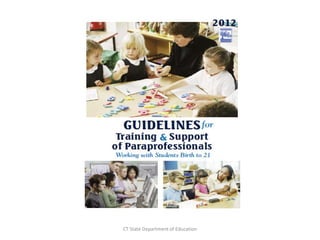
CT State Department of Education
National Resource Center for
Paraprofessionals (NRCP)
• NRCP Created a Model Framework
• Connecticut adopted a modified version of the
NRCP
• The Model framework articulates key
competencies for CT Paraprofessionals
National Resource Center for Paraprofessionals Model (1999). www.nrcpara.org
Connecticut Guidelines for Training and Supervision of Paraprofessionals, pp. 17-23
CT State Department of Education
A paraprofessional is…
…an employee who assists teachers and/or other
professional educators or therapists in the delivery of
instructional and related services to students. The
paraprofessional works under the direct supervision of the
teacher or other certified or licensed professional. The
ultimate responsibility for the design, implementation and
evaluation of instructional programs, including assessment
of student progress, is a collaborative effort of certified and
licensed staff.
CT State Department of Education
(CT Guidelines for the Training and Support of Paraprofessionals page 3.)
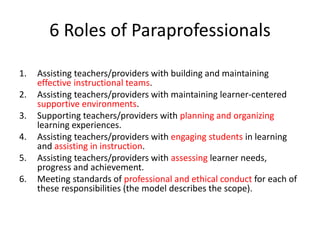
1. Assisting teachers/providers with building and maintaining
effective instructional teams.
2. Assisting teachers/providers with maintaining learner-centered
supportive environments.
3. Supporting teachers/providers with planning and organizing
learning experiences.
4. Assisting teachers/providers with engaging students in learning
and assisting in instruction.
5. Assisting teachers/providers with assessing learner needs,
progress and achievement.
6. Meeting standards of professional and ethical conduct for each of
these responsibilities (the model describes the scope).
6 Roles of Paraprofessionals
According to these guidelines, paraprofessionals have the
instructional responsibility to do the following:
1. Assist professionals with building and maintaining effective
instructional teams.
2. Assist professionals with maintaining learner-centered supportive
environments.
3. Support professionals with planning and organizing learning
experiences.
4. Assist professionals with engaging students in learning.
5. Assist professionals in instruction.
6. Assist professionals with assessing learner needs, progress and
achievement.
IEPs
In the case of paraprofessionals whose support
includes students with disabilities, it is
necessary for them to have an understanding of
the IEP information that is pertinent to their
role as an implementer.
15
• Paraprofessional attendance at placement team (PPT)
meetings is an individual district and school-based decision.
It is important that district or school personnel explain their
policy on the attendance of paraprofessionals at PPTs to
both parents and school staff. If a paraprofessional is
required in the IEP and not attending a student’s PPT
meeting, it is the responsibility of the student’s teacher and
the paraprofessional’s supervisor to communicate in detail
with the paraprofessional about the student, before the
PPT.
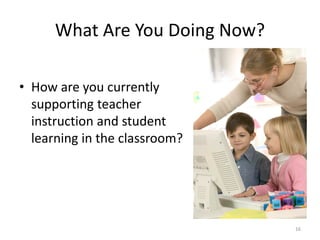
What Are You Doing Now?
16
• How are you currently
supporting teacher
instruction and student
learning in the classroom?
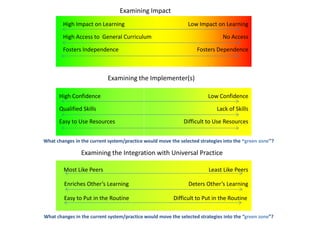
Examining Impact
Examining the Implementer(s)
High Impact on Learning
High Access to General Curriculum
Fosters Independence
Low Impact on Learning
No Access
Fosters Dependence
High Confidence
Qualified Skills
Easy to Use Resources
Low Confidence
Lack of Skills
Difficult to Use Resources
What changes in the current system/practice would move the selected strategies into the “green zone”?
Examining the Integration with Universal Practice
What changes in the current system/practice would move the selected strategies into the “green zone”?
Most Like Peers Least Like Peers
Enriches Other’s Learning Deters Other’s Learning
Easy to Put in the Routine Difficult to Put in the Routine
Responsible Inclusive Practice means…
18
• Students with disabilities attend the school they would attend
if they were not disabled. (“home school”)
 Each child is in an age-appropriate general education
classroom
 Every student is regarded as a full and valued member of the
class/school community
 Special education supports are provided within the context of
the general education classroom
 No child is excluded on the basis of type and degree of
disability
 The school promotes cooperative/collaborative teaching
arrangements
You can use these today!
19
Practical Strategies for Building
Student Independence…
Instructional Reading Strategies
When students do a Close Reading of a Text:
 Ask questions
 Model making inferences – a challenging skill for struggling readers
 Point out/highlight important or challenging words or phrases
 Discuss tasks in which students are prompted to use text evidence
 Help students refine their thinking
When students are asked to Analyze, Infer, and Give Evidence:
 Help students organize their ideas
 Help students find and use relevant information from the text
 Refer back to the text, quote, notate
 Ask questions
 Help students refine their thinking
Instructional Writing Strategies
When students are Writing to Sources:
• Assist students with note taking
• Provide organizers to manage ideas/thoughts
• Provide organizers for writing tasks that assess student
understanding of the text
Strategies:
• Scaffold
• Instruct using plans and strategies designed by the teacher
• Providing a book on tape and allowing student to follow in book.
Use highlighting techniques to capture important information
• Provide notes and cue student to highlight important information
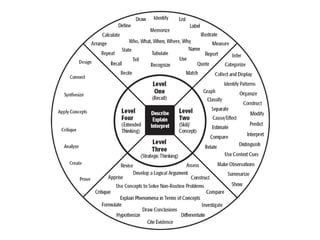
• Use higher level questioning (Bloom’s Taxonomy)
• Universal Design for Learning
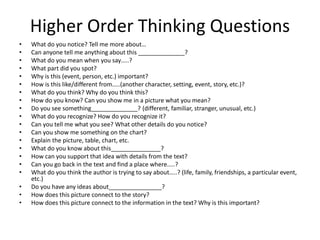
Higher Order Thinking Questions
• What do you notice? Tell me more about…
• Can anyone tell me anything about this ______________?
• What do you mean when you say…..?
• What part did you spot?
• Why is this (event, person, etc.) important?
• How is this like/different from…..(another character, setting, event, story, etc.)?
• What do you think? Why do you think this?
• How do you know? Can you show me in a picture what you mean?
• Do you see something______________? (different, familiar, stranger, unusual, etc.)
• What do you recognize? How do you recognize it?
• Can you tell me what you see? What other details do you notice?
• Can you show me something on the chart?
• Explain the picture, table, chart, etc.
• What do you know about this_______________?
• How can you support that idea with details from the text?
• Can you go back in the text and find a place where…..?
• What do you think the author is trying to say about…..? (life, family, friendships, a particular event,
etc.)
• Do you have any ideas about________________?
• How does this picture connect to the story?
• How does this picture connect to the information in the text? Why is this important?
Stages of Language Acquisition for EL
Stage I: Pre-production
Stage 2: Early Production
Stage 3: Speech Emergence
Stage 4: Intermediate Fluency
Stage 5: Advanced Fluency
10 Strategies to Promote Student-to-
Student Interaction
1. Ensure that the student is in
rich social environments.
2. Highlight similarities between
the student and peers.
3. Re-direct student conversation
to the student with a disability.
4. Directly teach and practice
interaction skills in natural
settings.
5. Use instructional strategies
that promote interaction.
6. Teach others how to interact
with the student with a disability.
7. Make rewards for behavior
social in nature.
8. Give the student
responsibilities
that allow for interactions with
peers.
9. Systematically fade direct
support.
10. Make interdependence a goal
for the student.
“Building Bridges: Strategies to Help
Paraprofessionals Promote Peer
Interaction”
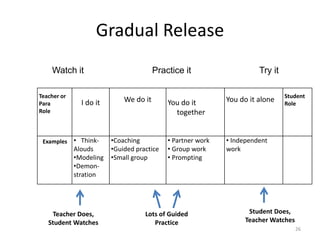
Gradual Release
Teacher or
Para
Role
I do it We do it You do it
together
You do it alone Student
Role
Examples • Think-
Alouds
•Modeling
•Demon-
stration
•Coaching
•Guided practice
•Small group
• Partner work
• Group work
• Prompting
• Independent
work
Watch it Practice it Try it
Student Does,
Teacher Watches
Teacher Does,
Student Watches
Lots of Guided
Practice
26
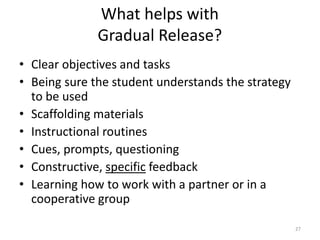
What helps with
Gradual Release?
• Clear objectives and tasks
• Being sure the student understands the strategy
to be used
• Scaffolding materials
• Instructional routines
• Cues, prompts, questioning
• Constructive, specific feedback
• Learning how to work with a partner or in a
cooperative group
27
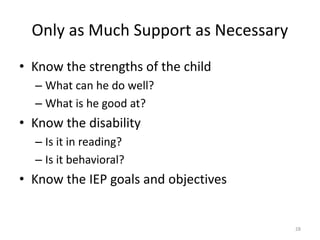
Only as Much Support as Necessary
28
• Know the strengths of the child
– What can he do well?
– What is he good at?
• Know the disability
– Is it in reading?
– Is it behavioral?
• Know the IEP goals and objectives
SERC
Anthony Brisson
Consultant, SERC
860-632-1485 x315
brisson@ctserc.org
Michelle LeBrun-Griffin
Consultant, SERC
860-632-1485 x321
griffin@ctserc.org
• SERC LIBRARY
(www.ctserc.org/library) offers
more than 10,000 resources
including:
• Books
• Instructional materials
• Tests
• Journals
• Online databases
• DVDs, videos, CD-ROMs
• Professional development materials
for staff

Helping vs. Hovering: When Paraeducators work with Students

  • 2.
    Helping vs. Hovering Thursday,April 16, 2015 Anthony Brisson Michelle LeBrun-Griffin
  • 3.
    Overview • State &Federal legislation overview • Roles and Responsibilities • “Helping vs. Hovering”
  • 4.
    Paraprofessional Study  TheLegislative Program Review and Investigations Committee authorized a study of paraprofessionals in April 2006. The study focused on whether CT should establish minimum standards for public school paraprofessionals who perform instructional tasks for students, K-12. Findings and recommendations were made in several areas affecting paraprofessionals with instructional responsibilities.  The full report can be downloaded at: www.cga.ct.gov/2006/pridata/Studies/School _Paraprofessionals_Final_Report.htm.
  • 5.
    Legislative Program Reviewand Investigations Committee Recommendations • The CT SDE should encourage all local public school districts to provide training to teachers, particularly new teachers at the beginning of each school year, on the role and effective use of instructional paraprofessionals. • The SDE should also encourage school districts to develop intradistrict methods and strategies whereby paraprofessionals, teachers, and administrators periodically discuss issues or concerns involving the use of paraprofessionals in providing effective student instruction.
  • 6.
    Connecticut Paraprofessional Legislation • Sec.10-155k. School Paraprofessional Advisory Council • The Commissioner of Education shall establish a School Paraprofessional Advisory Council consisting of one representative from each statewide bargaining representative organization that represents school paraprofessionals with instructional responsibilities. The council, shall advise, at least quarterly, the Commissioner of Education, or the commissioner’s designee, of the needs for the training of such paraprofessionals. The council shall report, at least quarterly, in accordance with the provisions of section 11-4a, on the recommendations given to the commissioner, of the commissioner’s designee, pursuant to the provisions of this section, to the joint standing committee of the General Assembly having cognizance of matters relating to education.
  • 7.
    Connecticut Paraprofessional Legislation • Sec.10-155j. Development of Paraprofessionals • The Department of Education, through the State Education Resource Center and within available appropriations for such purposes, shall promote and encourage professional development activities for school paraprofessionals with instructional responsibilities. Such activities may include, but shall not be limited to, providing local and regional boards of education with training modules and curricula for professional development for paraprofessionals and assisting boards of education in the effective use of paraprofessionals and the development of strategies to improve communication between teachers and paraprofessionals in the provision of effective student instruction.
  • 8.
    Connecticut Paraprofessional Legislation • Sec.2008. Not later than December 1, 2008, the department shall report and make recommendations to the joint standing committee of the General Assembly having cognizance of matters relating to education concerning professional development for paraprofessionals and the status and future of school paraprofessionals with instructional responsibilities.
  • 9.
    CT State Departmentof Education
  • 10.
    National Resource Centerfor Paraprofessionals (NRCP) • NRCP Created a Model Framework • Connecticut adopted a modified version of the NRCP • The Model framework articulates key competencies for CT Paraprofessionals National Resource Center for Paraprofessionals Model (1999). www.nrcpara.org Connecticut Guidelines for Training and Supervision of Paraprofessionals, pp. 17-23 CT State Department of Education
  • 11.
    A paraprofessional is… …anemployee who assists teachers and/or other professional educators or therapists in the delivery of instructional and related services to students. The paraprofessional works under the direct supervision of the teacher or other certified or licensed professional. The ultimate responsibility for the design, implementation and evaluation of instructional programs, including assessment of student progress, is a collaborative effort of certified and licensed staff. CT State Department of Education (CT Guidelines for the Training and Support of Paraprofessionals page 3.)
  • 12.
    1. Assisting teachers/providerswith building and maintaining effective instructional teams. 2. Assisting teachers/providers with maintaining learner-centered supportive environments. 3. Supporting teachers/providers with planning and organizing learning experiences. 4. Assisting teachers/providers with engaging students in learning and assisting in instruction. 5. Assisting teachers/providers with assessing learner needs, progress and achievement. 6. Meeting standards of professional and ethical conduct for each of these responsibilities (the model describes the scope). 6 Roles of Paraprofessionals
  • 13.
    According to theseguidelines, paraprofessionals have the instructional responsibility to do the following: 1. Assist professionals with building and maintaining effective instructional teams. 2. Assist professionals with maintaining learner-centered supportive environments. 3. Support professionals with planning and organizing learning experiences. 4. Assist professionals with engaging students in learning. 5. Assist professionals in instruction. 6. Assist professionals with assessing learner needs, progress and achievement.
  • 14.
    IEPs In the caseof paraprofessionals whose support includes students with disabilities, it is necessary for them to have an understanding of the IEP information that is pertinent to their role as an implementer.
  • 15.
    15 • Paraprofessional attendanceat placement team (PPT) meetings is an individual district and school-based decision. It is important that district or school personnel explain their policy on the attendance of paraprofessionals at PPTs to both parents and school staff. If a paraprofessional is required in the IEP and not attending a student’s PPT meeting, it is the responsibility of the student’s teacher and the paraprofessional’s supervisor to communicate in detail with the paraprofessional about the student, before the PPT.
  • 16.
    What Are YouDoing Now? 16 • How are you currently supporting teacher instruction and student learning in the classroom?
  • 17.
    Examining Impact Examining theImplementer(s) High Impact on Learning High Access to General Curriculum Fosters Independence Low Impact on Learning No Access Fosters Dependence High Confidence Qualified Skills Easy to Use Resources Low Confidence Lack of Skills Difficult to Use Resources What changes in the current system/practice would move the selected strategies into the “green zone”? Examining the Integration with Universal Practice What changes in the current system/practice would move the selected strategies into the “green zone”? Most Like Peers Least Like Peers Enriches Other’s Learning Deters Other’s Learning Easy to Put in the Routine Difficult to Put in the Routine
  • 18.
    Responsible Inclusive Practicemeans… 18 • Students with disabilities attend the school they would attend if they were not disabled. (“home school”)  Each child is in an age-appropriate general education classroom  Every student is regarded as a full and valued member of the class/school community  Special education supports are provided within the context of the general education classroom  No child is excluded on the basis of type and degree of disability  The school promotes cooperative/collaborative teaching arrangements
  • 19.
    You can usethese today! 19 Practical Strategies for Building Student Independence…
  • 20.
    Instructional Reading Strategies Whenstudents do a Close Reading of a Text:  Ask questions  Model making inferences – a challenging skill for struggling readers  Point out/highlight important or challenging words or phrases  Discuss tasks in which students are prompted to use text evidence  Help students refine their thinking When students are asked to Analyze, Infer, and Give Evidence:  Help students organize their ideas  Help students find and use relevant information from the text  Refer back to the text, quote, notate  Ask questions  Help students refine their thinking
  • 21.
    Instructional Writing Strategies Whenstudents are Writing to Sources: • Assist students with note taking • Provide organizers to manage ideas/thoughts • Provide organizers for writing tasks that assess student understanding of the text Strategies: • Scaffold • Instruct using plans and strategies designed by the teacher • Providing a book on tape and allowing student to follow in book. Use highlighting techniques to capture important information • Provide notes and cue student to highlight important information • Use higher level questioning (Bloom’s Taxonomy) • Universal Design for Learning
  • 23.
    Higher Order ThinkingQuestions • What do you notice? Tell me more about… • Can anyone tell me anything about this ______________? • What do you mean when you say…..? • What part did you spot? • Why is this (event, person, etc.) important? • How is this like/different from…..(another character, setting, event, story, etc.)? • What do you think? Why do you think this? • How do you know? Can you show me in a picture what you mean? • Do you see something______________? (different, familiar, stranger, unusual, etc.) • What do you recognize? How do you recognize it? • Can you tell me what you see? What other details do you notice? • Can you show me something on the chart? • Explain the picture, table, chart, etc. • What do you know about this_______________? • How can you support that idea with details from the text? • Can you go back in the text and find a place where…..? • What do you think the author is trying to say about…..? (life, family, friendships, a particular event, etc.) • Do you have any ideas about________________? • How does this picture connect to the story? • How does this picture connect to the information in the text? Why is this important?
  • 24.
    Stages of LanguageAcquisition for EL Stage I: Pre-production Stage 2: Early Production Stage 3: Speech Emergence Stage 4: Intermediate Fluency Stage 5: Advanced Fluency
  • 25.
    10 Strategies toPromote Student-to- Student Interaction 1. Ensure that the student is in rich social environments. 2. Highlight similarities between the student and peers. 3. Re-direct student conversation to the student with a disability. 4. Directly teach and practice interaction skills in natural settings. 5. Use instructional strategies that promote interaction. 6. Teach others how to interact with the student with a disability. 7. Make rewards for behavior social in nature. 8. Give the student responsibilities that allow for interactions with peers. 9. Systematically fade direct support. 10. Make interdependence a goal for the student. “Building Bridges: Strategies to Help Paraprofessionals Promote Peer Interaction”
  • 26.
    Gradual Release Teacher or Para Role Ido it We do it You do it together You do it alone Student Role Examples • Think- Alouds •Modeling •Demon- stration •Coaching •Guided practice •Small group • Partner work • Group work • Prompting • Independent work Watch it Practice it Try it Student Does, Teacher Watches Teacher Does, Student Watches Lots of Guided Practice 26
  • 27.
    What helps with GradualRelease? • Clear objectives and tasks • Being sure the student understands the strategy to be used • Scaffolding materials • Instructional routines • Cues, prompts, questioning • Constructive, specific feedback • Learning how to work with a partner or in a cooperative group 27
  • 28.
    Only as MuchSupport as Necessary 28 • Know the strengths of the child – What can he do well? – What is he good at? • Know the disability – Is it in reading? – Is it behavioral? • Know the IEP goals and objectives
  • 29.
    SERC Anthony Brisson Consultant, SERC 860-632-1485x315 brisson@ctserc.org Michelle LeBrun-Griffin Consultant, SERC 860-632-1485 x321 griffin@ctserc.org • SERC LIBRARY (www.ctserc.org/library) offers more than 10,000 resources including: • Books • Instructional materials • Tests • Journals • Online databases • DVDs, videos, CD-ROMs • Professional development materials for staff