A? B? C?
        Assigning
       Meaningful
   Grades for ELLs
           Terry Waldspurger
          TESOL Convention
             Philadelphia, PA
             March 30, 2012
twaldspurger@kent.k12.md.us
Grades are Here to Stay

    ā€œThere is no doubt that our
     society believes in grades. We
     look for four-star movies, five-
     star restaurants, top-10 colleges,
     and even Grade A eggs.ā€
          – (Scherer, 2011, p. 7)
The Culture of Grades
    Organizations expect teachers to
     evaluate multiple areas of a
     student’s learning and performance
     and fairly synthesize them into one
     meaningful, understandable value for
     a report card
    Over 90% of US schools use some
     kind of A-F grading scale
    Only 1% do not use grades at all
    Grades are taken seriously by
     parents, administrators, colleges
The Culture of Grades

    Grades carry consequences and
     expectations
    Poor grades can have lasting
     negative effects
     – Promotion and retention
     – G/T, STEM, AP, honors
     – Sports and extracurricular activities
     – College admissions and placement
Grading is Often Inconsistent

    Despite importance of grades,
     inconsistencies cause inequity and
     failure for many, including ELLs
    Grading is one of the last bastions of
     teacher power and control
     – Teachers determine what and how they
       grade, often including the grading scale
     – Studies show that even teachers in the
       same buildings interpret/assign grades
       differently despite school grading policy
           – (Reeves, 2008, Seeley, 1994)
Teachers are Conflicted

    Teachers need to enforce rigor of
     content standards
    Teachers need to ensure that their
     students are passing state tests
    Teachers need to assign grades
    How can teachers assess and grade
     ELLs and still be able to hold them to
     the same learning standards as
     other students?
Grading is Frustrating

    ā€œI just hate grades. They are very
     discouraging to our children. The
     ones who get A’s, get A’s. Some
     kids come to school every day –
     in our community that’s really
     wonderful – yet they get F’s. I
     give them F’s, because that’s
     what they earn, I guess. That’s
     the system.ā€
          – (Seeley, 1994, p. 5)
Teachers are Busy

    Teachers have a myriad of
     responsibilities built into their days --
     how can they also accommodate all
     their special populations?
    How can teachers find the time to
     create and grade multiple
     assessments that allow ELLs to
     show mastery of content despite
     lower English proficiency levels?
Teachers and Time
    ā€œI’m sure I’m not the only one…but 9
     of my ELLs are placed in a class of
     23 native speakers and 4 of my ELLs
     are in a class of 28 native speakers.
     Most of my ELLs are at a Level 2,
     but I do have some Level 1 students
     as well. Our 40-minute classes leave
     me with little time to deal with the
     issues of the native speakers, let
     alone to work on special
     assessments for my ELLs.ā€
          – (Pawan and Craig, 2011, p. 306)
Teachers are Confused
    Teachers are often unaware of (or
     disregard) organizational grading
     policies
    Teachers receive little if any
     professional development in
     converting classroom assessments
     into grades
    Teachers who effectively
     differentiate instruction/assessment
     do not know how to assign grades
     based on these ā€œadaptedā€ scores
Where Do ELLs Fit In?

    Many educators believe that report
     card grades should measure only
     one aspect: mastery of grade-level,
     content standards
          –   (Marzano, 2000, Reeves, 2008)
    What do teachers do, then, when an
     ELL can’t demonstrate grade-level
     ā€œmasteryā€ based on her English
     proficiency level?
The Many Facets of Grades
    Teachers enjoy special relationships
     with their students and see more
     than just numbers
     – Attitude, motivation, effort, participation
     – Special circumstances (poverty,
       proficiency level, disability)
    It is often difficult for teachers to
     separate ā€œproductā€ from ā€œprocessā€
    Grades often reflect ā€œjustice
     tempered with mercyā€
           – (Seeley, 1994, p. 5)
Research on Grades

    Reeves, 2008: The single most
     important change that would
     immediately reduce student failures
     in a school is to change the grading
     policy
    The difference between failure and
     honor roll can often be attributed to
     the way a teacher grades
Toxic Grading Practices
    Assigning zero’s for missing/late
     work (especially on a 100 pt. scale)
     – Averages tumble
     – Work remains undone (so student has
       no chance to learn)
     – ELLs often can’t complete assignments
       accurately or in a timely manner
    The appropriate response for
     missing work is to complete it!
     – Use recess, lunch, before/after school
Toxic Grading Practices

    Using grades as either motivation or
     punishment
     – High grades do not motivate students to
       work harder (often the opposite is true)
         Extrinsic vs. intrinsic motivation
         Teachers should foster intrinsic motivation

     – Low grades do not motivate failing
       students to try harder
           Students see no point in working hard if
            they are doomed to failure
Toxic Grading Practices

    Averaging all scores equally
     throughout a marking period
     – Allow more recent grades to replace
       (not average with) older grades
     – Students who begin at different levels
       can all eventually earn the same final
       (and high) grade
     – This would benefit ELLs, who are also
       struggling with language and need to
       be measured over time
Toxic Grading Practices
    Too many small, insignificant grades
     (busy work, homework, group work)
     pull down summative averages
     (leading to grade inflation or failure)
    Some believe that homework should
     never be graded (feedback only)
    Too few summative grades can ruin
     a final grade
     – No single assessment can be perfectly
       valid/reliable; effective accountability
       requires multiple measures
Grading Research

    A report card grade should consist
     only of summative, individual,
     performance-based work that is
     standards-based
    Grades should never be based on
     personal or behavioral factors
    A benefit of more valid, reliable
     grading: students develop a higher
     motivation to learn
          – (McTighe & O’Connor, 2005)
Grading ELLs

    ā€œIf they (ELLs) are not proficient in
     English, all the types of assessment
     in the world are not going to put
     them on equal footing with native
     speakers. This seems like a no-win
     situation for the students.ā€
          – (Pawan & Craig, 2011, p. 305)
    This is often a ā€œno-winā€ for teachers
     as well
ELLs can not be compared
with non-ELLs
    ā€œTraditional grading does not work for
     assessing the academic learning of
     Limited English Proficient students.ā€
          – Solis, 2005
    ā€œFairness does not exist when
     assessment is uniform, standardized,
     impersonal, and absolute. Rather, it
     exists when assessment is
     appropriateā€¦ā€
          – Indiana Department of Education, 2005
Equality vs. Equity

    Equality:
     – Absolute
     – Normed (on the curve)
     – Standardized
     – Same for all
    Equitable
     – Fair opportunities for all
     – Accommodating/modified
     – Individualized
What is Not Equitable

    Assigning lower grades based solely
     on English proficiency level
    Giving low grades to punish/motivate
     lower performing students
    Using grades to rank and/or
     differentiate student abilities
    Grading on the curve
    Continuing flawed policies because
     ā€œwe’ve always done it this wayā€
A Quandary for Teachers

    Assigning a low or even failing grade
     to an ELL for not mastering course
     content based on a lower language
     proficiency level is inherently unfair.
    However, if ELLs cannot
     demonstrate mastery as well as a
     native speaker, teachers often feel
     they can’t assign them an equally
     high grade
Where is the Balance?

    ā€œI asked an administrator one time if I
     should flunk all of my ESL students
     because they did not meet the
     requirements of the 10th grade
     curriculum, and he told me, ā€˜You
     must judge them on what they CAN
     do.ā€™ā€
          – (Pawan & Craig, 2011, p. 305)
Finding the Balance

    How do teachers find the balance
     between fairness and validity?
    We can’t assign low grades based
     on proficiency level
    However, neither can we ā€œpassā€ a
     student who has not met content
     standards
    We must provide access to same
     content while supporting instruction
     at the ELL’s current proficiency level
Lussi, 2010, p. 4
    Giving an ELL an ā€œAā€ for completing
     a graphic organizer while the native
     speakers are writing essays is fair!
    ā€œFair means giving the student what
     he/she needs so they will have the
     same opportunity as any other
     student to succeed…although the
     assignment may be perceived as
     ā€˜easier,’ the ELL student is already
     doing double the workā€ (learning
     both content and language)
Grading Tips for ELLs

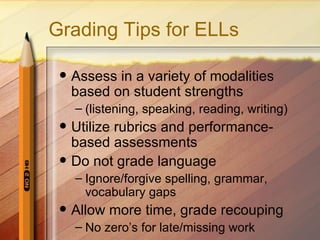
    Assess in a variety of modalities
     based on student strengths
     – (listening, speaking, reading, writing)
    Utilize rubrics and performance-
     based assessments
    Do not grade language
     – Ignore/forgive spelling, grammar,
       vocabulary gaps
    Allow more time, grade recouping
     – No zero’s for late/missing work
Grading Tips for ELLs

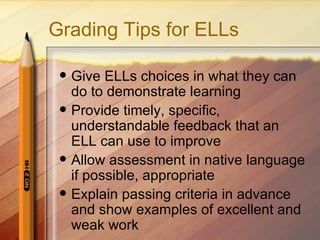
    Give ELLs choices in what they can
     do to demonstrate learning
    Provide timely, specific,
     understandable feedback that an
     ELL can use to improve
    Allow assessment in native language
     if possible, appropriate
    Explain passing criteria in advance
     and show examples of excellent and
     weak work
ELL Grading Systems

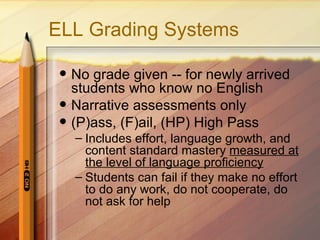
    No grade given -- for newly arrived
     students who know no English
    Narrative assessments only
    (P)ass, (F)ail, (HP) High Pass
     – Includes effort, language growth, and
       content standard mastery measured at
       the level of language proficiency
     – Students can fail if they make no effort
       to do any work, do not cooperate, do
       not ask for help
Grading Systems

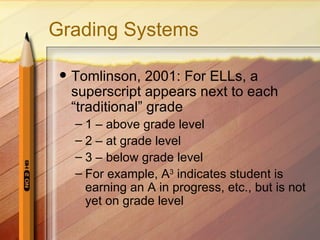
    Tomlinson, 2001: For ELLs, a
     superscript appears next to each
     ā€œtraditionalā€ grade
     – 1 – above grade level
     – 2 – at grade level
     – 3 – below grade level
     – For example, A3 indicates student is
       earning an A in progress, etc., but is not
       yet on grade level
Grading Systems

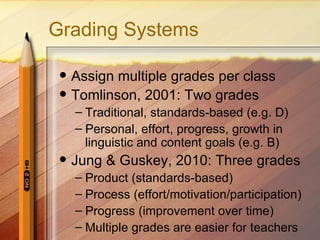
    Assign multiple grades per class
    Tomlinson, 2001: Two grades
     – Traditional, standards-based (e.g. D)
     – Personal, effort, progress, growth in
       linguistic and content goals (e.g. B)
    Jung & Guskey, 2010: Three grades
     – Product (standards-based)
     – Process (effort/motivation/participation)
     – Progress (improvement over time)
     – Multiple grades are easier for teachers
ELL Grading Sytems

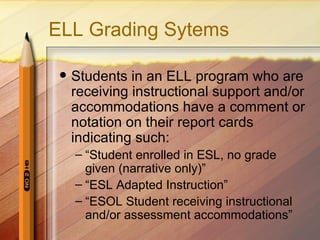
    Students in an ELL program who are
     receiving instructional support and/or
     accommodations have a comment or
     notation on their report cards
     indicating such:
     – ā€œStudent enrolled in ESL, no grade
       given (narrative only)ā€
     – ā€œESL Adapted Instructionā€
     – ā€œESOL Student receiving instructional
       and/or assessment accommodationsā€
Jung & Guskey, 2010

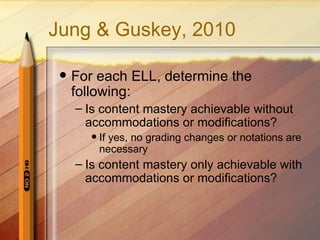
    For each ELL, determine the
     following:
     – Is content mastery achievable without
       accommodations or modifications?
          If yes, no grading changes or notations are
           necessary
     – Is content mastery only achievable with
       accommodations or modifications?
Jung & Guskey, 2010

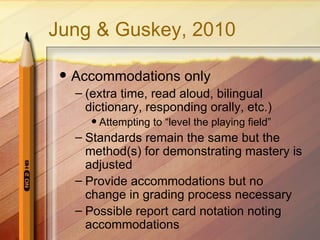
    Accommodations only
     – (extra time, read aloud, bilingual
       dictionary, responding orally, etc.)
           Attempting to ā€œlevel the playing fieldā€
     – Standards remain the same but the
       method(s) for demonstrating mastery is
       adjusted
     – Provide accommodations but no
       change in grading process necessary
     – Possible report card notation noting
       accommdations
Jung & Guskey, 2010
    Modifications – content standards
     are changed, adapted, simplified
     based on linguistic level and/or
     content gaps
           New 7th grade ELL with no English being
            taught 4th-5th grade science vocabulary
    If modifications needed, determine
     appropriate adapted standards
           E.g., 4th grade science for 7th grader
    Teach/assess student and report
     grades on modified standards only
Jung & Guskey, 2010

    For any reporting changes made,
     always communicate grades’
     meaning to parents and other
     stakeholders
    Add notation to grade or report card
    For example, a footnote stating,
     ā€œGrade(s) based on modified
     standardsā€
    Narrative could be attached
A Note on Legality

    According to USDE’s Office of Civil
     Rights (2008)
    It is legal to report ELL status and/or
     accommodation/modification
     adaptations on a report card, but not
     on transcripts
    If grade-level standards are
     fundamentally modified, these can
     be legally noted on transcripts
Some Final Thoughts

    Whatever grading system is used:
     – It needs to be based on clearly
       articulated and accepted policies
     – It needs to be adopted and used by all
       teachers
     – It needs to be explained to all
       stakeholders
    ELLs should be graded on growth
     and progress as well as mastery of
     standards

A? B? C? Assigning Meaningful Grades for ELLs

  • 1.
    A? B? C? Assigning Meaningful Grades for ELLs Terry Waldspurger TESOL Convention Philadelphia, PA March 30, 2012 twaldspurger@kent.k12.md.us
  • 2.
    Grades are Hereto Stay  ā€œThere is no doubt that our society believes in grades. We look for four-star movies, five- star restaurants, top-10 colleges, and even Grade A eggs.ā€ – (Scherer, 2011, p. 7)
  • 3.
    The Culture ofGrades  Organizations expect teachers to evaluate multiple areas of a student’s learning and performance and fairly synthesize them into one meaningful, understandable value for a report card  Over 90% of US schools use some kind of A-F grading scale  Only 1% do not use grades at all  Grades are taken seriously by parents, administrators, colleges
  • 4.
    The Culture ofGrades  Grades carry consequences and expectations  Poor grades can have lasting negative effects – Promotion and retention – G/T, STEM, AP, honors – Sports and extracurricular activities – College admissions and placement
  • 5.
    Grading is OftenInconsistent  Despite importance of grades, inconsistencies cause inequity and failure for many, including ELLs  Grading is one of the last bastions of teacher power and control – Teachers determine what and how they grade, often including the grading scale – Studies show that even teachers in the same buildings interpret/assign grades differently despite school grading policy – (Reeves, 2008, Seeley, 1994)
  • 6.
    Teachers are Conflicted  Teachers need to enforce rigor of content standards  Teachers need to ensure that their students are passing state tests  Teachers need to assign grades  How can teachers assess and grade ELLs and still be able to hold them to the same learning standards as other students?
  • 7.
    Grading is Frustrating  ā€œI just hate grades. They are very discouraging to our children. The ones who get A’s, get A’s. Some kids come to school every day – in our community that’s really wonderful – yet they get F’s. I give them F’s, because that’s what they earn, I guess. That’s the system.ā€ – (Seeley, 1994, p. 5)
  • 8.
    Teachers are Busy  Teachers have a myriad of responsibilities built into their days -- how can they also accommodate all their special populations?  How can teachers find the time to create and grade multiple assessments that allow ELLs to show mastery of content despite lower English proficiency levels?
  • 9.
    Teachers and Time  ā€œI’m sure I’m not the only one…but 9 of my ELLs are placed in a class of 23 native speakers and 4 of my ELLs are in a class of 28 native speakers. Most of my ELLs are at a Level 2, but I do have some Level 1 students as well. Our 40-minute classes leave me with little time to deal with the issues of the native speakers, let alone to work on special assessments for my ELLs.ā€ – (Pawan and Craig, 2011, p. 306)
  • 10.
    Teachers are Confused  Teachers are often unaware of (or disregard) organizational grading policies  Teachers receive little if any professional development in converting classroom assessments into grades  Teachers who effectively differentiate instruction/assessment do not know how to assign grades based on these ā€œadaptedā€ scores
  • 11.
    Where Do ELLsFit In?  Many educators believe that report card grades should measure only one aspect: mastery of grade-level, content standards – (Marzano, 2000, Reeves, 2008)  What do teachers do, then, when an ELL can’t demonstrate grade-level ā€œmasteryā€ based on her English proficiency level?
  • 12.
    The Many Facetsof Grades  Teachers enjoy special relationships with their students and see more than just numbers – Attitude, motivation, effort, participation – Special circumstances (poverty, proficiency level, disability)  It is often difficult for teachers to separate ā€œproductā€ from ā€œprocessā€  Grades often reflect ā€œjustice tempered with mercyā€ – (Seeley, 1994, p. 5)
  • 13.
    Research on Grades  Reeves, 2008: The single most important change that would immediately reduce student failures in a school is to change the grading policy  The difference between failure and honor roll can often be attributed to the way a teacher grades
  • 14.
    Toxic Grading Practices  Assigning zero’s for missing/late work (especially on a 100 pt. scale) – Averages tumble – Work remains undone (so student has no chance to learn) – ELLs often can’t complete assignments accurately or in a timely manner  The appropriate response for missing work is to complete it! – Use recess, lunch, before/after school
  • 15.
    Toxic Grading Practices  Using grades as either motivation or punishment – High grades do not motivate students to work harder (often the opposite is true)  Extrinsic vs. intrinsic motivation  Teachers should foster intrinsic motivation – Low grades do not motivate failing students to try harder  Students see no point in working hard if they are doomed to failure
  • 16.
    Toxic Grading Practices  Averaging all scores equally throughout a marking period – Allow more recent grades to replace (not average with) older grades – Students who begin at different levels can all eventually earn the same final (and high) grade – This would benefit ELLs, who are also struggling with language and need to be measured over time
  • 17.
    Toxic Grading Practices  Too many small, insignificant grades (busy work, homework, group work) pull down summative averages (leading to grade inflation or failure)  Some believe that homework should never be graded (feedback only)  Too few summative grades can ruin a final grade – No single assessment can be perfectly valid/reliable; effective accountability requires multiple measures
  • 18.
    Grading Research  A report card grade should consist only of summative, individual, performance-based work that is standards-based  Grades should never be based on personal or behavioral factors  A benefit of more valid, reliable grading: students develop a higher motivation to learn – (McTighe & O’Connor, 2005)
  • 19.
    Grading ELLs  ā€œIf they (ELLs) are not proficient in English, all the types of assessment in the world are not going to put them on equal footing with native speakers. This seems like a no-win situation for the students.ā€ – (Pawan & Craig, 2011, p. 305)  This is often a ā€œno-winā€ for teachers as well
  • 20.
    ELLs can notbe compared with non-ELLs  ā€œTraditional grading does not work for assessing the academic learning of Limited English Proficient students.ā€ – Solis, 2005  ā€œFairness does not exist when assessment is uniform, standardized, impersonal, and absolute. Rather, it exists when assessment is appropriateā€¦ā€ – Indiana Department of Education, 2005
  • 21.
    Equality vs. Equity  Equality: – Absolute – Normed (on the curve) – Standardized – Same for all  Equitable – Fair opportunities for all – Accommodating/modified – Individualized
  • 22.
    What is NotEquitable  Assigning lower grades based solely on English proficiency level  Giving low grades to punish/motivate lower performing students  Using grades to rank and/or differentiate student abilities  Grading on the curve  Continuing flawed policies because ā€œwe’ve always done it this wayā€
  • 23.
    A Quandary forTeachers  Assigning a low or even failing grade to an ELL for not mastering course content based on a lower language proficiency level is inherently unfair.  However, if ELLs cannot demonstrate mastery as well as a native speaker, teachers often feel they can’t assign them an equally high grade
  • 24.
    Where is theBalance?  ā€œI asked an administrator one time if I should flunk all of my ESL students because they did not meet the requirements of the 10th grade curriculum, and he told me, ā€˜You must judge them on what they CAN do.ā€™ā€ – (Pawan & Craig, 2011, p. 305)
  • 25.
    Finding the Balance  How do teachers find the balance between fairness and validity?  We can’t assign low grades based on proficiency level  However, neither can we ā€œpassā€ a student who has not met content standards  We must provide access to same content while supporting instruction at the ELL’s current proficiency level
  • 26.
    Lussi, 2010, p.4  Giving an ELL an ā€œAā€ for completing a graphic organizer while the native speakers are writing essays is fair!  ā€œFair means giving the student what he/she needs so they will have the same opportunity as any other student to succeed…although the assignment may be perceived as ā€˜easier,’ the ELL student is already doing double the workā€ (learning both content and language)
  • 27.
    Grading Tips forELLs  Assess in a variety of modalities based on student strengths – (listening, speaking, reading, writing)  Utilize rubrics and performance- based assessments  Do not grade language – Ignore/forgive spelling, grammar, vocabulary gaps  Allow more time, grade recouping – No zero’s for late/missing work
  • 28.
    Grading Tips forELLs  Give ELLs choices in what they can do to demonstrate learning  Provide timely, specific, understandable feedback that an ELL can use to improve  Allow assessment in native language if possible, appropriate  Explain passing criteria in advance and show examples of excellent and weak work
  • 29.
    ELL Grading Systems  No grade given -- for newly arrived students who know no English  Narrative assessments only  (P)ass, (F)ail, (HP) High Pass – Includes effort, language growth, and content standard mastery measured at the level of language proficiency – Students can fail if they make no effort to do any work, do not cooperate, do not ask for help
  • 30.
    Grading Systems  Tomlinson, 2001: For ELLs, a superscript appears next to each ā€œtraditionalā€ grade – 1 – above grade level – 2 – at grade level – 3 – below grade level – For example, A3 indicates student is earning an A in progress, etc., but is not yet on grade level
  • 31.
    Grading Systems  Assign multiple grades per class  Tomlinson, 2001: Two grades – Traditional, standards-based (e.g. D) – Personal, effort, progress, growth in linguistic and content goals (e.g. B)  Jung & Guskey, 2010: Three grades – Product (standards-based) – Process (effort/motivation/participation) – Progress (improvement over time) – Multiple grades are easier for teachers
  • 32.
    ELL Grading Sytems  Students in an ELL program who are receiving instructional support and/or accommodations have a comment or notation on their report cards indicating such: – ā€œStudent enrolled in ESL, no grade given (narrative only)ā€ – ā€œESL Adapted Instructionā€ – ā€œESOL Student receiving instructional and/or assessment accommodationsā€
  • 33.
    Jung & Guskey,2010  For each ELL, determine the following: – Is content mastery achievable without accommodations or modifications?  If yes, no grading changes or notations are necessary – Is content mastery only achievable with accommodations or modifications?
  • 34.
    Jung & Guskey,2010  Accommodations only – (extra time, read aloud, bilingual dictionary, responding orally, etc.)  Attempting to ā€œlevel the playing fieldā€ – Standards remain the same but the method(s) for demonstrating mastery is adjusted – Provide accommodations but no change in grading process necessary – Possible report card notation noting accommdations
  • 35.
    Jung & Guskey,2010  Modifications – content standards are changed, adapted, simplified based on linguistic level and/or content gaps  New 7th grade ELL with no English being taught 4th-5th grade science vocabulary  If modifications needed, determine appropriate adapted standards  E.g., 4th grade science for 7th grader  Teach/assess student and report grades on modified standards only
  • 36.
    Jung & Guskey,2010  For any reporting changes made, always communicate grades’ meaning to parents and other stakeholders  Add notation to grade or report card  For example, a footnote stating, ā€œGrade(s) based on modified standardsā€  Narrative could be attached
  • 37.
    A Note onLegality  According to USDE’s Office of Civil Rights (2008)  It is legal to report ELL status and/or accommodation/modification adaptations on a report card, but not on transcripts  If grade-level standards are fundamentally modified, these can be legally noted on transcripts
  • 38.
    Some Final Thoughts  Whatever grading system is used: – It needs to be based on clearly articulated and accepted policies – It needs to be adopted and used by all teachers – It needs to be explained to all stakeholders  ELLs should be graded on growth and progress as well as mastery of standards

Editor's Notes

  • #2Ā Preface: This presentation does not provide answers. It asks questions and suggests possible solutions. The area of grading – for all students – is murky and there is by no means consensus in various issues. Kent County, MD – 84 ESOL (PK-12), less than 4% of total population (2,200). Kent is MD’s smallest county, with 1 hs, 1 ms, and 5 es. Four full-time ESOL teachers cover all students and buildings. Two daily ESOL classes, but mostly pull-out and push-in. 30 min. 3x/wk to 90 min daily.
  • #8Ā One Kent student: ā€œI can’t give my ESOL students anything but Ds and Fs because they can’t demonstrate mastery of standards as well as the other students.ā€
  • #12Ā This is not a discussion of differentiated instruction – just what we do when we need to take our assessment data and knowledge and report a grade.
  • #32Ā These researchers stress that it is very important to explain these grading policies to parents and other stakeholders
  • #33Ā These notations give teachers ā€œpermissionā€ to give ELLs a high grade without being ā€œunfairā€ to their native speakers.
  • #36Ā Example – a new ninth grader from Guatemala with no English and a 5 th grade education in his country will be graded on modified standards – 5 th grade math standards and vocabulary, etc.
  • #38Ā NOTE: An ELL with accommodations only (no curricular modifications) CANNOT have this noted on transcripts.