PBIS in the ISS
Classroom
Positive Interventions
For Managing
Challenging Behavior
Presented By
Tory Lawrence
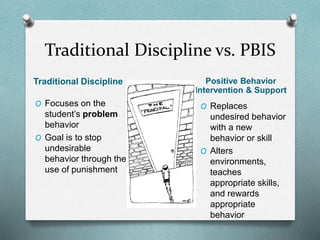
Traditional Discipline vs. PBIS
Traditional Discipline Positive Behavior
Intervention & Support
O Focuses on the
student’s problem
behavior
O Goal is to stop
undesirable
behavior through the
use of punishment
O Replaces
undesired behavior
with a new
behavior or skill
O Alters
environments,
teaches
appropriate skills,
and rewards
appropriate
behavior
Why Positive Behavior Intervention
and Support?
Some Facts About Behavior
O Behavior is learned-
whether intentionally
taught or not
O ALL behavior
(positive & negative)
has a function
O Students do not
always know their
behavior is
inappropriate- yes,
even older students
O Inappropriate or
undesired behavior
should not be taken
personally
O Appropriate or desired
behavior should be
modeled for students
O Increasing positive
interactions increases
the likelihood of
desired behavior
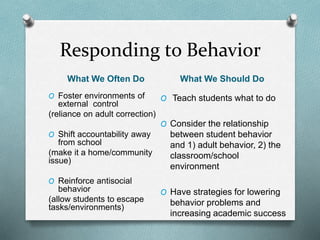
Responding to Behavior
What We Often Do What We Should Do
O Foster environments of
external control
(reliance on adult correction)
O Shift accountability away
from school
(make it a home/community
issue)
O Reinforce antisocial
behavior
(allow students to escape
tasks/environments)
O Teach students what to do
O Consider the relationship
between student behavior
and 1) adult behavior, 2) the
classroom/school
environment
O Have strategies for lowering
behavior problems and
increasing academic success
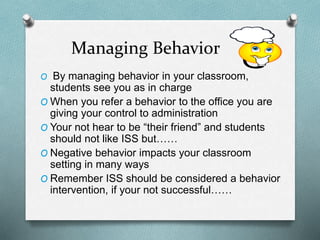
Managing Behavior
O By managing behavior in your classroom,
students see you as in charge
O When you refer a behavior to the office you are
giving your control to administration
O Your not hear to be “their friend” and students
should not like ISS but……
O Negative behavior impacts your classroom
setting in many ways
O Remember ISS should be considered a behavior
intervention, if your not successful……
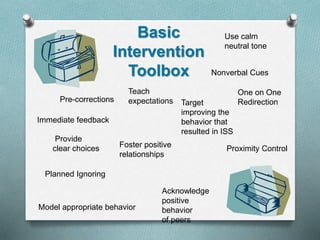
Basic
Intervention
Toolbox
Pre-corrections
Nonverbal Cues
Target
improving the
behavior that
resulted in ISS
Provide
clear choices
Planned Ignoring
Acknowledge
positive
behavior
of peers
Use calm
neutral tone
Proximity Control
One on One
Redirection
Model appropriate behavior
Teach
expectations
Immediate feedback
Foster positive
relationships
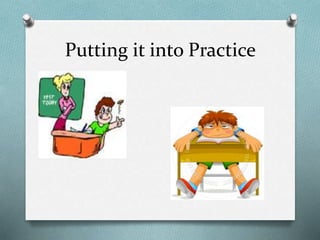
Putting it into Practice
Scenario 1
Jasmine enters ISS visibly upset slams down her books
an plops into her seat. Jasmine begins mumbling
negative comments about the school and the students
present in ISS. She yells at a peer “what are you looking
at?” The teacher provides Jasmine with a verbal warning
about her disruption and instructs her to prepare her
materials. Rolling her eyes, Jasmine states “This is
stupid. I don’t want to be here.” The teacher provides a
2nd redirection to which Jasmine rolled her eyes again
and states “why should I listen to you?” raising her voice
louder. What could you do to deescalate the situation?
Scenario 2
James is an intelligent young man but rarely is interested
in completing classroom tasks. He is not afraid to share
his opinions with his peers or with adults. He often
questions the intelligence of peers and teachers. When
given an undesired directive, James will question the
reason for the directive or will make negative comments
loudly in front of his peers. When redirected, James will
become argumentative with adults and make
disrespectful comments using inappropriate language.
Today is his 3rd assignment to ISS which will last 3 days.
Last time in ISS, James called you stupid and not a real
teacher and picked a fight with a student. What could
you do to set the tone and make James more successful
while in ISS and after he returns to his classes?
Final Thoughts
O Not every intervention will work for every
behavior or student- trial and error.
O Express disappoint in the behavior
demonstrated- not the student.
O Protect your own triggers and avoid the
power struggle trap!
O Be consistent with praise and
consequences.
O Train yourself to concentrate on the
positive.
O Don’t underestimate YOUR importance!
Your more than just a consequence
…………
Sources
O Akin-Little, K., Eckert, T., Lovett, B., & Little, S. (2004). Extrinsic
reinforcement in the classroom: Bribery or best practice. School
Psychology Review, 33, 344–362.
O Walker, H.M., Ramsey, E., & Gresham, F.M. (2004). Antisocial
behavior in school: Evidence-based practices (2nd ed.).
Belmont, CA: Wadsworth/Thomson Learning.
O Positive Behavior Intervention and Support website
http://www.pbis.org

PBIS in the ISS classroom

  • 1.
    PBIS in theISS Classroom Positive Interventions For Managing Challenging Behavior Presented By Tory Lawrence
  • 2.
    Traditional Discipline vs.PBIS Traditional Discipline Positive Behavior Intervention & Support O Focuses on the student’s problem behavior O Goal is to stop undesirable behavior through the use of punishment O Replaces undesired behavior with a new behavior or skill O Alters environments, teaches appropriate skills, and rewards appropriate behavior
  • 3.
    Why Positive BehaviorIntervention and Support?
  • 4.
    Some Facts AboutBehavior O Behavior is learned- whether intentionally taught or not O ALL behavior (positive & negative) has a function O Students do not always know their behavior is inappropriate- yes, even older students O Inappropriate or undesired behavior should not be taken personally O Appropriate or desired behavior should be modeled for students O Increasing positive interactions increases the likelihood of desired behavior
  • 5.
    Responding to Behavior WhatWe Often Do What We Should Do O Foster environments of external control (reliance on adult correction) O Shift accountability away from school (make it a home/community issue) O Reinforce antisocial behavior (allow students to escape tasks/environments) O Teach students what to do O Consider the relationship between student behavior and 1) adult behavior, 2) the classroom/school environment O Have strategies for lowering behavior problems and increasing academic success
  • 6.
    Managing Behavior O Bymanaging behavior in your classroom, students see you as in charge O When you refer a behavior to the office you are giving your control to administration O Your not hear to be “their friend” and students should not like ISS but…… O Negative behavior impacts your classroom setting in many ways O Remember ISS should be considered a behavior intervention, if your not successful……
  • 7.
    Basic Intervention Toolbox Pre-corrections Nonverbal Cues Target improving the behaviorthat resulted in ISS Provide clear choices Planned Ignoring Acknowledge positive behavior of peers Use calm neutral tone Proximity Control One on One Redirection Model appropriate behavior Teach expectations Immediate feedback Foster positive relationships
  • 8.
  • 9.
    Scenario 1 Jasmine entersISS visibly upset slams down her books an plops into her seat. Jasmine begins mumbling negative comments about the school and the students present in ISS. She yells at a peer “what are you looking at?” The teacher provides Jasmine with a verbal warning about her disruption and instructs her to prepare her materials. Rolling her eyes, Jasmine states “This is stupid. I don’t want to be here.” The teacher provides a 2nd redirection to which Jasmine rolled her eyes again and states “why should I listen to you?” raising her voice louder. What could you do to deescalate the situation?
  • 10.
    Scenario 2 James isan intelligent young man but rarely is interested in completing classroom tasks. He is not afraid to share his opinions with his peers or with adults. He often questions the intelligence of peers and teachers. When given an undesired directive, James will question the reason for the directive or will make negative comments loudly in front of his peers. When redirected, James will become argumentative with adults and make disrespectful comments using inappropriate language. Today is his 3rd assignment to ISS which will last 3 days. Last time in ISS, James called you stupid and not a real teacher and picked a fight with a student. What could you do to set the tone and make James more successful while in ISS and after he returns to his classes?
  • 11.
    Final Thoughts O Notevery intervention will work for every behavior or student- trial and error. O Express disappoint in the behavior demonstrated- not the student. O Protect your own triggers and avoid the power struggle trap! O Be consistent with praise and consequences. O Train yourself to concentrate on the positive. O Don’t underestimate YOUR importance! Your more than just a consequence …………
  • 12.
    Sources O Akin-Little, K.,Eckert, T., Lovett, B., & Little, S. (2004). Extrinsic reinforcement in the classroom: Bribery or best practice. School Psychology Review, 33, 344–362. O Walker, H.M., Ramsey, E., & Gresham, F.M. (2004). Antisocial behavior in school: Evidence-based practices (2nd ed.). Belmont, CA: Wadsworth/Thomson Learning. O Positive Behavior Intervention and Support website http://www.pbis.org

Editor's Notes

  • #6 Foster environments of external control: relies on adult intervention to “control” or “stop” student behavior, instead of teaching student what to do instead Shift accountability away from school: when we fail to consider the relationship between student behavior and (1) adult behavior, (2) the classroom/school environment Reinforce antisocial behavior: when students are allowed to escape from tasks or environments they don’t like