Mass Movement
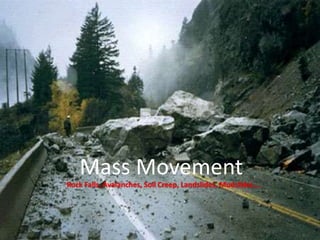
Rock Falls, Avalanches, Soil Creep, Landslides, Mudslides….
Mass Movement
Definition – The movement of material downhill under the
influence of gravity
Loose weathered material on the surface of the Earth is known
as Regolith
When you have regolith on a slope (even a gentle slope) the
possibility exists for Mass Movement
Movement can be very fast (Km/hr) or very slow (mm/year) –
but can dramatically change the Earth’s surface over time
Mass Movement can also be triggered by natural or man-
made factors – anything that makes regolith unstable
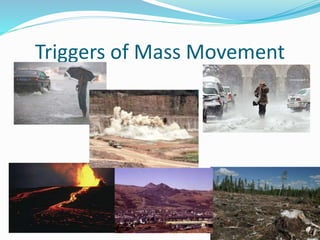
Triggers of Mass Movement
Factors affecting mass movement
Effect of Gravity – the bigger they are, the harder (and faster)
they fall
Slope – the steeper the slope, the faster the mass movement
Water – helps to lubricate the regolith, more water = more
sliding potential
Vegetation – roots help keep the regolith together, lack of
vegetation means more potential for movement
Human activities – anything that disturbs the regolith (e.g.
road building, farming on steep slopes)
Type of regolith – loose snow is more likely to move quickly
than Glacial Ice
Slow Mass Movement
Soil Creep – this is the slowest type of MM. It is probably the
most common type of MM in Ireland and despite it’s slowness
it can have significant impacts over time
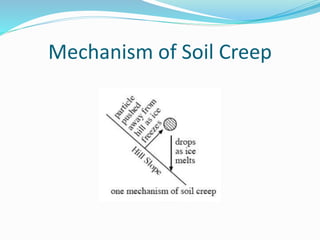
Main Processes Involved – Freeze Thaw, wetting and drying
These processes cause the soil to expand (freezing, wetting)
and shrink (thawing, drying) – eventually the soil moves
downhill
As little as 1mm of movement per year movement
Soil Creep is a relatively dry type of movement – the soil
“rolls” rather than “flows” downhill
Mechanism of Soil Creep
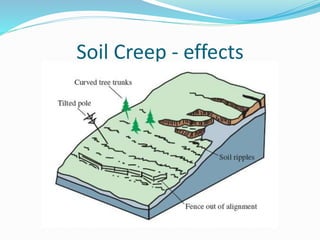
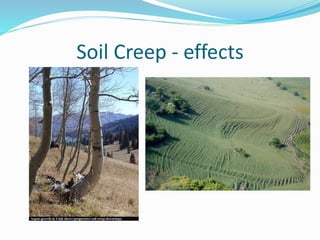
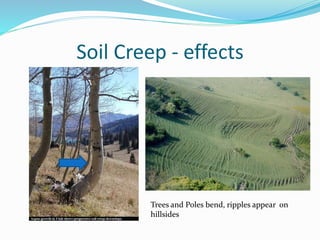
Soil Creep - effects
Trees and Poles bend, ripples appear on
hillsides
Solifluction
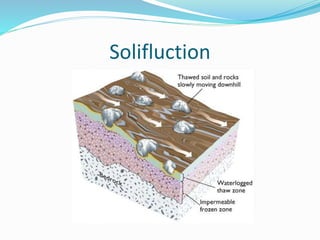
A type of “Waterlogged Soil Creep” that mainly occurs where
Permafrost is present
Upper layers of the soil melt in summer, however the lower
layers remain frozen
This results in the upper layers “sliding” over the lower layers
Regolith in this case has the consistency of treacle or honey
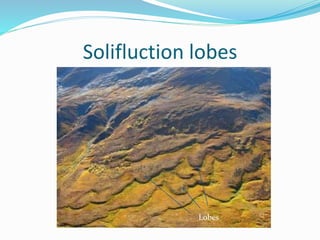
Leaves behind curved bulges called “lobes”
Solifluction
Solifluction lobes
Lobes
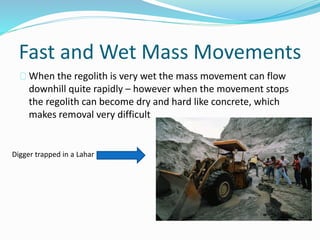
Fast and Wet Mass Movements
When the regolith is very wet the mass movement can flow
downhill quite rapidly – however when the movement stops
the regolith can become dry and hard like concrete, which
makes removal very difficult
Digger trapped in a Lahar
Mudflows
The main process at work here is heavy rain and flooding
Because of the mixture of water, mud and loose rock they are
very dangerous – think of a tsunami with rocks embedded in it
– the greater mass leads to greater damage
Can travel a long distance depending on the gradient -
gradients over 25 degrees are needed
http://www.youtube.com/watch?v=KP_Zug2D-tY
Lahar
These occur when volcanic ash, not mud, mixes with water
and flows downstream
On tall volcanoes the snow can melt and mix with the ash to
form a thick substance with the consistency of wet concrete –
when this substance flows downhill a Lahar is formed
Can cause massive damage and are very difficult to remove –
think of Pompeii in Italy
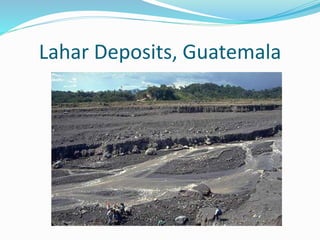
Lahar Deposits, Guatemala
Landslides or Slumps
These are very fast forms of mass movement (at least
compared to soil creep)
Need a “trigger” to take place – can be a storm, earthquake,
shockwave from explosion etc
Human activity (e.g. road building) can increase the likelihood
of a landslide – DART between Dalkey often disrupted (see
P189)
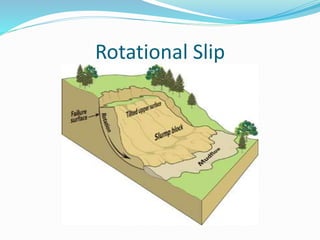
A Rotational Slump is a landslide where regolith slips along a
curved surface and falls back on itself
Landslides
http://www.youtube.com/watch?v=F31ywRvtNkY&feat
ure=related
http://www.youtube.com/watch?v=AiczROnfGbc&fea
ture=related
Rotational Slip
Avalanches
A sudden rapid movement of a mass of snow down a slope
Often confused with landslides – landslides have little or no
snow
Major issue in Alpine regions – a single skier can act as a
“trigger” and cause unstable snow to fall
Because snow in high areas is frozen, it acts like dry particles of
material – like dry sand
http://www.youtube.com/watch?v=PyzKtNZBZjc&feature=rela
ted
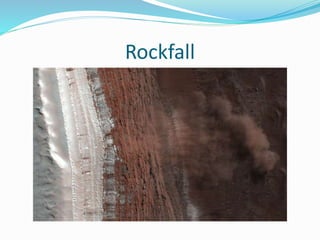
Rockfall
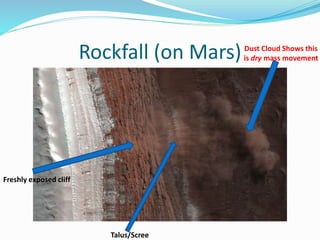
Rockfall (on Mars)
Talus/Scree
Freshly exposed cliff
Dust Cloud Shows this
is dry mass movement
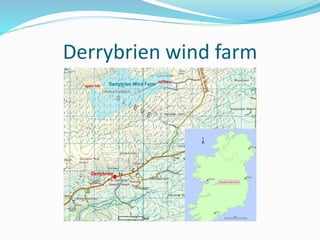
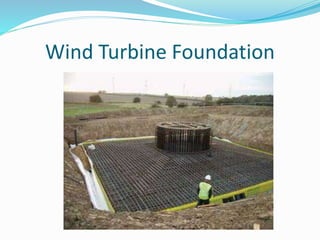
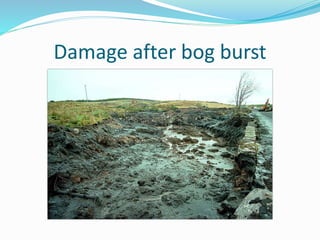
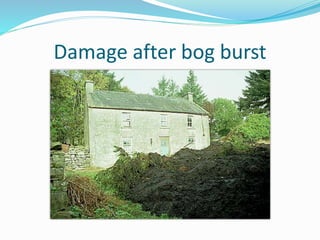
Bog Burst
A bog burst is a type of landslide where the regolith is peat
bog
Are often caused by inappropriate/poorly managed
development in blanket bogs (bogs on mountains)
Can cause severe damage to water supplies if the peat enters a
river
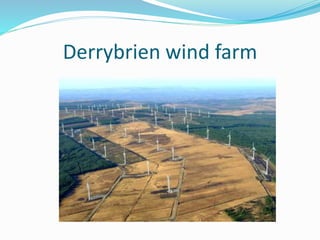
Most (in)famous example in Ireland was the Derrybrien bog
burst in Co. Galway.
Derrybrien wind farm
Wind Turbine Foundation
Damage after bog burst
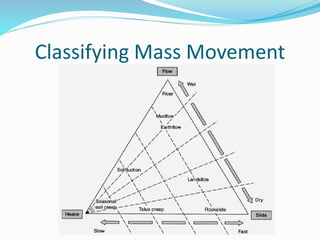
Classifying Mass Movement
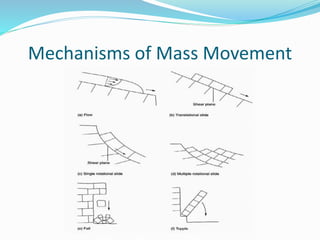
Mechanisms of Mass Movement
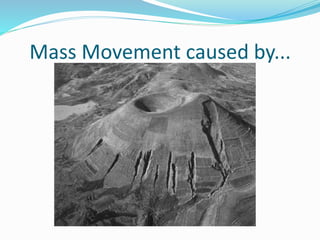
Mass Movement caused by...
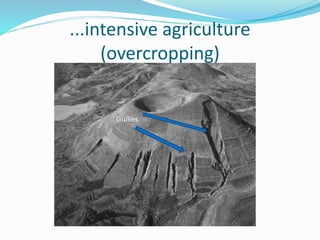
...intensive agriculture
(overcropping)
Gullies
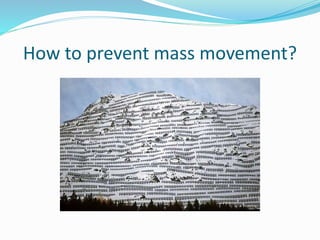
How to prevent mass movement?
5 well developed points on how to stop or limit undesirable
mass movement.
2/3 of a foolscap page

Mass Movement

  • 1.
    Mass Movement Rock Falls,Avalanches, Soil Creep, Landslides, Mudslides….
  • 2.
    Mass Movement Definition –The movement of material downhill under the influence of gravity Loose weathered material on the surface of the Earth is known as Regolith When you have regolith on a slope (even a gentle slope) the possibility exists for Mass Movement Movement can be very fast (Km/hr) or very slow (mm/year) – but can dramatically change the Earth’s surface over time Mass Movement can also be triggered by natural or man- made factors – anything that makes regolith unstable
  • 3.
  • 4.
    Factors affecting massmovement Effect of Gravity – the bigger they are, the harder (and faster) they fall Slope – the steeper the slope, the faster the mass movement Water – helps to lubricate the regolith, more water = more sliding potential Vegetation – roots help keep the regolith together, lack of vegetation means more potential for movement Human activities – anything that disturbs the regolith (e.g. road building, farming on steep slopes) Type of regolith – loose snow is more likely to move quickly than Glacial Ice
  • 5.
    Slow Mass Movement SoilCreep – this is the slowest type of MM. It is probably the most common type of MM in Ireland and despite it’s slowness it can have significant impacts over time Main Processes Involved – Freeze Thaw, wetting and drying These processes cause the soil to expand (freezing, wetting) and shrink (thawing, drying) – eventually the soil moves downhill As little as 1mm of movement per year movement Soil Creep is a relatively dry type of movement – the soil “rolls” rather than “flows” downhill
  • 6.
  • 7.
    Soil Creep -effects
  • 8.
    Soil Creep -effects
  • 9.
    Soil Creep -effects Trees and Poles bend, ripples appear on hillsides
  • 10.
    Solifluction A type of“Waterlogged Soil Creep” that mainly occurs where Permafrost is present Upper layers of the soil melt in summer, however the lower layers remain frozen This results in the upper layers “sliding” over the lower layers Regolith in this case has the consistency of treacle or honey Leaves behind curved bulges called “lobes”
  • 11.
  • 12.
  • 13.
    Fast and WetMass Movements When the regolith is very wet the mass movement can flow downhill quite rapidly – however when the movement stops the regolith can become dry and hard like concrete, which makes removal very difficult Digger trapped in a Lahar
  • 14.
    Mudflows The main processat work here is heavy rain and flooding Because of the mixture of water, mud and loose rock they are very dangerous – think of a tsunami with rocks embedded in it – the greater mass leads to greater damage Can travel a long distance depending on the gradient - gradients over 25 degrees are needed http://www.youtube.com/watch?v=KP_Zug2D-tY
  • 15.
    Lahar These occur whenvolcanic ash, not mud, mixes with water and flows downstream On tall volcanoes the snow can melt and mix with the ash to form a thick substance with the consistency of wet concrete – when this substance flows downhill a Lahar is formed Can cause massive damage and are very difficult to remove – think of Pompeii in Italy
  • 16.
  • 17.
    Landslides or Slumps Theseare very fast forms of mass movement (at least compared to soil creep) Need a “trigger” to take place – can be a storm, earthquake, shockwave from explosion etc Human activity (e.g. road building) can increase the likelihood of a landslide – DART between Dalkey often disrupted (see P189) A Rotational Slump is a landslide where regolith slips along a curved surface and falls back on itself
  • 18.
  • 19.
  • 20.
    Avalanches A sudden rapidmovement of a mass of snow down a slope Often confused with landslides – landslides have little or no snow Major issue in Alpine regions – a single skier can act as a “trigger” and cause unstable snow to fall Because snow in high areas is frozen, it acts like dry particles of material – like dry sand http://www.youtube.com/watch?v=PyzKtNZBZjc&feature=rela ted
  • 21.
  • 22.
    Rockfall (on Mars) Talus/Scree Freshlyexposed cliff Dust Cloud Shows this is dry mass movement
  • 23.
    Bog Burst A bogburst is a type of landslide where the regolith is peat bog Are often caused by inappropriate/poorly managed development in blanket bogs (bogs on mountains) Can cause severe damage to water supplies if the peat enters a river Most (in)famous example in Ireland was the Derrybrien bog burst in Co. Galway.
  • 24.
  • 25.
  • 26.
  • 27.
  • 28.
  • 29.
  • 30.
  • 31.
  • 32.
  • 33.
    How to preventmass movement?
  • 34.
    How to preventmass movement? 5 well developed points on how to stop or limit undesirable mass movement. 2/3 of a foolscap page