


















Identifying and
Nelia S. Bañaga Perez, RN, PhD, DNS
Stating the Problem
Research Topic
or Problem
An intellectual
stimulus calling for
an answer in the
form of scientific
inquiry.
Sources of Research Topics or Problems:
• Prevailing theories or philosophy
• Observations, intuitions or a combination of both
• Different subjects taken and from them identify a problem
that interests a student-researcher most
• Fields of interest or specialization or event from related
fields
• Existing problems in the classroom/school/campus/university
which one may want to solve are good sources of research
problems
Sources of Research Topics or Problems:
• Existing needs of the community or society
• Repetition or extension of investigations already conducted
or may be an offshoot of studies underway
• Related studies and literatures
• Advice of authorities or experts from funding agencies
• Offshoots of friendly conversations
• Incidental from interesting topics of professors during the
course meeting/session
Research Gap
• An issue that has
not been fully
addressed by
previous studies
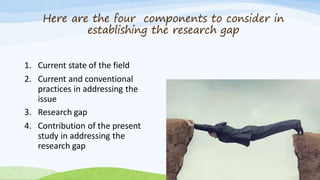
Here are the four components to consider in
establishing the research gap
1. Current state of the field
2. Current and conventional
practices in addressing the
issue
3. Research gap
4. Contribution of the present
study in addressing the
research gap
Many forms of instruction, both traditional and alternative,
have been introduced to develop students’ mathematical –
logical skills. One approach that continues to be widely used in
Asia is Singapore Math. Though many studies have attempted
to substantiate its effectiveness (see Jaciw, Hegseth & Toby,
2015; Powell, 2014), there remains a dearth of empirical
studies that have investigated the effectiveness of Singapore
Math in the Philippines. As Corpuz (2015) argued, there is a
need to conduct more studies on approaches that will help
Filipino students become equipped with the necessary
mathematical skills which are on a par with the ASEAN
counterparts. Math on developing the mathematical – logical
skills of Filipino students in selected public high schools in the
Philippines.
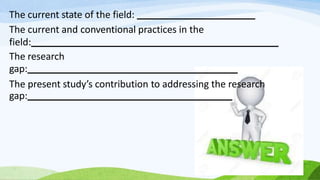
The current state of the field:
The current and conventional practices in the
field:
The research
gap:
The present study’s contribution to addressing the research
gap:
Criteria in Choosing a Research Problem:
• It should be something new or different from what has
already been written about.
• It must be original.
• It should be significant to the field of study or discipline.
• It must necessarily arouse intellectual curiosity.
• It should be of researcher’s interest and researcher must be
with the topic.
• It should be modest one for a beginner to be carried on
within a limited period of time.
Criteria in Choosing a Research Problem:
• It should be clear, not ambiguous.
• It should be specific, not general.
• It should consider the training and personal qualifications of
the researcher.
• It should consider the availability of data involved in the
study and the methods and techniques to be employed in
gathering them.
• It should consider the availability of effective instruments for
gathering the data and their treatment.
Criteria in Choosing a Research Problem:
• It should consider the financial capacity of the researcher to
support the project.
• It should consider the time factor involved in the
undertaking.
Basis for Selecting the Problem:
TECHNICAL
• Significant to chosen field/advancement
of science or specialization
• Pioneering or novel
• Originality
• Arouse intellectual curiosity
• Relevance to degree
• Availability or manageability of data
• Availability of instruments
PERSONAL
• Interest
• Training
• Expertise
• Financial capacity
• Time factor involved in the
project
Background of the Study
• It includes information which would focus attention on the
importance and validity of the problem. It is the general
orientation to the problem area. A brief rationale to justify the
problem must be provided. This is the present state of knowledge
regarding the problem.
• The background includes:
1. Discussion of the problem in general and the specific situations as
observed and experienced by the researcher
2. Concepts and ideas related to the problem
3. Discussion of the existing or present conditions and what is aimed
to be in the future or the gap to be filled in by the researcher.
Statement of the Problem
• This is the basic difficulty, the issue, the area of concern, the
circumstances which exist, then, how they ought to be. The
researcher should give the background which led to this
circumstances that exist. Briefly describe the condition or a
situation that exists which is perceived as something less
than the ideal: or what it should be and how you see it to
be.
• It has two main elements:
1. The objective
2. Research questions
Objective or Purpose of the Study
• It is the first part of the problem where the researcher
states the objective. This is a statement of a long term
objective expected to be achieved by the study. This is
derived by the identification and crystallization of the
research problem and as reflected in the title.
Research Questions or Investigative
Problems:
• These are the specific questions which are to be answered in
the study. The answers to these should lead to the solution of
the research problem. Focus on a clear goal or objective.
State the precise goal. The problem should be limited enough
in making a definite conclusion possible.
1. The major statement or question may be followed by minor
statements or questions. The introductory statement must
be the purpose/aim or the objective of the study.
Example: Specifically, the study aims to determine the causes
of low performance of selected programs in the board
examinations. Further, it seeks to answer to answer to the
following sub problems 1, 2, 3 etc.
Research Questions or Investigative
Problems:
2.If the goal is specifically to test a given hypothesis then state
so. In many cases, the objective will be a more general
statement than that of a hypothesis.
Example: The primary objective of this study is to test the
hypothesis that there is a relationship between workplace
condition and teaching performance of faculty members.
3.Investigative questions are the specific topical questions that
one must resolve to achieve research objective or test the
research hypothesis.
• This study attempted to evaluate the status and extent of
implementation of the Blended Learning for the Nursing
Subjects as perceived by teachers and
student respondents. Specifically this sought answers to the
following questions:
1. What is the profile of the respondents in terms of:
1. Teacher respondents
1. sex;
2. field of specialization;
3. educational attainment;
4. length of service; and,
5. seminar/training attended?
2. Student Respondents
1. sex;
2. monthly family income;
3. parent’s educational background;
4. accessibility to internet connection; and,
5. performance in Nursing Subject?
2. What is the extent of the Blended Learning implementation
as perceived by the teacher-respondents with respect to:
1. objectives and content of instruction;
2. teaching competencies;
3. learning competencies;
4. methods of teaching employed; and,
5. computer facilities?
3.What is the extent of the Blended Learning implementation
as perceived by the student- respondents with respect to:
1. objectives and content of instruction;
2. teaching competencies; and,
3. learning competencies
Scope and Delimitation of the Study
• The scope describes the coverage of the study. It specifies
what is covered in terms of concept, number of subjects or
the population included in the study, as well as the timeline
when the study was conducted.
• Delimit by citing factors or variables that are not to be
included and the boundary in terms of time frame, number
of subjects, participants or respondents who are excluded.
Specify that which you will not deal within the study.
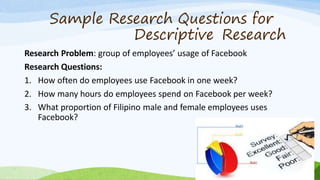
Sample Research Questions for
Descriptive Research
Research Problem: group of employees’ usage of Facebook
Research Questions:
1. How often do employees use Facebook in one week?
2. How many hours do employees spend on Facebook per week?
3. What proportion of Filipino male and female employees uses
Facebook?
Sample Research Questions for
Correlational Research
Research Problem: length of preparations for examinations and the
scores obtained by test-takers
Research Questions:
1. What is the relationship between the length of the review and
examinations scores?
2. Is there a relationship between the IQ of a test-taker and his/her
performance in review sessions?
3. Is there a relationship between the performance of a test-taker in a
previous examination and the length of review he/she
takes for a new one?
Sample Research Questions for
Causal- Comparative
Research
Research Problem: digital literacy and type of information technology
education that students obtain
Research Questions:
1. Are information technology education students and vocational
education students digitally literate?
2. Using the four components of digital literacy, what can be identified
as the strengths and weaknesses of information technology
education students and vocational education students?
3. Is there a difference between digitally literacy scores of information
technology students and vocational education students?
Sample Research Questions for
Experimental Research
Research Problem: tutorial sessions and academic performance
Research Questions:
1. Is there a significant posttest gain on students’ academic
performance?
2. Is there a difference between the posttest gains of the
control group and treatment group?
3. How do students rate experiences in one-on-one tutorial
sessions?
Parameters of the Research:
• What – the topic of investigation and the variables included
• Where – the venue or the setting of the research
• When - the time frame by which the study was conducted
• Why – the general objectives of the research
• Who – the subject of the study, the population and sampling
• How – the methodology of the research which may include
the research design, methodology and the research
instrument
Example:
The main purpose of the study is to provide information
regarding metro-sexuality and how being a metro sexual
affects the lifestyle of the student. The study considers the
student’s personal information such as their name (optional),
gender, age, and section.
The researchers limited the study to 80 male and female
secondary education student enrolled in the second semester of
school year 2015-2016 of Technological Institute of the
Philippines. Each of the respondents was given a questionnaire
to answer. The students selected came from four different
sections to prevent bias and get objective perceptions.
Significance of the Study
• The researcher defines who will benefit out of the findings of
the study. He describes how the problem will be solved and
specifically pinpoints who will benefit from such findings or
results.
Tips in Writing the Significance of the Study:
1. Refer to the statement of the problem.
2. Write from generic to specific.
Write one general research question and three
specific research questions for each of the given
research topics.
1. Effects of the wife’s employment on the power structure of the
family
2. The effects of online campaigning on the preferred election
candidates of young voters
3. The relationship between internet exposure and the digital literacy
of students
4. Stress levels among the senior citizens of Barangay Luciano
Thankyouforlistening!

The Research Problem and Statement.pptx

  • 1.
    Identifying and Nelia S.Bañaga Perez, RN, PhD, DNS Stating the Problem
  • 2.
    Research Topic or Problem Anintellectual stimulus calling for an answer in the form of scientific inquiry.
  • 3.
    Sources of ResearchTopics or Problems: • Prevailing theories or philosophy • Observations, intuitions or a combination of both • Different subjects taken and from them identify a problem that interests a student-researcher most • Fields of interest or specialization or event from related fields • Existing problems in the classroom/school/campus/university which one may want to solve are good sources of research problems
  • 4.
    Sources of ResearchTopics or Problems: • Existing needs of the community or society • Repetition or extension of investigations already conducted or may be an offshoot of studies underway • Related studies and literatures • Advice of authorities or experts from funding agencies • Offshoots of friendly conversations • Incidental from interesting topics of professors during the course meeting/session
  • 5.
    Research Gap • Anissue that has not been fully addressed by previous studies
  • 6.
    Here are thefour components to consider in establishing the research gap 1. Current state of the field 2. Current and conventional practices in addressing the issue 3. Research gap 4. Contribution of the present study in addressing the research gap
  • 7.
    Many forms ofinstruction, both traditional and alternative, have been introduced to develop students’ mathematical – logical skills. One approach that continues to be widely used in Asia is Singapore Math. Though many studies have attempted to substantiate its effectiveness (see Jaciw, Hegseth & Toby, 2015; Powell, 2014), there remains a dearth of empirical studies that have investigated the effectiveness of Singapore Math in the Philippines. As Corpuz (2015) argued, there is a need to conduct more studies on approaches that will help Filipino students become equipped with the necessary mathematical skills which are on a par with the ASEAN counterparts. Math on developing the mathematical – logical skills of Filipino students in selected public high schools in the Philippines.
  • 8.
    The current stateof the field: The current and conventional practices in the field: The research gap: The present study’s contribution to addressing the research gap:
  • 9.
    Criteria in Choosinga Research Problem: • It should be something new or different from what has already been written about. • It must be original. • It should be significant to the field of study or discipline. • It must necessarily arouse intellectual curiosity. • It should be of researcher’s interest and researcher must be with the topic. • It should be modest one for a beginner to be carried on within a limited period of time.
  • 10.
    Criteria in Choosinga Research Problem: • It should be clear, not ambiguous. • It should be specific, not general. • It should consider the training and personal qualifications of the researcher. • It should consider the availability of data involved in the study and the methods and techniques to be employed in gathering them. • It should consider the availability of effective instruments for gathering the data and their treatment.
  • 11.
    Criteria in Choosinga Research Problem: • It should consider the financial capacity of the researcher to support the project. • It should consider the time factor involved in the undertaking.
  • 12.
    Basis for Selectingthe Problem: TECHNICAL • Significant to chosen field/advancement of science or specialization • Pioneering or novel • Originality • Arouse intellectual curiosity • Relevance to degree • Availability or manageability of data • Availability of instruments PERSONAL • Interest • Training • Expertise • Financial capacity • Time factor involved in the project
  • 13.
    Background of theStudy • It includes information which would focus attention on the importance and validity of the problem. It is the general orientation to the problem area. A brief rationale to justify the problem must be provided. This is the present state of knowledge regarding the problem. • The background includes: 1. Discussion of the problem in general and the specific situations as observed and experienced by the researcher 2. Concepts and ideas related to the problem 3. Discussion of the existing or present conditions and what is aimed to be in the future or the gap to be filled in by the researcher.
  • 14.
    Statement of theProblem • This is the basic difficulty, the issue, the area of concern, the circumstances which exist, then, how they ought to be. The researcher should give the background which led to this circumstances that exist. Briefly describe the condition or a situation that exists which is perceived as something less than the ideal: or what it should be and how you see it to be. • It has two main elements: 1. The objective 2. Research questions
  • 15.
    Objective or Purposeof the Study • It is the first part of the problem where the researcher states the objective. This is a statement of a long term objective expected to be achieved by the study. This is derived by the identification and crystallization of the research problem and as reflected in the title.
  • 16.
    Research Questions orInvestigative Problems: • These are the specific questions which are to be answered in the study. The answers to these should lead to the solution of the research problem. Focus on a clear goal or objective. State the precise goal. The problem should be limited enough in making a definite conclusion possible. 1. The major statement or question may be followed by minor statements or questions. The introductory statement must be the purpose/aim or the objective of the study. Example: Specifically, the study aims to determine the causes of low performance of selected programs in the board examinations. Further, it seeks to answer to answer to the following sub problems 1, 2, 3 etc.
  • 17.
    Research Questions orInvestigative Problems: 2.If the goal is specifically to test a given hypothesis then state so. In many cases, the objective will be a more general statement than that of a hypothesis. Example: The primary objective of this study is to test the hypothesis that there is a relationship between workplace condition and teaching performance of faculty members. 3.Investigative questions are the specific topical questions that one must resolve to achieve research objective or test the research hypothesis.
  • 18.
    • This studyattempted to evaluate the status and extent of implementation of the Blended Learning for the Nursing Subjects as perceived by teachers and student respondents. Specifically this sought answers to the following questions: 1. What is the profile of the respondents in terms of: 1. Teacher respondents 1. sex; 2. field of specialization; 3. educational attainment; 4. length of service; and, 5. seminar/training attended?
  • 19.
    2. Student Respondents 1.sex; 2. monthly family income; 3. parent’s educational background; 4. accessibility to internet connection; and, 5. performance in Nursing Subject? 2. What is the extent of the Blended Learning implementation as perceived by the teacher-respondents with respect to: 1. objectives and content of instruction; 2. teaching competencies; 3. learning competencies; 4. methods of teaching employed; and, 5. computer facilities?
  • 20.
    3.What is theextent of the Blended Learning implementation as perceived by the student- respondents with respect to: 1. objectives and content of instruction; 2. teaching competencies; and, 3. learning competencies
  • 21.
    Scope and Delimitationof the Study • The scope describes the coverage of the study. It specifies what is covered in terms of concept, number of subjects or the population included in the study, as well as the timeline when the study was conducted. • Delimit by citing factors or variables that are not to be included and the boundary in terms of time frame, number of subjects, participants or respondents who are excluded. Specify that which you will not deal within the study.
  • 22.
    Sample Research Questionsfor Descriptive Research Research Problem: group of employees’ usage of Facebook Research Questions: 1. How often do employees use Facebook in one week? 2. How many hours do employees spend on Facebook per week? 3. What proportion of Filipino male and female employees uses Facebook?
  • 23.
    Sample Research Questionsfor Correlational Research Research Problem: length of preparations for examinations and the scores obtained by test-takers Research Questions: 1. What is the relationship between the length of the review and examinations scores? 2. Is there a relationship between the IQ of a test-taker and his/her performance in review sessions? 3. Is there a relationship between the performance of a test-taker in a previous examination and the length of review he/she takes for a new one?
  • 24.
    Sample Research Questionsfor Causal- Comparative Research Research Problem: digital literacy and type of information technology education that students obtain Research Questions: 1. Are information technology education students and vocational education students digitally literate? 2. Using the four components of digital literacy, what can be identified as the strengths and weaknesses of information technology education students and vocational education students? 3. Is there a difference between digitally literacy scores of information technology students and vocational education students?
  • 25.
    Sample Research Questionsfor Experimental Research Research Problem: tutorial sessions and academic performance Research Questions: 1. Is there a significant posttest gain on students’ academic performance? 2. Is there a difference between the posttest gains of the control group and treatment group? 3. How do students rate experiences in one-on-one tutorial sessions?
  • 26.
    Parameters of theResearch: • What – the topic of investigation and the variables included • Where – the venue or the setting of the research • When - the time frame by which the study was conducted • Why – the general objectives of the research • Who – the subject of the study, the population and sampling • How – the methodology of the research which may include the research design, methodology and the research instrument
  • 27.
    Example: The main purposeof the study is to provide information regarding metro-sexuality and how being a metro sexual affects the lifestyle of the student. The study considers the student’s personal information such as their name (optional), gender, age, and section. The researchers limited the study to 80 male and female secondary education student enrolled in the second semester of school year 2015-2016 of Technological Institute of the Philippines. Each of the respondents was given a questionnaire to answer. The students selected came from four different sections to prevent bias and get objective perceptions.
  • 28.
    Significance of theStudy • The researcher defines who will benefit out of the findings of the study. He describes how the problem will be solved and specifically pinpoints who will benefit from such findings or results. Tips in Writing the Significance of the Study: 1. Refer to the statement of the problem. 2. Write from generic to specific.
  • 29.
    Write one generalresearch question and three specific research questions for each of the given research topics. 1. Effects of the wife’s employment on the power structure of the family 2. The effects of online campaigning on the preferred election candidates of young voters 3. The relationship between internet exposure and the digital literacy of students 4. Stress levels among the senior citizens of Barangay Luciano
  • 30.