Business Research Methodology
Module 2
Selecting a Topic for Research, Types of Research Problems in Social Science,
Components & Sources of Research Problem, Techniques involved in Defining
Problem, Definition of Problem and Evaluating Problem, Review of Literature:
Need, Purpose & Note Taking, Research Gap Identification. Introduction to
Research Design: Meaning, Need & Importance, Types & Uses of Research
Design, Features of Good Research Design, Types of Research Design –
Concept, Pros & Cons. Qualitative, Quantitative and Mixed Research Designs,
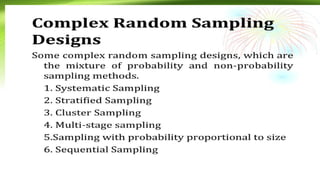
Steps in Sample Design, Complex Random Sample Designs, Variables in
Research: Introduction, Meaning, Types.
Defining the Research Problem
• A research problem can be defined as a gap or
uncertainty in the decision makers existing body of
knowledge which inhibits efficient decision making.
• Kerlinger (1986) states, “If one wants to solve a problem,
one must generally know what the problem is. It can be
said that a large part of the problem lies in knowing what
one is trying to do”
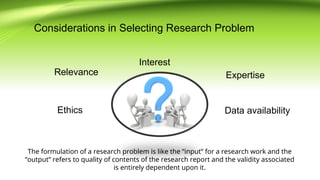
Considerations in Selecting Research Problem
Ethics
Interest
Expertise
Data availability
Relevance
The formulation of a research problem is like the “input” for a research work and the
“output” refers to quality of contents of the research report and the validity associated
is entirely dependent upon it.
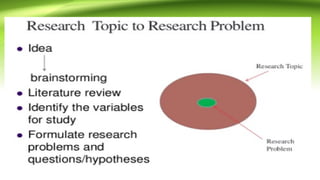
Selection and Formulation of Research
Problem
Defining a research problem as a query that asks what the relationship is between two
or more variables. (Example: Rewards & Recognition and Employee Performance,
Compensation and Retention or Advertisement and Sales)
Typically, researchers begin their work with problems, that is, questions about relations
between variables.
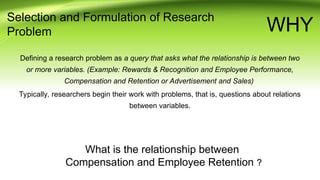
What is the relationship between
Compensation and Employee Retention ?
WHY
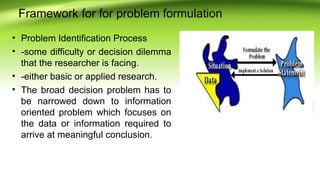
Framework for for problem formulation
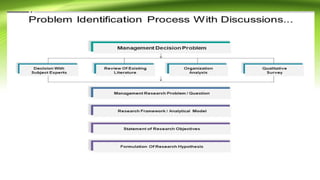
• Problem Identification Process
• -some difficulty or decision dilemma
that the researcher is facing.
• -either basic or applied research.
• The broad decision problem has to
be narrowed down to information
oriented problem which focuses on
the data or information required to
arrive at meaningful conclusion.
PROBLEM IDENTIFICATION
PROCESS
Management Decision Problem
• Problem Appraisal, which
would involve a
comprehensive audit of the
origin and symptoms of the
diagnosed business problem.
• Enlist the WHO, WHAT,
WHERE, WHEN AND WHY
AND HOW.
• Formulation of problem is more
important than the solution
itself.
Discussion with subject Experts
• Getting the problem in right
perspective through
discussions with industry and
subject experts.
• It could be obtained through a
semi-structured interview.
• Have pre-determined
questions.
• Accessibility to subject experts
might be an extremely difficult
task.
Review of Existing Literature
• A literature review is a
comprehensive
compilation of the
information obtained from
published and unpublished
sources.
• Survey might also uncover the
fact that the research problem
being considered has already
been invstigated and this
might be useful in solving the
decision dilemmas.
• It also helps in narrowing the
scope of the study into a
manageable research problem
that is relevant, significant and
testable.
Organization Analysis
• Another significant source of
deriving the research problem
is the industry and
organizational data.
• Organization demographics
• -Origin
• -History of the firm
• -size
• -assets
• -nature of business
• -locaation and resources
• -detailed organization
structure
Qualitative Survey
• An exploratory qualitative
survey might be required
to get an insight into the
behavioural or perceptual
aspects of the problem.
• -small groups
• -Focus groups
• -Pilot study
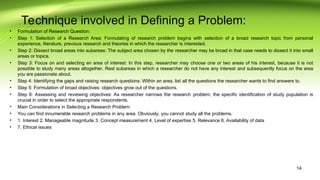
Technique involved in Defining a Problem:
• Formulation of Research Question:
• Step 1: Selection of a Research Area: Formulating of research problem begins with selection of a broad research topic from personal
experience, literature, previous research and theories in which the researcher is interested.
• Step 2: Dissect broad areas into subareas: The subject area chosen by the researcher may be broad in that case needs to dissect it into small
areas or topics.
• Step 3: Focus on and selecting an area of interest: In this step, researcher may choose one or two areas of his interest, because it is not
possible to study many areas altogether. Rest subareas in which a researcher do not have any interest and subsequently focus on the area
you are passionate about.
• Step 4: Identifying the gaps and raising research questions: Within an area, list all the questions the researcher wants to find answers to.
• Step 5: Formulation of broad objectives: objectives grow out of the questions.
• Step 6: Assessing and reviewing objectives: As researcher narrows the research problem, the specific identification of study population is
crucial in order to select the appropriate respondents.
• Main Considerations in Selecting a Research Problem
• You can find innumerable research problems in any area. Obviously, you cannot study all the problems.
• 1. Interest 2. Manageable magnitude 3. Concept measurement 4. Level of expertise 5. Relevance 6. Availability of data
• 7. Ethical issues
14
15
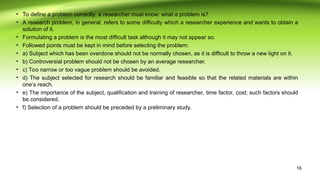
• To define a problem correctly, a researcher must know: what a problem is?
• A research problem, in general, refers to some difficulty which a researcher experience and wants to obtain a
solution of it.
• Formulating a problem is the most difficult task although it may not appear so.
• Followed points must be kept in mind before selecting the problem:
• a) Subject which has been overdone should not be normally chosen, as it is difficult to throw a new light on it.
• b) Controversial problem should not be chosen by an average researcher.
• c) Too narrow or too vague problem should be avoided.
• d) The subject selected for research should be familiar and feasible so that the related materials are within
one’s reach.
• e) The importance of the subject, qualification and training of researcher, time factor, cost; such factors should
be considered.
• f) Selection of a problem should be preceded by a preliminary study.
16
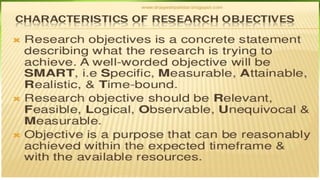
• Objectives are the goals you set out to attain in your study.
• They inform a reader what you want to attain through the tudy. Each objective should
contain only one aspect of the tudy. Objective must contain the main associations and
relationships that you seek to discover or establish.
• The objectives should start with words such as
• ‘
 To determine’,
• ‘
 To find out’,
• ‘
 To ascertain’,
• “
 To describe ‘
• “
 To measure’,
• ‘
 To explore’ etc
17
18
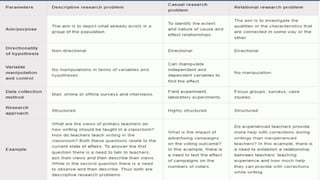
Types of research problem in social science
• research problems are of three types: descriptive
(pertains to issues that need studying), relational
(research questions which focus on the relationship
between two or more factors), and causal research
(problems that look at cause and effect).
Descriptive research problems
• Descriptive research problems focus on questions like ‘what is ?’, with its main aim
to describe the situation, state or the existence of certain specific phenomena. They
seek to depict what already exists in a group or population. For such studies,
surveys and opinion polls are best suitable because they require systematic
observation of social issues.
• For example, ‘what are the main factors affecting consumers’ purchase decisions?’
These problems use two different ways to collect data- cross-sectional studies and
longitudinal studies. Cross-sectional studies provide a snapshot of data at a certain
moment in time. On the other hand, longitudinal studies involve a fixed and stable
sample that is measured repeatedly over time. However, in both cases, methods
that can be used to collect data include mail, online or offline surveys, and
interviews. When a researcher is dealing with a descriptive research problem, there
can be no manipulation in the variables and hypotheses as they are usually
nondirectional (Hashimi, 2015).
Causal research problems
• Causal research problems focus on identifying the extent and nature of
cause and effect relationships. Such research problems help in
assessing the impact of some changes on existing norms and
processes. They thus identify patterns of relationships between different
elements.
• For example, ‘how does online education affect students’ learning
abilities?’ In such cases, experiments are the most popular way of
collecting primary data. Here, the hypothesis is usually directional, i.e.
explaining how one factor affects the behaviour of another one. Such
studies give the researcher the freedom to manipulate the variables as
desired. Data for causal research can be collected in two ways:
laboratory experiments and field experiments.
Relational research problem
• This research problem states that some sort of
relationship between two variables needs to be
investigated. The aim is to investigate the qualities or
characteristics that are connected in some way.
• For example, ‘how is the experience of a teacher related
to his/ her teaching style?’ Thus this sort of research
problem requires more than one variable that describes
the relationship between them (Hartanska, 2014).
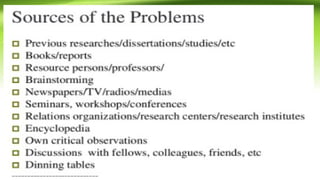
Sources of a research problem
• Interviews
• Interviews sessions can be
significant sources of research
problems. The method gives you an
opportunity to have formal
discussions and informal
interactions with individuals who can
provide useful insights into research
and make findings more relevant to
future research.
• Consider having discussions with
experts in the field you wish to
investigate.
• Personal Experiences:
• Should think critically about your personal
experiences with an issue that affects your
family, your personal life, or your community.
• Deductions from Theory
• A deduction from theory refers to inferences
a researcher makes from the generalizations
of life in a society that a researcher knows
very well. A researcher takes the deduction,
places them in an empirical frame, and then,
based on a theory, they come up with a
research problem and a hypothesis that
suggests some findings based on given
empirical results.
• Interdisciplinary Perspective
• The benefit of using this approach to
identify a research problem for your
research paper assignment is that it
presents an opportunity for you to
understand complex issues with ease.
• Relevant Literature
• Doing so allows you to find gaps on the
topic, making it easy for you to
understand just how much understudied
your area of interest is.
• Fill existing gaps in knowledge based on a
specific research
• • Determine if current studies can
have implications on further research
on the same issue
• • See if it‘s possible to conduct a
similar study in a different area or
apply the same in a different context
• • Determine if the methods used
in previous studies can be effective in
solving future problems
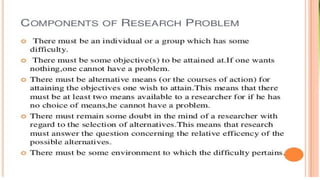
Components of Research Problem
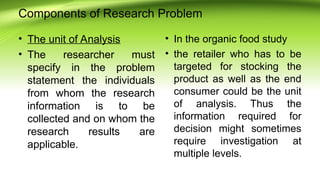
• The unit of Analysis
• The researcher must
specify in the problem
statement the individuals
from whom the research
information is to be
collected and on whom the
research results are
applicable.
• In the organic food study
• the retailer who has to be
targeted for stocking the
product as well as the end
consumer could be the unit
of analysis. Thus the
information required for
decision might sometimes
require investigation at
multiple levels.
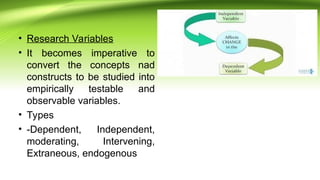
• Research Variables
• It becomes imperative to
convert the concepts nad
constructs to be studied into
empirically testable and
observable variables.
• Types
• -Dependent, Independent,
moderating, Intervening,
Extraneous, endogenous
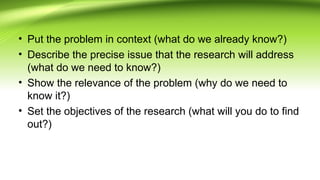
• Put the problem in context (what do we already know?)
• Describe the precise issue that the research will address
(what do we need to know?)
• Show the relevance of the problem (why do we need to
know it?)
• Set the objectives of the research (what will you do to find
out?)
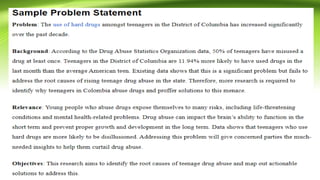
• "The problem of [description of
problem] affects [who is affected] and
results in [consequences of the
problem]. A successful solution would
[what a successful solution would
achieve].").
• The problem of lack of digital payment adoption
among small businesses affects small business
owners and customers in urban and rural areas and
results in limited customer reach, decreased sales,
and inefficiencies in transaction processes. A
successful solution would increase the adoption rate of
digital payments, enhance customer convenience,
and improve the overall efficiency and profitability of
small businesses.
Review of Literature
A literature review is an assessment of a body of research that addresses a
research question.
It focuses on a specific topic of interest to you and includes a critical analysis of the
relationship among different works, and relating this research to your work.
Purpose
A literature review:
• Identifies what is already known about an area of study
It may also:
• Identify questions a body of research does not answer
• Make a case for why further study of research questions is important to a field
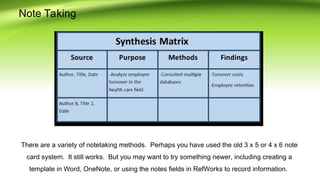
Note Taking
There are a variety of notetaking methods. Perhaps you have used the old 3 x 5 or 4 x 6 note
card system. It still works. But you may want to try something newer, including creating a
template in Word, OneNote, or using the notes fields in RefWorks to record information.
Need for Review of Literature Review
• Jump offs: Start off with handbooks and research overviews and review
their references
• Track and map authors:
• Record key definitions and their context
• Establish a personal search pattern
• Make strategic use of journal index and search engine advanced search
capabilities
• Use citation indexes: search key authors and specific works in a citation
index to find who has cited them
• Track your references
• Use library guides if needed
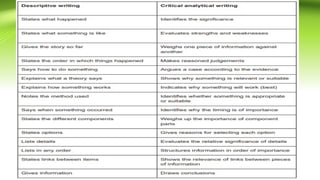
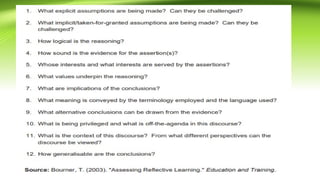
Critical Analysis of Literature
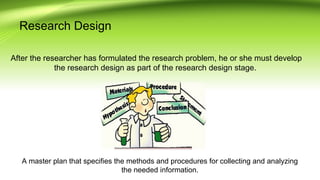
Research Design
Research Design
After the researcher has formulated the research problem, he or she must develop
the research design as part of the research design stage.
A master plan that specifies the methods and procedures for collecting and analyzing
the needed information.
A research design provides a framework or plan of action for
the research.
Objectives of the study determined during the early stages of
research are included in the design to ensure that the
information collected is appropriate for solving the problem.
The researcher also must determine the sources of information,
the design technique (survey or experiment, for example), the
sampling methodology, and the schedule and cost of the research.
Research Design
• At the beginning of every meaningful research, a researcher
chooses a framework of methods and techniques to be used and
applied in the research process. This framework is usually
referred to as the research design.
• It allows the researchers to decide on the research methodology
that is suitable for the topic of their study and to properly set up
their research. Research design also supports the specific type of
research (experiment, survey, review, case study, correlation, and
so on) that needs to be done.
Key elements of research design:
• As all research design types have certain common characteristics, here are
the top
• elements every good design should have or at least touch upon.
• 1. Purpose statement
• 2. Techniques for data collection
• 3. Methods for research analysis
• 4. Type of research methodology
• 5. Probable objections to conducting research
• 6. Research study settings
• 7. Timeline
• 8. Analysis measurement
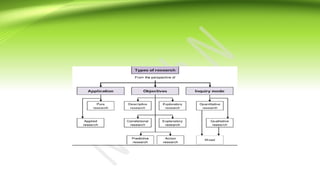
Types of Research Design
Descriptive research design
• This is a theory-based design, where the researcher is
primarily interested in describing the topic that is the subject
of the research. It is applied to case studies, naturalistic
observations, surveys, and so on.
• This method includes data collection, analysis, and
presentation. It lets the researcher clearly present the
problem statement in order to allow others to better
understand the need for this kind of research. Without a
clear problem statement, you’re not doing descriptive but
exploratory research.
• A prominent online marketplace, such as Amazon, might
use a descriptive research design to gather data on
customer satisfaction with its Prime membership services.
The company surveys Prime members, asking questions
about the frequency of their purchases, the value they
place on benefits like free shipping and streaming services,
and their overall satisfaction with the program. The data
collected helps Amazon describe the typical experience of
Prime members, identify areas for improvement, and make
informed decisions to enhance customer satisfaction.
Correlational research design
• Just as its name suggests, correlational design allows the
researcher to establish some kind of a relation between
two closely related topics or variables. It’s a non-
experimental research design type that requires at least
two groups of data.
• A large retail chain, like Walmart, might analyze data from various store
locations to determine if there's a correlation between the level of employee
engagement (measured through employee surveys) and customer satisfaction
scores (gathered from customer feedback surveys).
• The research could reveal a positive correlation, indicating that stores with
higher employee engagement levels tend to have higher customer satisfaction
ratings. This correlation suggests that when employees are more engaged, they
may provide better customer service, leading to happier customers.
• Again, while the study identifies a relationship, it doesn't prove causation. The
findings could prompt the company to explore further how improving employee
engagement could enhance customer experiences, but it would not conclude
that higher engagement directly causes increased customer satisfaction.
Experimental research design
• Whether it is a field experiment, a controlled experiment, or a quasi-
experiment, this is one of the research design types that establishes a
relation between the cause and effect of a particular happening.
• Here, the researcher observes the influence of an independent variable
on the dependent one. For instance, you can observe the impact of the
price (an independent variable) on customer satisfaction (a dependent
variable).
• Usually, this type of research design contributes to solving a particular
problem by manipulating the independent variables to observe the
change they have on the dependent one. For example, you can
experiment with changing the price and observe the effect it has on
customer satisfaction.
Diagnostic research design
• Diagnostic research is one of the research design types
that aims to examine the underlying cause of a certain
situation or phenomenon. It can help you find out more
about the factors that lead to specific issues or challenges
your customers might be facing.
• This design usually consists of three research phases –
• (1) Problem inception,
• (2) Problem diagnosis, and
• (3) Problem solution.
• Tata Motors, one of India's largest automobile manufacturers, noticed a
significant decline in sales of their passenger vehicles in certain segments,
despite a generally growing automotive market. To identify the underlying
causes, the company conducted a diagnostic research study.
Explanatory research design
• Again, the name is self-explanatory. Explanatory research
design is used to further expand, explore, and explain the
researcher’s ideas and theories. This type of research
design is used to elaborate on the unexplored aspects of
a particular topic and try to explain the missing pieces.
• Wipro Limited, a major IT services and consulting firm,
experiences a decline in the adoption of one of its flagship
cloud solutions among existing clients, despite ongoing
promotional efforts and competitive pricing. To uncover
the reasons behind this decline, Wipro employs an
explanatory research design.
Quantitative vs. Qualitative Research design
• Quantitative research design
• Quantitative research aims to give answers to questions
like who, what, when, where, and how many?
• Due to the fact that they use close-ended questions, the
results of quantitative surveys can easily be transformed
into numbers, stats, graphs, and charts. This is why
businesses often use quantitative surveys to learn about
their customers and drive their decisions using the data
obtained
• Qualitative research design
• Qualitative research, on the other hand, aims to give answers
to why and how something is happening.
• Qualitative research most commonly revolves around open-
ended survey questions and highly descriptive answers that
are hard to quantify and express through numbers. It’s a great
way to collect more complex information and explore people’s
thoughts and behavior.
• It’s often used to find ideas, formulate predictions, and explain
the numbers.
• Flipkart, one of India’s largest e-commerce platforms,
wants to understand the purchasing behavior of its
customers during major sales events like the Big Billion
Days to optimize future sales strategies.
Fixed vs. flexible research design
• Another distinction can be made between fixed and flexible
research design. Often, these two research design types coincide
with quantitative (fixed design) and qualitative (flexible design)
data collection.
• With a fixed research design, the design of the research is pre-
determined and known even before you start collecting data.
Flexible designs, on the other hand, allow for more freedom when
collecting data – for example, you don’t offer predetermined
answer options, so the respondents have to type in their own
answers.
Research design types by grouping
• Yet another classification of research design types can be made
based on the way participants are grouped. In most cases,
grouping depends on the research hypothesis and the way
participants are being sampled.
• For example, In a typical study based on experimental research
design, there’s usually at least one experimental and one control
group. In medical studies, let’s say, one group could be
receiving treatment, while the other would be given no treatment.
• Based on participant grouping, we can distinguish among 4
types of research design:
• Cohort study
• A cohort study is a type of longitudinal research that samples a cohort (a group of
people with a shared characteristic) while doing a cross-section at specific time
intervals. It is a type of panel study where the individuals in the panel share a common
characteristic. A study examining the long-term health effects of smoking might track a
cohort of smokers and non-smokers over 20 years to observe differences in rates of
lung cancer, heart disease, and other health conditions.
• Cross-sectional study (snap shot)
• A cross-sectional study is common in social science, medical research, and biology.
This type of research design analyzes data either from a population, or from a
representative sample, at a specified point in time.
• A study investigating the prevalence of high blood pressure in different age groups within a community might collect
blood pressure readings from a sample of individuals of various ages all at once. The study can reveal patterns or
associations between age and blood pressure levels, but it does not provide insights into how blood pressure
changes over time or as a result of interventions.
• Longitudinal study
• A longitudinal study is a research design that involves repeated observations
of the same variables over short or long periods of time. It is often a type of
observational study, although they can also be structured as longitudinal
randomized experiments.
• Cross-sequential study
• Cross-sequential research design combines longitudinal and cross-sectional
research design, aiming to compensate for some of the issues inherently
present in the two aforementioned designs.
•To understand how buying preferences for technology products evolve among different age groups over
time.
•track changes in preferences for types of technology, brand loyalty, and spending patterns within each
age group, and compare these changes between groups.
Process of Research Design Preparation
• 1) Selection and Definition of a problem
• 2) Sources of Data
• 3) Nature of study- the choice of the statistical, experimental or
comparative type of study
• 4) Object of Study- (objectives)
• 5) Social Cultural Context (eg. backward class could have religious,
economic and political connotations)
• 6) Temporal Context (geographical limit)
• 7) Dimension (to select sample out of population/universe)
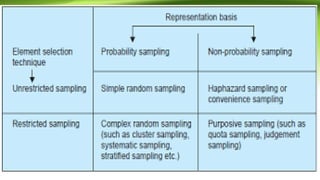
• 8) Basis of Selection (method of sampling)
• 9) Technique of data collection
Sample Designs
• Sampling: is that selecting some of the elements in a
population, we may draw conclusions about the entire
population.
• Population: is the total collection of eleemnts about which we
wish to make some inferences.
• Population element: is the individual participants or the object
on which the measurement is taken. It is a unit of study.
• Sample frame: The listing of all population elements from
which the sample will be drawn is the sample frame.
Why Sample?
• Lower cost
• Greater accuracy of results
• Greater speed of data collection
• Availability of population elements (eg crash test cars to
test bumper strengthe or efficiency of airbags to prevent
injury)
• Sample vs. census
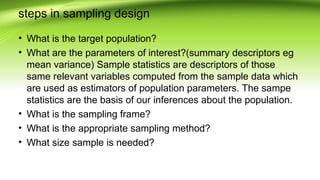
steps in sampling design
• What is the target population?
• What are the parameters of interest?(summary descriptors eg
mean variance) Sample statistics are descriptors of those
same relevant variables computed from the sample data which
are used as estimators of population parameters. The sampe
statistics are the basis of our inferences about the population.
• What is the sampling frame?
• What is the appropriate sampling method?
• What size sample is needed?
Advanced research methodology notes Chapter 2

Advanced research methodology notes Chapter 2

  • 1.
    Business Research Methodology Module2 Selecting a Topic for Research, Types of Research Problems in Social Science, Components & Sources of Research Problem, Techniques involved in Defining Problem, Definition of Problem and Evaluating Problem, Review of Literature: Need, Purpose & Note Taking, Research Gap Identification. Introduction to Research Design: Meaning, Need & Importance, Types & Uses of Research Design, Features of Good Research Design, Types of Research Design – Concept, Pros & Cons. Qualitative, Quantitative and Mixed Research Designs, Steps in Sample Design, Complex Random Sample Designs, Variables in Research: Introduction, Meaning, Types.
  • 2.
    Defining the ResearchProblem • A research problem can be defined as a gap or uncertainty in the decision makers existing body of knowledge which inhibits efficient decision making. • Kerlinger (1986) states, “If one wants to solve a problem, one must generally know what the problem is. It can be said that a large part of the problem lies in knowing what one is trying to do”
  • 3.
    Considerations in SelectingResearch Problem Ethics Interest Expertise Data availability Relevance The formulation of a research problem is like the “input” for a research work and the “output” refers to quality of contents of the research report and the validity associated is entirely dependent upon it.
  • 4.
    Selection and Formulationof Research Problem Defining a research problem as a query that asks what the relationship is between two or more variables. (Example: Rewards & Recognition and Employee Performance, Compensation and Retention or Advertisement and Sales) Typically, researchers begin their work with problems, that is, questions about relations between variables. What is the relationship between Compensation and Employee Retention ? WHY
  • 5.
    Framework for forproblem formulation • Problem Identification Process • -some difficulty or decision dilemma that the researcher is facing. • -either basic or applied research. • The broad decision problem has to be narrowed down to information oriented problem which focuses on the data or information required to arrive at meaningful conclusion.
  • 7.
  • 8.
    Management Decision Problem •Problem Appraisal, which would involve a comprehensive audit of the origin and symptoms of the diagnosed business problem. • Enlist the WHO, WHAT, WHERE, WHEN AND WHY AND HOW. • Formulation of problem is more important than the solution itself.
  • 9.
    Discussion with subjectExperts • Getting the problem in right perspective through discussions with industry and subject experts. • It could be obtained through a semi-structured interview. • Have pre-determined questions. • Accessibility to subject experts might be an extremely difficult task.
  • 10.
    Review of ExistingLiterature • A literature review is a comprehensive compilation of the information obtained from published and unpublished sources. • Survey might also uncover the fact that the research problem being considered has already been invstigated and this might be useful in solving the decision dilemmas. • It also helps in narrowing the scope of the study into a manageable research problem that is relevant, significant and testable.
  • 11.
    Organization Analysis • Anothersignificant source of deriving the research problem is the industry and organizational data. • Organization demographics • -Origin • -History of the firm • -size • -assets • -nature of business • -locaation and resources • -detailed organization structure
  • 12.
    Qualitative Survey • Anexploratory qualitative survey might be required to get an insight into the behavioural or perceptual aspects of the problem. • -small groups • -Focus groups • -Pilot study
  • 14.
    Technique involved inDefining a Problem: • Formulation of Research Question: • Step 1: Selection of a Research Area: Formulating of research problem begins with selection of a broad research topic from personal experience, literature, previous research and theories in which the researcher is interested. • Step 2: Dissect broad areas into subareas: The subject area chosen by the researcher may be broad in that case needs to dissect it into small areas or topics. • Step 3: Focus on and selecting an area of interest: In this step, researcher may choose one or two areas of his interest, because it is not possible to study many areas altogether. Rest subareas in which a researcher do not have any interest and subsequently focus on the area you are passionate about. • Step 4: Identifying the gaps and raising research questions: Within an area, list all the questions the researcher wants to find answers to. • Step 5: Formulation of broad objectives: objectives grow out of the questions. • Step 6: Assessing and reviewing objectives: As researcher narrows the research problem, the specific identification of study population is crucial in order to select the appropriate respondents. • Main Considerations in Selecting a Research Problem • You can find innumerable research problems in any area. Obviously, you cannot study all the problems. • 1. Interest 2. Manageable magnitude 3. Concept measurement 4. Level of expertise 5. Relevance 6. Availability of data • 7. Ethical issues 14
  • 15.
  • 16.
    • To definea problem correctly, a researcher must know: what a problem is? • A research problem, in general, refers to some difficulty which a researcher experience and wants to obtain a solution of it. • Formulating a problem is the most difficult task although it may not appear so. • Followed points must be kept in mind before selecting the problem: • a) Subject which has been overdone should not be normally chosen, as it is difficult to throw a new light on it. • b) Controversial problem should not be chosen by an average researcher. • c) Too narrow or too vague problem should be avoided. • d) The subject selected for research should be familiar and feasible so that the related materials are within one’s reach. • e) The importance of the subject, qualification and training of researcher, time factor, cost; such factors should be considered. • f) Selection of a problem should be preceded by a preliminary study. 16
  • 17.
    • Objectives arethe goals you set out to attain in your study. • They inform a reader what you want to attain through the tudy. Each objective should contain only one aspect of the tudy. Objective must contain the main associations and relationships that you seek to discover or establish. • The objectives should start with words such as • ‘  To determine’, • ‘  To find out’, • ‘  To ascertain’, • “  To describe ‘ • “  To measure’, • ‘  To explore’ etc 17
  • 18.
  • 19.
    Types of researchproblem in social science • research problems are of three types: descriptive (pertains to issues that need studying), relational (research questions which focus on the relationship between two or more factors), and causal research (problems that look at cause and effect).
  • 20.
    Descriptive research problems •Descriptive research problems focus on questions like ‘what is ?’, with its main aim to describe the situation, state or the existence of certain specific phenomena. They seek to depict what already exists in a group or population. For such studies, surveys and opinion polls are best suitable because they require systematic observation of social issues. • For example, ‘what are the main factors affecting consumers’ purchase decisions?’ These problems use two different ways to collect data- cross-sectional studies and longitudinal studies. Cross-sectional studies provide a snapshot of data at a certain moment in time. On the other hand, longitudinal studies involve a fixed and stable sample that is measured repeatedly over time. However, in both cases, methods that can be used to collect data include mail, online or offline surveys, and interviews. When a researcher is dealing with a descriptive research problem, there can be no manipulation in the variables and hypotheses as they are usually nondirectional (Hashimi, 2015).
  • 21.
    Causal research problems •Causal research problems focus on identifying the extent and nature of cause and effect relationships. Such research problems help in assessing the impact of some changes on existing norms and processes. They thus identify patterns of relationships between different elements. • For example, ‘how does online education affect students’ learning abilities?’ In such cases, experiments are the most popular way of collecting primary data. Here, the hypothesis is usually directional, i.e. explaining how one factor affects the behaviour of another one. Such studies give the researcher the freedom to manipulate the variables as desired. Data for causal research can be collected in two ways: laboratory experiments and field experiments.
  • 22.
    Relational research problem •This research problem states that some sort of relationship between two variables needs to be investigated. The aim is to investigate the qualities or characteristics that are connected in some way. • For example, ‘how is the experience of a teacher related to his/ her teaching style?’ Thus this sort of research problem requires more than one variable that describes the relationship between them (Hartanska, 2014).
  • 25.
    Sources of aresearch problem • Interviews • Interviews sessions can be significant sources of research problems. The method gives you an opportunity to have formal discussions and informal interactions with individuals who can provide useful insights into research and make findings more relevant to future research. • Consider having discussions with experts in the field you wish to investigate. • Personal Experiences: • Should think critically about your personal experiences with an issue that affects your family, your personal life, or your community. • Deductions from Theory • A deduction from theory refers to inferences a researcher makes from the generalizations of life in a society that a researcher knows very well. A researcher takes the deduction, places them in an empirical frame, and then, based on a theory, they come up with a research problem and a hypothesis that suggests some findings based on given empirical results.
  • 26.
    • Interdisciplinary Perspective •The benefit of using this approach to identify a research problem for your research paper assignment is that it presents an opportunity for you to understand complex issues with ease. • Relevant Literature • Doing so allows you to find gaps on the topic, making it easy for you to understand just how much understudied your area of interest is. • Fill existing gaps in knowledge based on a specific research • • Determine if current studies can have implications on further research on the same issue • • See if it‘s possible to conduct a similar study in a different area or apply the same in a different context • • Determine if the methods used in previous studies can be effective in solving future problems
  • 27.
    Components of ResearchProblem • The unit of Analysis • The researcher must specify in the problem statement the individuals from whom the research information is to be collected and on whom the research results are applicable. • In the organic food study • the retailer who has to be targeted for stocking the product as well as the end consumer could be the unit of analysis. Thus the information required for decision might sometimes require investigation at multiple levels.
  • 28.
    • Research Variables •It becomes imperative to convert the concepts nad constructs to be studied into empirically testable and observable variables. • Types • -Dependent, Independent, moderating, Intervening, Extraneous, endogenous
  • 29.
    • Put theproblem in context (what do we already know?) • Describe the precise issue that the research will address (what do we need to know?) • Show the relevance of the problem (why do we need to know it?) • Set the objectives of the research (what will you do to find out?)
  • 30.
    • "The problemof [description of problem] affects [who is affected] and results in [consequences of the problem]. A successful solution would [what a successful solution would achieve].").
  • 31.
    • The problemof lack of digital payment adoption among small businesses affects small business owners and customers in urban and rural areas and results in limited customer reach, decreased sales, and inefficiencies in transaction processes. A successful solution would increase the adoption rate of digital payments, enhance customer convenience, and improve the overall efficiency and profitability of small businesses.
  • 33.
  • 34.
    Review of Literature Aliterature review is an assessment of a body of research that addresses a research question. It focuses on a specific topic of interest to you and includes a critical analysis of the relationship among different works, and relating this research to your work. Purpose A literature review: • Identifies what is already known about an area of study It may also: • Identify questions a body of research does not answer • Make a case for why further study of research questions is important to a field
  • 35.
    Note Taking There area variety of notetaking methods. Perhaps you have used the old 3 x 5 or 4 x 6 note card system. It still works. But you may want to try something newer, including creating a template in Word, OneNote, or using the notes fields in RefWorks to record information.
  • 36.
    Need for Reviewof Literature Review • Jump offs: Start off with handbooks and research overviews and review their references • Track and map authors: • Record key definitions and their context • Establish a personal search pattern • Make strategic use of journal index and search engine advanced search capabilities • Use citation indexes: search key authors and specific works in a citation index to find who has cited them • Track your references • Use library guides if needed
  • 37.
  • 41.
  • 42.
    Research Design After theresearcher has formulated the research problem, he or she must develop the research design as part of the research design stage. A master plan that specifies the methods and procedures for collecting and analyzing the needed information.
  • 43.
    A research designprovides a framework or plan of action for the research. Objectives of the study determined during the early stages of research are included in the design to ensure that the information collected is appropriate for solving the problem. The researcher also must determine the sources of information, the design technique (survey or experiment, for example), the sampling methodology, and the schedule and cost of the research. Research Design
  • 44.
    • At thebeginning of every meaningful research, a researcher chooses a framework of methods and techniques to be used and applied in the research process. This framework is usually referred to as the research design. • It allows the researchers to decide on the research methodology that is suitable for the topic of their study and to properly set up their research. Research design also supports the specific type of research (experiment, survey, review, case study, correlation, and so on) that needs to be done.
  • 45.
    Key elements ofresearch design: • As all research design types have certain common characteristics, here are the top • elements every good design should have or at least touch upon. • 1. Purpose statement • 2. Techniques for data collection • 3. Methods for research analysis • 4. Type of research methodology • 5. Probable objections to conducting research • 6. Research study settings • 7. Timeline • 8. Analysis measurement
  • 46.
  • 47.
    Descriptive research design •This is a theory-based design, where the researcher is primarily interested in describing the topic that is the subject of the research. It is applied to case studies, naturalistic observations, surveys, and so on. • This method includes data collection, analysis, and presentation. It lets the researcher clearly present the problem statement in order to allow others to better understand the need for this kind of research. Without a clear problem statement, you’re not doing descriptive but exploratory research.
  • 48.
    • A prominentonline marketplace, such as Amazon, might use a descriptive research design to gather data on customer satisfaction with its Prime membership services. The company surveys Prime members, asking questions about the frequency of their purchases, the value they place on benefits like free shipping and streaming services, and their overall satisfaction with the program. The data collected helps Amazon describe the typical experience of Prime members, identify areas for improvement, and make informed decisions to enhance customer satisfaction.
  • 49.
    Correlational research design •Just as its name suggests, correlational design allows the researcher to establish some kind of a relation between two closely related topics or variables. It’s a non- experimental research design type that requires at least two groups of data.
  • 50.
    • A largeretail chain, like Walmart, might analyze data from various store locations to determine if there's a correlation between the level of employee engagement (measured through employee surveys) and customer satisfaction scores (gathered from customer feedback surveys). • The research could reveal a positive correlation, indicating that stores with higher employee engagement levels tend to have higher customer satisfaction ratings. This correlation suggests that when employees are more engaged, they may provide better customer service, leading to happier customers. • Again, while the study identifies a relationship, it doesn't prove causation. The findings could prompt the company to explore further how improving employee engagement could enhance customer experiences, but it would not conclude that higher engagement directly causes increased customer satisfaction.
  • 51.
    Experimental research design •Whether it is a field experiment, a controlled experiment, or a quasi- experiment, this is one of the research design types that establishes a relation between the cause and effect of a particular happening. • Here, the researcher observes the influence of an independent variable on the dependent one. For instance, you can observe the impact of the price (an independent variable) on customer satisfaction (a dependent variable). • Usually, this type of research design contributes to solving a particular problem by manipulating the independent variables to observe the change they have on the dependent one. For example, you can experiment with changing the price and observe the effect it has on customer satisfaction.
  • 52.
    Diagnostic research design •Diagnostic research is one of the research design types that aims to examine the underlying cause of a certain situation or phenomenon. It can help you find out more about the factors that lead to specific issues or challenges your customers might be facing. • This design usually consists of three research phases – • (1) Problem inception, • (2) Problem diagnosis, and • (3) Problem solution.
  • 53.
    • Tata Motors,one of India's largest automobile manufacturers, noticed a significant decline in sales of their passenger vehicles in certain segments, despite a generally growing automotive market. To identify the underlying causes, the company conducted a diagnostic research study.
  • 54.
    Explanatory research design •Again, the name is self-explanatory. Explanatory research design is used to further expand, explore, and explain the researcher’s ideas and theories. This type of research design is used to elaborate on the unexplored aspects of a particular topic and try to explain the missing pieces.
  • 55.
    • Wipro Limited,a major IT services and consulting firm, experiences a decline in the adoption of one of its flagship cloud solutions among existing clients, despite ongoing promotional efforts and competitive pricing. To uncover the reasons behind this decline, Wipro employs an explanatory research design.
  • 56.
    Quantitative vs. QualitativeResearch design • Quantitative research design • Quantitative research aims to give answers to questions like who, what, when, where, and how many? • Due to the fact that they use close-ended questions, the results of quantitative surveys can easily be transformed into numbers, stats, graphs, and charts. This is why businesses often use quantitative surveys to learn about their customers and drive their decisions using the data obtained
  • 57.
    • Qualitative researchdesign • Qualitative research, on the other hand, aims to give answers to why and how something is happening. • Qualitative research most commonly revolves around open- ended survey questions and highly descriptive answers that are hard to quantify and express through numbers. It’s a great way to collect more complex information and explore people’s thoughts and behavior. • It’s often used to find ideas, formulate predictions, and explain the numbers.
  • 58.
    • Flipkart, oneof India’s largest e-commerce platforms, wants to understand the purchasing behavior of its customers during major sales events like the Big Billion Days to optimize future sales strategies.
  • 59.
    Fixed vs. flexibleresearch design • Another distinction can be made between fixed and flexible research design. Often, these two research design types coincide with quantitative (fixed design) and qualitative (flexible design) data collection. • With a fixed research design, the design of the research is pre- determined and known even before you start collecting data. Flexible designs, on the other hand, allow for more freedom when collecting data – for example, you don’t offer predetermined answer options, so the respondents have to type in their own answers.
  • 60.
    Research design typesby grouping • Yet another classification of research design types can be made based on the way participants are grouped. In most cases, grouping depends on the research hypothesis and the way participants are being sampled. • For example, In a typical study based on experimental research design, there’s usually at least one experimental and one control group. In medical studies, let’s say, one group could be receiving treatment, while the other would be given no treatment. • Based on participant grouping, we can distinguish among 4 types of research design:
  • 61.
    • Cohort study •A cohort study is a type of longitudinal research that samples a cohort (a group of people with a shared characteristic) while doing a cross-section at specific time intervals. It is a type of panel study where the individuals in the panel share a common characteristic. A study examining the long-term health effects of smoking might track a cohort of smokers and non-smokers over 20 years to observe differences in rates of lung cancer, heart disease, and other health conditions. • Cross-sectional study (snap shot) • A cross-sectional study is common in social science, medical research, and biology. This type of research design analyzes data either from a population, or from a representative sample, at a specified point in time. • A study investigating the prevalence of high blood pressure in different age groups within a community might collect blood pressure readings from a sample of individuals of various ages all at once. The study can reveal patterns or associations between age and blood pressure levels, but it does not provide insights into how blood pressure changes over time or as a result of interventions.
  • 62.
    • Longitudinal study •A longitudinal study is a research design that involves repeated observations of the same variables over short or long periods of time. It is often a type of observational study, although they can also be structured as longitudinal randomized experiments. • Cross-sequential study • Cross-sequential research design combines longitudinal and cross-sectional research design, aiming to compensate for some of the issues inherently present in the two aforementioned designs. •To understand how buying preferences for technology products evolve among different age groups over time. •track changes in preferences for types of technology, brand loyalty, and spending patterns within each age group, and compare these changes between groups.
  • 63.
    Process of ResearchDesign Preparation • 1) Selection and Definition of a problem • 2) Sources of Data • 3) Nature of study- the choice of the statistical, experimental or comparative type of study • 4) Object of Study- (objectives) • 5) Social Cultural Context (eg. backward class could have religious, economic and political connotations) • 6) Temporal Context (geographical limit) • 7) Dimension (to select sample out of population/universe) • 8) Basis of Selection (method of sampling) • 9) Technique of data collection
  • 64.
    Sample Designs • Sampling:is that selecting some of the elements in a population, we may draw conclusions about the entire population. • Population: is the total collection of eleemnts about which we wish to make some inferences. • Population element: is the individual participants or the object on which the measurement is taken. It is a unit of study. • Sample frame: The listing of all population elements from which the sample will be drawn is the sample frame.
  • 65.
    Why Sample? • Lowercost • Greater accuracy of results • Greater speed of data collection • Availability of population elements (eg crash test cars to test bumper strengthe or efficiency of airbags to prevent injury) • Sample vs. census
  • 66.
    steps in samplingdesign • What is the target population? • What are the parameters of interest?(summary descriptors eg mean variance) Sample statistics are descriptors of those same relevant variables computed from the sample data which are used as estimators of population parameters. The sampe statistics are the basis of our inferences about the population. • What is the sampling frame? • What is the appropriate sampling method? • What size sample is needed?